Africa Business

76 people killed in Nigeria boat accident

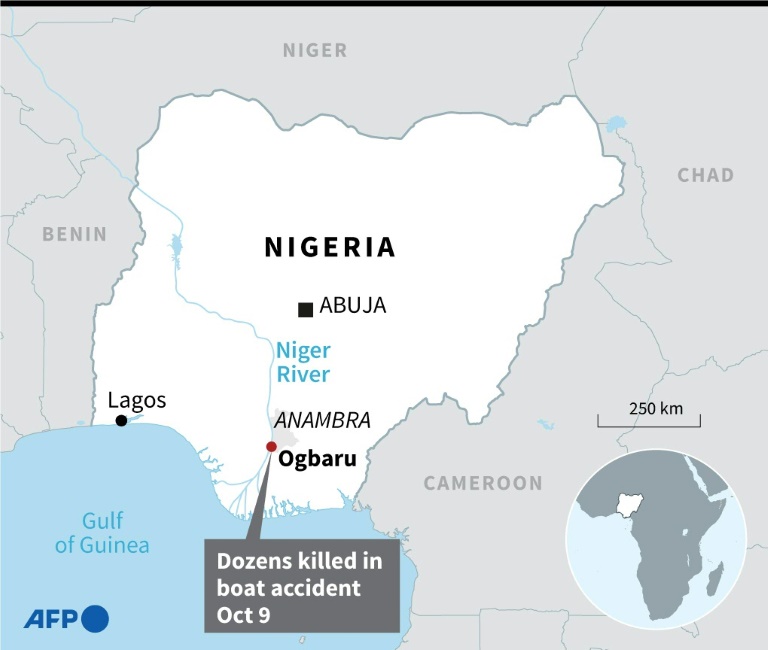
Almost everyone on board a boat died when it capsized in a flood-swollen river in Nigeria’s Anambra state, President Muhammadu Buhari said on Sunday.

An estimated 85 people were taking the overloaded boat on Friday when flooding of the Niger River caused it to tip over. 

“The boat reportedly carrying 85 persons capsized following rising floods in Ogbaru area of the state, with emergency services confirming a death toll of 76,” Buhari’s office quoted him as saying.

He directed the emergency services to provide relief to the victims.

“I pray for the repose of the souls of the deceased and for everyone’s safety, as well as the well-being of the family members of the victims of this tragic accident,” he added.

Earlier on Sunday, the emergency services said rising water level was hampering rescue efforts.

“The water level is very high and too risky for a smooth search and rescue operation,” Thickman Tanimu, the southeast coordinator of the National Emergency Management Agency (NEMA) told AFP.

He said the flooding was the worst the country has seen in years, with the water level around one-tenth higher than a decade ago.

NEMA requested the Nigerian Air Force provide helicopters for the rescue operation.

Anambra state governor Charles Soludo urged residents of flood-ravaged areas to relocate, while adding that the government would provide relief to those affected by the disaster.

“This development is still a shock to the government and good people of Anambra State. I sympathise with the families of people involved,” Soludo said in a statement. 

Boat accidents occur regularly in Nigeria because of overloading, speeding, poor maintenance and disregarding navigation rules.

Since the start of the rainy season, many regions of the West African nation of more than 200 million people have been devastated by floods.

More than 300 people have been killed and at least 100,000 made homeless, according to the emergency services.

The continuous rain has washed away farmland and crops, sparking fears of food shortages, famine and hunger in a country already struggling with the impact of the Covid-19 pandemic and the war in Ukraine.

Algeria, France seek to deepen ties after tensions ease

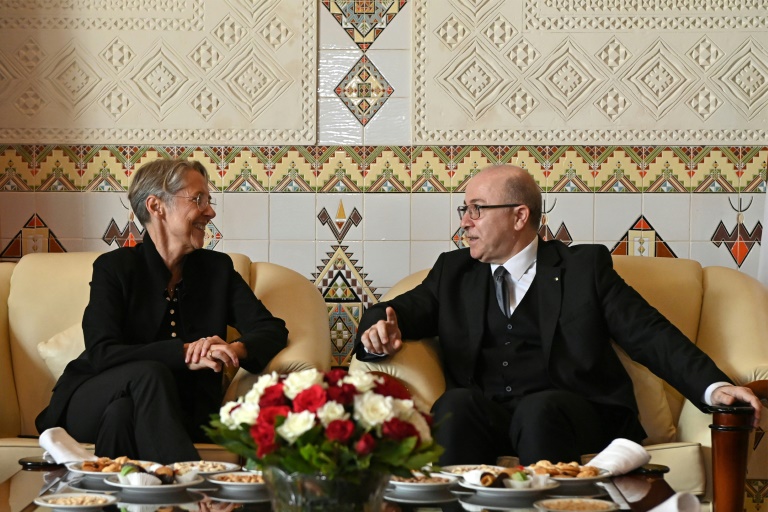
The French and Algerian prime ministers on Sunday declared a wish to “deepen” their countries’ ties as Paris seeks to repair relations with the former colony and major gas exporter.

Prime Minister Aimene Benabderrahmane personally welcomed French Premier Elisabeth Borne’s delegation before a top-level meeting mainly addressing economic cooperation.

French and Algerian ministers present signed around a dozen texts including “declarations of intent” on employment, industrial cooperation and tourism.

“This is a step to build even deeper cooperation between France and Algeria,” Borne told reporters afterwards.

Borne’s two-day trip to the North African country comes just six weeks after President Emmanuel Macron concluded his own three-day visit as part of a rapprochement drive.

Ties between the North African country and its former colonial ruler had deteriorated after Macron last year questioned Algeria’s existence as a nation before the French occupation, and accused the government of fomenting “hatred towards France”.

But the contentious subject of the two countries’ history, particularly during the war, were not set to feature prominently on Borne’s agenda.

Borne and her cohort are the latest in a string of top European officials to visit Algeria, Africa’s top natural gas exporter, as officials search out alternatives to Russian energy supplies since the start of the war in Ukraine.

Ahead of her trip, Borne’s office said deliveries of natural gas to France were “not on the table”.

Instead, the visit would focus on “education, culture, the ecological transition and the economy”, she told news website Tout Sur l’Algerie (TSA).

She is set to meet with the president on Monday.

– ‘Positive direction’ –

Borne said the three pillars of the “strengthened” partnership with Algeria were the economy — pointing to the desire to “develop trade, innovation and create jobs” — mobility and visas, with a focus on greater educational and cultural cooperation for youth.

During Macron’s visit this summer, Algerian entrepreneurs had quizzed him on the difficulties of getting visas to France after their numbers fell significantly in autumn 2021.

On Sunday, Macron and his Algerian counterpart Abdelmadjid Tebboune spoke on the phone and confirmed their “satisfaction with the positive direction” of ties, Algiers said.

Earlier in the day, Borne had laid a wreath at a monument to martyrs of Algeria’s eight-year war for independence, and visited a cemetery for French nationals who lived in Algeria during France’s 132-year rule, which ended in 1962.

The two countries have agreed to create a joint commission of historians to examine the colonial period, including the war.

Borne on Sunday said both sides were still working on the make-up of the commission.

Benabderrahmane underlined the “importance of continuing joint work”, through this commission and “the establishment of mixed working groups concerned with issues of memory”.

Macron has ruled out a state apology for acts committed during the colonial period.

– Gas supplies to Europe –

Macron and Borne have both de-emphasised the role gas supplies play as Paris attempts to repair ties with Algiers.  

In her interview with TSA, Borne noted France does not depend heavily on natural gas.

But she said Paris wanted to develop joint projects in the sector with Algeria “to increase the efficiency of its gas production capacity, which will increase its export capacity to Europe”.

Algeria’s Sonatrach signed a $4 billion oil and gas production deal with Italian, French and US majors in July, but experts have cast doubt over Algeria’s ability to ramp up capacity in the short term.

The European Union’s energy commissioner, Kadri Simson, is also expected in Algiers on Monday and Tuesday.

Rivers United, Sundowns steal CAF Champions League show

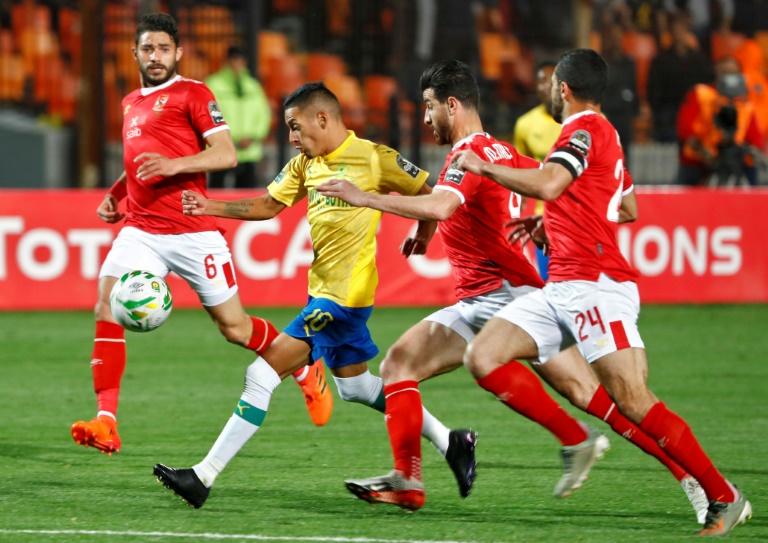
Rivers United of Nigeria and Mamelodi Sundowns of South Africa stole the show on Sunday in the CAF Champions League last 32 first legs.

Ghana-born Paul Acquah scored the 53rd-minute winner as Rivers came from behind to defeat title-holders Wydad Casablanca of Morocco 2-1 in southeastern city Port Harcourt.

Bouly Sambou gave three-time African champions Wydad a first-half lead that lasted only two minutes before Malachi Ohawume equalised.

After an impressive 2-0 victory over record 10-time winners Al Ahly of Egypt in the last Champions League final, Wydad have suffered setbacks on and off the field.

Coach Walid Regragui resigned and later replaced Bosnian Vahid Halilhodzic as coach of World Cup-bound Morocco.

He was succeeded by Houcine Ammouta, who saw his team crash 2-0 to underdogs Renaissance Berkane in an all-Moroccan CAF Super Cup match.

Now, Wydad must win at home against Rivers next Sunday to avoid a shock elimination from the premier African club competition, and relegation to the second-tier CAF Confederation Cup.

A joyful day for Nigeria in the Champions League was completed when Plateau United also came from behind to beat four-time winners Esperance of Tunisia 2-1 in Abuja.

All the goals came in the first half with Mustapha Ibrahim scoring the match winner after Ifeanyi Emmanuel had cancelled the lead Anice Badri gave the visitors.

Elsewhere, Sundowns equalled the record margin for an away win in the Champions League by trouncing La Passe of the Seychelles 7-0 in Pretoria.

Zamalek of Egypt set the benchmark in 2020 when they won 7-0 in an away fixture against Dekedaha of Somalia.

The Cairo club benefitted from the Somalis conceding home advantage and agreeing to play both matches in the Egyptian capital.

La Passe, whose ground does not meet international standards, also surrendered home advantage to Sundowns, and paid the price as they fell five goals behind by half-time.

A braver, more organised second-half showing from the Indian Ocean outfit restricted former African champions Sundowns to two more goals.

Six players shared in the goal fest with Uruguayan Gaston Sirino scoring twice as Sundowns once again overwhelmed opponents from the Seychelles.

When Sundowns crushed Cote d’Or 11-1 in the second leg of a 2020 qualifier they equalled the record for a Champions League home win and created one with a 16-1 overall victory. 

Greece and Egypt call Turkish-Libyan gas deal 'illegal'

Egypt and Greece on Sunday said a deal allowing Turkish hydrocarbon exploration in Libya’s Mediterranean waters was “illegal” as Athens said it would oppose it by all “legal means”.

On Monday, Turkey said it had signed a memorandum of understanding on exploration for hydrocarbons in Libya’s seas with the authorities in Tripoli.

“This agreement threatens stability and security in the Mediterranean,” Greek Foreign Minister Nikos Dendias said in Cairo, where he met his Egyptian counterpart Sameh Shoukry.

The deal follows an agreement Turkey signed three years ago with Tripoli that demarcated the countries’ shared maritime borders.

Greece, Egypt and Cyprus believe the 2019 agreement violates their economic rights in an area suspected to contain vast natural gas reserves.

“We will use all legal means to defend our rights,” Dendias added.

He said Tripoli “does not have the necessary sovereignty over this area”, and that the agreement is therefore “illegal and inadmissible”.

Shoukry charged that the mandate of the authorities in Tripoli has “expired” and that “the government of Tripoli does not have the legitimacy to sign agreements”.

A rival Libyan administration in the war-torn country’s east — which since March has been attempting to take office in Tripoli and also argues the government’s mandate has expired — has rejected the accord.

Monday’s deal builds on an agreement signed between Ankara and a previous Tripoli-based administration in 2019, at the height of a battle for the capital after eastern-based military chief Khalifa Haftar attempted to seize it by force.

The delivery of Turkish drones to Tripoli-based forces shortly afterwards was seen as crucial in the victory over Haftar, who was backed at the time by Egypt, Russia and the United Arab Emirates.

The question of rights to Libya’s vast hydrocarbon resources has become more urgent this year as global energy prices have soared.

The European Union has denounced the 2019 maritime border deal, while France has said the recent agreement was “not in accordance with international law”.

French PM leads delegation to Algeria as ties ease

French Prime Minister Elisabeth Borne arrived in Algeria on Sunday with a top-level delegation for a visit aimed at improving ties with the former French colony and major gas exporter.

Her two-day trip along with 16 ministers — over a third of her government — comes just six weeks after President Emmanuel Macron concluded a three-day visit that sought to end months of tensions with Algiers.

Prime Minister Aimene Benabderrahmane welcomed the delegation at the capital’s main airport.

Borne is expected to sign deals on economic cooperation, including energy — although deliveries of natural gas to France are “not on the table”, according to her office.

She was set to lay a wreath Sunday at a monument to martyrs of Algeria’s eight-year war for independence, and visit a cemetery for French nationals who lived in Algeria during France’s 132-year rule, which ended in 1962.

Ties between the North African country and its former colonial ruler had seen months of tensions after Macron last year questioned Algeria’s existence as a nation before the French occupation, accusing the government of fomenting “hatred towards France”.

But during his visit in August, Macron and his Algerian counterpart Abdelmadjid Tebboune drew a line under the spat.

On Sunday, the two spoke on the phone and confirmed their “satisfaction with the positive direction” of ties, Tebboune’s office said.

Borne is also set to meet Tebboune, and is expected to sign several agreements with premier Benabderrahmane.

In an interview with news website Tout Sur l’Algerie (TSA), she said the visit would focus on “education, culture, the ecological transition and the economy”.

“More cooperation will be a source of growth for our two countries,” Borne said.

– Gas supplies to Europe –

The contentious subject of the two countries’ history, particularly during the war, will not feature prominently on her agenda.

During Macron’s visit, the president had announced the creation of a joint commission of historians to examine the colonial period, including the war. France says the panel is still being set up.

Macron has ruled out a state apology for acts committed during the colonial period.

Borne and her cohort are the latest in a string of top European officials to visit Algeria, Africa’s top natural gas exporter, in search of alternatives to Russian energy supplies since the start of the war in Ukraine.

Algeria’s Sonatrach signed a $4-billion oil and gas production deal with Italian, French and US majors in July, but experts have cast doubt over Algeria’s ability to ramp up capacity in the short term.

In her interview with TSA, Borne noted that France does not depend heavily on natural gas.

But she said Paris wants to develop joint projects in the sector with Algeria “to increase the efficiency of its gas production capacity, which will increase its export capacity to Europe”.

The European Union’s energy commissioner Kadri Simson is also expected in Algiers on Monday and Tuesday.

are/par/lg

Deadly Burkina jihadist attack, catalyst for latest coup

Haulier Aziz falters as he describes how jihadists attacked a convoy of lorries laden with food for a starving town in northern Burkina Faso on September 26, events which contributed to the country’s latest coup.

Aziz was driving his lorry carrying rice and grain near the back of the 207-vehicle convoy under military escort when gunfire broke out near Gaskinde.

The ambush, claimed by Al-Qaeda, officially killed 37 people, including 27 soldiers.

But 70 truck drivers remain missing, according to their union.

The disaster has become a symbol of the state’s inability to secure remote countryside areas and protect local people, 10 years into a bloody jihadist insurgency in the Sahel region.

Five days later, Burkina was rocked its second coup in less than nine months — the fifth in two years in the landlocked West African region.

Local people speaking to AFP described carelessness by the army charged with protecting them and their own daily challenge of survival.

The convoy had left Ouagadougou for Djibo, one of the main cities in northern Burkina, which has been subject to an 18-month blockade by jihadists.

Islamists have frequently used such methods to assert control over rural populations.

Burkinabe soldiers, sometimes assisted by French special forces, have sought to break the blockade of Djibo and stave off the famine that threatens it.

The army has been providing security for the long supply convoys, which on September 26 included dozens of extra traders and other civilians, according to Aziz.

“Our work is to help the people of Djibo — if I don’t go, if my (colleagues) don’t go, who will go to Djibo? Nobody,” said Aziz who requested his real name be withheld for security reasons.

“(People in Djibo) are suffering, that’s what gets me down. So we will go to Djibo all the same.”

– Shots rang out –

An army officer present in the convoy said that as the long line of trucks got moving, a handful of shots rang out and a landmine was discovered, which was then bypassed.

But the snaking line of vehicles was then ambushed by raiders on motorbikes, backed by machine guns fixed to pick-up trucks.

“I have never seen an attack on this scale,” the officer said. 

“It lasted several hours. We tried to get the civilians out but we were overwhelmed, without air support.  

“They had vastly superior firepower.”

Rabo Brahima, president of the Union of Truck Drivers of Burkina, described the onslaught as a “rout.”

“It was every man for himself,” he said.

A drone strike “prevented more people from dying”, said the soldier, though there has been no official confirmation that an unmanned air vehicle was used.

Aziz turned his lorry around to find shelter in the first village he could reach.

Another driver, at the front of the convoy, was not so lucky. 

He told AFP that he spent more than four hours in the bush, saw men shot dead, and had to walk 27 kilometres (17 miles) to a nearby town.

His vehicle was torched by the attackers, along with more than 100 others in the convoy.

Videos taken by drivers and other civilian survivors show a long column of fire along the highway. 

Only 70 of the 207 trucks could be saved, according to Rabo.

– ‘Slaughterhouse’ –

News of the catastrophe quickly reached the capital Ouagadougou, where a first toll suggested 11 people had died with 50 missing, before rising swiftly.

Questions about the handling of the incident swirled, with media demanding to know why a military support helicopter was reportedly turned away, fuelling a debate about perceived military failings.

Security consultant Mahamoudou Savadogo and a military source said that a number of soldiers had objected to the convoy setting off in the first place.

The attack was “the straw that broke the camel’s back,” Savadogo said.

Following his January coup, Lieutenant-Colonel Paul-Henri Sandaogo Damiba had promised to gain the upper hand over the jihadists.

Sending the convoy on the “highway of death” to Djibo was like “sending men to the slaughterhouse,” Savadogo said.

The country’s new leader Captain Ibrahim Traore said his coup on September 30, the second putsch in less than nine months, was partly because of worsening security.

Djibo has since been supplied by the army using helicopters, with 70 tonnes of food flown in to ease shortages.

A ceremony for soldiers killed in Gaskinde was announced in Ouagadougou for Saturday.

“We civilians, will we get help and recognition from the state?” one trucker asked bitterly.

Brazilian Azulao stars as Petro Luanda thrash Cape Town City

Brazilian Tiago Azulao starred for Petro Luanda of Angola on Saturday as they won 3-0 at Cape Town City of South Africa to virtually clinch a CAF Champions League group place.   

The veteran captain and forward set up the first goal on 37 minutes for compatriot Gleison Moreira in the last 32 first leg.

Azulao converted a 48th-minute penalty to double the lead and punished a Cape Town blunder to complete the surprisingly comfortable victory with a tap-in on 63 minutes.  

He also scored in each leg of a preliminary round victory over Black Bulls of Mozambique last month.

Azulao, who joined Petro in 2020 from Cypriot club Olympiakos Nicosia, was the leading scorer in the 2021-2022 Champions League with seven goals.

Petro were the surprise team in the premier African club competition last season, reaching the semi-finals before bowing out to eventual champions Wydad Casablanca of Morocco. 

While Petro are appearing in the Champions League a 21st time, Cape Town have qualified for the first time after finishing runners-up in the South African Premiership.

Petro had plenty of pre-match information about their rivals as goalkeeper Hugo Marques played for Cape Town last season and was voted the best shot-stopper in the league.

It was a great day for away sides as former Champions League winners JS Kabylie of Algeria and Raja Casablanca of Morocco triumphed.

Kabylie, the 1981 and 1990 champions, beat ASKO Kara of Togo 2-1 in Lome thanks to early goals from Mostapha Alili and Ivory Coast-born Lamine Ouattara.

Kara halved the deficit through Moutalabou Ouattara 18 minutes from time, but could not score again to avoid defeat and are now staring elimination.

Three-time African champions Raja are even more comfortably placed after a 2-0 victory over Nigelec of Niger in Niamey.

The Nigerien electricity company club contained Raja until midway through the second half when Zakaria Habti netted and Soufiane Benjdida added a second goal in added time.

An eagerly anticipated east African showdown between Young Africans of Tanzania and twice Champions League runners-up Al Hilal of Sudan finished 1-1 in Dar es Salaam.

After scoring two hat-tricks in the previous round, Democratic Republic of Congo-born Fiston Mayele lifted his goal tally to seven by putting the hosts ahead soon after half-time.

But Hilal captain and star forward Mohamed Abdelrahman levelled midway through the half to give the Sudanese outfit a slight advantage ahead of the second leg next weekend.

On Friday, Al Merrikh, the great domestic rivals of Hilal, won 2-0 at home to Al Ahly Tripoli of Libya with Ugandan Eric Kambale and Aljezoli Nouh scoring.  

Deadly Burkina jihadist attack, catalyst for latest coup

Haulier Aziz falters as he describes how jihadists attacked a convoy of lorries laden with food for a starving town in northern Burkina Faso on September 26, events which contributed to the country’s latest coup.

Aziz was driving his lorry carrying rice and grain near the back of the 207-vehicle convoy under military escort when gunfire broke out near Gaskinde.

The ambush, claimed by Al-Qaeda, officially killed 37 people, including 27 soldiers.

But 70 truck drivers remain missing, according to their union.

The disaster has become a symbol of the state’s inability to secure remote countryside areas and protect local people, 10 years into a bloody jihadist insurgency in the Sahel region.

Five days later, Burkina was rocked its second coup in less than nine months — the fifth in two years in the landlocked West African region.

Local people speaking to AFP described carelessness by the army charged with protecting them and their own daily challenge of survival.

The convoy had left Ouagadougou for Djibo, one of the main cities in northern Burkina, which has been subject to an 18-month blockade by jihadists.

Islamists have frequently used such methods to assert control over rural populations.

Burkinabe soldiers, sometimes assisted by French special forces, have sought to break the blockade of Djibo and stave off the famine that threatens it.

The army has been providing security for the long supply convoys, which on September 26 included dozens of extra traders and other civilians, according to Aziz.

“Our work is to help the people of Djibo — if I don’t go, if my (colleagues) don’t go, who will go to Djibo? Nobody,” said Aziz who requested his real name be withheld for security reasons.

“(People in Djibo) are suffering, that’s what gets me down. So we will go to Djibo all the same.”

– Shots rang out –

An army officer present in the convoy said that as the long line of trucks got moving, a handful of shots rang out and a landmine was discovered, which was then bypassed.

But the snaking line of vehicles was then ambushed by raiders on motorbikes, backed by machine guns fixed to pick-up trucks.

“I have never seen an attack on this scale,” the officer said. 

“It lasted several hours. We tried to get the civilians out but we were overwhelmed, without air support.  

“They had vastly superior firepower.”

Rabo Brahima, president of the Union of Truck Drivers of Burkina, described the onslaught as a “rout.”

“It was every man for himself,” he said.

A drone strike “prevented more people from dying”, said the soldier, though there has been no official confirmation that an unmanned air vehicle was used.

Aziz turned his lorry around to find shelter in the first village he could reach.

Another driver, at the front of the convoy, was not so lucky. 

He told AFP that he spent more than four hours in the bush, saw men shot dead, and had to walk 27 kilometres (17 miles) to a nearby town.

His vehicle was torched by the attackers, along with more than 100 others in the convoy.

Videos taken by drivers and other civilian survivors show a long column of fire along the highway. 

Only 70 of the 207 trucks could be saved, according to Rabo.

– ‘Slaughterhouse’ –

News of the catastrophe quickly reached the capital Ouagadougou, where a first toll suggested 11 people had died with 50 missing, before rising swiftly.

Questions about the handling of the incident swirled, with media demanding to know why a military support helicopter was reportedly turned away, fuelling a debate about perceived military failings.

Security consultant Mahamoudou Savadogo and a military source said that a number of soldiers had objected to the convoy setting off in the first place.

The attack was “the straw that broke the camel’s back,” Savadogo said.

Following his January coup, Lieutenant-Colonel Paul-Henri Sandaogo Damiba had promised to gain the upper hand over the jihadists.

Sending the convoy on the “highway of death” to Djibo was like “sending men to the slaughterhouse,” Savadogo said.

The country’s new leader Captain Ibrahim Traore said his coup on September 30, the second putsch in less than nine months, was partly because of worsening security.

Djibo has since been supplied by the army using helicopters, with 70 tonnes of food flown in to ease shortages.

A ceremony for soldiers killed in Gaskinde was announced in Ouagadougou for Saturday.

“We civilians, will we get help and recognition from the state?” one trucker asked bitterly.
Tunisia coastguard struggles to rein in migrant boats

As dawn breaks over the Mediterranean, Tunisian coastguards intercept a flimsy craft packed with migrants, bringing their dream of reaching Europe to an end — for now.

“This is your final warning: stop!” an officer shouts.

Some two dozen migrants, wearing inflated inner tubes as makeshift life preservers, look downcast as they realise the game is up.

But Fatim, an 18-year-old from the Ivory Coast who spent a year working as a cleaner in Tunis to raise 1,250 euros in smugglers’ fees, says she will try again.

She sobs as she clambers from the rusty home-made vessel onto the coastguards’ modest speedboat.

“I don’t want to stay in Tunisia,” she says. “Life here is hard.”

The North African country, just 130 kilometres (80 miles) from Italy’s Lampedusa island, has long been a launchpad for people fleeing violence and poverty across the continent and seeking refuge in Europe.

In May last year Tunis signed a deal with Rome, which agreed to supply economic aid in exchange for Tunisian efforts to stem clandestine migration.

But while the Tunisian authorities intercept thousands of migrants a year, most are released once they are back on Tunisian soil, where few want to stay.

“If I found another boat I’d leave again straight away — I’ll never give up,” said Guinean migrant Ali, 20, after he was released at Sfax port.

In just one night early this week, the coastguard intercepted 130 African migrants, including children and babies, on four craft attempting the crossing from the central region of Sfax.

Idia Sow, a 26-year-old Guinean suffering the after-effects of a stroke, said she had paid smugglers 1,560 euros for places for herself and her three-month-old baby on an inflatable boat headed for Lampedusa.

– Recorded and released –

The migrants are taken back to the port in the provincial capital of the same name, their details are recorded — and then they are released.

Officials say the coastguard lacks the resources to halt the flow.

“We’re in a vicious cycle. We make enormous efforts to stop these migrants, but in the end they’re released and then we find them trying again,” said the patrol’s commander, Colonel Major Brahim Fahmi.

Hours earlier, AFP journalists saw police officers brandishing batons and pistols clear more than 100 migrants from an area of scrubland 30 kilometres (18 miles) along the coast from Sfax.

Some said they had been waiting two weeks for boats.

“This summer we hit a record of more than 17,000 migrants (intercepted off Sfax), almost double the figure in recent years,” said coastguard official Saber Younsi.

“This our role,” he said. “We have to keep doing it, but there’s been a worrying evolution.”

The demand has created one of the few thriving new industries in Tunisia: clandestine boat manufacture.

Younsi said new smuggling networks were emerging to cash in on the surging market, with demand also coming from Tunisians who have given up hope of finding decent jobs and in some cases are emigrating as entire families.

As he spoke at Sfax port, Younsi was surrounded by piles of hundreds of captured migrant boats.

According to official figures, more than 22,500 migrants have been intercepted off the Tunisian coast since the start of the year, around half of them from sub-Saharan Africa.

Some 536 people, mostly Tunisians, have been arrested on suspicion of people smuggling.

Younsi said the authorities were struggling with limited means.

“If the same trend continues, we’ll hit a point where this phenomenon gets out of control,” he said.

Russia gains ground among young in troubled Burkina

Alassane, a tailor in Burkina Faso’s capital Ouagadougou, said he worked non-stop last weekend.

“All I did the whole time was sew Russian flags,” he said in his workshop above the city’s main market. 

“There was a rush of big orders. But now work is back to normal.”

The sight of Russian tricolours brandished by demonstrators in Ouagadougou last weekend was an eye-catching moment in the latest turbulence to strike the troubled Sahel state.

Pro-Russian protestors took to the streets at the climax of the country’s second military coup in less than nine months.

The nation’s new leader is 34-year-old Captain Ibrahim Traore. 

Heading a group of disgruntled junior officers, he forced out junta leader Lieutenant-Colonel Paul-Henri Sandaogo Damiba, who had toppled the country’s elected president just in January.

Both Traore and Damiba before him defended their respective takeover on the grounds that they were the right people to act against a bloody jihadist insurgency.

But some say the denouement of their standoff — which saw both anti-French as well as pro-Russian demonstrations — may point to a new thread.

Is Burkina Faso the latest French ally in Africa to fall under the Kremlin’s influence?

– Domino theory –

In Central African Republic, and then in Burkina Faso’s neighbour Mali, Russia has struck close ties that have translated into Russian military support and waning French clout.

Backing for the junta in Mali, for instance, has included warplanes, helicopters and operatives described by the military as trainers but by western countries as Wagner mercenaries.

As its relations with Mali soured and Russia’s stock rose, France this year withdrew its last troops in an anti-jihadist force that had been deployed since 2013.

In the Sahel and elsewhere in French-speaking West Africa, France has been on the back foot in an information war.

It has been lashed on social media for its colonial past, which ended in the early 1960s, and for meddling in the post-independence era.

But observers caution against jumping to the conclusion that Burkina Faso is the next French ally in Africa to tumble into the Russian sphere.

“We’ll have to see what happens in the next few months to get the complete picture,” a Sahel diplomat said, and other sources, including local Burkinabe, agreed.

– Historic ties –  

Burkina’s ties with Russia “have always existed, although they have been less visible in the past,” said Henri Koubizara, who headed the parliament’s friendship group between the two countries between 2015 and 2020.

Like Mali, political relations and educational exchanges with Moscow date back to the former Soviet Union and the early post-colonial days.

The intensity started to fall back in the mid-1980s when the Soviet reform period of perestroika set in, and hit a wall with the breakup of the Soviet Union in 1991, he said.

Today, though, “Russia again feels comfortable” in Africa, appreciated by a new generation, Koubizara said.

Among young pro-Russian figures who have emerged in the past decade is Lassane Sawadogo, founder of a group called “France Must Leave.”

Meeting in a cafe with an AFP reporter, he reeled off a list of complaints against Burkina Faso’s former colonial master.

They include the CFA franc, created by France as a single currency to facilitate exchanges among its former colonies but attacked by campaign groups as monetary dictatorship, and the West African regional bloc, ECOWAS.

Then there are the accusations that France has interfered to secure cosy contracts for its firms and grab strategic minerals.

Koubiza said that Burkina-watchers should not obsess over Moscow.

But like those who took to the streets in Ouagadougou, he also argued that Burkina’s beleaguered armed forces urgently needed Russian military support.

“When you’re in a river and you are drowning, and you see a stick… you grab hold of it, no?” he said.

Close Bitnami banner
Bitnami