Bloomberg

Europe Car Sales Again Head Lower as Chip Woes Bite

(Bloomberg) —

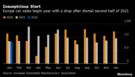
Europe’s car sales declined for a seventh consecutive month in January as an ongoing semiconductor shortage continued to hold back production.

New-car registrations in Europe fell 2.4% to 822,423 in January compared to last year, the European Automobile Manufacturers’ Association said Thursday. The drop prolongs the industry’s worst stretch since the association started tracking the market in the early 1990s.

“As global production continues to be limited by a lack of parts, particularly microchips, supply shortages remain the number one drag to better market results, with this expected to remain a key feature of the automotive landscape for 2022,” forecaster LMC Automotive said in a report.

A shortage of semiconductors has hindered production of consumer goods ranging from electronics to automobiles across the globe. Shoppers looking to buy new cars have been forced to wait for weeks or months, and the prices of used cars have surged. 

Car sales were uneven across Europe’s biggest markets last month. While France and Italy posted some of the most significant declines, sales in Germany and the U.K. grew modestly. But analysts and auto executives agree that the chip shortage will continue to dog the industry this year.

Volkswagen AG’s CEO Herbert Diess and other executives have signaled they see the chip supply improving in the second half of 2022, though few have offered specifics as to how it would be resolved. Speaking Wednesday, Diess said VW has introduced an early-warning system on chips, and its engineers have identified some 150 technology alternatives to replace missing semiconductors.

More stories like this are available on bloomberg.com

©2022 Bloomberg L.P.

Temasek-Backed Zilingo Seeking $200 Million in Funding

(Bloomberg) — Singapore’s Zilingo Pte, a startup providing technology to apparel factories and merchants, is seeking to raise $150 million to $200 million in its latest funding round, according to people with knowledge of the matter.

The company, which is backed by state-owned investor Temasek Holdings Pte, is working with Goldman Sachs Group Inc. on the potential fundraising deal that could boost its valuation to over $1 billion, said the people, who asked not to be identified as the process is private. Zilingo has reached out to some investors to gauge interest, the people said.

Deliberations are ongoing and details such as the fundraising size could change, said the people. Representatives for Goldman Sachs and Zilingo declined to comment.

Zilingo is joining a growing number of companies in Southeast Asia raising funds for expansion. ShopBack, a Singapore online shopping rewards app, is in talks with potential investors to raise $150 million, while Philippine fintech firm Voyager Innovations Inc. is considering raising $150 million to $200 million, Bloomberg News reported this week.

Co-founded in 2015 by Chief Executive Officer Ankiti Bose and Chief Technology and Product Officer Dhruv Kapoor, Zilingo has grown into a business-to-business marketplace for wholesale buyers and sellers in the fashion industry. It was valued at $970 million in early 2019 when it raised $226 million from investors including Sequoia Capital India and Temasek. Bose told Bloomberg Television in June that the company is weighing going public among options to raise capital.

More stories like this are available on bloomberg.com

©2022 Bloomberg L.P.

China Medical Robot Maker Hurwa Weighing Hong Kong IPO, Sources Say

(Bloomberg) — Hurwa, a Chinese developer of medical robots used in surgeries, is considering an initial public offering in Hong Kong that could raise about $200 million, people with knowledge of the matter said.

The Beijing-based company is working with China International Capital Corp. and CMB International Capital Corp. on a potential listing as soon as this year, the people said, asking not to be identified as the information is private. Hurwa is valued at 8 billion yuan ($1.3 billion) to 10 billion yuan, the people said.

The company, which was founded in 2018, is also seeking to raise $50 million to $80 million in a pre-IPO private funding round, one of the people said. 

Deliberations are preliminary and details such as size and timing could change, the people said. Representatives for Hurwa, CICC and CMBI didn’t immediately respond to requests for comment. 

A competitor, Shanghai Microport MedBot Group Co., raised about $200 million in a Hong Kong listing last year.

More stories like this are available on bloomberg.com

©2022 Bloomberg L.P.

China Tech Stocks Outlook Improves Year After $1.5 Trillion Rout

(Bloomberg) — A yearlong slide in Chinese technology stocks that wiped out $1.5 trillion in market value may finally be ending as investors look beyond regulatory hurdles to focus on valuations. 

Just 12 months ago, a rally that pushed Hong Kong’s Hang Seng Tech Index to the highest level since a July 2020 inception started to unravel as traders raced to the exit over sky-high valuations and Beijing’s sweeping crackdown on private enterprise. 

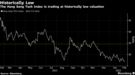
There are signs indicating that the rout may be nearing an end. Earnings estimates for the sector have been revised up 12% from a September bottom, while analyst target prices are implying robust returns. What’s more, the Hang Seng Tech Index is trading near its cheapest-ever valuation and outperforming offshore peers. 

China’s growth stocks “still have very strong fundamentals,” Catherine Yeung, an investment director at Fidelity International, said on Bloomberg Television. “They might change their business models accordingly given the regulatory reports we have seen. But valuation wise, they are looking very attractive.” 

Here are some charts illustrating key valuation and fundamental data points at the anniversary of the peak for the Hang Seng Tech Index. 

The Hang Seng Tech Index’s forward price-to-earnings ratio is trading near a record low, and is 21% below the historical average, according to Bloomberg data. Other valuation multiples, including price-to-sales and price-to-free cash flow ratios, are also hovering at historically low levels, suggesting buying opportunity.  

The gauge has outperformed both the ChiNext Index, its smaller mainland peer, as well as the Nasdaq 100 since the start of 2022. Part of the divergence with the U.S. comes as investors dump rate-sensitive technology shares ahead of the Federal Reserve’s looming tightening. China’s ChiNext gauge of small caps, on the other hand, is struggling with cooling enthusiasm over green stocks following a double-digit rally last year. 

Chinese Stocks Beating U.S. Peers on Rate Concerns: Tech Watch

Investors have grappled with uncertainty over the extent of Beijing’s clampdown on Chinese tech firms. But confidence over profitability has been improving in recent months, as seen by a 12% rise in the aggregate forward earnings estimate for the Hang Seng Tech Index, almost triple the pace for Nasdaq 100 stocks.  

Bargain hunters have emerged. Half of the most popular ETFs that track Hong Kong-listed stocks have been ones that mirror the performance of tech shares listed in the city. The ChinaAMC Hengsheng Internet Science and Technology Industry ETF and ChinaAMC Hang Seng TECH ETF have drawn in nearly $840 million this year, Bloomberg data shows. 

Read: Mainland Traders Lift Tencent, Meituan Stakes to 7-Month Highs

China tech bears are fading, with short-selling interest on video streaming giant Kuaishou Technology and delivery giant Meituan waning. Bets against Kuaishou – one of the most shorted stocks in Hong Kong previously and the biggest drag on the index in the past year – has fallen to about 4% of free float compared with 20% in mid 2021. 

(Updates with comment.)

More stories like this are available on bloomberg.com

©2022 Bloomberg L.P.

Amazon Says It’s Reached Agreement With Visa on Payment Fees

(Bloomberg) — Amazon.com Inc. has agreed to accept Visa Inc.’s cards across its global network, settling a feud that threatened to hammer the financial giant’s bottom line and disrupt e-commerce payments.

The retailer said it will no longer charge customers who use Visa cards on its site in Singapore and Australia an extra fee and it will not turn off Visa credit cards from amazon.co.uk. 

“We’ve recently reached a global agreement with Visa that allows all customers to continue using their Visa credit cards in our stores,” a company spokesman said via email. “Amazon remains committed to offering customers a payment experience that is convenient and offers choice.”

Amazon had considered shifting its popular co-brand credit card to Mastercard Inc., Bloomberg News has reported. The Amazon card is one of the industry’s largest co-branded portfolios, and the company used talks to renew the agreement as a way to secure better terms from Visa, according to people familiar with the matter.

Retailers have long balked at the fees they pay each time a consumer swipes a card at checkout. While it can amount to just pennies per purchase, that adds up: Merchants spent a whopping $110 billion in card-processing fees in 2020 alone.

Visa Believes It Will Resolve All Issues With Amazon, CFO Says

For the biggest banks and merchants, Visa often reaches special pricing agreements to persuade them to send more volume over its network. The company set aside $8.4 billion in fiscal 2021 for such incentives, 26% more than a year earlier.

But Visa has been known to go even further, including in 2015 when the company won the Costco Wholesale Corp. co-brand credit card by giving the retailer a break on the fees it pays to accept all Visa cards, not just its co-brand card. In talks to renew the longstanding co-brand card agreement between Amazon and Visa, the e-commerce firm was hoping to secure a similar deal.

Another sticking point had been Visa’s policy of categorizing all e-commerce payments as “card not present,” which typically translates into higher rates.

“Visa is pleased to have reached a broad, global agreement with Amazon,” a Visa spokesman said in an emailed statement. “This agreement includes the acceptance of Visa at all Amazon stores and sites today, as well as a joint commitment to collaboration on new product and technology initiatives to ensure innovative payment experiences for our customers in the future.”

While Amazon has been surcharging customers who use Visa cards on its site in Singapore and Australia for months, it sought to up the ante late last year with a threat to stop accepting the firm’s credit cards by U.K. customers entirely. Last month, the two companies said they were working on an agreement, narrowly avoiding an outright ban on U.K. cards. 

(Updates with additional context from fifth paragraph)

More stories like this are available on bloomberg.com

©2022 Bloomberg L.P.

Yuan’s Global Popularity Keeps Rising With Usage at Record High

(Bloomberg) — The Chinese yuan is making deeper inroads as a currency of choice for global payments, with international transactions climbing to their highest level ever. 

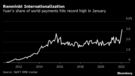
Payments using the renminbi, as the currency is also known, jumped to a record 3.2% of market share, according to data from the Society for Worldwide Interbank Financial Telecommunications, breaking through its previous high set in 2015 that came on the back of a currency devaluation in a bid to increase exports.

Usage has jumped in the past three months as international funds boosted holdings of Chinese government bonds, pushing their share to a fresh record, and amid gas producer Gazprom Neft’s decision to accept yuan rather than dollars for fueling the Russian airplanes at China’s airports. The People’s Bank of China governor Yi Gang urged emerging economies to promote the use of local currencies at a Group-of-20 central banks’ gathering Wednesday, echoing a similar call from Indonesia to reduce reliance on the dollar to manage the risk of Federal Reserve’s stimulus withdrawal.

The yuan will be one of the biggest beneficiaries as “trade between various Asian countries and China grows, and more of it is denominated in yuan,” said Alvin T. Tan, head of Asia FX strategy at Royal Bank of Canada in Hong Kong.

Yuan’s growing popularity could also provide additional support for assets denominated in the currency, even as China’s yield premium over the U.S. narrows due to policy divergence between the two nations. China’s bond market may see an inflow of 700 billion yuan to 800 billion yuan ($110 billion to $126 billion) in 2022, compared with 755 billion yuan last year, according to Becky Liu, head of China macro strategy at Standard Chartered Bank Plc. 

She expects yuan to be assigned a larger share in the International Monetary Fund’s reevaluation of Special Drawing Rights basket in July. The Regional Comprehensive Economic Partnership trade deal that deepens China’s regional foreign trade ties will also prompt member nations to raise yuan asset holdings due to further economic integration with China, she wrote in a note Wednesday.

The currency retained its fourth place in the past two months, compared with being the 35th most-popular medium of exchange for payments in October 2010 when Swift, which handles cross-border payment messages for more than 11,000 financial institutions in 200 countries, started tracking.

Still Lagging

Despite its rise in the rankings and having upped its market share by orders of magnitude over the last 12 years, the renminbi is still dwarfed in popularity by its more established peers, notably the U.S. dollar and the euro. 

The dollar kept its top spot in January, a position it’s held since June, even though its market share fell to about 39.9% from 40.5% in December. The euro also lost ground but held onto second place, while the British pound and yen rounded out the top five in third and fifth place, respectively. 

(updates with PBOC comments in third paragraph and strategist comments in fourth and fifth paragraphs.)

More stories like this are available on bloomberg.com

©2022 Bloomberg L.P.

Flying Cabs Steal Thunder at Airshow as Clean Future Beckons

(Bloomberg) — Electric flying taxis took center stage at the Singapore Airshow this week as pressure to cut emissions and rebound from the pandemic leads airlines to invest in short, battery-powered hops to spur future growth.

While conventional aircraft sales at the show were modest, Malaysian tycoon Tony Fernandes’s AirAsia reached a non-binding agreement with aircraft-leasing firm Avolon Holdings Ltd. to rent at least 100 of Vertical Aerospace Ltd.’s flying taxis, confirming an earlier Bloomberg News report. Avolon, an investor in Vertical, has ordered 500 of the U.K. startup’s VX4 aircraft, conditioned on milestones including certification. 

Separately, Embraer SA unit Eve Urban Air Mobility and Microflite, an Australian helicopter operator, announced an order of as many as 40 electric vertical take-off and landing aircraft, or eVTOLs, to support the start of operations in Australia in 2026. Eve also struck a deal with Aviair and HeliSpirit, which serve some of Western Australia’s most popular tourist attractions, for as many as 50 eVTOLs.

“Decarbonization is the world’s single biggest challenge we face as a generation, and the decarbonization of aviation is the single biggest opportunity us in the aviation industry have,” Domhnal Slattery, chief executive officer of Avolon, said. “The electrification of aircraft is a first and important step in that journey.” 

New Market

An increasing number of carriers are looking into the battery-powered aircraft market to connect business centers with airports and ferry people between cities. Legacy airlines including American Airlines Group Inc., Virgin Atlantic Airways Ltd. and Japan Airlines Co. have together ordered hundreds of Vertical eVTOLs. 

Startups such as Eve, Vertical and Joby Aviation Inc. are meanwhile racing to refine the technology and gain safety certifications. The push promises to jumpstart a generation of cleaner-emission aircraft that allow carriers to offer fast, reasonably priced trips competing with helicopter, taxi and train services.

“As we talk to our children that are coming up, they don’t want to fly in machines that emit any kind of emissions,” Slattery said. “It’s going to take us decades to solve that problem, but this is a first step in the right direction.”

With 82,500 passenger eVTOLs in operation by 2050, the Asia Pacific region will account for 51% of the global market, according to a study by Rolls-Royce Holdings Plc and Roland Berger released this week. The aircraft could be used as airport shuttles, for tourist flights or intercity travel, flying as far as 250 kilometers (155 miles), according to the study. 

Safety Hurdles

Demand for eVTOLs is exceptionally high, Slattery said this week. Prior to the AirAsia deal, Avolon had signed commitments for as many as 350 Vertical aircraft, including with Brazil’s largest airline, Gol Linhas Aéreas Inteligentes.

A number of obstacles will have to be cleared before people are zipping around like the Jetsons cartoon TV family. While many in the aviation industry have jumped on the electric flying taxi bandwagon, not a single unit has been certified by regulatory agencies so far.

EVTOL flight range remains limited as well, and the potential electrification of popular planes such as Airbus SE’s A320s or Boeing Co.’s 737 has been largely ruled out due to the weight of huge batteries that would be required to fly hundreds of miles. 

Resource Battle

There is competition for development funds too, as some in government or industry are more inclined toward alternatives such as sustainable aviation fuel, which can work in conventional aircraft, hydrogen-powered engines and hybrid-electric designs. Each will require new infrastructure.

That hasn’t deterred early movers from betting big. Joby said this week it will work with ANA Holdings Inc. to bring aerial ridesharing to Japan. 

Embraer’s Eve also sees huge potential for eVTOLs to circumvent traffic jams on busy streets in Asia-Pacific countries. It estimates some 25,000 eVTOLs in the region by 2035, accounting for about half of global demand, said co-CEO Andre Stein. 

The company expects to start services in 2026 after obtaining approvals from relevant authorities.

“Embraer has certified over 30 different aircraft models in the last 25 years,” Stein said. “We’re leveraging that same type of experience and engaging with customers to create a product that has a differentiation.”

(Updates with Rolls Royce study in eighth paragraph.)

More stories like this are available on bloomberg.com

©2022 Bloomberg L.P.

Intel CEO Is Tired of Wall Street Doubting His Comeback Plan

(Bloomberg) — Intel Corp. Chief Executive Officer Pat Gelsinger, who took the job in February 2021, gives himself an A- grade for his first year running the chipmaker. Investors are proving to be tougher graders.

No one is faulting the 60-year-old’s energy level and ambition. But he’s trying to reshape the competitive landscape of the $500 billion chip industry, turn around its most iconic company, and change industrial policy in the U.S. and Europe — at a pace he likes to call “torrid.”

And the plan is going to be expensive. Very expensive. In Ohio, Gelsinger is spending $20 billion to build the world’s biggest chipmaking facility. He’s also planning an expansion in Europe, making deals and ramping up research spending — weighing on Intel’s once-dependable profit margins. That’s testing the patience of investors, who have sent the shares down 22% in the past year.

Just this week, Intel agreed to buy Tower Semiconductor Ltd. for $5.4 billion, part of a push into making chips on a contract basis for other companies. 

In a Bloomberg Television interview, Gelsinger acknowledged that Intel’s comeback won’t happen overnight but slammed Wall Street analysts for sticking to a negative view. The executive said he’s “p—ed” off at what he calls perma-bears. But Gelsinger believes that others are getting excited about the company restoring its prowess and creating “the new old Intel.”

“In some regards, we’re ahead of where I thought we’d be; in some areas, we’re not as far as I thought we’d be,” Gelsinger told Emily Chang in a “Bloomberg Studio 1.0” conversation airing Wednesday night. “And it really is more a statement of the massive challenge in front of us.”

This is Gelsinger’s second stint at Intel, having spent decades at the chipmaker before leaving to run VMware Inc. in 2009. When he returned as CEO last year, the hope was he could chart a new course — but also remember what made Intel great in the first place.

Within a few weeks of rejoining the company, Gelsinger outlined an aggressive strategy aimed at reclaiming the manufacturing leadership that his predecessors had allowed to slip. He followed that up with his plans to rebuild production in the U.S. and Europe, aiming to counterbalance a shift of manufacturing to Asia. He’s also lobbied for billions of dollars in government support.

But it could be an uphill fight. Longtime underdog Advanced Micro Devices Inc. has become a fierce competitor, and some of Intel’s most prized customers — including Apple Inc. — are developing their own chips. 

For now, investors such as NZS Capital are taking a wait-and-see approach. 

“I think he deserves good marks for what he’s done,” said Jon Bathgate, a fund manager at the firm in Denver. “But the lift is just extremely heavy, and people that think that this can be resolved in a handful of quarters — even a handful of years — probably don’t understand the challenges that he was facing coming in in the first place.”

Bathgate said NZS isn’t investing in Intel because there are other companies that are “firing on all cylinders.” Intel will have to show better financials, prove it can land big outsourced chip customers and stop losing market share, he said.

Other investors agree. Intel’s performance over the past year puts it at 27th in the Philadelphia Stock Exchange Semiconductor Index of 30 stocks. And its shares have declined sharply each time Intel has reported earnings — a sign investors aren’t happy with Intel’s progress.

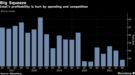
Take Intel’s gross margin — the percentage of revenue remaining after deducting the cost of production — a key sign of health for a manufacturing company. It’s expected to be about 52% this year. That figure would be stratospheric in the automotive industry, but it’s 10 percentage points below Intel’s historical levels. It’s also below those of some peers. Texas Instruments is close to 70%, and AMD — not known for its fat margins in the past — reached 50% last quarter. 

On Wednesday, the shares slipped less than 1% to $48.23. Intel will have a fresh opportunity to win over investors on Thursday, when the chipmaker holds its investor meeting.

Gelsinger’s efforts won praise from Third Point LLC’s Daniel Loeb on Wednesday, who said in an investor letter that the chipmaker could “deserve a second look.”

“We are encouraged by Intel’s aggressive investment plan,” he said. “We knew from the start that Intel’s turnaround would be complex and lengthy, and we have been pleased to see Mr. Gelsinger sacrifice near-term earnings for long-term growth.”

In many ways, Gelsinger is trying to turn back the clock and restore Intel to what it looked like in 2009, when he left to run VMware. Back then, the computer industry bought Intel chips because they had to: Its Xeons and Core processors were so much better than the few viable alternatives. That position gave Intel a level of profitability that was the envy of the chip industry and enough cash to let it spend more than any rival on technology and manufacturing.

Gelsinger started his career at Intel in 1979 and was the lead architect of the original 80486 chip. He likes to say he “went through puberty there,” working for chip-industry pioneers like Gordon Moore and Andy Grove. 

But these days, the company is playing catch-up. Gelsinger plans to spend as much as $28 billion on new plants and equipment this year, up as much as $10 billion from a year earlier. Taiwan Semiconductor Manufacturing Co. expects to shell out $40 billion and Samsung Electronics Co., which spent $36 billion in 2021, will likely exceed that level this year, according to analysts’ estimates. 

Gelsinger said he’s trying to overcome a decade of “bad decisions and poor execution.” But even with a spending spree underway, Intel isn’t keeping up with its fellow chip giants. 

Intel’s customer base has undergone a transformation too. The year before Gelsinger left Intel, the chipmaker had the same annual revenue as Apple: about $37 billion. Intel was about $5 billion ahead in market capitalization. Since then, Intel has roughly doubled in revenue. But Apple now has a valuation of $2.8 trillion, annual sales of $365 billion and a cash position that exceeds Intel’s total market capitalization. Other big buyers of chip buyers — Amazon.com Inc., Microsoft Corp., Alphabet Inc. and Facebook owner Meta Platforms Inc. — also dwarf Intel in size.

Intel is setting ambitious goals, but from “a position of relative weakness,” said Tom Fitzgerald, a fund manager at EdenTree Investment Management. The competition has evolved over the past decade, he said, and so have the customers.

Many of Intel’s biggest customers are designing their own chips. Apple has already abandoned Intel parts in its Mac line of computers, relying instead on technology from Arm Ltd. Amazon and Microsoft are taking similar steps with their server processors. 

With that in mind, Gelsinger’s mantra to his design team is to build a better chip.

“We have to create products and technologies that Apple says, ‘Huh, that’s better than I could have done myself,’” he said.

The good news is the proliferation of chips means there will be a bigger pie for the whole industry to carve up. More semiconductors are going into cars, household appliances and buildings — anything that needs to think for itself and connect to the internet. The Covid-fueled supply crisis of the past year has spotlighted just how reliant the world is on chips.

Semiconductor industry sales topped half a trillion last year, and Gelsinger believes that figure will double within the next decade.

And as Intel makes a wider variety of chips, it looks to become as indispensable as ever. 

“It’s going to take awhile, but we’re well on our way,” Gelsinger said.

(Updates with Loeb’s comments in 16th paragraph. A previous version of the story corrected the syntax referring to Intel’s spending plans.)

More stories like this are available on bloomberg.com

©2022 Bloomberg L.P.

Cisco Projects Sales Growth Constrained by Further Supply Chain Issues

(Bloomberg) — Cisco Systems Inc., the biggest maker of computer networking equipment, gained in late trading after giving a bullish forecast for the current quarter and boosting its share buyback program. 

Sales will increase 3% to 5% in the period ending in April, the company said Wednesday in a statement. That compares with the average analyst projection of 4% revenue growth, or $13.3 billion, according data compiled by Bloomberg. Excluding certain items, earnings will be 85 cents to 87 cents a share.

Chief Executive Officer Chuck Robbins said his company is seeing strong demand for equipment across its businesses, driven by companies looking to upgrade their infrastructure. In fact, it’s more than Cisco can handle. The company is swamped with orders it can’t fill because of a shortage of components — a problem hurting industries across the economy. 

“We delivered solid top-line growth combined with margins and earnings that exceeded the high ends of our guidance despite operating in a supply constrained and inflationary environment,” Robbins said on a conference call with analysts. 

The bulk of Cisco’s income comes from hardware, which serves as the backbone of the internet and corporate computer networks. The reliance on equipment sales has made the company vulnerable to industrywide shortages of electronic components, which have pushed up its costs and left it unable to ship as many products as it has orders for.

More components will translate into faster revenue growth, Chief Financial Officer Scott Herren said. Cisco now has a backlog of $14 billion, more than double the level it was a year ago, and orders grew at more than 30% for a third consecutive quarter. The company expects improvement in the second half of fiscal 2022, which ends in July. The inability to ship enough hardware is even dragging down software and services revenue because some of that is tied to device sales, he said on the conference call. 

Cisco shares rose as much as 6.7% to $57.87 in extended trading. The stock had fallen 14% this year through the close.

The company also announced a $15 billion increase to its share buyback program, which brings the total repurchase authorization to $18 billion.

The company has revised the categories used in earnings reports to reflect changes to its business. Sales in the Secure Networks unit, which includes networking hardware such as switches and routers, rose 7% to $5.9 billion in the quarter. Revenue from Internet for the Future, which includes optical networking and 5G-related products, jumped 42% to $1.32 billion. Both units topped analysts’ estimates.

Hybrid Work, which includes Webex and other collaboration products, declined 9% to $1.07 billion.

Services revenue was $3.37 billion, down about 1% from the period a year earlier and less than the average estimate of $3.45 billion.

(Updates with CFO comments on constraints in sixth paragraph.)

More stories like this are available on bloomberg.com

©2022 Bloomberg L.P.
CDPQ Is Said to Buy Stake in Warburg-Backed Cybersecurity Firm

(Bloomberg) — ESentire Inc., a cybersecurity company backed by private equity firm Warburg Pincus, has struck a deal to sell a stake to two investment firms at a $1.2 billion valuation, according to people familiar with the matter. 

Canadian pension fund Caisse de dépôt et placement du Québec and an existing investor, Canadian venture capital firm Georgian, are buying a 50% stake in ESentire, said the people, who asked to not be identified because the matter isn’t public. While the firms reached an agreement in December, the deal hasn’t closed yet, they said. 

Representatives for ESentire, Warburg, CDPQ and Georgian declined to comment.

ESentire, based in Waterloo, Ontario, helps companies detect security threats and then respond to them. It competes with larger rival Mandiant Inc., which Bloomberg News previously reported is in talks to be acquired by Microsoft Corp.

Cybersecurity has become an increasingly hot area for merger and investing activity, as people and companies seek to protect data as they do more business online. Founded in Canada in 2001, ESentire protects data and applications for more than 1,200 organizations in over 75 countries, according to its website.

Warburg acquired a majority stake in ESentire from Edison Partners in 2017 for undisclosed terms, according to data compiled by Bloomberg.

CDPQ, which manages Quebec’s public retirement and insurance funds, has net assets of about C$390 billion ($307 billion). In December, it said it had agreed to buy a minority stake in supply chain compliance provider QIMA. 


More stories like this are available on bloomberg.com

©2022 Bloomberg L.P.

Close Bitnami banner
Bitnami