Bloomberg

Commerzbank Delays Some Cost Cuts in Online Broker Integration

(Bloomberg) — Commerzbank AG will have to wait longer than expected for tens of millions of euros in cost savings that it had hoped to reap from consolidating its information technology, creating yet another expense headwind for Chief Executive Officer Manfred Knof.

The lender has decided to push back the integration of online broker Comdirect, meaning it will have to keep about 80 employees and maintain the unit’s IT systems for longer than planned, people familiar with the matter said. The impact will be less than 50 million euros ($57 million), according to one person.

A spokeswoman for Commerzbank confirmed the delay of the Comdirect integration, which was first reported by Wirtschaftswoche. She said the lender stands by its cost targets for 2024.

The decision adds to a number of unexpected expenses that have piled up since Knof unveiled his restructuring strategy for Germany’s second-biggest listed bank in February last year. The Comdirect project was delayed to ensure the online broker doesn’t lose value as it’s merged into the less nimble parent company, the people said.

Commerzbank’s other unexpected cost headwinds include severance payments and a court verdict last year voiding some fee increases at Germany’s banks. The lender last year also took an impairment charge of 200 million euros on a scrapped IT project and said it will take a 436 million-euro charge in the fourth quarter to draw a line under litigation at its Polish subsidiary.

Commerzbank is scheduled to reported to fourth-quarter earnings on Thursday. It has guided for a small annual profit. 

More stories like this are available on bloomberg.com

©2022 Bloomberg L.P.

EU Plans to Spend Billions on Satellite Fleet to Rival Musk

(Bloomberg) — The European Union revealed its most detailed plans yet for a low-earth orbit satellite system worth billions of euros aimed at delivering secure communications for the bloc. 

The project will cost an estimated 6 billion euros ($6.8 billion) in both public and private money. The European Commission plans to spend 2.4 billion euros from its budget, while the rest would come from EU countries and industry. 

Internal Market Commissioner Thierry Breton has been pushing the project through the bloc for more than a year. He told French TV station BFM on Monday it’s essential that Europe has its own so-called “constellation” of satellites. 

He said the EU’s space plans will help boost the cybersecurity and resilience of EU countries, while ensuring better broadband access across Europe and Africa. 

“This is of central importance in terms of our strategic and technical sovereignty,” Breton said Tuesday at a press conference.

The EU is entering a fierce global race to blanket the earth with rival low-earth orbit satellite coverage. These spacecraft are much closer to the planet than the traditional geostationary kind which beam TV and remote communications. This means they can connect users to faster broadband, although they don’t stay in orbit as long and many more need to be launched to achieve the same geographic coverage.

What’s more, fears of collisions are growing with the number and relative density of equipment in orbit.

The dominant player is Elon Musk’s Space Exploration Technologies Corp., which has launched about 2,000 spacecraft for its Starlink system. It aims to provide consumer broadband to remote regions, as well as defense and business applications, and has the advantage of using its own re-usable rockets. It’s become one of the world’s most valuable private companies. Rival billionaire Amazon.com Inc. founder Jeff Bezos is also planning a similar system called Project Kuiper.

The EU’s closest equivalent may be a startup called OneWeb, which was unexpectedly bought out of bankruptcy by the U.K. government after the outbreak of Covid-19. The U.K. is now part of a consortium which includes the Indian conglomerate Bharti Global, SoftBank Group Corp. and French satellite operator Eutelsat SA. It’s put two thirds of an initial phase of 648 satellites into orbit. 

More stories like this are available on bloomberg.com

©2022 Bloomberg L.P.

Analyst Price Targets May Be Too Good to Be True as Investors Exit Tech Stocks 

(Bloomberg) — Just when investors are turning bearish on tech stocks, sell-side analysts are sitting tight on their predictions of 50% or more gains for many stocks like Facebook-owner Meta Platforms Inc.

As U.S. equities tumbled in the past two months, brokerage firms in aggregate have hardly budged in their forecasts and the implied gains are getting bigger and bigger. The average stock in the Nasdaq 100 Index will rise 28% in the next year if Wall Street forecasts prove prescient.

Those targets contrast with the opinions of fund managers, who are fast exiting high-growth stocks. Professional investors this month turned the most bearish on technology stocks in almost 16 years, according to a Bank of America Corp. survey of its clients. Pessimism has built amid the Federal Reserve’s plan to raise interest rates at a faster pace than initially thought to tame inflation.

Among the stocks with the biggest potential gains according to analysts are Zoom Video Communications Inc., with 86% upside to the average analyst target, and PayPal Holdings Inc., forecast to rise 59%. As for Meta, while the target has come down by more than $60 since its dismal earnings report this month, the stock still has to rise almost $115, or 53%, to catch up. 

The kind of gains predicted by analysts are hardly achievable as interest rates are set to rise, said Jim Dixon, senior equity sales trader at Mirabaud Securities. 

“Historically this hasn’t been the ideal scenario to own these stocks,” he said, adding that of the 264 analyst ratings on Amazon.com Inc., Apple Inc., Meta, Google owner Alphabet Inc. and Nvidia Corp., only six are the equivalent of sell.

Analysts, as a whole, tend to be bullish on stocks, but the current optimism is a stretch even by historical measures. At the start of this year, the implied gain for Nasdaq 100 stocks from price targets was 10%, in line with a 5-year average of about 12%.

For Tuesday, at least, the optimism is paying off: the Nasdaq 100 is up 1.6% at 9:44 a.m. in New York as tensions eased between Russia and Ukraine.

Tech Chart of the Day


Top Tech Stories

  • Didi Global plans to cut 20% of its employees as the ride-hailing company pushes ahead with plans to transfer its stock-market listing to Hong Kong, people with knowledge of the matter said
  • Intel agreed to buy Tower Semiconductor for about $5.4 billion, part of Chief Executive Officer Pat Gelsinger’s push into the outsourced chip-manufacturing business
  • Peloton’s sweeping overhaul included the departures of executives running operations, its supply chain and other functions, according to people with knowledge of the matter
  • Cathie Wood’s ARK Investment Management LLC took advantage of the record slump in Sea, snapping up more of the gaming firm’s shares after India banned one of its products
  • Texas sued Meta Platforms over claims its Facebook and Instagram platforms are still monetizing people’s faces without their consent, as well as holding onto a facial-geometry database compiled over a decade

(Updates shares and gap between target prices throughout.)

More stories like this are available on bloomberg.com

©2022 Bloomberg L.P.

France-Backed Digital Africa to Fund 200 African Tech Startups

(Bloomberg) — Digital Africa, a French government-backed organization assisting African tech startups, will move to a for-profit model and provide 70 million euros ($79 million) for seed and Series A funding by 2025. 

Backed with 130 million euros from Proparco, a unit of the Agence Francaise de Developpement, Digital Africa aims to fund 200 African startups with seed funding of between 20,000 euros and 200,000 euros each, Stephan Eloise-Gras, the initiative’s executive director, said on an online press conference.

“To bring these changes to life, Digital Africa, is looking to move away from its initial nonprofit model, with the ambition to get closer to the African and global private sector by focusing on early stage startups,” it said in its White Paper 2022, which was released on Tuesday.

The initiative, launched by French President Emmanuel Macron in 2018, plans to shift its focus beyond the three key nodes of South Africa, Nigeria and Kenya, which together account for almost four fifths of the money raised by African startups. It will also look to provide funding to hubs in countries ranging from Ivory Coast to Tunisia, according to the White Paper. 

A record $5 billion in startup capital was raised in Africa last year.

Digital Africa set up the 5 million euro Bridge Fund with Proparco in 2020 and has so far disbursed seed funding of between 175,000 euros to 600,000 euros to 10 companies.

More stories like this are available on bloomberg.com

©2022 Bloomberg L.P.

Belgians Can Work 4-Day Week as Full-Time Staff in New Deal

(Bloomberg) — Belgian employees won the right to perform a full work week in four days instead of the usual five without loss of salary, part of an agreement that aims to make Belgium’s notoriously rigid labor market more flexible.

Employers will still have the right to turn down employees’ requests for a condensed work week, on condition they explain their refusal in writing, Deputy Prime Minister and Labor Minister Pierre-Yves Dermagne said Tuesday in Brussels. For companies, it will become easier to introduce evening and night work without prior agreement from all labor unions.

“The goal is to give people and companies more freedom to arrange their work time,” Prime Minister Alexander De Croo said on Tuesday in Brussels. “If you compare our country with others, you’ll often see we’re far less dynamic.”

Only about 71 out of 100 Belgians in the age group from 20 to 64 years have a job, fewer than the euro-area average of about 73 and a full 10 percentage points less than in neighboring countries such as the Netherlands and Germany, according to Eurostat data for the third quarter of 2021. Belgium’s seven-party federal coalition agreement set a goal for an employment rate of 80% by 2030, a panacea that would serve to keep its legal pensions affordable or finance future tax cuts.

A four-day week will help women caring for children and aging parents maintain a work-life balance, but it will also benefit the labor market, said Beatrice Delfin-Diaz, president of the Belgian Association of Women Business Leaders.

Many employers, however, won’t be able to navigate the maze of new procedural rules, according to the Federation of Enterprises in Belgium which represents more than 50,000 companies.

“Instead of creating more possibilities for employees, what we see is that the government provides for a number of additional conditions which will very likely discourage the employers” from entering into these kind of arrangements, said Monica De Jonghe, director of the federation.

Following the pandemic, the four-day week idea is catching on across the world, with the U.K. starting a six-month program in June, with about 30 companies that have so far signed up for the trial. Similar programs are set to start in the U.S. and Ireland, with more planned for Canada, Australia and New Zealand. The shorter work week has been an overwhelming success, researchers in Iceland found.

The Belgian government also introduced new rules for platform workers, setting out criteria for designating them as employees regardless of what they are called in their contract. According to Minister of Social Affairs Frank Vandenbroucke, the Belgian legislation will be modeled on the European Commission’s proposal from December for gig workers.

(Adds reaction to plan starting in fifth paragraph)

More stories like this are available on bloomberg.com

©2022 Bloomberg L.P.

Bitcoin Climbs Back Above $44,000 as Appetite for Risk Returns

(Bloomberg) —

Bitcoin rose to more than $44,000 for the first time since the end of last week as optimism over an easing of tensions around Ukraine renewed investors’ appetite for riskier assets.

The largest cryptocurrency by market value strengthened as much as 5.2% to $44,449. Other digital tokens also increased, with Ether jumping 7%, Solana up more than 9% and DeFi favorite Aave also up around 7%.   

Global equities rallied after Russia said Tuesday that some troops are starting to return to their regular bases after completing drills. U.S. warnings of a possible Russian attack on Ukraine had reached their most urgent level yet this week.

“The level of geopolitical tension that has existed over the last three weeks for right now appears to be easing, so therefore there is this sense of people jumping back in looking for bargain hunting,” Kenny Polcari, managing partner at Kace Capital Advisors, said.

James Butterfill, head of research at CoinShares, said reports that the Russian government could permit the trade of cryptocurrencies, in part to attract foreign investments, could also be pushing the token higher. 

Bitcoin was swept up in the recent market anxiety over Ukraine, falling 2.7% on Friday. Proponents of digital assets often tout an uncorrelated relationship with broader markets, yet the asset class continues to mimic movements in equities, particularly technology stocks. The correlation coefficient between Nasdaq 100 futures and Bitcoin currently stands at 0.4, with 1 representing parallel moves.

“It’s correlated for now,” Butterfill said. “It’s clear that it’s quite sensitive to rising interest rates, but what happens in a situation where you have a policy mistake, i.e. the Fed hikes too aggressively, for instance, or they don’t hike aggressively enough, and there’s an inflation problem. That would actually probably be much more supportive of Bitcoin and less supportive for equities.”

More stories like this are available on bloomberg.com

©2022 Bloomberg L.P.

Crypto Is Like a ‘Ponzi’ Scheme, India’s Central Bank Warns

(Bloomberg) — In a strong warning to Prime Minister Narendra Modi’s government, a top official at India’s central bank reiterated concerns over cryptocurrency trading, likening the virtual coins to Ponzi schemes.

Seeking a ban on cryptocurrencies, Reserve Bank of India Deputy Governor T. Rabi Sankar said the digital coins threaten “financial sovereignty” and “undermine financial integrity” of a country given that there are no underlying cash flows.

“We have also seen that cryptocurrencies are not amenable to definition as a currency, asset or commodity; they have no underlying cash flows, they have no intrinsic value; that they are akin to Ponzi schemes, and may even be worse,” Sankar said in a speech at a banking conference on Monday.

So far, India has no regulation on crypto trading. The Supreme Court in March 2020 struck down a ban by the RBI and since then crypto investments have exploded in the country. An October report from Chainalysis, a crypto-analysis firm, found the Indian market grew 641% from July 2020 through June 2021.  

The timing of the sternly-worded speech can’t be overlooked. It follows the government’s announcement earlier this month of levying a capital gains tax on crypto trading, thereby officially acknowledging the virtual coins as assets. Soon after, RBI Governor Shaktikanta Das, a long-time opponent of cryptocurrencies, voiced his concerns over India’s financial stability from such volatile trades and said the digital coins have no underlying asset, “not even a tulip.”     

India has seen the second-highest adoption rate for cryptocurrency investments with millions jumping on the bandwagon. That has added to the RBI’s concerns over money laundering, terrorist funding and erosion of household savings.  

Cryptocurrency trading can “wreck the currency system, the monetary authority, the banking system, and in general, government’s ability to control the economy,” RBI’s Sankar said.

More stories like this are available on bloomberg.com

©2022 Bloomberg L.P.

Baidu’s Self-Driving Vehicles Take a Turn With Olympics Showcase

(Bloomberg) — Stay on top of the electric car revolution by signing up to our Hyperdrive newsletter here.

Cities usually have many reasons for bidding to host major sports events like the Olympics, but demonstrating to the world the best the city has to offer is often the primary motivation. Preparations for the games frequently include building out transit infrastructure that serves Olympic athletes and visitors during the games and also benefits residents long after the closing ceremony. These transport solutions can range from new roads or train lines to hydrogen-powered vehicles.

Autonomous vehicles have become examples of how cities plan to provide cutting-edge transport solutions to their citizens. At the 2018 Winter Olympics in Pyeongchang, Hyundai offered demonstrations of its self-driving functionality to guests in vehicles operating on a controlled test loop. KT Corp also ran what it called a 5G bus which demonstrated some of the in-vehicle connectivity features that will likely become commonplace in autonomous vehicles. The 2020 Summer Olympics in Tokyo would have presented one of the largest real-world tests of autonomous vehicles as Toyota planned to transport fans in its e-Pallete vehicles. Covid-19 caused the delay of the games to 2021 and prevented supporters from attending. Athletes still were able to try out rides in the vehicles but the tests ultimately were a disappointment after a Paralympic judo athlete suffered a “non-serious” injury from a collision with one of the vehicles.

The 2022 Winter Olympics in Beijing promised another big opportunity for autonomous vehicle testing in a real-world situation, this time in vehicles made by one of China’s biggest technology companies, Baidu. Beijing’s strict Covid-19 protocols prevent any test rides for athletes but the public were able to ride in the shuttles prior to the start of the games.

The Olympic demonstrations of autonomous vehicles might not have been medal-worthy, but that should not distract from all the training that has gone on in the Olympic off-season. Beijing, Shanghai and California released separate reports in late January and early February detailing the testing of autonomous vehicles on public roads in their respective geographies. The three reports offer varying levels of detail that correspond to the different regulatory conditions in each region. However, all three show that 2021 was a record year for autonomous vehicle testing with a combined 6 million miles driven in autonomous mode on public roads. In Shanghai autonomous vehicle testing increased nearly sixfold from 2020. This ramp up in activity does not mean robo-taxis are ready for all city streets. The deployment of self-driving vehicles will continue as staggered entries into tightly geofenced areas that have been thoroughly mapped.

Unlike many of the Olympians, autonomous vehicles won’t have to wait another four years for a chance to demonstrate what they’re trained to do. Real-world trials of AVs will continue. Cruise is among the latest to offer a driverless robotaxi service to the public in its home market of San Francisco. It is awaiting one additional permit from the California Public Utilities Commission before it can charge a fee for these rides. More companies ranging from Mobileye to Auto-X are targeting the deployment of their own commercial robotaxi services before the next Summer Olympic Games will be held in Paris in 2024. By that time self-driving cars might not be enough to excite the first guests at an Olympics in the 2020s, with France already testing flying taxis ahead of the games.

More stories like this are available on bloomberg.com

©2022 Bloomberg L.P.

Crypto Gifts Surge 1,082% at Fidelity’s Philanthropic Powerhouse

(Bloomberg) — As cryptocurrencies boomed last year, boosting the wealth of investors in the asset class, so did the amount of philanthropic gifts made with digital tokens.

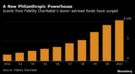
Fidelity Charitable, the largest grant-maker in the U.S., received $331 million in digital assets last year through its donor-advised funds, or DAFs, a nearly 12-fold increase from the $28 million it got in 2020, according to a report released Tuesday. Bitcoin accounted for 88% of crypto donations, followed by Ether at 11%.

“We’re seeing a mix of donors old and young” with crypto, Jacob Pruitt, Fidelity Charitable’s president, said in an interview. The organization’s team specializing in complex assets tries to sell donations of digital tokens as quickly as possible, he said, because of their volatility and so donors can grant money faster.

Fidelity Charitable, the nonprofit affiliate of Fidelity Investments, and other providers of DAFs can accept assets that many nonprofits can’t, from crypto to stakes in hedge funds and privately owned businesses. 

That’s helped fuel a surge of wealth into DAFs, because giving non-cash assets directly to charity comes with a big tax advantage: Under Internal Revenue Service rules, donors can both deduct the value of the gift and avoid any capital-gains tax on the investment. Fidelity Charitable has about $50 billion in assets.

Major Player

Last year, two-thirds of donations to Fidelity Charitable came in the form of non-cash assets, according to the organization’s 2022 Giving Report. Total contributions have surged, jumping to $15.3 billion in the fiscal year ended in June, up 43% from the previous 12-month period.

Those assets have made Fidelity Charitable a major player in philanthropy. Grants from the organization rose 13% last year to $10.3 billion, building on a 24% surge in donations in 2020. While grants to human services charities, like food banks and homeless shelters, surged around the time the pandemic hit, last year’s big trend was a rise in DAF money going to arts and cultural organizations, increasing the sector’s share of Fidelity grants to 9% from 5%.

The popularity of DAFs and the rapid growth of Fidelity Charitable, the largest in the space, have attracted scrutiny from nonprofits, philanthropists and members of Congress, who have voiced concerns that donations are sitting in the funds for too long, providing an immediate tax deduction for money that doesn’t reach working charities in a timely fashion. 

Bipartisan legislation, introduced in the Senate last year and in the House this month, would place new rules on DAFs, including a provision that provides an upfront deduction only for money distributed within 15 years. 

Pruitt warned new rules could have the unintended consequence of slowing down DAF grant-making to the bare minimum.

“We support any proposal that expands charitable giving, but we think this proposal is trying to solve a problem that really doesn’t exist,” he said. Fidelity Charitable makes an effort to encourage donors to “make your money work and get that money out to nonprofits.”

Activists’ Concerns

Fidelity’s size has made it the target of other criticism. In 2019, after Fidelity overtook the Gates Foundation as the largest grant-maker in the country, a coalition of activist organizations started a campaign called Unmasking Fidelity.

It argues Fidelity is “funneling millions of dollars through donor advised funds to anti-Muslim, anti-Black, anti-LGBTQ and anti-immigrant organizations,” said Ramah Kudaimi, a campaign director at Action Center on Race and the Economy, one of the groups in the Unmasking Fidelity coalition. “If the largest grantmaker sets the standard, then hopefully others will follow too.” 

Pruitt said the grantmaker vets donations only based on legal criteria like making sure the IRS has determined the recipient is a legitimate nonprofit. 

“These grants are not from us, per se,” Pruitt said. “They’re based on the recommendations from our donors.” 

While billionaires, including MacKenzie Scott and Jack Dorsey, have used Fidelity and other sponsors as a way station for their giving, most DAF users aren’t super-wealthy. Fidelity manages almost 175,000 DAFs, and its median account contains less than $25,000.

Dogecoin Donations

The Giving Block, a startup that helps nonprofits accept and raise funds in Bitcoin and other digital assets, saw a similar 16-fold jump in crypto gifts, to $69.6 million last year, according to its annual report. Co-founder Alex Wilson expects that figure to increase again in 2022, even if crypto prices don’t skyrocket like last year.

While Fidelity only helps clients with more established coins, the Giving Block also works with more speculative ones like Dogecoin, Shiba Inu and Dogelon Mars. The startup processed $358,155 worth of gifts from those three in 2021, mostly Dogecoin.

A CNBC survey in December found that the majority of millennial millionaires have the bulk of their wealth in crypto. For tax reasons, it makes sense to give your highest-appreciating assets first, Wilson said. 

“We’re very candid with the donors, essentially saying, ‘Would you rather donate to your favorite charity or donate to the IRS?’” he said. “That’s something that’s really resonated.”

More stories like this are available on bloomberg.com

©2022 Bloomberg L.P.

Databricks Is Undeterred by Wall Street’s Skepticism of the Software Industry

(Bloomberg) — Databricks Inc., one of the most valuable startups in the U.S., is still planning an initial public offering even as Wall Street has become more skeptical about growth in the software industry, according to Chief Executive Officer Ali Ghodsi.

Volatility in the stock market “doesn’t affect IPO timing,” Ghodsi said in an interview. “We’re not in a super hurry to IPO. We’re not pushing it out or anything like that. We’re on a long journey.” 

Databricks, which provides tools to help companies glean insights from large amounts of information, has raised $3.5 billion and commands a $38 billion valuation. It is the ninth-most valuable startup in the world, according to research firm CB Insights. The potential for Databricks’ market will reach an estimated $130 billion by 2025. 

And as investors clamor to find the next blockbuster IPO in the data analytics sector after Snowflake Inc.’s historic 2020 offering, some suggest it will be Databricks. The San Francisco-based company said it ended 2021 with more than $800 million in annual recurring revenue, more than an 80% jump year-over-year. Snowflake had an estimated $530 million in ARR when it went public in 2020. Databricks said it has more than 7,000 customers and a net retention rate — the percentage of recurring revenue from existing customers — of higher than 150%, which is significantly more than the industry average for pre-IPO software vendors. 

Databricks’s results thus far don’t include revenue for services like data storage and compute, Ghodsi said, which customers instead pay directly to the major public cloud vendors like Microsoft Corp. However, the company is beginning to give users the option to pay Databricks for those services alongside the cost of the underlying software. That’s noteworthy because other vendors make hundreds of millions of dollars a year alone from usage fees.    

“The number is just pure software,” Ghodsi said of the company’s ARR. “Going forward, we are going to have compute in our accounts.” He declined to comment on the timing of a potential IPO.

Shares of publicly traded software companies, many of which jumped during the pandemic, have dropped thus far in 2022. The 124-member S&P North American Technology Software Index has declined 14% this year.

Databricks is attracting top-tier talent, including former executives from the cloud divisions of Amazon.com Inc. and Alphabet Inc. Among them are Michalis Petropoulos, who oversaw Amazon’s Redshift product before moving to Google as director of engineering, and Sridhar Machiraju, who managed Google Cloud’s relational database Spanner. To build out the executive team, Databricks hired former Salesforce.com Inc. executive Andy Kofoid as head of field operations, former Google product security leader Fermin Serna as chief security officer and former Palo Alto Networks chief information officer Naveen Zutshi. 

The software vendor has already begun selling industry-specific products, following in the footsteps of companies like Snowflake, Microsoft, Salesforce and others that are increasingly tailoring their tools to sectors like retail and health care. 

On Tuesday, Databricks launched a new offering targeted at the financial services industry. Among other uses, the product is aimed at helping businesses like Nasdaq bring the vast amount of customer transaction information stored over decades of operations into one common repository to improve functions like fraud detection. 

“We do have a lot of very large data that historically has been really hard to process,” said Bill Dague, Nasdaq alternative data head. Databricks “allows us to share and manage access to very, very large data sets without having to move them in really inefficient ways.” 

More stories like this are available on bloomberg.com

©2022 Bloomberg L.P.

Close Bitnami banner
Bitnami