
Bloomberg

Forget About Fiat Currencies: Voyager to Let Users Buy Stocks With Crypto

(Bloomberg) — The disparate worlds of equities and crypto are set to move closer together: Voyager Digital Ltd. is planning to launch a feature later this year that will allow customers to buy traditional stocks using the stablecoin USDC. 

Voyager’s new offering is a result of a joint venture announced in May with Market Rebellion to operate a regulated broker-dealer, which will handle equity trades on behalf of Voyager’s customers. Stablecoins like USDC, which is operated by Circle, are designed to closely track a traditional currency or other asset, in this case the U.S. dollar. 

The move by Voyager highlights how fast-growing cryptocurrency exchanges are expanding into new business lines to diversify their revenue sources and keep customers on their platforms with more services. FTX US and Bitstamp USA are also exploring offering equities trading, though they haven’t announced any plans to allow stablecoins in those transactions. Such moves will ramp up crypto companies’ competition with old-school brokerages like Charles Schwab Corp. and fintech players like Robinhood Markets Inc. 

“Incorporating stock trading, especially basing it on digital dollars, is a natural extension of what we’re doing, of our value proposition and what consumers are going to want in the near future,” said Steve Ehrlich, chief executive officer and co-founder of Voyager.

Voyager plans to offer users commission-free equity trades in the second half of this year and it may receive some payment for order flow, Ehrlich said, adding that the company will be operating within all Financial Industry Regulatory Authority guidelines. Ehrlich declined to share details on the mechanics of the transactions between USDC and stocks, saying that information was proprietary.  

Voyager also plans to launch a crypto-funded debit card, in partnership with Mastercard Inc. and Metropolitan Commercial Bank, over the next eight weeks, Ehrlich added. The company also expects to expand into non-fungible tokens and enter Europe and Canada. It has grown from 35 employees a year ago to 275 currently and aims to reach a headcount of 450 by the end of the year, increasing hirings especially in services and technology.

New York-based Voyager, which offers crypto staking and yield products in addition to trading, is listed on the Toronto Stock Exchange and its shares are traded over-the-counter in the U.S. It has about $5 billion in assets under management and serves retail clients in the U.S., with the exception of New York state. Its preliminary revenues for last year are expected to exceed $415 million, up from $6.6 million in 2020.

Voyager is among cryptocurrency firms that are under a broad inquiry by the U.S. Securities and Exchange Commission into whether their high-yield products should be registered as securities. The platform offers a product that pays interest of up to 12% annually on certain token deposits. Ehrlich said regulations on this issue remain unclear, and the company will have a plan to address them when written rules and comments become available. 

More stories like this are available on bloomberg.com

©2022 Bloomberg L.P.

Big Tech’s Elevated Premium to Fade, Deutsche Bank Strategists Say

(Bloomberg) — The “stubbornly elevated” stock valuations of the likes of Apple Inc., Tesla Inc. and Amazon.com Inc. may not last for long, according to Deutsche Bank AG strategists.

A basket of these megacap growth and technology stocks trades at a 60% premium to the rest of the S&P 500 Index even though their earnings are growing no faster than the others, strategists led by Binky Chadha said in a note. The bank’s model suggests the premium should be about 40% based on the companies’ earnings growth, leverage and payout ratios, they said.

Tesla shares trade at 86 times and Nvidia Corp. at 48 times forward earnings, scanning as the most expensive among the cohort of dominant technology companies in the U.S., according to Bloomberg data.

Chadha said he expects those valuations to dip either via faster relative earnings growth or price underperformance. He noted that average analyst expectations so far don’t point to growth beating the rest of the market in 2022.

Indeed, last week Amazon and Facebook-owner Meta Platforms Inc. both gave revenue projections below estimates. Those results met with contrasting extreme reactions: Meta stock saw a record plunge, while Amazon registered the biggest one-day market value gain for a U.S. company after sales in its cloud computing business beat Wall Street estimates and the company raised the price of Amazon Prime subscriptions.

Apple, Amazon and Google owner Alphabet Inc. are down less than 4% for the year even as a surge in U.S. Treasury yields dented stock prices of pricier technology companies. The industry rout this year follows an extended period of outperformance related to both pandemic-era growth and low rates.

More stories like this are available on bloomberg.com

©2022 Bloomberg L.P.

Business Lobby Urges Biden to Negotiate Digital Trade Agreement

(Bloomberg) — The U.S. should negotiate a digital trade deal with like-minded countries to guarantee protection on issues including the movement of data across borders, the nation’s biggest business lobbying group said.

In a report set to be released Wednesday, the U.S. Chamber of Commerce outlines the case. The organization identifies a group of countries that it dubs the “Digital Dozen” that would be good partners. They include Australia, Canada, Chile, Colombia, Japan, South Korea, Mexico, New Zealand, Peru, Taiwan, the U.K. and the Association of Southeast Asian Nations.

Information and communications technology exports supported an estimated 317,000 jobs in 2020, similar to U.S. airplane and aerospace exports, the Chamber said. The U.S. digital economy, valued at $2 trillion in 2019, is growing almost three times as fast as the broader economy, the Chamber said.

U.S. exports of services that could potentially be offered digitally — such as management and consulting, and financial advisory services — have more than doubled in the past decade, with developed economies including Europe and the Asia Pacific the top markets, the Washington-based group said.

“Export opportunities for digitally tradeable services are expanding rapidly, and the U.S. is well positioned to build on its formidable advantages in these areas,” the Chamber said. “However, these opportunities are endangered by the spread of digital protectionism and the accumulation of discriminatory digital rules that often target American firms.”

Read more: U.S. to Share Asia Economic Agreement Details in Coming Weeks

The Biden administration has been working on an economic framework agreement with Asian nations and plans to share more details in the coming weeks. The U.S. is aiming for the pact — known as the Indo-Pacific economic framework — to include digital issues like data localization and cross-border data flows, deputy U.S. Trade Representative Sarah Bianchi said last week.

Commerce Secretary Gina Raimondo, who is leading the U.S. work with USTR Katherine Tai, announced the plan in November after talks with Australia, New Zealand, Singapore, Malaysia and Japan. The Biden administration has made clear that it isn’t rejoining the Comprehensive and Progressive Agreement for Trans-Pacific Partnership after then-President Donald Trump abandoned an earlier version of the deal.

More stories like this are available on bloomberg.com

©2022 Bloomberg L.P.
Bosch Says Chip Crunch, Costs to Weigh on Carmakers Also in 2022

(Bloomberg) — Robert Bosch GmbH expects the semiconductor shortage and materials-cost increases that have weighed on automakers to continue hampering vehicle output this year.

While the biggest auto-parts maker sees global production rising to around 85 million units in 2022, that’s still about 8% below pre-pandemic levels, it said Wednesday. Bosch plans to spend 400 million euros ($457 million) to expand chip facilities in Germany and Malaysia to help ease the bottleneck.

“There’s great uncertainty,” Chief Executive Officer Stefan Hartung said on a call with reporters. Bosch expects to grow revenue again this year, from 78.8 billion euros in 2021, provided there are “no major additional disturbances.”

READ MORE: Bosch Picks Hartung as New CEO to Tackle Industry Transformation

Hartung, who took over as CEO at the start of the year, is pushing to make Bosch fit for the industry’s shift toward battery power and digital services. Last month, the supplier announced it’s partnering with Volkswagen AG to develop a common software platform to bring hands-free driving functions to the carmaker’s entire fleet in a bid to catch up to Tesla Inc.

More stories like this are available on bloomberg.com

©2022 Bloomberg L.P.
Turkey Media Watchdog Threatens Western News Websites With Ban

(Bloomberg) — Turkey’s media watchdog warned three Western news organizations, including Washington-based Voice of America, that they could be banned if they didn’t apply for web broadcast licenses.

Foreign websites have become increasingly popular in Turkey as the government tightens its grip on local media.

The broadcast authority, known as RTUK, said the Turkish language websites of VOA, Bonn-based Deutsche Welle and Lyon-based Euronews needed to apply for licenses because they were publishing video news, according to Ilhan Tasci, an opposition member at the authority. The regulator has the right to go to court to seek to ban the websites if they fail to do so.

“This decision is an intervention against press freedom,” Tasci told Bloomberg. President Recep Tayyip Erdogan’s ruling AK Party dominates the authority’s board. RTUK Chairman Ebubekir Sahin didn’t immediately respond to Bloomberg when contacted by phone.

In 2018, Turkey revised its media regulations to allow RTUK to supervise online broadcasts. Since the new regulations went into effect, various streaming platforms including Netflix and Amazon Prime have applied for and received licenses.

RTUK’s broadened powers gave the government more leverage against critics in a country that already monitors social media closely and has previously hampered access to websites, including Twitter. The country has also been one of the world’s biggest jailers of journalists for several years running, and ranks 153 out of 180 countries in Reporters Without Borders’s World Press Freedom Index.

More stories like this are available on bloomberg.com

©2022 Bloomberg L.P.

KKR to Join $500 Million Funding for NFT Creator Animoca, Sources Say

(Bloomberg) — KKR & Co. is set to become the latest Wall Street name to back metaverse company Animoca Brands Corp., taking the Hong Kong startup’s latest funding round to about $500 million, according to people familiar with the matter.

The buyout giant is among several investors in talks to join Animoca’s most recent financing at a pre-money valuation of more than $5 billion, said the people, asking not to be identified discussing private information. That adds to the $359 million first tranche of the funding round, announced in January and involving investors including George Soros and the Winklevoss twins.

Animoca has more than doubled its valuation in just three months, benefiting from the record-beating rush of venture capital into the crypto industry. Executives have told existing investors that they target another funding round as soon as this year that would value Animoca at $10 billion, two of the people said. 

Read more: Market Downturn Rattles Venture Investors Despite Funding Surge

The investment will be one of just a handful that KKR has made in blockchain, after making one of its first plays as part of a $350 million financing that valued coin vault Anchorage Digital at more than $3 billion. The private equity giant in recent years has increasingly focused on startups to complement its traditional business.

Representatives with KKR and Animoca declined to comment.

Founded in 2014 by tech entrepreneur Yat Siu, Animoca offers a slew of blockchain-based games in genres like car racing and tower defense. It also acts as a venture firm itself, scooping up slices of over 150 crypto projects and companies from the NBA Top Shot maker Dapper Labs to NFT marketplace OpenSea and blockchain protocol Polygon.

It’s one of a plethora of blockchain industry players that have benefited from the massive influx of capital. Cryptocurrency exchange FTX Trading Ltd.’s valuation hit $25 billion in October and NFT trading platform OpenSea surpassed $13 billion in January. Animoca — whose other backers include Ubisoft, Sequoia China and Mirae Asset —  itself was valued at $2.2 billion as recently as October.

Read more about Animoca’s ambition in the metaverse

More stories like this are available on bloomberg.com

©2022 Bloomberg L.P.

Arm’s IPO Won’t Be as Lucrative for SoftBank as Nvidia Deal

(Bloomberg) — When Masayoshi Son said that Arm Ltd. would go public after a proposed acquisition by Nvidia Corp. fell through, he suggested the initial public offering could end up being a more lucrative outcome for SoftBank Group Corp. It won’t be.

Nvidia had agreed to buy Arm for a combination of cash and stock, which was worth about $40 billion when announced in 2020 and rose to more than $60 billion as the bidder’s shares climbed. SoftBank will struggle to get the original price for Arm in an IPO — and the Japanese company won’t be able to sell all of its stock.

Arm is months away from an offering, and it hasn’t yet disclosed the kind of detailed financial information that investors will need to see. Still, the company is likely worth $25 billion to $35 billion based on the industry’s valuation metrics and analysts’ early projections. 

“Although who knows what it will fetch, we think even $30 billion could be a stretch,” said Amir Anvarzadeh of Asymmetric Advisors.

SoftBank shares climbed 5.9% in Tokyo Wednesday after the company disclosed a surprise Vision Fund profit and unveiled its roadmap for Arm.

Arm’s revenue for the last 12 months is about $2.6 billion. That would make the company worth about $24 billion if investors value it at the average market capitalization-to-revenue ratio of the Philadelphia Stock Exchange Semiconductor Index. 

The chip designer may well command an above-average valuation given its growing importance in fields like cloud computing and automobiles. Nvidia’s takeover was met with resistance by regulators and customers like Qualcomm Inc. precisely because Arm designs are seen as too valuable for any single market participant to own.

Arm also gets much of its revenue from lucrative royalties. A ratio of 10 to 12 times revenue would give it a valuation of $26 billion to $31 billion.

“Masa was making it more like a roadshow itself, highlighting that this was actually the ideal situation for him,” Jefferies analyst Atul Goyal told Bloomberg Television. “Now, in an IPO process, it’s going to be tricky. This is still a company which has actually lost money in the last three, four years. In the current market situation, trying to get a decent valuation for such assets would be tricky.”

Analyst Mio Kato of LightStream Research said the IPO valuation will depend on the tech-heavy Nasdaq, which has slid of late, and the U.S. Federal Reserve, whose plan to raise interest rates has turned some investors away from technology stocks. 

“There is no guarantee it can fetch $20 billion to $30 billion even,” Kato said. 

SoftBank, which acquired the Arm business for $32 billion, had the potential for a neat profit in the Nvidia deal. The Japanese billionaire has been cashing in his equity stakes so he can make more investments in technology startups.

Arm would have to command a valuation along the lines of industry leaders like Nvidia for the IPO to prove as lucrative as an outright sale. Arm would be valued at $49 billion if it could reach the same market capitalization-to-revenue ratio of Nvidia.

Some analysts are optimistic. Revenue at Arm rose 47% over the first nine months of the fiscal year, a sign of its technology spreading beyond smartphones into automobiles and computers.

Anshel Sag, principal analyst of Moor Insights & Strategy, predicts an Arm valuation “north of $40 billion.”

“If you look at Arm processors, they are starting to eat up the server and PC markets, which simply wasn’t the case two years ago,” he said. “Arm already has many of the world’s leading automotive chip suppliers using its cores for all kinds of applications inside the car.”

More stories like this are available on bloomberg.com

©2022 Bloomberg L.P.

Biden Bid for Democratic FCC Resumes as Senators Grill Nominee

(Bloomberg) — President Joe Biden’s bid for a majority-Democrat Federal Communications Commission resumes Wednesday, as nominee Gigi Sohn defends herself from criticism leveled by Republicans and broadband providers.

Sohn, a communications lawyer, is to appear a second time before the Senate Commerce Committee. The panel was set to vote on her nomination last week but a Democratic senator, Ben Ray Lujan of New Mexico, fell ill, depriving Sohn of a needed vote on the closely divided committee and opening the way for the Wednesday hearing. 

“This is a delay strategy that ultimately will not prevent Gigi Sohn from being confirmed,” said Chip Pickering, a former Republican member of Congress and chief executive officer of the Incompas trade group that represents carriers competing with AT&T Inc. and Verizon Communications Inc.

The second hearing gives lawmakers a chance to scrutinize Sohn over a recusal stemming from her advocacy before the FCC.

Trade groups last week questioned her pledge to recuse herself from issues surrounding negotiations by broadband providers to carry local television signals. Senator Roger Wicker of Mississippi, the Commerce Committee’s top Republican, asked for the additional hearing.

Sohn continues to draw opposition from the right.

“Gigi Sohn’s problems are issues of ethics and recusal,” Grover Norquist, president of American for Tax Reform, said in an email. “She is unacceptable no matter how many Republicans and Democrats are at FCC.”

As Sohn’s nomination awaits Senate action, some Biden priorities languish, including restoring the net neutrality rules that forbid broadband providers from unfair handling of web traffic.

Sohn recused herself on issues raised in a petition she filed with the FCC in 2010 as leader of the Public Knowledge advocacy group.

Joshua Stager, deputy director, broadband and competition policy, at the Open Technology Institute, a group that works to spread access to digital technology, said “the notion that a background in consumer protection conflicts with serving in a consumer protection agency should not be taken seriously.”  

More stories like this are available on bloomberg.com

©2022 Bloomberg L.P.

How Much Lithium Will the World Need? It Depends Who You Ask

(Bloomberg) — Lithium’s vital role in electric-vehicle batteries means automakers, miners and investors are racing to figure out how much supply the world will need in the coming years — and also how much it’s going to get.

The problem is the predictions vary wildly.

The metal’s price has surged fivefold in the past year, reflecting mounting worries about availability. For years, batteries and EVs have become cheaper to make as the technology improved and production stepped up. But now there’s a risk that rising costs of raw materials — and lithium in particular — could hobble the transition just as momentum picks up.

The stakes are high for carmakers that are spending billions of dollars betting on a battery-powered future. Mining companies and governments are responding with ambitious plans to boost production. But demand is growing at such a breathtaking pace that it’s not clear whether it will be enough.

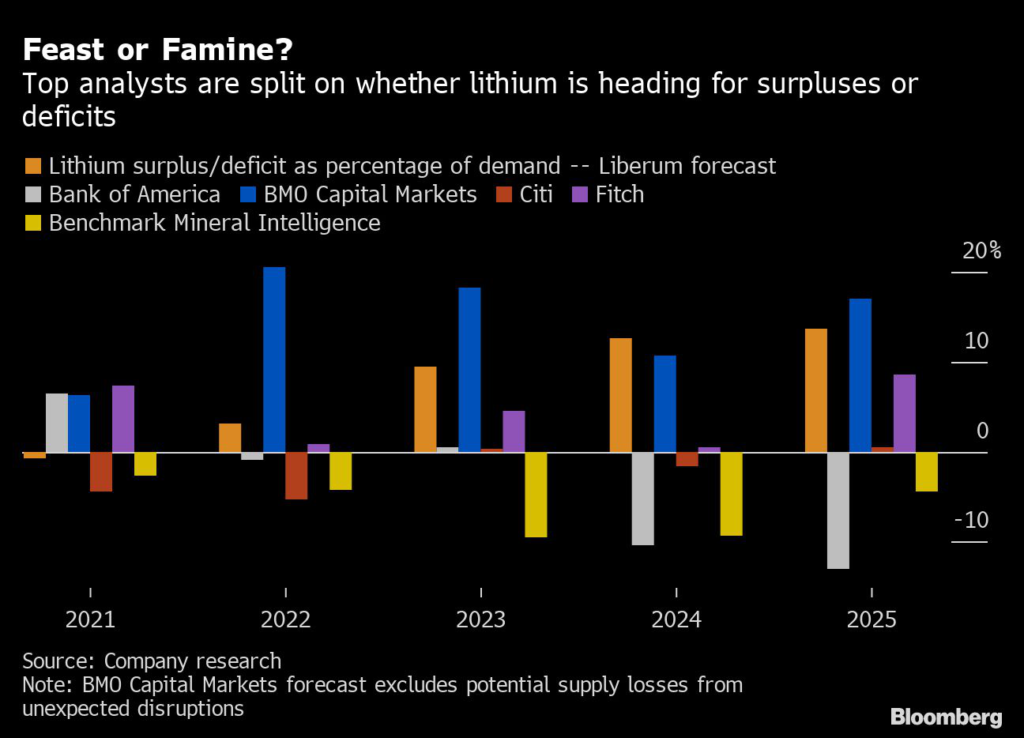
In a survey of six leading lithium forecasters, estimates for how the market will look in 2025 range from a deficit equal to 13% of demand to a 17% surplus. Projections for the market’s size diverge sharply too, with demand forecasts ranging from as little as 502,000 tons to as much as 1.3 million tons.

The gulf between forecasts reflects lithium’s status as a small market on the cusp of seismic expansion, with the average of the six estimates suggesting annual growth of more than 20% for both supply and demand between 2021 and 2025. That compares with typical growth rates of 2%-4% in larger and mature markets like copper, where surpluses and deficits usually equal a fraction of demand.

In a further sign of how quickly the surge in EV sales is reshaping the lithium landscape, Citigroup Inc. on Wednesday almost doubled its price forecast for 2022, warning that an “extreme” rally will be needed to rein in booming demand. 

Forecasts matter because banks use them for everything from gauging future car sales to valuing loans in mining projects. Vague market projections leave more room for sharp price swings when supply panic kicks in.

That could be particularly unnerving for the the car sector, which has placed lithium at the center of its electrification plans.

It has spent years experimenting with different chemical compounds to minimize use of other battery metals like cobalt — which is sometimes mined in unethical conditions — while boosting usage of abundant elements like iron. With lithium at the core of virtually every battery technology in commercial use and development, higher prices could quickly start to bite.

For example, if lithium spot prices remain at levels currently seen in China, that could add up to $1,000 to the cost of a new EV, according to Benchmark Mineral Intelligence.

Benchmark is among those forecasting supply to fall short of demand, even as it predicts output to roughly double from 2021 levels by 2025. Top lithium miners including Chile’s SQM reported annual demand growth of close to 50% last year.

“There’s a complete overoptimism about the responsiveness of supply in the lithium market,” said Andrew Miller, chief operating officer at Benchmark Mineral Intelligence. “It’s very hard to see how it’s going to accelerate at the speed that the battery market and electric vehicles are accelerating.”

So far, the auto industry has been relatively relaxed about lithium supplies, mainly because they occur in high concentrations in mining-friendly countries including Chile, Australia and Canada.

If anything, worries that large spikes in supply could quickly swamp the market is partly why some of the biggest miners have shunned developing lithium assets. Rio Tinto Group is the only mega-cap miner who’s so far been tempted to move into the metal — a market that’s still tiny compared with commodities like iron ore and copper.

History shows that even current heavyweight lithium miners like Ganfeng Lithium Co., Albemarle Corp., SQM and Livent Corp. should be cautious. A spike in prices a few years ago quickly unraveled as producers flooded the market. Some analysts warn it could happen again.

“We have some pretty open-ended supply opportunities opening up,” said Tom Price, an analyst at Liberum who started covering commodities in the early 1990s. “There are really no constraints on resource upgrades and additions for new supply.”

On the other hand, there are also good reasons why supply could lag.

The mining industry has a reputation for failing to deliver on targets, and McKinsey & Co. estimates that more than 80% of projects come in late and over budget. Many assets being studied are owned by junior miners who don’t have as much experience or existing revenue streams to fall back on as the majors.

Environmental Hurdles

Even the biggest miners face obstacles to bringing on new supply because of environmental concerns, despite lithium being a key material for a greener world. Serbia last month put a stop to Rio Tinto’s plans for a $2.4 billion mine after a nationwide backlash over the potential environmental risks.

In Chile, home to the world’s largest lithium reserves, the mining industry is also running into stiff political headwinds.

But as compelling as the supply risks are, it’s the potential for huge demand growth that’s really behind the difference in opinions on whether lithium will be over or undersupplied.

While Bank of America Corp. is among the most optimistic on supply, it’s forecasting deep deficits once consumption is factored in.

“There’s an awful lot of tons that producers need to bring into the market,” said Michael Widmer, head of metals research at the bank in London. “We have a disconnect where on the demand side we’re pushing very hard, but on the supply side, miners are only just starting to commit.”

(Updates with new Citigroup forecast in charts and seventh paragraph)

More stories like this are available on bloomberg.com

©2022 Bloomberg L.P.

Close Bitnami banner
Bitnami