Bloomberg

Regulators Should Block Costly Fintech Loans, Advocates Say

(Bloomberg) — U.S. regulators should crack down on banks that partner with fintechs to charge interest rates that would be illegal in the lenders’ home states, a coalition of advocacy groups said.

The Federal Deposit Insurance Corp. and other U.S. agencies need to stop banks they oversee from “engaging in high-cost predatory lending” through their work with financial-technology firms, the National Community Reinvestment Coalition, Consumer Reports, the NAACP, the Center for Responsible Lending and other groups said in a letter Friday.

“Rent-a-bank schemes have flourished at FDIC banks in the past few years and it is time for that to come to an end,” the coalition said in the letter to the heads of the FDIC, the Consumer Financial Protection Bureau and the Office of the Comptroller of the Currency. “The FDIC has the tools that it needs to prevent its banks from fronting for predatory lenders that are evading state law and making grossly high-cost installment loans and lines of credit” with annual percentage rates as high as 225%.

The letter follows Congress’s move last year to overturn the OCC’s Trump-era “true lender” rule that made it easier for banks to partner with fintechs without running afoul of state interest-rate limits. In signing the bill, President Joe Biden said the change would “protect borrowers against predatory lenders” who have found workarounds for interest-rate caps and trapped borrowers in “a cycle of debt.”

The FDIC, meanwhile, hasn’t proposed similar changes and “appears to have done nothing to curtail the predatory lending that has exploded on its watch,” the coalition of advocacy groups said in its letter.

“The FDIC has permitted its banks to use their charters to enable these practices,” Adam Rust, senior policy adviser at the National Community Reinvestment Coalition, said in a statement. “Now that the board of the FDIC is under new leadership, it is the time to close this loophole.”

FDIC Chairman Jelena McWilliams, appointed by former President Donald Trump, is leaving the regulator. Board member Martin Gruenberg, a Democrat, will be acting chair.

Pets, Furniture

Forty-two U.S. states and the District of Columbia “have at least one predatory lender using a rent-a-bank partnership,” the coalition said in its statement. Such loans are offered through check-cashing stores, online and even at pet stores, auto-repair shops and furniture retailers, the group said.

The coalition said it’s identified six companies working with high-cost, non-bank lenders offering loans that would be illegal for the banks to make directly: Republic Bank & Trust, chartered in Kentucky; Lead Bank, chartered in Missouri; and FinWise Bank, Capital Community Bank, First Electronic Bank and Transportation Alliance Bank, all chartered in Utah.

Capital Community Bank is “entirely focused on fair lending practices and providing financial products to customers at various stages of the financial journey,” Chief Executive Officer Mike Watson said in a statement. “We want to provide viable financial solutions to customers who often need a lifeline from a bank and an opportunity to reestablish and rebuild their credit, and our relationship with our servicers provides products to these customers that are fair, viable and regulated.”

First Electronic Bank said it too complies with regulations.

“For all loans we issue, we ensure compliance with the law, provide transparent rates and pay close attention to the activities of our service providers and any complaints we receive regarding our business activities or the loan products we offer,” First Electronic Bank said in an emailed statement. “Leveraging service providers helps us expand our reach to a broader community with more innovative products than we could otherwise provide.”

Representatives for the other banks didn’t immediately respond to phone calls and emails seeking comment.

(Updates with Capital Community Bank’s comment in fourth-to-last paragraph.)

More stories like this are available on bloomberg.com

©2022 Bloomberg L.P.

Steve Cohen-Backed Crypto Startup Radkl Loses a Managing Director

(Bloomberg) — Radkl, the cryptocurrency trading startup founded in 2021 by New York Stock Exchange market maker GTS and backed by hedge fund billionaire Steve Cohen, has lost three senior employees.

Jim Greco said in an interview that he left to found a crypto-trading business with a couple other Radkl managing directors: Allan Erskine and Jason Bell. The company is called F9 Research Manager LLC, and Greco is chief executive officer.

“Jim wanted to move onto other ventures,” according to a statement from a Radkl spokesman. “We’ve got a great team at Radkl and are excited about the business moving forward.”

The spokesman said Radkl has 15 employees. Radkl’s website lists five, including podcaster Aaron Lammer, who Bloomberg News published a story about in November because of his unusual path to becoming a Wall Street crypto expert.

In the November article, Greco said Radkl would have 25 employees and exchange trading volume of several billion dollars a day by the end of March. Earlier in his career, Greco worked at high-frequency trading firm Getco and then co-founded a Treasuries market called Direct Match.

(Updates to reflect that all three employees who left Radkl were managing directors.)

More stories like this are available on bloomberg.com

©2022 Bloomberg L.P.

Nike Files Trademark Suit Against StockX Over NFTs

(Bloomberg) — Nike Inc. accused the sneaker resale marketplace StockX LLC of minting non-fungible tokens that use its trademarks without approval and selling them at inflated prices.

The world’s largest maker of athletic shoes alleged StockX is “blatantly freeriding, almost exclusively, on the back of Nike’s famous trademarks and associated goodwill,” according to a trademark infringement suit filed Thursday in federal court in Manhattan. 

“Without Nike’s authorization or approval, StockX is ‘minting’ NFTs that prominently use Nike’s trademarks, marketing those NFTs using Nike’s goodwill, and selling those NFTs at heavily inflated prices to unsuspecting consumers who believe or are likely to believe that those ‘investible digital assets’ (as StockX calls them) are, in fact, authorized by Nike when they are not,” the sneaker maker said.

The lawsuit is the latest example of litigation over NFTs, which have gained in popularity and become more mainstream, including at Nike. The company agreed in December to buy RTFKT, a business that creates digital products like sneakers and uses blockchain technology. Nike has been filing requests to protect trademarks in “downloadable virtual goods” and related services. 

“Given Nike’s longstanding use in this space, StockX’s unauthorized and unapproved branding of Vault NFTs with Nike trademarks is all the more likely to confuse consumers, create a false association between the parties, jeopardize the capacity of Nike’s famous marks to identify its own digital goods in the metaverse and beyond, and harm Nike’s reputation through an association with inferior digital products,” Nike said in the suit.

StockX said in a statement Friday it doesn’t comment on pending litigation. The company has been working with banks on plans to go public in the first half of 2022 amidst a pandemic boom in collectibles, Bloomberg News previously reported. In April, the company said it was valued at $3.8 billion after a secondary tender offering. 

Last month, StockX said it was starting a service, Vault NFTs, that allows users to trade sneakers without ever taking possession of them. The service uses non-fungible tokens that are tied to physical products stored in a warehouse and can be delivered at any time, allowing traders to buy and sell sneakers instantly. 

But those NFTS “are far more than just physical Nike shoes,” according to the lawsuit. They also involve new products that have been combined with other StockX services and benefits including exclusive access to company releases, promotions and events, Nike said. 

“Nike does not sell StockX’s services or exclusive access to such benefits,” the sneaker maker said. 

The case is Nike Inc. v StockX LLC, 22-cv-983, U.S. District Court, Southern District of New York.

(Updates with statement from StockX.)

More stories like this are available on bloomberg.com

©2022 Bloomberg L.P.

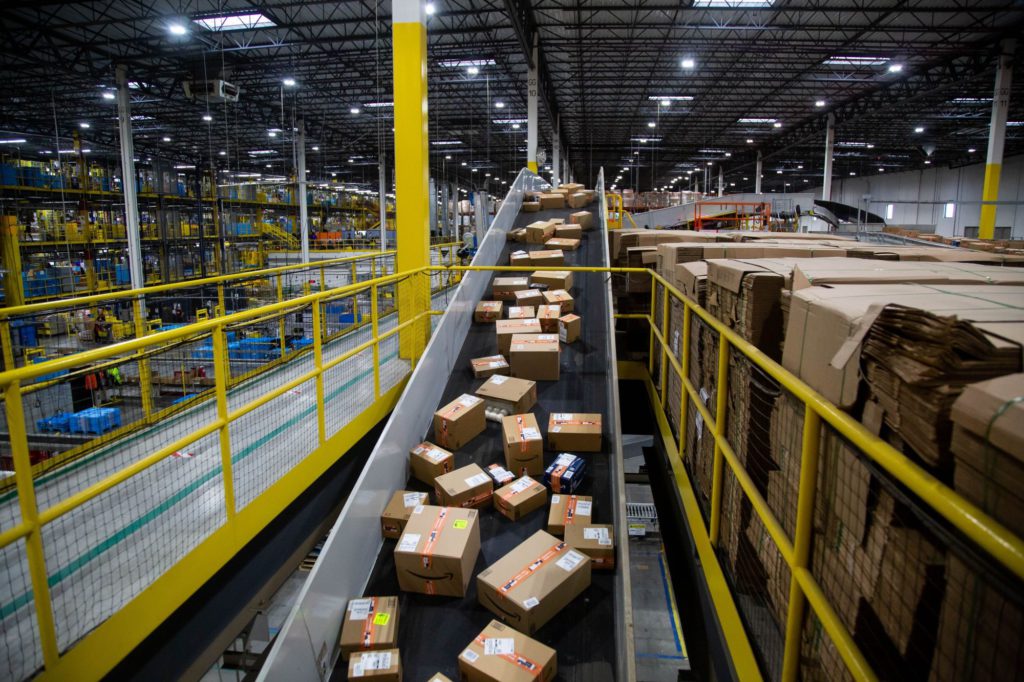
Amazon Shares Jump as Cloud Unit Helps Drive Profit Past Estimates

(Bloomberg) — Amazon.com Inc. shares surged Friday to the biggest increase in almost seven years, generating the largest single-day gain in market value in U.S. history.

Wall Street’s enthusiasm over Amazon was spurred by the tech giant’s earnings report Thursday afternoon, which showed strong performance in its cloud division, a huge boost in profit largely driven from an investment in Rivian Automotive Inc., and a price hike in its flagship Prime membership offering. The shares rose 14% to $3,152.79 at Friday’s close in New York, the best single-day advance since April 2015. The jump added about $191 billion in market value, giving the online retail giant a market capitalization of just more than $1.6 trillion.

The reaction from investors highlights the importance of Amazon’s diversification from its e-commerce roots. While online store sales actually declined from last year’s pandemic-fueled gains, Amazon’s profitable cloud-computing and advertising businesses combined to more than make up for it.

Read More: Amazon eyes record U.S. market value surge in wild swing

“Amazon has evolved into a true platform, as more than 50% of its revenue now comes from areas outside of first-party retailing, such as cloud computing and advertising,” Deren Baker, chief executive officer of market research firm Edge by Ascential, said Thursday after the earnings report.

The company’s results landed amid a gripping week for Big Tech earnings. Apple Inc., Microsoft Corp. and Alphabet Inc. all reported strong results. But Meta Platforms Inc. suffered the worst single-day share plunge in its history Thursday, a day after reporting slowing user growth in its signature Facebook app. 

Amazon in October had warned investors it would spend billions in the holiday period to ensure packages got to customers amid supply-chain bottlenecks and an acute labor shortage. A lot of that spending went into hiring 140,000 workers — just short of its goal of bringing on 150,000 recruits during the quarter. Amazon also lavished bonuses on workers, dispatched half-empty vehicles if it meant getting packages to customers on time and secured space on any ship it could find — a spending spree that totaled $22.4 billion.

The massive outlays helped reinforce the value of Prime membership with customers, giving the company confidence to raise the price by $20 to $139 a year — the first such increase since 2018. Prime, which offers subscribers shipping discounts, video streaming and other perks, helps Amazon convert occasional shoppers into loyal customers. Prime subscribers typically spend more on Amazon than non-members.

“As expected over the holidays, we saw higher costs driven by labor supply shortages and inflationary pressures, and these issues persisted into the first quarter due to omicron,” CEO Andy Jassy said in the statement. “Despite these short-term challenges, we continue to feel optimistic and excited about the business as we emerge from the pandemic.”

Fourth-quarter sales increased 9.4% to $137.4 billion, the Seattle-based company said Thursday in a statement. Profit was $27.75 a share, aided largely by a pretax gain from the company’s investment in Rivian, which went public in November. Analysts, on average, projected revenue of $137.8 billion and earnings of $3.77 a share, according to data compiled by Bloomberg.

Amazon’s most profitable unit, the Amazon Web Services cloud-computing division, generated sales of $17.8 billion, a 40% year-over-year increase, and operating profit of $5.29 billion, topping estimates. Advertising revenue was $9.7 billion, a 32% increase from a year earlier. It was the first time the company disclosed advertising as a separate line item. Previously it was part of the “other” revenue category.

Online store sales declined about 1% to $66.1 billion. Revenue from services Amazon offers third-party merchants increased 11% to $30.3 billion. 

“Every single drop of profit is being generated by the mushrooming Amazon Web Services cloud business,” said Sophie Lund-Yates, an equity analyst at Hargreaves Lansdown. “It’s hard not to admire the business model. However, no one should lose sight of the fact Amazon is supposed to be a retail giant, and it’s not the greatest look for the support act to be seen keeping profits afloat.”

In the period ending in March, Amazon projected revenue will be $112 billion to $117 billion. Operating profit will be as much as $6 billion. Analysts, on average, estimated sales of $120.5 billion and earnings of $6.06 billion.

(Updates with closing shares in the first two paragraphs.)

More stories like this are available on bloomberg.com

©2022 Bloomberg L.P.

Big Tech’s Week Featured Alphabet and Amazon Rallies, Meta Crash

(Bloomberg) — This week was one for the record books for big tech, in ways both good and historically bad.

Results from a trio of Wall Street’s most widely followed names spurred huge weekly moves, with hundreds of billions of dollars getting created or evaporated. For Alphabet Inc. and Amazon.com Inc., strong reports underlined their growth prospects, spurring rallies that led to their biggest one-week percentage gains in months. For Meta Platforms, the Facebook parent that had the single-worst day in Wall Street history by one metric, it was a different story.

Alphabet rose 7.5% for the week, its best such performance since October. Earlier this week, it reported results that beat expectations, help by a robust performance in its advertising business. The week’s advance added $122.5 billion to its market valuation, bringing it close to the $2 trillion threshold. It rose 0.1% on Friday.

Amazon rose 9.5% for the week, its biggest one-week gain since July 2020. The bulk of the week’s advance came on Friday, when shares surged nearly 14% on the back of a report that also sailed past expectations. Friday’s move was the biggest percentage gain for the stock since April 2015, and the nearly $191 billion it added in market value was a record one-day value gain for the U.S. market.

On the other end of the scale, Meta fell 21% over the week, its biggest one-week drop on record. The collapse came after it gave a weak revenue forecast amid stagnating user growth and increasing competition from TikTok. Shares suffered their biggest drop ever on Thursday, resulting in the biggest one-day wipeout of market value for any U.S. company in history. The stock fell 0.3% on Friday.


Overall, the tech-heavy Nasdaq 100 Index rose 1.7% for the week, its second straight weekly gain. Last week it was supported by strong reports from other mega-cap stocks, including Apple Inc. and Microsoft. 

More stories like this are available on bloomberg.com

©2022 Bloomberg L.P.

Facebook Parent Meta Rethinks Election Ads Ban Ahead of 2022 Midterms

(Bloomberg) — Facebook owner Meta Platforms Inc. is rethinking its policy of banning new political advertisements in the final days before an election, part of its preparation for the 2022 midterms, according to a person familiar with the matter.

Meta employees in recent days have been re-evaluating how that policy was executed during the 2020 U.S. election and whether there were potential unintended consequences, said the person, who wasn’t authorized to speak on the record. No final decisions have been made about whether the policy will change, the person said. 

A Meta spokesperson didn’t immediately respond to a request for comment. 

In 2020, Facebook announced it would block new political and issue ads from running on its social network during the final week of the presidential race, as a way to prevent last-minute manipulation of the election. Political candidates could still promote existing ads that had already been uploaded to Facebook and adjust the targeting for those campaigns. 

The company later extended the ban in the weeks following the election as then-U.S. President Donald Trump, who had been suspended from the network, publicly fought the outcome of the vote. Facebook allowed some political ads around a Senate runoff in Georgia in early January, but blocked all political ads again on Jan. 6.

One thing that Meta employees might look at are the factors that that determine what qualifies as a new ad. Campaigns that wanted to change their ad from “don’t forget to vote next week” to “don’t forget to vote tomorrow” were considered to be putting out a new ad under the old policy, the person said. 

Trump had ads removed that said “vote today” that he had uploaded a week earlier, presumably to sidestep the pre-election ban. 

The discussions, which are ongoing, are part of a larger effort by Meta to prepare for the high-stakes 2022 midterm elections. 

Democrats’ slim majorities in both chambers — and the headwinds typically faced by a president’s party in the first midterms — mean Republicans have a good chance of winning control of the House and potentially the Senate. This will also be the first major election since Trump refused to accept his 2020 loss and pushed other Republicans to question the integrity of that vote.

Social media companies are going to have to make tough calls about what content to take action against and what to leave alone in an election when all 435 seats in the House are up for grabs, as well as 34 of the 100 Senate seats. 

More stories like this are available on bloomberg.com

©2022 Bloomberg L.P.

Snap’s 59% Post-Earnings Gain Still Leaves Stock in Red for Year

(Bloomberg) — Snap Inc. surged 59% Friday, but even that won’t be enough to recoup the social media stock’s year-to-date losses.

The shares soared as high as $40.65 after the Snapchat parent gave a quarterly sales update that left analysts positively surprised, but that was still well below the $47.03 where they ended 2021.

The stock is rebounding from a 24% plunge on Thursday that was triggered by concern that a growth slowdown at Facebook and Instagram parent Meta Platforms Inc. would prove to be industry-wide. Large-cap technology stocks have also been hit more broadly in recent weeks on concern around a tightening of U.S. monetary policy.

“Simply put, Snap results were better than feared,” KeyBanc analyst Justin Patterson wrote in a note to clients. The firm is seeing “solid” revenue growth, while improvements in advertising efficacy and monetization of features like Spotlight and Maps offer potential upside drivers, Patterson said.

The stock closed at $38.91 on Friday. The results were announced after markets closed on Thursday.

Snap’s longer-term losses are even more severe. The stock is down about 48% since Oct. 21, when the firm issued financial guidance that missed Wall Street targets, warning that changes to Apple Inc.’s data collection rules and supply chain disruption were weighing on advertising spending.

(Updates share price moves throughout.)

More stories like this are available on bloomberg.com

©2022 Bloomberg L.P.

Spain May Relax Mask Rules; Moderna Vaccine Copied: Virus Update

(Bloomberg) — President Joe Biden said America is “back to work” and putting the Covid-19 pandemic behind it, after the labor market showed unexpected strength last month even as cases of the virus surged. New cases and hospitalizations are now declining across the U.S., with weekly infections in Illinois dropping by about half. 

Moderna Inc.’s vaccine received unanimous backing from a group of key U.S. health advisers after its full approval earlier this week from the Food and Drug Administration.

Singapore’s infections surged after the Lunar New Year holiday with the number of new local cases tripling on Friday. Hong Kong will propose tightened social distancing rules on Tuesday, Chief Executive Carrie Lam said at a briefing, without giving details. 

Key Developments:

  • Virus Tracker: Cases top 389.9 million; deaths pass 5.7 million
  • Vaccine Tracker: More than 10.2 billion shots administered
  • CDC expands hunt for early warnings of Covid in sewage waste
  • Covid rebellion brews in Canada, sending warning across globe
  • Covid-zero keeps Beijing Winter Olympics opening a muted affair
  • Is Covid becoming endemic? What would that mean?: QuickTake

Pennsylvania Doctor Fired Over Ivermectin (4:02 p.m. NY)

A Pennsylvania doctor was fired after being accused of prescribing ivermectin and hydroxychloroquine to treat Covid-19. 

Tower Health, a regional health-care provider in southeastern Pennsylvania, said in a statement that the employment of Edith Behr was “terminated immediately.” The statement said doctors may in some circumstances prescribe medications for “off-label” purposes but the use of the two drugs, not approved by the U.S. Food and Drug Administration against Covid-19, did not meet requirements. 

Moderna Shot Backed by CDC Panel (2:11 p.m. NY)

Moderna Inc.’s Covid-19 shot received unanimous backing from a group of key U.S. health advisers after its approval, a move that could help encourage the hesitant to get vaccinated as the omicron variant continues to spread across the country.

All 13 members of the U.S. Centers for Disease Control and Prevention’s Advisory Committee on Immunization Practices voted to recommend the two-dose regimen for adults on Friday.

Moderna’s shot, to be sold under the brand name Spikevax, won full approval this week from the Food and Drug Administration, becoming the second Covid vaccine to gain such a clearance. The similar messenger RNA shot from partners Pfizer Inc. and BioNTech SE was fully approved by regulators last year. Previously, the shots were available under emergency-use authorizations. 

Illinois Weekly Cases Halve (1:35 p.m. NY)

Illinois’s weekly Covid-19 cases have dropped by about half, according to a report from the state’s department of public health, as the surge driven by the omicron variant subsides around the U.S.

Confirmed and probable weekly cases fell to 60,389, from 123,812 a week earlier, the department said on its website Friday. The state reported 608 deaths during the week, compared with 843 a week ago as positive cases as a percent of total tests declined to 5.8% from 9.4%.

Governor J.B. Pritzker on Friday said the weakening of the outbreak could lead to an easing of some virus restrictions. He noted that one reason for the reduction in cases was rules like a state-wide mask mandate in indoor public spaces. But he said: “I believe that we should remove masks as soon as we possibly can. I am constantly listening to the doctors and scientists and encouraging them when can we do this.”

Biden Says U.S. ‘Back to Work’ (12:24 p.m. NY)

President Joe Biden said America is “back to work” and putting the Covid-19 pandemic behind it, after the labor market showed unexpected strength last month even as cases of the virus surged.

“America’s job machine is going stronger than ever,” Biden said at the White House on Friday. He praised “the extraordinary resilience and grit of the American people, and American capitalism.”

Nonfarm payrolls jumped 467,000 in January, well over the median estimate in a Bloomberg survey of economists that called for 125,000, though forecasts ranged widely. 

After peaking in early January, Covid-19 infections and hospitalizations driven largely by the omicron variant are declining: New cases fell almost 38% in the week ending Feb. 2, and hospitalizations dropped 18% in that same period, according to data from the U.S. Centers for Disease Control and Prevention. 

Singapore Cases Triple (11:03 a.m. NY) 

Singapore’s infections surged after the Lunar New Year holiday with the number of new local cases tripling on Friday, according to Ministry of Health’s data.

The city-state reported 13,046 new local cases, including those detected through rapid testings, from 4,087 on Thursday. Singapore celebrated the Lunar New Year on Feb. 1 and Feb. 2.

Luxembourg to Ease Restrictions (8:54 a.m. NY)

The situation in Luxembourg is favorable enough to ease Covid-related restrictions soon, Prime Minister Xavier Bettel said at a press conference on Friday, without specifying an exact time line.

An 11 p.m. curfew in restaurants and bars will be lifted, quarantine rules will be eased and the 2G+ system that’s been in place in most public spaces, such as restaurants, cinemas and fitness centers, will be replaced by a 3G system. While urging people who haven’t done so yet to get vaccinated, Bettel said an easing of the restrictions is necessary also to help with people’s psychological wellbeing.

Biden Administration Says Covid Funds Low (6:21 a.m. NY)

The Biden administration may have to ask Congress to approve additional aid to fund coronavirus testing, therapeutics and vaccines, the Washington Post reports, citing people familiar with the matter and documents it has seen.

Greece Eases Access for EU Vaccinated (6:05 a.m. NY)

Holders of a valid European Union vaccination certificate can soon enter Greece without the need for a mandatory Covid test, Health Minister Athanasios Plevris told state-run ERT TV Friday. The change takes effect Feb. 7.

The move is another step to enhance tourist flows to the country, according to Tourism Minister Vassilis Kikilias. The Greek summer season will start earlier than ever before on March 1, he said.

Hong Kong May Get New Distancing Curbs (5:16 a.m. NY)

Hong Kong will propose tightened social distancing rules during next Tuesday’s executive council meeting, Chief Executive Carrie Lam says at a briefing on Friday. Lam didn’t give details on the measures.

Hong Kong reported 131 cases, with 130 locally transmitted. Fifty nine of the 130 new locally-transmitted coronavirus infections reported on Friday are of unknown origin, Department of Health official Chuang Shuk-kwan says at a daily briefing. About 195 preliminary positive cases are detected.

Poland Wave May Have Peaked (5:54 p.m. HK)

Poland recorded 47,534 new cases, 17% fewer than a week ago. The number of confirmed infections fall on a weekly base for a second day, prompting the country’s Health Minister to suggest that the peak of the current omicron wave may be over, with remote schooling imposed last week helping to halve quarantines. The government remains reluctant to impose any further restrictions, including vaccine passes.

Moderna Shot Copied by S. African Firm (5:51 p.m. HK)

South Africa’s Afrigen Biologics & Vaccines Ltd. said it has made a vaccine that matches the one by Moderna Inc. after that company rebuffed it in its request for a partnership. 

Afrigen, part of the World Health Organization’s mRNA technology transfer hub in Cape Town, obtained the publicly available sequence of the Moderna shot from Stanford University and has now made its own version, Petro Terblanche, the managing director of Afrigen, said. 

Spain Set to Relax Mask Rules (4:49 p.m. HK)

Spain’s government will suspend the obligation to wear face masks outdoors as soon as next week, Cadena Ser reported.

The order, which was reintroduced last December to stem the omicron variant, will take effect by next Wednesday, the radio station said, citing people in the government it didn’t identify. 

Subvariant Is a Fifth of South Africa Cases (3:52 p.m. HK)

The omicron subvariant BA.2, which appears to be more transmissible than the original strain, accounted for almost a fifth of South African cases in January compared with 4% in December, a medical official said.

Germany’s Record Cases (1:53 p.m. HK)

Europe’s biggest economy reported 248,838 new cases as of Friday morning, compared with 236,120 the day before, according to the country’s public health authority RKI. 

It’s the third straight day of record infections. The 7-day incidence rate, which has been steadily climbing since the start of the year, also rose to a record 1,349.5 per 100,000 people.

China Reports 9 Olympic Cases (11:22 a.m. HK)

China reported nine infections among Olympic athletes and officials arriving at the airport and in a “closed-loop” system Thursday.

According to a statement from the Beijing Organizing Committee for the Olympics, there were 12 other infections involving “stakeholders,” which include include broadcasting staffers, members of international federations and the media. There have been 308 cases among people involved with the Games since the count began Jan. 23.

More stories like this are available on bloomberg.com

©2022 Bloomberg L.P.

Amazon’s $191 Billion Jump Sets Record for Market Value Gain

(Bloomberg) — Amazon.com Inc. gave the market back what Meta Platforms Inc. took away — or at least a big chunk of it. 

The e-commerce giant’s shares surged 14% on Friday, adding about $191 billion in market value, after investors cheered its fourth-quarter earnings report. The advance was the biggest single-day gain in U.S. stock market history, coming just a day after Facebook parent Meta Platforms entered the other end of the record book with a $251 billion wipeout. 

Amazon’s move surpassed the previous U.S. record set by Apple Inc. last week when the iPhone maker added about $179 billion in value on the day after its earnings report. The global record for a daily gain in market capitalization was set by PetroChina Co., which added $597 billion on one day in November 2007.

The surge in Amazon’s stock price came after sales in its cloud computing business beat Wall Street estimates and the company raised the price of Amazon Prime subscriptions, alleviating some concerns about the impact of cost increases on profitability. Those elements overshadowed forecasts for sales and operating profit in the current quarter that fell short of expectations.

Read more: Amazon Surges to Historic Market Value Gain After Earnings

Amazon on Thursday suffered its worst day since March 2020, as Meta’s earnings flop raised fears about results for other big technology companies. The 7.8% decline in the regular session on Thursday wiped out more than $110 billion in market value for the Seattle-based company. Even with Friday’s rally, Amazon’s stock price is only back to where it was trading on Jan. 18 and down 16% from a July 2021 record.

(Updates share prices throughout.)

More stories like this are available on bloomberg.com

©2022 Bloomberg L.P.

Amazon Powers Tech Shares; Bonds Fall on Jobs Beat: Markets Wrap

(Bloomberg) — Treasuries fell after a strong U.S. jobs report increased bets of tighter monetary policy while U.S. stocks powered higher on bullish sentiment from Amazon.com Inc. earnings.

The yield on the U.S. 10-year note rose to 1.92% as traders gave roughly even odds to the chance the Federal Reserve will start to raise interest rates with a 50 basis point hike in March instead of a typical quarter point move. 

The S&P 500 gained 0.5%, erasing an earlier loss, while the Nasdaq 100 added 1.3% with Amazon up 14% on a price increase for Prime memberships. The dollar was stronger against major peers while still posting its worst weekly performance since 2020.

U.S. employers added more jobs than forecast last month, despite a surge in Covid-19 infections and related business closures. Nonfarm payrolls gained more than all economists expected and average hourly earnings also rose 0.7% month over month.

“The jobs report blew away expectations across the board,” said Cliff Hodge, chief investment officer for Cornerstone Wealth. “The report is unequivocally good for the economy, but not for markets as the strength in the numbers presents another data point which supports more aggressively hawkish Fed action.”

It’s been a volatile week in markets as investors were jolted by weak numbers at U.S. tech giants including Facebook-owner Meta Platforms Inc., which wiped more than $250 billion from its market value on Thursday. However, positive earnings from Amazon helped lift sentiment, with the online marketplace and tech company adding roughly $190 billion to its market capitalization.

“It seems like each day we wake up to, ‘Thank you sir, may I have another?’ as a few tech blowups drag down the overall market,” said Mike Bailey, director of research at FBB Capital Partners. “There is an interesting behavioral metric where one bad thing requires four to five good things to make up for it.”

Here’s what else Wall Street said Friday:

“Hopefully now that the week is coming to a close, we’re seeing that the economy is still strong based on this jobs report, that people can take a breath and really reassess what is the economic environment that we’re going into in the year ahead.” — Lindsey Bell, chief markets and money strategist at Ally

“The January employment report was strong overall, informs us that businesses are willing to look through the Omicron shock (which is actually news), and reinforces the case for the Fed tightening.” — Gerard MacDonell, analyst at 22V Research

“It was always going to be a surprise as far as the payrolls report was concerned, given the range of outcomes. And we got a positive surprise … The Fed is further and further behind and they’re going to have to catch up.” — Anastasia Amoroso, chief investment strategist at iCapital

“The data reinforces the case for hikes and QT and I think the 10-year should rise more, especially real rates. With the 10-year getting close to 2%, I worry about mortgage-backed securities convexity hedging and more bond fund outflows.” — Priya Misra, global head of rates strategy at TD Securities

“A better-than-expected jobs report only fuels the Fed’s fire to raise rates, and act quickly. While they’ve already signaled that the labor market is in a good place, there was potential for omicron to derail that progress — and that just doesn’t seem to be the case. So with the market typically unwelcoming of news that could accelerate the pace of action from the Fed, we could see some volatility.” — Mike Loewengart, managing director of investment strategy at E*Trade from Morgan Stanley

Dip buyers have hoped a stronger earnings season would keep equities attractive and counter some concerns about rate hikes in the face of higher inflation. Of the 272 companies in the S&P 500 that have reported results, 82% have met or beaten estimates, with profits coming in 8.8% above projected levels.

Still, signs of stubborn price pressures abound with the latest data showing U.S. gasoline prices at the highest in more than seven years. Crude oil gained 2.2% in New York, extending a seven-year high, while banks including Goldman Sachs Group Inc. now forecast Brent will reach $100 a barrel.

Hawkish comments from European Central Bank President Christine Lagarde and a Bank of England interest-rate hike underlined risks from inflation. While a selloff in the region’s bonds eased Friday, the mood in the stock market was sour with Europe’s Stoxx 600 falling 1.4%.

For more market analysis, read our MLIV blog.

Some of the main moves in markets:

Stocks

  • The S&P 500 rose 0.5% as of 4 p.m. New York time
  • The Nasdaq 100 rose 1.3%
  • The Dow Jones Industrial Average was little changed
  • The MSCI World index rose 0.4%

Currencies

  • The Bloomberg Dollar Spot Index rose 0.2%
  • The euro rose 0.1% to $1.1454
  • The British pound fell 0.5% to $1.3530
  • The Japanese yen fell 0.2% to 115.20 per dollar

Bonds

  • The yield on 10-year Treasuries advanced nine basis points to 1.92%
  • Germany’s 10-year yield advanced six basis points to 0.21%
  • Britain’s 10-year yield advanced four basis points to 1.41%

Commodities

  • West Texas Intermediate crude rose 2.2% to $92.23 a barrel
  • Gold futures rose 0.2% to $1,808.30 an ounce

More stories like this are available on bloomberg.com

©2022 Bloomberg L.P.
Close Bitnami banner
Bitnami

