Bloomberg

The 20 Animal Species That Could Rewild the World

(Bloomberg) — Reintroducing just 20 large mammal species to their historic habitats could boost biodiversity across a broad swathe of the planet while helping to stabilize the climate, according to a new study.

“Solving the biodiversity crisis and the climate crisis is not only necessary, they’re mutually reinforcing,” said Carly Vynne, a conservation biologist and lead author of the paper published Jan. 27 in the journal Ecography.

That’s because biodiverse ecosystems are both more resilient to climate change and store more carbon dioxide from the atmosphere, research has shown. Yet climate change is exacerbating what some scientists call “the sixth great extinction.” The United Nations in 2019 warned that “nature is declining globally at rates unprecedented in human history” with a million species at risk of vanishing.

Predators and other large animals are landscape architects, influencing the growth of carbon dioxide-absorbing vegetation. Scientists have documented, for instance, how the return of gray wolves to Yellowstone National Park in 1995 reshaped the ecosystem by keeping plant-munching elk populations in check. That has allowed willows and other trees to flourish, resulting in growing numbers of beaver and bison.

“Large herds of mammals are themselves also carbon storage basins,” said Vynne.

Scientists have calculated that restoring densities of predators worldwide could result in landscape changes that could sequester 23 gigatons of atmospheric carbon. 

From 298 Species to 20

Vynne and a team of researchers identified 298 large mammal species and their ranges, analyzing satellite data to determine the presence of suitable habitat in 730 terrestrial ecoregions. An ecoregion is a conservation planning tool that identifies similar plant and animal communities in a particular area. 

The scientists then focused on ecoregions that were missing just one to three large mammal species that historically had occupied more than 80% of the area, reasoning it would be feasible to reintroduce those animals within five to 10 years. 

They whittled down the list of large mammals to the 20 that would have the most impact, triggering the complete restoration of large animal clusters over 54% of the world’s landmass. 

Seven of the species are predators, such as jaguars, wolverines and cougars, and 13 are herbivores such as pampas deer, hippopotamuses and gazelles. The animals are found on five continents and reintroducing them would expand the range of nine threatened species, according to the study. 

Bringing back the Eurasian beaver, European bison, reindeer and wolf to Europe, for instance, could dramatically expand the range of complete collections of large animals. 

Predator Problems

Reintroducing predators, though, can be politically fraught. The return of the gray wolf in the United States has led to decades of conflict over the predators’ killing of livestock. 

Wildlife ecologist Euan Ritchie, a professor at Deakin University in Melbourne, Australia, who was not involved in the research, said the paper’s prioritization of animals to reintroduce was valuable. “I think it’s a really important be aware of where there are gains to be potentially had in bringing species back.” 

However, restoring animals long gone from an ecosystem is challenging. “There’s a number of complexities when you’re talking about large carnivores in particular,” said Ritchie. “They need suitable prey so you might need to restore prey as well as predator populations at the same time.” 

Predators also roam over large territories and may cross local and national borders, requiring cooperation among governments and landowners. 

“It’s definitely not a case of just grabbing some large carnivores or herbivores and plugging them back into the ecosystem,” said Ritchie. “There’s a lot of thought that will need to go into this.” 

More stories like this are available on bloomberg.com

©2022 Bloomberg L.P.

Snap’s 44% Post-Earnings Gain Still Leaves Stock in Red for Year

(Bloomberg) — Snap Inc. surged 44% Friday, but even that won’t be enough to recoup the social media stock’s year-to-date losses.

The shares soared as high as $37 after the Snapchat parent gave a quarterly sales update that left analysts positively surprised, but that was still well below the $47.03 where they ended 2021.

The stock is rebounding from a 24% plunge on Thursday that was triggered by concern that a growth slowdown at Facebook and Instagram parent Meta Platforms Inc. would prove to be industry-wide. Large-cap technology stocks have also been hit more broadly in recent weeks on concern around a tightening of U.S. monetary policy.

“Simply put, Snap results were better than feared,” KeyBanc analyst Justin Patterson wrote in a note to clients. The firm is seeing “solid” revenue growth, while improvements in advertising efficacy and monetization of features like Spotlight and Maps offer potential upside drivers, Patterson said.

The stock traded at $35.10 as of 9:42 a.m. New York time. The results were announced after markets closed on Thursday.

Snap’s longer-term losses are even more severe. The stock is down about 52% since Oct. 21, when the firm issued financial guidance that missed Wall Street targets, warning that changes to Apple Inc.’s data collection rules and supply chain disruption were weighing on advertising spending.

(Updates share price moves throughout.)

More stories like this are available on bloomberg.com

©2022 Bloomberg L.P.

Ford Sinks as Shortages and Commodity Costs Weigh on Profit

(Bloomberg) — Ford Motor Co. shares tumbled the most in almost two years after the automaker missed estimates for quarterly earnings and cautioned it may get off to a slow start to the year due to supply chain issues.

The carmaker posted earnings of 26 cents a share excluding some items for the last three months of 2021, trailing the 45-cent average analyst estimate. Shortages of critical components including semiconductors disrupted production and will weigh on vehicle deliveries to dealers this quarter.

“We have incredible demand for our products,” John Lawler, Ford’s chief financial officer, told reporters on a call. “It’s the supply chains that limited what we could produce and what we could provide. And we see that easing into ’22, and you’ll see that flowing through our profits.”

Ford shares fell 12% at 9:42 a.m. in New York, the biggest intraday decline since March 2020. The stock was down 4.2% this year through Thursday’s close.

Sales rose 5% to $37.7 billion in the fourth quarter, with automotive revenue accounting for $35.3 billion of that total. Some analysts had anticipated double-digit sales growth, Lawler said. The company is estimating higher commodity costs will be a $1.5 billion to $2 billion headwind this year.

Investors have cheered Chief Executive Officer Jim Farley’s effort to accelerate Ford’s switch to electric vehicles, sending the shares up 136% last year. Ford’s market capitalization briefly topped $100 billion.

In recent weeks, the company’s valuation has fallen back to around $80 billion. 

“Financial performance is obviously critical,” Farley said in a statement.  “We’re also proud that customers see how Ford is taking EVs mainstream.”

Bloomberg News reported on Feb. 1 that Ford is considering adding up to $20 billion to its EV spending over the next decade to convert factories to battery powered models. Farley has already tripled output of its electric Mustang Mach-E in Mexico and doubled production of the F-150 Lightning going on sale this spring.

For this year, Ford forecast earnings before interest and taxes will rise 15% to 25% to as much as $12.5 billion. That compares with analysts’ estimates of $12.2 billion. Lawler projected a high-single-digit to low-double-digit percentage decline in wholesales for the first quarter due to supplier shortages. 

Crosstown rival GM earlier this week reported fourth-quarter earnings that beat analysts’ estimates, but its forecast for the year was little changed from 2021.

Read more: GM sees high costs, budget cars capping profit

Dearborn, Michigan-based Ford has seen car buyers pay up for its models as the pandemic and a shortage of semiconductors slashed inventory on dealer lots. The average sale price for Ford models in the U.S. reached almost $51,000 in the fourth quarter, up from $46,211 a year earlier, according to automotive researcher Edmunds.com.

In its home market of North America, Ford increased adjusted profit before interest and taxes by 70% in the fourth quarter to $1.82 billion, mainly due to strong demand for vehicles like the Bronco SUV and Maverick pickup. But that undershot the $2.34 billion profit projected by analysts.

Ford’s loss in China, the world’s largest car market, more than doubled in the quarter to $150 million from $66 million in the year-earlier period.

(Updates with share decline in first and fourth paragraphs)

More stories like this are available on bloomberg.com

©2022 Bloomberg L.P.

Meta Aside, Large Tech Stocks Put on a Great Earnings Show

(Bloomberg) — The post-earnings meltdown in shares of Meta Platforms Inc. aside, Wall Street’s biggest technology companies from Apple Inc. to Microsoft Corp. have reminded investors why the stocks have been favorites for years.

The results reported in the past 10 days surpassed already-high expectations, sending their shares surging despite jitters over the prospect of tighter Federal Reserve monetary policy. Apple set a record for the biggest single-day increase in market value gain for a U.S. company last week.

What’s more, analysts lifted their earnings estimates on Apple, Microsoft and Google owner Alphabet Inc. after their results, and similar moves are likely to follow Friday for Amazon.com Inc. Search giant Alphabet posted the strongest revenue growth of the group at 33%, followed by Microsoft and Apple.

“We’re in a environment of supply chain problems, inflation concerns and coming out of a pandemic where people aren’t sitting at home anymore,” Jon Maier, chief investment officer at Global X Management, said in an interview. “Companies like Apple and Google, they’ve been able to navigate some of these issues and show growth and the market is rewarding them.”

Meanwhile, Facebook parent Meta’s fall from grace — recording the biggest-ever market value loss — showed that investors stand ready to punish these decade-long favorites if they don’t deliver. The move sent Meta’s valuation cratering to 16 times projected profit, its biggest-ever discount to the Nasdaq 100 Index.

To be sure, investors have to be willing to put up with volatility: Amazon is up 10% in early trading Friday, but that comes a day after it fell 7.8%, and Snap Inc. is soaring 40% at the open after sinking 24% Thursday.

Here’s a look at how the market has greeted megacap tech earnings:

  • Microsoft: Analysts see the company earnings $9.48 a share this year, up 1.5% since the company reported earnings Jan. 25. The stock is up 4% since the results versus a 2.3% gain for the Nasdaq 100. Analysts’ price targets have barely budged, and Wall Street sees the stock gaining 24% over the next year.
  • Apple: Brokers have boosted their earnings estimate to $6.06 a share this year, up 5.8% since the earnings Jan. 27. The stock is up 7.6% since then, while analysts’ price targets rose 5%. Wall Street sees the stock gaining 11% over the next year.
  • Alphabet: Analysts see the company earnings $124.75 a share this year, up 1% since Tuesday’s earnings. The stock is up 2.5% since the results, while analysts’ price targets are up 2.7%. Wall Street sees the stock gaining 24% over the next year.
  • Meta: Street predictions for 2022 earnings per share have dropped 5.3% since Wednesday’s earnings bombshell, and the price target for the stock has fallen 12%. Looking on the bright side, after the plunge, analysts now see 41% upside for the stock in the next year, versus 18% previously.
  • Amazon: Analysts have already raised their 2022 earnings estimate by 1.3% in the wake of Thursday’s report. Analysts’ price targets have hardly changed, and Wall Street sees the stock gaining 36% over the next year.

Tech Chart of the Day

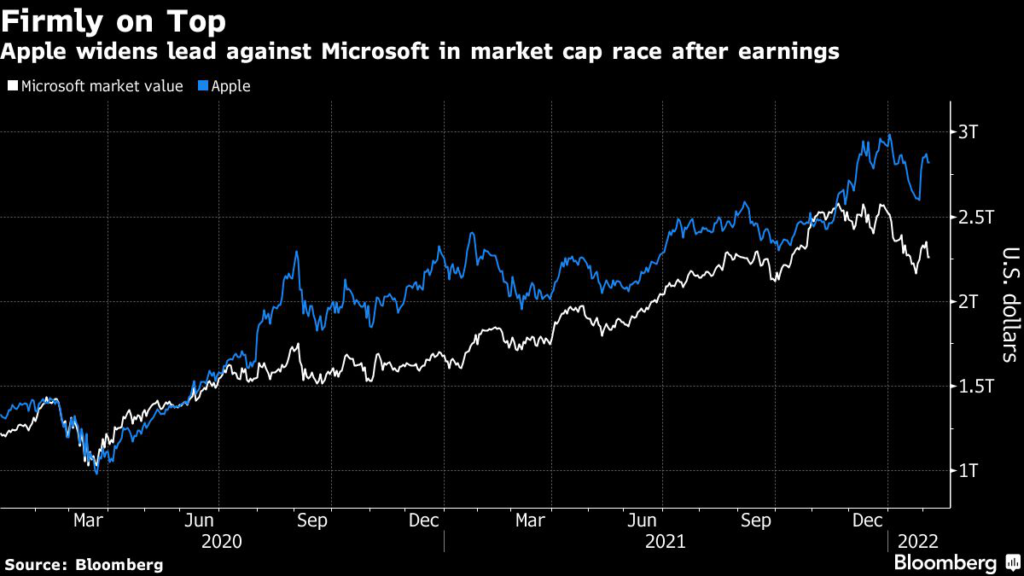
Apple’s blowout quarter followed by a record-setting market value gain late last month has now widened its lead against Microsoft in the race to be the world’s most valuable company. Microsoft had briefly dethroned Apple in the last quarter of 2021.

Top Tech Stories

  • Toshiba is considering changing its plan to split into three companies and may divide into two instead, TV Tokyo reported
  • Meta CEO Mark Zuckerberg told employees at a company-wide virtual meeting that it’s important to focus on expanding Facebook’s short-video product
  • Snap and Pinterest rallied after their quarterly results eased fears that a slowdown at rival Facebook reflected a broader slump for social media
  • Activision Blizzard reported earnings and revenue that missed analysts’ estimates just weeks after Microsoft announced its $69 billion acquisition of the video-game publisher
  • Chart patterns for the Nasdaq Golden Dragon China Index are starting to suggest the equity gauge may extend a recent revival
  • Saudi Arabia’s sovereign wealth fund deepened its bet on video games, fresh from the face-saving deal that turned around its investment in Activision Blizzard

(Updates prices throughout)

More stories like this are available on bloomberg.com

©2022 Bloomberg L.P.

Kyiv Says It Spots Russian Military Supplies: Ukraine Update

(Bloomberg) — Russian President Vladimir Putin, in Beijing for the opening of the Winter Olympics, met with Chinese President Xi Jinping to exchange views and pledge a bilateral friendship with “no forbidden zones.”  

Russia’s foreign minister brushed off U.S. claims that Moscow plans to release a graphic, fake video purporting to show a Ukrainian attack on Russia or Russian-speaking people, as a way to justify an invasion. 

Moscow has repeatedly denied that it plans to attack Ukraine, while the U.K. and U.S. say it has massed almost 130,000 troops close to the border. Russia has decried the use of NATO forces near Russia’s frontiers. 

Key Developments

  • Putin’s Financial Fortress Blunts Impact of Threatened Sanctions
  • Putin Courts China’s Xi for Help in Showdown With the West
  • Russia Signs Energy Deals With China as Relations With West Sour
  • Ukraine Briefing Spurs Greater Urgency on Sanctions in Congress
  • What we know so far about potential U.S.-EU sanctions on Russia
  • Where military forces are assembling around Russia and Ukraine

All times CET

Baltic Leaders Show Common Front on Energy Security (2:46 p.m.) 

NATO’s Baltic members have gas reserves and a liquid natural gas terminal, making them resilient to any potential shutoff of supplies by Russia, Latvian Prime Minister Krisjanis Karins said at a press conference with his Estonian and Lithuanian counterparts. 

The three prime ministers discussed energy security at their meeting in Riga, the Latvian capital. Estonian Prime Minister Kaja Kallas said she wasn’t convinced Russia would hold off using gas supplies as a weapon.

Russia Funneling Fuel, Hardware, Drones to Donbas, Kyiv Says (1:55 p.m.) 

Ukrainian intelligence services indicated that Russia continues to supply Kremlin-backed militants and Russian military personnel in the separatist-controlled areas in the eastern Donbas region, the Defense Ministry in Kyiv said in a statement.

Russian authorities dispatched 9,000 tons of fuel, several tanks, armored vehicles, self-propelled artillery units, Russian-made drones and other weapons by rail and road to Donetsk and Luhansk on Ukraine’s eastern border, the ministry said.

U.K. Backs U.S. Claim of Fake Video (1 p.m.)

U.K. Prime Minister Boris Johnson’s office said U.S. claims that Russia plans to make a graphic video of a Ukrainian attack to justify an invasion were “credible and extremely concerning.” 

“We’ve conducted our own analysis on this intelligence and share the US’s conclusion,” Johnson spokesman Max Blain told reporters at a regular briefing. The U.K. is “considering options for further military deployments to support NATO’s eastern flank”, Blain added. 

“We have high confidence Russia is planning to engineer a pretext blaming Ukraine for the attack in order to justify a Russian incursion into Ukraine,” Blain said. Russian Foreign Minister Sergei Lavrov earlier called the U.S. allegations “delusional.” 

Finland Bemoans EU Inaction (12:55 p.m.) 

Finland’s President Sauli Niinisto said the European Union must recognize that when its members are pulled into the Russia-Ukraine fray, it is also affected. 

Speaking to reporters in Helsinki, Niinisto referred to Russia’s demand that NATO agree not to expand eastward, which would effectively close the door to the military alliance for Finland and Sweden — although neither Nordic country has applied to join NATO. The EU’s lack of response on the subject stands in contrast to the solidarity that typically emerges quickly during financial crises, Niinisto said. 

NATO Chief to Depart After Central Bank Appointment (11:51 a.m.) 

Jens Stoltenberg, secretary general of the NATO military alliance, has been appointed governor of Norway’s central bank and will take up the post later this year.  

NATO chief since 2014, Stoltenberg has pledged to serve out his term, which ends Oct. 1. The U.S. and Germany were among countries that had asked Stoltenberg, who’s leading the alliance’s talks with Russia over its military buildup near Ukraine, to stay on, Norwegian newspapers had reported.

Kremlin Says No Basis for Putin-Zelenskiy Meeting (11:40 a.m. CET)

There’s no basis yet for a meeting between Putin and Ukrainian President Volodymyr Zelenskiy on the tensions, Kremlin spokesman Dmitry Peskov said. 

“For this there needs to be an understanding of what will come out of it and what will be discussed, and there isn’t one yet,” Peskov said on a conference call. The same goes for another so-called Normandy summit that would include the leaders of France and Germany to discuss eastern Ukraine, he said. 

Turkish President Recep Tayyip Erdogan reiterated his offer to mediate between the two sides but Peskov said any visit by Putin to Turkey would be focused on bilateral issues. 

Putin, Xi See ‘No Forbidden Zones’ (11:17 a.m.) 

Putin and Xi see no limits to the Russia-China friendship and “no forbidden zones” in cooperation between their countries, the two leaders said in a joint statement after talks in Beijing — their first face-to-face meeting since 2019.  

China “treats with understanding and supports” Russia’s demands for binding security guarantees from the U.S. and NATO, and the two states oppose further expansion of the military alliance, according to the statement.

The pair also said in the statement that Russia opposes Taiwan’s independence in any form. The two leaders described the “new type” of relations between Moscow and Beijing as superior to the Cold War-era blocs.

YouTube Blocks Separatist Accounts (10:55 a.m.)

YouTube blocked several accounts associated with separatists in two eastern Ukraine regions, Tass reported, citing media representatives of the self-proclaimed republics. 

The Luhanskinformcenter in the unrecognized Russian-backed Luhansk People’s Republic and the Ministry of Information in the Donetsk People’s Republic were among the channels affected, Tass said. 

The moves could expose Alphabet’s Google, which owns YouTube, to new criticism in Russia, where it’s under increasing pressure from the government. The company is facing potentially huge fines for blocking a Russian TV channel’s account on the video service and in December was hit with a $95 million penalty for not removing content. 

Russia Blamed for German Energy Cyber Attack (11:00 a.m.)

A Russia-linked cybercrime gang was allegedly responsible for ransomware attacks that took down a swath of Germany’s fuel-distribution system this week. Hackers using “Black Cat” ransomware infected computers at Mabanaft GmbH and Oiltanking GmbH Group, say people familiar with an investigation of the breaches.

While there’s no confirmed link to the Russian state, the attacks come as the U.S., U.K. and others warn of the risk of cyberattacks as part of a campaign to put pressure on Europe for its support of Ukraine. 

Lavrov Calls U.S. Claim of Fake Video ‘Delusional’ (10:10 a.m.)

Foreign Minister Sergei Lavrov dismissed claims by the U.S. that Russia plans to produce a graphic propaganda video that purports to show a terrorist attack on Russian-speaking people.

“I read on the internet that the State Department made some statements that Russia is allegedly preparing a fake video with an apparent attack by Ukrainian soldiers on Donbas,” Lavrov said in a clip posted by Ren TV. “This kind of fantasy is delusional in my opinion, and they are more and more of them every day.”

U.S. officials warned previously that Moscow may be planning a false flag event that would create a justification for sending troops into Ukraine, and have said it used similar tactics when it occupied Crimea and fought a war with Georgia.

Carlsberg CEO Downplays Impact on Business (9:30 a.m.)

The Danish brewer Carlsberg A/S said its business won’t be hit too hard by a possible Russia-Ukraine conflict. Carlsberg gets less than 8% of its profit from the two countries, CEO Cees ‘t Hart said in a Bloomberg Television interview. A decade ago, eastern Europe accounted for almost half of the company’s earnings. 

Putin, Xi Meet; Russia will Supply Gas From Far East (9:13 a.m.) 

In their first in-person meeting since 2019, Putin told China’s Xi that Russia will supply 10 billion cubic meters of gas per year to China from the Far East under a new contract. 

During the summit, timed to show solidarity on the sidelines of the Winter Olympics, Putin said conditions between the two countries were of an “unprecedented nature and an example of a dignified relationship.” 

EU Warned of New Russian Cyber Threat (8:40 a.m.) 

European Union institutions were warned Thursday of a new Russian-backed cyber threat that’s been running credential harvesting activity since mid-2021, according to an alert seen by Bloomberg News. 

The alert says it’s possible the capabilities will be used for cyberespionage purposes. No institutions have been targeted yet. The alert didn’t mention Ukraine. 

The group, known as Reuse Team or Callisto, has been involved in state-sponsored espionage and criminal activity since the early 2000s, the alert said. The group has recently targeted an EU body and was involved in a campaign that targeted a European ministry of foreign affairs in 2020. It has gathered intelligence related to foreign policy in Eastern Europe and the South Caucasus, according to a 2017 report by F-Secure, a cyber security research firm. 

Gazprom Reliability in Doubt, Von Der Leyen Says (8:31 a.m.) 

Gazprom is abiding by its contracts with the EU but unlike other suppliers isn’t shipping more gas than planned to Europe, and that’s casting doubt on its reliability, European Commission President Ursula von der Leyen said in an interview with Les Echos and Handelsblatt.

Gazprom’s behavior is “weird,” and Russia is using gas deliveries as a way to put pressure on Europe, she said.

Von der Leyen also described the EU’s sanctions package in the event of a Russian invasion of Ukraine, which includes including shutting Moscow off from foreign capital, and controlling exports of critical goods to Russia needed in areas such as artificial intelligence, weapons, quantum computing, lasers and space technologies.

Macron to Visit Russia, Ukraine Next Week (8:21 a.m.) 

French President Emmanuel Macron will travel to Moscow on Monday and Ukraine on Tuesday, an Elysee official said, as he continues an active diplomatic role in the crisis. 

The trips will follow three calls in the past week between Macron and Vladimir Putin to discuss the Ukrainian situation.    

U.S. Lawmakers Briefed by Top Security Team (11:00 p.m.) 

U.S. lawmakers are rushing to draft a new round of potential sanctions on Russia intended as a deterrent to any aggression against Ukraine. The sense of urgency in Congress escalated following day-long briefings Thursday by top national security officials. 

Negotiations had been slowed as Democrats and the Biden administration resisted Republican efforts to impose more sanctions on Russia now. Both sides agree on the need for more punishing penalties should Russia invade Ukraine, which the Kremlin denies it plans to do. 

More stories like this are available on bloomberg.com

©2022 Bloomberg L.P.

Amazon Surges to Add $135 Billion in Wild Market Value Swing

(Bloomberg) — Amazon.com Inc. is giving the market back what Meta Platforms Inc. just took away — or at least a big chunk of it. 

The e-commerce giant rose 9.6%, adding more than $135 billion in market value, after climbing as much as 12% at Friday’s open. That would be among the biggest single-day gains in U.S. stock market history, and would come just a day after Facebook parent Meta Platforms entered the other end of the record book with a $251 billion wipeout. 

Amazon’s move came close to Apple Inc.’s U.S. record from last week — the iPhone maker added about $179 billion in value on the day after its earnings report. The global record for a daily gain in market capitalization was set by PetroChina Co., which added $597 billion on one day in November 2007.

The surge in Amazon’s stock price came after sales in its cloud computing business beat Wall Street estimates and the company raised the price of Amazon Prime subscriptions, alleviating some concerns about the impact of cost increases on profitability. Those elements overshadowed forecasts for sales and operating profit in the current quarter that fell short of expectations.

Amazon on Thursday suffered its worst day since March 2020, as Meta’s earnings flop raised fears about results for other big technology companies. The 7.8% decline in the regular session on Thursday wiped out more than $110 billion in market value for the Seattle-based company. Even with Friday’s rally, Amazon’s stock price is only back to where it was trading on Feb. 2.

(Updates share prices throughout.)

More stories like this are available on bloomberg.com

©2022 Bloomberg L.P.
SPACs Head for Metaverse After Results From the Real World Flop

(Bloomberg) — After a year of mostly horrific returns tied to the real world, sponsors of three new blank-check companies are turning to the metaverse in search of takeover targets.

The ventures include one led by a former Sony PlayStation executive, and another from the video-game pioneer behind the Tomb Raider franchise; both managers have serious chops with highly successful track records. 

But to some observers, the new wave is an example of blank-check companies once again chasing the latest futuristic fad, after the industry’s bets on green vehicles and crypto went sour. This week’s volatility for tech and metaverse stocks likely made matters harder for sponsors of so-called special-purpose acquisition companies, which collectively are down more than 40% from last February’s peak.

That’s the nature of the beast, said Matthew Tuttle, chief executive officer of Tuttle Capital Management, which runs an index that tracks SPAC returns. “You have to do something to get and keep investor interest,” he said. “How do you do that? You find the new toy.” 

In this case, it’s the metaverse, a virtual reality world that people explore using headset systems, currently dominated by Oculus from Meta Platforms Inc. and PlayStation VR from Sony Group Inc. Meta CEO Mark Zuckerberg calls it “the next frontier” and Bloomberg Intelligence reckons the metaverse could be an $800 billion market by 2024. 

Warcraft Veteran 

Into this nascent arena comes Jack Tretton’s PowerUp Acquisition Corp., a SPAC looking to raise $225 million. Another led by Ian Livingstone called Hiro Metaverse Acquisitions I has already raised about $156 million.

SPACs are known as blank checks because they raise money from investors in an initial public offering with the goal of buying a private business that isn’t identified yet. They cite the expertise of their management team as a reason people should invest.

Tretton, for instance, is the former CEO of Sony Computer Entertainment America with a 35-year career in the gaming industry, according to the prospectus. His team includes Matthew Ball, the metaverse theorist, and Bruce Hack, the former CEO of Vivendi Games and vice chairman of Activision Blizzard Inc., who is listed as overseeing the launch of World of Warcraft, one of the industry’s iconic games. Their targets could include video-game companies and “new metaverse video gaming businesses.”

Efforts to reach New York-based PowerUp for comment weren’t successful; a phone number listed in its prospectus wasn’t in operation. A call to the law firm listed on its prospectus, McDermott Will & Emery LLP, wasn’t returned.

Livingstone founded Eidos Plc, the U.K. company that created Tomb Raider, and was non-executive chairman of Sumo Group before it was sold for more than $1 billion to Tencent Holdings Ltd. Hiro plans to focus on the metaverse, e-sports, interactive streaming and “Gen Z social networks,” according to filings, with games and the metaverse expected to be “a large proportion of the new economy of the 2030s.” 

Untapped Market 

European entrepreneurs and creators produce about a third of all the video-game content played worldwide, but only about 3% of the industry’s global public market capitalization, Livingstone said in a Jan. 31 statement. Hiro declined to comment, pointing to a filing where Livingstone touts a “deep experience of the rapidly evolving gaming industry” and the SPAC’s position “to identify and fund a target company that is further along its growth curve and still has high value creation potential.”

Evergreen Corp. is a SPAC aiming to raise $100 million with plans to buy a company involved in the metaverse, artificial intelligence, fintech or various other tech sectors, according to its prospectus. It’s led by CEO Liew Choon Lian, whose track record shows stints working with various large tech companies, and building a firm valued in the filing at $195 million. Officials at Malaysia-based Evergreen didn’t return a call seeking comment. 

Mission statements for SPACs leave a fair amount of wiggle room in what they might actually buy. “It’s likely they came up with the idea a few months ago and obviously the market changes very quickly,” said Julian Klymochko, who manages a SPAC-focused fund at Accelerate Financial Technologies. “They don’t have to stick with the mandate and oftentimes they do not.”


Waves of volatility have hit the SPAC industry as the mania faded in the past year. The IPOX SPAC Index plunged 43% since its record high last February and the De-SPAC Index, which tracks 25 former blank-check firms that bought something, has lost two-thirds of its value as of Thursday’s close.

To some, the pain is a signal of an over-saturated market that had focused on unproven technologies at high valuations. Skepticism remains high with interest rates rising and profitability still far off for many startups in the immediate future, said Ed Moya, a senior market analyst at Oanda Corp.

Still, SPACs tend to trade on “price-to-yearnings” rather than price-to-earnings, which could provide a lift for the new breed.

“Following last year’s bursting of the SPAC bubble, many traders are cautiously looking for companies that might capitalize on the explosive growth that will happen with Web 3.0 and the metaverse,” Moya said.

More stories like this are available on bloomberg.com

©2022 Bloomberg L.P.

Futures, Bonds Drop as Jobs Beat Fuels Fed Bets: Markets Wrap

(Bloomberg) — U.S. equity futures fell after a better-than-expected U.S. jobs report increased bets of tighter monetary policy, erasing previous gains on bullish sentiment from Amazon.com Inc. earnings.

Contracts on the S&P 500 declined 0.1% while the Nasdaq 100 was little changed after gaining as much as 2.3%. Amazon trimmed its premarket gains, driven by a price hike for Prime memberships. Meanwhile, Europe’s Stoxx 600 fell as rate-hike bets reduced risk appetite. Treasuries yields spiked and the dollar rose.

U.S. employers added more jobs than forecast last month, despite a surge in Covid-19 infections and related business closures. U.S. payrolls came in higher than all economists expected at 467,000 — a three-month high — while average hourly earnings also rose a higher-than-expected 0.7% month over month. 

The report is likely to increasing conviction in the Federal Reserve’s path forward.

“A strong jobs report, along with elevated inflationary economic data that we’ve seen recently, could boost expectations that we’ll see a 50-basis point rate increase at the March meeting,” said Brian Price, head of investment management for Commonwealth Financial Network. “I still believe that 25 basis points is the base case at this point but 50 is not off the table either.”   

It’s been a volatile week in markets as investors were jolted by weak numbers at U.S. tech giants including Facebook-owner Meta Platforms Inc., which wiped more than $250 billion from its market value on Thursday. However, positive earnings from Amazon helped lift sentiment, with the online marketplace and tech company set to increase its market cap by more than $150 billion if its premarket gains hold in the regular session.

“Now we’re seeing a little bit of FOMO — all of a sudden, everyone’s seeing the numbers are good, ‘I’ve got to get my exposure back,’ and that’s what we’re seeing in the after-market moves right now,” Alon Rosin, Oppenheimer & Co.’s head of institutional equity derivatives, said by phone, late Thursday.

Dip buyers have hoped a stronger earnings season would keep equities attractive and counter some concerns about tighter monetary policy in the face of higher inflation. Of the 272 companies in the S&P 500 that have reported results, 82% have met or beaten estimate, with profits coming in 8.8% above projected levels.

Still, signs of stubborn price pressures continue to appear as the latest data showed U.S. gasoline prices surged to the highest in more than seven years. Crude oil extended a fresh seven-year high in early trading, with banks including Goldman Sachs Group Inc. forecasting Brent will reach $100 a barrel.

“We are getting late in the cycle. The market is becoming more selective,” wrote Wells Fargo’s Chris Harvey. “The tide will no longer lift all boats and the market will become less and less forgiving in our view. Going forward, we feel investors will need to cut loses quickly and to focus on margins rather than the top or bottom line.”

Hawkish comments from European Central Bank President Christine Lagarde and a Bank of England interest-rate hike underlined risks from inflation. While a selloff in the region’s bonds eased Friday, the mood in the stock market turned sour. Europe’s Stoxx 600 fell 1.3% as rate-hike bets reduced risk appetite. Makers of cars and parts were the worst-performing industry group, while gains for technology shares surrendered gains.

Elsewhere, an Asia-Pacific equity gauge pushed higher partly on a 3% jump in Hong Kong where markets reopened from a holiday. 

For more market analysis, read our MLIV blog.

Some of the main moves in markets:

Stocks

  • Futures on the S&P 500 fell 0.1% as of 9:23 a.m. New York time
  • Futures on the Nasdaq 100 were little changed
  • Futures on the Dow Jones Industrial Average fell 0.2%
  • The Stoxx Europe 600 fell 1.3%
  • The MSCI World index was little changed

Currencies

  • The Bloomberg Dollar Spot Index rose 0.2%
  • The euro was little changed at $1.1446
  • The British pound fell 0.5% to $1.3529
  • The Japanese yen fell 0.2% to 115.23 per dollar

Bonds

  • The yield on 10-year Treasuries advanced six basis points to 1.89%
  • Germany’s 10-year yield advanced five basis points to 0.20%
  • Britain’s 10-year yield advanced two basis points to 1.38%

Commodities

  • West Texas Intermediate crude rose 2% to $92.06 a barrel
  • Gold futures fell 0.1% to $1,801.60 an ounce

More stories like this are available on bloomberg.com

©2022 Bloomberg L.P.

Apple Cuts Fees for Dating Apps in Dutch Antitrust Response

(Bloomberg) —

Apple Inc. set out reduced fees for dating apps targeting Dutch users that can now avoid its payment system, in an effort to dodge extra antitrust fines.

To comply with a Dutch antitrust order, Apple will allow Match Group Inc. and other dating apps to use an alternative to its App Store payments, it said in an update on its website for developers. The apps must hand Apple 27% of what users pay, three percentage points less than a standard fee.

Apple usually requires developers to use its own payment system, which helps it enforce a commission for apps on its platform. That tight control over app payments has attracted lawsuits and antitrust scrutiny, often focusing on the Apple’s refusal to allow developers steer users to other payment methods. 

The company’s move may limit potential fines of as much as 50 million euros ($57.3 million) from the Dutch Authority for Consumers & Markets. The watchdog last month fined Apple 5 million euros for failing to open up payment options for developers, with extra penalties possible if it failed to comply with the antitrust order. Bowing to the regulator’s pressure, Apple on Jan. 15 announced its first ever move to allow outside payments within App Store apps.

Apple Will Allow Outside Payments in Dutch Dating Apps 

While the Dutch fine was a fraction of Apple’s $365.8 billion-annual revenue, the decision was a sign regulators are hardening their resolve against the U.S. firm’s payment methods. 

Apple will require developers to collect and pay any additional taxes on the payments and to report to Apple every month on sales of digital services and content on the App store. It will have audit rights to check the accuracy of a developer’s record.

“Failure to pay Apple’s commission could result in the offset of proceeds owed to you in other markets, removal of your app from the App Store or removal from the Apple Developer program,” it warned.

(Updates with additional extra Apple comment from sixth paragraph)

More stories like this are available on bloomberg.com

©2022 Bloomberg L.P.

Texas Cold Snap Deepens, But Electrical Grid Holds Steady

(Bloomberg) — A bitter cold blast is gripping Texas in the wake of a winter storm, but the state’s power grid is managing to keep up with demand as residents crank up heaters.

Shortly before sunrise in Dallas, it was 20 degrees Fahrenheit (-7 degrees Celsius). Midland, in the oil- and gas-rich Permian basin, was 10. Highs will only be in the 30s.

“That’s a solid 20 degrees below average,” said Marc Chenard, a meteorologist at the U.S. Weather Prediction Center.

Those temperatures aren’t as extreme as last year’s deep freeze that triggered sprawling blackouts and left more than 200 people dead. But they’re enough to make power demand surge across the state — albeit at lower levels than officials initially expected. Critics have warned for months that grid managers and utilities haven’t done enough to winterize the system, while Governor Greg Abbott and other politicians have tried to reassure Texans the state is ready. 

Demand for electricity peaked early Friday at about 66.7 gigawatts at about 8 a.m. local time, and the state had about 82.2 gigawatts of generating capacity available. That peak is significantly lower than the 75.6 gigawatts that officials had forecast on Thursday, which would have been an all-time record for the state.  

Typically, a gigawatt is enough to power about 200,000 Texas homes.

Outages have so struck only a few pockets of the sprawling state by early Friday, with about 17,000 homes and bussinesses without power at 6:30 a.m. local time, according to PowerOutage.us, which tracks utility outage data.

“These are localized outages that are not related to system-wide reliability issues,” Peter Lake, chairman of the Public Utility Commission of Texas, said at a media briefing Thursday. “The grid remains strong, reliable, and it is performing well in this winter-weather event.”

Natural gas has continued to flow through the pipelines that feed many of the state’s power plants, with limited disruptions. And wind turbines, whose poor performance during last year’s deep freeze has become the focus of Abbott’s scorn, supplied far more power than expected, keeping electric heaters humming.

Abbott said Thursday the system was prepared. “The Texas power grid is the most reliable and resilient it’s ever been,” he said at a press conference.

See: Texas Had All Year to Prep for Cold, and It’s Not Ready  


More stories like this are available on bloomberg.com

©2022 Bloomberg L.P.

Close Bitnami banner
Bitnami