Bloomberg

Winter Olympics Opening Gives China a Chance to Spin Its Image

(Bloomberg) — The most political moment of the 2022 Winter Olympics is upon us.

The opening ceremony, which start Feb. 4 at 8 p.m. in Beijing, will give President Xi Jinping his best chance to use the games to burnish his country’s image. Almost immediately afterward, the competitions will take over the spotlight, but for a few hours on Friday, China will have the attention of a worldwide audience to itself. 

“The Olympics can be useful for bolstering China’s image because they draw attention from viewers who don’t necessarily pay lots of attention to global politics and foreign policy, where coverage of China’s behavior has been much more critical,” said Sheena Greitens, an associate professor at the University of Texas at Austin whose research focuses on East Asia. 

Even with the advantage of viewers’ general excitement and enthusiasm, Beijing has an uphill battle. Reports of human rights abuses in the country’s Xinjiang region, the suppression of dissent in Hong Kong and saber-rattling over Taiwan have pushed opinions about China to historic lows in the West, fueling opposition to its rise as a global power. 

Western TV networks including NBC and the BBC, have come under pressure to address China’s human rights record during live broadcasts of the opening ceremony, and some athletes may not participate as a form of protest. One U.S. senator has urged Americans to not watch the ceremony, calling it a “propaganda exercise.” Against that backdrop, the pageantry is one way Beijing can make its appeal. 

Last summer, Xi told senior officials the country needed a more “trustworthy, lovable and respectable” image internationally. To put that on display during the opening ceremony, Beijing tapped Zhang Yimou, China’s best-known film director. Zhang, whose movies include “Hero” and “House of Flying Daggers,” also directed the 2008 opening pageant, a four-hour spectacle that involved a cast of 15,000. 

This year’s opening ceremony will also take place at Beijing National Stadium, also known as the Bird’s Nest, which held the event in 2008. By contrast, it will be “simple, safe and splendid,” organizers have said, just over an hour and a half with a mere 3,000 performers. About 90% will be students.

“China will seek to use the Games to present a positive view of Chinese culture as something apolitical,” said University of Texas’s Greitens.

Domestically, Beijing will make its appeal to an audience exhausted by strict Covid restrictions and worried about a worsening economy. The property market, where many Chinese have the majority of their personal wealth, is slumping, just as Xi readies for a Communist Party congress later this year, where he’s expected to secure a precedent-defying third term. 

The opening ceremony will showcase technologies like 5G and artificial intelligence, according to the official Xinhua News Agency. Cathy Wu, an assistant professor at Old Dominion University whose research focuses on Chinese foreign policy, sees that as an attempt to demonstrate that China continues to achieve breakthroughs and make progress. “It’s kind of like sending a message to China’s domestic audience that we are doing fine,” she said.

China’s general challenges will be underscored by the sparse crowd at the opening ceremony. Attendance is limited as a precaution against Covid, and a U.S.-led diplomatic boycott of the games has persuaded many world leaders to stay away. Xi will host 21 world leaders at the Winter Olympics, and a majority of them preside over non-democratic regimes.  

In the end, there may be few truly open minds in the audience, noted Jules Boykoff, a professor at Pacific University in Oregon and author of several books on the Olympics. “Olympic boosters will be ready to praise the ceremony almost regardless of what actually transpires,” he said. “Critics will be sniffing out opportunities to platform their critiques.”

In the long run, the data is mixed on how the Olympics can affect a country’s image. Activists also recognize the power of the Olympics to market their causes, and polls and surveys by Anholt-Ipsos Nation Brands Index, Gallup Inc. and the BBC suggest perceptions of China may have suffered after the 2008 games.

“The effect of the Olympic games on national image is complicated and unpredictable,” said Susan Brownell, a professor at the University of Missouri at St. Louis and author of “Training the Body for China: Sports in the Moral Order of the People’s Republic.” “Soft power does not inevitably follow the hosting of Olympic games.”

(Updates with comments from U.S. senator in fifth paragraph)

More stories like this are available on bloomberg.com

©2022 Bloomberg L.P.

Tiger Global Raises $11 Billion for Latest Private Fund

(Bloomberg) — Tiger Global Management has raised more than $11 billion for its latest venture capital fund, and is targeting another billion dollars before its March close. 

The Private Investment Partners 15 fund — known as PIP 15 — is on track to close with $12 billion, according to a person familiar with the matter, exceeding the initial fundraising target of $10 billion. 

PIP 15, which invests in internet technology startups in the U.S., China and India, is Tiger’s largest one yet, and follows several fundraises in recent years, each bigger than the one preceding it.  

The firm’s $65 billion venture capital unit, led by Scott Shleifer, had raised $8.8 billion as of November with about $1.5 billion of that coming from employees, Bloomberg previously reported. By then it had already called about a third of the cash and started putting it to work. 

Read more: Tiger Global Raises $8.8 Billion in First Close of Biggest Fund

A spokeswoman for Chase Coleman’s $100 billion firm declined to comment. 

The Information earlier reported on the fundraising. 

More stories like this are available on bloomberg.com

©2022 Bloomberg L.P.

Truck It In Raises Largest Early Funding in Pakistan, MENA

(Bloomberg) — Pakistan’s Truck It In has raised $13 million in early-stage funding, the largest for a logistics startup in the Middle East, North Africa and its home country.

The Karachi-based startup’s seed round is jointly led by venture capital firms Global Founders Capital and Fatima Gobi Ventures. The other investors in the round include Picus Capital, Millville, Wamda, Zayn Capital, i2i Ventures, ADB Ventures, Cianna Capital, Reflect Ventures and K3 Ventures.

Pakistan, one of the world’s largest untapped markets, is seeing a funding frenzy in startups with more than $350 million raised last year, greater than the amount raised in at least the past six years combined. The nation relies on trucks for the bulk of its transportation needs with train cargo being almost non-existent. Pakistan’s freight market represents a $25 billion annual opportunity, according to the startup.

The startup is focusing on Pakistan’s small- and medium-sized truck operators that represent 80% of the fragmented market. Drivers can end up waiting days or weeks to get an order.

“Pakistan’s trucking industry is fragmented with several intermediaries operating at various levels and presents an enormous opportunity for disruption,” said Kalsoom Lakhani, co-founder at i2i Ventures. The startup “is able to lower cost, bring in efficiencies, improve access for both shippers and truckers.”

The company, which allows truckers to connect with shippers, started two years ago. The three founders worked together at Dubai-based ride hailing company Careem Inc. It is now going on a hiring spree to double its workforce to more than 400 employees. 

“There is so much low-hanging fruit,” Muhammad Sarmad Farooq, chief executive officer at Truck It In said in an interview by phone. “The company is going to grow aggressively after getting the fundamentals and infrastructure in order.”

More stories like this are available on bloomberg.com

©2022 Bloomberg L.P.

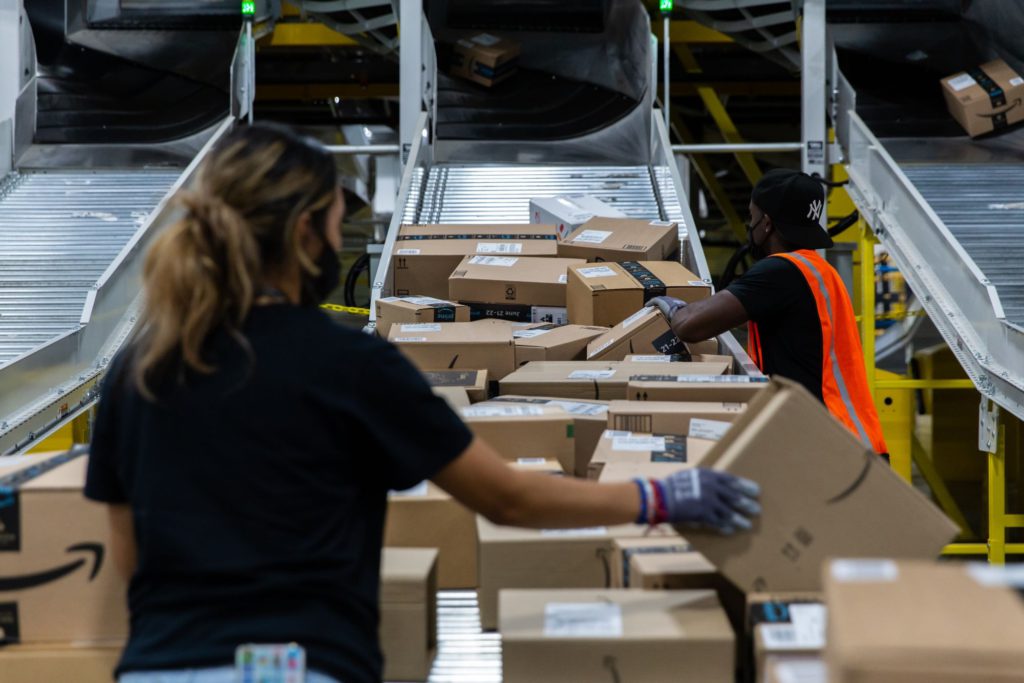
Amazon Poised for Biggest Ever Market Value Gain a Day After Facebook’s Record Loss

(Bloomberg) — Amazon.com Inc. is giving the market back what Meta Platforms Inc. just took away — or at least some of it. 

The e-commerce giant is poised to add nearly $200 billion in market value if the stock’s 14% gain in after-hours trading following the company’s fourth-quarter earnings report holds to Friday’s close. That what would be the biggest single-day gain in U.S. stock market history coming just a day after Facebook parent Meta Platforms Inc. entered the other end of the record book with a $251 billion wipeout. 

The surge in Amazon’s stock price came after sales in its cloud computing business beat Wall Street estimates and the company raised the price of Amazon Prime subscriptions, alleviating some concerns about the impact of cost increases on profitability. Those elements overshadowed forecasts for sales and operating profit in the current quarter that fell short of expectations.

Amazon’s gains come after the stock suffered its worst day since March 2020, as Meta’s earnings flop raised fears about Big Tech’s financial results. The 7.8% decline in Thursday’s regular session wiped out $119 billion in market value for the Seattle-based company.

Apple Inc. set the current record for added market value last week after it gained about $179 billion on the day after its earnings report. 

A $200 billion gain for Amazon would be bigger than the market values of more than 90% of the companies in the S&P 500 Index, according to data compiled by Bloomberg. 

(Adds context on the size of the would-be gain in the last paragraph. An earlier version clarified that the advance would be a U.S. stock market record.)

More stories like this are available on bloomberg.com

©2022 Bloomberg L.P.

Amazon Eyes Record U.S. Market Value Surge in Wild Swing

(Bloomberg) — Amazon.com Inc. is giving the market back what Meta Platforms Inc. just took away — or at least some of it. 

The e-commerce giant is poised to add nearly $200 billion in market value if the stock’s 14% gain in after-hours trading following the company’s fourth-quarter earnings report holds to Friday’s close. That what would be the biggest single-day gain in U.S. stock market history coming just a day after Facebook parent Meta Platforms Inc. entered the other end of the record book with a $251 billion wipeout. 

The surge in Amazon’s stock price came after sales in its cloud computing business beat Wall Street estimates and the company raised the price of Amazon Prime subscriptions, alleviating some concerns about the impact of cost increases on profitability. Those elements overshadowed forecasts for sales and operating profit in the current quarter that fell short of expectations.

Amazon’s gains come after the stock suffered its worst day since March 2020, as Meta’s earnings flop raised fears about Big Tech’s financial results. The 7.8% decline in Thursday’s regular session wiped out $119 billion in market value for the Seattle-based company.

Apple Inc. set the current record for added market value last week after it gained about $179 billion on the day after its earnings report. 

A $200 billion gain for Amazon would be bigger than the market values of more than 90% of the companies in the S&P 500 Index, according to data compiled by Bloomberg. 

(Adds context on the size of the would-be gain in the last paragraph. An earlier version clarified that the advance would be a U.S. stock market record.)

More stories like this are available on bloomberg.com

©2022 Bloomberg L.P.

U.S. Futures, Stocks Rise as Amazon Soothes Nerves: Markets Wrap

(Bloomberg) — U.S. equity futures and Asian stocks rose Friday as earnings from Amazon.com Inc. helped to stanch a technology rout. Worries about monetary tightening are also whipsawing markets, leaving bond yields higher.

Contracts on the S&P 500 and tech-heavy Nasdaq 100 climbed, the latter by 2%, after e-commerce titan Amazon and Snap Inc. soared in late trading on strong earnings. Japan and South Korea boosted an Asia-Pacific share gauge.

The Nasdaq 100 fell the most since 2020 on Thursday, hurt by a historic $251 billion wipeout for Facebook owner Meta Platforms Inc. But Amazon could add nearly $200 billion in market value if the stock’s 14% gain in after-hours trading holds to Friday’s Wall Street close.

Meanwhile, surprisingly hawkish comments from European Central Bank President Christine Lagarde and a Bank of England interest-rate hike highlighted persistent concerns about high inflation. 

That sapped sovereign debt: Japan’s five-year government bond yield advanced to zero for the first time since 2016, following a jump in European yields and renewed selling in U.S. Treasuries.

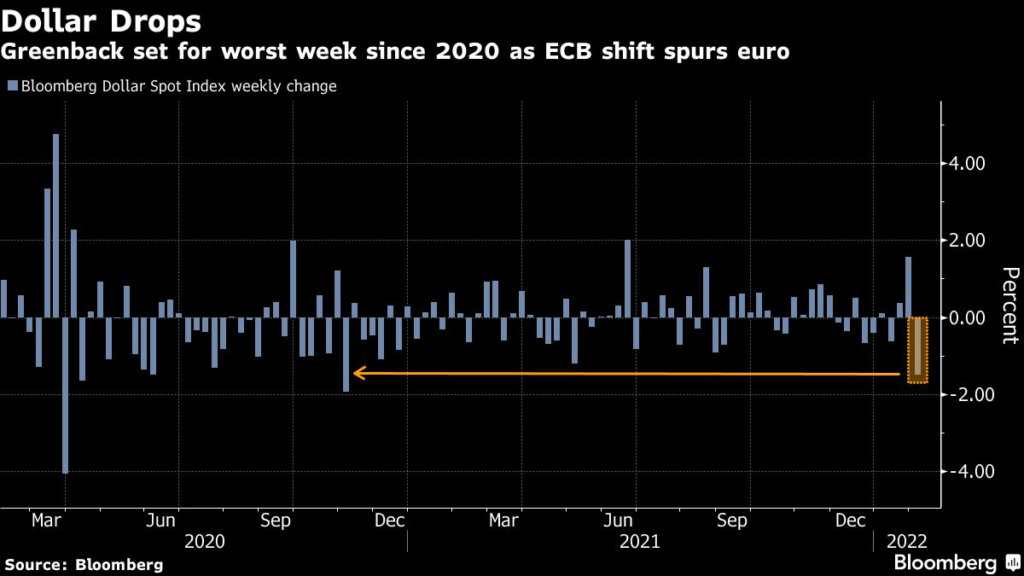
The euro held a rally and the dollar retreated. West Texas Intermediate oil stayed above $90 a barrel after scaling the mark for the first time since 2014.

The latest turbulence underscores how volatility has become the hallmark of global markets this year. Investors are trying to come to grips with less favorable monetary conditions just as the economic recovery from the pandemic show signs of moderating. 

“The first half this year we are now experiencing a rates shock,” Tracy Chen, portfolio manager at Brandywine Global Investment Management, said on Bloomberg Television. “If the Fed and BOE and other EM central banks are too aggressive in hiking interest rates, potentially we are going to face kind of a recession risk in the second half, or at least more slowdown in the economy.”

The latest data showed U.S. service-sector growth pulled back in January to the slowest pace in nearly a year. Meanwhile, U.S. initial jobless claims fell more than expected last week to 238,000 ahead of data on payrolls Friday. 

The looming jobs report “is a reminder that expectations for Fed policy are the key influence on this market right now,” wrote Tom Essaye, a former Merrill Lynch trader who founded The Sevens Report newsletter. A hot inflation print next week would “rekindle hawkish Fed concerns,” he added.

For more market analysis, read our MLIV blog.

What to watch this week:

  • U.S. payrolls report for January, Friday
  • Winter Olympics kick off in China, Russia’s President Vladimir Putin due to attend opening ceremony, Friday

Some of the main moves in markets:

Stocks

  • S&P 500 futures rose 1.2% as of 9:13 a.m. in Tokyo. The S&P 500 fell 2.4%
  • Nasdaq 100 futures rose 2%. The Nasdaq 100 fell 4.2%
  • Japan’s Topix index rose 0.3%
  • Australia’s S&P/ASX 200 index added 0.2%
  • South Korea’s Kospi index increased 1.2%

Currencies

  • The Bloomberg Dollar Spot Index fell 0.1%
  • The euro was at $1.1434
  • The Japanese yen was at 115.04 per dollar
  • The offshore yuan was at 6.3537 per dollar

Bonds

  • The yield on 10-year Treasuries advanced one basis point to 1.84%
  • Australia’s 10-year bond yield rose eight basis points to 1.95%

Commodities

  • West Texas Intermediate crude was at $90.24 a barrel
  • Gold was at $1,805.57 an ounce

More stories like this are available on bloomberg.com

©2022 Bloomberg L.P.

Omicron Slows in New Zealand; Korea May Keep Curbs: Virus Update

(Bloomberg) — New Zealand Prime Minister Jacinda Ardern said the country is managing to slow the spread of omicron, winning time to administer booster shots. South Korea will extend limits on social gatherings and dining out for two weeks after record new infections, Yonhap News reported. 

Covid-19 vaccinations among U.S. children aged 5-11 have fallen to the lowest levels since the shots were first approved, a sign that parental enthusiasm for the shots may be running low even as authorities consider expanding the shots to even younger kids.

American Express Co. is encouraging staffers in New York and the U.K. to start returning to the office early next month as coronavirus cases recede globally. In Brazil, daily infections climbed to their highest level since the pandemic began.

Key Developments:

  • Virus Tracker: Cases top 387.3 million; deaths pass 5.7 million
  • Vaccine Tracker: More than 10.1 billion shots administered
  • Covid’s endemic shift means slowdown for virus-product makers
  • New virus research will speed NIH’s next outbreak response
  • What we know about omicron and its subvariant BA.2: QuickTake
  • Sign up for the free Coronavirus Daily newsletter here

N.Z. Welcomes Slow Spread of Omicron (7:54 a.m. HK)

The slow spread is giving more people the opportunity to receive boosters, New Zealand Prime Minister Jacinda Ardern said. The strategy has to ensure the health system isn’t overwhelmed, she said. 

“Taken as a whole there is a range of factors that are making a difference to New Zealand’s experience of omicron versus other countries,” she said. “That’s a sign of success.”

S. Korea to Keep Distancing: Yonhap (7:40 a.m. HK)

South Korea will extend current social-distancing curbs, including limiting private gatherings to up to six people and 9 p.m. closing hours for restaurants and cafes, for another two weeks, Yonhap News reported.

The steps will be effective through Feb. 20, according to the report. South Korea has been reporting record number of daily new cases, topping 22,000 infections earlier this week.

Iowa, Maryland End Health Emergencies (5:57 p.m. NY)

Governor Kim Reynolds said she would allow Iowa’s public health emergency declaration, first issued near the start of the pandemic in March 2020, to expire on Feb. 15. 

“After two years, it’s no longer feasible or necessary,” the Republican governor said in a statement. “The flu and other infectious illnesses are part of our everyday lives, and coronavirus can be managed similarly.”

Health emergencies were declared at the start of the pandemic in all 50 states, and the expanded power of governors proved contentious in many of them. Roughly half of U.S. states have revoked them, and more are expected to do so as the surge caused by the omicron variant eases. Maryland, which includes part of the Washington metro area, allowed a 30-day state of emergency to expire on Thursday.  

Colorado Hopeful on Omicron Immunity (4:36 p.m. NY)

Public health modeling suggests 80% of Colorado residents could be “immune to infection” from the current omicron variant by mid-February, Rachel Herlihy, state epidemiologist, said during a Thursday briefing. At the same time, the number of omicron cases remains elevated “and we have a long way to come down,” said Scott Bookman, Covid-19 incident commander at the Colorado Department of Public Health and Environment. Johns Hopkins researchers estimate 70.1% of Coloradans are fully vaccinated.

Medicare to Cover Free Home Tests (2:46 p.m. NY)

Medicare beneficiaries will be able to get up to eight free over-the-counter Covid-19 tests per month beginning in early spring, the Biden administration announced Thursday.

The new initiative will allow Medicare to directly pay participating pharmacies and other entities for over-the-counter tests approved or authorized by the Food and Drug Administration.

Private Medicare Advantage plans may offer coverage of the tests as a supplemental benefit in addition to hospital Part A coverage and outpatient Part B benefits, the Centers for Medicare & Medicaid Services said. Beneficiaries covered by Medicare Advantage should check with their plan to see if it includes such a benefit.

Amex Tells NYC, U.K. Staff to Start Returning (2:15 p.m. NY)

American Express Co. is encouraging staffers in New York and the U.K. to start returning to the office early next month as Covid-19 cases recede globally.

AmEx has previously said most colleagues will work remotely at least part of the time even after the pandemic subsides. The firm asked New York staffers in those hybrid roles to begin coming back one day a week starting March 1 before a wider return on March 15, Chief Executive Officer Steve Squeri said in an internal memo Thursday seen by Bloomberg News.

“The purpose of this phased approach is to give colleagues some time to adjust to the transition of coming in after working virtually for the past two years, as well as to become familiar with some of the new technology and other changes that have been made to support our new way of working,” Squeri said in the memo.

Kids’ Vaccinations Plummet (1:53 p.m. NY)

Covid-19 vaccinations among children ages 5-11 have fallen to the lowest levels since the shots were first approved, a sign that parental enthusiasm for the shots may be running low even as authorities consider expanding the shots to even younger children.

The seven-day average of first doses fell to about 37,062 on Jan. 28, marking the slowest one-week period since the government approved the vaccines for those children on Nov. 2, according to U.S. Centers for Disease Control and Prevention data. Just 31% of kids 5-11 have gotten a shot, compared with 75% of the total population.

Trudeau Rules Out Army Against Truckers (1:08 p.m. NY)

Prime Minister Justin Trudeau downplayed the idea of deploying Canada’s military to help clear out a trucker protest that’s paralyzed the capital, raising the prospect of an extended occupation of Ottawa’s downtown core.

Trudeau, speaking in a virtual news conference from isolation after contracting Covid-19, said Thursday that the federal government would consider any request for military help from provincial or city officials — but he doesn’t see that happening in the near future.

“One has to be very, very cautious before deploying military in situations engaging Canadians,” Trudeau said. “There have been no requests, and that is not in the cards right now.”

Merck Trims Antiviral Sales View (9:01 a.m. NY)

Merck & Co. said early Thursday that it now expects lower sales for its Covid antiviral molnupiravir than it had previously projected. The company now projects $5 billion to $6 billion in sales of the drug for the year, compared with a previous estimate of $5 billion to $7 billion. 

EU’s Valneva Review to Take Longer (8:56 a.m. NY)

French drugmaker Valneva SE’s vaccine might not receive a decision from European Union regulators until after mid-April, extending the review process.

The European Medicines Agency is awaiting more data from Valneva covering the entire adult population, Marco Cavaleri, the regulator’s head of biological health threats and vaccines strategy, said at a briefing on Thursday. The pace of the review depends on when the data is available, though it’s unrealistic to expect it before Easter, he said.

Subvariant Has Spread Across Africa (8:50 a.m. NY)

The omicron subvariant known as BA.2 has been found across Africa, and countries should sequence more samples so the extent of its spread can be determined, the World Health Organization said. 

So far, the strain has been found in Senegal in West Africa, Kenya in East Africa and Malawi, Botswana and South Africa in southern Africa, Nicksy Gumede-Moeletsi, a virologist with the WHO, said Thursday on a conference call.

Subvariant Dominant in Denmark (8:22 a.m. NY)

The omicron subvariant BA.2 makes up 69% of confirmed cases in Denmark and will reach 100% by mid-February, according to a study from the Danish virus watchdog SSI. BA.2 is about 30% more contagious than the original omicron, known as BA.1, the study found.

While unvaccinated people have a bigger risk of contamination overall, those who have been vaccinated are more likely to catch the new strain than BA.1. Denmark lifted all its Covid restrictions on Tuesday despite record daily cases, as hospitalizations and the number of people with severe disease are gradually declining.

U.K. Regulator Clears Novavax Shot (7:41 a.m. NY)

Novavax Inc.’s vaccine won clearance from U.K. regulators for use in people aged 18 and over for a first and second dose. The Medicines and Healthcare Products Regulatory Agency said nuvaxovid, as the protein-based shot is known, will be the fifth Covid vaccine authorized for use in Britain. 

Health Secretary Sajid Javid said the next step will be for the Independent Joint Committee on Immunisation and Vaccination, the government’s advisory panel on inoculations, to consider its use as part of the country’s Covid vaccination program. 

Europe Could See Covid ‘Ceasefire:’ WHO (6:43 a.m. NY)

Europe is at a crossroads in the fight against the pandemic with a potential “ceasefire” in sight, according to the director for the region at the World Health Organization.

While cases and hospitalizations from the omicron-driven wave are still rising in Europe, deaths are beginning to plateau, Hans Kluge told reporters Thursday. As the omicron wave recedes, Europeans will have a relatively high level of immunity derived from vaccines and from previous infections. 

“This period of higher protection should be seen as a ceasefire that can bring us enduring peace,” Kluge said. He urged a “drastic” increase in vaccinations, particularly in lower- and middle-income countries.

EU Proposes to Extend Certificates (6:14 a.m. NY)

The European Union is proposing to extend its digital Covid certificate system for a year, until the end of June 2023, as it aims to facilitate travel even as many governments are easing or eliminating pandemic-related restrictions.

“Without this extension, we risk having many divergent national systems, and all the confusion and obstacles that this would cause,” Justice Commissioner Didier Reynders said in a statement.

Africa Needs $1.29 Billion for Vaccine Rollout (6 a.m. NY)

Africa is short at least $1.29 billion to fund the rollout of vaccines, the World Health Organization said, citing data from 40 of the continent’s 54 countries. Only 11% of Africa’s 1.2 billion people are fully inoculated and the weekly pace of vaccination needs to rise sixfold to hit a target of getting 70% immunized by the middle of this year, the WHO said Thursday.

German Group Backs Second Booster (6:06 p.m. HK)

Germany’s vaccine commission recommends a second messenger-RNA booster shot for the elderly and people with weakened immune systems or who work in medical and other care facilities.

The second booster should take place at least three months after the first for people who are at least five years old and at heightened risk of serious disease, the commission said. For those working in medical and other care facilities, the second booster should take place at least six months after the first, the commission said. 

More stories like this are available on bloomberg.com

©2022 Bloomberg L.P.

Hong Kong Markets Have Room to Rise After Return From Holidays

(Bloomberg) — Hong Kong’s stocks have room to play catchup in what could be a volatile session on Friday, with Wall Street and Chinese companies listed in the U.S. still trading higher than levels before the Lunar New Year holiday.

While the overnight rout in Meta Platforms Inc. is likely to temper any advance, the city’s equities should benefit from signs that the Federal Reserve won’t be rushed on rate-hikes, and from a more upbeat picture of corporate earnings this week.

The Nasdaq Golden Dragon China Index — which includes many large Chinese technology companies — has jumped 5% since Hong Kong shares last traded at midday Monday, helped in part by encouraging commentary from the country’s cyberspace watchdog. The gauge slid 2.5% Thursday.

“It will be a wild ride in fits and starts,” said Wai Ho Leong, a strategist at Modular Asset Management. Overvalued big tech stocks are “the most vulnerable to corrective bouts,” he said, pointing toward the volatility seen in Nasdaq 100 Index in recent days.

Post-holiday jumps for equity benchmarks in Seoul, Singapore and Kuala Lumpur on Thursday provide some reassurance for the prospect of a positive open in Hong Kong. The U.S. tech selloff Thursday also showed signs of easing in late trading after Amazon.com Inc. and Snap Inc. soared on quarterly results.

Yet there are significant threats to a sustained recovery in Hong Kong and mainland stocks, even as an increasing number of global banks turn bullish on them. Mainland China markets will reopen on Monday.

Some investors continue to sell into rallies, China’s property market distress remains acute and the slowing pace of economic growth continues to weigh. Positive statements toward the technology sector have yet to undo the damage inflicted on the business models of many internet platforms over the past year.

On top of all this, the mainland’s CSI 300 Index entered a bear market last week despite Beijing’s efforts to bolster confidence going into the holiday, and the central bank’s earlier pivot to stimulus.

Hong Kong’s Hang Seng Index had fallen into a bear market much earlier, in August, and remains down more than 20% from its peak in February last year.

Still, there are many who expect Hong Kong equities to successfully navigate global volatility and start on a slightly upbeat note after the extended break.

“Hong Kong should have a good day to reflect positive developments during the Chinese New Year holiday,” said Hao Hong, chief strategist and head of research at Bocom International.

(Updates with comments from Modular Asset Management and Bocom International.)

More stories like this are available on bloomberg.com

©2022 Bloomberg L.P.

Ford Reengineers Plug-In Mustang In Real Time to Boost Profit

(Bloomberg) — Ford Motor Co. is reengineering its electric Mustang Mach-E on the fly to make it more profitable, an approach that portends big changes in how the automaker designs and builds vehicles.

Chief Executive Officer Jim Farley told analysts Thursday Ford will no longer wait for the next model change to rework a vehicle. With software updates and hardware reengineering, the company is lowering the cost to build the Mach-E at its factory in Mexico in real time.

“We are not going to wait for next year,” Farley said on a conference call to discuss fourth-quarter earnings, which fell short of Wall Street estimates. “We’re are going to reengineer that vehicle now, and then use that expertise for the F-150 Lightning” plug-in pickup that’s going on sale this spring.

As an example, Farley said engineers are reworking the Mach-E’s cooling system to reduce the number of hoses by one-third and cut the number of motors in half. Fewer parts mean lower costs and higher profit, he said.

This on-the-fly engineering to boost the bottom line will become a new way of doing business at Ford, Farley said. Ford’s CEO has frequently praised Tesla Inc. and is said to be reorganizing using that company as a template.

“We have learned so much about the lack of integration in our engineering operations as we compared our engineering on Mach-E to others that are best-in-class, and we are finding lots of profit opportunities,” Farley said. “Being in the industry as long as I have, I haven’t felt this chance to take out so much cost after Job 1.”

More stories like this are available on bloomberg.com

©2022 Bloomberg L.P.
Ford CEO Farley Says Dealers Who Gouge Could Get Fewer Vehicles

(Bloomberg) — Some car dealers are taking advantage of lean inventories as a result of the semiconductor shortage by charging well above sticker price — and Ford Motor Co.’s chief executive officer isn’t happy about it.

“We have very good intelligence of who they are and their future allocation of product will be directly impacted because of that policy,” CEO Jim Farley said Thursday on a conference call with analysts. “We have about 10% of our dealers last year in the supply constrained environment that we’re in charging above MSRP to the best of our knowledge,” he said, referring to the manufacturer’s suggested retail price. 

Read more: Ford Sinks as Supply Shortages Lead to Earnings Shortfall (1)

The markups come as dealers’ leverage over buyers has increased with shrinking stocks of vehicles. Ford finished 2021 with 247,000 vehicles in inventory, down from 426,000 at the end of 2020. That reflects a limited supply of semiconductors and other key components, which has forced automakers to curtail vehicle production.

Average transaction prices for new vehicles hit an estimated $44,905 in January, a monthly record, according to J.D. Power.

More stories like this are available on bloomberg.com

©2022 Bloomberg L.P.
Close Bitnami banner
Bitnami

