Bloomberg

Trading Powerhouse’s $320 Million Save Suggests It’s Crypto-Rich

(Bloomberg) — This week’s $320 million blockchain hack gives a tantalizing hint at just how huge a presence Jump Trading Group has become in cryptocurrencies.

Jump was always notoriously tight-lipped about its operations even as it grew over the course of two decades into a quiet giant of financial markets. So people took notice when the Chicago-based trading firm started opening up last year about its crypto ambitions. But some secrets remained. Like, for instance, just how much money is the company making in crypto? 

Its quick decision to fully refund all the losses from Wednesday’s hack suggests quite a lot.

The firm’s Jump Crypto division is a leading force behind the development of Wormhole, which acts as a bridge between crypto ecosystems like Ethereum and Solana. On Feb. 2, someone took advantage of a software bug in Wormhole to steal 120,000 Ether worth hundreds of millions of dollars. Jump took action almost immediately, fully refunding the losses.

A spokeswoman for Jump declined to comment.

Robinhood Deal

So where does this crypto fortune come from? One way is via Robinhood Markets Inc., the popular brokerage app. Jump pays Robinhood, and in return Robinhood sends its clients’ crypto trades to Jump, which executes them.

During the first nine months of last year, those payments to Robinhood equaled 17% of the broker’s total revenue, according to a Securities and Exchange Commission filing. That amounts to about $247 million paid by Jump for the right to get orders from Robinhood. Jump’s profits presumably exceed that.

Jump views its role in crypto as more than just a trader: It wants to help build the emerging industry’s basic infrastructure. That’s what brought it to Wormhole. Last August, it bought Certus One, which helped develop Wormhole.

Jump contributes to other crypto projects, too, like Pyth, which gives regular people access to the turbocharged data feeds used by some of the world’s most sophisticated traders.

Despite having to cough up money to cover a loss that would’ve killed other trading firms, Jump didn’t seem to break a sweat. Kanav Kariya, who became the head of Jump Crypto last year at the age of 25, spent the hours after the incident answering tweets about it.

Praying Hands

He responded with the praying-hands emoji to a tweet Wednesday that said: “Don’t bet against a team willing to put up $300m of their own money to make users whole.”

“Yesterday I learned that crypto doesn’t know who Jump Trading is,” Twitter user @IamNomad posted Thursday. “Jump is in the top 5 of biggest, most well-capitalized trading firms in the world. They have easily 40 people dedicated to crypto.”

Kariya responded: “We’re closer to 140 on crypto now :)”

More stories like this are available on bloomberg.com

©2022 Bloomberg L.P.

House’s Antitrust Champion Seeks to Win Over Skeptical Democrats

(Bloomberg) — The Democrat leading the House’s push to challenge the dominance of technology giants in the digital economy is trying to win over more moderate colleagues who don’t yet support his bipartisan antitrust bills. 

A Democratic aide said David Cicilline, the Rhode Island Democrat who chairs the House Judiciary Antitrust Subcommittee, on Thursday met with the New Dems, a caucus of 97 centrist Democrats, some of whom are skeptical of his tech-focused legislation. 

The four bills, aimed at Apple Inc., Meta Platforms Inc., Amazon.com Inc. and Alphabet Inc.’s Google, were part of a bipartisan antitrust package that advanced out of committee last June, but still lack the Democratic support required to pass the full House, even with some Republican votes. 

Cicilline answered questions during the Thursday Zoom meeting about how his committee’s legislation would affect American competitiveness and user privacy, the aide said. Both are issues that have been raised by the technology companies that oppose the bills. 

The meeting didn’t cover any changes that might be made to the legislation before it goes to the House floor for a vote, added the aide, who was granted anonymity to discuss the meeting. 

Another group of Democrats who are against the measures includes lawmakers who represent the districts that are home to the companies that would be affected, led by Representative Zoe Lofgren of California. The New Dems plan to meet with her to discuss her concerns next week, the aide said. 

More stories like this are available on bloomberg.com

©2022 Bloomberg L.P.

Amazon Adds to a Huge Season for Faangs, While Meta’s Meltdown Is the Outlier

(Bloomberg) — Yes the market got shanked Thursday, and yes Mark Zuckerberg just saw his personal wealth reduced by an amount roughly equal to Consolidated Edison. But none of it amounted to a repudiation of risk-taking at the peak of earnings season. 

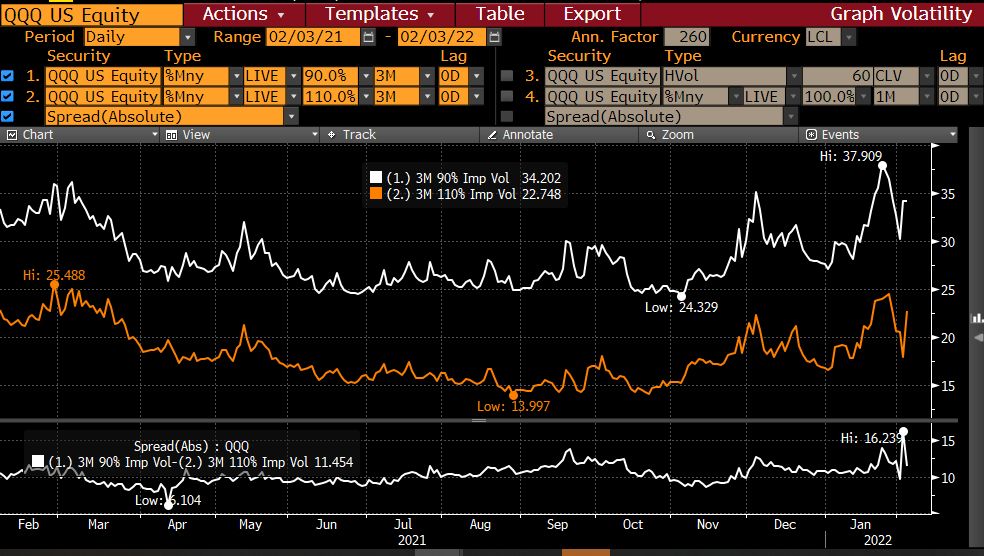
Quite the opposite. For all the ink spilled as the former Facebook fell Thursday, moves in equity volatility indexes — proxies for investor nerves — were relatively contained, particularly compared with past blowups. Gains in the price of bearish options on the biggest tech ETF were similarly muted — a sign that bulls kept their cool and had purchased hedges before the Meta Platforms Inc. massacre.

Amazon.com Inc., whose price hike for its Prime subscription service was cheered by investors, is poised to restore a rally that was disrupted by Meta’s debacle. Amazon surged in extending trading after the online giant’s profit beat expectations, helped by the cloud-computing division. Shares of Invesco QQQ Trust Series 1 (ticker QQQ), the biggest ETF tracking the tech-heavy Nasdaq 100, jumped almost 2% in after-hours trading. 

“Overall, the mega-tech companies did exceptionally well,” David Katz, president and chief investment officer of Matrix Asset Advisors, said by phone. “They had sold off prior to their earnings and many of them have started to rally post-earnings. For companies like Microsoft and Google and Apple and Amazon, that will hold. We think their very strong earnings season sets a much better tone for them.”

While history will no doubt remember this earnings season for Meta’s 26% collapse, its plunge was an outlier among the biggest of big tech — in terms of direction, anyway. The Faang block’s other main constituents all posted sizable post-result swings, and all of them were gains. Alphabet Inc. soared 7.5%, Apple Inc. climbed 7% and Microsoft Corp. saw an initial 10% drop morph into a 2.9% gain. In each case, the amount of market value added numbered in the tens of billions of dollars.

Since Microsoft’s shares reversed their loss on the evening of Jan. 25, the Nasdaq 100 exchange-traded fund is up about 7%.

“FB is clearly not representative of what’s going on in the broad market, where earnings are still strongly beating expectations and forward forecasts for revenue growth still rising,” said Gina Martin Adams of Bloomberg Intelligence. “It also confirms a breakup of the concept of Faang as a theme in general,” she added. “Clearly these are companies with very different business models and that shows in earnings results this season.”

Read: Goldman Touts Options Trade Netting 15% on Wild Earnings Days

The string of robust results from the Faangs is the latest evidence that while a hawkish Federal Reserve can still treat the market to anxiety-inducing quakes, the jury is still out as to whether central-bank policy alone will be enough to overwhelm the countervailing force of rising profits. 

It’s a lesson worth heeding for many who are betting that the glory days are likely over for the pandemic-era safety trade in large-cap equities. From long-only funds to professional speculators, tech shares are out of favor, with institutions having cut allocations to lows unseen since the financial crisis. Short sales are on the rise, and demand for puts have stayed elevated.  

Such sentiment explains why the price of bearish options on the biggest tech ETF held relatively firm during Thursday’s regular-session bloodbath. The skew of three-month QQQ puts betting on a 10% decline fell relative to calls wagering on a comparable gain, with the spread narrowing by roughly 5 points to 11.5.  

The CBOE NDX Volatility Index, a gauge of option costs tied to the Nasdaq 100, rose less than 2 points to 31.24, while the tech-heavy measure tumbled more than 4%. Historically, when the cash measure posted a drop of this size, the volatility index added almost 5 points, on average. 

Before Facebook’s fallout, almost $1 trillion were added to the total value of Faang stocks as the group surged 10% over six days, buttressed by better-than-expected earnings. 

“What drives companies is earnings and revenue growth,” said Chad Morganlander, senior portfolio manager at Washington Crossing Advisors. “And the names that have held up rather well have shown this quarter to have sturdy and vibrant attributes.”

Last week, Microsoft’s forecast on its Azure cloud-computing business soothed investor concern about a slowdown and Apple demonstrated the company’s ability to navigate a difficult supply environment. Google on Wednesday added to the latest evidence of Faang resilience, posting a surge in advertising revenue. 

Many tech stocks “can’t keep up with the high multiples that people had already priced in. At the first hint of weakness — bam! — investors headed for the exits and sold aggressively,” Adam Sarhan, chief executive of investment advisory service 50 Park Investments, said in an interview. “The only reprieve to the bullish side of the equation is Apple, Microsoft and Amazon, which have helped hold up the market.”

Their strong showings reawakened fear of missing out. 

“We’re seeing a little bit of FOMO,” Alon Rosin, Oppenheimer & Co.’s head of institutional equity derivatives, said by phone. “All of a sudden, everyone’s seeing the numbers are good, ‘I’ve got to get my exposure back,’ and that’s what we’re seeing in the after-market moves.”

More stories like this are available on bloomberg.com

©2022 Bloomberg L.P.

Texas Grid Faces Toughest Test Since Last Year’s Deadly Blackout

(Bloomberg) — The biggest test of Texas’s newly fortified power grid will arrive around sunrise Friday, when electricity demand may set a record as waking residents crank up their heaters in the sub-freezing cold. 

The state’s electrical system, whose collapse nearly a year ago during a brutal cold snap left more than 200 people dead, was expected to pass the trial. But success was not guaranteed. Critics have warned for months that grid managers and utilities haven’t done enough to winterize the system, while Governor Greg Abbott and other politicians have tried to reassure Texans the state was ready. 

Blackouts struck only a few pockets of the sprawling state on Thursday, as daytime highs dropped below 30 degrees Fahrenheit (-1 Celsius). Natural gas continued to flow through the pipelines that feed many of the state’s power plants, with limited disruptions. And wind turbines, whose poor performance during last year’s deep freeze become the focus of Abbott’s scorn, supplied far more power than expected, keeping electric heaters humming.

Colder temperatures were expected overnight, reaching their low around dawn on Friday. The Electric Reliability Council of Texas, which runs the power grid, said electricity demand could set a winter record of 73.5 gigawatts, close to the state’s summer high of 74.8 gigawatts. Typically, a gigawatt is enough to power about 200,000 Texas homes.

Abbott said Thursday the system was prepared. “The Texas power grid is the most reliable and resilient it’s ever been,” he said at a press conference.

About 37,000 homes and businesses were without power late on Thursday, according to PowerOutage.us, which tracks outages reported on utility websites. 

“These are localized outages that are not related to system-wide reliability issues,” Peter Lake, chairman of the Public Utility Commission of Texas, said at a media briefing. “The grid remains strong, reliable, and it is performing well in this winter-weather event.”

See: Texas Had All Year to Prep for Cold, and It’s Not Ready  

Texas has been bracing for the worst in this latest storm, which is part of a massive cold front that stretches to Maine. Many schools, universities and churches have closed, while gocery stores have been left depleted as residents stocked up on food. Even sea turtles off the Texas coast are under threat from the cold.

While it’s cold in Texas now, the worst will come overnight, according to William Iwasko, a meteorologist with the National Weather Service’s Lubbock office. Temperatures in the Panhandle region could fall to minus 3 degrees and Dallas may get down to 13 degrees. However, the storm is moving through fairly quickly, and temperatures could be close to normal on Saturday. That would be a key difference from last year’s storm, which lingered for days.

“It’s obviously quite cold, but the duration of that cold won’t be very long,” Iwasko said.

Some natural gas wells have frozen in Texas and neighboring Oklahoma, shutting about 5% of overall domestic output during the peak demand season for the furnace and power-plant fuel, according to Jade Patterson, an analyst at BloombergNEF. The interruptions will take as long as five days to restore once temperatures moderate, he said.

Meanwhile, wind is providing an unexpected benefit to the state’s electrical grid. Wind farms were producing about 17.5 gigawatts on Thursday morning, well above prior forecasts, to account for about 30% of the grid’s electricity supply, according to the Electric Reliability Council of Texas. 

“We expected significant icing in the western part of the state,” Ercot Interim Chief Executive Officer Brad Jones said in the briefing. “That has not occurred as severely as expected.”

More stories like this are available on bloomberg.com

©2022 Bloomberg L.P.

U.S. Futures Rise as Mood Steadies After Tech Rout: Markets Wrap

(Bloomberg) — U.S. equity futures rose Friday as sentiment steadied after worries about tightening monetary policy contributed to the worst slide in American technology shares since 2020 and a drop in sovereign bonds.

Contracts on the S&P 500 and tech-heavy Nasdaq 100 climbed more than 1%, aided by a surge in Amazon.com Inc. and Snap Inc. in late trading on strong earnings. On Thursday, the Nasdaq 100 shed 4.2% and the S&P 500 fell 2.4% as Facebook owner Meta Platforms Inc. suffered a historic $251 billion rout. 

In the Asia Pacific, Australian shares fluctuated and futures for Japan pointed lower. Traders are waiting to see how Hong Kong performs after a holiday. 

Meanwhile, surprisingly hawkish comments from European Central Bank President Christine Lagarde and a Bank of England interest-rate hike highlighted persistent concerns about high inflation. 

That sapped sovereign debt: Australian bonds fell following a jump in European yields and renewed selling in U.S. Treasuries. The euro held a jump and a dollar gauge retreated. West Texas Intermediate oil scaled $90 a barrel for the first time since 2014, stoking price pressures.

The latest turbulence underscores how volatility has become the hallmark of global markets this year. Investors are trying to come to grips with less favorable monetary conditions just as the economic recovery from the pandemic show signs of moderating. 

“The first half this year we are now experiencing a rates shock,” Tracy Chen, portfolio manager at Brandywine Global Investment Management, said on Bloomberg Television. “If the Fed and BOE and other EM central banks are too aggressive in hiking interest rates, potentially we are going to face kind of a recession risk in the second half, or at least more slowdown in the economy.”

The latest data showed U.S. service-sector growth pulled back in January to the slowest pace in nearly a year. Meanwhile, U.S. initial jobless claims fell more than expected last week to 238,000 ahead of data on payrolls Friday. 

The looming jobs report “is a reminder that expectations for Fed policy are the key influence on this market right now,” wrote Tom Essaye, a former Merrill Lynch trader who founded The Sevens Report newsletter. A hot inflation print next week would “rekindle hawkish Fed concerns,” he added.

For more market analysis, read our MLIV blog.

What to watch this week:

  • U.S. payrolls report for January, Friday
  • Winter Olympics kick off in China, Russia’s President Vladimir Putin due to attend opening ceremony, Friday

Some of the main moves in markets:

Stocks

  • S&P 500 futures rose 1.1% as of 8:16 a.m. in Tokyo. The S&P 500 fell 2.4%
  • Nasdaq 100 futures rose 1.8%. The Nasdaq 100 fell 4.2%
  • Nikkei 225 futures dropped 0.5%
  • Australia’s S&P/ASX 200 index was steady

Currencies

  • The Bloomberg Dollar Spot Index fell 0.3%
  • The euro was at $1.1437
  • The Japanese yen was at 114.97 per dollar
  • The offshore yuan was at 6.3521 per dollar

Bonds

  • The yield on 10-year Treasuries advanced six basis points to 1.83%
  • Australia’s 10-year bond yield rose six basis points to 1.93%

Commodities

  • West Texas Intermediate crude was at $90.16 a barrel
  • Gold was at $1,805.44 an ounce

More stories like this are available on bloomberg.com

©2022 Bloomberg L.P.

Kid Vaccinations Drop; Iowa Downgrades Covid Risk: Virus Update

(Bloomberg) — Covid-19 vaccinations among U.S. children ages 5-11 have fallen to the lowest levels since the shots were first approved, a sign that parental enthusiasm for the shots may be running low even as authorities consider expanding the shots to even younger children.

American Express Co. is encouraging staffers in New York and the U.K. to start returning to the office early next month as Covid-19 cases recede globally.

Prime Minister Justin Trudeau downplayed the idea of deploying Canada’s military to help clear out a trucker protest that’s paralyzed the capital, raising the prospect of an extended occupation of Ottawa’s downtown core.

Sweden will lift restrictions starting next week, citing a high vaccination rate and a manageable situation in its hospitals, while France’s health minister said the country is past the worst of the latest wave.

Key Developments:

  • Virus Tracker: Cases top 387.3 million; deaths pass 5.7 million
  • Vaccine Tracker: More than 10.1 billion shots administered
  • Covid’s endemic shift means slowdown for virus-product makers
  • New virus research will speed NIH’s next outbreak response
  • What we know about omicron and its subvariant BA.2: QuickTake
  • Sign up for the free Coronavirus Daily newsletter here

Iowa, Maryland End Health Emergencies (5:57 p.m. NY)

Governor Kim Reynolds said she would allow Iowa’s public health emergency declaration, first issued near the start of the pandemic in March 2020, to expire on Feb. 15. 

“After two years, it’s no longer feasible or necessary,” the Republican governor said in a statement. “The flu and other infectious illnesses are part of our everyday lives, and coronavirus can be managed similarly.”

Health emergencies were declared at the start of the pandemic in all 50 states, and the expanded power of governors proved contentious in many of them. Roughly half of U.S. states have revoked them, and more are expected to do so as the surge caused by the omicron variant eases. Maryland, which includes part of the Washington metro area, allowed a 30-day state of emergency to expire on Thursday.  

Colorado Hopeful on Omicron Immunity (4:36 p.m. NY)

Public health modeling suggests 80% of Colorado residents could be “immune to infection” from the current omicron variant by mid-February, Rachel Herlihy, state epidemiologist, said during a Thursday briefing. At the same time, the number of omicron cases remains elevated “and we have a long way to come down,” said Scott Bookman, Covid-19 incident commander at the Colorado Department of Public Health and Environment. Johns Hopkins researchers estimate 70.1% of Coloradans are fully vaccinated.

Medicare to Cover Free Home Tests (2:46 p.m. NY)

Medicare beneficiaries will be able to get up to eight free over-the-counter Covid-19 tests per month beginning in early spring, the Biden administration announced Thursday.

The new initiative will allow Medicare to directly pay participating pharmacies and other entities for over-the-counter tests approved or authorized by the Food and Drug Administration.

Private Medicare Advantage plans may offer coverage of the tests as a supplemental benefit in addition to hospital Part A coverage and outpatient Part B benefits, the Centers for Medicare & Medicaid Services said. Beneficiaries covered by Medicare Advantage should check with their plan to see if it includes such a benefit.

Amex Tells NYC, U.K. Staff to Start Returning (2:15 p.m. NY)

American Express Co. is encouraging staffers in New York and the U.K. to start returning to the office early next month as Covid-19 cases recede globally.

AmEx has previously said most colleagues will work remotely at least part of the time even after the pandemic subsides. The firm asked New York staffers in those hybrid roles to begin coming back one day a week starting March 1 before a wider return on March 15, Chief Executive Officer Steve Squeri said in an internal memo Thursday seen by Bloomberg News.

“The purpose of this phased approach is to give colleagues some time to adjust to the transition of coming in after working virtually for the past two years, as well as to become familiar with some of the new technology and other changes that have been made to support our new way of working,” Squeri said in the memo.

Kids’ Vaccinations Plummet (1:53 p.m. NY)

Covid-19 vaccinations among children ages 5-11 have fallen to the lowest levels since the shots were first approved, a sign that parental enthusiasm for the shots may be running low even as authorities consider expanding the shots to even younger children.

The seven-day average of first doses fell to about 37,062 on Jan. 28, marking the slowest one-week period since the government approved the vaccines for those children on Nov. 2, according to U.S. Centers for Disease Control and Prevention data. Just 31% of kids 5-11 have gotten a shot, compared with 75% of the total population.

Trudeau Rules Out Army Against Truckers (1:08 p.m. NY)

Prime Minister Justin Trudeau downplayed the idea of deploying Canada’s military to help clear out a trucker protest that’s paralyzed the capital, raising the prospect of an extended occupation of Ottawa’s downtown core.

Trudeau, speaking in a virtual news conference from isolation after contracting Covid-19, said Thursday that the federal government would consider any request for military help from provincial or city officials — but he doesn’t see that happening in the near future.

“One has to be very, very cautious before deploying military in situations engaging Canadians,” Trudeau said. “There have been no requests, and that is not in the cards right now.”

Merck Trims Antiviral Sales View (9:01 a.m. NY)

Merck & Co. said early Thursday that it now expects lower sales for its Covid antiviral molnupiravir than it had previously projected. The company now projects $5 billion to $6 billion in sales of the drug for the year, compared with a previous estimate of $5 billion to $7 billion. 

EU’s Valneva Review to Take Longer (8:56 a.m. NY)

French drugmaker Valneva SE’s vaccine might not receive a decision from European Union regulators until after mid-April, extending the review process.

The European Medicines Agency is awaiting more data from Valneva covering the entire adult population, Marco Cavaleri, the regulator’s head of biological health threats and vaccines strategy, said at a briefing on Thursday. The pace of the review depends on when the data is available, though it’s unrealistic to expect it before Easter, he said.

Subvariant Has Spread Across Africa (8:50 a.m. NY)

The omicron subvariant known as BA.2 has been found across Africa, and countries should sequence more samples so the extent of its spread can be determined, the World Health Organization said. 

So far, the strain has been found in Senegal in West Africa, Kenya in East Africa and Malawi, Botswana and South Africa in southern Africa, Nicksy Gumede-Moeletsi, a virologist with the WHO, said Thursday on a conference call.

Subvariant Dominant in Denmark (8:22 a.m. NY)

The omicron subvariant BA.2 makes up 69% of confirmed cases in Denmark and will reach 100% by mid-February, according to a study from the Danish virus watchdog SSI. BA.2 is about 30% more contagious than the original omicron, known as BA.1, the study found.

While unvaccinated people have a bigger risk of contamination overall, those who have been vaccinated are more likely to catch the new strain than BA.1. Denmark lifted all its Covid restrictions on Tuesday despite record daily cases, as hospitalizations and the number of people with severe disease are gradually declining.

U.K. Regulator Clears Novavax Shot (7:41 a.m. NY)

Novavax Inc.’s vaccine won clearance from U.K. regulators for use in people aged 18 and over for a first and second dose. The Medicines and Healthcare Products Regulatory Agency said nuvaxovid, as the protein-based shot is known, will be the fifth Covid vaccine authorized for use in Britain. 

Health Secretary Sajid Javid said the next step will be for the Independent Joint Committee on Immunisation and Vaccination, the government’s advisory panel on inoculations, to consider its use as part of the country’s Covid vaccination program. 

Europe Could See Covid ‘Ceasefire:’ WHO (6:43 a.m. NY)

Europe is at a crossroads in the fight against the pandemic with a potential “ceasefire” in sight, according to the director for the region at the World Health Organization.

While cases and hospitalizations from the omicron-driven wave are still rising in Europe, deaths are beginning to plateau, Hans Kluge told reporters Thursday. As the omicron wave recedes, Europeans will have a relatively high level of immunity derived from vaccines and from previous infections. 

“This period of higher protection should be seen as a ceasefire that can bring us enduring peace,” Kluge said. He urged a “drastic” increase in vaccinations, particularly in lower- and middle-income countries.

EU Proposes to Extend Certificates (6:14 a.m. NY)

The European Union is proposing to extend its digital Covid certificate system for a year, until the end of June 2023, as it aims to facilitate travel even as many governments are easing or eliminating pandemic-related restrictions.

“Without this extension, we risk having many divergent national systems, and all the confusion and obstacles that this would cause,” Justice Commissioner Didier Reynders said in a statement.

Africa Needs $1.29 Billion for Vaccine Rollout (6 a.m. NY)

Africa is short at least $1.29 billion to fund the rollout of vaccines, the World Health Organization said, citing data from 40 of the continent’s 54 countries. Only 11% of Africa’s 1.2 billion people are fully inoculated and the weekly pace of vaccination needs to rise sixfold to hit a target of getting 70% immunized by the middle of this year, the WHO said Thursday.

German Group Backs Second Booster (6:06 p.m. HK)

Germany’s vaccine commission recommends a second messenger-RNA booster shot for the elderly and people with weakened immune systems or who work in medical and other care facilities.

The second booster should take place at least three months after the first for people who are at least five years old and at heightened risk of serious disease, the commission said. For those working in medical and other care facilities, the second booster should take place at least six months after the first, the commission said. 

Sweden Lifts Restrictions (3:36 p.m. HK)

Sweden will lift restrictions starting next week, citing a high vaccination rate and a manageable situation in its hospitals despite what it calls a massive increase in transmission. “It’s time to open up Sweden again,” Prime Minister Magdalena Andersson told reporters in Stockholm.

‘Worst Is Behind Us,’ French Minister Says (2:20 p.m. HK)

French Health Minister Olivier Veran said the country has endured the hardest part of the latest pandemic wave.

“The worst is behind us,” the minister said late Wednesday on BFM TV, adding that the rate of hospitalizations is peaking.

France’s vaccine pass could be phased out before July if the current infection trends continue, he said. Some 7 million people will lose their vaccine passes by Feb. 15 if they don’t get a booster.

More stories like this are available on bloomberg.com

©2022 Bloomberg L.P.

Activision Earnings Miss Estimates After Microsoft Deal

(Bloomberg) — Activision Blizzard Inc. reported earnings and revenue that missed analysts’ estimates just weeks after Microsoft Corp. announced its $69 billion acquisition of the video game publisher. 

Adjusted revenue fell 18% to $2.49 billion in the fourth quarter, Activision said in a statement Thursday. Analysts had expected $2.84 billion, according to an average of estimates compiled by Bloomberg. Adjusted earnings per share were $1.25, compared with analysts’ forecasts for $1.31. The company cited “lower than expected performance” in its Activision division, which produces Call of Duty. 

Microsoft swooped in at a crucial time for Activision, which is behind hit games such as Candy Crush and World of Warcraft. The company, based in Santa Monica, California, has been rocked by allegations of rampant sexism and harassment, highlighted in a lawsuit from California’s Department of Fair Employment and Housing last July. The controversy caused executive-level shake-ups and broad discontent among employees. 

Some 2,000 workers have signed a petition to remove Chief Executive Officer Bobby Kotick after the Wall Street Journal reported that he was long aware of some of the allegations of sexual misconduct at the company, and neglected to inform the board. Three employee walkouts and the beginnings of union organizing — at Activision Blizzard and subsidiary game studio Raven Software — have punctuated six months of persistent upheaval among a swath of developers. Kotick has apologized publicly for the behavior reported at Activision Blizzard and has promised to make the company a more inclusive place to work. 

“As we look to the future, with Microsoft’s scale and resources, we will be better equipped to grow existing franchises, launch new potential franchises and unlock the rich library of games we have assembled over 40 years,” Kotick said in the statement.

Microsoft’s offer may have been a saving grace, analysts said, given that the cultural turbulence and ensuing attrition has taken a toll on the company’s ability to stick to its game release schedule. Already Activision has delayed the highly anticipated titles Diablo IV and Overwatch 2 to 2023 or later. Diablo Immortal is expected to be released early this year, although there is no set date yet. 

The turmoil also contributed to Microsoft’s move to purchase Activision, whose stock had plunged. Xbox head Phil Spencer, now CEO of Microsoft Gaming, approached Kotick late last year. 

Kotick, who has headed the company for 30 years, is expected to continue as CEO until Microsoft’s acquisition closes, which could take until mid-2023 as the Federal Trade Commission and other regulators review the deal. Kotick said in an interview with Bloomberg last month that the deal had nothing to do with the controversy surrounding Activision or the pressure on him as CEO.

The merger also gives analysts something more positive to focus on, rather than Activision Blizzard’s fundamentals, which, right now, are shaky. “The long-term prospects of Activision are much softer,” said Joost van Dreunen, former CEO of gaming research firm SuperData Research and a professor at New York University’s Stern School of Business. “Better to add themselves to a platform like they did for Microsoft. That solves the problem of their lack of content strategy.” Van Dreunen says Microsoft’s oversight may also help “ameliorate a lot of the cultural problems they had,” due to historically higher scrutiny applied to the tech giant.

Microsoft plans to incorporate Activision Blizzard’s treasure trove of games into its Game Pass subscription service, which boasts 25 million subscribers. The deal also gives Microsoft a boost in mobile gaming with Activision Blizzard subsidiary King, developer of hit game Candy Crush, which was acquired by Activision in 2015 for $5.9 billion. 

Revenue in Activision’s mobile games division rose 18% in the quarter, reflecting solid growth in net bookings in Candy Crush and Call of Duty Mobile. Net bookings, a measure of sales of virtual goods and licensing fees, in Call of Duty Mobile “grew strongly” in 2021, driven by demand from China. Worldwide spending on the title exceeds $1 billion, Activision said. Candy Crush in-game spending grew 20% from a year earlier, making it the top grossing game franchise in U.S. app stores.

Activision’s Blizzard division is planning “substantial new content” for its Warcraft franchise, including “all-new mobile Warcraft content.” In 2018, Kotaku reported that a Warcraft take on Pokemon Go may be in the works. Revenue from consoles fell 31% from a year earlier and and PC gaming dropped 12%.

The Microsoft deal has sparked concern that Activision will begin favoring the Xbox console over Sony Group Corp.’s PlayStation. But Activision plans to release at least the next three games in its mainstay Call of Duty franchise on the PlayStation, Bloomberg has reported. 

This year is already shaping up to be a blockbuster year for mergers in the gaming industry, with acquisition activity in the sector hitting an all-time high in the first month. In addition to Microsoft’s offer for Activision, Take-Two Interactive Software Inc. said it will buy Zynga Inc. in a deal valued at $11 billion. And last week Sony agreed to buy Destiny developer Bungie Inc. for $3.6 billion.

In light of the pending Microsoft acquisition, Activision didn’t hold an analyst call or provide an outlook. 

(Updates with segment breakdown in 11th paragraph.)

More stories like this are available on bloomberg.com

©2022 Bloomberg L.P.
Sky-High Markets Are New Risk to Wealth Beyond Death and Divorce

(Bloomberg) — For the world’s richest people, there used to be three ways to quickly see a fortune disappear: Death, default or divorce.

The past few months have added another risk: Sky-high valuations of giant technology companies falling from the stratosphere.

Mark Zuckerberg’s wealth plummeted as much as $31 billion on Thursday, the third-biggest one-day drop in wealth since the Bloomberg Billionaires Index began compiling data in 2012. Two of his co-founders, Eduardo Saverin and Dustin Moskovitz, saw their fortunes tumble $4.6 billion and $3.1 billion, respectively, as Meta Platforms Inc. shares plunged 26%. Over at Spotify Inc., Chief Executive Officer Daniel Ek’s net worth has fallen by $1.1 billion so far in 2022, to $2.7 billion.

An 11-digit move in wealth had previously been reserved for monumental events in the lives of billionaires. Some recent high-profile examples include Jeff Bezos’s divorce in 2019 and Bill Hwang losing $20 billion in a matter of days when his Archegos Capital Management imploded last year under the weight of margin calls.

Now it’s becoming almost routine, especially with the volatile swings in Elon Musk’s fortune. The world’s richest person lost $35 billion in a day in November as Tesla Inc. shares fell following a Twitter poll in which Musk asked voters if he should sell 10% of his stake in the company. His net worth also plunged $25.8 billion last week, adding to a long list of daily declines that dominate the list of the Top 10 biggest drops ever recorded by Bloomberg’s index. 

Of course, Musk and other tech titans can add to their fortunes in a blink of an eye, too. Shares of Amazon.com Inc. surged about 18% in extended trading on Thursday after profit beat estimates and it raised the price of its Prime subscription service. 

That’s a boon for Bezos, who slipped one spot to the world’s third-richest person on Thursday, the first time he’s fallen out of the Top 2 since September 2017. An 18% increase would boost his net worth by $25 billion, which would be the sixth-biggest gain on record in a decade of Bloomberg data.

“This kind of volatility is to be expected when you’re at these valuations,” Sharmin Mossavar-Rahmani, head of Goldman Sachs Group Inc.’s investment-strategy group, said in an interview last week.

Even if broader declines in tech shares are contained, Zuckerberg’s losses are especially striking because he’s been a mainstay among the world’s 10 richest people since mid-2015. He nearly fell out of the Top 10 after Thursday’s rout, ranking just ahead of Mukesh Ambani, Asia’s richest man, in the Bloomberg wealth index. 

It’s another indication of the unpredictable ways in which the U.S. rebound from the Covid-19 pandemic will ripple across markets, companies and the economy.

More stories like this are available on bloomberg.com

©2022 Bloomberg L.P.

Sky-High Markets Are New Risk to Billionaires Beyond Death and Divorce

(Bloomberg) — For the world’s richest people, there used to be three ways to quickly see a fortune disappear: Death, default or divorce.

The past few months have added another risk: Sky-high valuations of giant technology companies falling from the stratosphere.

Mark Zuckerberg’s wealth plummeted as much as $31 billion on Thursday, the third-biggest one-day drop in wealth since the Bloomberg Billionaires Index began compiling data in 2012. Two of his co-founders, Eduardo Saverin and Dustin Moskovitz, saw their fortunes tumble $4.6 billion and $3.1 billion, respectively, as Meta Platforms Inc. shares plunged 26%. Over at Spotify Inc., Chief Executive Officer Daniel Ek’s net worth has fallen by $1.1 billion so far in 2022, to $2.7 billion.

An 11-digit move in wealth had previously been reserved for monumental events in the lives of billionaires. Some recent high-profile examples include Jeff Bezos’s divorce in 2019 and Bill Hwang losing $20 billion in a matter of days when his Archegos Capital Management imploded last year under the weight of margin calls.

Now it’s becoming almost routine, especially with the volatile swings in Elon Musk’s fortune. The world’s richest person lost $35 billion in a day in November as Tesla Inc. shares fell following a Twitter poll in which Musk asked voters if he should sell 10% of his stake in the company. His net worth also plunged $25.8 billion last week, adding to a long list of daily declines that dominate the list of the Top 10 biggest drops ever recorded by Bloomberg’s index. 

Of course, Musk and other tech titans can add to their fortunes in a blink of an eye, too. Shares of Amazon.com Inc. surged about 18% in extended trading on Thursday after profit beat estimates and it raised the price of its Prime subscription service. 

That’s a boon for Bezos, who slipped one spot to the world’s third-richest person on Thursday, the first time he’s fallen out of the Top 2 since September 2017. An 18% increase would boost his net worth by $25 billion, which would be the sixth-biggest gain on record in a decade of Bloomberg data.

“This kind of volatility is to be expected when you’re at these valuations,” Sharmin Mossavar-Rahmani, head of Goldman Sachs Group Inc.’s investment-strategy group, said in an interview last week.

Even if broader declines in tech shares are contained, Zuckerberg’s losses are especially striking because he’s been a mainstay among the world’s 10 richest people since mid-2015. He nearly fell out of the Top 10 after Thursday’s rout, ranking just ahead of Mukesh Ambani, Asia’s richest man, in the Bloomberg wealth index. 

It’s another indication of the unpredictable ways in which the U.S. rebound from the Covid-19 pandemic will ripple across markets, companies and the economy.

More stories like this are available on bloomberg.com

©2022 Bloomberg L.P.

Homeland Security Forms Board to Examine Hacks Like NTSB Probes Plane Crashes

(Bloomberg) — The Biden administration has created an advisory board to review major cybersecurity incidents in the hopes of minimizing the impact of future attacks.

The U.S. Department of Homeland Security said Thursday that the Cyber Safety Review Board will include leaders from government and the private sector to examine past events, with the goal of meaningfully improving the nation’s ability to respond to major hacks. The board is modeled in part on the National Transportation Safety Board, which investigates airline crashes and other transportation accidents. 

The board’s first order of business will be a review of a vulnerability in Log4j open source software, a protocol used by thousands of global companies. The issue, which U.S. cyber officials said in December represented a “severe” flaw, could have allowed hackers to take complete control over an affected system.  

The board is scheduled to deliver a report this summer including an assessment of known threats associated with Log4j, a review of the actions taken to reduce the vulnerabilities and share any lessons learned from the incident. The board lacks the power to subpoena companies, meaning it will rely on voluntary disclosure from the private sector. 

The Cyber Safety Review Board was created as a result of a May 2021 executive order signed by President Joe Biden in response to a hack on the software supply chain involving the federal contractor SolarWinds Corp. In that breach, suspected Russian hackers compromised nine federal agencies, officials have said. 

The May executive order stated that the board would be responsible for assessing “cyber activities” in December 2020 — the date when the SolarWinds hack was disclosed. 

However, federal officials now believe the best use of the board is to focus on the widespread use of the Log4j software, the relative ease of exploitation and the potential impact of hackers exploiting the flaw, a department spokesperson said. 

The Cybersecurity and Infrastructure Security Agency will fund the board, with Director Jen Easterly appointing as many as 20 members, according to a notice in the federal register. It will function in an advisory capacity. 

Robert Silvers, DHS undersecretary for policy, will serve as the inaugural chair, a term that lasts two years. Other members include Heather Adkins, senior director for security engineering at Alphabet Inc.’s Google, National Cyber Director Chris Inglis, Crowdstrike Inc. Co-Founder Dmitri Alperovitch, and Katie Moussouris, an early developer of bug bounty and vulnerability management programs.

“We have a lot to work on, and Log4j is a complex issue” Moussouris said in an interview. “We’ll all be bringing our experiences from different areas of cybersecurity, especially incident response.”

She added, “It’s something the federal government hasn’t considered before.” 

(Adds remarks from board member in last paragraph.)

More stories like this are available on bloomberg.com

©2022 Bloomberg L.P.

Close Bitnami banner
Bitnami