
Bloomberg

Meta Needs the ‘Soul’ in Within’s App to Compete in VR, Executive Says

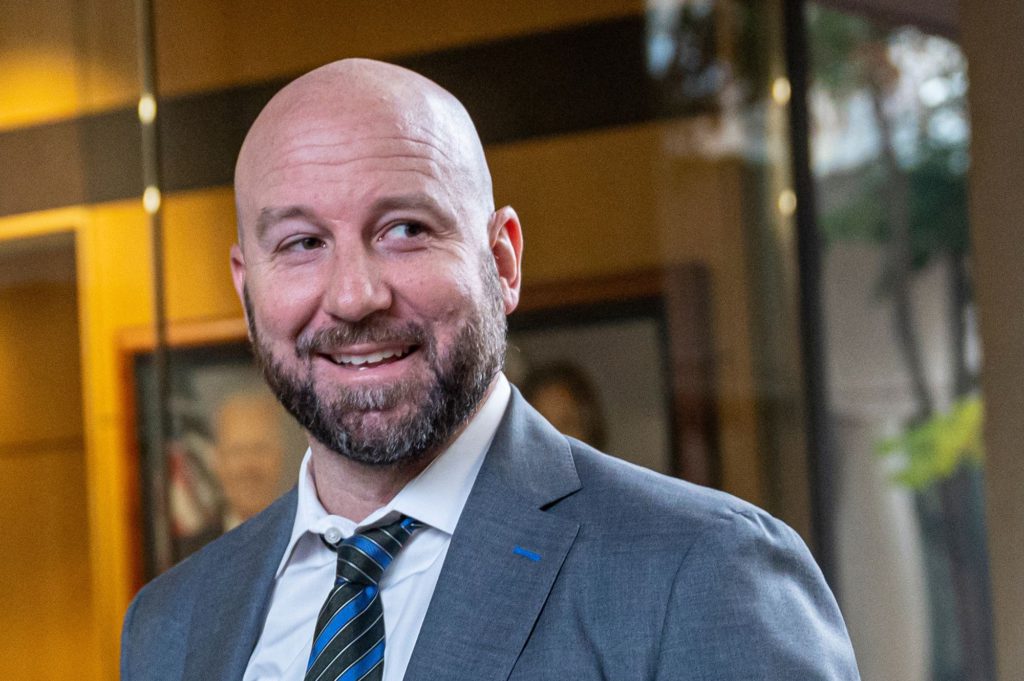
(Bloomberg) — Meta Platforms Inc.’s Chief Technology Officer Andrew Bosworth pointed to the innovative failures at the world’s biggest social media company to make the case that it should be permitted to buy a virtual reality startup.

Testifying in federal court in San Jose, California, Monday, Bosworth is a witness for Meta in its effort to beat back regulators seeking to block the company from acquiring Within, the maker of Supernatural — a popular VR fitness app.

The Federal Trade Commission claims Meta’s plan to buy the competitor will give it an unfair advantage in the burgeoning VR market. The argument is an early test for FTC Chair Lina Khan and her more aggressive stance to antitrust enforcement.

To counter the FTC’s allegation that Facebook parent Meta abandoned its own plans to develop a virtual reality fitness app in favor of buying Within, Bosworth said the target company is sophisticated, unique and impossible to reproduce — even with the money that Meta has.

“All the resources in the world don’t buy you success,” Bosworth said. “That’s particularly true for digital interactive content.”

He pointed to applications such as Spaces and Venues — apps designed to get users to interact socially with friends in virtual reality — that failed. Meta has invested heavily in and promoted Horizon Worlds, a successor to Venues, he said. “It’s still not as nearly as successful as we’d hoped it’d be.”

US District Judge Edward Davila pressed Bosworth on his claim that smaller competitors can outmaneuver a company of Meta’s size by being better at allocating its resources. The critical question, Bosworth said, is “Does the thing you create have a soul?” Simply cloning an app like Supernatural is a recipe for failure, he said.

“There’s an art to them,” Bosworth explained, adding that Within has captured an elusive element that resonates with large parts of the population. “You can’t just throw money at that,” he said. “It’s best to build around them.”

The FTC sued Meta in July over the deal, alleging the company was seeking to create a monopoly in virtual reality much in the same way Facebook bought up Instagram and WhatsApp to extend its dominance in social networking. During the Trump administration, the agency sued the company seeking to unwind those deals retroactively. That case is pending.

The Within suit represents the first time the FTC has preemptively challenged a deal by the social media giant, which has bought more than 100 smaller companies over the past decade. Tech companies and investors are closely watching the suit amid concerns the case may make startup acquisitions more difficult.

In court Monday, Bosworth also explained Meta’s broader VR vision. The company is still subsidizing consumers and app developers, he said, and continues to lose money on headsets. But the acquisition of Within would help VR, and Meta, take a step closer to sustainability, he said. “We are working toward a distant point where we’ve turned the corner on this and it is a money-maker.” 

Davila has said he will issue a decision by the end of the year on whether to block Meta’s acquisition while the FTC conducts a lengthier, administrative proceeding on the deal in 2023. Bosworth testified that the VR world is moving too quickly for Meta to fight a longer legal fight. Competitors are working away at fitness apps while “we’re doing something else with our time,” he said, referring to the court proceeding he was testifying at. 

“If this deal doesn’t close in a timely matter, we’ll probably just walk away,” he said.

–With assistance from Leah Nylen.

More stories like this are available on bloomberg.com

©2022 Bloomberg L.P.
Asian Bourses Join Billion-Dollar Race to Tap Carbon Offset Boom

(Bloomberg) — The drive to launch new carbon exchanges in Asia has reached new heights with Malaysia entering the fray, raising questions about how many will survive in a market that could be worth hundreds of billions in a few decades.

Bursa Malaysia Bhd. opened an exchange this month, joining more than a dozen that are under way or planned across the region. Thailand and Japan debuted their platforms in September, followed by Hong Kong a month later. Singapore has two fledgling bourses.

“We’re in another one of those mad dashes,” Thomas McMahon, co-founder of Singapore’s AirCarbon Pte, said in an interview. “We’ve seen this rush before, if you look at the early days of blockchain” and cryptocurrencies.

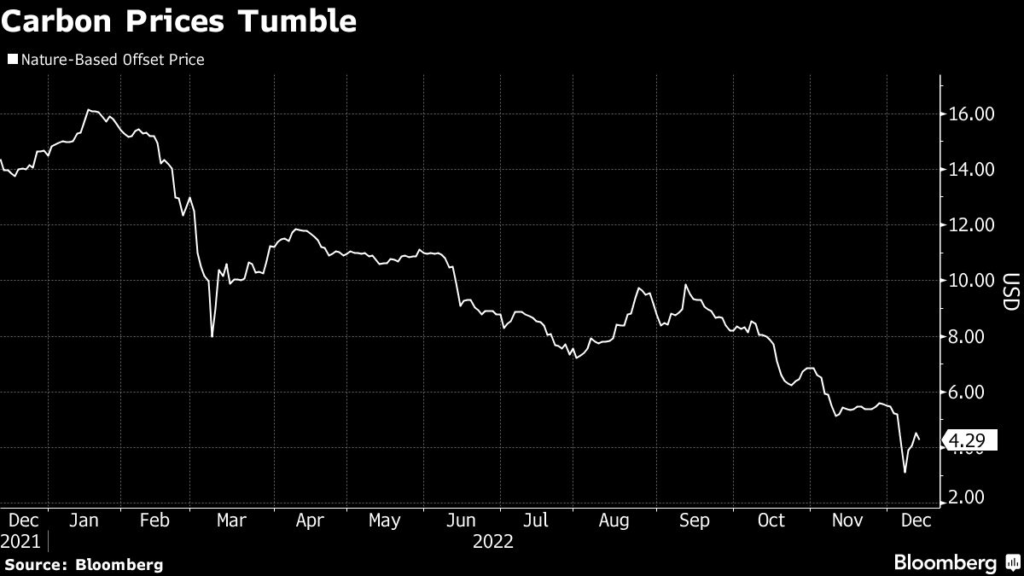
The exchanges enter a crowded voluntary offsets market that could soar over the next few decades but has so far gotten off to a slow start. Trading and prices have slumped, while concerns mount about how much offsets actually contribute to fighting climate change. 

What’s clear is that money in Asia is flowing into the space, with investors betting the flurry of climate pledges from countries and companies will drive growth. The exchanges have raised tens of millions of dollars, with powerful backers including sovereign wealth funds like Temasek Holdings Pte of Singapore and Abu Dhabi’s Mubadala Investment Co., along with banks such as Standard Chartered Plc and DBS Group Holdings Ltd.

Demand for offsets could grow 40-fold between now and 2050, to 5.2 billion tons of CO2 equivalent, or about 10% of global emissions, according to BloombergNEF. Prices could reach $120 per ton by then, making it potentially a $600 billion market.

Companies are drawn to the offsets market as a way to counter their emissions from burning fossil fuels. An offset is a promissory note that represents a ton of carbon dioxide emissions removed, or not added, to the atmosphere in return for a payment. Some regions, including the European Union and California, have mandatory programs imposed on some polluters, while many of the fledgling exchanges are voluntary markets.

Some of these new bourses are setting themselves up for what’s to come in the region, including additional compliance credit schemes that are set to grow, said Hannah Hauman, global head of carbon trading at Trafigura Pte.

“It’s a mix of national interest, capacity building, and that down the road, somebody could eventually have a lot of liquidity and win the game,” said Federico Di Credico, Asia-Pacific managing director at ACT Commodities.

Elusive Profits 

So far, it’s been far from lucrative. Existing platforms are struggling to attract enough transactions, with confusion over the integrity of carbon projects and a lack of clarity over how global trading of credits should work. Traders and analysts are also preparing for a bleak year ahead as polluters reduce buying amid inflation and recessionary fears.

For standardized contracts to be profitable, volumes would have to be “extremely high” and the market isn’t there yet, Singapore’s Climate Impact X CEO Mikkel Larsen said in an interview. “A lot of things have to improve in the market for all of us to make money.”

For now, profitability is “all in the primary market” as margins are higher, he added. In that market, buyers purchase carbon credits directly from project developers, such as through an auction. These can then be traded in the secondary market. CIX, which is backed by Singapore’s stock exchange and Temasek, has sold 420,000 credits through various auctions since it started.

AirCarbon, or ACX, which has transacted over 17 million carbon credits to date, aims to break even by 2025, McMahon said. Having raised more than $25 million from funders including Enterprise Singapore, Deutsche Boerse AG and Mubadala, it’s seeking another $50 million in a new round. ACX is targeting $33 million in revenue and 20 million credits transacted next year, McMahon said.

New Players

More platforms are coming. Indonesia’s bourse is looking to develop its own carbon exchange, while India is putting together a blueprint for a voluntary carbon market. Larsen and McMahon have talked to dozens of companies and countries interested in having their own exchanges. 

“Everybody decided in 2021, from a commercial perspective, that this would be a great area to build,” Peter Zaman, a Singapore-based lawyer at HFW, said in an interview. “For the current size of the voluntary market, especially in the latest weak demand environment, there are probably a few platforms too many.”

Experts meanwhile aren’t convinced the explosion of exchanges will have any meaningful impact on the climate.

“These sorts of exchanges might attract financial organizations, speculators, but maybe not so much buyers who actually want to use credits for their climate strategies,” said Gilles Dufrasne, global carbon markets lead at nonprofit Carbon Market Watch. “I don’t think that has the highest benefit for the climate.”


–With assistance from Ali Asghar.

More stories like this are available on bloomberg.com

©2022 Bloomberg L.P.

Amazon Ring Cameras Used in Nationwide ‘Swatting’ Spree, US Says

(Bloomberg) — Two people who hacked Yahoo! email accounts to gain access to Ring home security cameras have been charged over a weeklong “swatting” spree that involved placing bogus emergency calls and live-streaming the armed police responses on social media, according to a Los Angeles grand jury indictment, the US Justice Department said.

Kya Christian Nelson, 21, of Racine, Wisconsin, and James Thomas Andrew McCarty, 20, of Charlotte, North Carolina, were charged with conspiracy to access computers without authorization. Nelson, who is currently incarcerated in Kentucky in an unrelated case, was also charged with two counts of intentionally accessing a computer without authorization and two counts of aggravated identity theft.

The series of swatting incidents prompted the FBI to issue a public service announcement in late 2020 urging users of smarthome security cameras to use unique passwords with two-factor authentication.

Nelson and McCarty face a maximum of five years in prison for the conspiracy charges. A charge of aggravated identity theft carries a mandatory two-year consecutive sentence.

“Swatting is a serious crime, and those responsible for it should be brought to justice,” Ring spokesperson Emma Daniels said in an emailed statement. “We take the security of our customers extremely seriously — that’s why we made two-step verification mandatory, conduct regular scans for Ring passwords compromised in non-Ring breaches, and continually invest in new security protections to harden our systems.”

Yahoo! didn’t immediately respond to a request for comment.

The pair allegedly gained access to 12 Ring home security cameras in nine states in November 2020 and placed fake emergency calls to local law enforcement agencies to summon police to the homes where the cameras were located. 

They then streamed the police response on social media, according to the Justie Department. During several of the incidents, they taunted police officers and the victims through the Ring devices, prosecutors said.

In one instance, a hoax call was made to police in West Covina, California, with the caller pretending to be a minor reporting her parents were drinking and shooting guns in the home. Nelson allegedly accessed the Ring camera and used it to taunt and threaten the responding police officers, prosecutors said.


More stories like this are available on bloomberg.com

©2022 Bloomberg L.P.
Coinbase’s Value Is $1 Billion Below ‘Joke’ Token Dogecoin’s

(Bloomberg) — Coinbase Global Inc., the largest public digital-asset exchange in the US, is trailing behind meme cryptocurrency Dogecoin in terms of market value.  

The exchange now has about $8 billion in market capitalization while the value of Dogecoin — originally created as a joke in 2013 — is topping $9 billion. The measurement does not necessarily reflect the intrinsic worth of those projects, but it may show how a meme coin can outperform the shares of a major US-based exchange amid a highly volatile market. 

Coinbase has been among the hardest hit crypto firms as investors yank coins off exchanges or exit the asset class as a whole. The exchange has laid off more than 18% of its workforce, or the equivalent of roughly 1,200 this year. Chief Financial Officer Alesia Haas said the firm is preparing for 2023 with a more conservative bias.

“Coinbase is tied to the fortunes of the broader crypto markets.” said Michael Safai, partner at crypto trading firm Dexterity Capital. “Dogecoin has no real connection to the macro, but instead is driven almost primarily by headlines and hype, retail investors seem to be hungry for one last pop.”

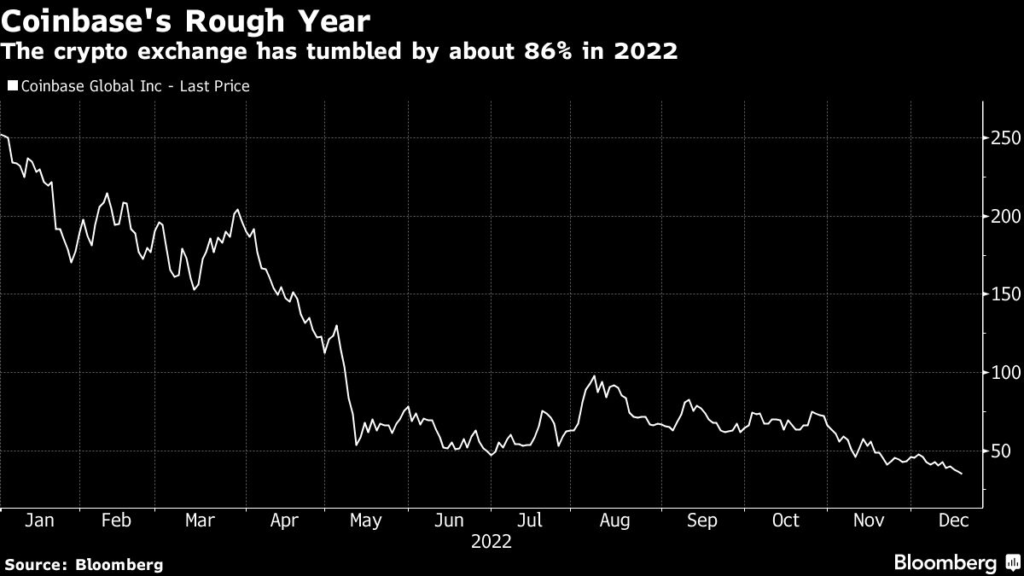
Its shares have tumbled by about 86% in 2022. Coinbase dropped 3.9% to a record low of $35.17 Monday in New York.

Dogecoin saw a substantial rebound since billionaire Elon Musk acquired Twitter in October, but has dipped along with the broad crypto market due to the implosion of exchange FTX.

“I don’t think there’s a tremendous amount of substance to be gleaned from the fact that Dogecoin has surpassed Coinbase in terms of market capitalization – except to say that the crypto market is very much in flux right now,” said Jacob Sansbury, chief executive officer at online trading platform Pluto. “It’s in such flux that good projects are down bad while sillier ones are doing relatively well.”

Dogecoin saw a historic surge earlier last year as Musk said Tesla’s customers could make purchases of the electric cars by the token. The coin, among a variety of other doge-themed cryptocurrencies and meme stocks, started being widely traded across trading platforms including Binance and Coinbase. 

“Dogecoin was a simple, straightforward joke that punches above its pay grade all the way to become a heavyweight champion,” said Teong Hng, chief executive officer of crypto investment firm Satori Research.

(Updates to add Coinbase trading. An earlier version corrected year of Dogecoin’s historic surge.)

More stories like this are available on bloomberg.com

©2022 Bloomberg L.P.

Pharmacies Are Limiting Sales of Kids’ Pain and Fever Medicine

(Bloomberg) — CVS Health Corp. and Walgreens Boots Alliance, Inc., two of the largest US pharmacy chains, are limiting purchases of children’s pain-relief medicines amid constrained supplies and high demand.

CVS is restricting shoppers to two products each for in-store and online purchases. Walgreens is limiting online orders to six products and isn’t setting limits for in-store purchases. Walmart Inc. isn’t placing any purchase limits, while Kroger Co. said it is asking shoppers to limit purchases to two kids pain medicine products. Rite Aid Corp. isn’t limiting purchases. 

“Due to increased demand and various supplier challenges, over-the-counter pediatric fever-reducing products are seeing constraint across the country,” Walgreens said in an email without offering more details on the supplier challenges.

Pediatric medicines containing acetaminophen and ibuprofen, which relieve pain and reduce fever, have been hard to come by across the US and Canada since at least October as respiratory viruses spread. Rates of hospitalization for respiratory syncytial virus, or RSV, and influenza have reached heights not seen in recent years. The drugs don’t kill the viruses, but they do relieve symptoms.

More US children had been hospitalized in 2022 for influenza as of Dec. 10 than in any other year since 2009, according to data from the Centers for Disease Control and Prevention. RSV hospitalizations are the highest since 2018, when the agency began tracking. 

On Oct. 7, Canadian health authorities posted a notice online alerting the public that childrens formulations of both types of drugs were limited because of high demand. “Over the summer months, there was unprecedented demand for these products and supply had not kept pace,” Health Canada said in a statement.

The Consumer Healthcare Products Association, a US organization which represents companies that make the medicines, said the scarcity “is a direct result of the recent and rapid increase in demand driven by a rise in pediatric cases of respiratory illnesses including the flu, COVID, and RSV.” 

A CVS location in downtown Boston had a sign posted on Monday morning informing shoppers of the two-item limit. The only kids acetaminophen or ibuprofen product on the shelf was a 12-pack of store-brand acetaminophen suppositories.

A spokesperson for Johnson & Johnson, which manufactures Motrin and Tylenol, said that the childrens version of those medicines “may be less readily available at some stores.”

Haleon Plc, which sells Advil, a product made with ibuprofen, declined to comment, referring to the Consumer Healthcare Products Association. 

More stories like this are available on bloomberg.com

©2022 Bloomberg L.P.

Uber Strike Fizzles in New York With Plenty of Cars on Road

(Bloomberg) — A planned strike by New York Uber drivers fizzled on Monday and there appeared to be plenty of cars on the road despite a call by drivers for a boycott of the app.

The New York Taxi Workers Alliance, a union representing the city’s yellow cab and rideshare industry, had asked Uber drivers to turn off their app for 24 hours starting at midnight on Sunday to protest Uber Technologies Inc.’s attempts to block wage increases approved by the city’s Taxi & Limousine Commission last week. The pay bump was supposed to go into effect Monday, but is on hold pending a court hearing on Jan. 31.

Some drivers remarked in Facebook groups where workers congregate at how there wasn’t morning surge pricing, a sign there were still sufficient cars on the road to meet customer demand. 

“Some drivers live day to day and Christmas is coming,” said Uber driver Fernando Feliciano, 50. 

A spokesman for Uber said the company hadn’t seen any disruptions in service due to the strike and isn’t concerned about driver supply. “Since 2019, driver pay has gone up 38.4% and drivers are out there today doing critical work for New Yorkers, not listening to political chatter on Twitter,” he said.

The spokesman said there were 3% more drivers on the road between 7 a.m. and 10 a.m. in New York, compared with the typical Monday over the last six months, and wait times were in line with the average.

Pay rates for Uber and Lyft Inc. drivers were set to increase by 7% per minute and 24% per mile, according to the TLC, with a sample trip of 30 minutes and 7.5 miles (12 kilometers) requiring a minimum payment of $27.15. Uber said the city’s calculation of the per-mile rate increase is misleading and that it is actually 16%, taking into account mandated annual adjustments implemented in 2020 and 2022.

The Independent Drivers Guild, which represents roughly 80,000 Uber and Lyft drivers in New York, said more than 500 of its members hit the streets on Monday morning, marching from Brooklyn to the Thurgood Marshall US Courthouse in Manhattan in protest of the decision to block pay raises.

Drivers asked New Yorkers to support their cause by not using the app on Monday. 

“Uber wants to pay nothing more to the drivers whose labor creates the company’s profits,” said New York Taxi Workers Alliance Executive Director Bhairavi Desai. “New York City drivers are mostly full-timers who invested in cars just for the job and who depend on this income to feed their families.”


–With assistance from Jennah Haque.

(Updates with comments from the New York Taxi Workers Alliance)

More stories like this are available on bloomberg.com

©2022 Bloomberg L.P.

An EV Buying Guide for People Fed Up With Tesla’s Elon Musk

(Bloomberg) — So you wanted to buy a Tesla, but then Elon Musk bought Twitter, got offended by trolls, flirted with QAnon and started banning journalists. Now you’re not so sure?

You’re not alone: The billionaire’s behavior has made some people publicly declare (on Twitter, of course) they will never buy one of his electric vehicles. And a poll of Twitter users just indicated that most would like for him to step down as the social network’s CEO.  

Tesla is still the leading electric-vehicle maker in the world, but China’s BYD is catching up. Tesla got an early jump on the industry with the 2012 launch of the first car it developed from scratch, the Model S, which forced the general public to rethink what EVs could be with its sleek looks, zippy performance and higher-end finishes.

But strong recent entries from established brands, as well as much-hyped debuts from other startups, are taking a bigger share of the growing EV market.

A market research brand, HundredX, showed a drop in loyalty in recent months among Telsa owners, who are known for their devotion to the company’s leader and his brand.

Still, you’re curious about EVs and considering switching to electric? Perhaps you respect Musk but are interested in what else is on the market. Or maybe you didn’t have strong feelings either way about Musk — but you don’t love Teslas and are hoping to find something more suited to your individual needs. 

Here, we break down each model in Tesla’s lineup and what alternatives are out there.

Instead of: Model 3

This is the entry-level Tesla sedan. The Long Range dual motor model starts at $57,990 with a range of 358 miles, though it’s currently unavailable for ordering. The real-wheel drive Model 3 starts at $46,990, has an estimated range of 272 miles and goes 0-60 in 5.8 seconds. The more powerful dual-motor Performance model has a significantly longer range of 315 miles, goes 0-60 in 3.1 seconds and starts at $62,990.

Try: BMW i4,  Polestar 2 or Kia EV6

The BMW’s entry into the luxury electric vehicle space came with the stunning i4. Our review noted its tight steering, responsive suspension and powerful motors, as well as the high-quality interiors that BMW is known for. A rear-wheel-drive model, the i4 eDrive40, has a range of 300 miles and starts at $55,900. The i4 M50 goes from 0-60 in 3.7 seconds, has a range of 245 miles and starts at $67,300. “It is impossible to replicate more than a century of German manufacturing in a few years’ time; the fit and finish of interior cabins in the electric vehicles coming from Audi, Porsche, and now BMW is one way it shows,” our review said of the i4.

Meanwhile, the Polestar 2’s looks and build quality are better than Tesla’s, with comparable performance and a range of 270 miles. The dual motor starts at $53,300. The Kia EV6 crossover, starting at $48,500, has a range of 310 miles with about twice as much cargo space as the Tesla sedan.

Instead of: Model Y

Although it doesn’t exactly look like a station wagon, the Model Y serves that purpose in the fleet. It’s like a shrunken Model X, but it still has plenty more cargo space than the sedans—or, it can be configured to fit seven seats. The Model Y Long Range starts at $65,990, has a range of 330 miles and goes 0-60 in 4.8 seconds.

Try: Audi Q4 e-tron or BMW iX

Starting at $49,800, the Audi Q4 e-Tron Premium has a range of 265 miles and goes 0-60 mph in 5.8 seconds. Its interior and build quality feels on par with BMW and superior to Tesla. The BMW iX, meanwhile, starts at $83,200, has a range of more than 300 miles, and goes 0-62 mph in 4.6 seconds. Our review calls it unattractive and a bit boring to drive but says it has the high quality expected from BMW.

Instead of: Model X

The closest thing Tesla has to an SUV is the the Model X, which starts at $120,990, has range of 333 miles and goes 0-60 in 2.5 seconds.

Try: Porsche Taycan Cross Turismo

This Porsche station wagon really drives like a Porsche. Its acceleration is silky smooth and flawless, driving engagement is instant, and thrilling performance can be had at any speed. The range is only about 235 miles and it starts at $97,700, but it has some excellent off-road power and provides a very enjoyable way to get your groceries home.

Instead of: Model S

This luxury sedan from Tesla is quick, especially if you purchase the extra power boost model that gets it to 60 mph in less than 3 seconds. The dual-motor model starts at $104,990, with a range of 405 miles and a dash from 0-60 in 3.1 seconds.

Try: Mercedes EQS or Audi e-tron GT

For $104,400, you’ll get the most technologically advanced car that Mercedes-Benz has ever offered to the general public. The EQS makes tight U-turns and has an incredible 485 mile driving range. There are also luxury amenities such as Burmester 3D surround sound. The spacious, beautiful interiors, HEPA air filters and front seats that heat rapidly and offer massages make the car’s environment feel like a health spa. Gripes include the look of the car — it’s reminiscent of a lozenge — and the lack of resistance when pushing the brakes.

More stories like this are available on bloomberg.com

©2022 Bloomberg L.P.

Energy Efficiency Startup Redaptive Raises $200 Million From CPPIB 

(Bloomberg) — Redaptive Inc., a company that manages energy-efficiency upgrades for commercial buildings, raised $200 million from Canada Pension Plan Investment Board in a funding round after withdrawing its plan for a US initial public offering. 

The San Francisco-based company was valued at close to $1 billion in the round, according to a person with knowledge of the matter who asked not to be identified discussing private information.

Some existing investors, including Linse Capital and CBRE, will also be participating in the investment, according to a statement reviewed by Bloomberg News. The company is expected to announce a second close early next year. 

Arvin Vohra, Redaptive’s chief executive officer, said the company’s growth trajectory is “very attractive” even though it tabled its IPO.

“It’s a phenomenal time for Redaptive, despite the macro environment,” he said.

A representative for Redaptive declined to comment on the company’s valuation.

Redaptive filed listing documents with the US Securities and Exchange Commission last year. It reported a $35 million net loss on $68 million in revenue in 2021, according to an updated filing in March. 

The company could consider going public within a couple of years, Vohra said. 

Founded in 2015, Redaptive uses software and meters to take a a snapshot of the energy usage. It then installs new gear, such as lighting or air conditioning, or recommends ways to operate more efficiently. The company owns and operates the equipment itself, charging customers based on the savings in energy bills. Vohra described the operation as a “repair or replace model.”

His business is one of several upstarts selling energy management services as the industry scrambles to curb carbon emissions. Currently Redaptive offers ways to upgrade lighting, heating and cooling, and water services, as well as solar panels. Vohra said the company is working on adding features for energy storage and electric vehicle fleets. 

Through the end of 2021, Redaptive disclosed in a filing that it had installed about 2,700 project upgrades at 2,400 customer facilities. The number of customer facilities is now “shy of 3,000,” Vohra said.

(Corrects number of facility upgrades in last paragraph.)

More stories like this are available on bloomberg.com

©2022 Bloomberg L.P.
Twitter Is Probably Too Small to Trouble EU’s Antitrust Cops

(Bloomberg) — Elon Musk’s sudden policy change barring users from promoting other social media accounts drew concern that the move was anticompetitive and would violate European Union rules. In the end, Twitter is probably too small to matter.

“Twitter is unlikely to incur penalties in Europe,” said Tommaso Valletti, a professor at Imperial College London and the former chief economist at the European Commission. “The practice is exclusionary, which is a violation of antitrust law, but only if you are a dominant company.”

On Sunday, Twitter announced a new policy that it would take down any accounts or posts promoting alternative social media sites including Facebook, Instagram and Mastodon. The move led to users including venture capitalist Paul Graham being suspended after he tweeted a link to his Mastodon account, before the company changed course and deleted all references to the policy.

The EU has new competition rules that explicitly bar companies from self-preferencing, but Twitter might not be captured by the rules because it’s too small. 

The Digital Markets Act designates companies “gatekeepers” if they have 45 million users in the EU and an annual turnover of at least €7.5 billion within the EU the past three years or an average market valuation of at least €75 billion in the previous year. 

Twitter doesn’t make enough money to qualify as a gatekeeper, but pressure is building on the European Union’s executive arm, the European Commission to designate Twitter a gatekeeper following a “qualitative assessment.”

“The European Commission is objectively under pressure to designate Twitter as a gatekeeper,” said Andreas Schwab, the lead author of the DMA in the European Parliament, arguing that doing so would be easy. Twitter likely meets the user threshold.

Damien Geradin, a competition lawyer in Brussels, said that Musk’s policy change would likely increase the pressure on the commission to act. “Musk is not doing the company any favors,” he said. 

Read More: Musk Faces European Anger Over Twitter Ban of Journalists 

Cristina Caffarra, a managing partner and head of consulting group Keystone Europe, said that all of these solutions take time — likely years — whether the commission tries to hit Twitter with an antitrust case or designate the company a gatekeeper, leaving “plenty of time for the bluebird to wriggle away.”

Musk will more likely run into issues with another European law, the Digital Services Act, as “Twitter is posing a risk for free speech,” Schwab said. Musk’s changes over the weekend likely violated requirements for companies to make changes to terms and services clear for users, lay them out all in all EU languages and maintain media plurality. But the DSA and DMA won’t go into effect until next year at the earliest.

Christel Schaldemose, the lead author of the DSA in the parliament, said the best thing the EU can do is prepare to enforce DMA and DSA when they are applicable. “Would it have been better if the DSA was in force now? Yes certainly. But it also proves that the new DSA, DMA regime is needed,” she said.

US antitrust enforcers will also face challenges bringing Musk to task for his actions at Twitter, experts said.

The Federal Trade Commission alleged in its 2020 antitrust complaint against Facebook – now renamed Meta Platforms Inc. – that the social media giant violated antitrust law when it blocked access to its platform for several rivals, including Twitter’s now-defunct video service Vine.

The agency, and a group of states that filed a similar antitrust suit, alleged that Facebook’s actions to cut competitors’ access was part of a pattern of conduct intended to maintain its dominance in social networking. A federal judge dismissed that part of the cases in 2021, though the states are appealing.

US courts have made it difficult to bring antitrust cases that seek to challenge when a company decides not to work with a rival, said Charlotte Slaiman, competition policy director at tech advocacy group Public Knowledge. 

The FTC could pursue such conduct through a little-used section of its founding statute to challenge unfair methods of competition, she said.

Any case challenging Twitter’s denial of access would need to show the platform has market power – a particularly “tricky question,” Slaiman said, as the site loses more users. Still, the fact that Twitter cut off access to rivals as users fled the platform would be key to a case.

“It would matter that it took place at this crucial moment,” said Slaiman, a former FTC attorney. “We definitely see with social media that there are these moments when there’s a scandal, people want to leave and join a new platform.”

–With assistance from Stephanie Bodoni and Peter Chapman.

(Updates with context on US antitrust framework from 12th paragraph)

More stories like this are available on bloomberg.com

©2022 Bloomberg L.P.
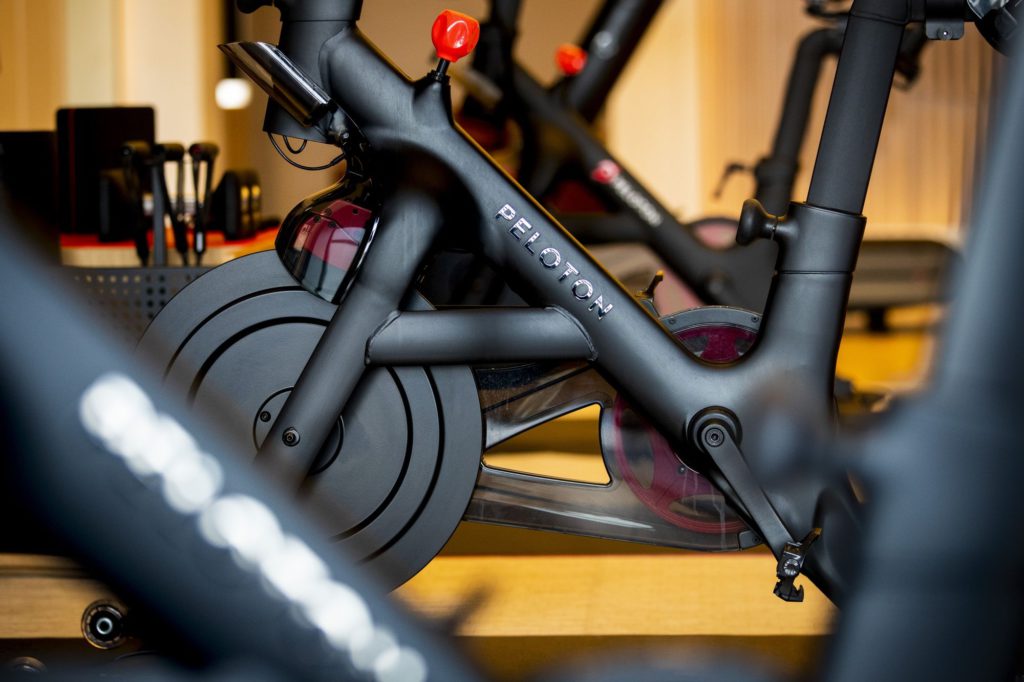
Peloton Promises to Crack Down on Explicit Spam Accounts

(Bloomberg) — The home-fitness streamer Peloton Interactive Inc. has promised to crack down on spam accounts featuring explicit images in their user display fields.

“Today, Peloton is taking active action against accounts being intentionally created with inappropriate content, including explicit imagery in their profile picture,” the company wrote in an emailed statement to members. The statement said that such images directly violate the company’s terms of service, and that it’s working to block the accounts. Members are encouraged to report usernames that violate the terms of service to the company.

The company’s terms of service stipulates that users “may not use someone else’s name, or any name, location, other public profile information or image that violates any third party rights, is against the law, or that is offensive, obscene or otherwise objectionable.” 

A representative for Peloton declined to comment beyond the statement. Users on Peloton’s dedicated Reddit community, r/pelotoncycle have reported seeing inappropriate spam accounts in recent days and called for a way to more easily report and block such accounts. 

Peloton was an early-pandemic darling but has found itself with excess inventory and slowing sales over the last year. The company in November delivered a sales forecast for its second quarter that was down about 37% from a year earlier. The company has cut thousands of jobs since Chief Executive Officer Barry McCarthy took over in February along with outsourcing manufacturing and shuttering stores to cut costs. Last month, McCarthy said that the company’s turnaround is a “work in progress.”

(Updates with Peloton comment in fourth paragraph.)

More stories like this are available on bloomberg.com

©2022 Bloomberg L.P.

Close Bitnami banner
Bitnami
