Bloomberg

Jane Street Culture: A View Into SBF’s Roots (Podcast)

(Bloomberg) — Listen to Bloomberg Crypto on the iHeartRadio App, Apple Podcasts or  Spotify.

It’s been just over a month since the digital-asset exchange FTX filed for bankruptcy. And it didn’t take long for events to catch up with its co-founder Sam Bankman-Fried – the onetime crypto billionaire known to most people as SBF.

Bankman-Fried has been arrested in the Bahamas and US authorities have unleashed a slew of charges against him, including defrauding customers who put money on FTX.

Bankman-Fried, the former CEO of FTX, has said it was all down to sloppy accounting and mismanagement. Which is all the more surprising given that he spent three years earlier in his career at one of the Wall Street shops famous for its level of caution: Jane Street. Bloomberg’s Hannah Miller has been reporting on this and she joins this episode. 

Subscribe to the Bloomberg Crypto Newsletter at https://bloom.bg/cryptonewsletter 

This podcast is produced by the Bloomberg Crypto Podcast team: Supervising producer: Vicki Vergolina, Senior Producer: Janet Babin, Producers: Sharon Beriro and Muhammad Farouk, Associate Producers: Mo Andam and Ty Butler. Sound Design/Engineer: Desta Wondirad.


More stories like this are available on bloomberg.com

©2022 Bloomberg L.P.

South Africa Latest: Ramaphosa Wins ANC Reelection in Tight Race

(Bloomberg) — South African President Cyril Ramaphosa was reelected as the head of the governing African National Congress.

Ramaphosa beat former Health Minister Zweli Mkhize, according to Kgalema Motlanthe, head of the party’s election panel. 

Rand gains before results of vote (Dec. 19, 10:55 a.m.)

South Africa’s currency traded 1.2% firmer at 17.4695 per dollar by 10:53 a.m. in Johannesburg as the race for the party’s top post became a closer race than anticipated. 

Conference Delays May Have Benefitted Mkhize (Dec. 19, 8:50 a.m.)

While Ramaphosa received more than double Mkhize’s nominations for the party presidency position in the run-up to the conference, the race narrowed at the weekend as alliances shifted. Delays to the conference program caused by technical glitches that slowed the registration of delegates may have been used by Mkhize’s camp to build support, Oxford Economics Africa said in a research note on Monday. 

“The delays in getting the conference started likely worked in favor of Team Mkhize and gave those campaigning against Mr. Ramaphosa an extra day to lobby delegates from vote-rich provinces,” it said.

ANC Condemns Accusations of Vote Buying (Dec. 18, 3:23 p.m.)

Accusations of vote buying damaged the ANC’s brand and undermined the credibility of its leaders and the practice wouldn’t be tolerated, according to spokesman Pule Mabe. Security officials and marshals had been briefed to report any suspicious exchange of money to the conference’s steering committee, he told reporters.

Vote buying is the “antithesis of what we stand for,” Mabe said. “The leadership of the ANC must be beyond reproach.”

The Candidates for Top Positions (Dec. 18, 2:20 a.m.)

Ramaphosa former Mkhize are the only nominees to lead the party. Cooperative Governance Minister Nkosazana Dlamini-Zuma, who narrowly lost to Ramaphosa in the contest to lead the ANC in 2017 and is among the president’s detractors, declined a nomination from the conference floor to run for the top post.

Deputy President David Mabuza also said he wasn’t available to be re-elected deputy party leader, leaving the position to be contested by Justice Minister Ronald Lamola, Eastern Cape Premier Oscar Mabuyane and ANC Treasurer-General Paul Mashatile. Mabuza’s decision means he’s unlikely to serve a second term as the nation’s deputy president. 

These are the candidates for the other top posts:

Secretary-General:

  • Mdumiseni Ntuli, a former ANC secretary in the KwaZulu-Natal province
  • Phumulo Masualle, the deputy minister of public enterprises
  • Fikile Mbalula, the transport minister

Deputy Secretary-General:

  • Nomvula Mokonyane, a former minister of environmental affairs
  • Tina Joemat-Pettersson, a former energy minister

Second Deputy Secretary-General 

  • Maropene Ramokgopa, a presidential adviser on international relations
  • Ronalda Nalomanga, an ANC official from the Western Cape province

Chairperson:    

  • Stanley Mathabatha, the premier of the Limpopo province
  • Gwede Mantashe, the mineral resources and energy minister, and incumbent ANC chairman
  • David Masondo, the deputy finance minister

Treasurer-General:

  • Bejani Chauke, a special adviser to Ramaphosa
  • Pule Mabe, the ANC’s spokesman
  • Mzwandile Masina, a former mayor of the Ekurhuleni municipality
  • Gwen Ramakgopa, a former deputy health minister

ANC Registers Delegates to Pick Leader (Dec. 17, 10 p.m.)

The ANC completed the registration of 4,426 voting delegates attending its conference.

Challenges that delayed the process included a new registration system, a poor computer network, faulty equipment and power cuts, the ANC’s credentials committee said in a report on Saturday. There were also late changes to some delegate lists and problems with tags and photos, it said.

The five-day conference is due to end on Dec. 20. 

ANC Membership Nosedives (Dec. 17, 9 p.m.)

The party’s membership has fallen sharply over the past two years, a decline that mirrors its waning support.

The ANC credential committee’s report shows the party has 691,381 paid-up members, down from 1.6 million in July 2020. 

“The sharp fall in membership numbers shows the general apathy toward the party and organizational disarray,” said Melanie Verwoerd, an independent political analyst and former ANC lawmaker. “The use of an electronic membership system by the ANC since its last national conference in 2017 also lends credence to suspicions then that membership numbers had been inflated.”

Godongwana Says Policy Shift Unlikely (Dec. 17, 8 a.m. )

Finance Minister Enoch Godongwana told business leaders attending a breakfast on the sidelines of the conference that ANC policy isn’t determined by the party’s leaders and won’t necessarily shift if power does change hands. He also said he’d be prepared to continue working with Ramaphosa or Mkhize.

“Unlike in the USA where the policy belongs to the president, policy belongs to the party, so irrespective of the change in government, the party will continue to pursue its policy,” Godongwana said. “I am not panicking an inch about who comes out.”

–With assistance from Paul Vecchiatto, Monique Vanek, Rene Vollgraaff and Amogelang Mbatha.

More stories like this are available on bloomberg.com

©2022 Bloomberg L.P.

The Humble Hybrid Vehicle Isn’t Going Anywhere Yet

(Bloomberg) — At 78, Jim Beermann realizes his carbon footprint will go to zero sometime in the not-too-distant future. He’s just hoping to keep it relatively low in the meantime. So Beermann was frustrated to find that his senior center in Juno Beach, Florida, doesn’t have electric vehicle chargers or plans to build them anytime soon. 

Like many people on the cusp of EV adoption, Beermann bought himself a hybrid instead. In a typical week, he drives his 2019 Ford Fusion — a plugless car — about 140 miles and uses a little less than three gallons of gasoline. “More than anything it’s the footprint I’m leaving,” he says. “I appreciate the fact that I’m using less gasoline … and the fact that I’m not using the car a lot is also reducing my footprint.”

The humble hybrid vehicle, long considered a half-step on the road to electrified transport, is sticking around longer than many anticipated, as carmakers work out the kinks on manufacturing full EVs at scale and consumers deal with sticker shock. In the first nine months of the year, drivers around the world bought almost 2 million hybrid vehicles, a 45% increase from the year-earlier period, according to BloombergNEF. Full EVs are far more popular — they outsell hybrids at a pace almost three to one — but the two technologies have accelerated in parallel. Over the past three years, EV sales are up almost five-fold, while hybrid sales have quadrupled.

For many drivers, it appears, a few electric miles are enough — and certainly better than none at all.

For carmakers, hybrids present a pragmatic way to dip a toe into electrification and capitalize on the wide swath of drivers who are both EV-curious and EV-skeptical. While a fully electric vehicle requires dedicated architecture to accommodate a massive battery, engineers can easily tuck away the smaller power plant found in most hybrids. That means almost any car can be hybridized without too much additional cost.Three of the most popular BMW models, for example, come in a full-gasoline or a plug-in version that can manage up to 30 miles entirely on electrons. The story is similar at Hyundai, where two of the best-selling models can be had in three fuel forms: gas, plugless hybrid or a more robust plug-in hybrid.

Toyota, in particular, is capitalizing on the trend: One quarter of the vehicles it sold globally this year have both a gas engine and an electric motor. The company also just unveiled the fifth iteration of its Prius, some 25 years after the car’s debut. 

Toyota is keeping a hybrid-heavy lineup in part because it expects battery materials and charging infrastructure to remain scarce for at least the coming decade. “We need to employ systems thinking,” Gill Pratt, Toyota’s chief scientist, recently told Bloomberg. “Battery cells should be put where they will do the most good.” From a carbon perspective, Pratt says dozens of hybrids in a fleet of cars is cleaner than just a few EVs. 

The extension of hybrids’ half-step moment has a lot to do with the electric future’s faltering start. EV fever is rising faster than most auto executives expected, and car companies are hustling to catch up. For some countries, the gap between demand and supply is closing quickly. In Norway, for example, every fifth car on the road is an EV, and in China one quarter of new car sales are electric. But as factories rush to link battery supply chains and spool up new assembly lines, many places won’t see supply meet demand for years. In the US, one quarter of potential car buyers wanted to go electric in the first half of 2022, but only 4% of vehicles coming out of North American factories fit the bill.

That imbalance has made it tough to find an electric car, especially one at a decent price. The average sticker price for an EV in October was almost $59,000 in the US, nearly a quarter more than the industry at large, according to Edmunds. Hybrids were more expensive than gas cars, but only slightly.

“They make sense for someone looking to maximize value,” says Edmunds analyst Ivan Drury. “They’re not nearly as costly as full EVs, nor do they come with compromises.”

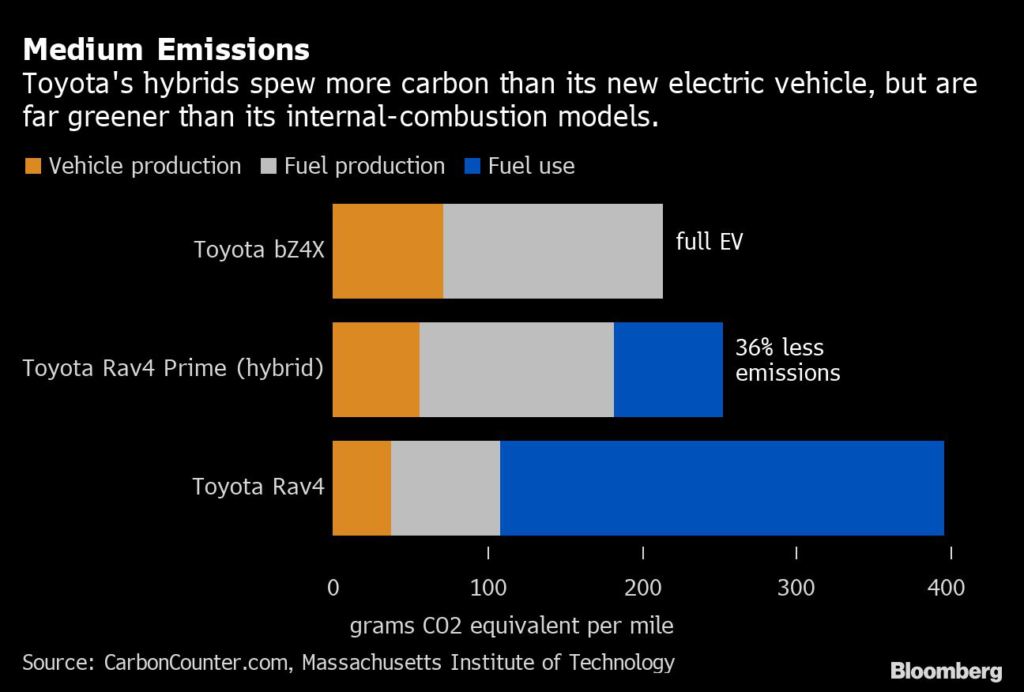
There’s also a growing awareness that full EVs come with a notable carbon footprint of their own. Driving an electric car generates little in the way of emissions, but mining rare earth metals for giant batteries and shipping those ponderous power plants around the world emits far more than stamping out an engine to burn gasoline — up to two times more, according to CarbonCounter.com, a model developed by the Massachusetts Institute of Technology’s Trancik Lab. And while a full electric vehicle is always the cleaner option over the life of a car, some consumers — particularly those who don’t drive very much —  figure a hybrid is a fairly similar shade of green.

“I don’t know that we necessarily need two cars, but we sort of need like 1.5 cars,” says Kate Buckens, a food stylist who lives in rural Connecticut with her husband and toddler. In May, the couple bought a hybrid Toyota Rav4 Prime to supplement their gasoline-powered 2015 Subaru Forester. When Buckens travels to New York for a styling job, about half of the trip — each way — is entirely on electrons.

“The full electric vehicle is in our future, but we’re not ready for it right now,” she says. “And if we’re in our 30-mile radius, which is how we tend to live when I’m not working, then we use very little gas, often none at all.”

The Buckens’ Rav4 didn’t take much carbon to make, at least not much more than a standard Rav4 that runs on dead dinosaur goo. Over its lifetime, a Toyota bZ4X, the company’s new EV, will emit 46% less carbon than a standard Rav4, according to CarbonCounter. The hybrid Rav4 Prime, however, is no carbon slouch; its emissions will be about 36% lower than its internal-combustion cousin by the time it rolls into a recycling center. 

“On average, your emissions are substantially lower if you go for the full electric,” says Jessika Trancik, an MIT professor and architect of the school’s CarbonCounter. “But we could probably think of extreme edge cases where a hybrid is just as good.”

A small, lighter hybrid car, for example, closes the carbon gap on a bulky gasoline-powered truck. Likewise, the difference in emissions between a hybrid and a full EV is lower in parts of the country where the power grid is still rich with fossil-fuel generation — for example, the Mountain West. Topping up a Tesla in Wyoming is a dirtier exercise than doing so in Texas, a gusher of renewable energy.

Ultimately, Trancik says people should try to electrify as much of their travel as they are able, particularly because any new vehicle is going to be around for at least 10 to 15 years. 

“It’s really like a tiny power plant — that’s the commitment you’re making to whatever type of fuel it uses,” she says. “As a consumer, you can think of yourself as an agent of market creation for the technology you choose; you’re shifting the market in a small way.” 

More stories like this are available on bloomberg.com

©2022 Bloomberg L.P.

South Africa Latest: Rand Gains Amid Speculation About ANC Vote

(Bloomberg) — The rand strengthened as speculation about the outcome of the race to lead South Africa’s governing party intensified.

The currency traded 1.2% firmer at 17.4695 per dollar by 10:53 a.m. in Johannesburg. The African National Congress is preparing to announce the results of the weekend election, with President Cyril Ramaphosa and Health Minister Zweli Mkhize in a closer race than anticipated for the top party job.

Conference Delays May Have Benefitted Mkhize (Dec. 19, 8:50 a.m.)

While Ramaphosa received more than double Mkhize’s nominations for the party presidency position in the run-up to the conference, the race narrowed at the weekend as alliances shifted. Delays to the conference program caused by technical glitches that slowed the registration of delegates may have been used by Mkhize’s camp to build support, Oxford Economics Africa said in a research note on Monday. 

“The delays in getting the conference started likely worked in favor of Team Mkhize and gave those campaigning against Mr. Ramaphosa an extra day to lobby delegates from vote-rich provinces,” it said.

ANC Condemns Accusations of Vote Buying (Dec. 18, 3:23 p.m.)

Accusations of vote buying damaged the ANC’s brand and undermined the credibility of its leaders and the practice wouldn’t be tolerated, according to spokesman Pule Mabe. Security officials and marshals had been briefed to report any suspicious exchange of money to the conference’s steering committee, he told reporters.

Vote buying is the “antithesis of what we stand for,” Mabe said. “The leadership of the ANC must be beyond reproach.”

The Candidates for Top Positions (Dec. 18, 2:20 a.m.)

Ramaphosa former Mkhize are the only nominees to lead the party. Cooperative Governance Minister Nkosazana Dlamini-Zuma, who narrowly lost to Ramaphosa in the contest to lead the ANC in 2017 and is among the president’s detractors, declined a nomination from the conference floor to run for the top post.

Deputy President David Mabuza also said he wasn’t available to be re-elected deputy party leader, leaving the position to be contested by Justice Minister Ronald Lamola, Eastern Cape Premier Oscar Mabuyane and ANC Treasurer-General Paul Mashatile. Mabuza’s decision means he’s unlikely to serve a second term as the nation’s deputy president. 

These are the candidates for the other top posts:

Secretary-General:

  • Mdumiseni Ntuli, a former ANC secretary in the KwaZulu-Natal province
  • Phumulo Masualle, the deputy minister of public enterprises
  • Fikile Mbalula, the transport minister

Deputy Secretary-General:

  • Nomvula Mokonyane, a former minister of environmental affairs
  • Tina Joemat-Pettersson, a former energy minister

Second Deputy Secretary-General 

  • Maropene Ramokgopa, a presidential adviser on international relations
  • Ronalda Nalomanga, an ANC official from the Western Cape province

Chairperson:    

  • Stanley Mathabatha, the premier of the Limpopo province
  • Gwede Mantashe, the mineral resources and energy minister, and incumbent ANC chairman
  • David Masondo, the deputy finance minister

Treasurer-General:

  • Bejani Chauke, a special adviser to Ramaphosa
  • Pule Mabe, the ANC’s spokesman
  • Mzwandile Masina, a former mayor of the Ekurhuleni municipality
  • Gwen Ramakgopa, a former deputy health minister

ANC Registers Delegates to Pick Leader (Dec. 17, 10 p.m.)

The ANC completed the registration of 4,426 voting delegates attending its conference.

Challenges that delayed the process included a new registration system, a poor computer network, faulty equipment and power cuts, the ANC’s credentials committee said in a report on Saturday. There were also late changes to some delegate lists and problems with tags and photos, it said.

The five-day conference is due to end on Dec. 20. 

ANC Membership Nosedives (Dec. 17, 9 p.m.)

The party’s membership has fallen sharply over the past two years, a decline that mirrors its waning support.

The ANC credential committee’s report shows the party has 691,381 paid-up members, down from 1.6 million in July 2020. 

“The sharp fall in membership numbers shows the general apathy toward the party and organizational disarray,” said Melanie Verwoerd, an independent political analyst and former ANC lawmaker. “The use of an electronic membership system by the ANC since its last national conference in 2017 also lends credence to suspicions then that membership numbers had been inflated.”

Godongwana Says Policy Shift Unlikely (Dec. 17, 8 a.m. )

Finance Minister Enoch Godongwana told business leaders attending a breakfast on the sidelines of the conference that ANC policy isn’t determined by the party’s leaders and won’t necessarily shift if power does change hands. He also said he’d be prepared to continue working with Ramaphosa or Mkhize.

“Unlike in the USA where the policy belongs to the president, policy belongs to the party, so irrespective of the change in government, the party will continue to pursue its policy,” Godongwana said. “I am not panicking an inch about who comes out.”

More stories like this are available on bloomberg.com

©2022 Bloomberg L.P.

Musk Poll on Stepping Down as Twitter Chief Leans Toward Yes

(Bloomberg) — Elon Musk, under fire for recent policy changes at Twitter Inc., is asking users whether he should step down as head of the social media site.

With about four hours left and 14 million votes cast, 57% of participants have said yes. The billionaire owner of Twitter and chief executive officer of Tesla Inc. will abide by the results of the poll, he pledged in a tweet Sunday. Three of the top trending topics in the US overnight were about the platform itself, including “VOTE YES” and “CEO of Twitter.”

Musk was in Qatar to watch the World Cup final match between Argentina and France and tweeted out his poll after the game’s conclusion. He also pledged to implement a vote for any major policy changes in the future, apologizing for not having done so before. 

Following his takeover of Twitter, Musk has weathered criticism for his sweeping changes at the social network — such as firing more than half its staff and bringing back previously barred accounts — as well as calls to refocus on Tesla, whose share price has been plummeting. Since reluctantly completing the Twitter acquisition at the end of October, he has spent much of his time on the social service.

He was posting late into the night Thursday after tangling with journalists, Twitter’s most engaged and active contributors. The company banned a number of them from major publications like the Washington Post and CNN, alleging they were doxxing his location. The move incurred condemnation from the likes of the American Civil Liberties Union and even the United Nations, who called it a “dangerous precedent.”

Over the weekend, Twitter also announced and withdrew a policy change whereby it would bar accounts “created solely” to promote competing social networks. That decision led to the suspension of at least one prominent account, prompting Musk to say he’ll adjust the policy mere hours after its introduction. The Twitter Safety account later offered a poll on whether it should have the policy on removing accounts promoting other social media platforms.

(Updates with latest poll standings; an earlier version corrected spelling of Jared Kushner’s name in photo caption)

More stories like this are available on bloomberg.com

©2022 Bloomberg L.P.

South Africa Latest: ANC Resumes Meeting After Leadership Vote

(Bloomberg) — South Africa’s governing African National Congress will resume its conference on Monday after holding an election for top leaders at the weekend.

The party will resume its plenary session at 9 a.m., the party said in a memorandum circulated to the party. Members spent most of Sunday voting for the positions of ANC president, deputy president and five other executive posts. Balloting took place a day later than planned after technical glitches delayed the registration of delegates at the five-yearly conference.

While President Cyril Ramaphosa received more than double former Health Minister Zweli Mkhize nominations for the party presidency position in the run-up to the conference, the race narrowed at the weekend as alliances shifted. “The delays in getting the conference started likely worked in favor of Team Mkhize and gave those campaigning against Mr. Ramaphosa an extra day to lobby delegates from vote-rich provinces,” Oxford Economics Africa said in a research note on Monday.  

ANC Condemns Accusations of Vote Buying (Dec. 18, 3:23 p.m.)

Accusations of vote buying damaged the ANC’s brand and undermined the credibility of its leaders and the practice wouldn’t be tolerated, according to spokesman Pule Mabe. Security officials and marshals had been briefed to report any suspicious exchange of money to the conference’s steering committee, he told reporters.

Vote buying is the “antithesis of what we stand for,” Mabe said. “The leadership of the ANC must be beyond reproach.”

The Candidates for Top Positions (Dec. 18, 2:20 a.m.)

President Cyril Ramaphosa and former Health Minister Zweli Mkhize are the only nominees to lead the party. Cooperative Governance Minister Nkosazana Dlamini-Zuma, who narrowly lost to Ramaphosa in the contest to lead the ANC in 2017 and is among the president’s detractors, declined a nomination from the conference floor to run for the top post.

Deputy President David Mabuza also said he wasn’t available to be re-elected deputy party leader, leaving the position to be contested by Justice Minister Ronald Lamola, Eastern Cape Premier Oscar Mabuyane and ANC Treasurer-General Paul Mashatile. Mabuza’s decision means he’s unlikely to serve a second term as the nation’s deputy president. 

These are the candidates for the other top posts:

Secretary-General:

  • Mdumiseni Ntuli, a former ANC secretary in the KwaZulu-Natal province
  • Phumulo Masualle, the deputy minister of public enterprises
  • Fikile Mbalula, the transport minister

Deputy Secretary-General:

  • Nomvula Mokonyane, a former minister of environmental affairs
  • Tina Joemat-Pettersson, a former energy minister

Second Deputy Secretary-General 

  • Maropene Ramokgopa, a presidential adviser on international relations
  • Ronalda Nalomanga, an ANC official from the Western Cape province

Chairperson:    

  • Stanley Mathabatha, the premier of the Limpopo province
  • Gwede Mantashe, the mineral resources and energy minister, and incumbent ANC chairman
  • David Masondo, the deputy finance minister

Treasurer-General:

  • Bejani Chauke, a special adviser to Ramaphosa
  • Pule Mabe, the ANC’s spokesman
  • Mzwandile Masina, a former mayor of the Ekurhuleni municipality
  • Gwen Ramakgopa, a former deputy health minister

ANC Registers Delegates to Pick Leader (Dec. 17, 10 p.m.)

The ANC completed the registration of 4,426 voting delegates attending its conference.

Challenges that delayed the process included a new registration system, a poor computer network, faulty equipment and power cuts, the ANC’s credentials committee said in a report on Saturday. There were also late changes to some delegate lists and problems with tags and photos, it said.

The five-day conference is due to end on Dec. 20. 

ANC Membership Nosedives (Dec. 17, 9 p.m.)

The party’s membership has fallen sharply over the past two years, a decline that mirrors its waning support.

The ANC credential committee’s report shows the party has 691,381 paid-up members, down from 1.6 million in July 2020. 

“The sharp fall in membership numbers shows the general apathy toward the party and organizational disarray,” said Melanie Verwoerd, an independent political analyst and former ANC lawmaker. “The use of an electronic membership system by the ANC since its last national conference in 2017 also lends credence to suspicions then that membership numbers had been inflated.”

Godongwana Says Policy Shift Unlikely (Dec. 17, 8 a.m. )

Finance Minister Enoch Godongwana told business leaders attending a breakfast on the sidelines of the conference that ANC policy isn’t determined by the party’s leaders and won’t necessarily shift if power does change hands. He also said he’d be prepared to continue working with Ramaphosa or Mkhize.

“Unlike in the USA where the policy belongs to the president, policy belongs to the party, so irrespective of the change in government, the party will continue to pursue its policy,” Godongwana said. “I am not panicking an inch about who comes out.”

–With assistance from Paul Vecchiatto, Monique Vanek, Rene Vollgraaff and Amogelang Mbatha.

More stories like this are available on bloomberg.com

©2022 Bloomberg L.P.
Binance Token Snaps Losing Streak Spurred by Worries Over Crypto Exchange

(Bloomberg) — The native token of crypto exchange Binance Holdings Ltd. snapped a prolonged slide that was sparked in part by concerns about outflows from the world’s largest digital-asset trading platform. 

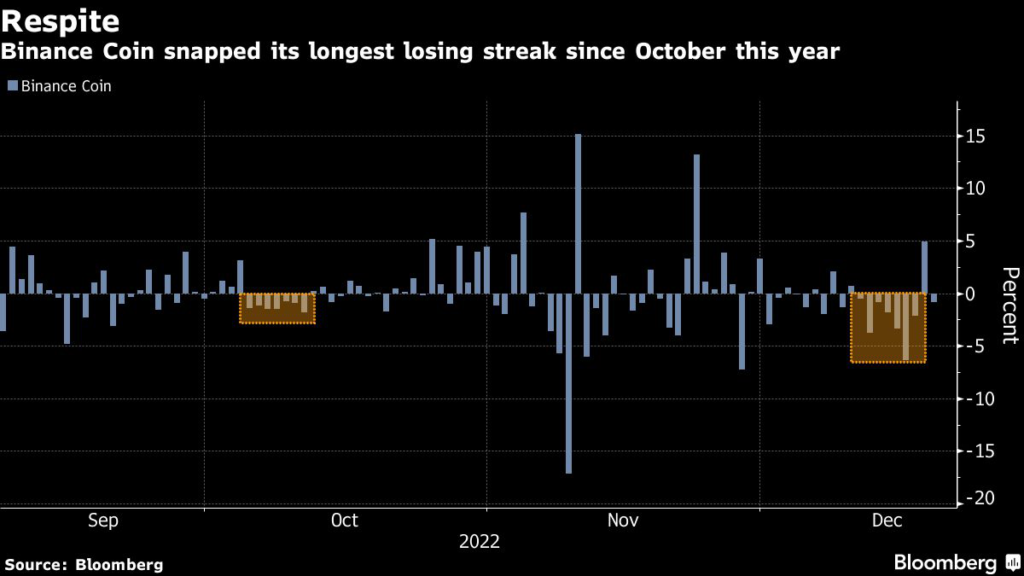
Binance Coin — or BNB — is up about 4% in the past two days, ending a seven-day losing streak through Saturday that was the longest since October. Bitcoin and a gauge of the top 100 tokens treaded water over Sunday and Monday.

BNB could be viewed as an arbiter of sentiment toward Binance. The platform saw $6 billion of net withdrawals over three days last week amid a general lack of confidence in crypto following the bankruptcy of rival exchange FTX and allegations of fraud against the latter’s founder Sam Bankman-Fried.

A Binance spokesperson declined to comment on BNB price movements while reiterating that by fulfilling recent withdrawals, the exchange passed a stress test that should offer “extraordinary comfort” that funds are secure.

There was “a lot of FUD about Binance last week,” said Cici Lu, chief executive officer of crypto consultancy Venn Link Partners, using an acronym for fear, uncertainty and doubt. “The market is in ‘shoot first and ask questions later’ mode but perhaps the selling is overdone — for now.”

There was a net inflow of 338 Bitcoins to Binance on Sunday, compared with a record net daily efflux of more than 40,000 on Dec. 13, according to data from CryptoQuant. Net outflows of Ether slowed to 1,183 tokens on Sunday versus a net exit of more than 278,000 last Tuesday.

Binance and some other digital-asset exchanges had engaged accounting firm Mazars Group to work on reports that were meant to show the companies have the needed reserves to cover a surge in withdrawals.

But Mazars last week said it was suspending work for crypto outfits because of signs that markets haven’t been reassured by “proof-of-reserves” reports published so far. The firm was also concerned about intense media scrutiny.

Zhao’s Defense

Binance said the company embraces additional transparency and is searching for a big accountancy firm that’s willing to work on such reports. 

Chief Executive Officer Changpeng Zhao has been defending the exchange’s position. He said in a tweet Sunday that “we are still hiring,” linking back to a post from June saying that Binance was hiring for 2,000 open positions. Before that, he’d tweeted that “FUD is temporary.” 

Fundstrat Global Advisors LLC’s head of digital-asset strategy Sean Farrell said in a note on Friday that it’s likely that Binance is solvent and has customer assets fully backed.

But he also said there’s “a non-zero chance” of Binance going “belly-up in the instance of a complete bank run.” He added that “to easily mitigate any risk of asset loss or seizure, one should remove all funds from the exchange.”

BNB was trading at about $247 as of 2:10 p.m. in Singapore on Monday. The token has shed 9% over the past month, a period when Bitcoin has been steady. BNB is up more than $1,600% over the past three years, compared with Bitcoin’s 133% gain.

For crypto market prices: CRYP; for top crypto news: TOP CRYPTO.

–With assistance from Sidhartha Shukla.

More stories like this are available on bloomberg.com

©2022 Bloomberg L.P.
North Korea Hails Satellite Success, Unveils Spy Photos of Seoul

(Bloomberg) — North Korea said it carried out the final tests of a military spy satellite, publishing a pair of black-and-white overhead images of South Korea’s capital region in an attempt to show the device worked.

The country announced the breakthrough via state media Monday, a day after South Korea said its rival lobbed at least two suspected medium-range ballistic missiles through space and into the sea. While North Korea described a single rocket launch with a similar flight path Sunday, it said the vehicle released a demonstration satellite carrying various cameras and transmitters. 

The pictures released by the Korean Central News Agency covered much of Seoul and the adjacent port of Incheon and included an area where South Korean President Yoon Suk Yeol’s office is located. They had a resolution of 20 meters, KCNA said, far less detailed than the 0.5 meters standard that experts say is typical for modern military applications. 

“The technology looks like what South Korea had in the start of its satellite development in 1990s,” said Bang Hyo-choong, who teaches spacecraft flight dynamics and control at Korea Advanced Institute of Science and Technology. “What’s important is how much they can zoom in and whether their technology is advanced enough to discern roads and buildings.”

The authenticity of the images couldn’t immediately be confirmed. Leader Kim Jong Un has gone to great lengths to convince the world of his military achievements, apparently launching an older intercontinental ballistic missile earlier this year to pass off the failure of a new model as a success in a video.

North Korea has in the past used space activities to obscure the development of its nuclear missile program, because sending a satellite into space and lobbing a warhead to another continent relies on much the same technology. Sunday’s rocket launch coincided with the 10th anniversary of Pyongyang’s test of its “Shining Star” Earth-observation satellite. 

“That ended up a dud in orbit, so this photo shows how much the program and its launch capabilities have improved in the decade,” Martyn Williams, a fellow with the Washington-based Stimson Center think tank, said on Twitter. 

The new satellite project is on track for completion in April, KNCA said, a month when North Korea often marks the birthday of its founder, Kim Il Sung, with parades and other displays of military might. Kim has stepped up the development of his nuclear weapons program this year, launching a record number of ballistic missiles, while refusing US President Joe Biden’s overtures to resume talks.

American officials are concerned North Korea is seeking to develop an ICBM with multiple warheads in a bid to overwhelm missile defense systems. Describing such tests as satellite launches could reduce pressure on China to take a stronger stand at the United Nations, where Washington has been urging Beijing and Moscow to support additional sanctions.

The two missiles South Korea said were launched Sunday were fired off from a site near the Sohae Satellite Launching Ground, where the regime also tested a new solid-fuel rocket engine last week. Solid-fuel missiles are quicker to deploy and easier to hide, giving the US and its allies less time to see signs of a launch and prepare interceptors. 

The reconnaissance satellite project North Korea’s National Aerospace Development Administration conducted was intended to “evaluate the capabilities of satellite photography and data-transmission system and ground-control system,” KCNA said.

The resolution of the photos North Korea released may seem low now, but Pyongyang wants to show that it’s capable of detecting signs of any preemptive strikes from allied bases, said Lim Eul-chul, a professor at Kyungnam University’s Institute for Far Eastern Studies in Seoul.

“They must have already taken shots of South Korea throughout, but it might look too explicit to release images of areas with military bases at the moment,” Lim said. “That’s why they chose to unveil images of Seoul and other areas instead.”  

–With assistance from Shinhye Kang and Seyoon Kim.

More stories like this are available on bloomberg.com

©2022 Bloomberg L.P.
Retailers Dangle Credit to Get UK Holiday Shoppers Spending

(Bloomberg) — British retailers are drumming up new credit offers to encourage shoppers to spend more during one of the most challenging Christmas periods for business in years.

For the first time in a decade, department store John Lewis Partnership Plc, a favorite of middle-class Britons, has lowered the threshold for interest-free loans to £500 ($608) from £1,000. High Street mainstays Marks & Spencer Group Plc and Currys Plc are also offering more attractive financing options to tempt shoppers into splurging, and Frasers Group Plc is planning to launch a credit product as well.

“Credit has come into its own in the cost-of-living crisis,” said Alex Baldock, chief executive officer of electronics seller Currys.

While retailers have always provided financing, the flurry of new offers — including interest-free proposals that cost the shops more to fund — indicate how hard-fought this Christmas will be. With inflation at a four-decade high and energy bills set to surge, consumers are pulling back on discretionary spending.

Retailers need to drive sales and cash flow during the festive period to help them shoulder their own cost burden as large rent, wage, tax and stock bills loom in January. 

Critics warn stores are urging shoppers to take on more debt at a dangerous time. The UK is in a recession and real incomes are falling, making it harder to repay borrowings. About 30% of British consumers are already depending on loans and Buy Now, Pay Later programs to fund Christmas this year, according to a survey by e-commerce agency RVS Media. 

“There’s a risk of people piling borrowing on top of borrowing,” said Matthew Upton, director of policy at charity Citizens Advice. “As living costs spiral, the number of people who will see credit as the answer will grow, showing just how much people are struggling to get by.”

Unregulated Buy Now, Pay Later arrangements — point-of-sale financing that allows shoppers to make purchases and pay at a future date, often without interest — are particularly dangerous, according to Labour MP Stella Creasy, who is campaigning for regulation of the industry. “Many end up spending more than they meant to by using it. I’m urging retailers not to offer it.”  

There are clear signs shoppers are borrowing more, and not just on Christmas gifts. The average size of an Iceland Foods loan has increased to about £70 from £55 earlier in the year as consumers feel the pinch, according to Fair for You, the not-for-profit consumer lender partnering with Iceland.

The grocer’s micro loans, which let customers pay for food in installments, are so popular that last week 4,000 loans were issued on a single day, amounting to more than £250,000.

Bigger Baskets 

Consumers borrowed £400 million on credit cards in October, up from £100 million the month before, according to Bank of England data. The growth rate in consumer credit reached 7.2% in September, the highest since March 2019.

More and more retailers are providing a range of credit options, partly because it often leads to bigger basket sizes, said Peter Hewlett, fintech leader at PwC.

Frasers is preparing to launch its own regulated Buy Now, Pay Later platform, Frasers Plus, in coming months, along with a loyalty scheme across the group. Shoppers, for example, will be able to gain rewards at Sports Direct and spend them at Flannels, CEO Michael Murray said in a phone interview.

M&S is planning to extend its regulated digital credit account to be used in its stores by Spring. Currently customers using Sparks Pay can spend as much as £500 interest-free on the app or website.

Credit Costs

Rising interest rates mean offering interest-free credit doesn’t come cheaply for retailers. Stores are paying more to firms like Novuna and Barclays Partner Finance, who receive a slice of each sale in exchange for providing the consumer credit.

The key question is whether more consumers are defaulting. The answer appears to be not yet.

Next Plc, which has a major regulated finance arm, said in September that customer defaults are below pre-Covid levels and shoppers are paying down more of their balance each month than before. But The Very Group, which has always offered flexible financing as part of its business, set aside an extra £5 million in October “for prudence” in case defaults rise. 

“When times are straitened, the majority of folks will shop around for affordability,” said Clive Black, a retail analyst at Shore Capital. “Those retailers who have capability for safe and reliable credit will probably capture market share.”

More stories like this are available on bloomberg.com

©2022 Bloomberg L.P.
Apple Suppliers Accelerate Buildup Outside China, Analysts Say

(Bloomberg) — India and Vietnam are emerging as Apple Inc.’s next manufacturing hubs as assembly partners seek to add resilience to a supply chain heavily centered on China and shaken by its geopolitical and health challenges.

Key electronics manufacturers are moving faster to diversify their capacity globally, taking advantage of local incentive policies, according to Counterpoint Research analysts Ivan Lam and Shenghao Bai. The multiyear effort, which began before Covid-19 and economically stifling lockdowns roiled China, may see leading partner Hon Hai Precision Industry Co. move as much as 30% of its capacity to those Asian nations and Brazil, they said.

They caution that a direct replacement for China isn’t immediately in the cards, however firms like Hon Hai, also known as Foxconn, and fellow Taiwanese assembler Pegatron Corp. are putting the foundations in place to handle more of the final assembly and packaging of products outside China.

“Led by Foxconn and Pegatron, companies have already invested in factories, production lines, relatively advanced manufacturing processes, and personnel training in India,” they wrote. The country’s vast population and high birth rate make it an attractive market for end-products as well as a manufacturing base, while Vietnam’s workforce offers lower labor costs than in China. Vietnam has attracted 21 Apple suppliers to operate in the country, according to the report, though it lacks the ability to produce the all-important iPhone handset.

According to Counterpoint’s research, smartphones manufactured in India grew 16% in the second quarter of this year, reaching more than 44 million units.

China, for its part, has seen its workforce shrinking since 2020, according to data from the World Bank. A legion of skilled workers who’d received some education and training has been the backbone of China’s rise as the world’s factory.

Apple has done its part to reduce reliance on individual factories or skilled labor by making its iPhone product design more modular and transferable across facilities, Counterpoint said. The company has put a focus on ease of maintenance and deployment of new product assembly.

Manufacturing difficulty was reduced significantly with the iPhone 14 and iPhone 14 Plus models, according to the analysts. “Now it is possible for the plants in India to produce the iPhone 14 almost simultaneously with the plants in China,” they wrote. Apple did begin iPhone production in India much faster this year than with prior generations.

Read more: China’s iPhone Factory Stumbles Give India a Chance to Swoop In

More stories like this are available on bloomberg.com

©2022 Bloomberg L.P.
Close Bitnami banner
Bitnami