
Bloomberg

Foxconn to Sell Stake in China Chip Giant Amid Taiwan Review

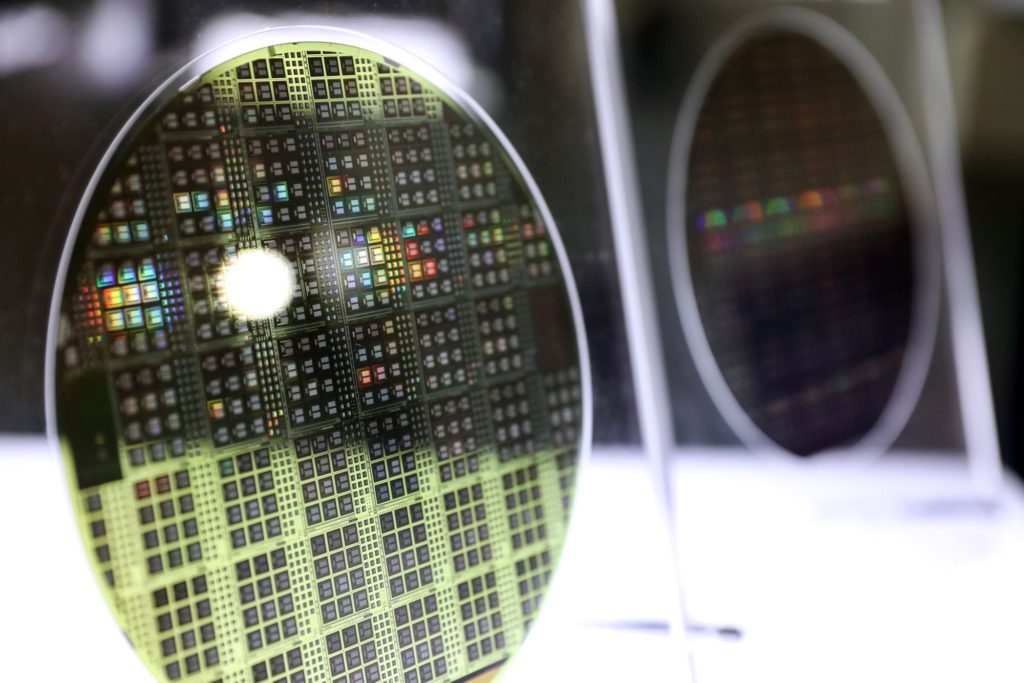
(Bloomberg) — A subsidiary of Taiwan’s Hon Hai Precision Industry will dispose of its indirect minority stake in China’s semiconductor giant Tsinghua Unigroup, the latest sign that Beijing’s chip industry is becoming increasingly isolated from the rest of the world.

Hon Hai’s China-listed Foxconn Industrial Internet will sell the shares to Yantai Haixiu IC Investment Center for not less than 5.38 billion yuan ($772 million), according to an exchange filing Friday.

Hon Hai said in a separate statement that it decided to sell the stake to avoid uncertainty because the investment still cannot be finalized. The company’s interest in the Chinese chipmaker, despite being relatively small, has triggered concerns from the Taiwan government because the state-backed Tsinghua Unigroup is one of the most prominent semiconductor companies in China.

Beijing’s ruling Communist Party sees the self-governing island as a part of China. A visit to Taiwan in August by then-Speaker of the House, Nancy Pelosi, raised tension between the two sides, with Beijing staging unprecedented military exercises in the waters around the island. China has continued to send warplanes on provocative flight paths in the Taiwan Strait.

Opposed Investment 

Taiwan’s Ministry of Economic Affairs said in a statement on Saturday that it will still fine Foxconn for investing in Unigroup without informing the government first. Taiwan opposed the investment and wanted Hon Hai to exit the deal, according to a report by the Financial Times in October. 

FII holds the stake in Unigroup indirectly through Xingwei (Guangzhou) Industrial Investment Partnership. Xingwei invested in Beijing Zhiguangxin Holdings, the parent company of Tsinghua Unigroup, via an affiliate, according to a previous filing.

Hon Hai, better known as Foxconn, is the biggest contract maker of Apple Inc.’s iPhones and operates several assembly plants on the Chinese mainland.

Tsinghua Unigroup didn’t reply to inquiries for comment from Bloomberg News out of business hours.


Beijing’s efforts to develop a self-sufficient chip supply chain at home are facing mounting challenges, with the US and its allies about to jointly restrict Chinese firms’ access to advanced semiconductor technologies.

The US government earlier this week included dozens of Chinese technology companies on its so-called Entity List, making it almost impossible for them to procure critical foreign components and ratcheting up a trade conflict between the world’s two largest economies.

Washington’s action followed the Biden administration’s implementation of tough export controls two months ago to prevent China from buying or making leading-edge semiconductors — crucial for the Asian nation to leapfrog the US in areas such as artificial intelligence and supercomputing. Key US allies, including the Netherlands and Japan, are planning to adopt at least some of the new US rules as well, Bloomberg News reported.


(Adds comment from Taiwan Ministry of Economic Affairs in fifth paragraph)

More stories like this are available on bloomberg.com

©2022 Bloomberg L.P.

Japan Companies Raise Winter Bonus by 9.7%, Nikkei Says

(Bloomberg) — Japanese companies are set to raise winter bonus payments by 9.7%, the largest gain since 1975, a survey by Nikkei newspaper reported Sunday. 

Steel makers led all industries in bonus increases, while semiconductors saw several companies reporting record profit led by strong demand.

Disco Corp., a maker of precision processing equipment, paid ¥3.16 million, the highest level among all companies, according to the survey. Nippon Steel Corp. raised its bonus payments by 2.3 times to ¥1.18 million.

The payout was ¥863,059 ($6,312) per person on a weighted average basis, the highest level since 2018. Bonuses among manufacturers, which make up about 70% of the 511 companies surveyed by the newspaper, rose 9.3%, while non-manufacturers increased by 11%.


More stories like this are available on bloomberg.com

©2022 Bloomberg L.P.

South Africa Latest: Ramaphosa Critic Won’t Run for ANC Leader

(Bloomberg) — South African Cooperative Governance Minister Nkosazana Dlamini-Zuma, a critic of President Cyril Ramaphosa, declined a nomination to run for leader of the nation’s governing party.

Dlamini-Zuma narrowly lost to Ramaphosa in the contest to lead the African National Congress in 2017. Her decision means Ramaphosa and former Health Minister Zweli Mkhize are the only candidates in the running for the top party job at its elective conference beaing held in the Nasrec convention center near Johannesburg.

Deputy President David Mabuza also declined a nomination from the conference floor to be re-elected deputy party leader, leaving the position to be contested by Justice Minister Ronald Lamola, Eastern Cape Premier Oscar Mabuyane and ANC Treasurer-General Paul Mashatile. Mabuza’s decision means he’s unlikely to serve a second term as the nation’s deputy president.

The Other Candidates for Top Positions (Dec. 18, 00:44 a.m.)

The ANC also finalized nominations for other top leadership positions. Voting will take place on Sunday.

There were no further nominations for chair of the party, leaving incumbent Gwede Mantashe, Deputy Finance Minister David Masondo and Limpopo Premier Stanley Mathabatha in the running for the post. There were also no proposals for alternative candidates for the secretary-general post, leaving former ANC KwaZulu-Natal provincial secretary Mdumiseni Ntuli, ex-Eastern Cape Premier Phumulo Masualle and Transport Minister Fikile Mbalula to compete for the position.

Bejani Chauke, a special adviser to Ramaphosa, ANC spokesman Pule Mabe and Mzwandile Masina, the former mayor of the Ekurhuleni municipality will run for the position of treasurer-general, as will Gwen Ramokgopa, a former health minister in the central Gauteng province, who was nominated from the floor. 

Former Environment Minister Nomvula Mokonyane will stand against Tina Joemat-Pettersson, a former energy minister, for the position of first deputy secretary-general.

ANC Registers Delegates to Pick Leader (Dec. 17, 10 p.m.)

The ANC completed the registration of 4,426 voting delegates attending its five-yearly conference , a process that was dogged by a series of delays, clearing the way for its internal elections to proceed.    

Challenges included a new registration system, a poor computer network, faulty equipment and power cuts, the ANC’s credentials committee said in a report on Saturday. There were also late changes to some delegate lists and problems with tags and photos, it said.

The five-day conference is due to end on Dec. 20. 

ANC Membership Nosedives (Dec. 17, 9 p.m.)

The ANC’s membership has fallen sharply over the past two years, a decline that mirrors its waning support.

The credential committee’s report shows the party has 691,381 paid-up members, down from 1.6 million in July 2020. ANC spokesman Pule Mabe estimated earlier on Saturday that there were about 1 million ANC members but said the number was based on raw data that had to be refined.

“The sharp fall in membership numbers shows the general apathy toward the party and organizational disarray,” said Melanie Verwoerd, an independent political analyst and former ANC lawmaker. “The use of an electronic membership system by the ANC since its last national conference in 2017 also lends credence to suspicions then that membership numbers had been inflated.”

ANC Conference Resumes (Dec. 17, 2:30 p.m.)

Proceedings on Saturday got under way several hours later than planned. Mabuza presented reports on the state of the party during a closed session that took place a day later than scheduled.

A report was also due to be presented on the ANC’s finances, and additional nominations for leadership posts sought from the conference floor. 

Godongwana Says Policy Shift Unlikely (Dec. 17, 8 a.m. )

Finance Minister Enoch Godongwana told business leaders attending a breakfast on the sidelines of the conference that ANC policy isn’t determined by the party’s leaders and won’t necessarily shift if power does change hands. He also said he’d be prepared to continue working with Ramaphosa or Mkhize.

“Unlike in the USA where the policy belongs to the president, policy belongs to the party, so irrespective of the change in government, the party will continue to pursue its policy,” Godongwana said. “I am not panicking an inch about who comes out.”

Ramaphosa Warns of Graft Crackdown  (Dec. 16, 6:15 p.m.)

Ramaphosa described those who were guilty of state capture, a term used to describe the mass looting of state funds during his predecessor’s Jacob Zuma nine-year rule, as “anti-democratic and anti-revolutionary,” without identifying name anyone. “Whoever they are and wherever they are, they will be held responsible,” he said, while looking in Zuma’s direction.

The president’s speech was interrupted by delegates from KwaZulu-Natal who want him to be replaced by Mkhize, the province’s former premier. They sang songs in support of Zuma, who was forced to step down as president in 2018 after being implicated in a succession of scandals.

–With assistance from Monique Vanek and Rene Vollgraaff.

More stories like this are available on bloomberg.com

©2022 Bloomberg L.P.
Sam Bankman-Fried to Drop Fight Against US Extradition

(Bloomberg) — Sam Bankman-Fried plans to drop his fight against extradition to the US to face a range of criminal charges, according to people familiar with the matter.

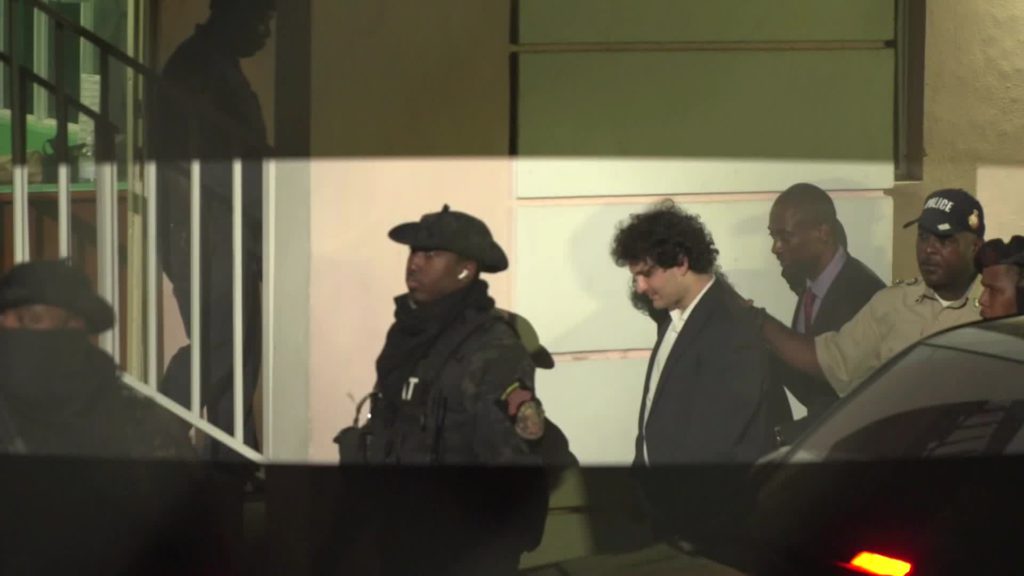
The disgraced co-founder of crypto exchange FTX has been locked up in the Bahamas since last Monday when he was arrested at the request of American authorities. US prosecutors have accused him of a range of crimes including wire fraud. 

Bankman-Fried is expected to disclose that he won’t fight extradition in a court appearance next week, said the people who asked not to be named due to the sensitivity of the matter. Before his arrest, in numerous interviews following FTX’s implosion last month, the 30-year-old denied knowingly committing fraud or breaking the law.

At his first court appearance, Bankman-Fried’s lawyers said he would fight being sent back to the US. If convicted of all the charges against him, Bankman-Fried could face decades behind bars.

A representative for Bankman-Fried declined to comment. The reversal in plans to fight extradition was first reported by Reuters.

After being denied bail at a court appearance on Tuesday, Bankman-Fried was sent to a notorious correctional facility on the outskirts of Nassau known as Fox Hill.

It wasn’t immediately clear what had caused Bankman-Fried to shift his stance.

Authorities in both the Bahamas and the US are continuing to probe Bankman-Fried’s involvement in FTX’s collapse last month. The firm was headquartered in the Bahamas.

More stories like this are available on bloomberg.com

©2022 Bloomberg L.P.
Game Industry Pioneer Quits Meta Over VR Strategy Frustration

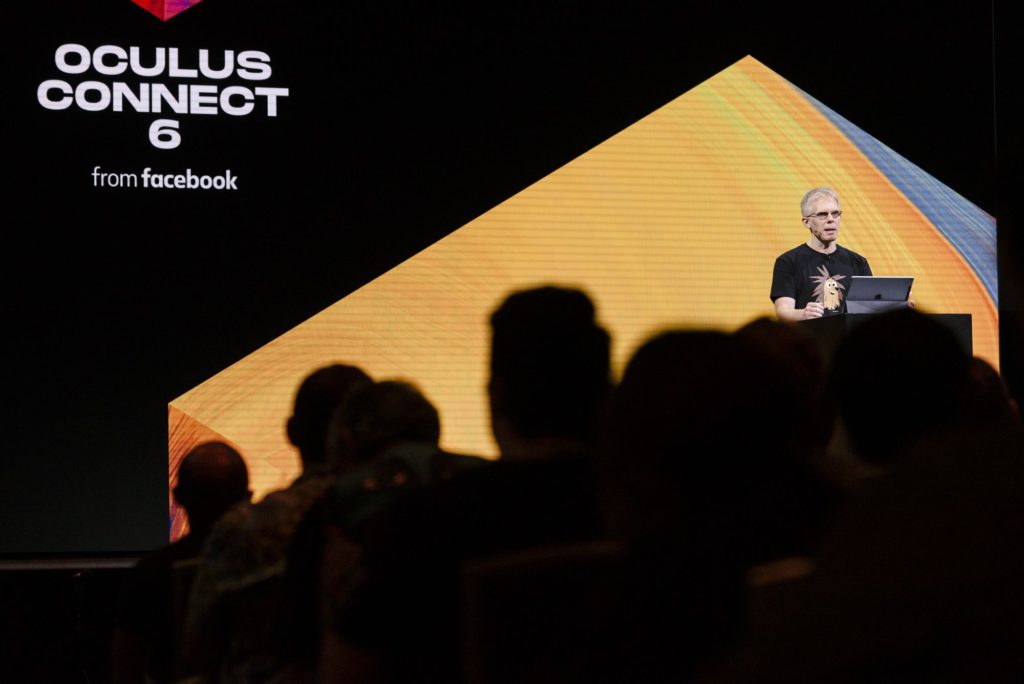
(Bloomberg) — John Carmack resigned from his leadership role at Meta Platforms Inc.’s virtual reality unit, citing frustration with its slow progress and disagreements over strategy with company founder Mark Zuckerberg.

The games industry veteran said in his resignation note that he’d long been frustrated by the poor operational efficiency of Meta’s VR endeavor, which he never felt adequately able to influence in the right direction. 

Carmack, 52, joined VR developer Oculus in 2013 ahead of its acquisition by Meta — then still known as Facebook — in 2014. Having started at Oculus as chief technology officer, he most recently was executive consultant for VR at Meta, where he acted as an outspoken internal critic. Zuckerberg renamed the company he founded Meta to signal its commitment to developing a so-called metaverse of virtual 3D experiences.

“I have a voice at the highest levels here, so it feels like I should be able to move things,” said Carmack in the note. “But I have never been able to kill stupid things before they cause damage, or set a direction and have a team actually stick to it.”

The games industry veteran, whose id Software produced classic first-person shooter games Quake and Doom and helped usher in 3D graphics for PC video games, added on Twitter that he found a “notable gap” in strategic thinking between himself and Zuckerberg. He believes “everything necessary for spectacular success is right there, but it doesn’t get put together effectively” at the company.

Meta is spending billions of dollars each year on its metaverse and VR project, and its Meta Quest 2 is widely regarded as the best VR headset on the market. The company said in October that the operating losses of the Reality Labs unit that houses the venture will grow significantly in 2023, which has not been welcomed by investors looking for more cost discipline from tech companies.

What Bloomberg Intelligence Says

With Meta not having seen an uptick in engagement for its Horizon Worlds app from both the content creators and early users, despite being the most aggressive with its investments in building the metaverse, we believe the company may focus on curtailing operating losses for its Reality Labs’ segment. 

— Mandeep Singh, analyst

Click here for the research 

Meta Investors in No Mood for Zuckerberg’s Metaverse Moonshot

Following the announcement of Carmack’s departure, Meta Chief Technology Officer Andrew Bosworth said on Twitter that “it is impossible to overstate the impact you’ve had on our work and the industry as a whole.”

More stories like this are available on bloomberg.com

©2022 Bloomberg L.P.
South Africa Latest: ANC Registers Delegates to Pick New Leaders

(Bloomberg) — South Africa’s governing party completed the registration of 4,426 voting delegates attending its five-yearly national conference in Johannesburg, a process that was dogged by a series of delays, clearing the way for its internal elections to proceed.    

Challenges included a new registration system, a poor computer network, faulty equipment and power cuts, the African National Congress’s credentials committee said in a report. There were also late changes to some delegate lists and problems with tags and photos, it said.  

President Cyril Ramaphosa is running for a second term as ANC leader, and faces a challenge from former Health Minister Zweli Mkhize. Delegates will also choose six other top officials and 80 additional members of the ANC’s National Executive Committee. The five-day gathering is due to end on Dec. 20, with voting now likely to take place on Sunday.  

ANC Membership Nosedives (Dec. 17, 9 p.m.)

The ANC’s membership has fallen sharply over the past two years, a decline that mirrors its waning support.

The credential committee’s report shows the party has 691,381 paid-up members, down from 1.6 million in July 2020. ANC spokesman Pule Mabe estimated earlier on Saturday that there were about 1 million ANC members but said the number was based on raw data that had to be refined.

“The sharp fall in membership numbers shows the general apathy toward the party and organizational disarray,” said Melanie Verwoerd, an independent political analyst and former ANC lawmaker. “The use of an electronic membership system by the ANC since its last national conference in 2017 also lends credence to suspicions then that membership numbers had been inflated.”

ANC Conference Resumes (Dec. 17, 2:30 p.m.)

Proceedings on Saturday got under way several hours later than planned. Deputy President David Mabuza presented reports on the state of the party during a closed session that took place a day later than scheduled.

A report was also due to be presented on the ANC’s finances, and additional nominations for leadership posts sought from the conference floor. 

Godongwana Says Policy Shift Unlikely (Dec. 17, 8 a.m. )

Finance Minister Enoch Godongwana told business leaders attending a breakfast on the sidelines of the conference that ANC policy isn’t determined by the party’s leaders and won’t necessarily shift if power does change hands. He also said he’d be prepared to continue working with Ramaphosa or Mkhize.

“Unlike in the USA where the policy belongs to the president, policy belongs to the party, so irrespective of the change in government, the party will continue to pursue its policy,” Godongwana said. “I am not panicking an inch about who comes out.”

Ramaphosa Warns of Graft Crackdown  (Dec. 16, 6:15 p.m.)

Ramaphosa described those who were guilty of state capture, a term used to describe the mass looting of state funds during his predecessor’s Jacob Zuma nine-year rule, as “anti-democratic and anti-revolutionary,” without identifying name anyone. “Whoever they are and wherever they are, they will be held responsible,” he said, while looking in Zuma’s direction.

The president’s speech was interrupted by delegates from KwaZulu-Natal who want him to be replaced by Mkhize, the province’s former premier. They sang songs in support of Zuma, who was forced to step down as president in 2018 after being implicated in a succession of scandals.

Pace of Land Reform Too Slow: Ramaphosa (Dec. 16, 6 p.m.)

The ANC resolved at its last national conference in 2017 to change the constitution to make it easier for the state to take land without paying for it, but its plans required backing from two-thirds of lawmakers and were derailed by the opposition. The pace of land reform remains too slow and the ANC is pursuing other avenues to address racially skewed ownership patterns, Ramaphosa said.

“Since the advent of democracy, government has transferred over 4 million hectares of land through restitution and over 5 million hectares through redistribution, accounting for nearly 11% of commercial farmland,” he said. “This is far below the initial target of 30% by 2014.”

–With assistance from Monique Vanek and Rene Vollgraaff.

More stories like this are available on bloomberg.com

©2022 Bloomberg L.P.

Your Saturday Briefing: Movers and Shakers

(Bloomberg) — Hello. 

It’s been yet another tumultuous year for the global economy and markets, and arguably few have had a rockier time than Sam Bankman-Fried. A month ago, the former FTX chief was undisputed king of the digital-asset industry. Now the 30-year-old is under arrest, facing criminal charges, while almost a million creditors are unlikely to get their money back.

The collapse of FTX was only one of the low points in crypto’s very bad, no good year, which Vildana Hajric and Emily Nicolle break down in their podcast. It also threatens to upend the once-lucrative collaboration between professional sports and an industry that saw its fans as a major source of potential customers. Meanwhile, there’s growing unease over the dominance that rival Binance holds in the cryptocurrency market.

While SBF failed to make the Bloomberg 50, his successor at FTX John Ray III was included in our list of people who defined global business in 2022. Check out the other 49 notable individuals, hailing from the worlds of politics, business, finance, science and technology, and entertainment.

Elon Musk (too obvious to include on the Bloomberg 50) has also had a busy year. Just this week alone, the mercurial billionaire lost his title as the world’s richest person, dumped another chunk of Tesla shares, disbanded Twitter’s trust and safety council, and handed out a wave of suspensions on the site. Kurt Wagner, Sarah Frier and Brad Stone chronicle the Shakespearean drama that’s currently playing out in Silicon Valley, while Esha Dey takes a look at how “Musk Risk” is pushing Tesla investors closer to the edge.  

The World Cup enters its home stretch, with two former champions facing off in Sunday’s finals. It’s possibly the last chance ever for Argentinian star Lionel Messi, 35, to win a World Cup title, and besides, victory would do more for his country’s economy than France’s. But for host Qatar, it’s unclear whether the $300 billion games was really worth it, as departing fans leave behind the controversy, empty stadiums and unfinished hotels.

If soccer isn’t your cup of tea, this weekend offers other distractions. Avatar: The Way of Water lands in theaters, more than a decade after the first Avatar movie became a cultural phenomenon — and the highest-grossing picture of all time. Alternatively, there are a blizzard (150 or so) of cheap and cheerful Christmas movies available on streaming services.  

And finally, if you haven’t checked off everyone on your Christmas list, Bloomberg Pursuits has compiled a list of the 26 best-in-class gifts that’ll have them saying “that’s the one.” Or for the oenophile in your life, here are the top 10 wines of the year. 

Enjoy the rest of your Saturday. We’ll be back tomorrow with a look-ahead to the coming week.

More stories like this are available on bloomberg.com

©2022 Bloomberg L.P.
What’s Buzzing on Social Media

(Bloomberg) — What’s buzzing on social media this morning:

BUZZING HEADLINES:

A magnitude 3.6 earthquake rattled the Bay Area early on Saturday, with people reporting buildings and homes shaking from San Francisco to as far south as Santa Cruz, according to the US Geological Survey. The quake was centered in the East Bay city of El Cerrito, according to the USGS. Earthquakes do not usually cause damage until a magnitude above 4 or 5, the agency’s website said.

The chief investment officer at Peconic Partners, Bill Harnisch, predicts ongoing pricing pressures in 2023, dashing hopes for a pivot by the Federal Reserve, with the tighter monetary policy keeping S&P 500 mostly stagnant. Harnisch scored a 29% return this year at a time when many stock pickers have failed to deliver.

Lionel Messi, considered by some the greatest soccer player in the history of the game, will make his last World Cup appearance on Sunday when Argentina takes on defending champion France in Qatar.

Meanwhile, a cold virus is circulating through the France squad ahead of the final, affecting at least three players in the squad, the Associated Press reports.

BUZZING TWEETS:

There was another major announcement — but really, this time.

More stories like this are available on bloomberg.com

©2022 Bloomberg L.P.
Crypto.com’s World Cup Win Is Overshadowed by FTX Industry Chaos

(Bloomberg) — At Sunday’s World Cup championship final between France and Argentina, Crypto.com will have a highly coveted seat right on the sideline, with the digital-asset exchange’s name plastered on the wall just feet from both teams’ star players. For viewers still smarting from rival FTX’s implosion, the signage may put a damper on their revelry.

Crypto.com’s field position is a highly visible symbol of how aggressively crytocurrency companies once courted mainstream investors by pouring billions into advertising and sports sponsorships as the speculative mania peaked, culminating in a blitz by FTX during last year’s US Super Bowl. But the bubble has now burst, FTX is bankrupt, its former CEO is facing fraud charges — and Crypto.com is standing out as crypto’s remaining major sports patron. 

The Super Bowl and the World Cup bookend a turbulent year for crypto, whose fortunes have dramatically reversed course as tokens like Bitcoin tumbled precipitously and a series of blowups rocked the sector, hammering investors with losses that have left them soured on the industry.  

Because many sponsorship agreements are intended to last for years, some of them will stick around despite crypto’s malaise. But teams and leagues have scrambled to call off deals with FTX, whose co-founder, Sam Bankman-Fried, was arrested this week for allegedly misappropriating billions of customers’ funds. Meanwhile, by casting a cloud over the entire industry, FTX’s collapse is threatening a once-lucrative collaboration between professional sports and an industry that saw its fans as a major source of potential customers.

“Whether they’re willing to take the risk in accepting crypto money remains to be seen,”  said Peter Laatz of sponsorship researcher IEG when asked about sports’ teams continuing interest in associating with the tarnished sector. “People are going to be a little more hesitant.”

FTX had spent close to $100 million on sports sponsorships in 2021, according to consulting firm GlobalData, which tracks commercial agreements across the sports industry including media rights, sponsorships, and event-hosting opportunities. That trailed only Crypto.com ($144 million) and Socios.com ($132 million), a company that partners with teams to create fan tokens that provide rewards to users — a different line of business than FTX or Crypto.com.

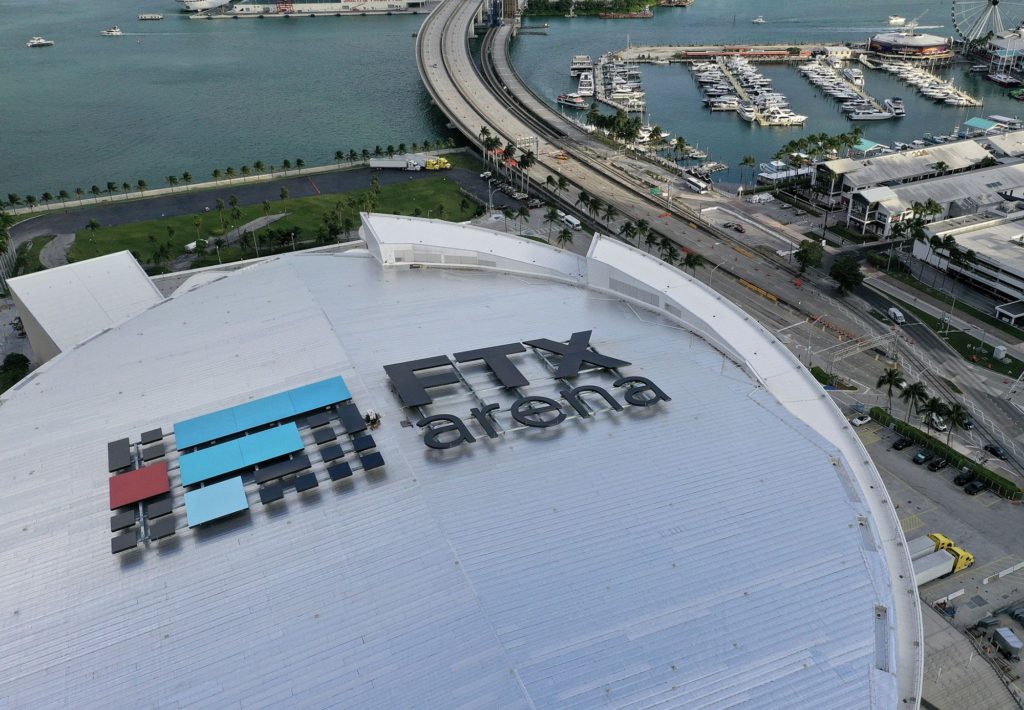
Last month, Miami-Dade County asked a bankruptcy court for the right to remove the disgraced FTX name from its arena, the home of the National Basketball Association’s Miami Heat. The University of California, Berkeley’s athletics department and Mercedes-AMG Petronas Formula 1 racing team have also suspended sponsorship deals with the company.

“From our point of view, the collapse of FTX has already had an impact on the sponsorship market,” said GlobalData analyst Conrad Wiacek.

Yet even before FTX collapsed, the relationship between the two industries had started to cool in the wake of a market downdraft in the spring that triggered a series of earlier crypto implosions. The number of deals signed since July is down more than 50% compared to the first half of 2022, according to GlobalData. 

Amber Group, one of Asia’s leading crypto trading and lending platforms, announced this month it would terminate its sponsorship deal with the English soccer team Chelsea FC, while DigitalBits, a blockchain used to power digital assets, has failed to make sponsorship payments to FC Internazionale Milano SpA, an Italian team.

Alexandre Dreyfus, the CEO of fan token platform Socios.com, said sports firms have increased due diligence around potential crypto sponsors, often requesting shorter-term deals and upfront payments. IEG’s Laatz expects that in 2023, new deals “will slow to a trickle.” And of the 161 deals signed in 2022, nearly half will expire next year, according to GlobalData. 

Even so, many blockchain companies are sticking with the sports industry. Crypto exchange OKX said such deals are key to building name recognition — bull or bear market aside. “Sports and other brand partnerships continue to be an important element of our brand building,” wrote Haider Rafique, OKX’s global chief marketing officer.

Crypto.com similarly said it remains committed to sports sponsorships, despite all of this year’s chaos. Deals include a $700 million agreement for naming rights to the former Staples Center in Los Angeles; a five-year, $100 million tie-up with Formula 1 racing; and, of course, the current World Cup.

Crypto.com only announced its sponsorship of the soccer tournament in March. The next World Cup occurs in four years. It’s far too soon to say which firms may make an appearance on the sidelines then — but given recent events, GlobalData’s Wiacek said Crypto.com’s return is unlikely.

“I’d be very much surprised,” he said.

–With assistance from Anna Irrera.

More stories like this are available on bloomberg.com

©2022 Bloomberg L.P.

Hedge Fund Manager Netting 29% Gain Sees S&P 500 Going Nowhere

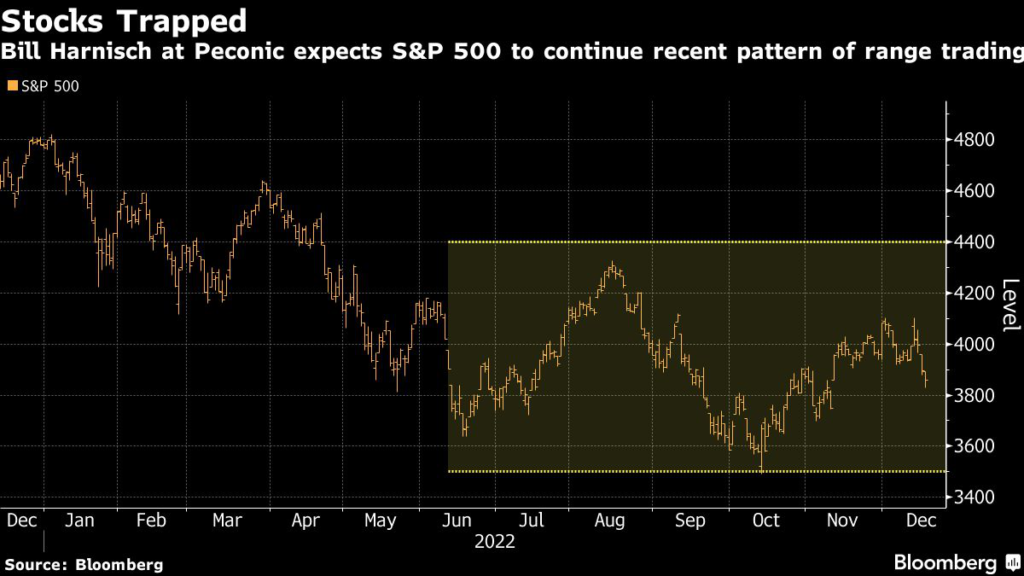
(Bloomberg) — Hedge fund manager Bill Harnisch, who has scored a 29% return this year, credits most of the success to a prescient call on inflation 15 months ago. If his take on consumer prices turns out to be correct again, stocks may go nowhere in coming years.

The chief investment officer at Peconic Partners expects persistent pricing pressures to force the hands of the Federal Reserve in 2023, upsetting any hopes for a pivot. Stocks may rally periodically, he says, only to fade when reality sets in that rates will stay higher for longer, earnings are poised to fall and equities are far from cheap. 

The S&P 500 will be trapped in a band between 3,500 to 4,400 in the next 18 to 36 months, according to the market veteran who oversees $1.2 billion. That’s a range that has confined the index since its trough in June. The gauge closed near 3,850 Friday.

“Rates will be sticky. And with the S&P at 19 times earnings, it’s going to be tough for the index to be doing much,” Harnisch, who began his career in the financial industry in 1968, said in an interview. “It’s going to be a pretty broad trading range.”

The manager’s record stands out at a time when many stock pickers have failed to deliver amid a violent selloff and dramatic shift in market leadership. Over the past three years, Peconic has returned 43% annually, compared with a gain of 9% in the S&P 500 over the same period. 

Peconic, which started in 2004, has a team of a dozen to discover companies that will expand faster than the economy in the long run. These stocks, the kernel of its portfolios, are usually held for seven to eight years. On the short side, the team builds hedges to offset the risk from the core holdings while looking for mispriced shares. 

With the specter of a recession on the horizon, Harnisch prefers companies whose revenues and profits will continue to increase regardless of how bad the economy goes. Businesses that offer that kind of resilience, he says, are those that tap into the ever rising demand for things like high-speed internet and clean energy — areas where the government also plans to spend billions of dollars to promote growth.

Peconic counts power-line builder Quanta Services Inc. and Wesco International Inc., a distributor of electrical gear, among its top holdings on the long side. Shares of Quanta are up 25% this year, while Wesco has lost 9%. Both are ahead of the S&P 500, which is down 19%.

“The people on the ground like Quanta, Wesco — they’re not looking at a recession,” Harnisch said. “When you add up everything that is taking place, the industrial space is not so much the soft landing story as much as it is what’s happening to these companies and why they’re not seeing a slowdown. It’s a tsunami.” 

The seed for a winning year was sown in September 2021, when Harnisch’s team spotted a spike in wage gains. While Fed officials largely dismissed inflation as transitory at that time, the money manager saw red flags that wage inflation would persist, forcing policy makers to reverse their zero-interest rate policy fairly soon.

His firm began doubling down on bearish wagers against tech firms and pandemic high-flyers including online retailers Carvana Co. and Wayfair Inc., shares that had surged either on Fed largesse or false hopes for a durable sales boom. 

Those bets paid off handsomely as the central bank has rushed to raise rates at the fastest pace in a generation. Carvana and Wayfair have plunged more than 80% this year while the tech industry hosts some of 2022’s worst losers. 

Now Peconic is targeting the next big short, such as cable-services providers, advertising firms and retailers. Harnisch wouldn’t identify specific names as his team is still in the process of building positions.

The way Harnisch sees it, optimism that stocks will go back to new highs in 2023 is premature. While Peconic is ready to ride bear-market bounces, as it did during the equity rally in October and November, the money manager expects a combination of weakening corporate profits and higher rates to put a cap on equities. 

After boosting net leverage to 50% during the latest market recovery, the high end of its typical range, the firm started cutting stock exposure as the S&P 500 failed to pierce through the 4,100 level. As of Thursday, its leverage sat near 30%. 

“With the tape the way it is, it’s starting to discount some of the earnings challenges,” Harnisch said. “We’re very comfortable pulling back now and seeing how low it goes.” 

More stories like this are available on bloomberg.com

©2022 Bloomberg L.P.

Close Bitnami banner
Bitnami