
Bloomberg

Binance, Alone at the Top After FTX, Stirs ‘Too Big to Fail’ Crypto Worry

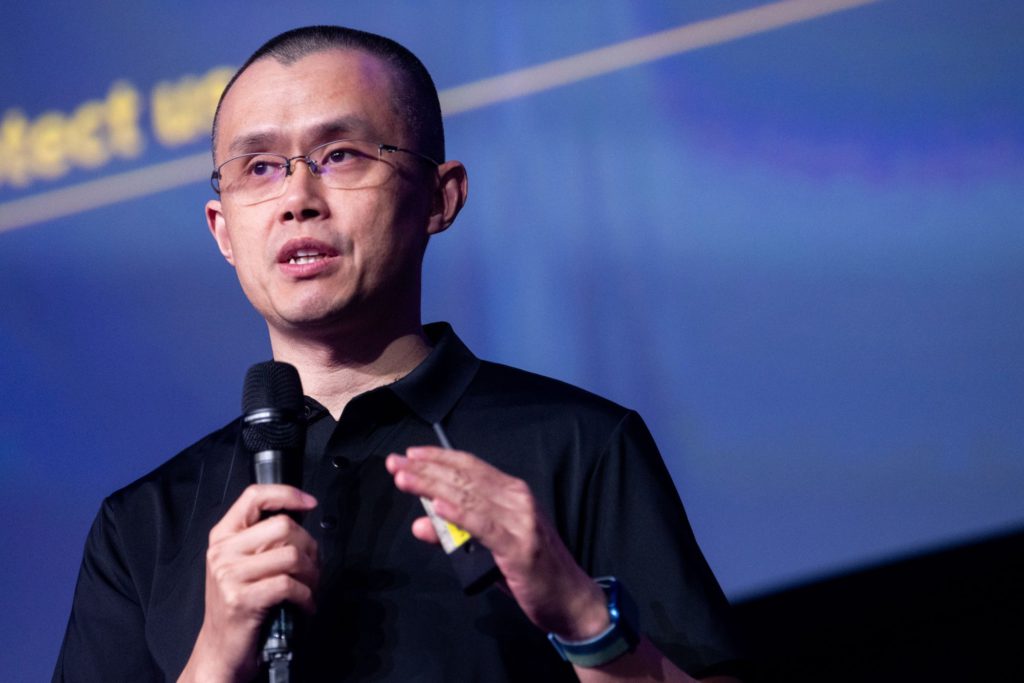
(Bloomberg) — Now that Sam Bankman-Fried’s fall from grace is complete, uneasiness is growing around the dominance that his rival Changpeng Zhao’s Binance holds in the cryptocurrency market.

The worries surfaced again on Friday as the accounting firm Mazars Group halted work for Binance and other crypto firms on reports that are meant to demonstrate that the companies hold the necessary reserves needed to cover any potential surge of customer withdrawals.

Zhao, who goes by his initials CZ, has insisted repeatedly that Binance doesn’t misuse customer funds like FTX allegedly did and that his exchange can process whatever amount of withdrawals comes its way. Binance has a longer track record than FTX, proof it’s been able to survive previous “crypto winters,” including a more than 80% plunge in Bitcoin from December of 2017 to the end of 2018.

Still, it’s been a tough few days. Mazars’ move threatens to cloud an accounting picture many already found opaque — indeed it was likely the market’s lack of reassurance from Mazars’ “proof-of-reserves” reports that led the firm to halt all such work. A televised appearance earlier in the week in which CZ was peppered with questions about Binance’s financial strength gave critics grist for another round of heckling.

Even for those who ostensibly support CZ and his exchange, Binance’s market supremacy in the wake of FTX’s collapse doesn’t sit well in an industry that preaches decentralization. Weakness in crypto prices that followed headlines about CZ’s company this week reinforce concern that Binance has become a “too big to fail” player in a market where, unlike traditional finance, there’s no one to stop a potential failure, offer a bailout or soothe any contagion.

“I don’t think Binance is trying to cause problems, but that organization is now a risk to all of us,” said Mark Lurie, the chief executive officer and co-founder of Shipyard Software, a developer of decentralized exchanges. “Anytime you have one player controlling substantial amount of volume, there’s a lot of systematic risks.”

As Bankman-Fried’s FTX empire collapsed into bankruptcy and the 30-year-old former billionaire swapped a luxury penthouse for a Bahamas jail cell, Binance has increased its market share to 52.9%, its largest ever, and grown its share of derivatives trading to 67.2%, according to CryptoCompare.

Binance’s dominance came up in a Senate committee hearing on FTX on Wednesday, with Tennessee Senator Bill Hagerty saying a hypothetical similar implosion by CZ’s exchange would prove “catastrophic for the cryptocurrency industry, and it would prove catastrophic to all of the consumers that utilize the industry.”

For his part, Binance’s CZ has insisted in tweets and public statements that there is no amount of client exodus that will put the company under pressure. That confidence was put to the test this week amid a crush of withdrawal requests from clients. Binance’s BNB, the native token of the exchange, has also been hit hard, slumping some 20% since Monday.

In an email Friday, a spokesperson for Binance said that despite $6 billion in net withdrawals between Monday and Wednesday, “we were able to fulfill them without breaking stride.” The spokesperson said Binance does not invest user funds, it holds clients’ crypto in segregated accounts and all assets are backed 1-to-1. Binance also maintains a $1 billion emergency fund to protect users in extreme situations, the spokesperson added, and its capital structure is debt-free. 

CZ likes to chalk up much of the newfound attention to the type of unwarranted “FUD” — fear, uncertainty and doubt — that has dogged crypto from the beginning. But it’s unlikely that the clouds will part for him anytime soon.  

Even if Mazars’ report on Binance’s reserves fell short of a full audit, and failed to shore up confidence entirely, the accounting firm’s retreat leaves CZ without a third-party expert to back up his own words. And in the post-FTX environment, trust in the proclamations of crypto billionaires is deteriorating faster than the value of their tokens.

The Binance spokesperson said the exchange is exploring how it might provide additional transparency to show users their assets exist on the blockchain, and is seeking another accounting firm to work with it to show proof of its reserves. That may prove difficult: Late Friday, the Wall Street Journal reported that BDO, which recently vouched for stablecoin giant Tether’s reserves, was reconsidering its work for crypto companies.

Government Scrutiny

Binance may well prove to be invulnerable to the type of run on the bank that’s toppled FTX and other firms this year, but CZ still faces legal risks and government scrutiny that could swell into existential threats to the business. 

Bloomberg reported last year that Binance is being probed for money laundering and tax offenses by the Justice Department and Internal Revenue Service. Chainalysis Inc., a blockchain forensics firm whose clients include U.S. federal agencies, concluded in 2020 that among transactions that it examined, more funds tied to criminal activity flowed through Binance than any other crypto exchange.

Disagreements among prosecutors are delaying the conclusion of the DOJ investigation, Reuters reported on Monday, citing people familiar with the matter. Some prosecutors involved in the case believe the government has enough evidence to file criminal charges against Binance executives including CZ, the report said, while others want to review more evidence. “Binance has established clear business practices to ensure we operate globally in a regulatory compliant manner,” the company spokesperson said Friday.  (CZ worked at Bloomberg LP, the parent company of Bloomberg News, from 2002 to 2005.)

Meanwhile, the crypto world also has its laser-eye on the prospect that FTX’s bankruptcy case could result in efforts to claw back the $2.1 billion that FTX paid to buy back Binance’s stake in Bankman-Fried’s company, much of which was paid in an FTX token whose value has since  plunged.  “Maybe I want a Madoff clawback on those proceeds,” Kevin O’Leary, the “Shark Tank”  television personality who has millions of dollars in crypto from a paid sponsorship locked up in FTX, told the Senate committee. 

Asked during a CNBC interview Thursday if he was prepared to return that $2.1 billion, CZ’s answer —  “I think we’ll leave that to the lawyers” — set off a new round of tweets from the crypto peanut gallery that focused on its evasiveness. Only time will tell if they were just more FUD.    

–With assistance from Tom Schoenberg, Emily Nicolle and Dave Liedtka.

More stories like this are available on bloomberg.com

©2022 Bloomberg L.P.
Crypto Pessimism Grows With Bitcoin Falling Back Below $17,000

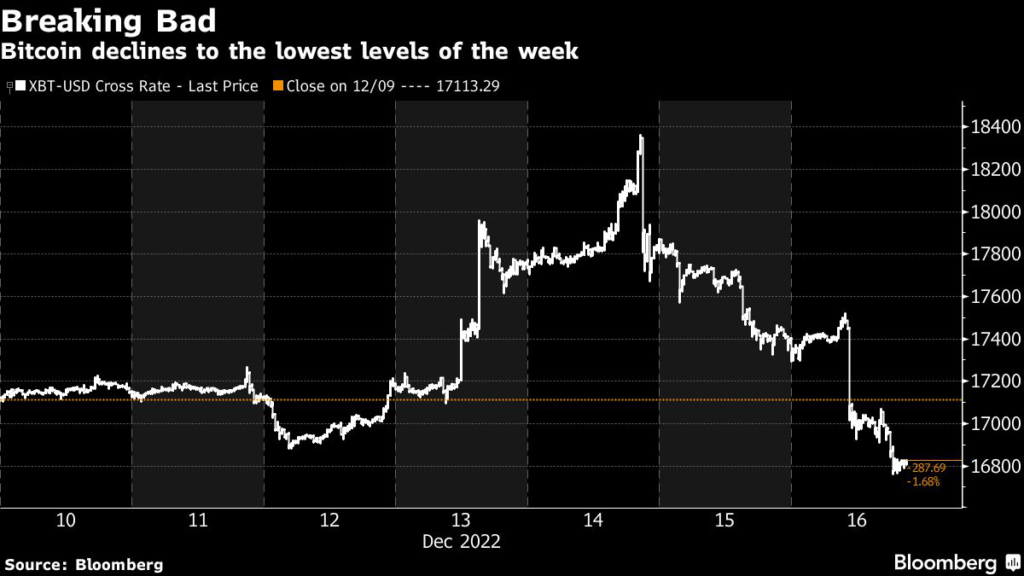
(Bloomberg) — Bitcoin dropped back below $17,000 and several smaller cryptocurrencies referred to as altcoins posted significantly steeper declines as concern increases that the digital-asset market’s woes are far from over. 

The largest token dropped as much as 3.7% to $16,762 on Friday. Earlier in the week, Bitcoin reached its highest price since Sam Bankman-Fried’s crypto empire filed for bankruptcy last month. On Friday, Ether declined as much as 6.3%, while other altcoins like Avalanche and Solana dropped as well. 

Cryptocurrencies dipped alongside US stocks as the economy weathers the Federal Reserve’s aggressive tightening. The drop reverses a brief relief rally that pared back some of the token’s November losses. Since the start of the year, Bitcoin has declined roughly 65%.

Fairlead Strategies Senior Analyst Will Tamplin said that the token is at risk of re-approaching its November lows. Then, it sank to its lowest price since November 2020.  

Noelle Acheson, author of the of the “Crypto is Macro Now” newsletter, wrote that investors remain skittish about the fates of other crypto-related companies, including Binance Holdings Ltd. and Digital Currency Group, parent company of troubled crypto broker Genesis. Binance’s BNB token was down 6.3% on Friday, and has slumped about 50% in the past year.

“There may be some ugly contagion news yet to drop,” Acheson wrote. “But most investors who were going to sell have done so.”

Shares of companies tied to the digital-asset world continued to be under pressure. Coinbase Global Inc., fell as much as 9% to $34.71, another all-time low. The shares of the biggest US crypto exchange have tumbled 85%. Bitcoin miners Marathon Digital fell almost 85, while Riot Blockchain dropped 6%. They’re down 88% and 83%, respectively, since last December. 

More stories like this are available on bloomberg.com

©2022 Bloomberg L.P.
Musk Cries Foul Over Flight Data That’s Readily Available

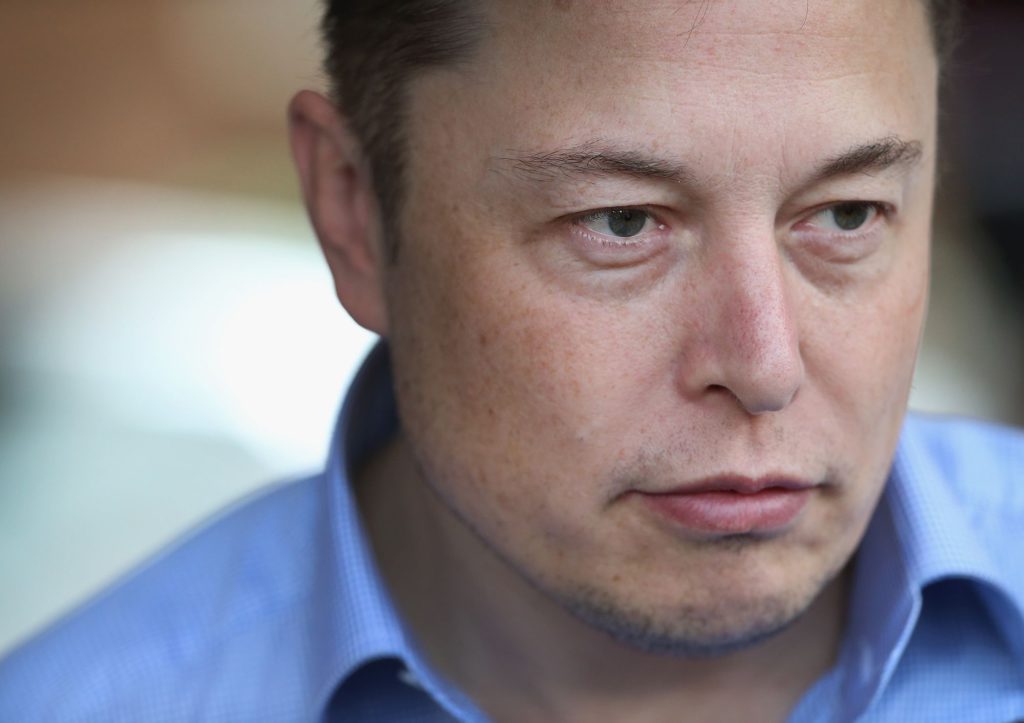
(Bloomberg) — Twitter Inc. owner Elon Musk this week suspended the account of a Florida student who was posting the location of private jets, including Musk’s. He suggested the student was tweeting out his “assassination coordinates.” 

The shutdowns escalated to include prominent journalists and other accounts that had discussed his plane’s location. To justify the move, he rewrote some of Twitter’s policies to try and stop people from sharing those details.

But some of the information Musk was concerned about on Twitter is publicly available, due to dramatic improvements in how the aviation system tracks aircraft to ensure a high level of safety and to improve efficiency. Untangling privacy concerns from the improvements in the underlying technology isn’t easy, say aviation experts.

Why are billionaires’ private planes so easily tracked?

The flight-tracking data can be used to monitor planes in real time because of years of improvements in computers and growing use of GPS. Portions of the data are publicly available from the US Federal Aviation Administration, or it can be accessible to anyone with the right radio receiver at home.

Starting in 2020, the FAA required that any aircraft that expected to be guided by air-traffic controllers — which includes almost all high-performance jets — needed to install equipment that used on-board GPS to automatically broadcast its position. 

That meant that the expensive, government-run radar system was no longer the primary means of tracking planes. The result is higher accuracy and safety improvements for such things as mid-air collision prevention. It has even allowed real-time aircraft tracking in the most remote regions of the world from space, and near instantaneous notifications of crashes. 

But it also meant that the radio broadcasts from aircraft could be monitored by anyone with a receiver on the ground. 

Services such as ADSBExchange, Flightradar24 and FlightAware, among others, have created networks of receivers — often operated by volunteers — across the world. 

ADSBexchange.com LLC was a source of data for Jack Sweeney, the Florida student who ran Twitter accounts that tracked Musk and others with private planes. Its account was among the suspended. “I don’t get it,” said Dan Streufert, the flight-tracking company’s founder and president.

Streufert said he never intended his service to become a de facto paparazzi tool. What had started as a hobby has evolved into a growing business that tracks flights, but has also assisted accident investigations and can perform a public service by helping monitor aircraft noise and other issues, he said. 

Were those who shared the data “doxxing”?

Following his suspensions of the journalists, Musk cited Twitter’s “doxxing” policy, which forbids users from sharing sensitive or personal information about other people on the service without their consent. The violations appear to tie back to a single Twitter account – @ElonJet, run by Sweeney – which has more than half a million followers and tweets out the location of Musk’s private plane, including when and where it took off and landed.

On Wednesday, Musk suspended @ElonJet after an incident in LA where he says a car carrying his young son was followed by a stalker. Musk has suggested that public access to his plane information led to the incident.

Twitter has long had a doxxing policy that forbids sharing things like another person’s home address or phone number, but that policy was updated this week to add new language about “live location information.”

The update meant that people who share “travel routes, actual physical location, or other identifying information that would reveal a person’s location, regardless if this information is publicly available” could now be suspended. Many of the journalists that were suspended have covered Musk for years, and had linked to info about @ElonJet or linked to other non-Twitter accounts that included Musk’s private jet information.

Musk also suspended the account for a rival social network, Mastodon, for tweeting a promotion that @ElonJet was publishing Musk’s private plane details on their service, instead.

The suspensions led to an outcry by those who pointed out that private jet information is largely public. Twitter’s policy also says that “sharing information that is publicly available elsewhere” is not a violation of the doxxing policy, and previously had an exemption for journalists, who often report on real-time events.

Can’t Musk just make his data private?

People who for security or privacy reasons don’t want their location known can opt for FAA to screen their aircraft’s identity. But some of the underlying information remains a public record and enterprising sleuths such as Sweeney have taken advantage of that for their broadcast accounts. 

Because most US airports are public, anyone watching a $50-million private jet on a runway can also crack the code. 

“These privacy mitigation programs are effective for real-time operations but do not guarantee absolute privacy,” the FAA said in a statement. 

Eliminating this data from the public domain seems unlikely. “The current system of aviation in this country is mostly funded by the taxpayer,” said Jeff Guzzetti, an aviation safety consultant who previously served as the head of accident investigations with the FAA. “So the federal government owns and operates this equipment and therefore is obligated to make it available to the citizens who are paying for it.”

The underlying reason for the current system is to prevent planes from colliding in midair and other safety concerns, Guzzetti said. 

“Aviation in this country is a very complex, well thought-out choreography of thousands of aircraft to ensure safety,” he said. “The whole industry needs to be on-board with that.”

More stories like this are available on bloomberg.com

©2022 Bloomberg L.P.
Musk Is Seeking New Twitter Investors at Same Price He Paid

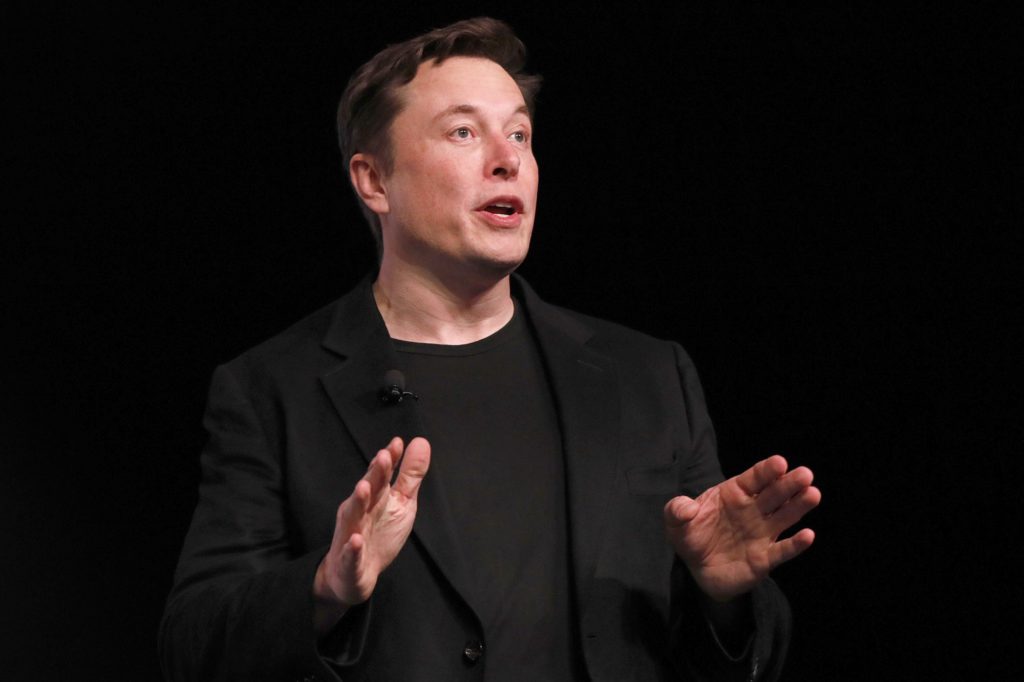
(Bloomberg) — Elon Musk is seeking new investors for Twitter Inc. at $54.20 a share, the same price he paid when he took the company private for $44 billion in October and kicked off a contentious overhaul. 

The managing director of the billionaire’s family office, Jared Birchall, has been reaching out to potential backers this week, news site Semafor reported on Friday. Ross Gerber, who runs Gerber Kawasaki Wealth and Investment Management and took part in the earlier Twitter buyout, confirmed the outreach.

The fundraising attempt follows a tumultuous stretch at Twitter, where Musk has slashed jobs, upended longstanding policies and reinstated banned accounts. Just this week, the company suspended several journalists that Musk said had put his family in danger by revealing location information about his private plane.

Musk, who also runs Tesla Inc. and SpaceX, has acknowledged in the past that he paid too much for Twitter but has expressed confidence in its prospects in the long run.

“Obviously, myself and the other investors are obviously overpaying for Twitter right now,” he said on a Tesla conference call in October. “The long-term potential for Twitter, in my view is, an order of magnitude greater than its current value.”

Twitter didn’t immediately respond to a request for comment.

A pitch document announcing the new investment opportunity described it as “a follow-on equity offering for common shares at the original price and terms, targeting a year-end close,” according to Semafor. The move followed “numerous” inbound requests to invest in Twitter, the document said.

Gerber said he plans to check with his clients — many of whom have large positions in Tesla — to gauge their interest in the Twitter offering.

Musk agreed to acquire Twitter in April but then spent months trying unsuccessfully to get out of the deal. He has sold Tesla shares to help finance the purchase, and that has weighed on the stock, which is down 57% this year. As of this week, Musk had unloaded almost $40 billion in Tesla shares.

–With assistance from Dana Hull.

(Updates with confirmation of outreach in second paragraph.)

More stories like this are available on bloomberg.com

©2022 Bloomberg L.P.
Musk Seeks Twitter Investors at Same Price He Paid, Semafor Says

(Bloomberg) — Elon Musk is seeking new investors for Twitter Inc. at $54.20 a share, the same price he paid when he took the company private for $44 billion in October, according to news site Semafor. 

The managing director of the billionaire’s family office, Jared Birchall, has been reaching out to potential backers this week, Semafor reported. The news outlet cited a pitch document announcing “a follow-on equity offering for common shares at the original price and terms, targeting a year-end close.” The move followed “numerous” inbound requests to invest in Twitter, the document said. 

The fundraising attempt follows a tumultuous stretch at Twitter, where Musk has slashed jobs, upended longstanding policies and reinstated banned accounts. Just this week, the company suspended several journalists that Musk said had put his family in danger by revealing location information about his private plane.

Musk has acknowledged in the past that he paid too much for Twitter but has expressed confidence in its prospects in the long run.

“Obviously, myself and the other investors are obviously overpaying for Twitter right now,” he said on a Tesla Inc. conference call in October. “The long-term potential for Twitter, in my view is, an order of magnitude greater than its current value.”

More stories like this are available on bloomberg.com

©2022 Bloomberg L.P.

Twitter’s Cost-Cutting Efforts Are Hitting an Obscure Group of Investors

(Bloomberg) — Elon Musk’s efforts to cut costs at Twitter Inc. are hitting an obscure group of investors: holders of bonds tied to the company’s headquarters building in San Francisco. 

Twitter hasn’t paid rent on its headquarters, or any of its other global offices, in weeks, the New York Times reported on Dec. 13. Its main office at 1355 Market Street in San Francisco has a mortgage that was packaged into a $400 million bond in 2015. 

Prices on one portion of the bond dropped to about 85 cents on the dollar in the middle of the week, from around 99 cents on Tuesday, according to price data compiled by Bloomberg. Those securities were originally rated B- by Morningstar. 

Twitter isn’t the only tenant in the building, but it’s the biggest by far. The social media company is also looking to renegotiate terms of its leases on offices including its San Francisco headquarters, according to the New York Times.    

Shorenstein Realty Investors manages the building and owns a portion alongside outside investors. Twitter’s efforts to cut lease expenses only adds to the owners’ difficulty. The mortgage on the building matured in September, and the borrower failed to refinance it, according to Morningstar Credit Information and Analytics. Shorenstein declined to comment through a representative.  

Getting mortgages on big office buildings is difficult enough now, but missed lease payments from the biggest tenant will only make efforts to refinance the property harder, said David Putro, head of commercial real estate analytics at MCIA. 

“In an already difficult lending environment, even a temporary cessation of lease payments would further complicate a refinancing,” said Putro. 

If Shorenstein and others on the hook for repayments fail to repay the mortgage loan again in January, lenders have a handful of options to try to ensure they get paid. That could include giving the borrowers more time to repay bondholders in exchange for other borrower concessions and equity contributions, or foreclosing on the building and selling it, said Michael Cohen, managing partner at Brighton Capital Advisors. 

Musk didn’t close on his buyout of Twitter until October, signaling that the owners’ mortgage difficulty predated the new ownership. Shorenstein now has until January to refinance the loan. A representative for the property company declined to comment.   

More stories like this are available on bloomberg.com

©2022 Bloomberg L.P.

OneCoin Cofounder Pleads Guilty to Fraud for Hyping Fake Crypto

(Bloomberg) — A cofounder of the OneCoin pyramid scheme pleaded guilty to his role in the global, multibillion-dollar fraud.

Karl Sebastian Greenwood admitted OneCoin, which he founded in 2014 with Ruja Ignatova, the so-called “Cryptoqueen,” was based on a phony cryptocurrency. Greenwood, who was arrested in Thailand in 2018 and extradited to the US, pleaded guilty Friday to three criminal counts of conspiracy and wire fraud in a hearing in Manhattan federal court.

Greenwood admitted hyping OneCoin as competition to Bitcoin despite knowing it was a fraudulent currency whose value was arbitrarily set by its backers, not the market, and was used to lure victims into a multi-level marketing scam. 

“I knew at the time I participated in this conspiracy in the US that it was wrong,” Greenwood, shackled at the ankles and wearing tan jail fatigues, told US District Judge Edgardo Ramos. Greenwood faces as long as 20 years in prison on each of the counts when he’s sentenced.

OneCoin generated 3.4 billion euros ($3.6 billion) in revenue from the fourth quarter of 2014 to the third quarter of 2016, according to the government, but had no real value and couldn’t be used to buy anything. It operated as a Ponzi scheme, paying commissions to members worldwide for recruiting others to buy OneCoin packages, according to the government. 

The company, which was based in Sofia, Bulgaria, claimed to have more than 3 million members worldwide. Ignatova disappeared in 2017 as OneCoin came under suspicion. She was added to the FBI’s list of Ten Most Wanted fugitives. 

Read More: OneCoin Leaders Charged in Multibillion-Dollar Pyramid Scam

The case is US v. Greenwood, 17-cr-00630, US District Court, Southern District of New York (Manhattan).

More stories like this are available on bloomberg.com

©2022 Bloomberg L.P.
Bankrupt Celsius’ Advisers and Lawyers Seek $52 Million in Fees

(Bloomberg) — Advisers , experts and lawyers to bankrupt crypto lender Celsius Network Ltd. are seeking $52.8 million in fees for up to four months of services rendered as of end of October, according to Dec. 15 and 16 docket filings.

Kirkland & Ellis billed nearly $20 million for its services from July through October. White & Case LLP, which represents Celsius’ creditors, has billed $10.2 million for its services from July 29 to October 31, according to a filing. The next highest was charged by Alvarez & Marsal North America LLC a financial adviser for debtors has asking for $6.5 million, a separate filing showed. Another adviser M3 Advisory Partners LLP has sought $4 million during the period. Eleven firms working on the liquidation process of Celsius have filed their compensation applications, which also include requests for reimbursement of expenses. 

Celsius, once one of the crypto’s most prominent lenders, succumbed after making risky bets during a $2 trillion rout in the digital tokens industry and ended up seeking bankruptcy protection in July. Litigation and professional service fees for companies working on Celsius could be substantial given the time and number of people involved in the process. Alvarez cited 29 people working on the case with one managing director putting in 725.2 hours at $975 hourly rate among five others who worked for more than 700 hours, the filing showed.

Read: Crypto Bankruptcies Have Lawyers Turning to Twitter for Clients

Celsius, which had 1.7 million customers, is in a protracted bankruptcy battle with some of them in bankruptcy court over cryptocurrency ownership. As part of its effort to recover every penny Celsius is seeking to sue bankrupt Voyager Digital LLC to get back $7.7 million worth of crypto.

More stories like this are available on bloomberg.com

©2022 Bloomberg L.P.

Twitter Accused in Lawsuit of Stiffing Software Supplier Owed Millions

(Bloomberg) — Twitter Inc. was sued by one of its software suppliers for allegedly refusing to honor a multiyear, multimillion-dollar contract, the latest complaint suggesting that new management under Elon Musk is burning relations with business partners.

Imply Data Inc. claims that after paying invoices totaling about $4.4 million under a contract for proprietary software services that runs until 2024, Twitter didn’t pay its Nov. 30 quarterly bill and “disclaimed any obligation to pay any future invoices,” according to the complaint filed in San Francisco state court. Imply estimated its damages at more than $8 million.

Just a week ago, Twitter was sued by a private jet provider for refusing to pay about $200,000 for two flights taken by it former chief marketing officer as Musk was preparing to close his $44 billion acquisition of the social media platform.

It’s been a tumultuous time for the company under Musk’s leadership, with mass layoffs, an exodus of advertisers and departures from the platform by high-profile users as well as suspensions of journalists critical of Musk. As bills have mounted, Musk has asked staff to renegotiate prices with vendors and suppliers, threatening to throw around the weight of his other companies if things don’t go his way, Bloomberg Businessweek reported this week.

Read More: Elon Musk’s Twitter Is a Shakespearean Drama in Silicon Valley

Imply, which was founded in 2015 and is based in Burlingame, California, said its lawsuit marks an “egregious example” of Twitter’s refusal to pay what it owes other companies “without good cause.”

In the suit, Imply said that prior to Musk’s arrival, Twitter paid the software company more than $10 million over four years and “has always been very pleased with Imply’s product and its related maintenance and support services.” A decision was made in mid-2021 to extend their contract another three years.

Twitter didn’t immediately respond to a request for comment.

The case is Imply Data Inc. v. Twitter Inc., CGC-22-603473, California Superior Court, San Francisco County.

More stories like this are available on bloomberg.com

©2022 Bloomberg L.P.

Blizzard Brings Back Veteran Designer Amid Gaming Reorganization

(Bloomberg) — As Blizzard Entertainment looks toward the future, it’s returning to the past. The video game developer and publisher is bringing back Chris Metzen, once one of the company’s most prominent writers and designers, to work as an advisor on the World of Warcraft team.

Known for his bombastic stage presence and for writing the stories behind many of Blizzard’s best-known games, Metzen spent 23 years as a top creative developer before resigning in 2016.

His return comes as Blizzard’s parent company Activision Blizzard Inc., is reshaping its corporate culture following a 2021 sexual misconduct scandal and awaits the outcome of a pending $69 billion acquisition by Microsoft Corp. Consummation of the deal is far from certain after the US Federal Trade Commission voted to sue to block the merger and the EU and UK are also taking a hard look at the tie-up. 

Yet business continues as usual for the Irvine, California-based company, which recently released the mobile game Diablo Immortal and the shooter Overwatch 2 and plans to release Diablo IV  in June. Blizzard has made several big changes in recent months, leaning on experienced veterans and reorganizing units as it seeks to boost staff morale and bolster its lineup of games. Until Diablo Immortal launched in June, the company had gone six years without releasing a new title, rankling executives at Activision and leading to heavier oversight from the top.  

In addition to rehiring Metzen, Blizzard also recently elevated Allen Adham to chief design officer, a role that will have him overseeing many of the company’s products. Adham co-founded Blizzard in 1991 and served in various roles before departing in early 2004 and then returning twelve years later to steer the company’s fledgling incubation department. 

In November 2021, Blizzard reorganized its video game units, placing general managers in charge of each of its big franchises such as Warcraft, Overwatch, Diablo and an unannounced survival game code-named Odyssey. These managers are tasked with building road maps for the franchises that the company hopes will facilitate releasing more games on a regular schedule. The reorganization and promotion of Adham haven’t previously been reported.

John Hight, now general manager of Warcraft, alluded to the plans in a message announcing Metzen’s return. “Chris’s focus initially will be on World of Warcraft, then his work will expand to other projects across this growing franchise,” he wrote.

In recent years, Activision has taken a larger role in operations at Blizzard, leading to tension and the departure of key people, such as former Chief Executive Officer Mike Morhaime. Executives from Activision have pushed Blizzard to release games more frequently and to focus on profits.

More stories like this are available on bloomberg.com

©2022 Bloomberg L.P.

Close Bitnami banner
Bitnami