
Bloomberg

Sam Bankman-Fried Needs New Defense Besides ‘Sorry,’ Lawyers Say

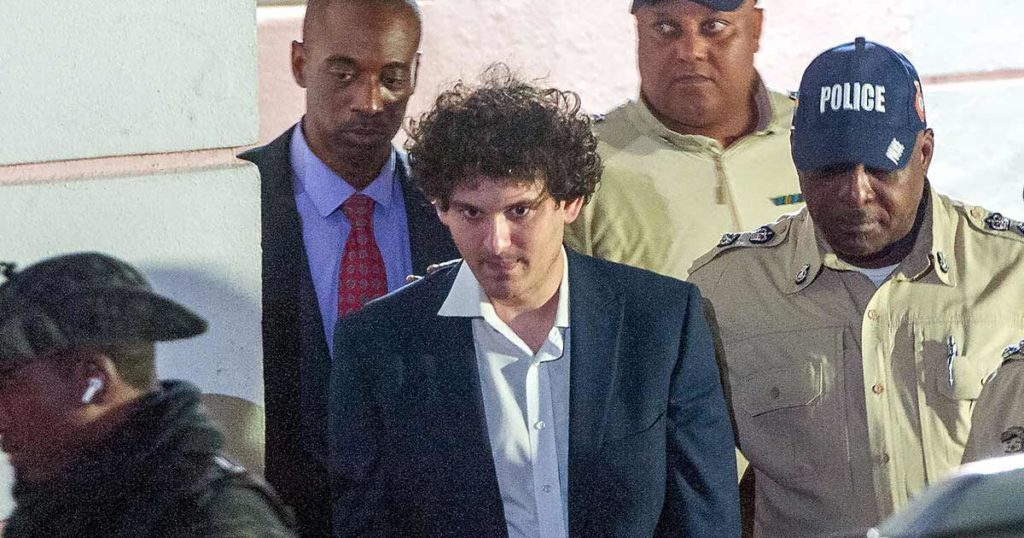
(Bloomberg) — For weeks, FTX founder Sam Bankman-Fried has been previewing a possible defense to criminal charges over the cryptocurrency exchange’s collapse: I made mistakes but I didn’t mean to do it.

But that’s probably not going to cut it now that he’s been arrested in the Bahamas and charged by federal prosecutors in New York, several lawyers not involved in his defense said. According to the indictment unsealed Tuesday, Bankman-Fried, 30, defrauded FTX customers and investors by using at least $1.8 billion of their money for personal expenses and risky bets by its sister trading firm, Alameda Research.

“‘I wish things worked out in the end’ is more of a (guilty) plea allocution than a defense,” said former federal prosecutor Harry Sandick. “It’s hard to see that being a triable defense. It’s hard to know what the whole thinking was in terms of those public statements, or if there was very much thinking.”

Mark Bortnick, a spokesperson for Bankman-Fried, declined to comment on his legal defense.

‘No-Frills’ Indictment

Prosecutors need to prove beyond a reasonable doubt that Bankman-Fried intended to defraud investors to convict him. His public claims of mismanagement are clearly aimed at suggesting that whatever happened was unintentional.

But Sandick and other lawyers point out that the sparely written eight-count indictment states that Bankman-Fried lied again and again about fund transfers. And prosecutors almost certainly have cooperating witnesses from FTX or Alameda who will testify to that effect, the lawyers said, though there’s no hint of that in the charging document. 

“Although this is an extremely high-profile case, the indictment is a no-nonsense, no-frills document,” said Jaimie Nawaday, another former federal prosecutor. “The factual statements are short and plain. The theories of fraud are very standard — lying to get money, lying about what you’re doing with the money.”

The bare-bones indictment gives Bankman-Fried no indication of what evidence the government has against him, Nawaday said. He can’t know with precision how his many public statements trying to explain the collapse of FTX as the result of mismanagement rather than fraud match up against the prosecution’s case. 

If he’s later contradicted, it would be devastating for his defense, said Sandick. “There’s a saying that a false exculpatory statement is almost as good as a confession.”

Robert Frenchman, a New York white-collar defense lawyer, said Bankman-Fried’s claims that FTX’s collapse resulted from management missteps aren’t all that convincing, even without the prosecution showing its hand. In particular, Frenchman said, the relationship between FTX and Alameda is hard to spin as innocent.

“There’s some very troubling facts here that don’t fit the mismanagement narrative,” Frenchman said. “I think it’s very difficult to mount that kind of a defense when the defendant is alleged to have given secret preferential treatment to his own hedge fund. Those facts surrounding Alameda are going to be much tougher to defend. They look a lot more like fraud and deception than anything unintentional.”

And that defense will become even harder to mount if, as is widely expected, some of Bankman-Fried’s close associates testify that there was fraud.

Alameda Chief Executive Officer Caroline Ellison, who has hired prominent white-collar lawyers to represent her, would be a prime candidate for a cooperation deal with prosecutors. Filings this week in FTX’s bankruptcy proceedings also show that senior executive Ryan Salame reported possible fraudulent transfers at the Bahamas-based exchange to local authorities days before its collapse.

Confronted with such witnesses, many white-collar defendants try to turn the tables and claim the cooperator was the true bad actor and is now lying to get leniency for their crimes. Earlier this year, former Goldman Sachs Group Inc. investment banker Roger Ng did that when his ex-boss and 1MDB co-conspirator Tim Leissner testified against him. Ng was found guilty.

Sandick said more detail about the government’s case will eventually emerge, and then Bankman-Fried and his lawyers will take stock of his situation and options. 

“You really need to make an assessment as every defendant does whether to take a plea or go to trial,” Sandick said. “You wouldn’t know that until you really got into the evidence. It’s a very personal decision.”

If Bankman-Fried does decide to strike a plea deal with prosecutors, he probably can’t expect much leniency in return, Frenchman said. The government gives generous deals to witnesses who can testify against even bigger fish, but Bankman-Fried is the main target in the FTX case.

“He’s at the top of the food chain here,” said Frenchman.

More stories like this are available on bloomberg.com

©2022 Bloomberg L.P.
Amazon, Ancient Tribe Face Off Over Cape Town Office (Correct)

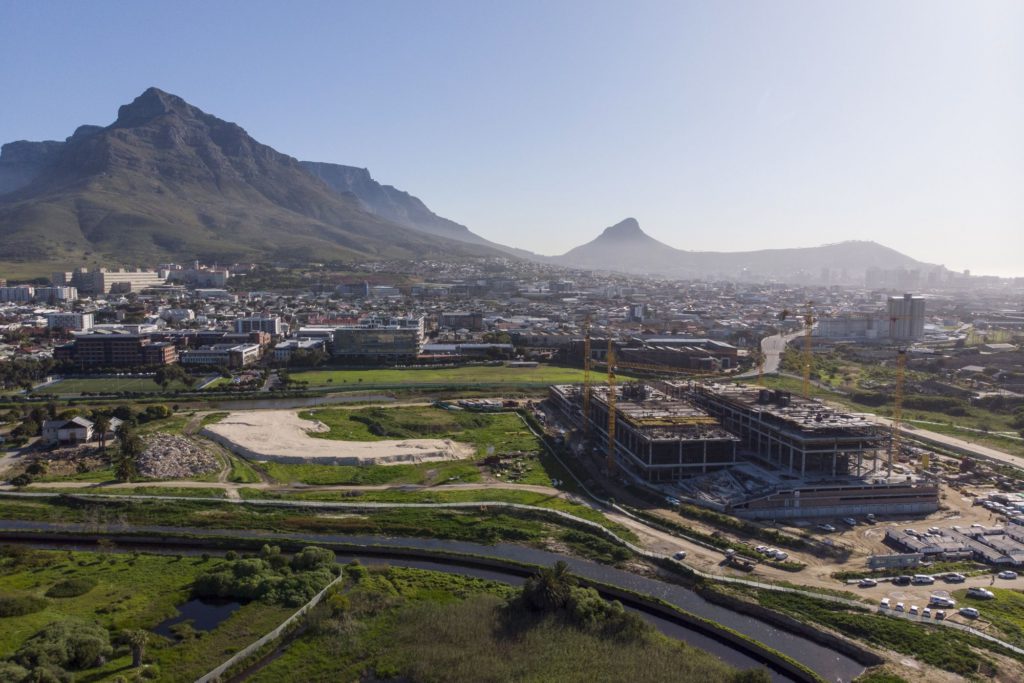
(Bloomberg) — On the outskirts of Cape Town, at the base of Table Mountain and set back from a tangle of freeways, the Liesbeek and Black rivers meet in a small stretch of marshland. The 37-acre plot isn’t pristine — it lies next to a railyard and was until recently home to a golf course — but for centuries, this land has been sacred ground for the Khoisan, a southern African tribe that traces its lineage back more than 100,000 years. In the near future, if all goes to plan, it will be the site of Amazon’s next regional headquarters.

To many local First Nations peoples, news of the project came as an unhappy surprise. Since approval for the e-commerce giant’s $250 million office complex on the 150,000 square-meter site was granted, groups aligned with the Khoisan to oppose the project have tried to derail construction. On a near-monthly basis, dozens of protestors have gathered on the steps of the High Court in Cape Town with signs reading “Concrete will never be our heritage,” and “No means no.” They’ve filed petitions and lawsuits, appealed to media and lawmakers, and forced Capetonians to reckon with the uncomfortable question of whether they’re willing to prioritize economic development over the fight to recognize indigenous land rights in South Africa.

“It’s almost a case of history repeating itself,” said a Khoisan chief Bradley Van Sitters, who also goes by the name Hyi!Gaeb!Gorallgaullaes, the exclamation points representing the clicks in the tribe’s language. “A lot of our people’s blood has been spilled here.”

For its part, Amazon has been working with the developer to accommodate the Khoi and San tribes, which are often referred to collectively. In collaboration with Khoisan members who support the project, the company has announced plans to build a heritage center which will include a garden, a media area, and roads and pathways with Khoisan names.  

With the economy stalling, Amazon also brings the promise of jobs and development in a city that desperately needs them. Unemployment is above 30% in South Africa, and nearly 27% in Cape Town. City government representatives say that the project will indirectly create jobs for 19,000 people, including more than 5,200 construction workers. Cape Town’s leaders are thrilled with the arrangement.

Although Amazon delivery services aren’t yet available in South Africa, the e-commerce giant has long had a presence in the country. It has kept offices in Cape Town for about 18 years, and the purpose of the Liesbeek hub is to consolidate the estimated 3,000-plus employees already in the city with another 5,000 or more to be hired in the next few years. This is part of a broader retail expansion into sub-Saharan Africa. Amazon Web Services recently opened offices in Johannesburg and Lagos, and according to people familiar with the matter who do not want to be identified as plans are not public, Amazon intends to roll out online delivery in South Africa and in Nigeria as early as next year.

None of these ambitions, however, rely on the Cape Town headquarters, which is nicknamed Project Zola, according to a bid proposal seen by Bloomberg.  “The campus is a nice-to-have rather than a have-to-have,” said Arthur Goldstuck, a technology analyst and managing director of World Wide Worx.

That “nice-to-have” hasn’t come easily. In Cape Town, litigation began almost as soon as the project became public. Protestors scored an early victory against Amazon in March, when the High Court in Cape Town ordered Liesbeek Leisure to temporarily stop work, ruling that “the core consideration is the issue of proper and meaningful consultation with all affected First Nations Peoples.”

It wasn’t the first time Amazon encountered obstacles when trying to set up shop outside the U.S. Plans to build large logistics hubs in France were scrapped on at least four occasions in the past 18 months due to political, environmental and financial concerns. Earlier this year, the company was blocked from building a 76,200-square-meter warehouse near the eastern French city of Belfort on the grounds that the proposal for the project did not include “compensatory measures to offset the destruction of wetlands.”

In the Liesbeek case, however, the decision didn’t stick. The court sided with the company on appeal and dismissed claims that the development would threaten the site’s cultural legacy.  As part of the development, $2.2 million (38 million rand) will be spent on environmental rehabilitation, the ruling went on to suggest that “development might enhance the land’s resources.” Construction on the site continued, though nobody can say for sure when it will be completed. 

To Tauriq Jenkins, a leader of the Goringhaicona Khoi Khoin Indigenous Traditional council, the decision made little sense. “How can you build a heritage center on top of the history being destroyed?”

What might be the opposition’s last chance to stop the project now comes down to proving that stakeholders were not properly consulted. A date for the review hearing hasn’t been scheduled, but optimism is running low. Without “the deep pockets our opponents have,” said Leslie London, a professor at the University of Cape Town who has been involved in the case, the groups have been “outmanoeuvred legally.”A sticking point in this conflict is that the Khoisan as a group don’t have one organizational structure. Some factions have sided with Jenkins and Van Sitters, and some with the developer and its promises to restore the site. A court decided that Jenkins didn’t have the mandate to represent the council legally after he was found to have erroneously included an affidavit from a member whom he hadn’t spoken to directly. He’s appealing that decision.  

Amazon’s spokespeople in South Africa, Europe and the US declined to respond when contacted multiple times for comment. The site’s developer responded to queries. 

Both the city and river valley have complicated histories. Europeans arrived in what is now Cape Town in the 15th century, and over the next several hundred years, local populations were brutally subjected to the rise of the slave trade, the introduction of apartheid, and government efforts to limit Black property ownership. When the Dutch settled along the Liesbeek in the 17th century, parcels of the valley were allocated to farmers and cut off from the Khoisan. It has mostly remained private land ever since. In recent years, the site has been used “as a private golf driving range, restaurant, bar and tarmac parking lot,” according to Liesbeek Leisure Properties Trust, the developer overseeing the Amazon project.

The current saga has led some to wonder why Amazon chose this site in the first place. “When it was announced that the Liesbeek Leisure Properties Trust was the preferred bidder to construct the Amazon headquarters on the River Club site, I was very surprised,” architect Derick Henstra, who advised one of the short-listed firms on the project, said in an affidavit filed as part of the case. “Both Amazon and the LLPT must have been conscious that selecting the site carried with it the risk of substantial delays.” In response, the developer said that “there was no reason to believe there would be delays or legal challenges to what is ostensibly an attempt to breathe life into a dilapidated space,” and added that it had all the necessary approvals to move ahead.

The project has also become a public relations headache. While many Cape Town residents are excited by the opportunities Amazon can offer (both in terms of jobs and midnight shopping binges) others have been put off by how the multinational handled this process. Ryan Dick, a software developer who lives in Cape Town, said he doesn’t “see how putting thousands of tons of concrete on top of a wetland is saving anything.” Another Capetonian, Sarah Driver-Jowitt, said that while she understood why Amazon Web Services wanted to centralize, she thought the site was “not an appropriate one.” Nadia Vatalidis, a human resources specialist, was sanguine about the controversy. Although any project has its downsides, she said, South Africa needs the jobs and investment.

One silver lining may be that the controversy has increased awareness around the Khoisan. In recent years, South Africa’s President Cyril Ramaphosa has signed legislation to acknowledge First Nations governance structures and established an advisory panel to address questions of land restitution. The Khoisan and others have also called on South Africa’s Heritage Resources Agency to declare the Liesbeek River Valley a heritage site. That wouldn’t stop construction, but it could delay it by two years.

As the Khoisan chief Van Sitters observed, fights over land have long moved off the battlefields and now happen in court.

For now, protestors say they will continue their efforts. Standing on the edge of the construction site one morning in October, Jenkins, the indigenous council leader, shook his head at the scene. “We want this development stopped,” he said over sounds of hammering and drilling. “We don’t want this concrete monstrosity here. This is sacred terrain.”

(Corrects Tariq Jenkins’s title to reflect outcome of court decision in eleventh paragraph. Adds additional context about the trial in the 13th paragraph.)

More stories like this are available on bloomberg.com

©2022 Bloomberg L.P.

Amazon, Ancient Tribe Face Off Over Cape Town Office

(Bloomberg) — On the outskirts of Cape Town, at the base of Table Mountain and set back from a tangle of freeways, the Liesbeek and Black rivers meet in a small stretch of marshland. The 37-acre plot isn’t pristine — it lies next to a railyard and was until recently home to a golf course — but for centuries, this land has been sacred ground for the Khoisan, a southern African tribe that traces its lineage back more than 100,000 years. In the near future, if all goes to plan, it will be the site of Amazon’s next regional headquarters.

To many local First Nations peoples, news of the project came as an unhappy surprise. Since approval for the e-commerce giant’s $250 million office complex on the 150,000 square-meter site was granted, groups aligned with the Khoisan to oppose the project have tried to derail construction. On a near-monthly basis, dozens of protestors have gathered on the steps of the High Court in Cape Town with signs reading “Concrete will never be our heritage,” and “No means no.” They’ve filed petitions and lawsuits, appealed to media and lawmakers, and forced Capetonians to reckon with the uncomfortable question of whether they’re willing to prioritize economic development over the fight to recognize indigenous land rights in South Africa.

“It’s almost a case of history repeating itself,” said a Khoisan chief Bradley Van Sitters, who also goes by the name Hyi!Gaeb!Gorallgaullaes, the exclamation points representing the clicks in the tribe’s language. “A lot of our people’s blood has been spilled here.”

For its part, Amazon has been working with the developer to accommodate the Khoi and San tribes, which are often referred to collectively. In collaboration with Khoisan members who support the project, the company has announced plans to build a heritage center which will include a garden, a media area, and roads and pathways with Khoisan names.  

With the economy stalling, Amazon also brings the promise of jobs and development in a city that desperately needs them. Unemployment is above 30% in South Africa, and nearly 27% in Cape Town. City government representatives say that the project will indirectly create jobs for 19,000 people, including more than 5,200 construction workers. Cape Town’s leaders are thrilled with the arrangement.

Although Amazon delivery services aren’t yet available in South Africa, the e-commerce giant has long had a presence in the country. It has kept offices in Cape Town for about 18 years, and the purpose of the Liesbeek hub is to consolidate the estimated 3,000-plus employees already in the city with another 5,000 or more to be hired in the next few years. This is part of a broader retail expansion into sub-Saharan Africa. Amazon Web Services recently opened offices in Johannesburg and Lagos, and according to people familiar with the matter who do not want to be identified as plans are not public, Amazon intends to roll out online delivery in South Africa and in Nigeria as early as next year.

None of these ambitions, however, rely on the Cape Town headquarters, which is nicknamed Project Zola, according to a bid proposal seen by Bloomberg.  “The campus is a nice-to-have rather than a have-to-have,” said Arthur Goldstuck, a technology analyst and managing director of World Wide Worx.

That “nice-to-have” hasn’t come easily. In Cape Town, litigation began almost as soon as the project became public. Protestors scored an early victory against Amazon in March, when the High Court in Cape Town ordered Liesbeek Leisure to temporarily stop work, ruling that “the core consideration is the issue of proper and meaningful consultation with all affected First Nations Peoples.”

It wasn’t the first time Amazon encountered obstacles when trying to set up shop outside the U.S. Plans to build large logistics hubs in France were scrapped on at least four occasions in the past 18 months due to political, environmental and financial concerns. Earlier this year, the company was blocked from building a 76,200-square-meter warehouse near the eastern French city of Belfort on the grounds that the proposal for the project did not include “compensatory measures to offset the destruction of wetlands.”

In the Liesbeek case, however, the decision didn’t stick. The court sided with the company on appeal and dismissed claims that the development would threaten the site’s cultural legacy.  As part of the development, $2.2 million (38 million rand) will be spent on environmental rehabilitation, the ruling went on to suggest that “development might enhance the land’s resources.” Construction on the site continued, though nobody can say for sure when it will be completed. 

To Tauriq Jenkins, a leader of the Goringhaicona Khoi Khoin Indigenous Traditional council, the decision made little sense. “How can you build a heritage center on top of the history being destroyed?”

What might be the opposition’s last chance to stop the project now comes down to proving that stakeholders were not properly consulted. A date for the review hearing hasn’t been scheduled, but optimism is running low. Without “the deep pockets our opponents have,” said Leslie London, a professor at the University of Cape Town who has been involved in the case, the groups have been “outmanoeuvred legally.”A sticking point in this conflict is that the Khoisan as a group don’t have one organizational structure. Some factions have sided with Jenkins and Van Sitters, and some with the developer and its promises to restore the site. A court decided that Jenkins didn’t have the mandate to represent the council legally after he was found to have erroneously included an affidavit from a member whom he hadn’t spoken to directly. He’s appealing that decision.  

Amazon’s spokespeople in South Africa, Europe and the US declined to respond when contacted multiple times for comment. The site’s developer responded to queries. 

Both the city and river valley have complicated histories. Europeans arrived in what is now Cape Town in the 15th century, and over the next several hundred years, local populations were brutally subjected to the rise of the slave trade, the introduction of apartheid, and government efforts to limit Black property ownership. When the Dutch settled along the Liesbeek in the 17th century, parcels of the valley were allocated to farmers and cut off from the Khoisan. It has mostly remained private land ever since. In recent years, the site has been used “as a private golf driving range, restaurant, bar and tarmac parking lot,” according to Liesbeek Leisure Properties Trust, the developer overseeing the Amazon project.

The current saga has led some to wonder why Amazon chose this site in the first place. “When it was announced that the Liesbeek Leisure Properties Trust was the preferred bidder to construct the Amazon headquarters on the River Club site, I was very surprised,” architect Derick Henstra, who advised one of the short-listed firms on the project, said in an affidavit filed as part of the case. “Both Amazon and the LLPT must have been conscious that selecting the site carried with it the risk of substantial delays.” In response, the developer said that “there was no reason to believe there would be delays or legal challenges to what is ostensibly an attempt to breathe life into a dilapidated space,” and added that it had all the necessary approvals to move ahead.

The project has also become a public relations headache. While many Cape Town residents are excited by the opportunities Amazon can offer (both in terms of jobs and midnight shopping binges) others have been put off by how the multinational handled this process. Ryan Dick, a software developer who lives in Cape Town, said he doesn’t “see how putting thousands of tons of concrete on top of a wetland is saving anything.” Another Capetonian, Sarah Driver-Jowitt, said that while she understood why Amazon Web Services wanted to centralize, she thought the site was “not an appropriate one.” Nadia Vatalidis, a human resources specialist, was sanguine about the controversy. Although any project has its downsides, she said, South Africa needs the jobs and investment.

One silver lining may be that the controversy has increased awareness around the Khoisan. In recent years, South Africa’s President Cyril Ramaphosa has signed legislation to acknowledge First Nations governance structures and established an advisory panel to address questions of land restitution. The Khoisan and others have also called on South Africa’s Heritage Resources Agency to declare the Liesbeek River Valley a heritage site. That wouldn’t stop construction, but it could delay it by two years.

As the Khoisan chief Van Sitters observed, fights over land have long moved off the battlefields and now happen in court.

For now, protestors say they will continue their efforts. Standing on the edge of the construction site one morning in October, Jenkins, the indigenous council leader, shook his head at the scene. “We want this development stopped,” he said over sounds of hammering and drilling. “We don’t want this concrete monstrosity here. This is sacred terrain.”

(Corrects Tariq Jenkins’s title to reflect outcome of court decision in eleventh paragraph. Adds additional context about the trial in the 13th paragraph.)

More stories like this are available on bloomberg.com

©2022 Bloomberg L.P.
Startup Uses Blockchain for Muni-Bond Deals in an Industry First

(Bloomberg) — A startup is modernizing the stodgy world of municipal bonds by using blockchain to originate deals. The company said it is a first in the $4 trillion market.

Alphaledger recently acted as the underwriter for three debt sales in New York, documenting the deals on its platform based on blockchain, the technology used for verifying and recording transactions that’s at the heart of Bitcoin. More municipal sales are in the works, company leadership said.

Until now, the Poulsbo, Washington-based company, founded in 2019, had used its platform mainly for direct lending to cities and localities. But that corner of the market is far smaller than its latest endeavor. Banks held $209 billion of direct loans to municipalities as of the third quarter, a fraction of the public-debt market, according to Municipal Market Analytics. 

Blockchain can bring transparency, traceability, and access to a market dating back to the 1800s known for being old-fashioned and opaque, Alphaledger co-founder Manish Dutta said. It gives a wider group of investors — such as regional banks — the ability to bid on a deal, creating more competition and reducing borrowing costs. Dutta likened it to calling a car using a ride-sharing service, which allows you to reach more drivers than flagging down a ride on the side of the street.

“The value to the issuer is as such — greater access to clients and not relying on a single broker dealer as an entry point,” he said. 

The company essentially functions as a bidding broker dealer through a wholly owned subsidiary, Iris Trading, Inc. Alphaledger doesn’t commit its own capital but connects potential investors with issuers as an agent, said co-founder Tammie Arnold, speaking in an interview earlier this year.

The Villages of Fredonia and Frankfort and the Southold Union Free School District had their debt issuances underwritten by Alphaledger earlier this year. Fredonia’s Treasurer Erlyssa LeBeau said she didn’t know about the blockchain component, and the village’s municipal advisor didn’t become aware until after the deal had closed. 

“It was sold just as a normal transaction like we would for any other client,” said Rick Ganci, executive vice president and principal at Capital Markets Advisors, LLC, which assisted Fredonia in the deal. “Nothing was different at all on our end, it was a regular competitive sale.”

The three deals utilized so-called “parallel recordkeeping,” meaning files are kept using traditional methods like PDFs and databases in addition to blockchain, according to Alphaledger. That’s a key point of interest for regulators, who are keenly scrutinizing the space. Bond originations are more complex than bank loans given the broader investor base and need for ongoing disclosures.

A spokesperson for the Municipal Securities Rulemaking Board declined to comment. Alphaledger said the deals mark a first step toward a “fully on-chain life” for municipal bonds, according to a release. 

To be sure, adoption of the tech is still in its infancy in fixed-income markets, especially public finance, where innovation is rare and past startups have tried and failed to enter the space. 

Read More: Tough-to-Disrupt Municipal Market Attracts Blockchain Developer

It’s also a complicated time for blockchain given its centrality to cryptocurrency, which is currently in decline following the bankruptcy of crypto exchange FTX. 

Despite the FTX contagion, BlackRock Inc. Chief Executive Larry Fink said last month he still sees potential in the technology underlying crypto, including instant settlement of securities and simplified shareholder voting.

More stories like this are available on bloomberg.com

©2022 Bloomberg L.P.

San Francisco Mayor Warns of Budget Deficit as Remote Work Hits Revenue

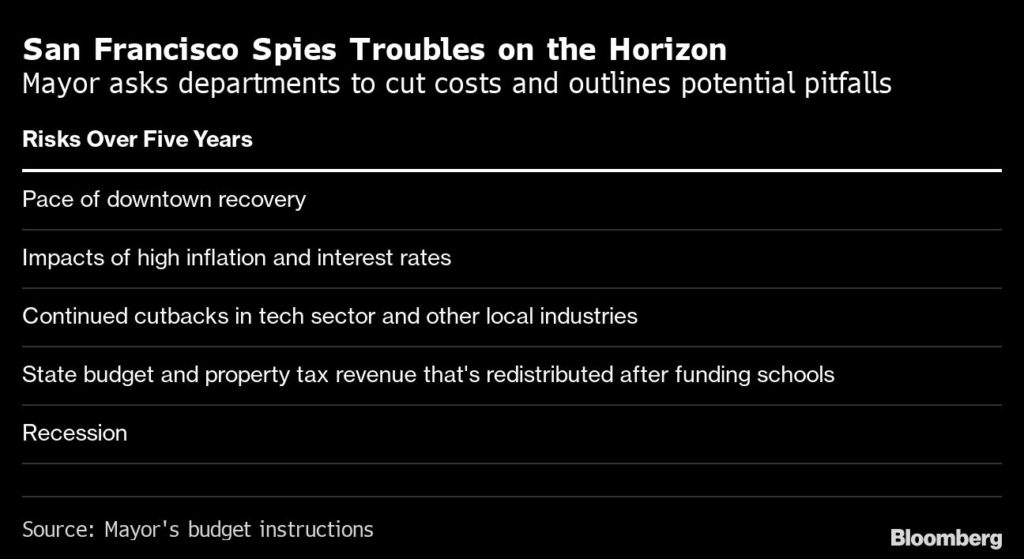
(Bloomberg) — San Francisco is projecting a $728 million budget gap over the next two fiscal years as the technology hub reels from the economic hit of remote work and the depletion of one-time federal aid.

Mayor London Breed asked municipal departments Thursday to find ways to reduce costs by 5% in the next fiscal year and by 8% in the year after that as part of the budget process for the city, which has a $6.8 billion general fund. The fiscal plan for the years beginning in July 2023 and July 2024 must balance by June 1 when she submits it to the board of supervisors for approval.

San Francisco, suffering from some of the nation’s weakest office occupancies and stubbornly low transit ridership, is now expecting business taxes over the next two years to decline by $179.3 million from previous estimates. Significantly, property taxes — usually a stable revenue source in downturns — are now projected over the same period to drop by $261 million from the earlier forecast. 

A report from the city economist last month modeled a worst-case scenario of $200 million in lost tax revenue over five years from lower commercial real estate values sparked by office vacancies.

Breed isn’t calling for layoffs. Still, the grim forecast doesn’t factor in a possible recession, and “departments should prepare for outlook to worsen,” according to the presentation.

“We know the challenges facing San Francisco are significant, and we have a lot of work ahead of us to maintain the city’s recovery efforts,” Breed said in a statement. “As we work to close this deficit, it will require tough choices and real tradeoffs.” 

San Francisco’s shortfall underscores the challenges the city faces in adapting to a landscape where its central district, which accounted for most of its economic output and jobs pre-pandemic, is largely deserted. Tech companies, which had embraced flexible work policies to attract and retain talent in the wake of the pandemic, are now shedding thousands of employees as the economy weakens.

Besides slowing revenue growth, the city expects costs to rise from employee wages and pensions. In addition, a measure approved by voters in November to set aside grants for school students means less for the general fund. The deficit jumps higher in the second fiscal year — accounting for $528 million of the total shortfall — when one-time federal dollars run out.

Additional aid is unlikely to come from the US Congress, which had doled out an unprecedented $513 billion to municipal governments and agencies as part of the Covid-19 rescue. Meanwhile, California has warned it may see a deficit of its own for the next fiscal year after years of surpluses, leaving the odds of largesse from the state budget slim.

Breed said in her presentation that she wants to continue her focus on economic recovery, improving public safety and reducing homelessness, and that departments should work toward fulfilling these initiatives, such as reclassifying jobs to support those efforts.

(Adds mayor’s statement in sixth paragraph.)

More stories like this are available on bloomberg.com

©2022 Bloomberg L.P.

Verizon Lost Its Network Superiority — Now It’s Paying the Price

(Bloomberg) — For Verizon Communications Inc. investors, 2022 can’t end fast enough. By the time the books close, the largest US wireless carrier will have logged a third-straight year of below-industry growth, going from first to last in mobile-subscriber gains. 

“Verizon bungled 5G and lost its network leadership position,” said Roger Entner of Recon Analytics, a boutique advisory group.

Some investors worry Verizon will ignite a costly price war to win back market share, hurting all of the players as they continue to spend billions of dollars on network expansion and upgrades. The last few years have been marked by more stable industry pricing, record high margins and low customer churn.

This isn’t how the era of better, faster wireless service — known as 5G — was supposed to unfold for the No. 1 US provider. Verizon headed into the decade with a reputation for the best network and service. But management was outflanked by T-Mobile US Inc.’s rapid ascent in network quality, as well as lower prices, and out marketed by AT&T Inc.’s free-phone giveaways. 

“The Verizon brand was closely tied to its network prowess,” said Tammy Parker, an analyst with GlobalData, a consulting company. “But it’s difficult to pin down what exactly Verizon stands for now, and that’s a tremendous problem.”

The latest trouble erupted last week, when the head of Verizon’s consumer division departed. It’s the second time in a year that the chief of the company’s largest business got the boot. Chief Executive Officer Hans Vestberg is overseeing that operation for now.

Verizon shares reflect all that concern. The stock is down 29% this year and near an 11-year low, including a loss of more than 2% Friday in New York to $36.96. That compares with an 19% drop for the S&P 500 in 2022. No. 2 T-Mobile is up 20% while AT&T, the No. 3 player, is down over 1% after unwinding years of investments in media and pay-TV businesses and refocusing on phone service.

Next year looks challenging, too. Analysts expect Verizon revenue to rise 1% in 2023, trailing T-Mobile again.

Vestberg, who has taken on the duties of his departing consumer chief Manon Brouillette, isn’t tipping his hand, saying he’ll be guided by “what’s happening in the market.”

“There might be segments where it makes sense to increase prices,” Vestberg said at a UBS investor conference in New York on Dec. 5 “And there might also be areas where it make sense to be more aggressive.” 

Still No. 1

The good news for Verizon is it’s still No. 1 by a wide margin, with 120 million regular monthly customers, compared with more than 90 million for T-Mobile and almost 84 million for AT&T. As the company builds out its 5G network, it can remind consumers about its record of superior coverage and reliability.

A Verizon spokesman said Vestberg wasn’t available to discuss the company’s strategy.

The 57-year-old Swede joined Verizon in 2017 as head of network technology after more than 20 years at telecom equipment maker Ericsson AB, where he rose to CEO and then was pushed out in 2016 amid slowing growth. He became CEO of Verizon in 2018, focused on ushering in 5G service.

However, the 2020 sale of Sprint Corp. upended the status quo. With that acquisition, T-Mobile gained airwaves that allowed management to build out crucial parts of its 5G network more quickly than either of its competitors. 

Verizon is also having to contend with a reinvigorated AT&T. That company has begun a rebound by focusing on expanding its network, adding subscribers and reducing debt. 

Price War?

Verizon, along with T-Mobile and AT&T, raised prices earlier this year to pass along higher labor and supply costs. Customers were willing to absorb the higher bills, showing just how essential wireless service has become.

A price war doesn’t figure into AT&T’s plans. 

“What do you gain by lowering rates?” Chief Operating Officer Jeff McElfresh asked at the same UBS conference. “At what point do you lower so far just to match somebody else. It doesn’t seem like a winning strategy to me.”

In his public comments, T-Mobile CEO Mike Sievert now claims to have both the best network and the best prices. In reality, it’s too close to call. There’s no indisputable winner on network quality, and prices for unlimited plans by the big three all start at about $60 to $65 a month. 

It’s not uncommon for each carrier to match the other’s free phone promotions and other perks. 

“There’s kind of an industry collusion going on,” said Stephen Stokols, executive vice president of Dish Network Corp.’s retail wireless division, which is offering a low-priced $25 monthly mobile plan. “They are each getting their signals from the other.”

Turning Verizon around will be a challenge for Vestberg, who has never run a large consumer business. 

That will involve more than just a new pricing or advertising strategy. Accelerating customer sign-ups requires getting back to what Verizon used to do well — improving the network, its reliability and the company’s message to consumers, Recon’s Entner said.

“It’s going to take strong leadership to break from what’s not been working,” Entner said. “Hans needs the courage to do that.”

(Updates stock price in seventh paragraph.)

More stories like this are available on bloomberg.com

©2022 Bloomberg L.P.
Joe Manchin Meant to Make Electric Car Tax Credits Hard to Get

(Bloomberg) —

US Senator Joe Manchin hasn’t minced words about where he stands on tax credits for electric vehicles. Throwing thousands of dollars at consumers was “ludicrous,” he said, when car buyers already were on waiting lists to purchase them, and not enough were being manufactured in America.

The West Virginia Democrat ultimately obliged on one condition: “You want to get your $7,500, then build this industry,” he told auto industry representatives. “They thought I would cave on that. I said, ‘I’ll cave — I’m going to take everything away from you.’”

These blunt remarks from the pivotal senator behind the Biden administration passing a landmark piece of clean energy legislation in August apparently weren’t clear enough. Automakers and governments have grumbled ever since about requirements that electric vehicles and their batteries are made in North America, and that raw materials for the latter are sourced locally or from countries the US has free trade agreements with. Manchin and others in Washington are particularly concerned about China’s dominant role in the EV and battery supply chain.

Recently, several of those grumblers have gone so far as to urge the Treasury Department to loosely interpret what types of EVs can be considered commercial vehicles, since the Inflation Reduction Act (IRA) offers those cars and trucks credits without battery component or mineral sourcing requirements, and aren’t limited to vehicles below certain price points.

This week, Manchin sought to shut that effort down.

The push was coming from the likes of Rivian and Hyundai, as well as the government of South Korea. They encouraged Treasury Secretary Janet Yellen, whose department has until year-end to finalize details of how the IRA is implemented, to allow leased vehicles to qualify as commercial vehicles. Hyundai and South Korea suggested rental cars and ride-share vehicles also ought to be included.

“If these vehicles are deemed eligible, I can guarantee that companies will focus their attention away from trying to invest in North America to meet the requirements” for non-commercial vehicles, Manchin wrote in a Dec. 12 letter to Yellen. He said manufacturers “will instead continue with business as usual.”

There were some obvious reasons for the IRA to be more forthcoming with credits for commercial vehicles. Medium- and heavy-duty trucks sell in much smaller numbers than passenger cars, but they account for an outsize proportion of emissions from the transportation sector, which itself is a huge contributor to carbon emissions. They’re also more difficult to electrify, so the market for cleaner big rigs is far more nascent.

It’s less clear that writers of the bill may have sought to make it easier for, say, Hertz and Avis, or Uber and Lyft drivers, to have an easier time getting tax credits than the typical American consumer. And it’s especially a stretch to think that the authors had leased cars in mind. If the grumblers pushing for this get their way, it will make little sense for consumers to buy EVs outright when they can lease them instead at a significant discount.

One automaker that would get a boost from Treasury counting leased cars as commercial vehicles is advocating against it anyway.

“Such a broad interpretation would benefit automobile manufacturers, including Toyota,” Stephen Ciccone, group vice president of public affairs for the maker of the Prius, wrote in a public comment this month. Still, he said counting leased cars as commercial vehicles would contradict the IRA’s objective to incentivize battery supply chain development in the US.

“The goal is not to simply increase the number of BEV sales by any means necessary,” Ciccone wrote, referring to battery-electric vehicles. “There are more pressing priorities for taxpayer dollars than helping wealthy consumers lease a luxury electric vehicle, that may be their second or third car.”

Paging through company comments on this aspect of the IRA provides a fascinating window into automakers’ interests and motives. Toyota talking against its book makes a little more sense when you consider its cozy relationship with Manchin — it has a plant in West Virginia — and its position on EVs. It’s been slower to roll them out and sought to leverage the strength of its hybrid lineup.

But this much is clear: The broader interpretation some companies and governments are asking for would go against what the key member of Congress behind this bill wanted all along.

More stories like this are available on bloomberg.com

©2022 Bloomberg L.P.

Here’s What Happened in the City of London This Week

(Bloomberg) — Follow us at @BloombergUK and on Facebook, wrap up your day with The Readout newsletter with Allegra Stratton and listen to our weekly podcast In the City.

Good afternoon from Bloomberg’s UK finance team. Big tech takes a stake in the City, inflation peaks, and a tycoon settles into a luxury prison. Here’s five stories from the past five days.

1)  BOE Says Inflation May Have Peaked as Rates Hit 14-Year HighThe Bank of England said Britain’s inflation rate may have peaked already and two of its policy makers believe interest rates are now high enough to drain pricing pressure. 2) Europe’s Trading Superhighway in the Alps Highlights Data RushData centers are utterly key to the world’s financial infrastructure. Take a tour inside one.3)  Microsoft to Buy 4% of London Stock Exchange on Cloud DealMicrosoft agreed to buy a 4% stake in the LSE in a $2.8 billion cloud-computing deal – pushing big tech further into financial markets.4)  Tycoon’s Prison in the Sky Shows How Wealthy Set Their Own RulesThe arrested Chinese property tycoon Zhang Li has a novel way to avoid a London jail — lock himself in his own luxury tower block.5)  HSBC Sends Recruitment Emails to Rival Bankers Facing Cuts With Wall Street firms trimming staff on gloomier outlook, HSBC has a plan to pick up talent.

More stories like this are available on bloomberg.com

©2022 Bloomberg L.P.

Musk Faces European Anger Over Twitter Ban of Journalists

(Bloomberg) — Backlash against Elon Musk suspending journalists from Twitter Inc. has spread among senior European politicians, with threats of future sanctions and lawmakers leaving the platform. 

“News about arbitrary suspension of journalists on Twitter is worrying,” said Commission Vice President Vera Jourova in a tweet. “There are red lines. And sanctions, soon.” 

Twitter suspended the accounts of several prominent journalists — including from the Washington Post, CNN, and the New York Times — covering the social network’s billionaire owner Elon Musk, who alleged they were endangering his family. Musk said the suspended profiles were of people who had posted his real-time location, describing the information as “basically assassination coordinates.“

Jourova — one of the EU’s more senior officials — cited the Digital Services Act and the Media Freedom Act, two major pillars of European tech regulation. The DSA — the EU’s content moderation rulebook which would ban arbitrary suspensions of accounts — was made law in the fall, but companies won’t start the compliance process until the summer. Companies like Twitter first have to report the number of users they have in the EU in February.

The European Commission proposed the Media Freedom Act in September to establish new safeguards for media. The plan is in the early stages of negotiations in the EU institutions. 

Read More:: Musk Disables Twitter Spaces After Clash With Journalists

The German Foreign Ministry also voiced its concern — via Twitter, stating that “#PressFreedom must not be switched on and off at will. As of today, the journalists listed below can also no longer follow, comment or criticize us. This means we have a problem @Twitter.” 

Twitter has drawn criticism from the German government since Musk’s purchase of the platform, which is observing Twitter “with growing concern,” Christiane Hoffmann, a spokeswoman for German Chancellor Olaf Scholz said at a press conference on Friday morning. The government is still in the process of evaluating its policy on using the platform, Hoffmann said.

“From our point of view, freedom of the press is an extremely valuable asset that must be defended when it is called into question,” Christofer Burger, spokesman for Germany’s Foreign Office said.

The French minister in charge of industry Roland Lescure tweeted on Friday morning that he would suspend his account. “Following the suspension of journalists’ accounts by @elonmusk, I am suspending all activity on @Twitter until further notice”, he wrote. The French digital minister Jean-Noel Barrot tweeted he was “distressed by the drift in which Elon Musk precipitates Twitter”. 

Although Europe currently has little power to penalize Musk for suspending journalist, he will soon have to contend with a litany of new rules for how he handles posts under the DSA, which will require platforms to take down illegal content and take more action against harmful content. He will also have to have content moderators to handle content in different EU languages. 

Under the incoming EU rules, user accounts may be restricted or blocked — but they have to be informed, the grounds have to be set out and must be based on terms of use. Account holders have to be able to appeal the decision.

Before taking over the platform, Musk spoke openly against arbitrary or indefinite bans on users, especially taking aim at Twitter for banning former US President Donald Trump from the platform. These bans were also viewed critically by EU politicians at the time including former German Chancellor Angela Merkel. 

Musk has reinstated Trump as well as right-wing commentators who were banned by previous leadership. Ye, the rapper formerly known as Kanye West, was reinstated but then banned again after tweeting a swastika.

Key lawmakers in the European Parliament also warned in a letter seen by Bloomberg on Friday that they have “deep concerns” about Musk’s acquisition of Twitter. 

Christel Schaldemose, the lead author of the DSA in parliament, as well as lawmakers Paul Tang and Rene Repasi, asked Musk to make a number of changes to comply with the rules and to speak in the parliament. 

“By taking up our suggestions you avoid Twitter becoming the public sewer of hate speech and fake news and ensure it does not clash with its obligations under the new European rulebook,” the letter said.

–With assistance from Benoit Berthelot, Stephanie Bodoni and Kamil Kowalcze.

(Additional comments on letter to Musk.)

More stories like this are available on bloomberg.com

©2022 Bloomberg L.P.

Accountant That Vetted Binance Reserves Halts Crypto Work

(Bloomberg) — Mazars Group, the accounting firm used by crypto giant Binance Holdings Ltd. and other big players in the industry to vouch for their assets held in reserve, has halted all such work for crypto clients, dealing a blow to an industry seeking to shore up confidence in the wake of FTX’s collapse. 

In an email sent by the French firm, Mazars said it had suspended work for cryptocurrency firms because of indications that markets haven’t been reassured by the “proof-of-reserves” reports it had published so far. The firm was also concerned about intense media scrutiny, the email said. A Mazars spokesperson later said the suspension was limited to its provision of proof-of-reserves reports, citing “concerns regarding the way these reports are understood by the public.”

“Mazars has indicated that they will temporarily pause their work with all of their crypto clients globally,” a spokesperson for Binance said in a statement to Bloomberg News on Friday. “Unfortunately, this means that we will not be able to work with Mazars for the moment.”

The decision is a setback for an industry that’s been trying to bolster its credibility with investors following the collapse of crypto exchange FTX, which has been accused of misusing customer funds. Auditors have faced similar backlash in recent weeks, given that FTX itself had engaged such services prior to its collapse that seemingly missed any warning signs. Cryptocurrencies fell after the report, with Bitcoin down as much as 2.8% in trading Friday. BNB, the native token of Binance Smart Chain, fell as much as 4.8%.

Paris-based Mazars has been at the forefront of the crypto industry’s rush to conduct proof-of-reserves reports for the likes of Binance and other large exchanges, including Crypto.com and Kucoin. Statements from spokespeople for Crypto.com and KuCoin said they would be open to engagement with other audit firms. A website hosting Mazars’s reports for crypto clients is currently inactive. 

Incomplete Picture

Proof-of-reserves reports have faced scrutiny as they are not comparable to a full audit, in that they only show a firm’s assets, not its liabilites, and instead serve as snapshots in time that say information provided by clients broadly checks out. 

These disclosures have failed to calm investors, with many opting to pull their tokens off exchanges in fear of further implosions. Over the past two weeks, a net $554 million in stablecoins and more than $2 billion in Bitcoin and Ether have been withdrawn from centralized exchanges, according to data from CryptoQuant — though this is largely stabilized compared to the mass withdrawals seen when FTX collapsed in early November.

“It is unclear how far the solvency contagion could run, and proof of reserves is not the same as proof of solvency,” said Simon Taylor, head of strategy and content at crypto startup Sardine. “The issue with FTX was that while it had reserves, those reserves were massively over valued relative to their risk in a bank run scenario.”

The Binance spokesperson said the exchange is exploring how it might provide additional transparency on its reserves in the coming months.

The cryptocurrency sector has long been plagued with a lack of established auditing standards, the consequences of which were laid bare in the recent unraveling of FTX. The exchange’s co-founder and former CEO Sam Bankman-Fried was arrested this week in the Bahamas, and faces civil and criminal charges in the US for wire fraud among other allegations.

John J. Ray, FTX’s new CEO, told US lawmakers on Tuesday that the defunct exchange had used accounting software QuickBooks to try and keep track of its finances, a system he said was wholly unsuitable for a company of its size. 

Read: FTX Collapse Puts Auditors in Crosshairs of Clients, Regulators

FTX had previously engaged auditing services by Armanino LLP and Prager Metis CPAs LLC. Ray said that FTX had yet to go through Armanino’s recent audit of the firm’s books, adding: “We do have to look through the books and records and look at the audits themselves and see how comprehensive they were to see if the audit would have picked up anything that we see. Certainly we’re going to look at the related party disclosures that are in those audits, whether there’s any footnotes or exceptions.”

Afraid of Crypto?

Many crypto companies have argued that they struggled to engage auditors at the top of the food chain for a deeper look at their books, due in part to the industry’s tarnished image as a vector for money laundering and other fraudulent behavior. Several companies have pledged to release full audits in due course, including Binance.

“Many audit firms are scared to work with crypto businesses,” said Binance CEO Changpeng “CZ” Zhao in a Thursday interview on CNBC. When asked why Binance hasn’t engaged a Big Four auditor — a moniker that refers to the largest accountancy companies PwC, Deloitte, EY and KPMG — Zhao added that such firms “don’t even know how to audit crypto exchanges.”

All four firms either declined or did not respond to requests by Bloomberg News to be interviewed.

Not Impossible

Critics have pointed out that, while it may be challenging, it is not impossible for cryptocurrency companies to secure full audits. Coinbase, the US-based publicly-listed exchange, works with Deloitte for its annual audited statements.

“Over the last several years, we’ve seen more auditors build out their practice to cater to the unique challenges crypto companies face,” said Maya Zehavi, a cryptocurrency angel investor. “It’s a shame that obfuscated business norms that have become the standard for offshore exchanges will ruin access for legit crypto companies to get professional auditing.”

Others have bemoaned an historic lack of expertise among top-tier auditors about how to analyze blockchain transactions and cryptoassets. Jean-Marie Mognetti, CEO of crypto asset management firm CoinShares, described several difficulties in getting a 2017 audit of its books by Deloitte over the line.

“It has always been difficult for them to play catch-up, because the people they have in-house don’t really have the skills,” Mognetti said in an interview. The process required a significant amount of training from CoinShares to teach Deloitte’s auditors how to properly vet a crypto firm’s books, he said, with the report then passed around to numerous partners overseas out of concern for the firm’s reputation.

The following year, the team at Deloitte in charge of CoinShares as a client was turned over with new staff, meaning that CoinShares would need to start the training all over again, Mognetti said. CoinShares now works with Grant Thornton for its annual audit. A spokesperson for Deloitte declined to comment on Mognetti’s statement.

‘Better Than Nothing’

Ultimately, a consensus remains that proof-of-reserves reports are insufficient, even as a stepping stone for crypto companies eager to show their financial health.

“If, for example, there are different parties that have claims on these assets, that might not necessarily come out through a proof-of-reserves report, and similarly that wouldn’t look at the internal control environment of these companies,” said Esther Mallowah, head of tech policy at the ICAEW, a global professional body for chartered accountants. “It’s a start, and it’s better than nothing, but I don’t think they provide the complete picture that investors need.”

A report published Thursday by industry group UK Finance included suggestions that as a first step, crypto firms should be required to meet local accounting and audit standards laid out under so-called client assets rules, which were strengthened after the 2008 financial crisis. “This would provide a framework for identification of client assets, segregation and safeguarding, reconciliation, and registration and legal title,” the group said.

–With assistance from Anna Irrera, Sidhartha Shukla and Philip Lagerkranser.

(Updates with statements from Mazars, KuCoin in second and fifth paragraphs.)

More stories like this are available on bloomberg.com

©2022 Bloomberg L.P.

Close Bitnami banner
Bitnami