
Bloomberg

Crypto’s Post-FTX Crisis Is Laid Bare as Trading Volumes Plummet by 50%

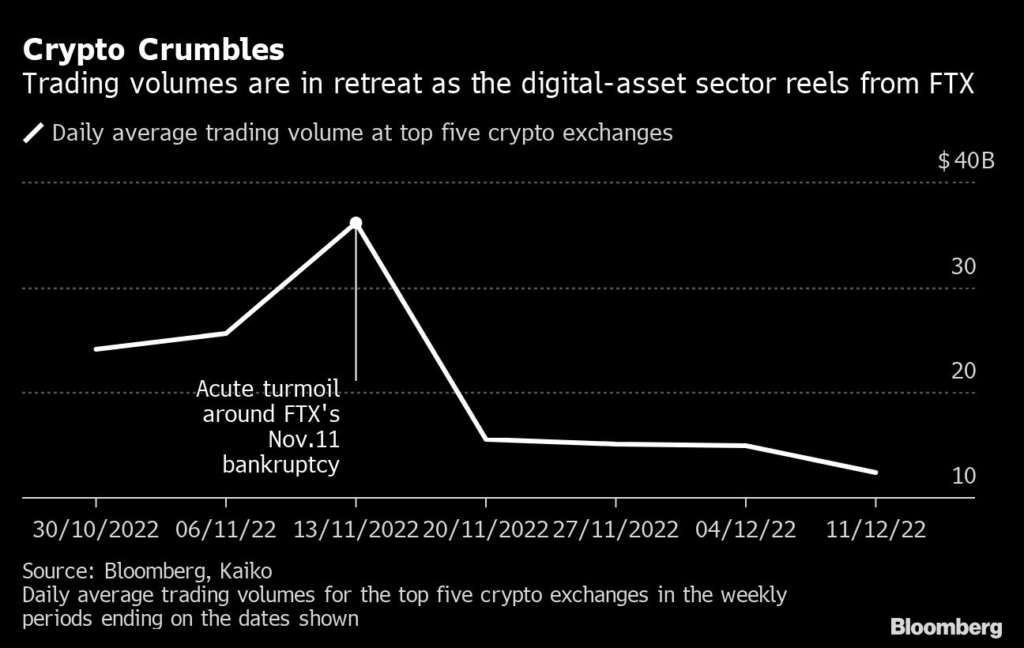
(Bloomberg) — Trading volumes at digital-asset exchanges have halved amid a loss of confidence in the crypto sector following the collapse of Sam Bankman-Fried’s FTX platform. 

Daily average trading volume slid to $13.1 billion in the week through Dec. 11 versus $26.7 billion in the seven days to Oct. 30, according to Bloomberg calculations on data from research firm Kaiko. 

FTX’s fall into bankruptcy began to rock the crypto sector from early November and is still causing contagion. Bankman-Fried has been arrested and charged with fraud for allegedly misappropriating billions of dollars of customer money.

The drop in trading volumes may partly reflect fearful investors yanking their coins off crypto platforms and anticipating little respite from a $2 trillion rout in digital assets since a peak in November 2021.

“The public is afraid more exchanges will fail, and have pulled assets off exchanges en masse,” said Hayden Hughes, chief executive officer of social-trading platform Alpha Impact. “Trading firms and market makers have also pulled assets, meaning lower volume overall.”

The figures from Kaiko span platforms accounting for the majority virtual-asset trading, including the likes of Binance, Bitfinex, Coinbase, OKX and Kraken. Such centralized platforms take custody of client assets whereas their much smaller decentralized rivals leave the safe-keeping of tokens with owners.

The guardianship of tokens is a topic of intense debate in FTX’s shadow. But decentralized exchanges — sometimes called DEXs — have also suffered: their daily average volumes sank about 44% to $1.5 billion in the week through Dec. 11 from $2.6 billion in Oct. 24-30, according to data from DefiLlama.

Among the challenges is that the “user experience and execution on DEXs is so different from centralized exchanges,” said Katie Talati, director of research at digital-asset specialist Arca.

Bitcoin, Ether and a gauge of the top 100 tokens are all down more than 60% this year, which is shaping up to be among the worst ever in crypto.

Rapidly tightening monetary policy sapped speculative ardor and sparked a series of blowups at risky crypto outfits, leaving many prognosticators unsure about what kind of future lies ahead for digital assets.

–With assistance from Sidhartha Shukla.

More stories like this are available on bloomberg.com

©2022 Bloomberg L.P.

Veon Nears Sale of Pakistan Towers to TPL-TASC Group

(Bloomberg) — Wireless operator Veon Ltd. is close to selling its tower assets in Pakistan to a consortium comprised of Pakistan’s TPL Corp. and UAE-based TASC Towers Holding Ltd. in what could be the country’s largest deal in more than a decade, according to people familiar with the matter.

Discussions are at an advanced stage and a transaction, which involves Veon’s 10,000 to 12,000 towers in Pakistan, could be announced in the coming weeks, the people said. A deal could value the assets at more than $600 million, one of the people said. The TPL-TASC group has emerged as the likeliest buyer after beating out rival bidders including other telecom companies, the people said, who asked not to be identified as the information is private. 

A sale of the towers, if successful, could mark Pakistan’s largest deal since 2011, according to data compiled by Bloomberg. Deliberations are ongoing and the companies could still decide against a deal, the people said. A representative for Veon declined to comment, while representatives for TPL and TASC didn’t immediately respond to requests for comment.

The process of divesting the towers in Pakistan “is very close to conclusion,” Veon Chief Executive Officer Kaan Terzioglu said in an interview last month, without identifying any bidder. A Saudi Telecom Co. unit and Pakistani conglomerate Engro were among the suitors for the assets, the people have said.

Pakistan’s TPL in September said it has formed a strategic partnership with TASC to bid for an unidentified telecom tower company. TPL’s businesses span across GPS tracking services, insurance, venture capital and security services. Its real estate arm TPL Properties Ltd. raised about $697 million rupees ($3 million) in an initial public offering in Karachi in 2016. TPL REIT Management Co. is seeking to raise as much as $500 million through a private real estate investment trust, which could be one of the largest fundraisings in the country’s history.

Veon was founded in Moscow in 1992 as VimpelCom, one of Russia’s first cellular-phone providers. It has grown into a Dutch-domiciled telecommunications giant with more than 200 million customers in seven countries. Veon agreed in November to sell its Russian unit for $2.1 billion to senior members of the country’s management team.  

The company is the largest telecom operator in Pakistan. Separately, the second largest operator Telenor ASA is pushing ahead with plans to sell its operations in Pakistan, which could be valued at about $1 billion, Bloomberg News reported last month. 

Last year, Veon sold more than 15,000 towers in Russia for around $970 million to Service-Telecom LLC. It has about 30,000 more towers to sell and holding talks with potential buyers in Pakistan, Bangladesh, Kazakhstan, Uzbekistan and Ukraine, Terzioglu told Bloomberg News in August. Shares of Veon have fallen about 67% this year in Amsterdam, giving the company a market value of about $932 million.

(Adds Veon’s share price in last paragraph. An earlier version corrected the sixth paragraph to give the accurate number of customers and countries where Veon operates.)

More stories like this are available on bloomberg.com

©2022 Bloomberg L.P.

Amazon Signs Deal With Games Workshop for Warhammer 40k Films

(Bloomberg) — Games Workshop Group Plc will work with Amazon.com Inc. to develop film and television productions, with initial work focusing on the Warhammer 40,000 universe.

Warhammer 40,000, or 40k as it’s known by fans, is a sci-fi universe set in humanity’s ‘grimdark’ future. It focuses on themes of conflict, galaxy-spanning empire, and fanatic religiosity. The Games Workshop franchise already includes popular tabletop games, over 300 novels, and has licensed its content for several successful video games.

The announcement Friday was “very exciting news for Games Workshop,” said Andrew Wade, an analyst at Jefferies in a research note, noting that licensing income has built strongly in recent years. “A mainstream TV/film product could be game-changing in terms of Warhammer’s brand reach and awareness.”

Shares in Games Workshop rose 11% in early trading on Friday, the most in almost nine months. The stock — a pandemic market darling as lockdowns boosted demand for home-based hobbies — had previously fell about a quarter year-to-date.  

Amazon is gearing up to spend more than $1 billion a year to produce movies that it will release in theaters, following the $8.5 billion acquisition of MGM, a 98-year-old Hollywood studio that released Ben-Hur and Legally Blonde. I

The ex-superman actor Henry Cavill is likely to star and executive produce a series adaption of Warhammer 40k, a franchise he’s made no secret of his love for, according to a report the Hollywood Reporter Thursday. 

While Amazon and Games Workshop have reached an agreement on material commercial terms, the project has yet to be finalized, according to a statement. Games workshop made no change to its forecast for the period ended May 2023.

(Adds Jefferies reaction, shares.)

More stories like this are available on bloomberg.com

©2022 Bloomberg L.P.

Amazon to Bring Games Workshop to the Screen: The London Rush

(Bloomberg) — It is a big morning for fans of table top fantasy game Warhammer, with the news that a long-awaited agreement to develop the brand into TV and film has been signed in principle with tech giant Amazon. Meanwhile, UK retail sales unexpectedly fell in November as the cost of the living crisis engulfing the sector deepened leaving the confidence of British consumers is still lingering near its record low.

Here’s the key business news from London this morning:

In The City

Games Workshop Group Plc: The maker of Warhammer, the table-top fantasy figurines, has signed an agreement in principle with Amazon to turn its intellectual property into film and television productions, alongside associated merchandising rights.

  • Amazon can start discussing the project with writers, and it is expected that the rights will initially be granted to develop the futuristic Warhammer 40,000 universe

BT Group Plc: The telecommunications giant will  combine its Global and Enterprise units into a single unit, BT Business.

  • The company says it’ll leverage the “full scale and capabilities” of the company to deliver a better  service for its business customers, as well as driving costs savings of at least £100 million by the end of 2025

CRH Plc: The building materials provider is setting up a venture capital unit to help develop new technologies and solutions in construction sector.

  • CRH Ventures will have $250 million venturing and innovation fund and will focus on technologies focusing on sustainability, decarbonisation and automation 

In Westminster

The Labour Party easily retained a parliamentary seat in a special election in northwest England, bolstering Keir Starmer’s position ahead of a national vote expected in less than two years.

UK consumer confidence lingered near its record low for an eighth month, the longest streak of gloom in the survey’s 50-year history. 

That’s as London’s pubs and restaurants that survived Covid and the widespread adoption of working-from-home are now facing another threat in persistent train strikes. Snow and walkouts aren’t helping, but they won’t “upend holiday spending,” says Bloomberg Opinion’s Andrea Felsted, adding that it’s January that “we should all be worrying about.” 

In Case You Missed It 

“UK equities are far cheaper than can be reasonably explained. That’s fantastic news for investors,” writes personal finance columnist Merryn Somerset Webb. 

Elsewhere, Citigroup Inc. told most employees they can work from anywhere for the final two weeks of the year, as Chief Executive Officer Jane Fraser bucks a trend among rivals to get office workers back to their desks full time.

Finally, EY is standing by its plan to split into two companies by mid-year despite choppy capital markets that could make the move pricier than expected. Global Managing Partner Andy Baldwin told Bloomberg the group is moving toward an initial “soft” separation of the auditing and consulting businesses by July 1. 

Looking Ahead 

Next week has unsurprisingly slim pickings, but one calendar item still stands out: final third-quarter UK GDP are due on Thursday morning, following the Bank of England’s projection yesterday that the economy should contract slightly less this quarter than previously forecast. 

For a news fix when the day is done, sign up to The Readout with Allegra Stratton, to make sense of the day’s events.

More stories like this are available on bloomberg.com

©2022 Bloomberg L.P.
Wretched Year for Yen Set to Cut Wealth in Japan Below Neighbors

(Bloomberg) — Japan’s economic clout calculated per person is seen slipping behind neighbors such as Taiwan and South Korea, a likely development accelerated by the yen’s slide that raises concerns about the country’s long-term growth prospects.

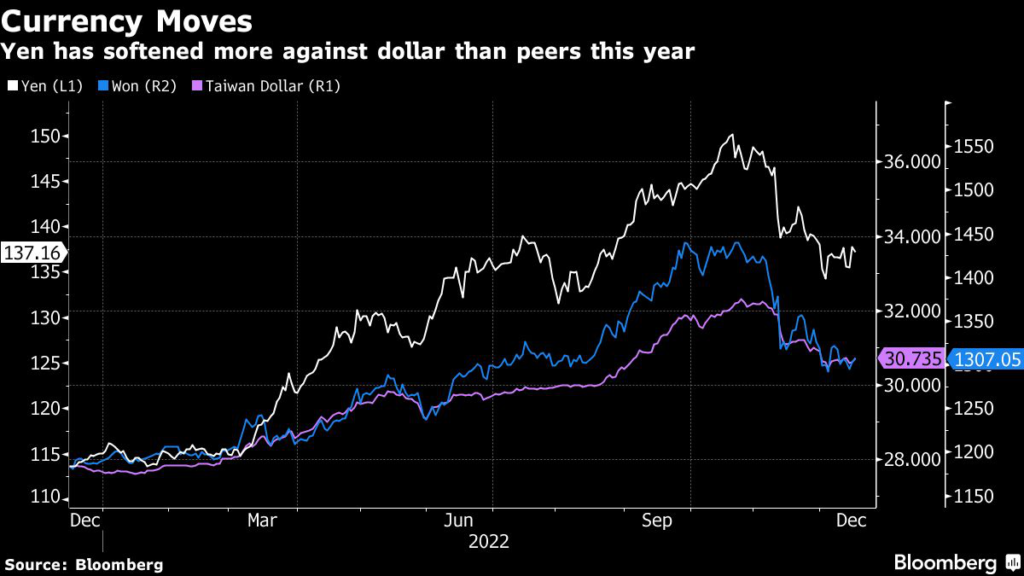
The dollar’s strength this year has battered currencies around the world, but the yen has taken a bigger hit than either the won or the Taiwan dollar, leading to a less favorable comparison of gross domestic product in dollar terms.

Japan’s nominal gross domestic product per capita is expected to have already fallen below Taiwan’s this year and is projected to be smaller than South Korea’s in 2023, according to a report this week by the Japan Center for Economic Research. 

The institute previously forecast it would take until at least 2027 before the two neighboring economies would outrun Japan on a per person basis. 

While the exchange rate has clearly been the main factor bringing forward the expected development, the trend points to the stronger growth trajectories of the smaller economies. 

“One reason behind the huge difference in exchange rates is Japan’s enormous trade deficit. Korea’s trade balance is better than Japan’s,” said economist Atsushi Takeda at Itochu Research Institute. “The difference in export power is clear. Japan’s export competitiveness is clearly declining.”

Economists point out that a mature economy like Japan’s can’t be expected to expand at the same pace as emerging rivals. 

Still, the trend can’t simply be blamed on Japan’s aging population, Takeda indicated, since Korea also faces the issue of a declining birthrate. 

Japan’s rivals are better harnessing and developing their tech sectors, the report indicated.

The report cited sluggish growth in labor productivity, driven by slow progress in digitalization, as a factor behind Japan’s gloomier growth prospects. The institute expects South Korea and Taiwan to further accelerate digitalization, helping them outrun a Japanese economy where paper forms, hanko stamps and even fax machines are still used by many companies and government bodies.

“In terms of cutting-edge technology, there are many areas where Japan is already behind and semiconductors are a good example,” Takeda said. He noted that the government has started making large investments to narrow the technology gap. 

“Still, the number of fields in which Japan has an advantage is steadily decreasing,” he said.

More stories like this are available on bloomberg.com

©2022 Bloomberg L.P.
UK Retail Sales Fall in November as Inflation Crisis Deepens

(Bloomberg) — UK retail sales unexpectedly fell in November as Black Friday failed to deliver its usual boost, deepening the cost of the living crisis engulfing the sector.

The volume of goods sold in shops and online fell 0.4%, the Office for National Statistics said Friday. Sales excluding auto fuel fell 0.3%. Economists expected a 0.3% gain on both measures. 

The data underscore concerns that the UK is already in recession, as the Bank of England believes. Consumer spending accounts for two thirds of national output and is key for growth. Separate figures Friday show consumer confidence continues to linger around its lowest levels for at least half a century.

The decline last month was driven by online sales, with Black Friday on Nov. 25 helping less than in previous years. Sales of auto fuel, second-hand goods at auction houses and computer goods also declined. 

That was partly offset by higher sales of food and drink, clothing and household goods, with shoppers attracted by discounts at department stores lasting for longer. However any hopes that the pickup might extend into December appear to have been dashed by a week of heavy snow, freezing temperatures and rail strikes that have hit retail and hospitality businesses hard.  

The last few months have been volatile for retailers. Sales were hit in September by an extra bank holiday for Queen Elizabeth II’s funeral but rebounded strongly in October. The ONS revised down its estimate for September to a loss of 1.8% and revised up October to growth of 0.9%.

The BOE and private-sector economists say Britain is now almost certainly in recession, with GDP set to register a second consecutive quarter of contraction in the final three months of 2022. Soaring prices and interest rates have left households with less money to spend on non-essential items and piled pressure on companies.

Retail sales will shrink over the quarter unless December sees an increase of 3%. Business in November was 5.9% lower than a year earlier. Yet surging prices mean people are spending more to buy the same basket of goods. The value of sales has risen 4.2% over the same period.

Lisa Hooker, industry leader for consumer markets at PwC, said: “November’s retail sales figures starkly indicate the growing gap between how much we are spending and what we are getting in return, which reflects record high inflation.”

“Whilst these figures make worrying reading for the high street, shoppers told us that they planned to do the majority of their Christmas present shopping in December this year, which is later than in the past. Therefore the real test for the retail sector will be how it fares this month.”

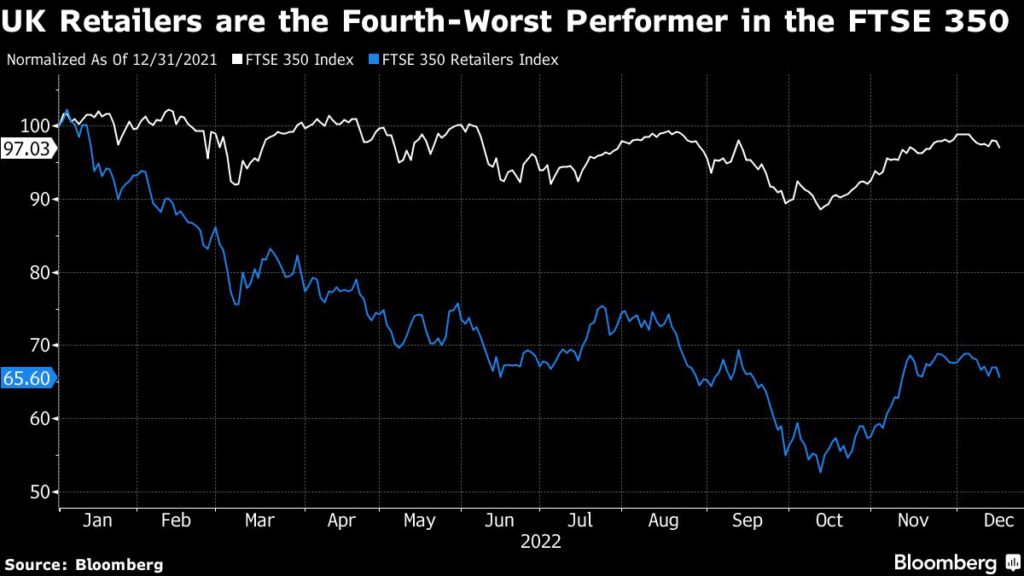
Retailer shares have slumped 34% this year, underperforming the broader FTSE 350 Index, as stores struggle with a combination of falling demand and rising costs.

On Thursday, electronics retailer Currys Plc cut its profit guidance, following similar warnings from firms including Next Plc and Boohoo Group Plc. Insolvencies in the sector are running at their highest level for a decade, with clothing retailer Joules Group Plc among the casualties.


–With assistance from Joshua Robinson and Joel Rinneby.

(Adds details from report, economist comment)

More stories like this are available on bloomberg.com

©2022 Bloomberg L.P.
The Worst Food Trend of 2022? Of Course It’s the TikTok Butter Board

(Bloomberg) — Imagine you were a stick of butter in 2022. The beginning of the year would’ve been ordinary enough. But around summertime, things would’ve gotten chaotic. Your price in the UK would’ve begun to climb dramatically enough—30%—to make headlines and to become a talking point in the cost-of-living crisis. In the fall, people in the US would worry you’d gotten too expensive ahead of prime baking season.

But the year’s most unexpected twist would’ve been when you found yourself spread on all manner of nonfood surfaces and headlining an unlikely food trend: the butter board.

Indeed, TikTok enthusiasts made it a very big year for butter. They showed the world innumerable ways to serve the dairy product, first by swirling it around on some version of a board, then by adding garnishes that ranged from appetizing—radishes, toast—to ridiculous, such as unripe strawberries (because the trend blasted off in October, way past true berry season in most parts of the US).

I’m a butter fanatic. It was, in fact, the behind-the-scenes star of the best dishes I ate this year, from the browned butter that takes a chocolate tart over the top at Perilla in London, to the melted stream pulling together the salted egg dressing that flavors fried chicken at Brooklyn’s Pecking House.

It’s just the absurdity of a butter board as a new holiday party trick that makes it untenable to me. A pile of good butter with accouterments certainly has a place on a restaurant table—the trend seems to have officially gotten its start via chef Joshua McFadden in Oregon. He created butter-slathered planks for farm dinners as a way to highlight seasonal ingredients and different breads. It’s fine when you’re at a table with people you’ve chosen to eat with, as well as a great opportunity to show off the outstanding varieties of butter available on store shelves. And yes, it’s a less expensive way to outfit a board than with cheese or charcuterie.

But the concept of putting out a platter of room-temperature butter(s) at a party and having innumerable people coming through and swiping? It’s hard to think of something less palatable (not to mention hygienic) than that. And then there’s the issue of cleaning up the greasy mess afterward.

@foodmymuse

Still not over the #butterboard trend (Original idea by Joshua McFadden via Justine Snacks) ???? #pumpkinbutter #brownbutter #butterboards #pumpkinseason #recipes

♬ original sound – Nadia Aidi

But, some will ask, is TikTok the real problem? Isn’t the trending agent what’s at fault here?

I say no. TikTok is responsible for proliferating any number of bad food trends—just this year, we have it to blame for spreading the word about Nyquil-infused sleepy chicken and healthy Coke. And for creating time-sucking, viral videos touting “pink sauce” and “it’s a chicken salad.”

Still, I believe it’s also a powerful force for good in the food world. It will remind some of us of the early days of the Food Network in the 1990s and, specifically, the rise of Emeril Lagasse. Did the omnipresent shout of “Bam!” get tiresome? Did people start overseasoning all their food with the Creole spices Lagasse promoted? Did too many dinner parties become wannabe cooking shows? Yes, yes, yes. But Lagasse in particular and early food TV stars in general got the public excited to talk about food, and interested in the process of preparing it, in a way that hadn’t happened since the heyday of Julia Child. And by extension, home cooking became a much more popular pastime. (Food TV also ushered in the era of the celebrity chef, but that’s another story.) 

Likewise, TikTok has spurred a new generation of people to make dishes they might’ve once just ordered in, and to create content with it. Dalgona coffee was a great way to get people excited about instant coffee when resources were limited in the early days of the pandemic. Baked feta pasta is a legit delicious and simple way to make a cheese and tomato sauce for noodles.

Just, please, not the butter board.

More stories like this are available on bloomberg.com

©2022 Bloomberg L.P.

North Korea Tests New Engine for Long-Range Missile Strikes

(Bloomberg) — North Korean leader Kim Jong Un oversaw the test of a new solid-fuel rocket engine that could enhance the state’s ability to fire off quick-strike, longer-range missiles for delivering nuclear warheads.

State media on Friday said Kim “guided the important test” of a “high-thrust solid-fuel motor,” noting its was the first of its kind for the country. “This important test has provided a sure sci-tech guarantee for the development of another new-type strategic weapon system,” the official Korean Central News Agency reported.

It also released photos of Kim, with cigarette in hand, smiling in front of a massive cloud of smoke from the test site at its Sohae Satellite Launching Ground, along with other shots showing flames shooting out from the place where it said the engine test took place.

“This is the largest solid fuel motor test ever conducted by North Korea,” said David Schmerler, a senior research associate at the James Martin Center for Nonproliferation Studies with the Middlebury Institute of International Studies at Monterey.

Solid-fuel missiles are quick to deploy and can be easier to hide, giving the US and its allies less time to see signs of a launch and prepare interceptors. Kim has been modernizing his missile arsenal over the past several years, and has rolled out new, nuclear-capable, short-range ballistic missiles that can hit US military bases in all of South Korea and parts of Japan.

“Solid fuel missiles require less preparation prior to launching as they are built with the fuel ‘baked’ into the missile body. Shorter launch times ultimately increase the survivability of the system,” Schmerler said.

The engine could be used for its Pukguksong series of submarine-launched ballistic missiles — a two-stage, nuclear-capable rocket that has a range to hit all of Japan. It could also be used for longer-range missiles, including possible intercontinental ballistic ones that could deliver a nuclear warhead to the US mainland.

The size of the rocket motor, with an estimated diameter of 2.1 meters, is larger than a 1.7-meter diameter motor used in the first stage of a US Minuteman-1 ICBM, according to George William Herbert, an adjunct professor at the Center for Nonproliferation Studies. 

North Korea is steadily moving toward larger and more capable missiles that are “more portable and easier and faster to fire,” Herbert said. Pyongyang is continuing a rapid development of a program that employs significant portions of the state’s available national resources, he added.

“We aren’t going to like the implications and capabilities they’re demonstrating now,” he said in an email. “They’re good engineers and designers, and moving very quickly through advanced development towards a modern nuclear deterrent and possibly nuclear warfighting force.”

North Korea’s current ICBMs use liquid-fuel engines, which take longer to prepare and give the US and its allies a greater chance to shoot them down on the launch pad than would be the case with a potential solid-fuel version.

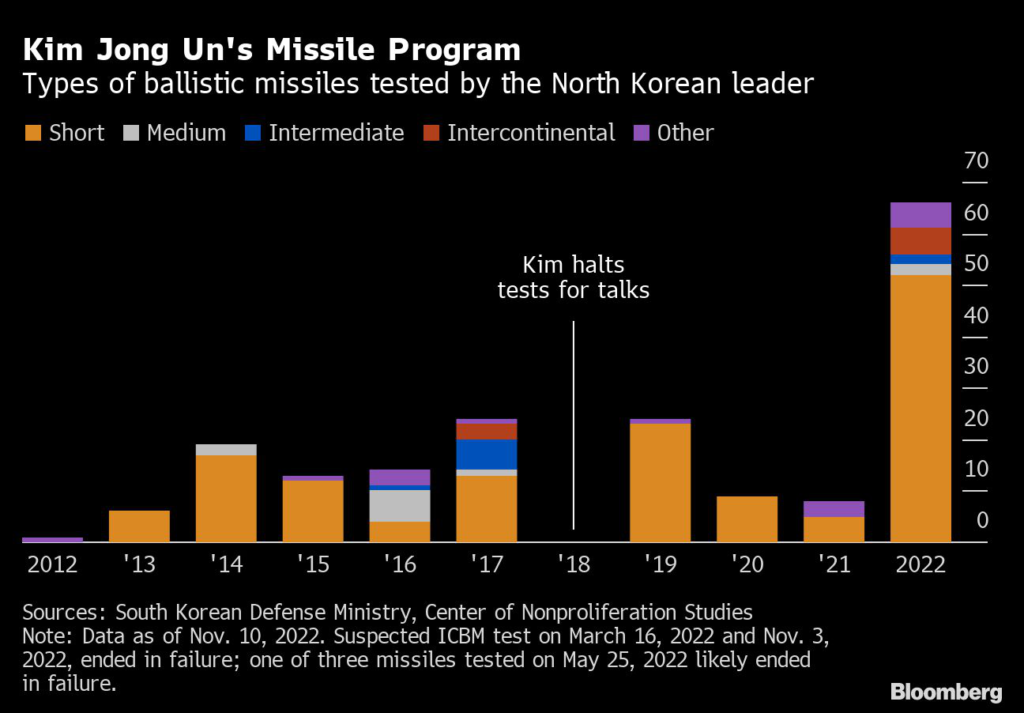
This year, Kim’s regime has fired off more than 65 ballistic missiles, the most during his decade in power and in defiance of United Nations resolutions that bar the launches. He has stepped up the provocations in recent weeks in a display of anger at joint military drills in the region conducted by the US and its allies South Korea and Japan.

The US, Japan and South Korea have warned that Pyongyang could soon raise tensions even higher with a nuclear test, which would be its first in five years and seventh overall. 

The US push to isolate Russia over Vladimir Putin’s war in Ukraine, coupled with increasing animosity toward China, has allowed Kim to strengthen his nuclear deterrent without fear of facing more sanctions at the UN Security Council. There’s almost no chance Russia or China, which have veto power at the council, would support any measures against North Korea, as they did in 2017 following a series of weapons tests that prompted former President Donald Trump to warn of “fire and fury.” 

(Updates with comments from specialist.)

More stories like this are available on bloomberg.com

©2022 Bloomberg L.P.
Gabon to Conserve 30% of Territory With Bezos, Waltons Support

(Bloomberg) — Some of the world’s richest families have entered a financial arrangement that will help the planet’s second-most forested nation conserve 30% of its natural capital.

The agreement with Gabon is backed by Enduring Earth, a partnership that includes The Nature Conservancy, Pew Charitable Trusts and Zomalab, which is the office of Ben and Lucy Ana Walton of the family that founded Walmart Inc. Money has also been provided by the Bezos Earth Fund, backed by Jeff Bezos, the founder of Amazon.com Inc. The financial details of the deal weren’t made public.

Under the agreement, known as a Project Finance for Permanence, the central African nation will bring to 80,000 square kilometers (30,888 square miles) the amount of forest under protection, 60,000 square kilometers of ocean and 19,000 square kilometers of rivers by 2030, the country said in a joint statement with its funders on Friday. 

About 22% of Gabon’s land is already under protection, as is 27% of its ocean territory. The nation is home to large populations of endangered forest elephants and lowland gorillas and its waters host a number of whale and dolphin species.

We plan to develop innovative “sustainable finance mechanisms to protect our lands, oceans, and freshwater resources,” Lee White, Gabon’s environmental minister, said in the statement. “We are committed to developing this PFP as a step-change for Gabon’s approach to financing nature.”

Gabon will be the first nation to commit to protecting 30% of its natural capital, according to White.

It’s the latest in a string of measures enacted by Gabon with a view to protecting its natural assets. Earlier this year, White said the country was in talks with the Nature Conservancy to reorganize as much as $700 million of its Eurobond debt to fund marine conservation. The US-based conservation nonprofit would buy the bonds and then sell debt to Gabon at a lower interest rate and with a longer maturity, according to White. The differential would be used to fund marine conservation at around $5 million a year for about 15 years, with the rest going toward a fund to finance programs after that date. 

White didn’t immediately respond to a request for comment about Friday’s statement, which was released at the United Nations Conference on Biological Diversity in Montreal. Mongolia is expected to announce a similar agreement, the groups said in the statement. 


More stories like this are available on bloomberg.com

©2022 Bloomberg L.P.

Twitter Suspends Journalists Who Musk Says Imperiled His Safety

(Bloomberg) — Twitter Inc. suspended the accounts of several prominent journalists covering the social network’s billionaire owner Elon Musk, who alleged they were endangering his family.

Late Thursday, reporters from publications including the Washington Post, the New York Times, Mashable and CNN were listed as blocked and their tweets were no longer visible. Musk said the suspended profiles, which included sports and political commentator Keith Olbermann, were of people who had posted his real-time location, describing the information as “basically assassination coordinates.”

“I was given no warning. I have no email or communication from the company about the reason for suspension,” New York Times reporter Ryan Mac tweeted from a new account. He posted a screen grab from the app saying he’s been permanently suspended. “I report on Twitter, Elon Musk and his companies. And I will continue to do so.”

The mercurial owner of the service followed up with a poll among his followers as to when he should remove the suspensions. The vote concluded he should remove the bans, and he issued a new poll with fewer options where voting again leans toward lifting the restrictions. The standard ban period for disclosing personal location information — also known as doxxing — on the service is seven days, he said.

“You doxx, you get suspended, end of story, that’s it,” Musk said in a journalist-hosted Twitter Spaces session shortly after his first poll. Participants in the Spaces audio session included the Washington Post’s Drew Harwell, who, alongside other banned reporters, was still able to participate in the network’s live audio service. 

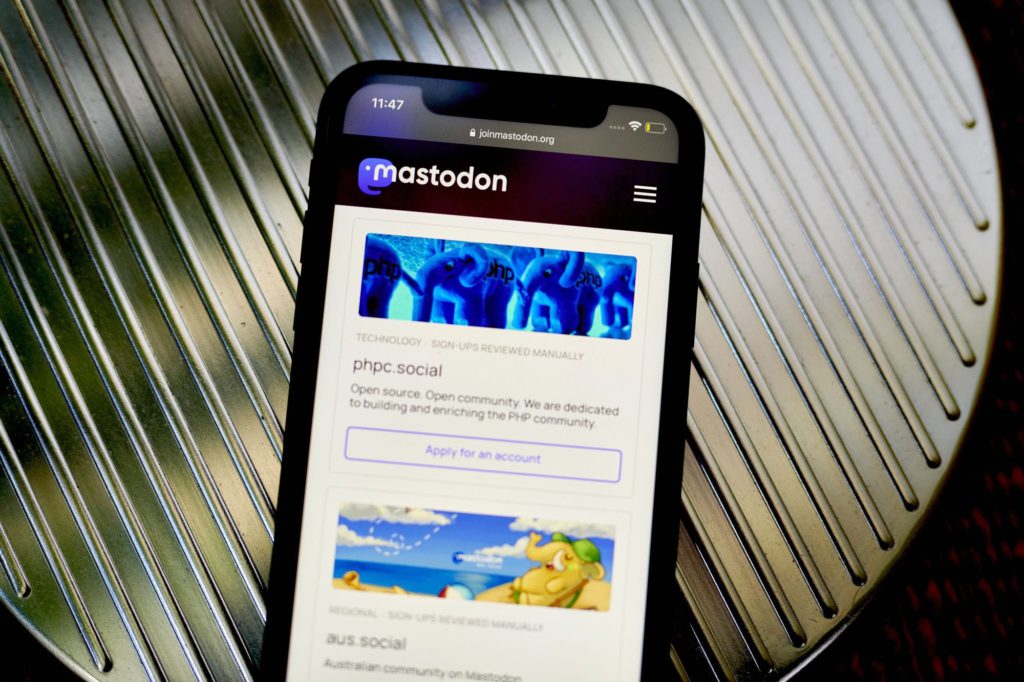
Twitter earlier cut off the feed of competing social network Mastodon, which had posted a link on its Twitter page to an account on its own service that uses publicly available flight data to track Musk’s private jet. Musk argued that pointing or linking to any source that might reveal his jet’s whereabouts was tantamount to posting his real-time location. On Wednesday, Twitter had suspended multiple profiles that tracked private jet locations, including his.

Twitter’s owner, who took the reins under the banner of free-speech absolutism and eliminating censorship, tweeted that “doxxing rules apply to ‘journalists’ as to everyone else.” He pinned a tweet to his profile explaining his reasoning and that he believed the offending Twitter profiles had threatened his family.

“This is management as dark performance art,” said Paul Barrett, deputy director of the NYU Stern Center for Business and Human Rights, in an email. “The one thing for which we can all thank Musk is that he’s demonstrating, day by day, how dangerous (and self-destructive) it is for so much corporate power to be concentrated in the hands of a few Silicon Valley moguls.”

CNN, whose reporter was swept up in the rash of suspensions, responded by saying “the impulsive and unjustified suspension of a number of reporters, including CNN’s Donie O’Sullivan, is concerning but not surprising. Twitter’s increasing instability and volatility should be of incredible concern for everyone who uses the platform. We have asked Twitter for an explanation, and we will reevaluate our relationship based on that response.”

An email to Twitter seeking comment on the journalists’ suspensions wasn’t immediately returned.

(Updates with quote from Musk)

More stories like this are available on bloomberg.com

©2022 Bloomberg L.P.

Close Bitnami banner
Bitnami