
Bloomberg

Twitter Suspends Prominent Journalists Covering Musk

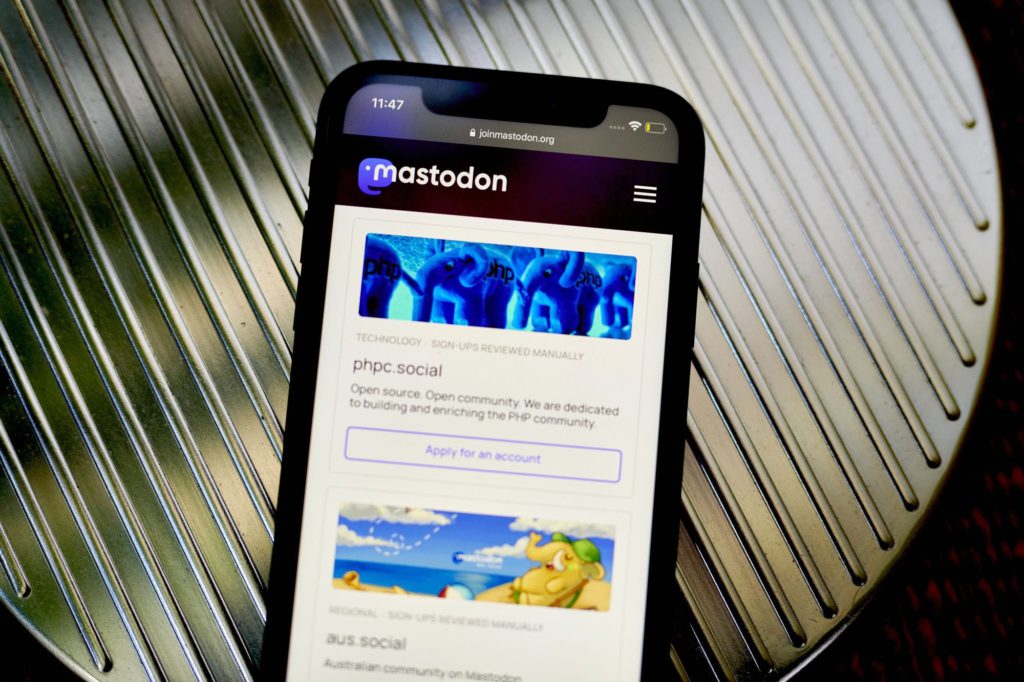
(Bloomberg) — Twitter Inc. suspended the accounts of upstart rival service Mastodon and several prominent journalists covering the social network’s billionaire owner Elon Musk.

Late Thursday, reporters from publications including the Washington Post, the New York Times, Mashable and CNN were listed as blocked and their tweets were no longer visible. Musk said the suspended profiles, which included sports and political commentator Keith Olbermann, were of people who had posted his real-time location, describing the information as “basically assassination coordinates.”

“I was given no warning. I have no email or communication from the company about the reason for suspension,” New York Times reporter Ryan Mac tweeted from a new account. He posted a screen grab from the app saying he’s been permanently suspended. “I report on Twitter, Elon Musk and his companies. And I will continue to do so.”

The mercurial owner of the service followed up with a poll among his followers as to when he should remove the suspensions. The standard ban period for disclosing personal location information — also known as doxxing — on the service is 7 days, he said.

The Washington Post’s Drew Harwell, alongside other banned reporters, was able to participate in a Twitter Spaces audio session while under suspension, exposing a loophole in Twitter’s enforcement.

Twitter earlier cut off the feed of competing social network Mastodon, which had posted a link on its Twitter page to an account on its own service that uses publicly available flight data to track Musk’s private jet. On Wednesday, Twitter had suspended multiple profiles that tracked private jet locations, including Musk’s.

Musk, who has called himself a free-speech absolutist and took over Twitter with the stated goal of eliminating censorship, tweeted that “doxxing rules apply to ‘journalists’ as to everyone else.”

“This is management as dark performance art,” said Paul Barrett, deputy director of the NYU Stern Center for Business and Human Rights, in an email. “The one thing for which we can all thank Musk is that he’s demonstrating, day by day, how dangerous (and self-destructive) it is for so much corporate power to be concentrated in the hands of a few Silicon Valley moguls.”

CNN, whose reporter was swept up in the rash of suspensions, responded by saying “the impulsive and unjustified suspension of a number of reporters, including CNN’s Donie O’Sullivan, is concerning but not surprising. Twitter’s increasing instability and volatility should be of incredible concern for everyone who uses the platform. We have asked Twitter for an explanation, and we will reevaluate our relationship based on that response.”

An email to Twitter seeking comment on the journalists’ suspensions wasn’t immediately returned.

–With assistance from Vlad Savov.

(Updates with poll by Musk)

More stories like this are available on bloomberg.com

©2022 Bloomberg L.P.
South Korean President’s Support Rate Hits Highest Since July

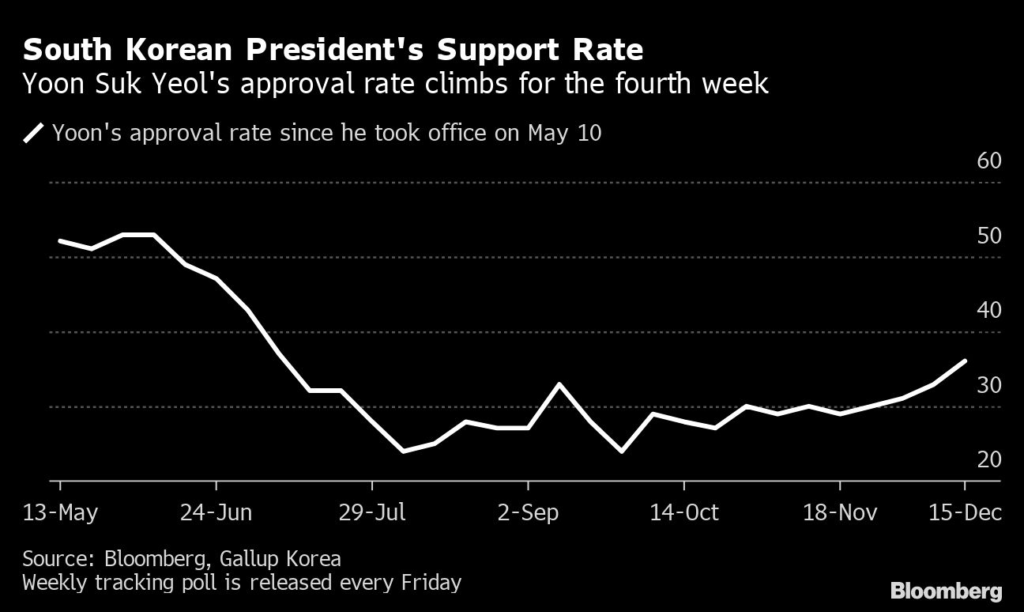
(Bloomberg) — The support rate for South Korean President Yoon Suk Yeol rebounded to its highest mark in about five months after he took a tough line on striking truckers and increased his focus on undoing policies of his predecessor.

Yoon’s approval rating rose three percentage points to 36% in a weekly tracking poll released Friday by Gallup Korea. Backing for his conservative People Power Party also topped that of the main opposition Democratic Party, which could help the president in parliament, where his progressive political foes hold a solid majority and may not want to see a further erosion in public support.

Support for Yoon, a prosecutor-turned-politician who took office in May, plummeted to 24% in late September, with survey respondents citing troubles with diplomacy, personnel choices and a lack of experience as reasons for the disapproval. 

Since then, his government has sharpened its plans to roll back labor policies under progressive former President Moon Jae-in that it sees as hurting businesses. In a nationally televised town hall meeting Thursday, Yoon reiterated calls to reform the education, labor and pension systems to ensure fairness and sustainability.

Korean Truckers Vote to End Strikes Disrupting Supply Chains

Earlier this month, Yoon ordered striking truckers to return to work, which helped pave the way for ending a labor dispute that threatened to disrupt supply chains of key export industries. The strike had added to worries after South Korea’s exports fell the most in two-and-a-half years in November, dragged down by an economic slowdown in China and cooling demand for semiconductors.

His approval rating in the Gallup poll climbed for a fourth straight week, as tensions with labor unions have heated up.

One of his government’s top priorities is to finalize the 2023 budget after parliament missed a Thursday deadline, as the ruling party and the main opposition failed to narrow differences.

Yoon needs to seek compromise with the Democratic Party, which holds a majority large enough to vote down his legislative proposals and can override any measure he vetoes. The next parliamentary elections are not until 2024, and Yoon may be on his back foot for a large part of his single, five-year term that ends in 2027.

–With assistance from Seyoon Kim.

More stories like this are available on bloomberg.com

©2022 Bloomberg L.P.

Surprise Corporate Actions by Indian Tech Darlings Spur Scrutiny

(Bloomberg) — The relentless rout in shares of India’s tech darlings since their much-hyped initial public offerings last year has driven some of them to use surprise tactics to arrest the slide, drawing scrutiny from investors and market experts.

First it was FSN E-Commerce Ventures Pvt., the owner of beauty e-retailer Nykaa, which announced a bonus share issue to coincide with the expiry of an IPO lockup on key investors in November that risked extending the stock’s slump. Then this month, the loss-making parent of payments firm Paytm somewhat baffled investors with a decision to buy back shares a little over a year since its Mumbai listing.

While within the rules, several market experts say the actions point to the fixation that newly listed firms have with their stock prices. Afterall, Nykaa and Paytm are among a flurry of hot startups that came to the Indian market with much fanfare. Their disastrous performance since listing has prompted some key backers to trim holdings while hoards of retail investors have taken to social media to voice their disappointment.

“I am not in agreement with the methods used by some of the newly listed companies to improve or sustain value of their capital,” said Shyam Sekhar, founder of ithought Financial Consulting LLP in Chennai. “I see these methods are expedient in nature.”

Boosted by gush of global liquidity, India’s consumer-facing technology startups witnessed strong investor appetite amid a booming local IPO market last year, despite questions over their profitability and valuations. The worldwide meltdown in the tech sector then triggered their share collapse.

Touted as India’s largest-ever IPO at the time of its listing last November, Paytm’s stock lost 75% of its value in the first year, making it the world’s worst-performing large IPO in a decade. The stock jumped 7.2% last Friday following the announcement of a share buyback plan. It is down almost 3% so far this week.

READ: An $18 Billion Wipeout Is Harsh Reality of Five Famed India IPOs

Nykaa, led by former investment banker Falguni Nayar, almost doubled on its listing day late last year, but has since been falling. Last month, the stock climbed about 18% over two days after the company allotted free shares to shareholders just as an IPO lock-up expired. Those gains are all gone now.

“The decision of the buyback has been taken after an in-depth review and detailed deliberations of our projected investment requirements to drive long-term value creation,” a spokesperson for Paytm wrote in response to emailed questions. “Paytm continues to grow despite the headwinds that have impacted major stocks globally.”

Nykaa didn’t reply to an email seeking comment. 

Reliance Power

Sekhar compared the recent corporate actions to what followed the listing of Reliance Power Ltd. — one of India’s most-hyped IPOs — back in 2008. The firm issued free shares to investors within days of its trading debut, but the move turned out to be short-sighted.

“Companies should instead try building confidence about their business models, communicating with shareholders about their efforts to improve businesses,” he said. 

To be sure, sell-side analysts seem to be turning more sanguine about the prospects of a recovery. The average 12-month price target for Nykaa is 48% above its current price while the consensus for Paytm is a return potential of 65%, data compiled by Bloomberg show. Paytm also has buy or equivalent ratings from eight out of the 12 analysts tracking the stock, the highest number of such calls since its trading debut.

READ: Nykaa Has Long Runway in Fashion, With Strong Margin Prospects

“It will be unfair to say the two companies are not focused on building their business,” according to Rakhi Prasad, an investment manager with Alder Capital. Investors in India are still learning about consumer technology companies’ business models, which is why many investors, even few institutional holders, are ignoring improvement shown by them on monthly operating metrics, she added.

Paytm is on track to break even on adjusted operating profit basis in the second quarter of the next fiscal year and will burn about $33 million before achieving the milestone, according to JPMorgan Chase & Co. analyst Ankur Rudra wrote in a note.

Still, questions remain on the rationale of these moves, especially as their impact on stocks seems to be fleeting.

“The companies look more concerned about their falling stock prices and this in a way tells us that they got their valuations wrong when they debuted the markets,” said Aditya Shah, chief investment officer at Mumbai-based JST Investments Pvt.

READ: IPO Pipeline in India Seen Active in 2023 on Smaller Deals

–With assistance from Sanjit Das and Menaka Doshi.

More stories like this are available on bloomberg.com

©2022 Bloomberg L.P.
Crypto Firm Amber Raises $300 Million to Tackle Damage From FTX

(Bloomberg) — Embattled crypto firm Amber Group has raised $300 million mainly for customers who lost money on the platform’s products due to FTX’s implosion, according to co-founder and and Chief Executive Officer Michael Wu.

Amber, a leading crypto trading and lending platform, had planned to raise $100 million at a $3 billion valuation in multiple parts, but changed tack once Sam Bankman-Fried’s FTX exchange blew up, Wu said in an interview.

“We made a quick decision to basically pause that previous round,” he said, adding that the new Series C round is being led by venture capital firm Fenbushi Capital US. The valuation is lower than the $3 billion achieved in February, Wu said, while declining to give an exact number.

Fenbushi Capital didn’t immediately reply to an email seeking comment.

Singapore-based Amber had less than 10% of its overall trading capital on FTX when the exchange collapsed into bankruptcy. That proportion has since expanded as Amber’s overall trading volume has shrunk, according to Wu. 

The company is cutting costs as it goes back to its roots of only supporting institutional and wealthier clients, according to Wu. He said Amber’s workforce will shrink to around 300 people, which was the size of its headcount at the end of 2020 and early 2021. 

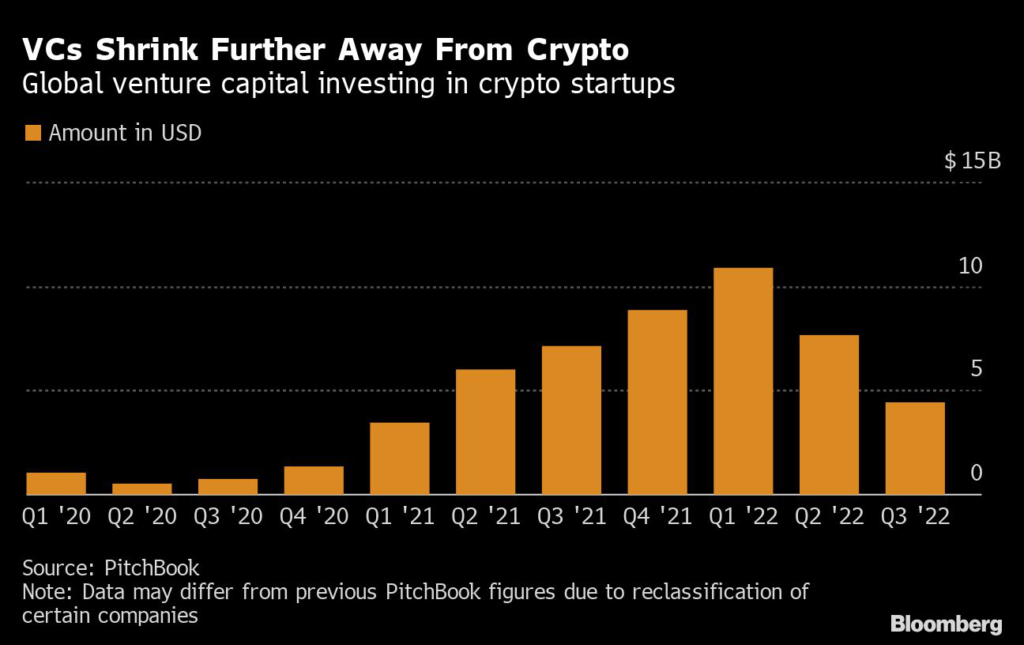
Crypto platforms are trying to assuage customer worries as contagion ripples out from FTX. Firms like BlockFi Inc. — now in bankruptcy — Blockchain.com and Blockstream recently sought to raise funds at lower valuations, reflecting tough market conditions and plunging interest from venture capitalists.

Amber’s troubles have included dragged-out layoffs, bonus suspensions and salary reductions among management. The company also shut down its retail customer operations and ended a sponsorship deal with Chelsea FC. 

When asked if Amber would be terminating a partnership with Atletico de Madrid — where the the logo of the company’s WhaleFin trading platform appears on the front of the soccer team’s jersey — Wu declined to comment specifically on the deal, but noted Amber is “reducing all marketing efforts.”

He said the company is still operating and that the majority of the $300 million funding will go to its institutional and high-net-worth clients who invested in products that used FTX — an example of the latter is a product that sought to exploit arbitrage opportunities between different exchanges.

Retail customers were unable to invest in these types of products through Amber, Wu said. 

Long-Term Prospects

At its peak, Amber had more than 1,000 employees at the end of the second quarter and early in the third quarter of this year, according to Wu. He said he’s confident in Amber’s long-term prospects.

“Going into next year, I do believe we will be one of the very few large crypto services companies remaining,” he said. 

Amber’s backers include Temasek Holdings Pte and Sequoia China. It was launched in 2018 by a group of founders that included former Morgan Stanley traders. One of its founders, Tiantian Kullander, passed away unexpectedly at the age of 30 in November.

Crypto markets are nursing heavy losses, hurt by rapidly tightening monetary policy and a series of blowups. A gauge of the top 100 digital assets has shed more then 60% so far this year.

For crypto market prices: CRYP; for top crypto news: TOP CRYPTO.

–With assistance from Suvashree Ghosh.

More stories like this are available on bloomberg.com

©2022 Bloomberg L.P.

Spark NZ Quits Sports Streaming, Ending Four Years of Disruption

(Bloomberg) — New Zealand telecommunications company Spark will give up streaming sports content when it shuts its Spark Sports unit in July next year.

Auckland-based Spark said escalating content rights costs and a broader range of investment opportunities across its business were the key drivers of the decision, according to an NZX filing Friday. It announced a content partnering agreement with state-owned broadcaster TVNZ, which it said will become the home of the majority of Spark content from July 1, 2023.

The decision ends four years of disruption in New Zealand sports broadcasting that saw Spark emulating global phone companies like the UK’s BT Group by securing sports content, betting it would drive more customers to its broadband and mobile streaming services. Spark ruffled the feathers of established pay-television company Sky Network Television by winning the rights to the Rugby World Cup in 2019 and then securing a six-year deal with New Zealand Cricket.

“It has been challenging to reach the scale we aspired to across the Spark Sport platform, with Covid causing major disruption to sporting codes globally just a year after launch,” Spark Chief Executive Officer Jolie Hodson said. “That slower than expected start, coupled with the escalating costs of content rights globally, makes it difficult to justify the type of investment Spark Sport requires when we have a wider range of investment opportunities across our broader business.”

Spark said it will make a NZ$52 million provision in the current financial year to cover ongoing obligations under content rights agreements that extend to 2028. Its shares rose 0.5% in Wellington trading Friday. 

During its existence, Spark has held the rights to English Premier League, Formula-1 and a range of other sports. Sky, which won back the Premier League rights last year, today announced a multi-year agreement to deliver Formula 1 from early 2023.

Spark said agreement has already been reached with New Zealand Cricket, meaning TVNZ will show and produce all mens and womens internationals and domestic T20 matches for three years from the start of the 2023-24 season.

The deal means more than 300 matches will be screened on free-to-air television over the period, NZ Cricket said in a statement. The sport’s administrator had been criticized for the decision to switch to the streaming service because of the potential impact on viewer numbers.

“This is a very good outcome for the game of cricket in New Zealand,” Chief Executive David White said. “We’re delighted New Zealanders can look forward to this level of free-to-air coverage. It’s a game-changer for the sport in this country.”

More stories like this are available on bloomberg.com

©2022 Bloomberg L.P.
Hong Kong Bitcoin, Ether Crypto ETFs Raise $79 Million in Shadow of FTX Crisis

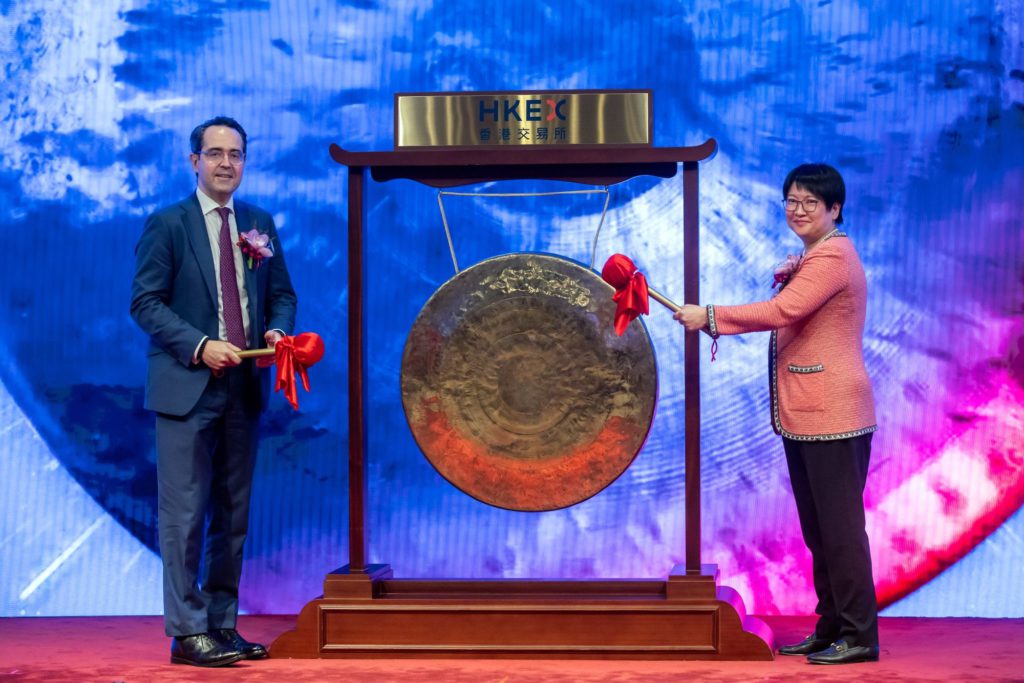
(Bloomberg) — A pair of Hong Kong exchange-traded funds investing in Bitcoin and Ether futures raised $79 million as the city pushes ahead with a plan to become a crypto hub even as the sector globally reels from the FTX collapse.

The CSOP Bitcoin Futures and CSOP Ether Futures ETFs, due to be listed later Friday, achieved $59 million and $20 million of initial investment respectively, according to a statement from issuer CSOP Asset Management Ltd. 

Billed as Asia’s first listed Bitcoin and Ether futures ETFs, the products offer the region a regulated environment for access to contracts traded on the CME Group Inc. platform, according to Bloomberg Intelligence.

Hong Kong earlier this year laid out a plan to become a top Asian crypto hub offering legalized retail trading and digital-asset ETFs, seeking to restore the city’s credentials as a financial center. The territory seems to be staying the course after indicating that recent crises show why investors would embrace a rule book offering transparency, compliance and investor protection.

Crypto exchange-traded products rocketed in popularity during 2021’s boom in token prices. But demand withered as digital assets tumbled into a rout and crypto firms like Sam Bankman-Fried’s FTX slid into bankruptcy.

A gauge of the top 100 tokens has tumbled more than 60% this year, compared with a less than 20% decline in global stocks over the same period.

For crypto market prices: CRYP; for top crypto news: TOP CRYPTO.

More stories like this are available on bloomberg.com

©2022 Bloomberg L.P.
Chinese Stock Delisting Threat Eases as US Gets Access to Audit Data

(Bloomberg) — US officials said they gained sufficient access to audit documents on companies in China and Hong Kong for the first time, a breakthrough that removes the acute threat of delisting for about 200 companies on New York exchanges.

The US Public Company Accounting Oversight Board said on Thursday that its inspectors have been able to sufficiently review audit documents from firms based in the two jurisdictions, after a decades-long standoff on the issue between Washington and Beijing.

The determination diminishes the chances that companies including Alibaba Group Holding Ltd. and JD.com Inc. will be delisted in the US, though the PCAOB must be able to fully inspect audit work papers for at least three consecutive years before the companies’ American Depositary Receipts will be in the clear.

Beijing’s willingness to make concessions on audits shows that China and the US can still work together on some tricky issues even as they clash on everything from semiconductors to national security and human rights. President Xi Jinping’s administration faces pressure to avoid unnecessary disruptions to China’s corporate sector at a time when the economy is struggling and the country is navigating a turbulent exit from its zero-tolerance strategy toward Covid.

“It’s a great first step and an important victory and very significant to show that there are areas where the US and China can have meaningful dialog in an otherwise very tense environment,” said Sandra Hanna, who leads the securities enforcement practice for Miller & Chevalier. “We need to continue to have a long-term view and monitor progress closely.”

Read more: Golden Dragons Dodge Threat of Delistings for Now

The China Securities Regulatory Commission said in a statement it welcomed the PCAOB’s decision and will continue to promote audit supervision cooperation with US. China and Hong Kong are the only places that historically haven’t allowed the reviews, with officials citing national-security and confidentiality concerns. 

“Today’s announcement is about one question and one question only: is the PCAOB able to inspect and investigate firms in mainland China and Hong Kong completely at this time. The answer, following thorough and systematic testing, is yes,” PCAOB Chair Erica Williams told reporters. The agency would re-assess if access ebbed, she added. 

Shares of US-listed China stocks initially jumped across the board on the news, pushing the Nasdaq Golden Dragon Index up as much as 2.5% just after the open on Thursday. Large-cap tech companies Alibaba and JD.com rallied as much as 3.5% each, while Pinduoduo Inc. rose 3.1%, before they erased gains to track a broad market slump. 

The Golden Dragon Index closed 2.3% lower, while the Nasdaq 100 Index fell 3.4%. Bloomberg News had reported in November that US officials completed their first on-site inspection round in Hong Kong ahead of schedule. 

The PCAOB said in a report that its inspectors and investigators were able to view full audit work papers of eight companies audited by KPMG Huazhen LLP in mainland China and PricewaterhouseCoopers in Hong Kong, and retain the information that they needed. The board will release a report on its inspections of each auditing firm in the first half of 2023, Williams said.

The individual companies whose audits were inspected won’t be identified in the reports. PCAOB inspections serve as an audit of the auditor, ensuring they meet basic standards and provide an effective check on corporate accounting.

Hong Kong

The agency’s 32 staff sent to Hong Kong found myriad potential deficiencies, but Williams said that the type of lapses and their number are typical for jurisdictions that have never been scrutinized by the PCAOB before. “We look at this as a sign really that our inspection process worked,” she said.

Williams told Bloomberg News that the agency has five ongoing investigations stemming from its work in China. Three were begun before PCAOB staff landed in Hong Kong in September, and two were initiated afterward, she said. “We try to move our investigations as as quickly as we can,” Williams said, adding that “enforcement is one of the best ways that we keep investors protected.” 

The PCAOB said in its report that it “has not observed any instances of non-compliance” by the Chinese government with the terms of the inspection agreement between the two countries. 

“This is the beginning — not the end — of our work to inspect and investigate completely,” Williams said in an interview Thursday with “Bloomberg Markets: The Close.” 

“We already are making plans to have teams on the ground in 2023 in order to continue our regular inspections there,” she said. “And if China denies our access, if there are any impediments that they put in our way, we will not hesitate to make a determination immediately next year.”

The clash over audits became a political sticking point after the 2020 Holding Foreign Companies Accountable Act (HFCAA) said clients of firms whose work papers can’t be inspected face being kicked off the New York Stock Exchange and Nasdaq. The legislation set a three-year time frame for delisting companies. The board’s vote Thursday vacates a 2021 determination that China did not grant access that year, triggering the compliance countdown. 

In a separate statement, Securities and Exchange Commission Chair Gary Gensler said the new determination “resets the three-year clock for compliance.” 

Nevertheless, Chinese companies in the US face heightened disclosure requirements to inform investors of the risks associated with their corporate structure and their ability to pay investor dividends, Gensler said. 

–With assistance from Matt Turner.

(Adds context from first paragraph and CSRC statement in sixth paragraph.)

More stories like this are available on bloomberg.com

©2022 Bloomberg L.P.
Amazon Pressed on Warehouse-Rebuilding Plan After Deadly 2021 Tornado

(Bloomberg) — Three US lawmakers questioned Amazon.com Inc.’s plans for rebuilding an Illinois warehouse that collapsed in a tornado last year, killing six workers and prompting an investigation by workplace safety regulators. 

The lawmakers said the e-commerce company should be constructing the warehouse with stronger safety features than existed before the collapse. Amazon is a tenant in the facility owned by a separate company.

“Workers have a right to safety at work, and employers have a duty to ensure, to the best of their ability, that their workplace is safe from harm and built to withstand reasonably expectable safety risks,” according to the letter signed by Senator Elizabeth Warren of Massachusetts and Representatives Alexandria Ocasio-Cortez of New York and Cori Bush of Missouri, all Democrats. “Amazon had reasonable cause to be concerned about tornado risk and should have updated the facility with a specifically designed storm shelter to avoid the exact sort of disaster that occurred a year ago.”

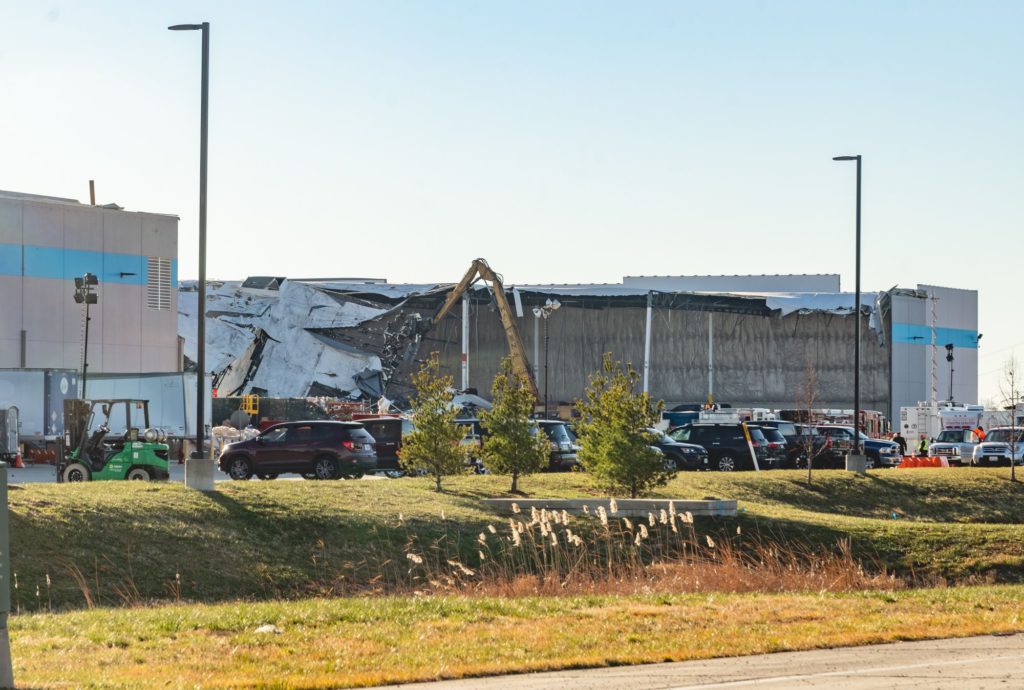
The deadly tornado ripped through an Amazon warehouse in Edwardsville, Illinois, last December, killing six workers and injuring several others. The Occupational Safety and Health Administration in April found several lapses, including that a megaphone used to alert workers was locked and inaccessible during the event. The agency didn’t levy any fines, but encouraged Amazon to review and improve its safety procedures.

The accident heightened public scrutiny of Amazon’s workplace safety record and how it balances customers’ desire for products with workers’ well-being in dangerous conditions.

In a letter addressed to Amazon Chief Executive Officer Andy Jassy, the lawmakers said Amazon has begun reconstruction of the facility “only to meet the same ‘pre-loss conditions’” that it had previously. The lawmakers said “it is clear that Amazon’s effort to protect workers at the Edwardsville facility were sorely lacking.”

Amazon said in a statement it has “strengthened our emergency response plans and tailored them to meet the specific needs of individual sites, increased the frequency of emergency drills for employees and partners, and reevaluated the severe weather assembly area locations in many of our facilities to ensure they meet not only OSHA requirements” but also guidance from the Federal Emergency Management Agency, “which is the most stringent and comprehensive.”

(Updates with comments from Amazon in the seventh paragraph.)

More stories like this are available on bloomberg.com

©2022 Bloomberg L.P.

Chinese Oil Demand Faces Bumpy Road to Recovery as Covid Curbs Ease

(Bloomberg) — Oil demand in China is expected to pick up as the world’s largest crude importer pivots away from its strict Covid Zero policy, although analysts caution that it may take time for gains to kick in.

Energy Aspects Ltd. boosted its first-quarter outlook by 260,000 barrels a day, according to a Dec. 12 note from analysts including Jianan Sun. The revision centers on gasoline and jet fuel as mobility increases, with the latter expected to rise to about 750,000 barrels a day from a low base of 450,000 barrels.

Increased energy consumption in Asia’s biggest economy following the abrupt shift in policy may help to support futures prices that are on course for a back-to-back quarterly drop, with global benchmark Brent well down from the peak seen after Russia’s invasion of Ukraine. Nevertheless, a potential surge in infections in China as curbs are lifted could make for near-term disruption.

“People’s will to go out may still be conservative in the next one or two months as most cities have yet to see big outbreaks,” Zhang Xiao, an analyst at OilChem, told a webinar, adding that gasoline usage may actually drop near term as people opt to stay home to avoid infection or to recover “The market will wait at least till March to see a recovery in gasoline demand.”

China’s shift comes at a complex time in energy markets. The Organization of Petroleum Exporting Countries and its allies recently opted to slash supply as global growth slows, traders are tracking the impact of the Group of Seven’s price cap on Russian oil exports, and central banks are still battling inflation.

IEA Outlook

The International Energy Agency, which advises major economies, bolstered its forecasts for global demand in 2023 by 300,000 barrels a day, citing factors including surprising resilience in China. Usage will grow by 1.7 million barrels a day next year to average 101.6 million a day, it said in a report this week.

There’s also guarded optimism from Vitol Group, the world’s biggest independent oil trader. Demand in China may recover as early as the second quarter, according to Mike Muller, head of Asia, who said this week there will probably be a “Nike-swoosh or J-shaped” rebound in transport-fuel usage

Some high-frequency data already points to an improvement. Congestion levels on Thursday morning in Urumqi, where months of lockdown devastated mobility, was 5% higher on-year, data from Baidu Inc. showed. In the southern metropolis of Guangzhou, the on-year decline has narrowed.

Separately, the number of trucks running on the nation’s highways rose to 7.62 million on Wednesday, 7% higher than a month ago, according to Ministry of Transport data. Domestic flights operated by China Eastern Airlines Corp. — one the country’s leading carriers — rose to 1,379 on Dec. 12, more than double the figure on Dec. 1, the China Aviation Daily has reported. 

Jet-fuel demand will probably be 50% higher in December, up from a previous estimate for a 15% increase, according to Mia Geng at FGE. “The current strength in flight and bookings is largely driven by pent-up demand,” Geng said. “But this will not be sustained if cases continue to rise.”

–With assistance from Leen Al-Rashdan.

(Adds Vitol’s outlook in seventh paragraph.)

More stories like this are available on bloomberg.com

©2022 Bloomberg L.P.
Stocks Bulls Losing Support as $4 Trillion of Options Set to Expire

(Bloomberg) — Bulls reeling from the Federal Reserve’s still-hawkish tilt are about to lose a major force that helped tamp down turbulence in US stocks during this week’s macroeconomic drama.

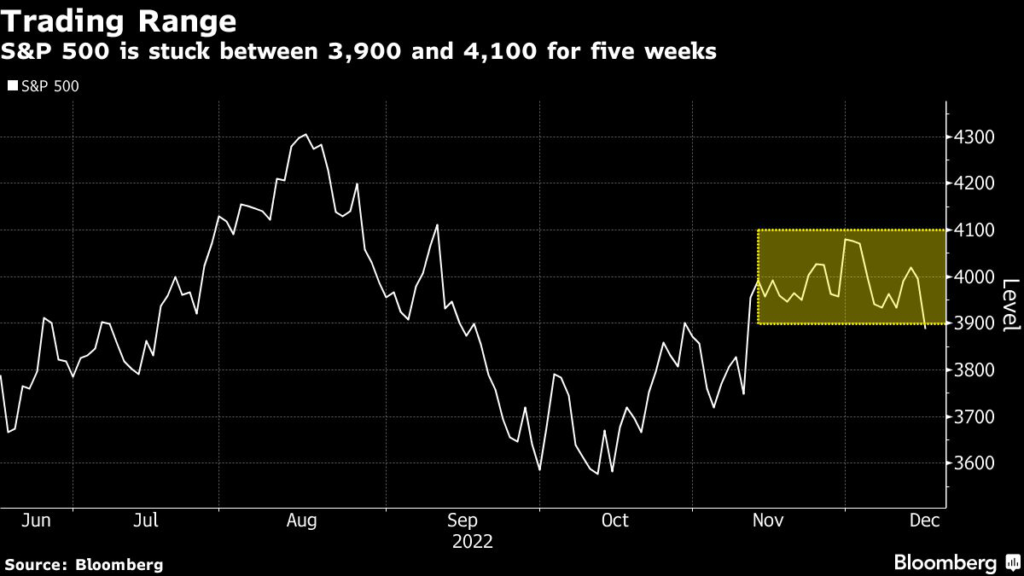
An estimated $4 trillion of options is expected to expire Friday in a monthly event that in tends to add turbulence to the trading day. This time, with the S&P 500 stuck for weeks within 100 points of 4,000, the sheer volume provides a positioning reset that could turbocharge market moves. Given the brutal backdrop that emerged in recent days, from a raft of rate hikes by global central banks to signs the American economy is starting to flag, worries are mounting the expiration will act as an air pocket.

That’s how David Reidy, founder of First Growth Capital LLC, sees it playing out. In his view, the market has been mired in a “long gamma” state where options dealers need to go against the prevailing trend, buying stocks when they fall and vice versa. 

Friday’s event “could break the tightness of the gamma exposure and lead to some dispersion, that is, room for the index to break out,” Reidy said. “That would be a downside move given yearend position adjustments and the macro recession view.”

Options tied to the 4,000 level on the S&P 500 account for the biggest chunk of open interest set to mature and acted as something of a tether for the index’s price in the weeks leading up to Friday, according to Brent Kochuba, founder of Spot Gamma. 

Stocks were already under pressure Thursday as the European Central Bank joined the Fed in raising interest rates and warning of more pain to come. The S&P 500 sank 2.5%, closing below 3,900 for the first time in five weeks.

That sets up a pivotal day, when holders of options tied to indexes and individual stocks — whose notional value according to Goldman Sachs Group Inc. strategist Rocky Fishman is worth $4 trillion — will have to either roll over existing positions or start new ones. 

The event this time coincides with the quarterly expiration of index futures in a process ominously known as triple witching. Added to that comes a rebalancing of benchmark indexes including the S&P 500. The combination tends to spark single-day volumes that rank among the highest of the year.

“Between expiration and rebalances, Friday will likely be the last ‘liquidity day’ of 2022,” said Chris Murphy, co-head of derivatives strategy at Susquehanna International Group.

Options traders were gearing up for turmoil going into this week’s report on consumer prices and the last Federal Open Market Committee meeting of the year. In a sign of heightened anxiety, the derivatives market did something unusual Monday with the Cboe Volatility index, a gauge of options cost known as VIX, jumping more than 2 points while the S&P 500 climbed 1.4%. That’s the biggest concerted gains since 1997.

“Essentially all of the options prices tied to Friday were extremely high, and very sensitive to implied volatility (and time decay) because they are expiring in just a few days,” SpotGamma’s Kochuba said. “Once the events passed, the implied volatility (i.e. value of these options) tanked, leading to hedging flows that brought mean reversion to markets.” 

The dynamic was on display Wednesday, as a drop in the S&P 500 coincided with a slide in the VIX, again bucking the historic pattern of their moving in opposite directions. 

That unwinding of hedging removed one market support and opened the door for more volatility, according to Danny Kirsch, head of options at Piper Sandler & Co. 

“Now that the event has passed, the market is free to move more,” he said. “And the realization of higher-for-longer Fed is setting in, plus the high possibility of recession next year.” 

More stories like this are available on bloomberg.com

©2022 Bloomberg L.P.

Close Bitnami banner
Bitnami
