
Bloomberg

Harvard Ex-Coach’s Wife Says Alleged Bribes Were Really Loans

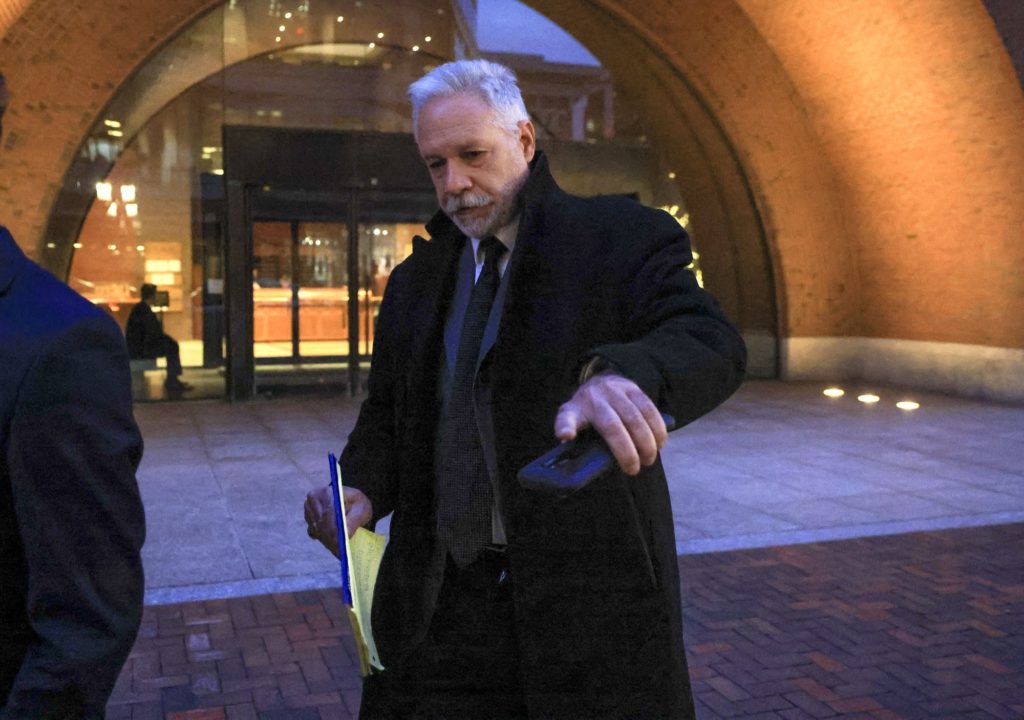
(Bloomberg) — The wife of the former Harvard University fencing coach accused of taking payments a Maryland businessman to recruit his sons testified the alleged bribes were actually loans that were recently repaid.

Jacqueline Phillips told jurors Thursday that telecommunications tycoon Jie “Jack” Zhao loaned her and her husband Peter Brand more than $500,000 with no repayment plan and sought no interest because he was a “kind,” close friend of her husband, who was Harvard’s head fencing coach for 20 years.

Pressed by a federal prosecutor why the money wasn’t repaid until after the men were indicted in 2020, she said they had an understanding Zhao would get his money when Brand, 69, received an inheritance. “We had to wait for my mother-in-law to pass away,” she said.

Read More: Harvard Coach’s Ratings Clinched Brothers’ Admission, Jury Told

During hours of cross examination, Philips, 70, admitted the couple did not declare the loans as liabilities on a 2016 mortgage application. “In retrospect, that should have been listed,” she said.

The trial in Boston has echoes of the Justice Department’s “Varsity Blues” college admissions bribery scandal but with a major difference. At Harvard, a coach can’t guarantee admission as a recruit. Zhao’s sons, who both fenced and graduated, had to win acceptance from Harvard’s admissions committee of more than 40 people.

Brand’s wife, who is retired after working for the city of Cambridge, testified extensively about the sale of their suburban Boston home to Zhao for almost $1 million, well over its assessed value. Zhao soon resold the home at a loss of $290,000.

She said she felt badly when she learned Zhao lost money and apologized to him. “I was very sorry he lost money on that house,” she said.

The government claims Brand received $1.5 million from Zhao through a series of benefits. Zhao covered Brand’s mortgage, bought him a new car, paid for the coach’s son’s tuition and loans at Penn State, and bought the couple’s house for hundreds of thousands of dollars over its assessed value.

Brand, 69, and Zhao, 63, have both claimed they’ve done nothing wrong and insist Zhao’s sons earned admission to Harvard on their own academic and athletic merits. Zhao’s lawyers also contend he has a history of being generous lending money to friends and say he didn’t befriend the coach until after his eldest son was already admitted.

The men each face up to 15 years in prison if convicted in the alleged bribery scheme.


More stories like this are available on bloomberg.com

©2022 Bloomberg L.P.
Ultra-Rich Chinese Push Premier Singapore Golf Entry Fee to $618,000 for Expats

(Bloomberg) — In a year when everything from stocks and bonds to cryptocurrencies have tumbled, an investment in Singapore’s most elite golf club stands out.

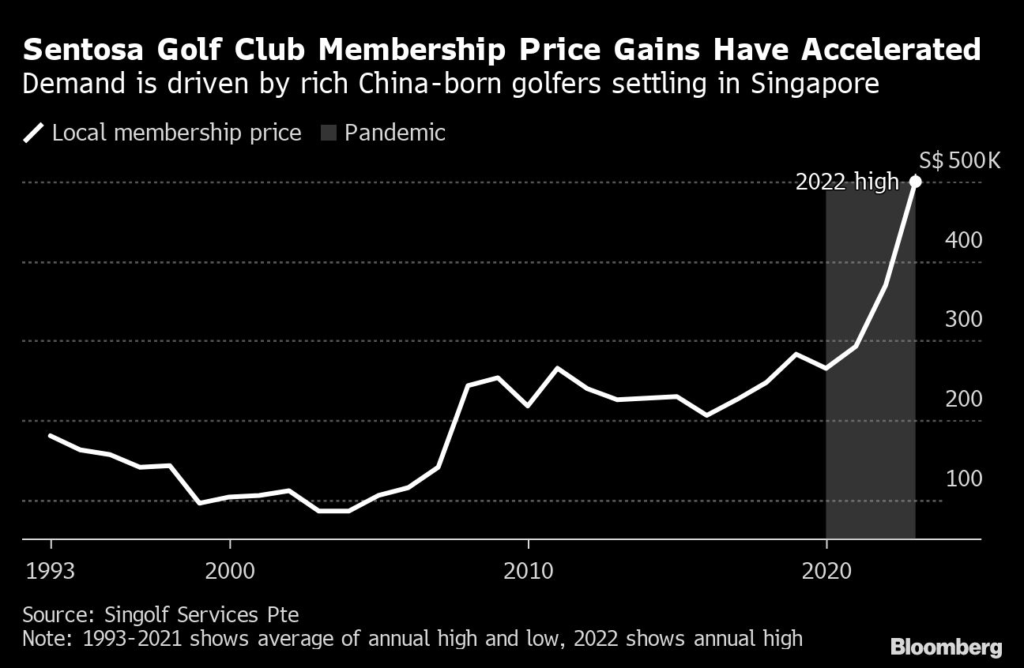
The cost for an expatriate to join the 36-hole Sentosa Golf Club overlooking the Singapore Strait has more than doubled since the end of 2019 to S$840,000 ($618,000), according to brokerage Singolf Services Pte. For citizens and permanent residents, the membership price has surged to as much as S$500,000. 

It’s another way the city-state is defying gravity in a world upended by the global stocks implosion, strict Covid restrictions in China and Russia’s war in Ukraine. Prime real estate has never been more expensive, luxury-car sales are higher than ever and country clubs are thriving. 

The manicured and almost crime-free financial hub has long attracted wealth from countries with more complicated prospects, led by rich Chinese settling in the city. Few venues exemplify the trend better than the championship course some rank top in Asia Pacific.

Set on a lush island south of Singapore’s rump, the facility is nestled between the Resorts World casino, Universal Studios, a marina that attracts ocean-going yachts from as far as the Caribbean, and native jungle pocked by battlements ruined during World War II.

Golfers will tell you there are few tougher or more precisely trimmed layouts in the region. Hardly a blade of grass on the fairways or grain of sand in the bunkers is misplaced on any given day as Bentley, Mercedes-Benz and Rolls-Royce sedans disgorge the smartly dressed who’s who of the financial community.

“These are the ultra-rich Chinese, for them it could be a small sum,” said Lip Ooi, an instructor at the public Marina Bay Golf Course. “If someone wants to find a golf club, and wants to only join the best, and because they are ultra-rich, of course they would go for Sentosa Golf Club.”

The Sentosa club declined to comment for this article.

The venue for high-profile tournaments including the SMBC Singapore Open and HSBC Women’s World Championship will return to the sporting headlines in April by hosting the LIV Golf League. The controversial series backed by Saudi Arabia features 48 of the world’s best players including Phil Mickelson, Dustin Johnson and Bryson DeChambeau.

At Sentosa, the rally in membership fees started during the pandemic as lovers of green fairways sought relief from the strictures of Covid lockdowns. Demand has since accelerated, driven by the prestige sought by wealthy foreigners, primarily from China’s mainland but also from countries like South Korea and Japan.

“People like Sentosa because it has this name. It’s for the rich and famous,” said Lee Lee Langdale, owner of Singolf Services and a broker of memberships since 1991. “But they run the club very well. Many mainland Chinese also live near Sentosa.”

@scanlandavid explains why pic.twitter.com/Ff6mNwOYST

— Bloomberg Quicktake (@Quicktake) December 16, 2022


Family Offices

Singapore’s reputation as a low-tax bastion of stability has made it a hub for the wealthy from across Asia. Mainland Chinese are by far the biggest factor behind a near doubling of family offices to about 700 at the end of 2021. Previously, the super-rich used Singapore as a business base. Now, many Chinese families are opting to live there as well.

“We see a huge demand that we didn’t see before the pandemic,” said Madeline Choo, manager of Active Golf Services Pte, another brokerage. “They need to buy a membership because they intend to stay in Singapore for very long.”

Those who can’t afford Sentosa or a clutch of other private clubs including Tanah Merah Country Club, Laguna National and Singapore Island Country Club, face a narrowing range of options after the government closed some courses to redevelop the land. Some golfers look outside Singapore for cheaper options.

“It’s getting a little bit expensive, but there is a chance for them to play in Malaysia” or the nearby Indonesian island of Batam, said M. Murugiah, president of the Singapore Professional Golfers’ Association. “It’s not that expensive like Singapore.”

In the city-state, club memberships are commonly transferable in an open market, and many have more than doubled in value in half a decade. The prospect that demand will outstrip dwindling supply has prompted some to treat it as a speculative investment, even buying into a range of clubs, said Lip, the golf instructor.

On Sentosa’s balmy terraces, as golfers dissect their matches with opponents over drinks, the market is a hot topic of discussion. Some are tempted to cash in before the boom falters.

“Quite a number of foreigners are waiting for S$1 million to sell,” said Langdale. “Whatever goes up must come down. And it will come down, it’s just a matter of time.”

More stories like this are available on bloomberg.com

©2022 Bloomberg L.P.
Wall Street’s Crypto FOMO Fades After Market Fall, US Watchdog Says

(Bloomberg) — Wall Street banks’ interest in crypto has significantly fallen off as digital-asset prices have tumbled, according to a top US financial regulator. 

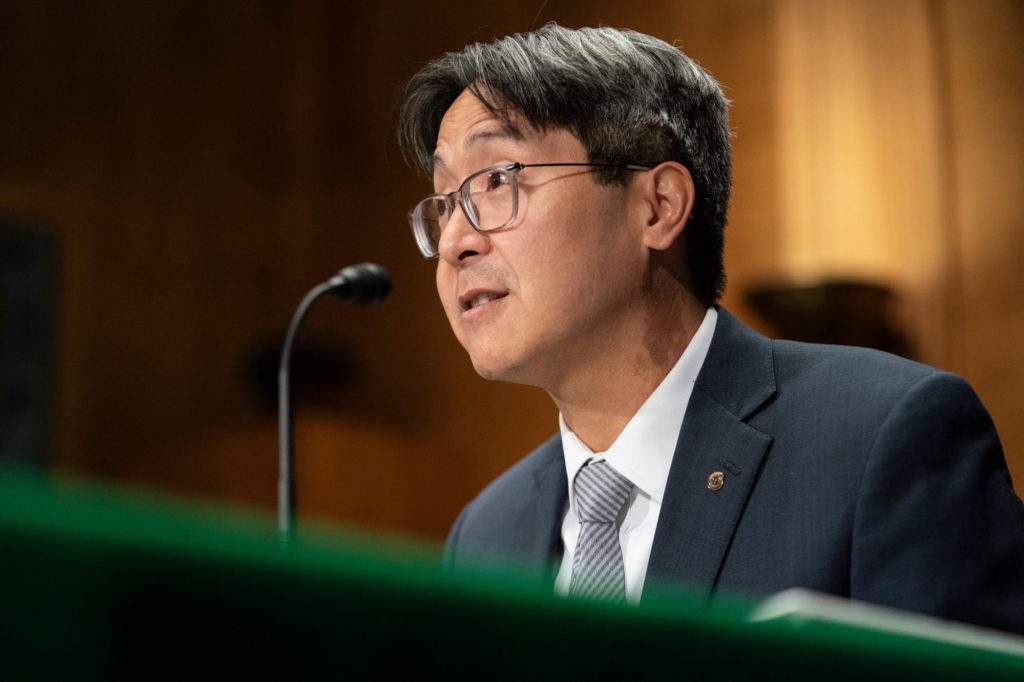
“A lot of the crypto curiosity went away,” Michael Hsu, acting head of the Office of the Comptroller of the Currency, said in an interview at Bloomberg’s Washington bureau on Thursday. “I would be astounded if a lot of banks were saying, ‘Hey, I really want to get into crypto’ now.” 

It’s a stark difference from the interest that banks showed at the end of last year, when the price of Bitcoin, the largest digital asset, was at an all-time high and the total crypto market was worth more than $3 trillion, he added. The industry “took off” and there was a lot of “FOMO,” he said, referring to an acronym that stands for “fear of missing out.”

The crypto industry has seen its fair share of turmoil over the past few months with the price of tokens plummeting, the collapse of the TerraUSD stablecoin and, more recently, FTX’s implosion. The current “crypto winter” has given US banking regulators more time to mull substantive guidance on issues such as crypto custody, Hsu said.

Read More: Warren Presses Fed’s Powell on Bank-Crypto Links Following FTX

The OCC, Federal Reserve and the Federal Deposit Insurance Corp. announced a “policy sprint” on crypto assets last November. There was urgency to weigh in given the intense interest from banks. That work continues, but agencies can now take their time and be more deliberate, he said.

The implosion of FTX placed new scrutiny on banks with crypto business after it was revealed that a number of lenders, including some regulated in the US, had relationships with the failed exchange and its sister company, Alameda Research. Democratic Senators Elizabeth Warren and Tina Smith, have called for the OCC, Fed and FDIC to conduct a broad review of banks’ exposure to the digital-asset market.  

The OCC previously has said banks that want to get involved in crypto activities must first notify and get the agency’s go-ahead. 

According to Hsu, contagion from failures within the digital-asset industry, including FTX, hasn’t spread to the banking sector due to what he referred to as the regulator’s “careful and cautious” approach.

However, he said he’s always concerned about banks potentially falling through the cracks and having more exposure to crypto than they should. 

“We’re constantly paranoid about this,” Hsu said. 

(Updates with FTX’s impact on banking sector in eighth paragraph and video.)

More stories like this are available on bloomberg.com

©2022 Bloomberg L.P.
US Stocks Drop for a Second Day; Oil Snaps Rally: Markets Wrap

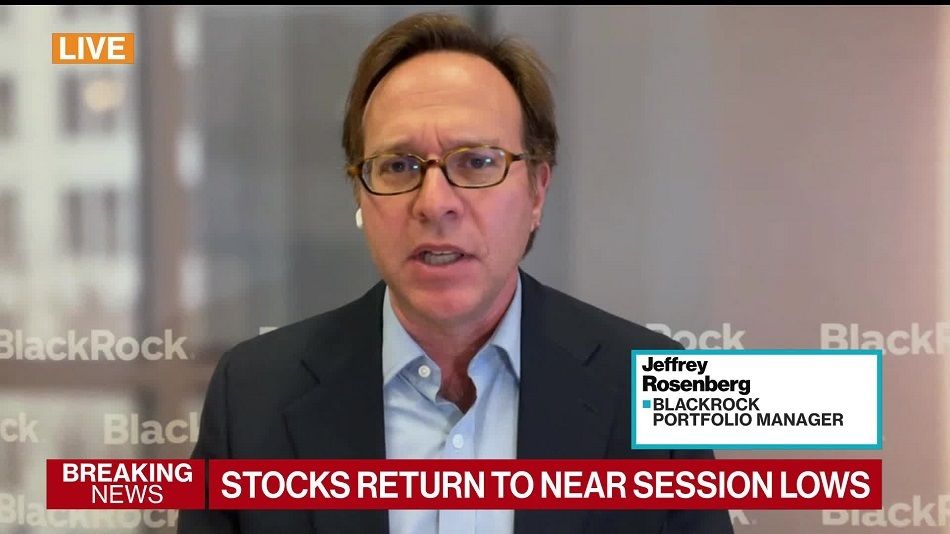
(Bloomberg) — Stocks dropped and the dollar rallied after a wave of rate hikes from central banks this week, with the Federal Reserve and the European Central Bank warning of more pain to come.

The S&P 500 fell more than 2%, closing at its lowest level in more than a month. The tech-heavy Nasdaq 100’s losses exceeded 3%, with yield-sensitive stocks taking a hit. Equities in Europe also closed Thursday lower after the ECB’s upward revision to 2024 inflation projections. 

Oil snapped a three-day rally. Commodities from oil to copper were under pressure as fears of a global economic slowdown and waning demand mounted. The dollar climbed the most since September as investors sought haven assets. 

Risk assets have been on the back foot since Fed Chair Jerome Powell reiterated his hawkish stance on Wednesday and policymakers signaled a peak rate that was above market expectations. The ECB and the Bank of England were among major central banks that followed the Fed with hikes of half a percentage point. But the BOE tempering its pace of monetary tightening was interpreted as a sign that rates could peak at a lower level than expected, which pushed the pound to its worst day versus the dollar in six weeks. 

While the Fed and ECB also slowed the tempo of their hikes, Powell and ECB President Christine Lagarde hammered home their resolve to remain persistent as they battle inflation. This didn’t sit well with investors, who hoped for a dovish shift in tone. 

Traders also digested a bevy of US data Thursday showing the economy cooling, even as the labor market stays strong. Softening in the labor market remains a big target for the Fed. 

“The pullback in the market today — we aren’t surprised by it,” Nadia Lovell, UBS Global Wealth Management senior US equity strategist, told Bloomberg Television on Thursday. “This is a market that has traded on the hope that the Fed will not do what they say they will do. Yesterday they sent a clearly different message.”

Key events this week:

  • Eurozone S&P Global PMI, CPI, Friday

Some of the main moves in markets:

Stocks

  • The S&P 500 fell 2.5% as of 4:03 p.m. New York time
  • The Nasdaq 100 fell 3.4%
  • The Dow Jones Industrial Average fell 2.2%
  • The MSCI World index fell 0.2%

Currencies

  • The Bloomberg Dollar Spot Index rose 1%
  • The euro fell 0.6% to $1.0623
  • The British pound fell 2% to $1.2176
  • The Japanese yen fell 1.6% to 137.68 per dollar

Cryptocurrencies

  • Bitcoin fell 2.3% to $17,423.09
  • Ether fell 3% to $1,271.7

Bonds

  • The yield on 10-year Treasuries declined three basis points to 3.45%
  • Germany’s 10-year yield advanced 14 basis points to 2.08%
  • Britain’s 10-year yield declined seven basis points to 3.24%

Commodities

  • West Texas Intermediate crude fell 1.5% to $76.12 a barrel
  • Gold futures fell 1.7% to $1,787 an ounce

This story was produced with the assistance of Bloomberg Automation.

–With assistance from Isabelle Lee and John McCorry.

More stories like this are available on bloomberg.com

©2022 Bloomberg L.P.

Adobe Affirms Sales Forecast on Steady Demand for Design Software

(Bloomberg) — Adobe Inc. affirmed its annual revenue forecast, signaling it’s seeing steady demand for creative design and analytics software despite the uncertain economy. The shares gained about 6% in extended trading. 

The company also said it expects to complete its $20 billion purchase of Figma Inc. next year, despite regulatory review in the US, UK and Europe.

Revenue will be about $19.2 billion in fiscal 2023, which began this month. Profit, excluding some items, will be $15.15 to $15.45 a share, the company said Thursday in a statement. The forecast, as well as the sales outlook for Adobe’s divisions, was the same as the company’s previous guidance given in October. Adobe’s forecast doesn’t include any contribution from Figma.

“Strong demand for our offerings, industry-leading innovation and track record of top- and bottom-line growth set us up to capture the massive opportunities in 2023 and beyond,” Chief Financial Officer Dan Durn said in the statement.

Adobe, which has dominated the software market for design professionals, is seeking to expand its user base to more casual consumers with its proposed acquisition of Figma, announced in September. The deal would be one of the most-expensive purchases ever of a private software maker.

The company said it also expects European Union regulators will review the deal, according to a transcript of remarks prepared for a conference call later Thursday.

“Overall the regulatory process is proceeding as expected,” David Wadhwani, Adobe’s president of digital media, said according to the transcript. “We continue to feel positive about the facts underlying the transaction and expect to receive approval to close the transaction in 2023.”

Despite concerns about the price, the Figma acquisition should support “Adobe’s leading position in digital creation and marketing,” Brian Schwartz, an analyst at Oppenheimer, said ahead of earnings. 

The shares jumped to a high of $350.93 in extended trading after closing at $328.71 in New York. The stock has tumbled 42% this year as investors have soured on most software companies.

What Bloomberg Intelligence Says:

Adobe’s fiscal 2023 guidance calls for the Digital Media segment to grow 13% in constant currency, or 9% after accounting for FX headwinds, affirming our view that growth in the Creative Cloud unit is easing. Though total sales guidance was slightly below consensus, adjusted EPS view for the full year indicates that margin may not come under much pressure next year, which is an encouraging sign. 

— Anurag Rana and Andrew Girard

Click here to see the research

Revenue increased 10% to $4.53 billion in the fiscal fourth quarter, in line with estimates. Profit, excluding some items, was $3.60 a share in the period ended Dec. 2. Analysts, on average, projected $3.50. Adobe has avoided major job cuts like those announced by many tech companies, including Meta Platforms Inc. and Amazon.com Inc., but last week eliminated about 100 positions concentrated in sales.

Sales in digital media, the division that includes Photoshop and other signature software, increased 10% to $3.3 billion in quarter. Revenue in the digital experience unit, which includes analytics and marketing, rose 14% to $1.15 billion.

(Updates with segment revenue in the final paragraph.)

More stories like this are available on bloomberg.com

©2022 Bloomberg L.P.
Tech Groups Ask Supreme Court to Review Texas Social Media Law

(Bloomberg) — Trade groups that represent Meta Platforms Inc. and Alphabet Inc.’s Google said they asked the US Supreme Court to overturn a Texas law that would sharply restrict the editorial discretion of social media companies.

The appeal by NetChoice LLC and the Computer & Communications Industry Association contends the Texas law violates the First Amendment by forcing social media companies to disseminate what they see as harmful speech and putting platforms at risk of being overrun by spam and bullying.

The law “would wreak havoc by requiring transformational change to websites’ operations,” the groups argued. The New Orleans-based 5th US Circuit Court of Appeals upheld the law in September but left the measure on hold to allow time for an appeal to the Supreme Court.

The Texas law bars social media platforms with more than 50 million users from discriminating on the basis of viewpoint. Texas Governor Greg Abbott and other Republicans say the law is needed to protect conservative voices from being silenced. 

The appeal adds a new layer to a Supreme Court term that could reshape the legal rules for online content. The justices are already considering opening social media companies to lawsuits over the targeted recommendations they make to users. 

In addition, the high court may say as early as January whether it will to review a new Florida law that would regulate social media companies. That law, backed by former President Donald Trump, includes a requirement that platforms give a “thorough rationale” for every content-moderation decision they make.  

The new case is NetChoice v. Paxton.

More stories like this are available on bloomberg.com

©2022 Bloomberg L.P.

TikTok Crackdown Gathers Steam in US Congress on National Security Risks

(Bloomberg) — Senators in both parties Thursday pressed for more action by the Biden administration to address national security concerns raised by widespread use of TikTok a day after voting to ban the video-sharing app on government phones.

Senate Intelligence Chairman Mark Warner said Congress and states may take further steps soon to limit TikTok because of security concerns if the Biden administration doesn’t quickly come forward with a solution to protect American users of the Chinese-owned social media network.

“My patience has run thin,” the Virginia Democrat said on Bloomberg Television’s “Balance of Power with David Westin,” referring to a Justice Department review of TikTok to safeguard data. “If they’ve got a solution set, they ought to lay it out, and if they don’t, if they ever get to a solution, it may be moot because individual states or Congress may act.”

The Senate on Wednesday unanimously backed legislation to ban the hugely popular app from all government-issued phones and other devices. The bill allows employees to download the app on their phones for investigation, research and intelligence-gathering activities.

The sponsor of the legislation, Republican Senator Josh Hawley of Missouri, called TikTok “a Trojan Horse for the Chinese Communist Party.” Five states have banned the use of TikTok on government phones, with more expected to follow, and several federal agencies are also mulling bans.

House Speaker Nancy Pelosi on Thursday was non-committal about whether the House would act on the Senate legislation before Congress breaks for the holidays next week. She said she wants to consult about the language of the bill with the administration.

“We’re checking with the administration,” she said at a news conference. “Not in terms of being opposed to the idea, but being specific about the language.”

White House press secretary Karine Jean-Pierre on Thursday said the administration has not taked a position on the legislation, nor on another bill that could restrict Huawei Technologies Co.’s access to the US financial system.

House Republican leader Kevin McCarthy urged quick action. 

“Speaker Pelosi—who claims to be tough on China—should immediately allow an up-or-down vote,” he tweeted.

Hawley said Pelosi can do anything she wants in the House and “should make it a priority.”

After the Senate acted, Brooke Oberwetter, a TikTok spokesperson, said in a statement that Hawley’s legislation “does nothing to advance US national security interests.”

Hawley said the Committee on Foreign Investment in the US, a secretive inter-agency panel led by the Treasury Department that reviews foreign investments in US companies, also should force TikTok to separate from its parent company, China’s ByteDance Ltd. 

If that doesn’t happen, he said, Congress should take additional steps. A bipartisan group of lawmakers in the Senate and the House already have introduced a bill that would ban TikTok from operating in the US.

“That’s in Joe Biden’s court,” Hawley told reporters at the Capitol.

Warner said the concerns are twofold — one about the protection of user data and also that the company, ByteDance, will adjust its algorithm to feature Chinese Communist Party propaganda on Taiwan or other issues.

“No matter what TikTok says, I am very worried that that data may end up residing on servers back in China,” he said. “The potential data exfiltration is a security risk.”

In another move that illustrates the bipartisan desire to curb China, Senate Majority Leader Chuck Schumer and Republican Senator Tom Cotton introduced legislation that could cut Huawei and other foreign firms from the US financial system.

The legislation would ban US companies from participating in significant transactions with foreign firms that produce 5G technology and engage in industrial espionage. If Huawei were so designated, it would effectively halt its access to US banks.

However that bill isn’t likely to get action in Congress before the end of the year as time is running short for the House and Senate to finish work on a government spending bill.

“It’s certainly an important issue and I probably would support the effort, but I think we need to look for another way to do this,” Republican Senator John Cornyn, who is close to GOP leadership, said. “It’s probably something for next year.”

–With assistance from Jennifer Jacobs, Todd Shields, David Westin and Billy House.

(Adds White House comment, McCarthy starting in eighth paragraph)

More stories like this are available on bloomberg.com

©2022 Bloomberg L.P.
Donald Trump Targets Social-Media ‘Censorship’ for 2024 Campaign

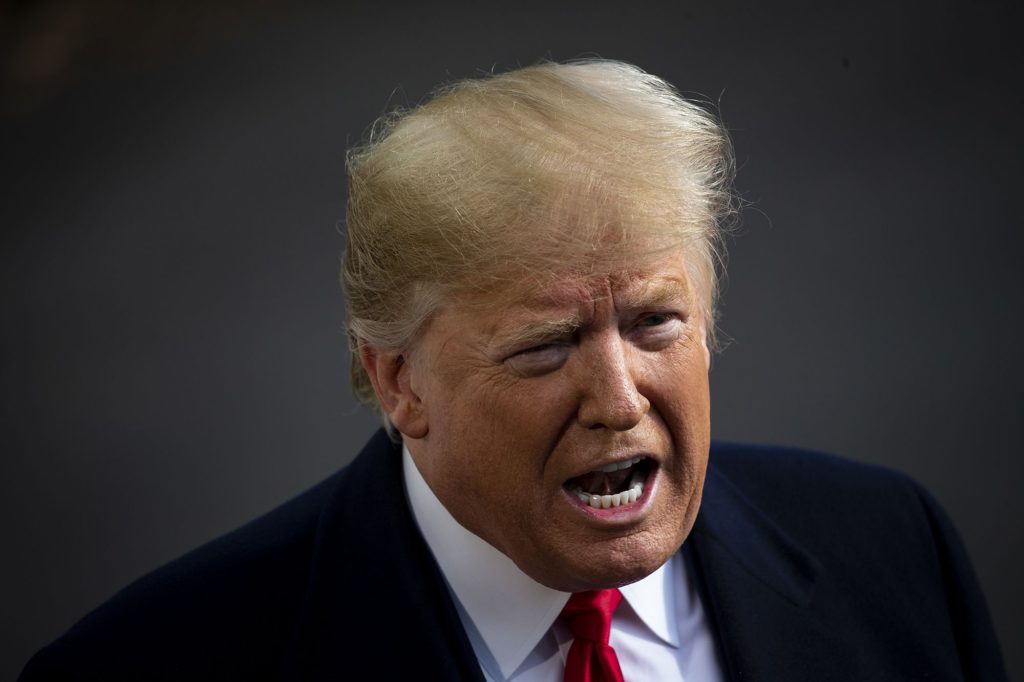
(Bloomberg) — Former President Donald Trump pledged to take on what he called “Silicon Valley censorship” as he makes a third White House run, elevating allegations that the social-media companies have routinely censored conservative voices.

Billed as a “free-speech platform,” Trump’s announcement signals that debates about social media are likely to become a central theme for the 2024 presidential election cycle, coinciding with billionaire Elon Musk’s efforts to thrust Republican allegations of liberal bias into the spotlight since he bought Twitter Inc. in October.

Musk gave a tranche of internal Twitter documents to two journalists who have been publishing a series called the “Twitter Files.” Those internal communications have shown Twitter employees discussing deliberations around removing Trump from the platform and handling right-leaning accounts that spread misinformation. 

“In recent weeks, bombshell reports have confirmed that a sinister group of Deep State bureaucrats, Silicon Valley tyrants, left-wing activists, and depraved corporate news media have been conspiring to manipulate and silence the American People,” Trump said in a video posted on Thursday. “The censorship cartel must be dismantled and destroyed — and it must happen immediately.” 

Trump’s platform calls for a series of reforms that would be likely to face constitutional challenges. He called for an executive order barring federal agencies from colluding with businesses or people to “censor” American citizens, a ban on “federal money from being used to label domestic speech as ‘mis-’ or ‘disinformation,” and “firing every federal bureaucrat who has engaged in domestic censorship.” 

Republicans previously opposed the Biden administration’s efforts to create a “Disinformation Governance Board,” which would have advised the Department of Homeland Security on handling falsehoods around elections, the Covid-19 pandemic and other sensitive topics without running afoul of the First Amendment. That board was shut down in August amid public pressure, largely from Republicans. 

Though Trump’s agenda sounds similar to Musk’s stated efforts to create “free speech” online, the former president has yet to rejoin Twitter. 

He was booted from the platform for violating Twitter’s policies against incitement to violence in the wake of the Jan. 6, 2021 storming of the US Capitol by Trump supporters seeking to prevent Joe Biden’s certification as president after the 2020 election.   

While Musk reinstated Trump’s account after taking over at Twitter, the ex-president said he prefers to stay on his own social-media network, Truth Social. 

Shortly before his policy pronouncement, Trump on Thursday began hawking digital trading cards with images such as his head atop cartoon super-hero figures. 

More stories like this are available on bloomberg.com

©2022 Bloomberg L.P.
Dollar Rallies as Risk-Off Tone Takes Stocks Lower: Markets Wrap

(Bloomberg) — Stocks across global financial markets were pummeled after a wave of rate hikes from central banks, with the Federal Reserve and the European Central Bank warning of more pain to come. 

US equities hit session lows in the afternoon in New York, with the S&P 500 declining as much as 2.9% and the tech-heavy Nasdaq 100 falling as much as 3.8%. Risk assets have been on the back foot since Fed Chair Jerome Powell reiterated his hawkish stance on Wednesday and policymakers signaled a peak rate that was above market expectations. Stocks in Europe closed Thursday’s session lower after the ECB’s upward revision to 2024 inflation projections.

The US dollar rallied the most in two months. Britain’s pound fell after the Bank of England slowed its pace of monetary tightening, which investors interpreted as a sign that rates could peak at a lower level than expected. The euro dropped.

A global rally sparked by softer-than-expected US consumer price index data came to an abrupt halt on Wednesday after the Fed sought to dispel hopes for a rate cut next year. While Fed and ECB slowed the tempo of their hikes to half a percentage point, Powell and ECB President Christine Lagarde hammered home their resolve to remain persistent as they battle inflation. 

Investors are also digesting a bevy of US data Thursday showing the economy cooling, even as a labor market stays strong. Softening in the labor market remains a big target for the Fed. 

“The pullback in the market today — we aren’t surprised by it,” Nadia Lovell, UBS Global Wealth Management senior US equity strategist, told Bloomberg Television on Thursday. “This is a market that has traded on the hope that the Fed will not do what they say they will do. Yesterday they sent a clearly different message.”

Lovell doesn’t think a recession is already priced in and said she expects repricing in the first half of 2023 to account for slower growth.

Key events this week:

  • Eurozone S&P Global PMI, CPI, Friday

Some of the main moves in markets:

Stocks

  • The S&P 500 fell 2.6% as of 2:35 p.m. New York time
  • The Nasdaq 100 fell 3.4%
  • The Dow Jones Industrial Average fell 2.5%
  • The MSCI World index fell 0.2%

Currencies

  • The Bloomberg Dollar Spot Index rose 1%
  • The euro fell 0.6% to $1.0622
  • The British pound fell 2% to $1.2176
  • The Japanese yen fell 1.7% to 137.78 per dollar

Cryptocurrencies

  • Bitcoin fell 2.2% to $17,439.5
  • Ether fell 2.8% to $1,273.88

Bonds

  • The yield on 10-year Treasuries declined three basis points to 3.44%
  • Germany’s 10-year yield advanced 14 basis points to 2.08%
  • Britain’s 10-year yield declined seven basis points to 3.24%

Commodities

  • West Texas Intermediate crude fell 1% to $76.49 a barrel
  • Gold futures fell 1.6% to $1,788.90 an ounce

This story was produced with the assistance of Bloomberg Automation.

–With assistance from Isabelle Lee and John McCorry.

More stories like this are available on bloomberg.com

©2022 Bloomberg L.P.

Elon Musk’s Tesla Share Sales Could Point to Debt Help for Twitter

(Bloomberg) — As he was offloading almost $3.6 billion of Tesla Inc. shares this week, Elon Musk took to Twitter, his newest business, to offer some financial advice.

“At risk of stating obvious, beware of debt in turbulent macroeconomic conditions, especially when Fed keeps raising rates,” he wrote on Tuesday, the day before the US central bank boosted its policy rate by another 50 basis points.

Among those who have reason to be concerned about such things: Musk himself. 

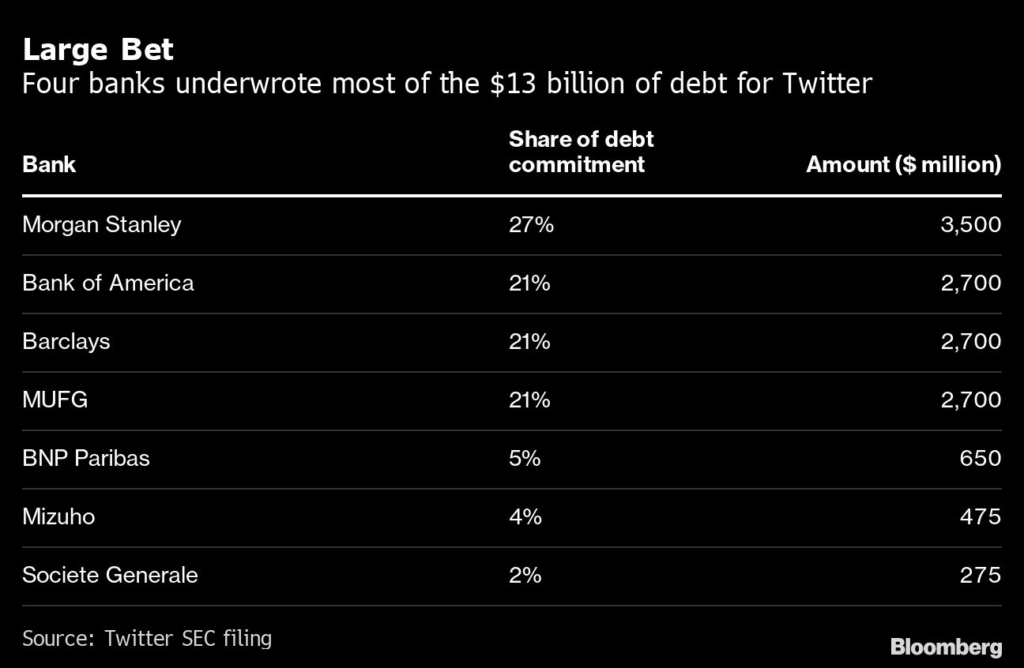
His Twitter Inc. buyout piled about $13 billion of high-interest debt onto the social media platform. The riskiest portion, with a painful fixed coupon of around 11.75%, is a $3 billion bond – notably an amount that could be covered by his recent Tesla stock sale. 

There are various reasons why Musk might find buying the debt appealing. It would save Twitter about $350 million in annual interest payments, according to Bloomberg calculations. What’s more, Musk would likely be able to buy the bonds at a steep discount, further lowering the company’s debt burden. Owning the obligations could even potentially put Musk in a better position if Twitter’s financial situation became more dire — he notoriously raised the specter of bankruptcy to employees last month.

“To the extent that Musk could buy back the debt at a significant discount to par, that seems like a plausible scenario,” said Jordan Chalfin, a senior analyst at credit research firm CreditSights. Banks have presumably marked down the value of the debt and likely want to reduce their exposure, Chalfin added.

Representatives for Morgan Stanley, which led the debt transaction, Twitter, and Musk didn’t immediately respond to requests seeking comment.

Of course, how Musk and his bankers proceed remains an open question. But both have every reason to see Twitter succeed. Musk wants to protect his equity investment, which along with a handful of other backers, totals $33.5 billion. The banks want to protect the value of the $13 billion they lent the company and currently hold on their balance sheets. But both also have much to lose in any negotiations. 

Should Musk try to buy the debt from the banks, he would almost certainly only want to do so at a steep discount, a tactic common in distressed debt situations. 

That would likely result in significant losses for the banks, and makes the decision to offload it more complicated.

The debt financing includes a $6.5 billion floating-rate secured leveraged loan, and $6 billion of bonds, split equally between a secured and unsecured tranche. The secured portions are considered safer because they are backed by the assets of Twitter, and therefore have lower interest rates. 

In November, hedge funds and other asset managers offered to buy a portion of the senior secured loan at a discounted price as low as 60 cents on the dollar — meaning banks would lose 40% on any debt they sold — but the banks deemed those bids unattractive at the time, Bloomberg reported. Any discount on the unsecured bonds would need to be even lower still.

If Musk and the banks did come to some kind of an agreement, he would also have to decide how to buy the debt. If the billionaire bought it himself, then technically Twitter would still have to pay interest to him. Alternatively, Musk could inject more cash into Twitter, and the company would buy back its own debt directly, essentially canceling the interest expense in the process. 

More Control

Owning the debt would afford Musk more leeway in a worst-case scenario in which Twitter declared bankruptcy — the prospect of which he’s already raised with employees.

The type and amount of his debt holdings would determine his position in a restructuring. Owners of senior secured debt typically hold more sway than unsecured bondholders, and all debtholders are in a better negotiating position than equity holders, who are usually wiped out in the Chapter 11 process. As it currently stands, the banks would presumably become the new owners if a bankruptcy were to happen.

More Cash

Twitter’s banks have already been weighing replacing some of the riskiest bonds with new margin loans backed by Tesla stock, one of several options being discussed to soften the company’s interest burden, Bloomberg reported last week. 

Musk could also consider an equity infusion to support Twitter’s operations. The company is currently burning cash, and he has noted that the social-media platform has experienced a significant drop in revenue amid advertiser defections.

“I think he’s sold enough Tesla stock already to cover operating losses,” said Gene Munster, managing partner of Loup Ventures.

Of course, a cash injection would be among the riskiest tactics. While it could give Twitter the breathing room it needs, it may also mean Musk is just throwing good money after bad.

–With assistance from Brian Chappatta, Dana Hull and Eliza Ronalds-Hannon.

More stories like this are available on bloomberg.com

©2022 Bloomberg L.P.

Close Bitnami banner
Bitnami