
Bloomberg

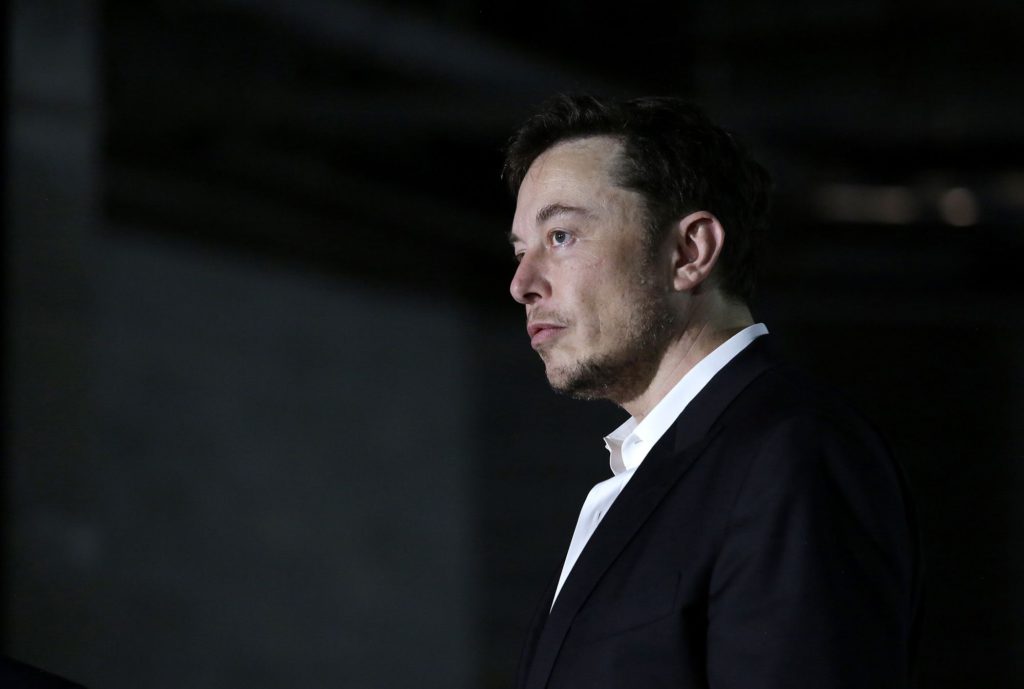
Elon Musk’s Tesla Share Sales Approach the $40 Billion Mark

(Bloomberg) — Elon Musk sold another $3.58 billion worth of Tesla Inc. shares, bringing the total amount he’s offloaded since late last year to almost $40 billion.

The latest disposal of about 22 million shares this week coincided with Musk falling from the top spot on the Bloomberg Billionaires Index, a position he’d occupied since September of last year. Tesla’s market value also slumped below the half-trillion-dollar mark for the first time since November 2020.

Musk’s persistent selling after repeated assurances that he was done unloading Tesla stock reflects mounting pressure on the finances of Twitter Inc. His erratic and impulsive approach to running the social-media company has alienated advertisers, and efforts to bring in more revenue from subscription fees backfired when impostor accounts exploited a poorly executed rollout of verification badges.

The chaos at Twitter has been an overhang on Tesla, which is facing its own set of challenges. The electric-car maker has cut prices and production this quarter in China and taken the rare step of offering incentives in the US. Musk has said the company is struggling to cope with the effects that China’s slumping property market, Europe’s energy crisis and the Federal Reserve’s interest rate increases are having on demand.

Tesla shares rose 0.6% to $157.67 as of 11:13 a.m. Thursday in New York. The stock has plunged 55% this year.

Musk tried for months to get out of the Twitter deal but ultimately failed. To help finance the purchase, he offloaded more than $15 billion of Tesla shares before closing the transaction — about $8.5 billion in April, then $6.9 billion in August. In November, he sold another $3.95 billion of his holdings.

Musk layered a significant amount of high-interest debt on Twitter’s balance sheet as part of his buyout. The company’s debt load swelled to about $13 billion — up from $1.7 billion pre-deal — and it’s now facing annual interest payments approaching $1.2 billion. Its borrowing could get even more expensive because the interest rates on about half of that debt aren’t locked in and will rise with the market.

“At risk of stating obvious, beware of debt in turbulent macroeconomic conditions, especially when Fed keeps raising rates,” Musk tweeted this week.

Musk’s recent sales shrink his stake in the company to roughly 13%, according to Bloomberg data. As of Wednesday’s close, he was worth $160.9 billion, ranking No. 2 on the Bloomberg Billionaires Index after France’s Bernard Arnault. His fortune has dropped by $109.4 billion this year.

Musk’s remaining stake in Tesla — roughly $94 billion — still makes up almost 60% of his total net worth, according to the index. Around $57 billion of that is shares he owns outright, and the remainder is vested stock options he’s received from a 2018 mega grant.

–With assistance from Venus Feng, Brian Chappatta and Anders Melin.

(Updates with Musk’s Tesla holding in final paragraph.)

More stories like this are available on bloomberg.com

©2022 Bloomberg L.P.
EU Regulators Must Update Telecom Rules, Spain’s Calvino Says

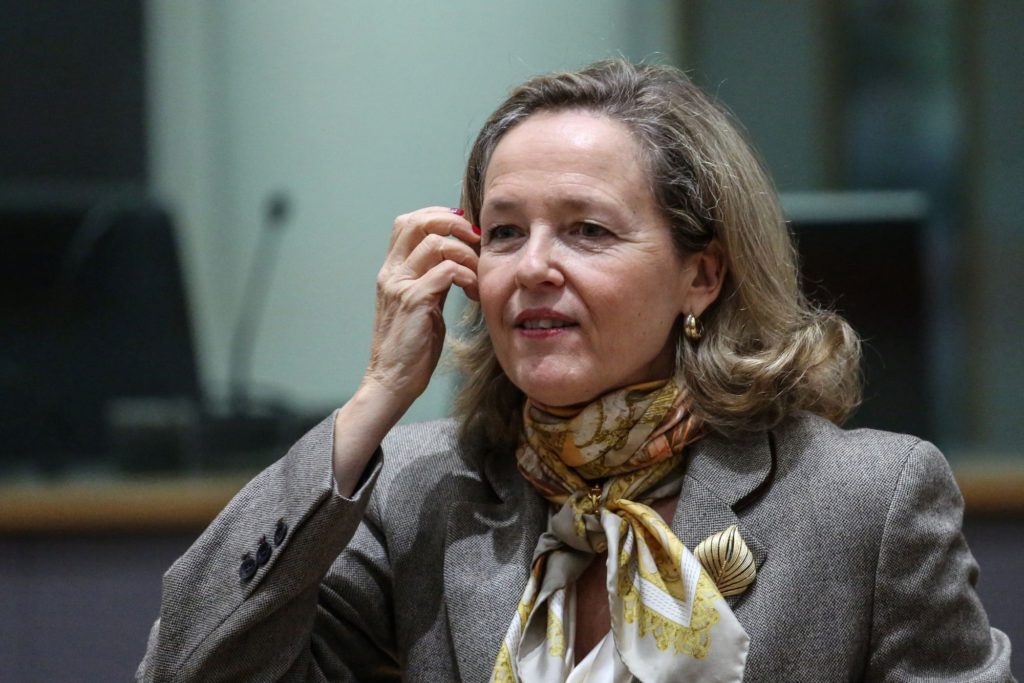
(Bloomberg) — Spain’s economy minister is advocating for consolidation in the telecom market, as regulators study the proposed merger between Orange SA’s local business and Masmovil Ibercom SA, two of the country’s largest carriers.

“Competition policy has to adapt to the changes that are taking place in the market,” Economy Minister Nadia Calviño said in an interview when asked about the deal. “The current competition structure has nothing to do with that of the past. Traditional telecommunications operators are subject to increasing competition from new entrants such as the large digital platforms.”

Read More: Orange, Masmovil Sign Deal to Forge $19 Billion Telecom Unit

The European Commission is expected to issue an opinion next year on Orange and Masmovil’s plan to combine businesses in Spain, in a deal with an enterprise value of at about €18.6 billion ($19.9 billion) that will create the country’s largest carrier. In recent years, the Commission has opposed large deals, most notably with its 2016 decision to block CK Hutchison Holdings’s attempt to buy Telefonica SA’s O2 UK — its first-ever veto of a mobile tie-up. 

At the time of the Hutchison-02 decision, regulators argued that pledges to increase investment and freeze prices failed to offset antitrust concerns. Still, a 2020 European court ruling overturned the veto. While the decision came too late for the deal, it was seen as a sign that the bloc might be more open to tie-ups in the future. 

Read More: Vodafone-Three Merger Set to Be £14 Billion Test for Watchdogs

The industry has long argued that the European market is too fragmented, with hundreds of operators, and that consolidation is necessary to sustain profitability. They also say that they face competition from technologies such as WhatsApp, the messaging service owned by Meta Platforms Inc., which is widely used for calls and messages.

Between 2006 and 2010, Calviño was assistant director general for competition at the European Commission.

More stories like this are available on bloomberg.com

©2022 Bloomberg L.P.

Humans Hold the Key to Collaboration No Matter How Good the Software Tools

(Bloomberg) — The universal working assumption is that productivity depends on collaboration, but there’s no agreement on what’s the best way to achieve it. While the market for digital tools, platforms, teleconferencing and software to facilitate collaboration is worth nearly $20 billion, technology alone isn’t the answer. In the end, it’s about the humans, not the machines.

For one, the understanding of teamwork predates the widespread use of office technology. Bruce Tuckman and Mary Jensen wrote a model of group development back in 1977. Their five-stage “forming, storming, norming, performing and adjourning” process still stands as key to designing the iterative process of collaboration. For instance, the “norming” phase is when a group gets into the teeth of a project and learns to trust each other and assign roles, while “performing” relies on interdependence. In a testament to the endurance of their principles, Slack, one of the highest performing collaboration software providers, cited them in a 2019 blog post.

The mid-70s were a rich seam for management theory and coincided with the start of what I describe in my book The Nowhere Office as The Mezzanine Years (the time between the supremacy of offices and a tech-enabled future which could operate outside them). It’s important to frame the plethora of technological platforms and applications which have flooded increasingly into the workplace as only ever as good as the human minds using them. Nothing can replace this—the technology is a utility to augment the creativity and dynamics of what happens when people work together.

That said, the development of technology to support people working is impressive and reflects that the workplace isn’t a fixed place all the time anymore for increasing numbers of white collar workers. Not only are we seeing the rapid evolution of dominant players, such as Zoom Video Communications Inc., moving beyond teleconferencing but new models of co-working apps like Polywork and hybrid working platform Kadence underscore the reality that collaboration isn’t always done from an office. In September, for example, remote jobs were 14% of all posts on LinkedIn, but got 52% of US applications.

Read more: Forget Zoom Calls, Remote Work Startups Want to Build a Virtual Office

The more new technology supports new patterns of work and keeps it simple and user-friendly the more it’s likely to succeed. Let’s not forget that perhaps the best example of an early workplace collaboration tool is Google Docs, designed sixteen years ago by Jen Mazzon. She wrote at the time “everyone told us it was crazy to try and give people a way to access their documents from anywhere — not to mention share documents instantly, or collaborate online within their browsers.”

Everyone knows the pain point of a badly designed interface or something overly complex: Phrase of the year may well be Toggling Tax, from a Harvard Business Review paper showing the sheer scale of interactions required these days to switch between different applications. Which is why the clunky complexity of the metaverse makes me wonder whether it will ever live up to the hype as being the next big thing in collaboration enabling technology.

It’s thirty years since the phrase “metaverse” was used in Neal Stephenson’s 1992 sci-fi story Snow Crash. He correctly predicted the possibility of a real-time synchronous 3D world in which digital facsimiles of humans—also known as avatars—will unite and enhance co-working and community. The metaverse currently looks like it’s in a distinctly beta phase when it comes to being used for collaboration, notwithstanding that the global market is predicted to grow by 50% by 2029. This is partly because at the moment it just doesn’t seem cool. Let’s not forget the story that the European Commission was left with egg on its face trying to attract Gen Z to engage with them by throwing a metaverse party which few attended.

The metaverse isn’t working yet because it’s putting technological design before function. Analysts at Tech Target noted that industry watchers have questioned if the metaverse will ultimately be much different from the digital experiences we have today or if the masses will be willing to spend hours in a headset navigating digital space. Recent research by the University of Primorska’s Faculty of Mathematics, Natural Sciences and Information Technologies shows significant productivity losses and mental health issues from trying to work in virtual reality for prolonged periods of time.

All of which brings us back to the human in the machine age. As long as collaboration technology is underpinned by collaboration management in the next phase of work, the teams that come together can get their work done. Whether in-person, in-cyberspace or in between.

Julia Hobsbawm is a columnist for Bloomberg Work Shift and a speaker, broadcaster and consultant on The Nowhere Office email: jhobsbawm@bloomberg.net

More stories like this are available on bloomberg.com

©2022 Bloomberg L.P.
Billionaire Drahi Is Said to Gauge Interest in French Data Centers

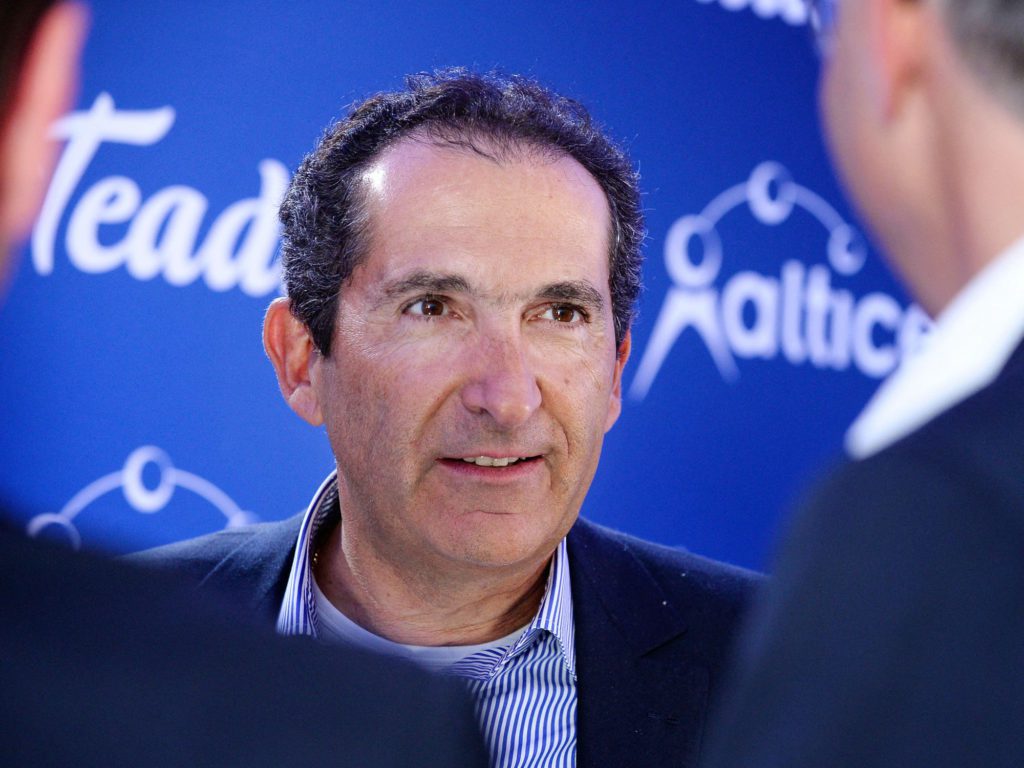
(Bloomberg) — Billionaire Patrick Drahi has started gauging interest from potential investors in a portfolio of French data centers, people with knowledge of the matter said. 

The telecom mogul’s Altice France has sent preliminary information on the data centers to potential bidders as it prepares to kick off the sale of a stake in the assets, the people said. A deal could value the portfolio at about €1 billion ($1.1 billion), according to the people, who asked not to be identified because the information is private. 

Altice may seek initial expressions of interest early next year for the assets, which are likely to draw interest from infrastructure funds, the people said. The exact structure of a potential transaction hasn’t been finalized, and Altice may decide to keep a stake in the portfolio in any deal, the people said. 

Drahi’s Altice Portugal is also exploring a possible divestment of its Covilha data center operation, which could fetch roughly €200 million, the people said.

Data centers have been attracting interest globally as infrastructure funds amass ever-bigger pools of capital and seek investments that can take advantage of booming demand for cloud services. 

Private equity firms including PAG have been pursuing UK data center company Global Switch Holdings Ltd., which could be valued at $10 billion in any deal, Bloomberg News has reported. US infrastructure firms DigitalBridge Group Inc. and Equinix Inc. have also been hunting for acquisitions.

TMT Finance first reported last month that Drahi was considering a sale of the data centers in France, citing unidentified people. Deliberations are ongoing, and there’s no certainty they will lead to a transaction. A representative for Altice declined to comment. 

Drahi was gauging potential interest in his Portuguese unit last year, though a deal didn’t materialize. Altice USA Inc. said this month it decided not to sell its Suddenlink business, after earlier exploring a deal that could have valued the cable and internet service provider at about $20 billion.

–With assistance from Julien Ponthus.

(Updates with background on data center deals in paragraphs 5-6.)

More stories like this are available on bloomberg.com

©2022 Bloomberg L.P.
Tech Weighs on Stocks as Fed, ECB Sour Sentiment: Markets Wrap

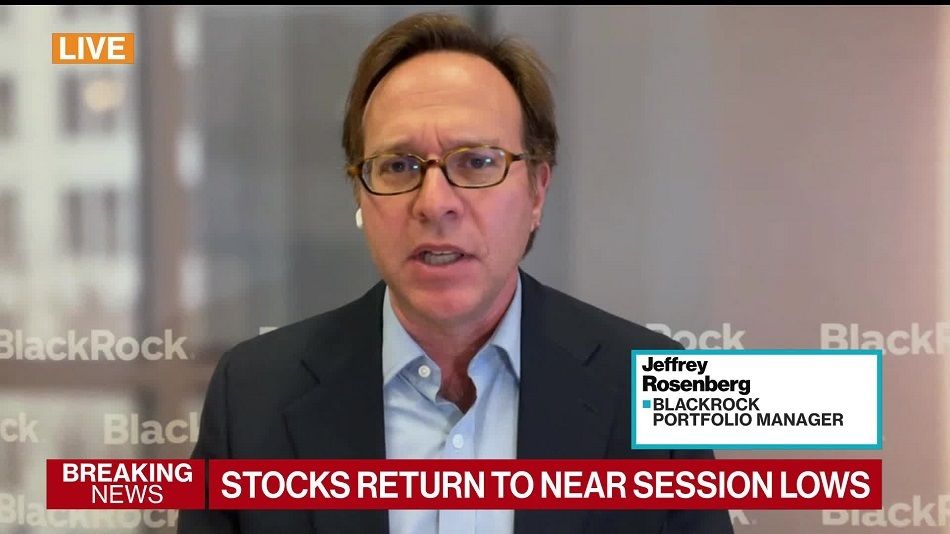
(Bloomberg) — Stocks declined across global financial markets after a wave of rate hikes from central banks, with the Federal Reserve and the European Central Bank warning of more pain to come. 

Over 90% of S&P 500 stocks fell. The tech-heavy Nasdaq 100 declined more than 2%. Both indexes ended Wednesday in the red after Fed Chair Jerome Powell reiterated his hawkish stance and policymakers signaled a peak rate that was above market expectations. Europe’s equity benchmark, the Stoxx 600, pushed lower after ECB President Christine Lagarde said the central bank needs to do more than traders priced in.

The US dollar strengthened. Britain’s pound slid after an expected half-point hike from the Bank of England. The euro dropped as traders parsed Lagarde’s remarks. 

A global rally sparked by softer-than-forecast US consumer price index data came to an abrupt halt on Wednesday after the Fed sought to dispel hopes for a rate cut next year. Powell reaffirmed the central bank won’t back down from its fight against inflation despite mounting fears of job losses and a recession. 

“Markets have been in a tug-of-war between better-than-feared economic data juxtaposed with concerns about the potential for the Fed to over-tighten monetary policy and push the economy into a recession,” said Art Hogan, chief market strategist at B. Riley Wealth. 

Investors are also parsing a bevy of US economic data Thursday. While retail sales were worse than expected, initial jobless claims came in lower than expected, underscoring the strength in the labor market. US factory production, meanwhile, declined for the first time since June. 

“The consumer has been resilient amid hot inflation and rising rates, but high prices and talks of a recession may have some now second guessing reaching for their wallet,” said Mike Loewengart, head of model portfolio construction for Morgan Stanley’s global investment office. “It’s been a busy week for investors with both the Fed and ECB raising rates, so it shouldn’t be a surprise to see a shaky market.”

Key events this week:

  • Eurozone S&P Global PMI, CPI, Friday

Some of the main moves in markets:

Stocks

  • The S&P 500 fell 2% as of 10:19 a.m. New York time
  • The Nasdaq 100 fell 2.4%
  • The Dow Jones Industrial Average fell 1.9%
  • The Stoxx Europe 600 fell 2.9%
  • The MSCI World index fell 0.2%

Currencies

  • The Bloomberg Dollar Spot Index rose 0.8%
  • The euro fell 0.2% to $1.0662
  • The British pound fell 1.4% to $1.2252
  • The Japanese yen fell 1.4% to 137.44 per dollar

Cryptocurrencies

  • Bitcoin fell 2% to $17,475.54
  • Ether fell 2.9% to $1,273.08

Bonds

  • The yield on 10-year Treasuries was little changed at 3.48%
  • Germany’s 10-year yield advanced 16 basis points to 2.10%
  • Britain’s 10-year yield declined seven basis points to 3.25%

Commodities

  • West Texas Intermediate crude fell 1% to $76.48 a barrel
  • Gold futures fell 1.5% to $1,791.20 an ounce

This story was produced with the assistance of Bloomberg Automation.

–With assistance from Isabelle Lee.

More stories like this are available on bloomberg.com

©2022 Bloomberg L.P.

Former FTX Co-CEO Salame Invested $6 Million in Massachusetts Restaurants

(Bloomberg) — A thousand miles away from FTX’s Bahamanian villas and beach-side getaways, one top executive of the failed crypto exchange spotted a different investment opportunity: the restaurant scene of a tiny town in Western Massachusetts. 

Ryan Salame, the former co-chief executive officer of FTX Digital Markets who tipped off Bahamian authorities to possible misuse of funds at the exchange, spent more than $6 million on restaurants and real estate in the Berkshire town of Lenox, according to local property records. He owns five dining enterprises in the hamlet through the Lenox Eats Collective: two restaurants, a dessert shop, a catering company and a food truck called The Lunch Pail. 

In the past month, the spending habits of Salame and other FTX executives have come under scrutiny. Company leaders sank millions into political campaigns and real estate, despite several of them owing money to the infamous crypto empire. 

Bankruptcy filings revealed that Salame received a $55 million loan from Alameda Research, FTX’s trading arm. The firm also lent $1 billion to Sam Bankman-Fried, Salame’s former co-executive, and $543 million to former engineering chief Nishad Singh. Salame didn’t respond to messages seeking comment.   

Salame told Bahamian regulators on Nov. 9 that client assets were transferred to Alameda Research to “cover financial losses” at the trading firm, court filings show. FTX and more than 100 related companies, including Alameda, filed for bankruptcy protection Nov. 11. 

Lenox-area residents told Bloomberg that Salame, who primarily resided in the Bahamas, was not involved in the day-to-day operations of the restaurants. He relegated much of those responsibilities to local manager Jane Blanchard, who declined to comment on recent events, adding only that she is a “big Ryan fan.”

Salame, a 2015 graduate of the University of Massachusetts Amherst, purchased properties through one of the more than half a dozen businesses connected to him, each registered in Massachusetts according to state records. In addition to buying up property, Salame gave more than $20 million to Republican candidates this cycle. Other executives at FTX exhibited similar interest in political giving.

But Salame’s flair for restaurants was unique. The spending made him a heavyweight in the quaint restaurant scene of Lenox, a town of roughly 5,000 people according to 2020 census data. 

The purchases also surprised community members. The Massachusetts native began eyeing local restaurants in 2020 as the Covid-19 pandemic forced many eateries to shutter their operations. At the time, he answered questions from local reporters regarding staffing shortages and the prudence of restaurant investments amid economic uncertainty.

Over the past month, Salame has kept quiet online—unlike Bankman-Fried. The now disgraced founder had been active on social media and answered questions via live stream before federal prosecutors levied criminal charges against him this week. Bankman-Fried is currently in a Bahamas jail after being denied bail.

Since FTX filed or bankruptcy, Salame’s eateries have continued to operate per usual. This month, The Olde Heritage Tavern and Firefly Gastropub & Catering Co. hosted guests for the town’s pub crawl, the Jolly Poker Restaurant Walk. Salame’s food truck parked outside of a local holiday market over the weekend.

Jennifer Nacht, executive director at the Lenox Chamber of Commerce, said restaurants often change hands in the town—although these particular circumstances are a bit unusual. Nacht, who sold her ice cream store “The Scoop” to Salame in 2021, said she met him on multiple occasions, describing him as smart and kind.

“He wanted to preserve the town as it was,” Nacht said. “I really think he had a sincere interest.”

–With assistance from Kenneth Hughes.

(Updates to clarify Salame’s college in the seventh paragraph.)

More stories like this are available on bloomberg.com

©2022 Bloomberg L.P.
Binance CEO Says Customer Funds Fully Backed on Crypto Exchange

(Bloomberg) — Binance Holdings Ltd. Chief Executive Officer Changpeng ‘CZ’ Zhao downplayed concern about a recent wave of user redemptions from the world’s biggest cryptocurrency exchange, saying that customers could pull back all their funds without any problem if needed. 

“People can withdraw 100% of the assets they have on Binance, we will not have an issue in any given day,” Zhao said during an interview on CNBC Thursday. He noted that Binance doesn’t operate on a fractional banking system, referring to the practice by large banks through which they are allowed to lend a proportion of their customers’ deposits to borrowers. Crypto businesses should “hold user assets 1-to-1 and that is what we do.” 

Digital asset platforms are facing a crisis in investor confidence following the swift collapse of Sam Bankman-Fried’s FTX exchange which was precipitated last month by a surge in withdrawals. FTX’s rapid downfall has prompted some users to take control of their assets, leading to a jump in outflows across industry exchanges. Binance was hit with about $1.14 billion of net withdrawals on Tuesday, but the situation stabilized later in the week. 

Many exchanges have looked to calm nerves by publishing partial views of their holdings, or so called “proof-of-reserves,” which fall short of full financial audits and have failed to convince investors. Asked why his firm had not opted for a full financial audit, Zhao said many audit firms were wary of working with crypto businesses out of for fear of reputational damage. He added some did not know how to audit crypto exchanges. 

Throughout the interview Zhao sought to distance his company’s practices from those of FTX, which authorities have alleged mishandled customer funds, using some to cover the bad debts of sister trading firm Alameda Research.  

More stories like this are available on bloomberg.com

©2022 Bloomberg L.P.
Day Trading Meets Communal Working Space in Puerto Rico

(Bloomberg) — For day traders with wanderlust, Puerto Rico seems to have it all: killer tax breaks, endless beaches and a laid-back Caribbean vibe that can take the edge off even the cruelest market.

What it didn’t have was the raw energy and camaraderie of a trading floor. So Anand Sanghvi and Dip Patel — a former hedge fund manager from Boston and a banker from New Jersey — decided to build one in the capital, San Juan.

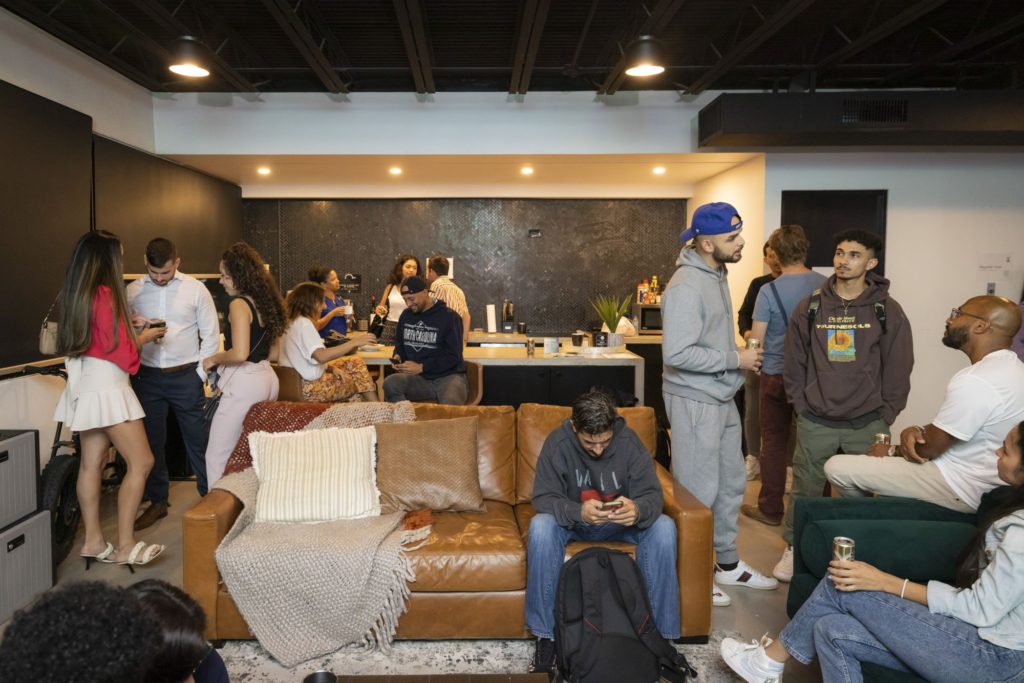
TradeSpace is a co-working facility that caters to a new breed of work-from-anywhere traders. With 14 stations plugged into high-speed internet, a lounge, a meditation room and showers, the business attracts a mix of locals and globe-trotting investors testing their luck in the stock market.

Inaugurated just before the pandemic, the space was designed to be part trading room, part educational effort and part social club.

“Traders are generally a lonely bunch,” said Sanghvi. “They just kind of sit at home and do it. They probably don’t even talk to their spouse about it because they’d get worried. So, I was like, ‘I don’t want us to be lonely anymore.’”

Lately, there’s been a lot to commiserate about. As the stock market has tanked and the crypto winter has set in, traders have been awash in pain.

Sanghvi said he has about $300,000 locked up in the FTX collapse, and another TradeSpace member owns thousands of Bitcoin ATMs. “So yeah, there’s been plenty of crypto woes here,” he said.

Sanghvi, 39, is better known by his online moniker “Lucci” and the Sang Lucci website and social media accounts he helped start that offer financial education and irreverent advice on options trading. TradeSpace is an extension of those efforts.

Sofa, Pizza, Yellen

At first blush the business looks like it might be a student lounge. It’s tucked away on the fourth floor of a nondescript building in a busy commercial district. Pizza boxes and bicycles are stacked in the corner, and a group of 20- and 30-somethings are sprawled on couches in front of a massive TV. But instead of a football game they’re watching Treasury Secretary Janet Yellen. And the water cooler chatter is about crypto plays and shorting equities.

Membership to TradeSpace ranges from $300 to $950 a month — more expensive than generic co-working spaces that dot the island.

Puerto Rico has become an unlikely hotbed for traders. Those who establish residency in the US territory — and meet certain requirements — don’t have to pay federal income tax, and have access to a local 4% tax rate. Crucially, they also pay no capital gains tax, which makes it alluring for equity and crypto investors.

Among the mainland celebrity financiers who sometimes call the island home are Peter Schiff, Nicholas Prouty and Dan Morehead.

Adam Gefvert, 44, left a New York hedge fund a few years ago to be a stay-at-home day trader in Medellin, Colombia. But the visa headaches, time zone difference, and dual-nation tax complications left him looking for greener pastures. 

He moved to Puerto Rico in 2021, lured primarily by the tax benefits.

“It’s the only place where you can get these kind of tax breaks without having to get rid of your American citizenship, and that makes it unique,” said Gefvert, who specializes in shorting micro-cap stocks. “I have no family and the weather is nice, so this is great.”

At TradeSpace he’s found a community of like-minded investors who can kick around ideas. “That’s what keeps me coming back, I always learn something,” he said.

Local Tension?

Day trading in Puerto Rico comes with risks.

Even when the island isn’t getting battered by storms, electricity outages are still common. (TradeSpace has battery backups and a generator to keep the lights on and the trades flowing. It also has three separate high-speed internet connections, including Elon Musk’s Starlink.)

Read More: Hurricane Fiona exposes Puerto Rico’s fragile power grid…again

There’s also some pushback against the newcomers. In a territory with one of the highest poverty rates of any US jurisdiction, the perception that wealthy mainlanders have access to tax breaks not available to locals is a source of friction.

Shortly after Gefvert bought his apartment in a tony area of San Juan, someone scrawled “Gringo go home” on the street.

“Some Puerto Ricans are resentful that I get tax breaks that they don’t,” he said. “That’s not an uncommon thing around here.”

Sanghvi and Patel are sensitive to those issues, and they’re trying to make TradeSpace benefit locals as much as it does mainlanders.

Read More: Tax breaks for crypto millionaires stir outrage in Puerto Rico

After Hurricane Fiona caused an island-wide blackout in September, the office opened its doors to non-members so people could charge their phones and use the internet.

TradeSpace also has a nonprofit arm called OYE — Own Yourself Everyday — that provides free business and financial education workshops aimed at locals. It also does charity work.

Kevin Rodriguez, a 22-year-old day trader who also produces a video blog about personal finance, says being at the office during the market tumult has been eye opening, as he’s watched colleagues capitalize on the chaos through short positions.

“Beyond the solidarity we feel for people who have been hurt, there’s also a sense of euphoria,” he said. “This could represent a great speculative opportunity for us.”

Patel and Sanghvi plan to eventually roll out TradeSpace in other places such as the Dominican Republic, Colombia, Miami, New York, and Austin, Texas — creating a network for roving traders.

“Trading doesn’t have to be just sitting in front of your screens all the time,” Sanghvi said. “We’re all here to make some money, so let’s make money, but also let’s help some people out if we can. Let’s have fun.”

More stories like this are available on bloomberg.com

©2022 Bloomberg L.P.
US Retail Sales Drop Most in 11 Months, Missing Estimates

(Bloomberg) — US retail sales fell in November by the most in nearly a year, reflecting softness in a range of categories that suggest some easing in Americans’ demand for merchandise.

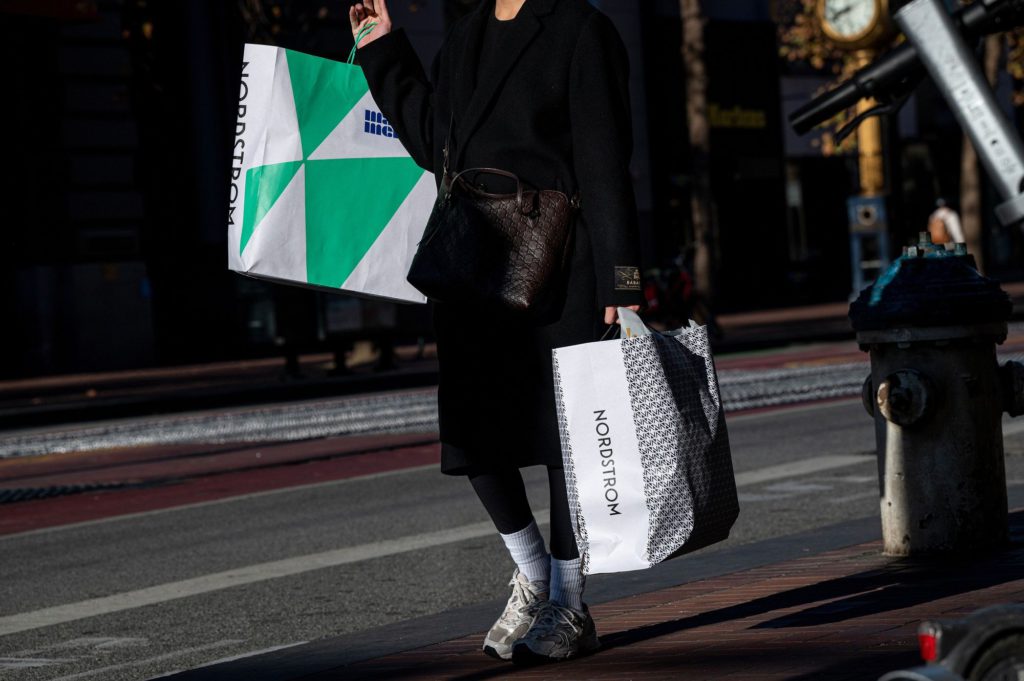
The value of overall retail purchases dropped 0.6% last month after rising 1.3% in October, Commerce Department data showed Thursday. Excluding gasoline and autos, retail sales were down 0.2%. The figures aren’t adjusted for inflation.

The median estimate in a Bloomberg survey of economists called for a 0.2% decline in total retail sales.

Nine of 13 retail categories fell last month, according to the report, including motor vehicles, electronics, furniture and building materials stores. The value of sales at gasoline stations were down 0.1% as pump prices fell.

Sales at restaurants and bars — the only service-sector category in the report — rose 0.9% in November, the fourth-straight increase.

The report suggests some loss of momentum in consumer demand for goods amid high inflation as well as what’s been a shift in preferences toward services. While rising wages and pandemic-era savings have helped support shoppers, Americans are beginning to feel the squeeze — the saving rate is near a record low and credit-card balances have surged.

What Bloomberg Economics Says… 

“A surprisingly weak retail print indicates that the Fed’s rate hikes are starting to bite. With Powell signaling at the Dec. 13-14 meeting that the Fed is not done raising rates — and with consumers shifting their spending from goods to services, which largely aren’t captured in the retail-sales report – the weakness could persist in the new year.”

— Anna Wong and Eliza Winger, economists

For the full note, click here. 

Other data on Thursday showed that the labor market remains resilient with the fewest weekly initial unemployment filings in more than two months. Meanwhile, two regional Federal Reserve manufacturing gauges showed weaker activity this month.

The Fed is looking for a slowdown in consumer spending that will lower economic growth in order to help stamp out inflation. Policymakers stepped down the pace of interest-rate increases Wednesday as expected, and while inflation has been decelerating in recent months, they acknowledge that price pressures are still far too high.

Widespread Discounts

November includes some of the biggest shopping days of the year, and retailers offered widespread discounts across a range of products like toys, clothing and electronics on Black Friday and beyond. Separate data from Adobe Analytics found online spending during Cyber Week — Thanksgiving to Cyber Monday — was up 4% from last year.

Thursday’s report showed spending at nonstore retailers were down 0.9%, which includes e-commerce businesses like Amazon.com Inc.. One of the only categories to rise were grocery stores amid higher food prices, though the pace was slower than the prior month.

So-called control group sales — which are used to calculate gross domestic product and exclude food services, auto dealers, building materials stores and gasoline stations — fell 0.2%, missing estimates for a 0.1% gain.

The retail sales report can be difficult to draw concrete conclusions from since the data aren’t adjusted for inflation and mostly only capture spending on goods. A fuller picture of November household demand, which includes both price-adjusted figures and services spending, will be released next week.

–With assistance from Jordan Yadoo.

(Adds comment from Bloomberg Economics)

More stories like this are available on bloomberg.com

©2022 Bloomberg L.P.

Fallen FAANGs, Nasdaq Wipeout, Value Rally Mark 2022 for Tech Stocks

(Bloomberg) — Investors will remember 2022 as the year when the narrative around Big Tech finally cracked, ending a years-long stretch of powerful market leadership. Next year offers few signs of relief. 

Marquee stocks like Amazon.com Inc., Alphabet Inc., Tesla Inc., Nvidia Corp., and Meta Platforms Inc. have lost a third of their value or more this year, and the tech-heavy Nasdaq 100 Index has fallen 29%, wiping out about $5.6 trillion of market value. 

Surging inflation and interest rates have eroded the favorable conditions that contributed to tech’s years-long advance, raising the prospect of recession in 2023. While that’s hit the whole stock market, highly valued tech stocks had further to fall.

“For the first time in five to 10 years, big tech is seeing a significant degradation in fundamentals,” said Justin Kelly, chief executive officer at Winslow Capital Management. “That’s a substantial change in the long-term outlook for these companies, and why they’re no longer the leadership.”

Here’s a look at how tech stocks fared in 2022.

Difficult Backdrop

The economic backdrop at the end of 2022 is harsher than it was a year ago. High inflation has been a driving theme of the year, along with the Federal Reserve’s attempts to combat it through aggressive interest rate increases. 

The yield on the 10-year Treasury has more than doubled in 2022, while the US Dollar Index is on track for its biggest one-year jump since 2015. Both are toxic for the fast-growing, highly valued companies that dominate the Nasdaq 100.  

While recent reports show price pressures are beginning to cool, Fed Chair Jerome Powell said Wednesday the central bank isn’t close to ending its anti-inflation campaign. 

Such conditions have made 2022’s tech rout notable not only for its scale, but also its length. The Nasdaq 100 hasn’t closed above its 200-day moving average since April, its longest such stretch in 20 years.

Big Tech Loses Influence

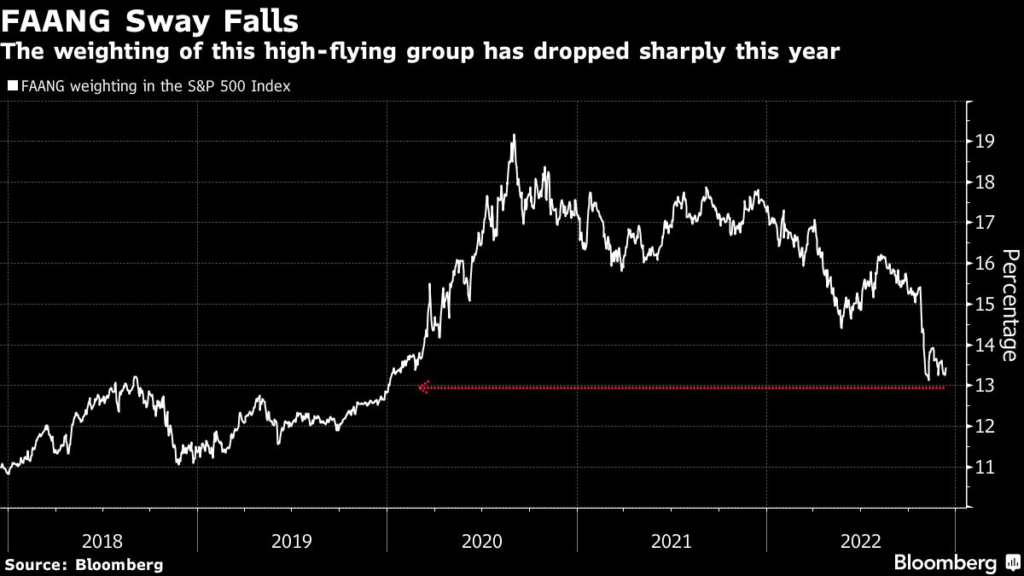
This selloff reduced the importance of the so-called FAANG group of companies that had dominated the market. The cohort — Facebook owner Meta, Amazon, Apple Inc., Netflix Inc. and Google parent Alphabet —- now accounts for about 13% of the S&P 500 Index’s weighting, the lowest in more than two years. That’s down from a record 19% in 2020.

While the group remains well liked on Wall Street, history suggests the market leaders of one era almost never dominate the next one.

“We’ve had a decade of outperformance,” said Keith Lerner, co-chief investment officer at Truist Advisory Services. “Each time tech fell, investors bought the dip and were validated. It will take time for people to accept that things have changed.” He cited “above-average valuations and weak earnings momentum” as reasons he is underweight the sector.

Biggest Losers

A record 13 S&P 500 components have lost at least $100 billion in market value this year, and 12 of them are tech-related companies. Notable wipeouts: Amazon.com Inc. has lost $756.7 billion, Alphabet has shed $689.7 billion and Meta has seen $616.8 billion in value evaporate. The list also includes Apple, Tesla, Microsoft, Nvidia, and Netflix.

Depending on how the last two weeks of December pan out, this group could get a couple of other technology stocks to join them: Intel Corp. and Accenture Plc’s losses sit at around $90 billion.

Winners

There were some bright spots within the sector. “Value” tech staged a comeback, as investors favored shares of dividend-paying companies that sell at low earnings multiples. International Business Machines Corp., for years an underperformer, soared 18% this year including dividends, while Hewlett Packard Enterprise Co. is up 6.1% on a total-return basis. The S&P 500’s tech sector index, which has fallen 23% this year, was down 2% on Thursday.

Top Tech Stories

  • Foxconn Technology Group, the primary assembler of iPhones for Apple, is easing most anti-Covid restrictions at its factory in Zhengzhou, China — a facility that had become a flashpoint in the country’s efforts to contain infections.
  • Elon Musk, who lost his No. 1 spot on Bloomberg’s ranking of the world’s richest people this week, unloaded Tesla Inc. stock for the fourth time this year.
  • Cathie Wood scooped up more shares of Tesla and Coinbase Global Inc., underscoring her faith that electric vehicles and cryptocurrency are key future trends.
  • Twitter Inc. employees terminated in Elon Musk’s mass layoffs must be told about a lawsuit on their behalf against the company before they’re asked to give up their legal rights to qualify for severance pay, a judge ruled.
  • The US Senate voted to ban the hugely popular TikTok video-sharing app from all government-issued phones and other devices as the Biden administration considers restrictions on the Chinese-owned platform.
  • Headspace Health, the maker of a popular meditation and mental-health mobile app, cut about 50 jobs, or 4% of its workforce, the latest internet startup to scale back as funding dries up and economic growth decelerates.

–With assistance from Tom Contiliano.

(Updates to market open.)

More stories like this are available on bloomberg.com

©2022 Bloomberg L.P.

Close Bitnami banner
Bitnami