
Bloomberg

Ford, China’s CATL Mull Workaround for New US Battery Plant With US-Chinese Tensions High

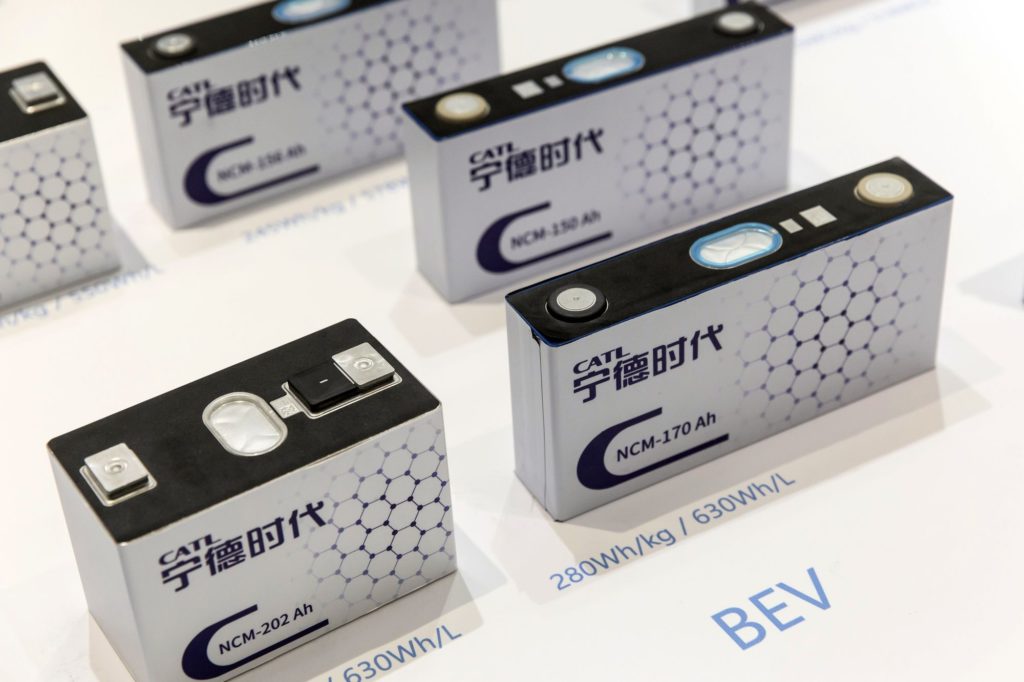
(Bloomberg) — Ford Motor Co. and China’s Contemporary Amperex Technology Co. Ltd. are considering building a battery manufacturing plant in Michigan in a complex arrangement designed to reap new tax benefits without running afoul of US-China political sensitivities.

The state has emerged along with Virginia as a potential home of the multibillion-dollar facility, according to people familiar with the matter, who asked not to be identified discussing sensitive negotiations. The factory will provide lithium iron phosphate batteries for Ford’s electric models.

The companies are weighing a novel ownership structure under which Ford would own 100% of the plant, including the building and the infrastructure, while CATL would operate the factory and own the technology to build the cells, the people said. Such an arrangement would let the facility qualify for lucrative production tax credits under the new Inflation Reduction Act while requiring no direct financial investment from CATL. 

The Chinese government has discouraged CATL from investing in the US due to tensions with Beijing’s top geopolitical rival, according to the people. The battery maker paused plans this summer to establish a new facility in North America after House Speaker Nancy Pelosi’s trip to Taiwan further strained relations between the superpowers, Bloomberg reported in August.

Read more: Ford Secures Batteries to Build 600,000 EVs a Year by 2023

The proposal is just one option that has emerged since the IRA was signed into law in August, and it’s still far from being a done deal, the people said. The lack of clarity around specific content requirements in the IRA is also impacting the decision, and sites in Mexico and Canada haven’t been ruled out.

Shares in CATL jumped 5.3% Thursday, the biggest gain in two months. Ford shares fell 2.2% to $13.18 as of 9:43 a.m. in New York.

The Treasury Department is scheduled to issue guidance finalizing the content requirements and tax credits of the IRA by the end of this month.

‘Still Deliberating’

“CATL is still deliberating on investing in the US and we have not made the decision yet,” the battery maker said in an emailed statement. “There are multiple models being discussed regarding our investment in the US, and all of those choices are purely based on and only based on business concerns.”

The company, which already has a deal to sell batteries to Ford for use in its flagship F-150 Lightning and Mustang Mach-E vehicles, said it’s “not true” that the Chinese government objects to CATL investing in the US.

China’s Foreign Ministry said in a statement Thursday it was unaware of the situation. The Chinese Embassy in Washington had no immediate response to a request for comment. 

Ford said in a statement that “our talks with CATL continue — and we have nothing new to announce.”

If the Dearborn, Michigan-based carmaker opts for Virginia or elsewhere, it would mark another high-profile snub of its home state. Ford opted to build battery hubs in Tennessee and Kentucky in its initial $11 billion investment with South Korea’s SK Innovation Co.

Securing enough batteries to build millions of plug-in models has become a key competitive battleground in the emerging EV market. In addition to Ford’s joint venture with SK, General Motors Co. has established a partnership with South Korea’s LG Energy Solution Ltd. to build battery plants in the US.

See also: How a Battery Metals Squeeze Puts EV Future at Risk

“It is incredibly important to own the battery value chain, there’s no doubt,” Lisa Drake, Ford’s vice president of EV industrialization, said in an interview Tuesday on the sidelines of a Ford technology event. That “is why we are controlling the raw materials ourselves, nickel, lithium, etc.”

She declined to comment on the specifics of negotiations with CATL.

Cost Competitive

CATL, the world’s biggest maker of batteries for electric vehicles, has been considering locations in Mexico and the US to supply cells to automakers including Ford and Tesla Inc., Bloomberg reported earlier this year. But the production tax credit in the IRA, worth as much as $35 per kilowatt hour for each cell produced, could make manufacturing batteries in the US cheaper than in Mexico, according to the people familiar with the matter. The subsidies also offset US tariffs on raw materials imported from China.

Ford announced its partnership with CATL in July, saying it had secured 70% of the battery capacity needed to build more than 2 million EVs annually starting in 2026, a goal set by Chief Executive Officer Jim Farley.

On Ford’s third-quarter earnings call in October, Farley was asked about the status of the CATL partnership given tensions between the US and China. Farley said Ford could “economically” import lithium iron phosphate, or LFP, batteries from China, but alluded to other options to localize production.

“The real billion-dollar question is, when do you localize production of LFP in North America?,” he said on the call. “Whose name is on the front of the building?”

–With assistance from Ed Ludlow, Danny Lee and Philip Glamann.

(Updates with Ford opening shares in sixth paragrph.)

More stories like this are available on bloomberg.com

©2022 Bloomberg L.P.
About 96% of S&P 500 Stocks Drop After Fed, ECB: Markets Wrap

(Bloomberg) — Stocks dropped across global financial markets after a wave of rate hikes from central banks this week, with the Federal Reserve and the European Central Bank warning of more pain to come. 

About 96% of S&P 500 stocks fell. The Nasdaq 100 also started Thursday’s session lower. Both indexes ended Wednesday in the red after Fed Chair Jerome Powell reiterated his hawkish stance and policymakers signaled a peak rate that was above market expectations. Europe’s equity benchmark, the Stoxx 600, pushed lower after the ECB saw 2024 inflation higher than previously forecast.

The US dollar strengthened. The euro rose after ECB President Christine Lagarde said the central bank needs to do more than traders priced in. Britain’s pound slid after an expected half-point hike from the Bank of England. 

A global rally sparked by softer-than-forecast US consumer price index data came to an abrupt halt on Wednesday after the Fed sought to dispel hopes for a rate cut next year. Powell reaffirmed the central bank won’t back away from its fight against inflation despite mounting fears of job losses and a recession. 

“Markets have been in a tug-of-war between better-than-feared economic data juxtaposed with concerns about the potential for the Fed to over-tighten monetary policy and push the economy into a recession,” said Art Hogan, chief market strategist at B. Riley Wealth. “We know that inflation is rolling over and is likely to continue.”

Investors are also parsing a bevy of US economic data Thursday. While retail sales were worse than expected, initial jobless claims came in lower than expected, underscoring the strength in the labor market. 

“The consumer has been resilient amid hot inflation and rising rates, but high prices and talks of a recession may have some now second guessing reaching for their wallet,” said Mike Loewengart, head of model portfolio construction for Morgan Stanley’s global investment office. “It’s been a busy week for investors with both the Fed and ECB raising rates, so it shouldn’t be a surprise to see a shaky market.”

Key events this week:

  • Eurozone S&P Global PMI, CPI, Friday

Some of the main moves in markets:

Stocks

  • The S&P 500 fell 1.5% as of 9:34 a.m. New York time
  • The Nasdaq 100 fell 1.8%
  • The Dow Jones Industrial Average fell 1.2%
  • The Stoxx Europe 600 fell 2.5%
  • The MSCI World index fell 0.2%

Currencies

  • The Bloomberg Dollar Spot Index rose 0.4%
  • The euro rose 0.3% to $1.0710
  • The British pound fell 0.9% to $1.2313
  • The Japanese yen fell 0.8% to 136.52 per dollar

Cryptocurrencies

  • Bitcoin fell 1.8% to $17,510.51
  • Ether fell 2.8% to $1,274.61

Bonds

  • The yield on 10-year Treasuries declined three basis points to 3.45%
  • Germany’s 10-year yield advanced 13 basis points to 2.07%
  • Britain’s 10-year yield declined seven basis points to 3.24%

Commodities

  • West Texas Intermediate crude fell 0.3% to $77.04 a barrel
  • Gold futures fell 1.4% to $1,793.20 an ounce

This story was produced with the assistance of Bloomberg Automation.

–With assistance from Isabelle Lee.

More stories like this are available on bloomberg.com

©2022 Bloomberg L.P.
Banks Must Seek Approval for Crypto Business, NY Regulator Says

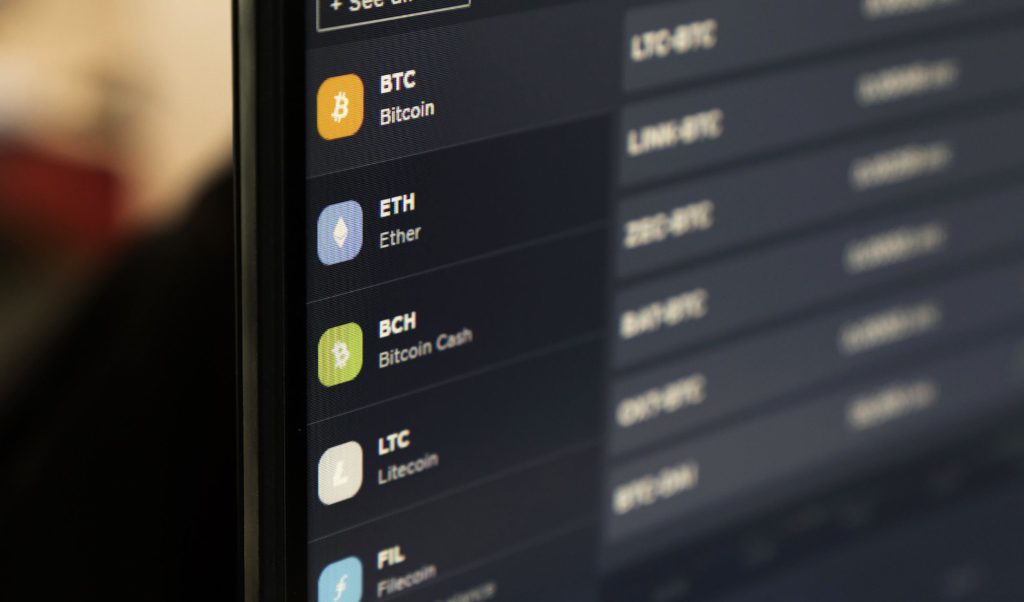
(Bloomberg) — Banks must seek and obtain prior approval before engaging in cryptocurrency-related activities, and those that already engage in such activities must immediately notify the agency, the New York Department of Financial Services said. 

For banks already active in crypto, the department will seek further information and impose requirements as needed, it said in a statement Thursday. The guidance also applies to banks that use a third party to conduct any crypto-related business. As part of its review, the NY regulator said it would assess several areas, including the banks’ business plan, risk management, corporate governance and consumer protection.

“Today’s guidance is critical to ensuring that consumers’ hard-earned money is protected, that New York regulated banking organizations remain resilient and competitive, and that the expectations are clear for those that wish to submit proposals for virtual currency-related activity,” Superintendent Adrienne Harris said in the statement. 

Banks with crypto-related business or partnerships with digital-asset firms have drawn greater scrutiny following the collapse of FTX. After the firm went bankrupt it was revealed that the crypto exchange and its sister company Alameda Research had ties to a number of banks, including some regulated in the US.

Federal banking regulators, including the US Federal Reserve, the Office of the Comptroller of the Currency and the Federal Deposit Insurance Corp., have issued guidance similar to the New York DFS requiring banks they oversee to notify them and obtain approval before partaking in crypto activities. Democratic Senators Elizabeth Warren and Tina Smith recently asked the heads of the OCC, Fed and FDIC to conduct a broad review of crypto firms’ ties to the banking industry following FTX’s unraveling.

“We write to express concern regarding recent revelations of ties between the banking industry and cryptocurrency firms,” the US senators said in the letters sent earlier this month.

More stories like this are available on bloomberg.com

©2022 Bloomberg L.P.
Carbon-Removal Startups Win Early Backing From Stripe and Shopify

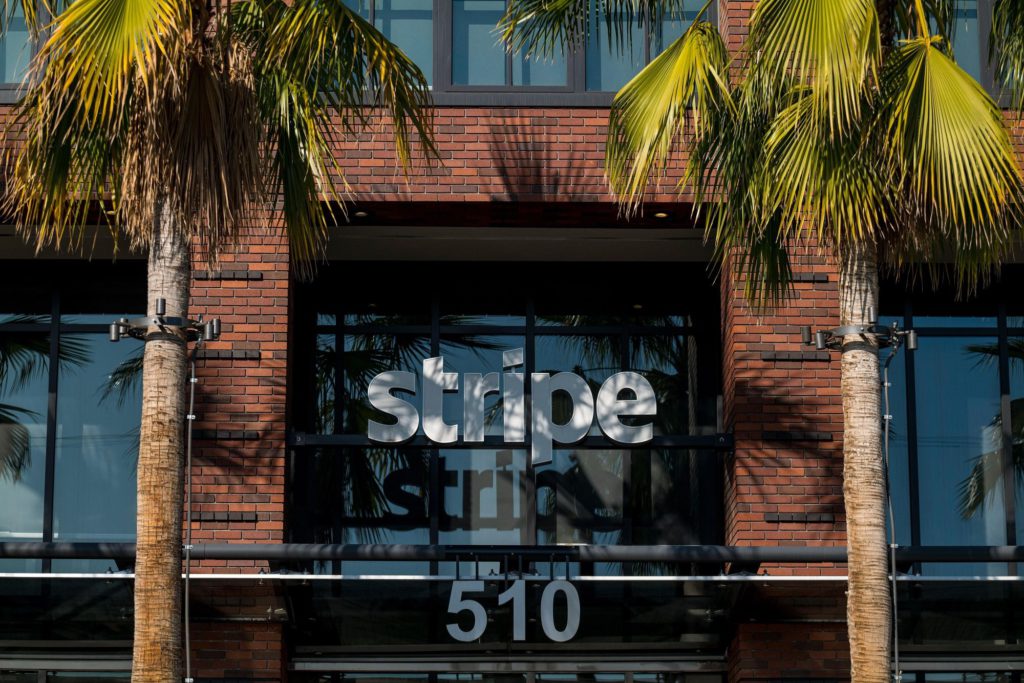
(Bloomberg) — A new group of early-stage carbon-removal startups received pledges of $11.5 million from Stripe Inc. and Shopify Inc. as the Silicon Valley companies continue their effort to create a robust market for technologies that remove carbon dioxide from the atmosphere. 

This is the second batch of startups working on ways to sequester greenhouse gas, such as storing CO₂ deep in the ground or pulling it out of the ocean, that have won support from Frontier, a $925 million effort started last year inspired by similar projects at the two technology giants. The goal is to select promising carbon-removal companies and to help them get off the ground by committing to be an early customer — often the first ever for these startups — or by providing research grants.

The announcement on Thursday included funding for nine startups doing work in the US, Kenya, Brazil, Germany, Canada and Australia. They include Captura, which removes CO₂ from the ocean; Cella, which is mineralizing CO₂ by injecting it into volcanic rock formations; and Kodama Systems, which is burying biomass thinned from forests to prevent it from decomposing. In June, Frontier selected six companies out of 26 applicants for its initial round. 

Carbon-removal technology is in nascent stages and remains quite expensive. But climate experts project that by 2050, in order to meet net zero goals, the world will need to be removing 5 billion tons of carbon from the air each year. That leaves an enormous gap to close in the decades ahead. The technologies to do so need to be developed, and the price of removing a ton of carbon needs to drop drastically.

With this second round of startups, Frontier is providing research grants to two recipients and promising to pay a total of $3.5 million to seven others in the form of a “pre-purchase agreement” while the technology is still developing. Another $7 million is set aside to buy more from those seven companies if they meet certain milestones. Right now, only Shopify and Stripe have made financial commitments to these companies, although Meta Platforms Inc., Alphabet Inc. and McKinsey & Co. have agreed to buy carbon removal through Frontier when the companies are more mature.

Startups selected in Frontier’s second batch are trying to make use of industrial waste streams such as mine tailings and brine from desalination plants. It’s a particularly encouraging trend, said Joanna Klitzke, who works on Stripe’s climate team, because it allows them to use cheaper inputs to capture carbon more cost-effectively.

Progress can be heartening and disheartening at the same time. Nan Ransohoff, the head of Frontier and of Stripe’s climate projects, said that the commitment to Frontier is nothing compared to what might have to be spent in the future to remove enough carbon from the air — by some estimates as much as $500 billion a year. At that size, either governments will have to be buying carbon removal directly or other major policy changes will be needed.

“It’s very unlikely that the voluntary markets by themselves are going to get to the scales needed,” Ransohoff said. “We’re going to need policy to help this market scale eventually.”

  • READ MORE: Bloomberg 50: Nan Ransohoff, Carbon-Removal Champion

More stories like this are available on bloomberg.com

©2022 Bloomberg L.P.

Futures Selloff Deepens as ECB Adds to Fed Gloom: Markets Wrap

(Bloomberg) — US equity-index futures and European stocks declined after the Federal Reserve rebuffed expectations for a dovish tilt and said interest rates will go higher for longer. The European Central Bank’s signals on consumer-price pressures deepened the selloff.

Contracts on the S&P 500 and Nasdaq 100 gauges fell at least 1.3% each. Europe’s equity benchmark, the Stoxx 600, fell after the ECB saw 2024 inflation higher than previously forecast. 

Demand for haven assets sent the dollar and Swiss franc higher amid a wave of rate hikes from Taiwan to Norway. The euro trimmed losses. Britain’s pound slid after an expected half-point rate hike from the Bank of England.

A global rally sparked by softer-than-forecast US inflation came to an abrupt halt on Wednesday after policymakers signaled a peak rate that was far above market expectations and sought to dispel hopes for a rate cut next year. Chair Jerome Powell reaffirmed the central bank won’t back away from its fight against inflation despite mounting fears of job losses and a recession.

“The Fed was more hawkish than markets had expected,” Jack McIntyre, a money manager at Brandywine Global Investment Management, wrote in a note. “They seemingly still want financial markets to tighten further, which essentially means they want lower equity prices.”

Investors are also parsing a bevy of US economic data Thursday. While retail sales were worse than expected, initial jobless claims came in lower than expected, underscoring the strength in the labor market. 

Key events this week:

  • ECB President Lagarde briefing, Thursday
  • Eurozone S&P Global PMI, CPI, Friday

Some of the main moves in markets:

Stocks

  • Futures on the S&P 500 fell 1.3% as of 8:45 a.m. New York time
  • Futures on the Nasdaq 100 fell 1.7%
  • Futures on the Dow Jones Industrial Average fell 1%
  • The Stoxx Europe 600 fell 1.6%
  • The MSCI World index fell 0.2%

Currencies

  • The Bloomberg Dollar Spot Index rose 0.5%
  • The euro fell 0.2% to $1.0661
  • The British pound fell 0.8% to $1.2321
  • The Japanese yen fell 0.8% to 136.55 per dollar

Cryptocurrencies

  • Bitcoin fell 1.9% to $17,498.87
  • Ether fell 2.8% to $1,274.04

Bonds

  • The yield on 10-year Treasuries declined two basis points to 3.45%
  • Germany’s 10-year yield advanced seven basis points to 2.01%
  • Britain’s 10-year yield declined six basis points to 3.26%

Commodities

  • West Texas Intermediate crude fell 0.3% to $77.04 a barrel
  • Gold futures fell 1.7% to $1,787.20 an ounce

This story was produced with the assistance of Bloomberg Automation.

–With assistance from Richard Henderson and Georgina Mckay.

More stories like this are available on bloomberg.com

©2022 Bloomberg L.P.
Billionaire Zara Owner Agrees to Buy Seattle Luxury High-Rise

(Bloomberg) — Amancio Ortega, the billionaire founder of the Zara clothing chain, is doubling down on US luxury residential real estate with a deal to buy an apartment building in Seattle.

Ortega’s family office Pontegadea has agreed to buy the 40-floor Kiara skyscraper for $323 million, a spokesperson said on Thursday, confirming an earlier report by newspaper El Pais.

This is Pontegadea’s second acquisition of premium residential real estate in the US, after agreeing to buy a New York building earlier this year. Traditionally, the firm focused on high-end office buildings and retail sites. Ortega receives hundreds of millions of euros in dividends every year for his 59% stake in Inditex SA, the parent company of Zara.

One of Pontegadea’s most iconic investments is an office-building in Seattle, where the firm is landlord to Amazon.com Inc. 

In recent years, the company has sought to diversify beyond real estate, with investments in telecommunications and energy infrastructure as well as renewable-energy plants. This year, Pontegadea also invested about $700 million in logistics facilities in the US, a first in the sector for it. 

More stories like this are available on bloomberg.com

©2022 Bloomberg L.P.

Prosus Considers Various Deal Options in Push to Improve Returns

(Bloomberg) — Prosus NV is considering selling certain units through an initial public offering as part of the investment company’s plans to raise shareholder returns and become profitable.

“We are actively working on multiple situations which will span both listing businesses as well as mergers and sales,” Prosus Chief Investment Officer Ervin Tu said in an interview. “The market can expect to see much more from us in the coming months.”

This will include the expansion of its existing businesses and the reduction of costs, Tu said. 

The e-commerce firm has been working on narrowing the discount between the sum of its parts and its stake in China’s Tencent for years, with both Prosus and its Cape Town-based parent Naspers Ltd. already having taken a number of steps to address the problem.

These include the spin-off of the African PayTV business, the creation of Prosus through the Euronext-listing of the internet companies, a share swap between Naspers and Prosus, and a number of share buybacks. 

With assets which include food delivery, travel bookings and online education sites across the world, Prosus plans to continue the buyback program at scale, Tu said. It may also use some of its $20 billion cash to buy companies on the cheap from private firms that are struggling, he said. 

More stories like this are available on bloomberg.com

©2022 Bloomberg L.P.

Equities Decline as Fed Shock Halts Global Rally: Markets Wrap

(Bloomberg) — US equity-index futures and European stocks declined after the Federal Reserve rebuffed expectations for a dovish tilt and said interest rates will go higher for longer.

Contracts on the S&P 500 and Nasdaq 100 gauges fell at least 0.9% each. Demand for haven assets sent the dollar and Swiss franc higher amid a wave of rate hikes from Taiwan to Norway. Britain’s pound extended losses after an expected half-point rate hike by the Bank of England. The euro fell before the European Central Bank’s decision. Tesla Inc. dropped in premarket New York trading after Elon Musk sold $3.6 billion of shares.

A global rally sparked by softer-than-forecast US inflation came to an abrupt halt on Wednesday after policymakers signaled a peak rate that was far above market expectations and sought to dispel hopes for a rate cut next year. Chair Jerome Powell reaffirmed the central bank won’t back away from its fight against inflation despite mounting fears of job losses and a recession.

“The Fed was more hawkish than markets had expected,” Jack McIntyre, a money manager at Brandywine Global Investment Management, wrote in a note. “They seemingly still want financial markets to tighten further, which essentially means they want lower equity prices.”


An index of the dollar’s strength headed for the biggest gain since Dec. 5. The euro fell from a six-month high as the ECB was expected to follow the Fed with a half-point hike. The pound extended its losses after policymakers in London delivered an expected hike, but growing divisions were noted in their decision.

The Swiss franc held its gain after the nation’s central bank doubled the policy rate to 1% as forecast. China’s yuan fell as poor economic data and a surge in Covid cases weighed.

Europe’s equity benchmark, the Stoxx 600, fell the most since Oct. 7 on a closing basis. Tesla dropped 1.7% in early New York trading after Chief Executive Officer Musk sold almost 22 million shares of the electric-car maker for $3.58 billion. Western Digital Corp. lost 4.8% as Goldman Sachs Group Inc. recommended selling the stock.

Shorter-dated Treasury yields edged higher, with the two-year rate adding 1 basis point. The 10-year rate was little changed as investors weighed the economic impact of Fed’s hawkishness.

Oil fluctuated between gains and losses after rallying almost 9% over the previous three sessions as TC Energy Corp. restarted a section of the Keystone pipeline, allowing for some flows to resume on the major conduit.


Key events this week:

  • ECB rate decision and ECB President Lagarde briefing, Thursday
  • Rate decisions for UK BOE, Mexico, Norway, Philippines, Switzerland, Taiwan, Thursday
  • US cross-border investment, business inventories, empire manufacturing, retail sales, initial jobless claims, industrial production, Thursday
  • Eurozone S&P Global PMI, CPI, Friday

Some of the main moves in markets:

Stocks

  • Futures on the S&P 500 fell 0.9% as of 7:01 a.m. New York time
  • Futures on the Nasdaq 100 fell 1.2%
  • Futures on the Dow Jones Industrial Average fell 0.7%
  • The Stoxx Europe 600 fell 1%
  • The MSCI World index fell 0.5%

Currencies

  • The Bloomberg Dollar Spot Index rose 0.6%
  • The euro fell 0.6% to $1.0619
  • The British pound fell 0.9% to $1.2314
  • The Japanese yen fell 0.8% to 136.59 per dollar

Cryptocurrencies

  • Bitcoin fell 0.6% to $17,722.3
  • Ether fell 1.5% to $1,290.5

Bonds

  • The yield on 10-year Treasuries declined one basis point to 3.46%
  • Germany’s 10-year yield was little changed at 1.95%
  • Britain’s 10-year yield declined nine basis points to 3.23%

Commodities

  • West Texas Intermediate crude was little changed
  • Gold futures fell 1.7% to $1,788.40 an ounce

This story was produced with the assistance of Bloomberg Automation.

–With assistance from Richard Henderson and Georgina Mckay.

More stories like this are available on bloomberg.com

©2022 Bloomberg L.P.

China’s EV Exports Won’t Be a Mostly Tesla Story for Much Longer

(Bloomberg) —

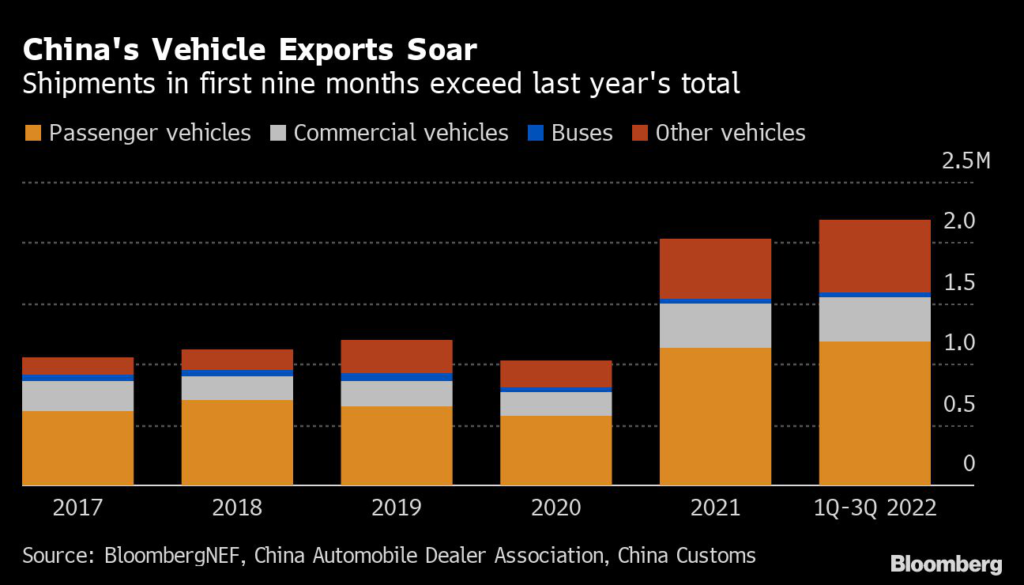
Auto exports from China have surged this year as domestic automakers look to establish themselves beyond their home market.

Through September, a total of 2.2 million passenger cars, trucks, buses and other vehicles were exported from China. That’s up 54% from the same period last year and already more than double the average from 2012 through 2020.

Electric vehicles are the biggest contributor to the surge, with 342,000 passenger EVs exported in the first three quarters of the year. That’s 29% of all vehicle exports in this segment and a big increase from 2019, when EVs accounted for just 2% of exports. Another 314,000 low-speed EVs and 4,000 electric buses also were exported.

There are several factors driving China’s EV export growth. Its dominance of EV battery and materials supplies has allowed domestic auto markets to ramp up production. Western automakers are using the country’s lower production costs and established supply chain to churn out EVs for customers around the globe as interest in the technology takes off.

Tesla emerged as a major exporter from its factory in Shanghai starting last year. It’s shipped almost 165,000 vehicles from the plant to international markets in the first nine months of this year. Other global automakers including Renault and BMW also are exporting Chinese-made EVs, and Volkswagen will start doing so next year.

Chinese domestic brands make up the balance. SAIC saw its EV exports jump to 78,000 vehicles in the first three quarters, mostly with the MG brand that it acquired in 2007. Rival BYD exported 22,000 vehicles and plans to do a lot more volume in 2023 as it continues to enter new markets. Companies including Xpeng, Nio and Great Wall also have announced big expansion plans.

That’s all starting to show up in the EV sales figures in other countries. Of the 1.8 million EVs sold in Europe in the first three quarters of this year, 11% came from Chinese automakers, up from 2% in 2020.

It’s worth reflecting for a bit on how we got here. For much of the last decade, there’s been heated discussion about whether Chinese automakers could establish themselves on the global stage. That talk felt somewhat abstract when Chinese automakers weren’t even dominating their home market. In 2015, 66% of all vehicle sales in China were from joint ventures between international and domestic brands. Entering Germany or the US seemed like quite a leap.

EVs are changing all that. While many Western brands dragged their feet and spent years fighting against tighter fuel economy regulations, China was building up its EV industry through government fleet purchasing requirements, subsidies, supply-side incentives and extensive investments in charging infrastructure. Almost 60% of global EV sales are now in China; its share of the battery supply chain is even higher.

Much of China’s EV exports so far are at the higher end of the market, but that could change. Established Western automakers are increasingly trying to move upmarket to sell more premium vehicles. Some are getting out of car segments altogether to focus on higher-margin SUVs and trucks.

This move upmarket may make sense from a profit margin perspective, but it’s opening up a sizeable gap at the lower end that Chinese automakers may try to fill.

China’s price advantage here is real. BNEF’s recently published Lithium-Ion Battery Price Survey shows battery pack prices were 33% higher in Europe than in China and 24% higher in the US. The average price of a battery-electric vehicle in China in 2021 was $26,500, which is less than two-thirds of the average EV transaction price in Europe and less than half of those in the US.

The steady refrain from legacy automakers over the last decade has been that, as soon as there was real demand for EVs, they would quickly ramp up and own the market. That’s not how it played out in the world’s largest auto market. Plug-in vehicles now account for almost 30% of sales in China. Excluding Tesla, international automakers have a tiny sliver of those sales and are increasingly getting squeezed out.

Established automakers now generally talk about competing to be No. 2 in EVs after Tesla, or surpassing them later this decade. Even that shows there’s a giant, BYD-shaped blind spot in their field of view. BYD is on pace to sell almost 2 million plug-in vehicles this year and is targeting more than 3 million in 2023. That’s far ahead of where leading legacy automaker VW is likely to land for the year.

None of this means the road ahead will be easy for Chinese brands internationally. Gaining consumer trust, brand recognition and market share takes time, and making good-quality cars is still difficult. Still, study after study finds that consumers who drive EVs really like them, and markets have a way of getting people what they want. The latest export data suggests they’re already doing just that.

–With assistance from Siyi Mi.

More stories like this are available on bloomberg.com

©2022 Bloomberg L.P.

Binance’s Biggest Platform Shows Concern Over Crypto Contagion Is Rising

(Bloomberg) — One of the most closely watched indicators of trader sentiment on Binance’s market-leading derivatives exchange suggests that anxiety over additional fallout from this year’s crypto market meltdown has grown.  

The seven-day average of open interest for Bitcoin perpetual futures has dropped 40.3% from the start of November as of Wednesday, according to researcher CryptoCompare. Open interest is the total number of futures contracts held at the end of the trading day. Bitcoin perpetual contracts — which, unlike traditional calendar futures, don’t expire — have long been a favorite of crypto speculators because they allow them to more easily maintain leveraged bets. 

The decline comes as investors pull cryptocurrencies from exchanges such as those run by Binance, which operates the largest spot, or cash, exchange as well. Binance founder Changpeng “CZ” Zhao said Wednesday that outflows have “stabilized” while warning employees that the industry’s recovery from rival FTX’s November collapse will be “bumpy.” Bitcoin has tumbled more than 60% this year and trades around $17,700. 

“Since Binance is the biggest derivatives exchange, it is likely that the closing of positions from major institutional market participants, who are now risk-averse, has driven the decline in OI,” said Jacob Joseph, a research analyst at CryptoCompare. “The decline in open interest suggests a lack of speculation as traders turn risk-averse as they await any further contagion in this uncertain market.” 

Other derivatives exchanges are seeing mixed comparable results, though that may be skewed because of Binance’s dominance of the sector. The seven-day average for Bitcoin perpetuals on Kraken rose 46.5% since the beginning of November, according to CryptoCompare. Open interest on Bybit and OKX exchanges fell 19.1% and 21.1%, respectively. Crypto.com’s open interest dropped 83.1% over the same period. 

Binance holds a nearly 60% share of the crypto derivatives market, having traded $1.45 trillion in November, according to CryptoCompare. Kraken’s share is under 1%, while OKX and Bybit have market shares of 14.4% and 11% respectively, according to the researcher. CryptoCompare doesn’t track Crypto.com’s market-share data.

Crypto derivatives is a bigger market than spot trading. When FTX announced its bankruptcy on Nov. 11, the seven-day average derivatives trading volume was more than three times bigger than spot, according to CryptoCompare. Currently, it’s roughly double the size of spot.

“We are seeing that open interest on perps is starting to stabilize but certainly it’s come down pretty sharply,” said David Duong, head of institutional research at Coinbase Global Inc., which owns derivatives tracker Skew. “That’s happening irrespective anything idiosyncratic to Binance. Definitely it’s showing that in the very short term most sentiment believes it’s going to be range-bound or weaker.”    

–With assistance from Vildana Hajric.

(Updates the price of Bitcoin in the third paragraph.)

More stories like this are available on bloomberg.com

©2022 Bloomberg L.P.

Close Bitnami banner
Bitnami