
Bloomberg

FTX Executive Ryan Salame Tipped Off Bahamian Regulators to Possible Fraud

(Bloomberg) — Several days before FTX collapsed into bankruptcy, one of Sam Bankman-Fried’s most senior executives was tipping off Bahamian authorities to possible misuse of funds at the exchange. Ryan Salame, the former co-CEO at FTX Digital Markets, told island regulators on Nov. 9 that client assets were transferred to Alameda Research to “cover financial losses” at the trading firm, court filings show. 

Salame further alleged that only three people had the ability to authorize such a transfer: Bankman-Fried, former engineering executive Nishad Singh, and FTX co-founder Gary Wang, according to the court filings. The Financial Times first reported on the contents of the documents. 

  • Read more: FTX’s Other Billionaires Lie Low After Sam Bankman-Fried Arrest

Salame indicated to the executive director of the Securities Commission of the Bahamas on a conference call that “such transfers were not allowed and therefore may constitute misappropriation, theft, fraud or some other crime,” the filings show. 

The disclosure triggered an urgent request from Christina Rolle, the executive director, to the local commissioner of police for an investigation, according to emails included in the court filings. Rolle didn’t return an email seeking comment sent outside of normal business hours, and could not be reached by phone.

FTX experienced a bank run in the few days prior to Salame approaching Bahamian authorities and filed for bankruptcy on Nov. 11. 

The filings show that during that pivotal pre-bankruptcy period, Bankman-Fried exchanged emails with several different Bahamian officials, including Rolle and with Ryan Pinder, the Attorney General. 

In one email sent on the night of Nov. 9, Bankman-Fried apologized to Pinder for “delayed responses” to previous messages. In that email, Bankman-Fried wrote: “it’s been a hectic week but that’s on me. Myself, and Joe (cc’ed), will be responsive going forward.” His father, Joseph Bankman, was in the CC line of the email.  

In the same message, Bankman-Fried wrote that FTX had “segregated funds for all Bahamian customers,” adding that “we would be more than happy to open up withdrawals for all Bahamian customers on FTX, so that they can, tomorrow, fully withdraw all of their assets, making them fully whole.”

Bankman-Fried remains the only senior executive charged with any crimes and is facing extradition to the US from the Bahamas. 

  • Read more: Here Are the Wildest Parts From SEC’s Bankman-Fried Allegations

Several billion worth of customer assets have disappeared, FTX’s new CEO John Ray III testified before Congress yesterday. Some of the funds likely went to Alameda, he said.

Salame didn’t return calls or messages seeking comment. Bankman-Fried is currently in a Bahamas jail after being denied bail. Mark Botnick, a representative for Bankman-Fried, declined to comment. Singh didn’t respond to requests for comment. 

  • Read more: FTX’s Salame Invested $6 Million in Massachusetts Eateries

–With assistance from Katanga Johnson.

(Updates with additional context throughout and updates comment line from Mark Botnick in final paragraph.)

More stories like this are available on bloomberg.com

©2022 Bloomberg L.P.

Chinese Startup’s Rocket With Methane-Oxygen Fuel Mix Fails

(Bloomberg) — A Chinese startup’s attempt to use a rocket fueled with liquid methane and oxygen to place a satellite in orbit failed in its mission on Wednesday, according to a statement on the company’s Weibo account. 

The brief statement on LandSpace Technology Corp.’s launch said the rocket’s main engines were performing normally, but that there was an abnormality in a supplementary second-stage engine. The setback is still being reviewed, according to the statement. 

LandSpace is vying to be China’s private-sector answer to Elon Musk’s SpaceX. SpaceX and other rivals have been developing rockets that can use methane-based fuel, thanks to its potential to be cleaner and safer than solid propellants, liquid hydrogen and other fuels currently used. But so far, no company has successfully used methane to send a satellite or astronauts into orbit.

China Startup Takes Aim at SpaceX With Methane-Fueled Rocket (1)

Since its founding in 2015 by Zhang Changwu, LandSpace has raised at least 2.1 billion yuan ($300 million) from the government-backed China SME Development Fund as well as private-sector investors such as Sequoia China and Matrix Partners China, according to statements from the company.

China’s space program has notched a number of accomplishments, including sending three astronauts to a newly completed Chinese space station in late November. 

–With assistance from Jessica Sui, Zibang Xiao and Phila Siu.

More stories like this are available on bloomberg.com

©2022 Bloomberg L.P.

FTX Told Australia of Work on ‘Robust’ Security Before Collapse

(Bloomberg) — FTX described its “robust” security practices and advocated against stricter safeguards on client assets in a letter to the Australian government a little more than five months before the cryptocurrency exchange collapsed.

Crypto firms shouldn’t be forced to keep clients assets locally or using a third-party firm, FTX wrote in a submission to the nation’s Treasury department dated May 29 that was recently made public. 

“Larger more sophisticated groups such as FTX have invested significant sums in developing robust security practices which achieve the necessary levels of security while keeping custody of assets ‘in-house,’” according to the document.

FTX’s implosion last month came after the exchange had wooed regulators worldwide for years. Founder Sam Bankman-Fried, who was arrested in the Bahamas on Monday, had testified before the US Congress and had been active in the debate over whether the crypto space should be more tightly regulated. 

The assertions in the Australian letter are at odds with the assessment of new FTX CEO John J. Ray III, who said recently that the exchange had “absolute concentration of control in the hands of a very small group of grossly inexperienced and unsophisticated individuals.”

Read more: Bankman-Fried Accused of Fraud by US After Bahamas Arrest (1)

“By providing regulatory certainty, consumers can be confident that they are dealing with legitimate businesses and that their consumer rights can be enforced,” FTX said in the Australian letter. “Likewise, a clear regulatory regime will provide greater business certainty.”

The Australian Financial Review reported earlier on the letter.

–With assistance from Victoria Batchelor.

More stories like this are available on bloomberg.com

©2022 Bloomberg L.P.

Tech Giants Doing Too Little on Abuse Content, Report Says

(Bloomberg) — Global technology giants are doing too little to remove video and images of child sexual exploitation from their own digital platforms, according to an Australian government report.

Using new legislation, Australian e-Safety Commissioner Julie Inman Grant compelled businesses ranging from Meta Inc.-owned Facebook to Microsoft Corp.’s Skype to disclose how they tackle the issue. The report released Thursday highlighted their inadequate use of detection technology and response times that can stretch to days. 

Apple Inc. and Microsoft don’t pro-actively detect child abuse material stored on their iCloud and OneDrive services, despite the wide availability of identifying technology, the report found. Neither company uses tools to detect live-streaming of abuse in video chats on Skype, Microsoft Teams or FaceTime, even though Skype is used extensively for this purpose, the report said.

In a statement, Microsoft described online child sexual exploitation as “a horrific crime,” and said the company is committed to combating its proliferation. “We continue to challenge ourselves to adapt our response and welcome engagement with external stakeholders that can help us improve,” it said. Apple didn’t respond to emails and calls seeking a response to the report.

“It is unacceptable that tech giants with long-term knowledge of extensive child sexual exploitation, access to existing technical tools and significant resources are not doing everything they can to stamp this out on their platforms,” Inman Grant said.

The typical time taken to remove content or ban a user after abusive material is reported ranges from 4 minutes at Snapchat to two days at Skype, according to the report.

(Updates with response from Microsoft in the fourth paragraph)

More stories like this are available on bloomberg.com

©2022 Bloomberg L.P.

US Senate Votes to Ban TikTok App on Government-Owned Phones

(Bloomberg) — The US Senate voted to ban the hugely popular TikTok video-sharing app from all government-issued phones and other devices as the Biden administration considers restrictions on the Chinese-owned platform.

The measure, which was approved unanimously, would have to be passed by the US House before Congress leaves for the year. 

The bill, sponsored by Senator Josh Hawley, a Missouri Republican, underscores fears that TikTok and its parent, ByteDance Ltd., could share information on US users with Chinese authorities. The Senate also passed the ban in the last Congress.

“TikTok is a Trojan Horse for the Chinese Communist Party. It’s a major security risk to the United States, and until it is forced to sever ties with China completely, it has no place on government devices,” Hawley said in a statement.

The legislation includes exceptions for “law enforcement activities, national security interests and activities, and security researchers,” under certain circumstances, according to the text of the bill.

Last month, FBI Director Christopher Wray told the House Homeland Security Committee that China’s government could use TikTok to control millions of users’ data or software, and its recommendation algorithm — which determines which videos users will see next — “could be used for influence operations if they so choose.” 

“Under Chinese law, Chinese companies are required to essentially — and I’m going to shorthand here — basically do whatever the Chinese government wants them to do in terms of sharing information or serving as a tool of the Chinese government,” Wray told lawmakers.

After the vote, Brooke Oberwetter, a TikTok spokesperson, said in a statement: “Once again, Senator Hawley has moved forward with legislation to ban TikTok on government devices, a proposal which does nothing to advance US national security interests.”

“We hope that rather than continuing down that road, he will urge the administration to move forward on an agreement that would actually address his concerns,” Oberwetter added.

The Biden administration has been attempting to forge an agreement with TikTok that would allow the video-sharing site to keep operating in the US by enacting additional safeguards on how US user data is stored, according to people familiar with the discussions who requested not to be identified discussing a national security matter.

That effort has faltered.

A final deal has been held up at the Justice Department, and questions linger over whether any deal could protect all US users’ data from misuse. A plan would be expected to build on an arrangement announced by TikTok in June under which US user traffic is routed through servers maintained by Oracle Corp.

The White House did not immediately respond to a request for comment on Wednesday night. 

A plan by the Trump administration to force ByteDance to sell stakes in the app to US companies fell through.   

–With assistance from Daniel Flatley, Alex Barinka and Jennifer Jacobs.

(Updates with Hawley quote, White House asked for comment, starting in fourth paragraph.)

More stories like this are available on bloomberg.com

©2022 Bloomberg L.P.

China’s Home Price Slump Persists as Buyer Demand Remains Weak

(Bloomberg) — China’s housing market slump persisted in November as prices and sales fell, underscoring the challenge for authorities as they seek to revive the beleaguered property market. 

New-home prices in 70 cities, excluding state-subsidized housing, slid 0.25% last month from October, when they fell 0.37%, National Bureau of Statistics figures showed Thursday. Sales dropped 31% from a year earlier, worsening from a 23% decrease in October, according to Bloomberg calculations based on official data.

The declines came in a month when policy makers unveiled a sweeping plan to rescue the sector, focusing mainly on the supply side by easing financing to developers. Arresting the drop in prices is seen as key to reviving demand from homebuyers and ending an unprecedented real estate slump that’s curtailing economic growth. 

“The policy ‘adrenaline shot’ hasn’t shown its effect on the home market,” Yang Kewei, chief analyst at property service provider China Real Estate Information Corp., said before the figures were released. “As homebuyers take time restoring their confidence in developers, the home market may not bottom out until the second quarter next year.” 

November transactions were hindered by Covid outbreaks in major cities, prompting restrictions including lockdowns. President Xi Jinping’s administration has since begun a rapid shift away from its zero-tolerance policy, which risks a further spread of the disease even as it allows economic activity to pick up. 

Shares of Chinese developers fell on Thursday morning, with a Bloomberg Intelligence gauge dropping more than 4%. The measure is still up about 66% since the end of October as the government stepped up its efforts to support the industry.

The slump in home values also persisted in the closely watched secondary market. Existing-home prices dropped 0.44%, easing slightly from 0.47% a month earlier, the figures showed.

Buyers Wary

“Chinese homebuyers could continue to stay on the sidelines in early 2023 as the downtrend of new-home prices is unlikely to be turned around in the coming months,” Bloomberg Intelligence analysts including Kristy Hung wrote in a note. 

In manufacturing hub Guangzhou, which enforced snap lockdowns in November, home sales plunged 67% from a year earlier, CRIC data showed. In 30 major cities tracked by CRIC, only 26% of projects offered were successfully sold. 

Property investment dropped 20% in November from a year earlier, the steepest decline since at least 2013, according to Bloomberg calculations based on the government’s figures.

Slow improvements in developers’ contract sales will likely remain a drag on their liquidity, despite a short-term boost via support from banks and improved access to bond sales, BI’s Hung estimated. 

(Updates with housing sales figures in second paragraph)

More stories like this are available on bloomberg.com

©2022 Bloomberg L.P.
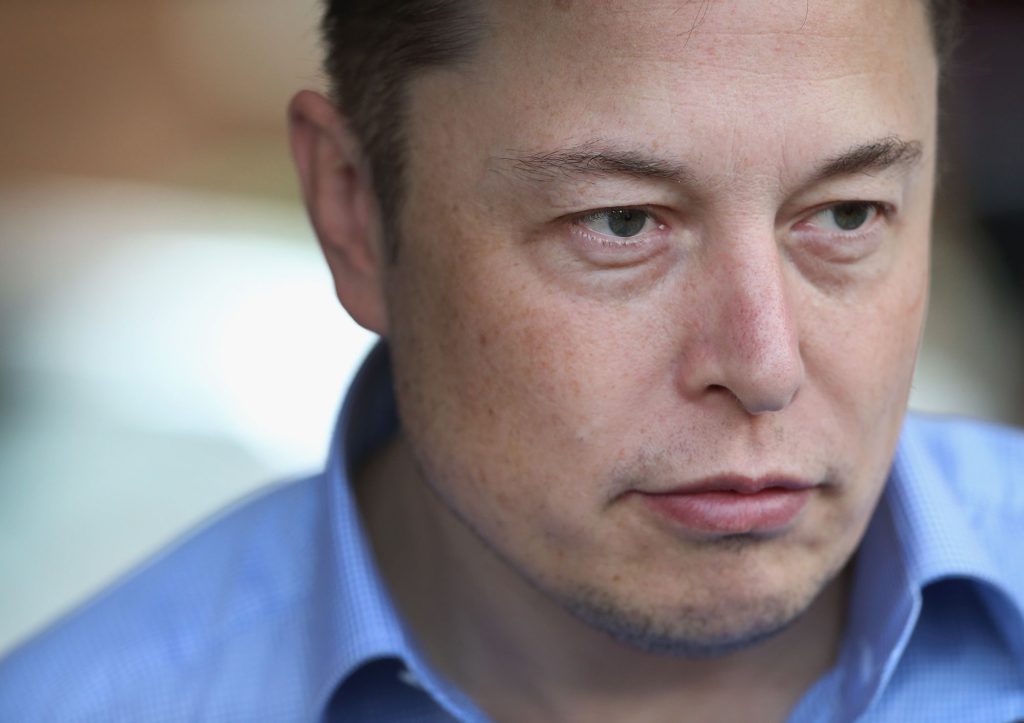
Twitter Suspends the Accounts Tracking Musk’s Jet and The Man Behind It

(Bloomberg) — Twitter Inc. suspended multiple accounts that track the locations of private jets using publicly available flight data, including one that followed the plane of the company’s owner, Elon Musk.

Musk publicly declared last month that he would not ban the account even though he saw it as a safety risk, saying that it was evidence of his commitment to free speech. 

Early Wednesday morning in New York, the @elonjet page showed a message that read “account suspended” because it violated the platform’s rules. The account had been operated since 2020 by Jack Sweeney, who also ran other Twitter accounts that tracked the private jets of Mark Zuckerberg and other celebrities.

By the afternoon, Twitter updated its policy to bar accounts from sharing someone else’s current location information, though tweeting about “historical (not same-day)” locations would be allowed. The @elonjet account reappeared and began tweeting, but then was suspended again.

Musk said in a tweet that legal action was being taken against Sweeney and the “organizations who supported harm to my family.”

In an earlier interview, Sweeney said that the 30 Twitter accounts he manages were all suspended, as was his personal account.

Musk bought Twitter for $44 billion in late October and has set about making sometimes drastic changes regarding how the platform operates. He has made sweeping cuts to the company’s workforce, including those responsible for trust and safety, and has been making his own content decisions, like reinstating the accounts of some people who had previously been suspended. 

Musk and representatives for Twitter didn’t respond to requests for comment. The billionaire tweeted later on Wednesday that posting someone’s location in real time on the social network violates the company’s policy against publishing certain personal details, “but delayed posting of locations are OK.”

Sweeney’s last tweet on his own account before it was suspended asked, “Can I have my $8 back?” — a reference to the company’s Twitter Blue subscription service. 

Jason Calacanis, a venture capitalist and podcaster who has been assisting Musk in his takeover of Twitter, appeared to defend the billionaire’s decision. “My personal belief is that sustained sharing of public location information is de facto doxing,” Calacanis said in a tweet before Musk weighed in. “If one individual followed another around all day & shared their location on a twitter handle called “Susan’s location” that would obviously present a dangerous security risk.”

Sweeney, a student at the University of Central Florida, said he hasn’t received any other notices from Twitter via email or other mediums.

“Musk literally said he wouldn’t do anything because he protects free speech, but this is the exact opposite,” Sweeney said by phone. 

Sweeney, 20, turned down a $5,000 offer from the Tesla Inc. chief executive officer in 2021 to shut down his bot account and countered with a demand to boost the payout to $50,000. Musk made multiple attempts to contact him to ask to shut it down, Sweeney has said.

Read More: Teen Tracking Musk’s Jet on Twitter Is Making Contingency Plans

Sweeney has continued tracking Musk’s private jet on Facebook, Instagram and the Donald Trump-affiliated Truth Social.

Musk’s jet landed in Austin, Texas, last night, following the suspension of the @elonjet Twitter account, Sweeney said on Instagram. 

(Updates with Musk tweeting about legal action in fifth paragraph.)

More stories like this are available on bloomberg.com

©2022 Bloomberg L.P.

California OKs $2.9 Billion to Double Car Chargers in State

(Bloomberg) — California will spend $2.9 billion building out its network of electric vehicle chargers and hydrogen fueling stations as the state moves to phase out fossil fuel-burning cars and trucks.

The California Energy Commission approved the funding Wednesday, saying it would more than double the 80,000 public chargers already deployed across the state and keep California on track to reach its goal of 250,000 chargers by 2025. The largest chunk of funding — $1.7 billion — will go toward supporting zero-emission trucks.

California has long been the nation’s largest market for electric cars, with more than 872,000 pure-electric vehicles and 417,000 plug-in hybrids registered in the state. Regulations adopted in August will end sales of new gas-burning models in California in 2035. It’s a key step toward the state’s goal of eliminating net greenhouse gas emissions by 2045. 

But the state still needs more publicly accessible chargers to convince potential EV buyers they won’t run out of electricity on the road. The spending devotes $900 million to charging cars and light-duty trucks, $90 million for hydrogen fueling stations, $118 million to zero-emission vehicle manufacturing and $97 million to exploring new ways to power planes, trains and marine vessels. The money comes from a 14-year California program for zero-emission transportation projects, with more than $1 billion spent to date.  

“California is bringing our roads and highways into the 21st Century with electric vehicle chargers in every community, in every corner of our state,” Governor Gavin Newsom said in a press release Wednesday.


More stories like this are available on bloomberg.com

©2022 Bloomberg L.P.

Irish Economic Growth Set to Slow Significantly Next Year

(Bloomberg) — Ireland’s economic growth will slow significantly in 2023 due to high inflation and weaker consumer confidence, according to the OECD.

The country will avoid a recession, with exports of multinationals expected to support gross domestic product growth “albeit at a decelerating rate,” the OECD said in a report on Wednesday. It expects GDP growth to slow to 3.8% in 2023 and 3.3% in 2024 from 10.1% this year.

“As inflationary pressures and higher interest rates lower demand, growth in the Irish domestic economy is expected to subdue into next year and similarly, as some of our trading partners experience tough economic conditions, our exports to them will be affected,” Finance Minister Paschal Donohoe said in a briefing following the publication of the survey. 

In a separate quarterly report published on Thursday, Ireland’s Economic & Social Research Institute said it expects GDP growth to slump to 3% in 2023 from 10.8% this year as households slow spending and the global outlook worsens.

Domestic demand will be further dented by inflation, which the ESRI now predicts will average 7.1% next year, up from a previous forecast of 6.8%. The ESRI expects modified domestic demand growth — a measure that excludes the impact of some foreign companies — to drop to 2.2% from 8.4% this year. The OECD sees it slowing to 0.9%.

Increased costs will also mean lower investment levels in 2023, in particular impacting the already tight supply of housing, the ESRI noted. It expects completions to decline to 26,000 next year from 28,000 in 2022.

Elevated Debt

While the labor market remains resilient and corporate tax receipts have helped improve public finances, public debt is “elevated” at about $60,000 per capita, well above the EU average, the OECD said. Challenges to Ireland’s long-term growth include spending pressure in health care, housing and addressing climate change.

The organization recommended investment to boost housing supply as well as to speed up reductions in carbon emissions. It also suggested the government’s policy of setting aside €6 billion of potentially non-recurring tax receipts may be continued.

“We need to do this not just because of the risk of what could happen to tax streams in the future, but also because Irish public debt on a per capita basis remains very high,” Donohoe said at the Institute of International and European Affairs in Dublin.

Part of the concern relates to reliance on the information and communications technology sector and pharmaceuticals for corporate tax receipts, highly paid jobs and exports.

Tech contributed more than 15% of Ireland’s total economic value in 2019 compared with 8% in 2009, according to the ESRI. There have been several recent high-profile staff reductions at firms such as Twitter Inc., Meta Platforms Inc. and Stripe Inc., including at their Irish offices.

“While it is a key strength, it is also a key weakness,” Conor O’Toole, an associate research professor at the ESRI, said at a briefing. “This is one of the key elements we’re noting as a potential risk if the ICT sector goes into any sort of prolonged downturn.”

–With assistance from Zoe Schneeweiss.

(Updates with details from ESRI quarterly report starting in fourth paragraph)

More stories like this are available on bloomberg.com

©2022 Bloomberg L.P.
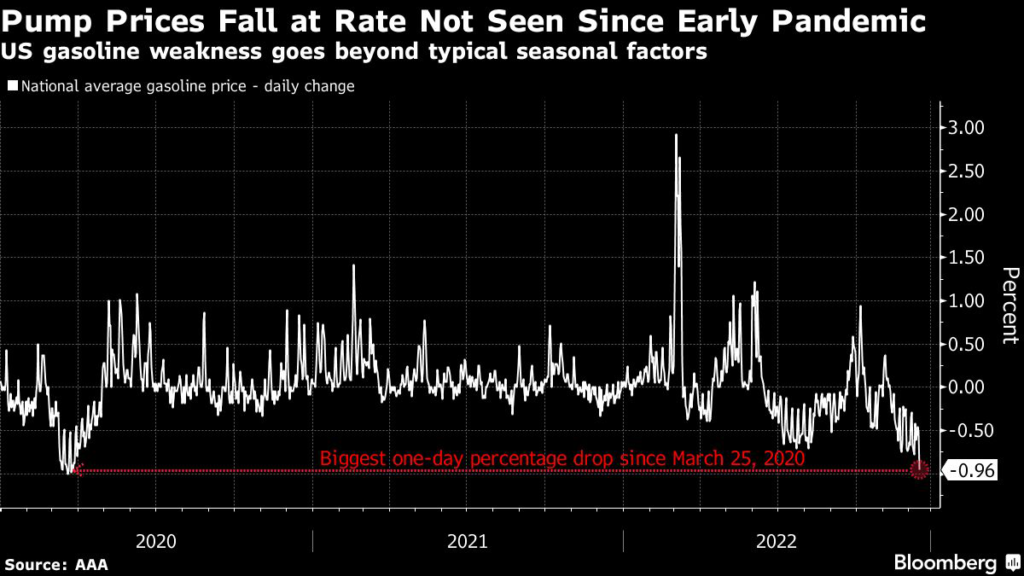
Pump Prices in US Have Biggest One-Day Drop Since March 2020

(Bloomberg) — Average pump prices in the US fell by nearly 1% overnight, the largest decline since late March 2020, shortly after the Covid-19 pandemic shut down offices and schools across the country, devastating fuel demand.

The national average of gasoline now stands at $3.214 a gallon, according to auto club AAA. That’s the cheapest price American motorists have paid in more than 14 months. 

Gasoline’s seasonal weakness this year is compounded by softer-than-usual demand, which fell to its lowest level for this time of year since 1998, excluding 2020, according to trailing 12-month data from the US Energy Information Administration. The drop in fuel use is driven by improving fuel efficiency in the long term and a winter storm sweeping the country in the short term.

Pressure is building on the supply side as well, with Europe poised to export an excess of the fuel to the US. As a result, stockpiles have grown for five straight weeks to levels exceeding those at the same time last year. US East Coast inventories are also building. 

(Updates with detail on East Coast inventories in last paragraph)

More stories like this are available on bloomberg.com

©2022 Bloomberg L.P.

Close Bitnami banner
Bitnami
