Bloomberg

Russians Arrested for Smuggling US Military Tech, PDVSA Oil

(Bloomberg) — Two Russian nationals were arrested and several other individuals charged with evading sanctions to smuggle US military technology, some of which was used in Ukraine, and Venezuelan oil.

Yury Orekhov, co-owner and chief executive officer of Hamburg-based Nord-Deutsche Industrieanlagenbau (NDA) GmbH, and Artem Uss, the other co-owner of NDA, were among five Russian nationals and two Venezuelan oil traders charged in an indictment unsealed Wednesday in federal court in Brooklyn, New York. The two were arrested in Germany and Italy on Monday.

“As alleged, the defendants were criminal enablers for oligarchs, orchestrating a complex scheme to unlawfully obtain US military technology and Venezuelan sanctioned oil through a myriad of transactions involving shell companies and cryptocurrency,” Brooklyn US Attorney Breon Peace said in a statement. “Their efforts undermined security, economic stability and rule of law around the world.”

According to the indictment, many of the illegal oil transactions were with a Russian aluminum company controlled by a billionaire oligarch for whom Orekhov previously worked as a procurement manager. A person familiar with the matter said the company was Rusal, now part of EN+ Group International, in which Oleg Deripaska is the largest shareholder. 

Rusal said it “does not buy Venezuelan oil or any other sanctioned products and has been operating in full compliance with international sanctions law.”

The US alleges Orekhov and Uss used NDA as a front to purchase sensitive military and dual-use technologies from US manufacturers, including advanced semiconductors and microprocessors used in fighter aircraft, missile systems, smart munitions, satellites and other military applications. According to the US, the items were then shipped to Russia, and some of the same technology was found in Russian weapons seized in Ukraine.

‘Disneyland’

Orekhov and Uss also allegedly used NDA to smuggle hundreds of millions of barrels of oil from Venezuela to Russian and Chinese purchasers, including Rusal and the world’s largest oil refining, gas and petrochemical conglomerate based in Beijing. The two Venezuelans charged in the case allegedly brokered deals for the oil between NDA and Petróleos de Venezuela SA, the state-owned oil company, using shell companies to disguise the transactions. 

Venezuelan oil was targeted for US sanctions in 2019, cutting it off from many American and European refineries. Venezuela responded by boosting sales to China, but the government of President Nicolas Maduro faced the challenge of avoiding possible US seizure during the 50-day tanker journeys to Asia. 

PDVSA has in some cases disguised the origin of its oil by faking ship documents and painting over the vessels’ names. According to the indictment unsealed on Wednesday, Orekhov was advised that tankers leaving Venezuela would turn off their GPS trackers in international waters to disguise the ship’s stop in the country they code-named “Disneyland.”

In a communication with one of the Venezuelan traders named in the indictment, Orekhov allegedly admitted that he was acting on behalf of a sanctioned Russian oligarch, saying “He is under sanctions as well. That’s why we [are] acting from this company [NDA GmbH]. As fronting.”

Deripaska, who was sanctioned in 2018 over Russian actions in Ukraine, was indicted by US prosecutors last month due to his attempts to have two of his children born in Los Angeles. The oligarch’s UK property manager was also charged last week with helping his boss violate US sanctions.

The case is US v. Orekhov, 22-cr-434, US District Court, Eastern District of New York (Brooklyn).

–With assistance from Lucia Kassai.

(Updates with response from Rusal in fifth paragraph. A previous version of this story corrected the spelling of a defendant’s name in the sixth paragraph.)

More stories like this are available on bloomberg.com

©2022 Bloomberg L.P.

Telecom Firms Told to Reverse Tariff Hikes in Nigeria

(Bloomberg) — Nigeria’s telecommunications regulator ordered mobile telecommunication companies to reverse a 10% tariff hike that was meant to cover rising costs. 

The Nigerian Communications Commission said in an emailed statement that its board didn’t approve the increase, which had been initially agreed with the companies. “As a result, it is reversed,” it said. 

Wireless service providers in the West African nation are facing increased operating costs, with inflation accelerating to a 17-year high of 20.8% in September. Cost pressure have been compounded by a weakening currency and more than a 200% jump in the price of diesel, which is required to power towers across the country due to the poor power supply. 

MTN Nigeria is the biggest wireless operator in Africa’s most populous nation, while Airtel Africa Plc, which listed in Lagos and London in 2019, vies with local operator Globacom Ltd. for the No. 2 slot. 

The regulator said that it had forced the reversal of a proposed 5% tax on telecommunication services earlier this year, “in order to maintain a conducive enabling environment for the telecom operators.” 

The government’s priority is “to protect the citizens,” and “anything that will bring more hardship at this critical time will not be accepted,” it said in its statement.  

Rising living costs are a key issue in the country as it gears up for national elections in February next year. The ruling party faces stiff competition from the main opposition Peoples Democratic Party and the Labour Party, whose candidate has emerged as the frontrunner in three seperate opinion polls. 

More stories like this are available on bloomberg.com

©2022 Bloomberg L.P.

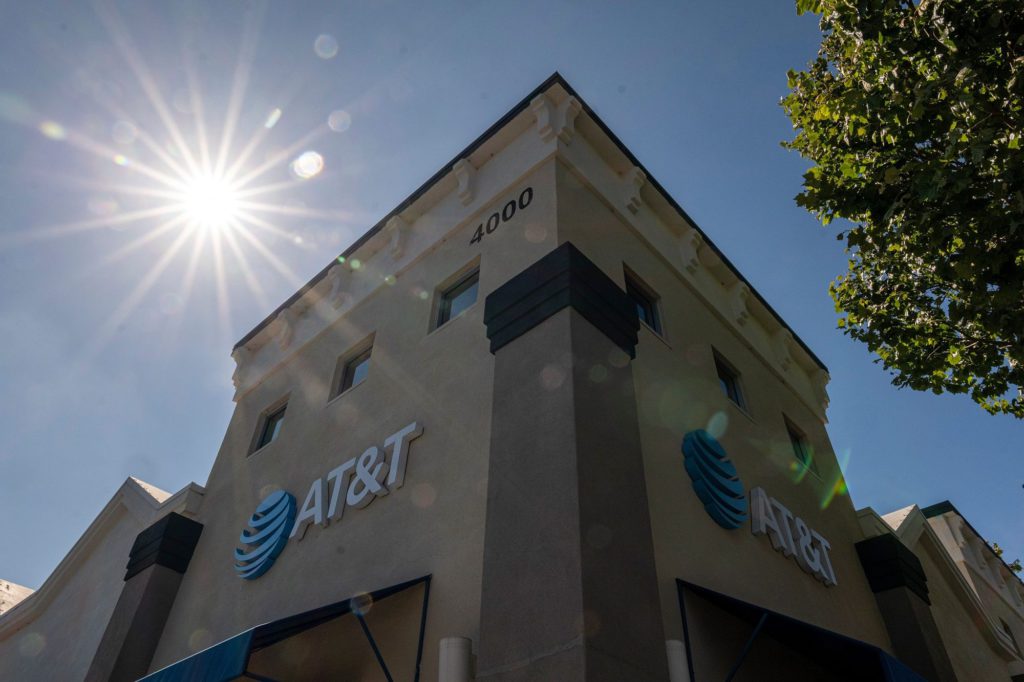
AT&T Rises Most in Two Years as Customer Growth Defies Inflation

(Bloomberg) — AT&T Inc. shares had their biggest gain since the early days of the pandemic after the company reported better-than-expected profit and customer growth.

Strong results from the telecommunications giant — the first wireless carrier to release earnings this quarter — suggest that the industry remains insulated from decades-high inflation and tighter consumer budgets.

AT&T shares rose as much as 10% in New York on Thursday, their biggest intraday gain since March 2020. 

The No. 3 US wireless carrier added 964,000 subscribers in the third quarter, topping analyst estimates of 913,000. That included 708,000 regular monthly phone customers, ahead of the 631,000 average projection.

“AT&T keeps accelerating its wireless growth,” said Walt Piecyk, an analyst with Lightshed Partners. “It will be interesting to see if its peers can match it.”

US wireless leader Verizon Communications Inc. reports earnings on Friday. T-Mobile US Inc. will release results Oct. 27.

AT&T’s earnings, excluding some items, were 68 cents a share, while analysts were looking for 60 cents. Revenue came in slightly ahead of estimates. AT&T raised its full-year earnings forecast to at least $2.50 a share, up from a range of $2.42 to $2.46.

While AT&T may have dodged most of the effects of inflation, concerns about its cash supply remain. The company’s $3.8 billion free cash flow in the third quarter came up short of the $4.28 billion average analyst projection, but AT&T still expects to reach its $14 billion target for the year.

Investors became concerned about the company’s ability to pay its $8 billion dividend and hold to debt-reduction promises earlier this year when it lowered its free cash flow forecast from $16 billion in part due to late customer payments.

Speaking an an earnings call with analysts, Chief Executive Officer John Stankey said customers have returned to prepandemic bill paying patterns. 

In consumer broadband, AT&T added 338,000 new fiber customers in the quarter, exceeding the 316,000 added in the prior quarter. However, the gains weren’t enough to offset the number of nonfiber broadband customers who canceled service. AT&T posted a net loss of 29,000 consumer broadband customers in the third quarter.

The company said it’s ahead of schedule on wireless upgrades in part due to “record levels” of spending on 5G and fiber-network build-outs in the first three quarters of the year. Looking ahead, AT&T expects spending to taper down by more than $2 billion in the fourth quarter.

AT&T sold its media business in order to focus entirely on 5G wireless and fiber broadband expansion. AT&T is exploring a JV to help build out fiber to new markets, as Bloomberg reported Wednesday. Stankey said on the earnings call that the company is evaluating ways to expand fiber networks outside its region.

(Updates shares in third paragraph, adds analyst in fifth.)

More stories like this are available on bloomberg.com

©2022 Bloomberg L.P.

Texas Sues Google, Claiming Its Search Engine Illegally Captures Biometric User Data

(Bloomberg) — Texas sued Google over claims that the search-engine giant is illegally capturing the biometric data of users without their consent, the latest in a series of lawsuits by the state against tech companies over online privacy.

Google, a unit of Alphabet Inc.,  has collected millions of biometric identifiers from Texas residents, including voice prints and records of face geometry through products like Google Photos and Google Assistant, Texas Attorney General Ken Paxton said Thursday in a statement. 

“Google’s indiscriminate collection of the personal information of Texans, including very sensitive information like biometric identifiers, will not be tolerated,” Paxton said. 

One technology targeted by the federal lawsuit is “photo grouping” utilized by Google Photos, in which the app analyzes facial features of people captured in images uploaded to the website and then proceeds to group those files based on the people captured in the images. This allows users to sort and find photos of a specific individual from a large library of images.

The lawsuit argues that the process allows Google to capture and store biometric information of any individual featured in images uploaded to the platform, including both users and non-users who had no opportunity to consent to the capture of this data.

Texas is one of a handful of states with a biometric privacy law prohibiting the capture of biometric identifiers for commercial purposes without an individual’s consent. Violators can face up to $25,000 in penalties for each violation.

In addition to relevant civil penalties, Paxton is seeking a temporary injunction to bar Google from continuing the data collection in question.

More stories like this are available on bloomberg.com

©2022 Bloomberg L.P.

Megacap Tech Rally Drives Rebound in US Stocks: Markets Wrap

(Bloomberg) — A rally in some of the world’s largest technology companies pushed US stocks decidedly higher, with the earnings season rolling in. The pound held gains after Liz Truss resigned as UK prime minister.

Apple Inc., Microsoft Corp. and Amazon.com Inc. contributed the most to the advance in the S&P 500, overshadowing a rout in Tesla Inc. that followed disappointing sales. International Business Machines Corp. surged on a bullish revenue forecast. AT&T Inc. beat estimates for wireless subscriber growth, suggesting mobile-service providers remain insulated from tighter consumer budgets.

“Company earnings seem to be going fairly well,” said Chris Gaffney, president of world markets at TIAA Bank. “And we’re seeing some warnings of what comes in the future, but right now the earnings are holding up. As long as companies can make money, maybe the higher interest rates don’t impact the markets as much as they could.”

To be sure, several market observers remarked that the bar has been lowered quite a bit ahead of the current earnings season, boosting the odds of upside surprises. It’s also worth pointing out that there’s been no shortage of warning signals about the economy when it comes to corporate outlooks.

Alcoa Corp. — which is a dependable barometer of US economic health across industries including construction, automotive, aerospace and consumer packaging — said demand for the world’s heavy industries is falling. Union Pacific Corp. — the largest US freight railroad — cut its forecast for volume growth to reflect a “challenging year.”

As traders wade through corporate results, “with an extra eye on guidance, expect volatility to remain elevated,” said Mike Loewengart at Morgan Stanley Global Investment Office.

Investors also kept an eye on economic data, with existing-home sales posting their longest stretch of monthly declines since 2007 and jobless claims dropping to a three-week low.

A month of economic chaos will be a warning to any future British leaders about the risk of being reckless with the country’s finances, said UK traders after Truss stepped down. In interviews Thursday, many investors predicted the next prime minister will restore calm and make policy decisions that bring stability back to markets. Some traders said markets will be volatile until a replacement is named, and any new leader will struggle to fix the UK’s weak economy and double-digit inflation. 

The pound strengthened to above $1.13, and the yield on UK 10-year gilts was near levels before the mini-budget was announced last month. The FTSE 250 Index rallied as much as 1.2%. 

Key events this week:

  • Euro area consumer confidence, Friday

Some of the main moves in markets:

Stocks

  • The S&P 500 rose 0.7% as of 11:21 a.m. New York time
  • The Nasdaq 100 rose 1.2%
  • The Dow Jones Industrial Average rose 0.9%
  • The Stoxx Europe 600 rose 0.3%
  • The MSCI World index rose 0.6%

Currencies

  • The Bloomberg Dollar Spot Index fell 0.4%
  • The euro rose 0.5% to $0.9826
  • The British pound rose 0.7% to $1.1297
  • The Japanese yen rose 0.1% to 149.74 per dollar

Cryptocurrencies

  • Bitcoin rose 0.5% to $19,288.44
  • Ether rose 0.8% to $1,304.4

Bonds

  • The yield on 10-year Treasuries advanced two basis points to 4.15%
  • Germany’s 10-year yield advanced two basis points to 2.40%
  • Britain’s 10-year yield declined one basis point to 3.87%

Commodities

  • West Texas Intermediate crude rose 2% to $87.25 a barrel
  • Gold futures rose 0.8% to $1,647.30 an ounce

–With assistance from Vildana Hajric and Peyton Forte.

More stories like this are available on bloomberg.com

©2022 Bloomberg L.P.

Google Hit With $162 Million India Fine Over Android Dominance

(Bloomberg) — India’s antitrust regulator has fined Alphabet Inc.’s Google 13.4 billion rupees ($162 million) for accelerating the dominant position of its Android smartphone operating system. 

The Competition Commission of India said Google had strengthened its market position by making the installation of its own apps compulsory on new smartphones, among other moves the regulator deemed anti-competitive.

“Google, by making pre-installation of Google’s proprietary apps (particularly Google Play Store)… for all Android devices manufactured, distributed [and] marketed by device manufacturers, has reduced the ability and incentive of device manufacturers to develop and sell devices operating on alternative versions of Android,” the CCI said in a statement on Thursday.

Google didn’t immediately respond to an email seeking comment.

Google has also furthered its dominant position in online search, making it harder for rival search apps to break into the market, the CCI said, adding that it was issuing a cease and desist order against Google from behaving unfairly.

The CCI’s findings and suggested remedial measures will probably dampen Google’s growth in the world’s second-biggest smartphone market, where Android is the dominant mobile operating system.

The regulator directed Google to change several of its current practices on Android including allowing smartphone users to uninstall apps as well as letting them select a search engine of their choice.

More stories like this are available on bloomberg.com

©2022 Bloomberg L.P.

Ukraine Latest: Kyiv Sees Growing Offensive Threat From North

(Bloomberg) — Ukrainians were warned of rolling blackouts because of damage to the country’s power infrastructure from Russian missile attacks this month, and President Volodymyr Zelenskiy urged people to use as little electricity as possible. Camping stoves, generators and winter underwear are in high demand. 

The UK defense secretary said a Russian warplane in late September fired a missile “in the vicinity of” an unarmed RAF jet flying in international airspace over the Black Sea. 

Weeks after Russia and Belarus announced the formation of a new joint force, and days after the force started to assemble in Belarus, Ukraine’s army sees rising military threats from the north. 

(See RSAN on the Bloomberg Terminal for the Russian Sanctions Dashboard.) 

Key Developments

  • Putin’s Belarusian Ally Lets Him Build Up Forces Near Ukraine Again 
  • US Calls for Security Council Briefing on Russia, Iranian Drones
  • Ukraine Faces Rolling Blackouts After Attacks on Power Stations
  • Ukraine’s New Central Banker Focuses on IMF Aid: Decision Guide
  • Italy’s Rising Coalition Dealt Blow After Berlusconi Lauds Putin

On the Ground

Russia hit Mykolaiv and the surrounding region with C-300 missiles on Thursday morning, Kyrylo Tymoshenko, deputy head of the president’s office, said on Telegram. Ukrainian forces repelled Russian assaults near nine settlements in the Donetsk and Luhansk regions, including Bakhmut, Ukraine’s General Staff said. Russia hit an industrial facility and energy infrastructure in the Kryvyi Rih district of the Dnipropetrovsk region overnight, inflicting serious damage, local authorities said on Telegram. 

(All times CET)

Ukraine Sees Growing Threat of Russian Offensive From North (4:15 p.m.)

Ukraine’s armed forces see a rising threat of a fresh new military offensive from the north, where Russian and Belarusian troops have assembled a “joint force,” pokesman Oleksiy Hromov said Thursday at a video briefing. 

Putin’s Ally Lets Him Build Up Forces Near Ukraine Again 

Increasingly bellicose rhetoric from Russian and Belarusian leadership has accompanied the deployment of forces in Belarus, which started last weekend, he said. 

The offensive may be repositioned to the northwest part of the Belarus-Ukraine border — that is, closer to Poland — in a bid to cut the main logistical arteries supplying weapons to Ukraine from allies, Hromov said. 

Read more: Ukraine Army Sees Growing Threat of Russian Offensive From North

Turkey Wants Another Russian-Built Atomic Plant (4:08 p.m.)

Turkey asked Russia to build its second nuclear power plant, in the latest sign of closer economic ties even as the US and its allies try to isolate the Kremlin for its invasion of Ukraine. 

Turkey’s President Recep Tayyip Erdogan made the request in talks last week in Kazakhstan with Russian counterpart Vladimir Putin, their fourth meeting in as many months, according to people familiar with the situation. 

Read more: Turkey Asks Russia to Build Another Nuclear Plant, Defying US

Russia Will be Snubbed at Atomic-Energy Summit in Washington (3:45 p.m.) 

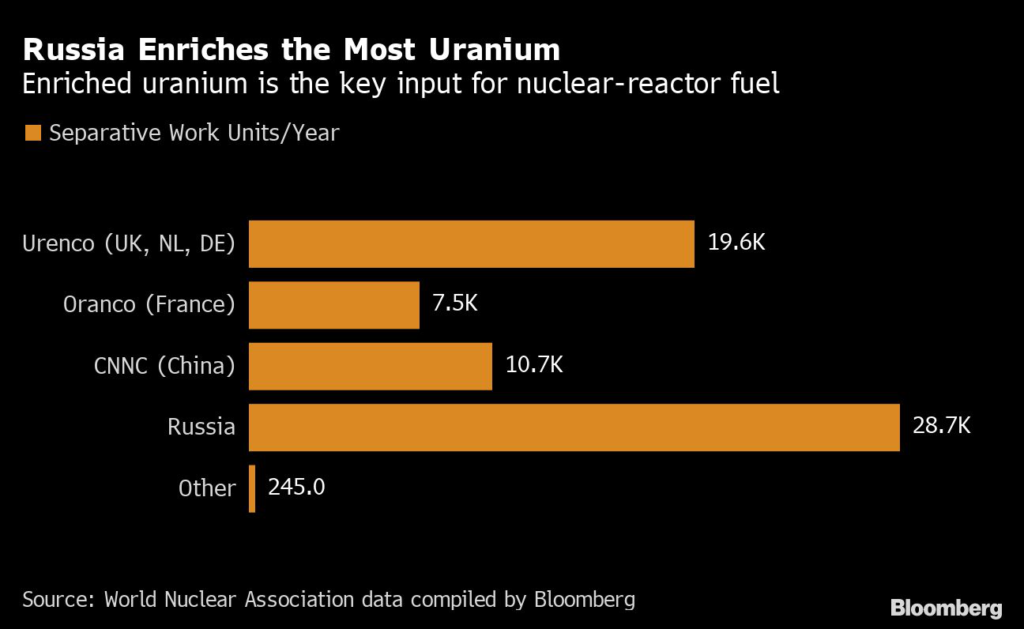
Russia will lose its pace on stage at a key  atomic summit in Washington next week, as US authorities seek ways to limit the influence of Kremlin-controlled nuclear fuel and technology suppliers on the global market.

The International Atomic Energy Agency confirmed that executives from Rosatom Corp. and Russia’s industry regulator were dropped from the agenda. White House officials have been considering for months ways to reduce the Kremlin’s influence on global nuclear markets. 

Read more: Russia Removed From Nuclear-Energy Stage at Washington Summit 

Ukrainians Stock Up on Power Banks, Generators (3:48 p.m.)

Demand for power banks, generators and candles jumped in the week since Kremlin forces launched widespread attacks on power infrastructure, said Prom.ua, one of Ukraine’s biggest online sellers. 

“The demand for electric generators rose fivefold, and the average check grew to 20,000 hryvnia ($541),” the retailer said in an emailed comment. 

Gas cylinders, headlamps and camping stoves are also in demand, along with thermal underwear. In September, radiation meters and preventative medicine were the most-coveted items, Prom.ua said.

Push For New EU Sanctions on Russia (2:41 p.m.) 

Estonia, Lithuania, Latvia and Poland proposed broadening EU sanctions on Russia by adding a ban on cooperating with Russia on nuclear energy, according to a document seen by Bloomberg News. The nations also want to ban the sale of real estate to Russian citizens and companies and limit the concessions that Belgium previously won on the import of steel products from Russia.

The ninth sanctions package should broaden the ban on information and communication technology services to include computer software and extend the scope of a ban on business services to cover marketing and opinion poll services, according to the document. 

“Schemes involving marketing and leasing services are regularly used in Russia as a cover-up to facilitate flows of a large scale providing funds for military sector,” the countries said.

Ukraine Expects Electrical Equipment Next Week (2:10 p.m.)

Generators, components and spare parts needed to replace equipment damaged by recent Russian strikes are expected to start arriving in Ukraine next week from Italy, France, Lithuania, Finland, Germany and Poland, Ukraine’s foreign minister said. 

“The equipment will help to ensure uninterrupted functioning of Ukrainian households, hospitals and schools,” Dmytro Kuleba said in a statement.

Separately, on Twitter, Kuleba welcomed the EU’s moves against Iran for its provision of drones used by Russia in recent attacks on energy infrastructure and other targets. 

Ukraine Sanctions Thousands of Russian Citizens, Companies (2 p.m.) 

Ukraine sanctioned 1,374 Russian companies and companies affiliated with Russia, and 2,507 individuals, mainly Russian citizens, in decrees signed on Wednesday. 

Billionaire Roman Abramovich was sanctioned, with the proviso that the measures only take effect after an exchange of prisoners and bodies of deceased soldiers between Ukraine and Russia is complete. 

Among others, Ukraine sanctioned billionaire Mikhail Fridman; Petr Aven; Eugene Kaspersky, CEO of the cybersecurity firm Kaspersky Lab, and the daughter of President Vladimir Putin, Ekaterina Tikhonova.  

UK Says Russia Fired Missile Near RAF Jet in September (1:34 p.m.) 

A Russian aircraft released a missile on Sept. 29 near an unarmed British plane patrolling in international airspace over the Black Sea, UK Defense Secretary Ben Wallace told parliament during an update on the situation in Ukraine. 

The UK temporarily suspended patrols after the “potentially dangerous” incident and raised its concerns with Russian Defence Minister Sergei Shoigu. Russia, in an Oct. 10 response, blamed a “technical malfunction” by its fighter jet, Wallace said. After consulting with allies, “I have restarted routine patrols but this time escorted by fighter aircraft,” he added. 

Russia’s defense ministry doesn’t immediately respond to requests from Bloomberg News for comment. 

Ukraine Keeps Key Rate Steady (1:04 p.m.)

Ukraine’s central bank, as expected, kept its benchmark borrowing rate unchanged at 25% as the body’s new governor presses ahead with negotiations with the IMF on a financial lifeline for the war-battered economy. 

“Continued cooperation with international partners remains an important factor in maintaining the Ukrainian economy during the full-scale war and post-war recovery,” the Kyiv-based bank said in a statement. 

Russia Controls Only 1.8% of Kharkiv Region, Official Says (12:58 p.m.)

Russia retains control over 1.8% of the area around Kharkiv in the east of Ukraine, Kharkiv Governor Oleh Syniehubov said on Telegram. 

“Since September, our military has expelled the occupiers from 544 settlements in the region. Only 1.8% of the region’s territory remains under temporary occupation — that’s 32 settlements,” Syniehubov told. 

Ukraine’s armed forces and local authorities have formed three lines of defence in liberated areas, he said. Kremlin troops continue “limited assaults” in a bit to recapture lost territory, according to the Institute for Study of War. 

Germany Probing Fire at Refugee Shelter (11:45 a.m.)

German authorities are investigating a suspected arson attack which local media said almost completely destroyed a property in the east of the country housing Ukrainian refugees.

Interior Minister Nancy Faeser said in a tweet that if arson is confirmed the perpetrators would “be prosecuted with the utmost severity” and thanked emergency services for rescuing all of the residents from the building. 

“People who found shelter with us from Putin’s war had to be rescued from the flames,” Faeser wrote. “It is very fortunate that everyone was unharmed.”

Italy’s Rising Coalition Dealt Blow After Berlusconi Lauds Putin (11:30 a.m.)

Giorgia Meloni, the right-wing leader poised to form a new Italian government, said she’d give up on the fledgling coalition if her allies can’t commit to supporting Ukraine along with Italy’s European Union and NATO partners. 

Meloni commented after audio surfaced of coalition partner Silvio Berlusconi saying he rekindled his friendship with Russian President Vladimir Putin and laying the blame of Russia’s invasion of Ukraine on President Volodymyr Zelenskiy. 

EU Adopts Sanctions Against Iran for Drone Sales to Russia (11:23 a.m.)

Bloomberg reported the measures targeting three Iranian generals and Shahed Aviation Industries, a company responsible for the design and development of the Shahed series of Iranian drones that have been supplied to Russia and are currently being used in Ukraine. Iran denies sending weapons to Russia.

EU States Split on Forming War Crimes Tribunal for Ukraine (10:33 a.m.)

Some EU member states are wary about setting up a war crimes tribunal for atrocities committed in Ukraine, following what some said were mixed experiences of the court set to deal with such crimes committed during the 1990s in the former Yugoslavia, according to a person familiar with the issue.

An early version of the EU summit conclusions contained a reference suggesting a special tribunal to investigate crimes of aggression be formed, but the reference to the “special tribunal” was removed in a subsequent draft after opposition from a few countries. Some nations are not pushing to have it restored.

NATO Chief Calls on Iran to Not Back Russia Against Ukraine (10:21 a.m.)

While NATO Secretary General Jens Stoltenberg said “every indication points to Iran supplying Russia with drones,” he declined to confirm reports the country is also sending missiles to Russia, saying he wouldn’t go into specific intelligence.

Sweden to Work With Turkey on Support for NATO Bid (10:15 a.m.)

Sweden’s new cabinet will “redouble efforts” to work with Turkey to allay its concerns so that it’s able to ratify the Nordic country’s accession to NATO, Prime Minister Ulf Kristersson told reporters in Brussels. He added that he’s prepared to visit Ankara as soon as possible, with preparations for the trip already being made.

EU Leaders to Discuss Ukraine’s Emergency Needs (9:41 a.m.)

European Union leaders meeting in Brussels will discuss how to help Ukraine’s emergency energy needs following Russia’s attacks on critical infrastructure this month, according to people familiar with the matter.

The issue was a late addition to the agenda for the summit starting Thursday, the people said. Kyiv has provided a list of its most urgent needs, covering dozens of items such as circuit breakers, disconnecters, transformers and relay protection automation devices. 

Other requirements include surge arresters, aerials, power cables, vehicles, as well as several types of switches and high-voltage inputs, according to a document seen by Bloomberg.

Grid Operator Warns of Possible Blackouts Across Ukraine (7:57 a.m.)

Ukrenergo, the state-run energy company, warned about possible blackouts all over Ukraine and urged citizens to reduce electricity consumption on Thursday. 

“Russian constant missile attacks destroy our energy infrastructure, and energy workers need time to restore it,” the company said on Telegram. “We need to be very conscious and frugal with our electricity consumption in order to get through the coming winter as well as possible.”

US Hands Out Charges in Plot to Buy Chips for Russia (2:05 a.m.)

The US Justice Department accused seven people of evading US sanctions as part of a purported plot to sell Venezuelan oil to Russia and China and use the proceeds to buy black market chips for Russia to install in high-tech weapons on the battlefields in Ukraine.

The five Russians and two Venezuelans, “knowingly sought to conceal the theft of US military technology and profit off black market oil,” FBI Assistant Director in Charge Michael Driscoll said in announcing the charges in New York. “This network schemed to procure sophisticated technology in direct support of a floundering Russian Federation military industrial complex.”

Zelenskiy Urges Citizens to Conserve Power (1:40 a.m.)

Zelenskiy urged Ukrainians to use as little electricity as possible on Thursday after electrical grid operator Ukrenergo warned of rolling blackouts because of damage to power infrastructure from Russian missile attacks.

“It is very important energy is consumed with awareness tomorrow,” Zelenskiy said in his nightly address. “We are preparing for all possible scenarios in the light of approaching winter season. We proceed from the fact that Russian terror will be directed at energy facilities until, with the help of our partners, we can shoot down 100% of enemy’s missiles and drones.”

All regions in Ukraine may face four-hour cutoffs between 7 a.m. and 10 p.m., a necessary step because of a shortage of power generation, Ukrenergo said.

More stories like this are available on bloomberg.com

©2022 Bloomberg L.P.

Vanguard Is Preparing Its Debt Funds for a Recession in 2023

(Bloomberg) — Vanguard Group Inc. is preparing its debt funds for a recession, using selloffs in the world’s beleaguered credit markets to buy higher-quality assets at a discount.

“Ironically, the worse returns get, the better bonds should look in the future,” the asset manager’s fixed-income head, Sara Devereux, and others wrote in a report. “The risk-reward profiles of various market sectors — including Treasuries, corporates, emerging markets, and long-term municipals — are more attractive than they were six months ago.”

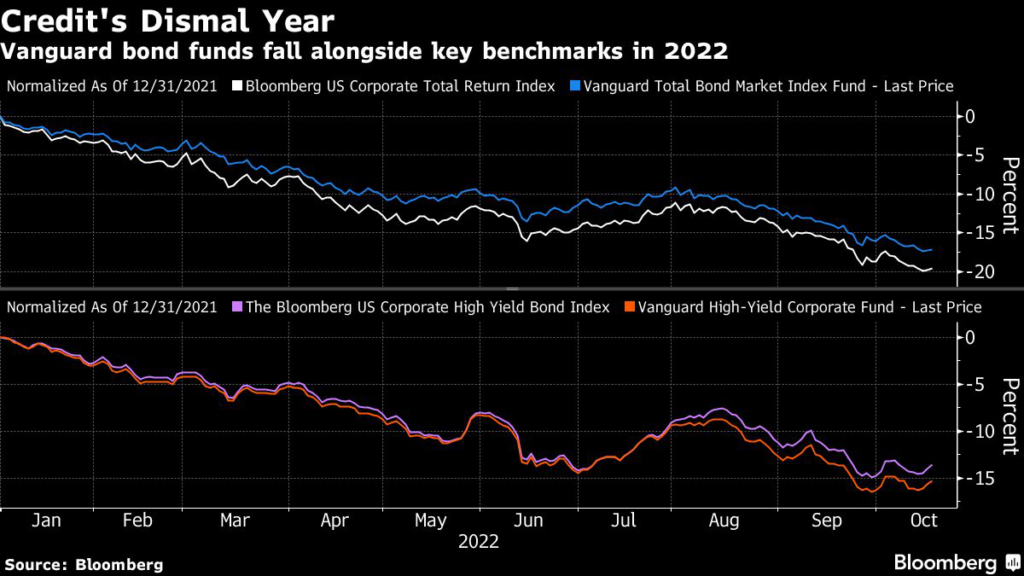
It’s a stance that reflects growing risk of a recession as the Federal Reserve fights the hottest inflation in 40 years with aggressive policy tightening. Risk-averse investors have sent US investment-grade bonds down about 20% this year, while high-yield debt has fallen, on average, roughly 14%.

But for Vanguard, which managed $6.7 trillion as of Sept. 30, a likely recession in 2023 means there’s opportunity to hunt for debt from defensive corporate issuers that can withstand an economic downturn. Securities rated BB, the highest tier of junk, are especially attractive, they wrote.

The group also likes sovereign debt from better-quality emerging markets, they wrote. Vanguard is also buying higher-quality municipal bonds at “attractive levels,” adding to sectors such as water and sewer, toll roads, and better-scored state, city and local general obligation debt.

Of course, investors wading into the weakest end of the credit spectrum will have to do so cautiously. A chorus has emerged on Wall Street warning of an uptick in defaults in the year ahead. Fitch Ratings this week forecast a high-yield default rate as high as 3.5% by end-2023, with delinquencies likely concentrated in consumer-focused industries such as retail, telecommunications and media.

Even Vanguard said it was underweight in the B rated portion of corporate debt and urged caution on CCC scored issues. The extra yield investors demand to hold risky CCC debt over US Treasuries, on average, has risen to 11.15 percentage points, well above the 10 percentage points threshold typically associated with distress. That’s just off the highest risk premium since mid-2020, according to data compiled from a Bloomberg index. 

Still, “higher yields mean bonds look better going forward,” Devereux’s team wrote. “For investors who have added new, more esoteric positions in search of yield or uncorrelated assets such as private credit, it seems a good time to reconsider old-fashioned long-term asset allocation.”

(Updates with low-grade spreads, chart in penultimate paragraph.)

More stories like this are available on bloomberg.com

©2022 Bloomberg L.P.
Tesla’s Model Y Passes Perennial Top-Sellers in Global Rankings

(Bloomberg) — Tesla just followed up a vehicle deliveries report that fell short of expectations with quarterly revenue that also was a bit lower than hoped, disappointing investors looking for a more clear-cut kibosh on debate over whether it’s starting to have demand issues.

Elon Musk has a broad target to grow sales around 50% annually. While the company now expects to fall just short of that mark this year, one of its models is climbing toward the top of global sales rankings.

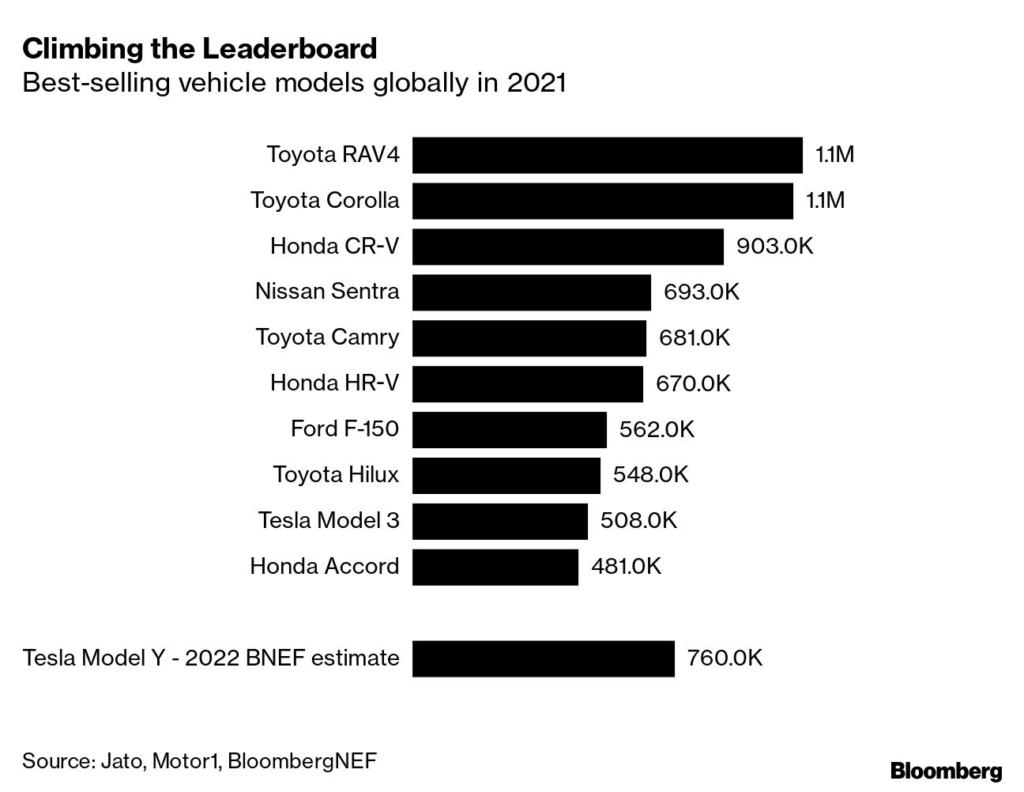
Tesla doesn’t disclose the split in sales between its Model 3 sedan and Model Y sport utility vehicle, but given the latter’s performance, maybe it should. BloombergNEF estimates that the company sold around 200,000 Model Ys in the third quarter, bringing the total so far this year to more than 500,000. That means the SUV is broadly on pace to hit our estimate, published at the beginning of the year, of almost 800,000 — enough to comfortably place among the top five best-selling vehicles in the world.

The Model Y is passing some household names along the way. Ford, for example, sold around 562,000 F-150 pickups last year. It looks like Tesla’s SUV probably overtook the truck in the third quarter and should come out ahead for the full year. While Ford has recently upped its EV game, this change in hierarchy has to be a bit jarring for its executives, one of which publicly mocked Musk in 2018 by noting his company was making roughly the same number of cars in four hours that Tesla was in a week.

To be fair, F-150 volumes are largely limited to North America, while the Model Y is sold globally. Looking at North America alone, the F-150 still dominates the sales charts and probably will for a long time.

Farther up the leaderboard, it’s the Japanese that rule the roost. Honda’s HR-V, Toyota’s Camry and Nissan’s Sentra each exceeded 670,000 units last year. It will be a few months before it’s clear whether Model Y overtakes these three, but Tesla stands a good chance.

The top three in the world last year went to Honda’s CR-V and Toyota’s Corolla and RAV4. Topping those is almost certainly a bridge too far for the Model Y this year. With Tesla’s factories in Austin, Texas, and outside Berlin continuing to ramp up into 2023, Musk may be able to lay claim to the best-selling vehicle in the world, as he predicted last year.

The Corolla has been a perennial top-seller for many years and regularly clocks in above 1 million units. Passing it won’t be easy, especially since the car sells at a much different price point, beginning at around $20,000. That’s less than a third of the current cost of the Model Y, which starts at more than $60,000 in the US. It’s not clear if the global auto market can support 1 million sales of a single model at that high a price point on an ongoing basis.

Macroeconomic conditions are also quickly deteriorating, with higher interest rates, falling home prices and stock market turmoil all likely to take a toll on big-ticket purchases. Sales of high-end EV models grew briskly through the pandemic partly because white collar workers kept their jobs, reduced their spending and saw their home values and stock portfolios soar as governments and central banks stepped in with stimulus. The environment is quite different now, and it remains to be seen how the premium segment of the auto market holds up. BMW recently suggested that cracks are starting to appear.

Still, it’s hard to overstate how big a deal it is for an EV model to be this high in the global sales rankings. It increasingly feels like a question of when one rises to the top, not if this will happen.

(Updated to embed Musk tweet after the eighth paragraph.)

More stories like this are available on bloomberg.com

©2022 Bloomberg L.P.

Crypto Assets to Be Treated as Financial Products in South Africa

(Bloomberg) — Cryptocurrency exchanges operating in South Africa will be subject to supervision for the first time, after the authorities unveiled new rules to increase its oversight of the industry and safeguard consumers.

The Financial Sector Conduct Authority declared crypto assets as financial products in a notice published Wednesday and said it would require companies that trade in cryptocurrencies and other digital assets to obtain a license from June 1. The FSCA announcement is the first step needed to bring the industry within the South African legal framework, said Brent Peterson, head of legal at Easy Crypto Ltd., a crypto exchange.

“The new regulation is really to protect the man in street,” FSCA Commissioner Unathi Kamlana said Thursday in an interview. “It provides some consumer protection — previously we were not able to do this, because crypto was trading completely outside our parameters.”

The measures come as governments around the world push to regulate cryptocurrencies to protect users from turbulent digital coins and fraudsters. US regulators and lawmakers are studying ways to guide the operation of stablecoins.

The introduction of regulations follows two major crypto scams that originated in South Africa, both of which led to the disappearance of billions of dollars in investments. Digital currencies have moved from the periphery of the finance world to the mainstream over the past few years, leading to deeper scrutiny worldwide to prevent providers operating unfettered.

Licensing Period

The new rules will enable clients to complain about crypto exchanges that don’t comply with existing laws in South Africa, and give the regulator the mandate to act on non-compliance. They’ll also allow the FSCA to request information from the crypto companies to enable it better to understand their business models and practices.

Registration of crypto platforms will take between June 1 and Nov. 30, 2023, with the currently unregistered companies allowed to continue trading until then, it said.

“All companies operating in the crypto space can continue doing so, but need to do their checks and be compliant,” Kamlana said.

Most of South Africa’s lenders don’t provide banking services to crypto platforms, citing the high risks associated with cryptocurrencies.

“We don’t do crypto trading, but as I said, we’d love to,” Coen Jonker, chief executive officer of banking startup Tymebank, said in an interview. “We will probably move as soon as we think there’s enough clarity. The sooner we get the guidelines and the regulations out, the better for everyone, because up until that point, what you’re going to have is millions of South Africans who participate in these assets in a completely unregulated manner.”

More stories like this are available on bloomberg.com

©2022 Bloomberg L.P.
Close Bitnami banner
Bitnami