Bloomberg

Twitter Updates Private Information-Sharing Policy After Accounts Suspended

(Bloomberg) — Twitter Safety announced an update to its Private Information Policy, just hours after the social media outlet suspended multiple accounts that track private jets. The company says it will remove any tweets or accounts that share someone’s live location going forward, pointing to “increased risk of physical harm” when such information is shared. 

The new policy also says that any content that shares the “location information related to a public engagement or event” will not be impacted by the changes. First time offenders will be temporarily locked out of their account and another offense will cause a user’s account to be permanently suspended, the platform says. Any accounts dedicated to sharing a person’s live location will be permanently suspended. 

More stories like this are available on bloomberg.com

©2022 Bloomberg L.P.

FTX Fiasco Fails to Mute Congress’s Biggest Crypto Enthusiasts

(Bloomberg) — The implosion of Sam Bankman-Fried’s FTX empire hasn’t dimmed the enthusiasm for digital currency among crypto fans in the US Capitol.

With skepticism about cryptocurrency growing among members of Congress, a handful of lawmakers, including Republican Senators Cynthia Lummis of Wyoming and Pat Toomey of Pennsylvania, are trying to convince colleagues that the FTX fiasco doesn’t diminish the underlying value of digital currency.

“There are two conversations going on. One is FTX, and the other is digital assets,” Lummis said on Bloomberg Television’s “Balance of Power with David Westin. “We’re conflating the two in some of these discussions.”

Still, FTX has wedged open a split between some Republicans and Democrats. Since last month’s collapse of FTX and other turmoil in the crypto market Democrats are more likely to say that the fraud charges against Bankman-Fried demonstrate a pattern of unsavory behavior in the industry, while many Republicans see FTX as an outlier.

At a Tuesday House hearing on FTX, Representative Brad Sherman, a California Democrat, who has long wanted to ban cryptocurrencies, said his fear is that people will look at Bankman-Fried as one snake in a Garden of Eden, but that, in reality, “crypto is a garden of snakes.”

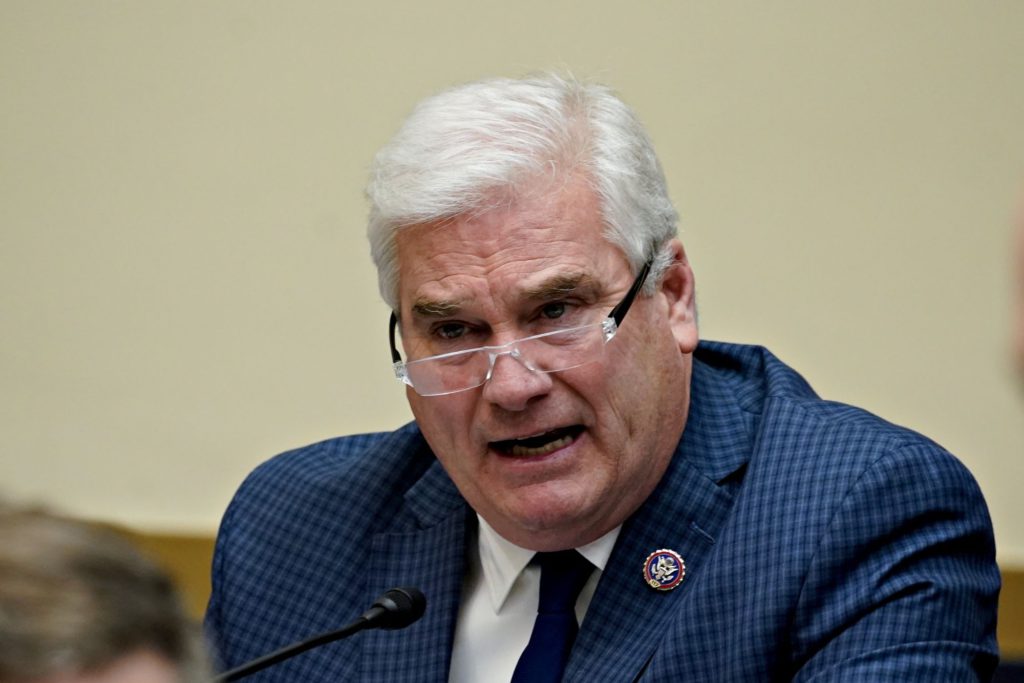
Representative Tom Emmer of Minnesota, the incoming GOP whip and co-chair of the Blockchain Caucus, said during the same hearing that FTX represented a business failure and a crime, “not a failure of technology.”

“For the most engaged members of Congress on crypto policy, the FTX collapse remind us of why we care so deeply about this technology — decentralization is the point,” Emmer said.

Another House Republican, Patrick McHenry, who is poised to lead the Financial Services Committee next year, said he’s “a believer in digital assets and the potential it has as a foundation stone of the next internet.”

Toomey, the top Republican on the Senate Banking Committee, held as much as $45,000 in digital assets as of last year, according to the most recent financial disclosures on record. He said he continues to see plenty of value in digital currencies, adding that they should be regulated, starting with stablecoins, which are backed by underlying assets like dollars. 

Echoing Lummis, Toomey, who is retiring at the end of this term, said at a Banking Committee hearing on Wednesday that “FTX and cryptocurrencies are not the same thing. FTX was opaque, centralized and dishonest. Cryptocurrencies usually are open-source, decentralized and transparent.”

Lummis has proposed legislation with Senator Kirsten Gillibrand, a New York Democrat, to create a regulatory framework for crypto, one of several that have been proposed.

Lummis argues most digital currencies should be regulated by the Securities and Exchange Commission but Bitcoin should be regulated by the Commodity Futures Trading Commission as a commodity.

“The case for Bitcoin as a store of value is solid,” she said, pointing out that it is limited in number, is fully decentralized and isn’t controlled by anyone.  “It has the characteristics of a commodity.”

Lummis’s disclosure showed holdings of $100,001 to $250,000 in Bitcoin as of last year, though she said Wednesday her assets are in a blind trust, “so I don’t know whether I have Bitcoin” currently. Crypto valuations have also decreased substantially over the course of this year.

Lummis said she’s bullish on getting legislation passed next year, with the new House Republican majority and Gillibrand working with the Biden administration, with the goal of forging a bipartisan and “asset neutral” bill.

“We’re going to make a full court press,” she said.

Republican Senator Thom Tillis of North Carolina, another member of the Banking Committee, also sees the potential for bipartisan legislation next year on regulating crypto and non-bank fintechs.

“It may very well be if we research it that it may need to be banned, but I’m not there yet,” he said, adding that he said he wouldn’t invest in crypto himself yet. “It’s not proven.”

–With assistance from Jarrell Dillard, Allyson Versprille and Madison Mills.

More stories like this are available on bloomberg.com

©2022 Bloomberg L.P.

Wall Street Stock Trading Set for Overhaul in New SEC Plan

(Bloomberg) — US regulators took the first step toward the most widespread revamp in more than a decade of the way stocks are traded, a move that aims to spur better prices for investors and direct more business to traditional exchanges.  

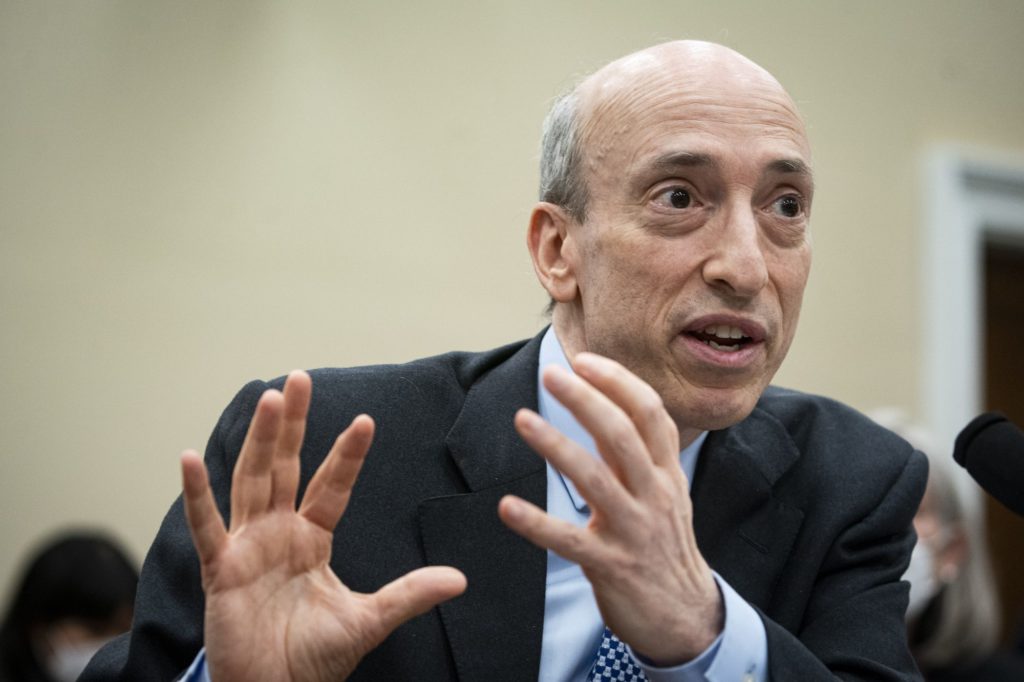
The Securities and Exchange Commission laid out four proposals on Wednesday that Chair Gary Gensler says would boost transparency and competition. They delve into the guts of how the $43 trillion market works, and affect everything from order routing to pricing and disclosures that brokers must make to clients.

The SEC’s plans, which a majority of the agency’s five commissioners voted to propose on Wednesday, represent a direct response to many of the issues that were spotlighted by last year’s meme-stock-trading craze. Over the past year, the contours of the effort have been a source of significant angst for the industry as Gensler signaled that major overhauls loomed. 

On Wednesday, the SEC chief doubled down. “Today’s markets are not as fair and competitive as possible for individual investors — everyday retail investors,” Gensler said. The plans could be adopted separately, but taken together, the changes would be the biggest since 2005. 

Broadly, the plans could lead to more stock orders filled on exchanges like Nasdaq and the New York Stock Exchange. Currently, a significant chunk of retail trades are handled by wholesale brokerages like Virtu Financial Inc. and Citadel Securities, which pay to process customer trades from firms such as Robinhood Markets Inc.

Virtu shares fell as much as 7.5% in New York trading, the biggest intraday decline since April, while Robinhood dropped as much as 4.4% before rebounding.

A representative for Virtu declined to comment. David Millar, a spokesman for Citadel Securities, said that “any proposed changes must provide demonstrable solutions to real problems while avoiding unintended consequences that will hurt American investors.”

Michael Blaugrund, chief operating officer at NYSE, said in a statement that the “proposals aim to level the playing field between on- and off-exchange trading.” Nasdaq didn’t immediately respond to a request for comment.

Lucas Moskowitz, Robinhood’s deputy general counsel, said some of the plans “stand to resurrect discriminatory barriers to entry and hurt millions of retail investors.” He said the firm would engage with the SEC on its proposal, but that the amount of time the agency is allowing for feedback is “insufficient for the public to meaningfully comment on a package of this size and complexity.”

Gensler has frequently criticized the arrangement, which is commonly known as payment for order flow, as creating conflicts of interest for brokers. He floated banning the practice. 

Meanwhile, wholesale brokerages like Virtu and Citadel Securities have pushed back, arguing that it’s beneficial to retail traders and allows them to get the best price and have trades efficiently filled.

Backers of payment for order flow also say it’s responsible for widespread commission-free trading in the US. 

Since 2019, most major online brokerages haven’t charged retail clients fees for their transactions, following a model made popular by Robinhood. Legions of traders who put money in the market for the first time during the Covid-19 pandemic have known nothing else.

Notably, the SEC didn’t call for banning the practice. Instead, the proposals would require market participants to engage in auctions for the right to process many orders within milliseconds. That requirement would apply to most market-making firms and major stock exchanges. 

The regulator also wants to reduce the rebates that exchanges can offer brokers in their own bid to pull more trades onto those platforms. Platform operators would have to start making their fees publicly known in advance, rather than after the fact based on volume within a given month. 

The SEC estimates that the auctions could save retail investors $1.5 billion annually. 

If implemented, the auctions could directly affect market-making firms that have built algorithms and technology to process trades quickly and provide what they say is the best deal for customers. The changes would also alter exchanges’ existing business models, which involve charging for data and access to their venues for trading. 

‘Substantial Changes’

In a statement, the Wall Street trade group known as Sifma said that the SEC should be mindful of possible fallout from its plans. “The substantial changes proposed today by the SEC are incredibly complex with material impact to all market participants, but particularly to investors,” Kenneth Bentsen , the group’s leader, said in a statement. “We strongly believe the SEC needs to be extremely careful in its approach.”

Hester Peirce, one of the agency’s two Republicans, also pushed back during the meeting. “There is no emergency in our markets that demands a comprehensive revamping of how market makers and broker dealers handle order flows,” she said.

The agency’s three Democrats led by Gensler supported all four of the proposals during a marathon meeting that spanned more than five hours. The agency’s two Republicans opposed some of the measures.

Venues would also need to start allowing stocks to trade at smaller price increments on and off exchanges. The move, according to the SEC, would increase competition to fill orders and lower costs. The agency is also proposing to reduce other fees, which could drive more trading to the platforms.

Now that a majority of the SEC’s five commissioners have voted to propose the changes, the agency will take comments through March. Staff will then take those recommendations and write a final plan that the commissioners will have to approve for the regulations to take effect. 

At Wednesday’s meeting, the SEC also finalized a rule to restrict stock trading by corporate executives. The measure requires company directors and officers to await at least 90 days between scheduling a trade and selling shares. Companies will also have to disclose their executives’ use of trading plans in quarterly reports. 

–With assistance from Andrew Ramonas.

(Updates with comments starting in seventh paragraph.)

More stories like this are available on bloomberg.com

©2022 Bloomberg L.P.

Asian Stocks to Open Lower After Hawkish Fed View: Markets Wrap

(Bloomberg) — Asian stocks are poised to open on the back foot Thursday as US stocks fell after the Federal Reserve signaled interest rates will climb higher than anticipated next year.

Equity futures for Australia and Japan declined while contracts for Hong Kong eked out a gain. US shares snapped a two-day rally, ending off their lows in a volatile session.  

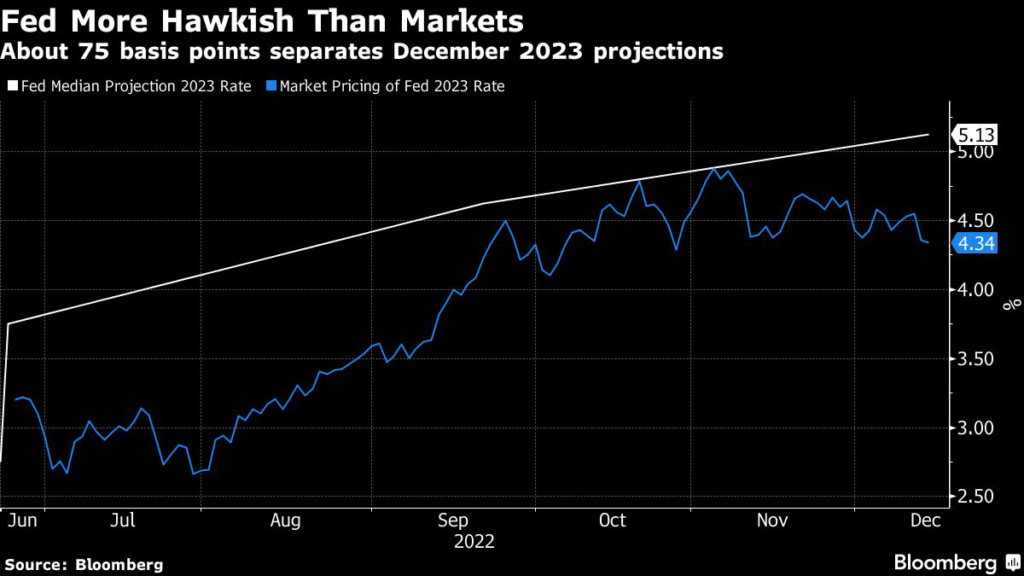
Fed Chair Jerome Powell said the central bank has a “ways to go” in its campaign to rein in inflation. Policy makers projected rates would end next year at 5.1%, a higher level than previously indicated. Ahead of the decision, traders bet rates would reach about 4.8% in May. 

“Asian markets will take their lead from the US markets,” said Anthony Doyle, head of investment strategy at Firetrail Investments. “The theme of today for Asian markets is defensives holding up the most, so sectors like healthcare, food and beverages, and transport.”

Read: Wall Street’s Optimism Dims as Fed Decision ‘Screams Hawkish’

Australian bonds fell slightly, taking the 10-year yield up by two basis points to 3.38%. In the US Wednesday, Treasuries whipsawed after the hawkish decision and Powell’s comments, with policy sensitive two-year rates spiking higher before ending the day little changed. The dollar fell for a second day.

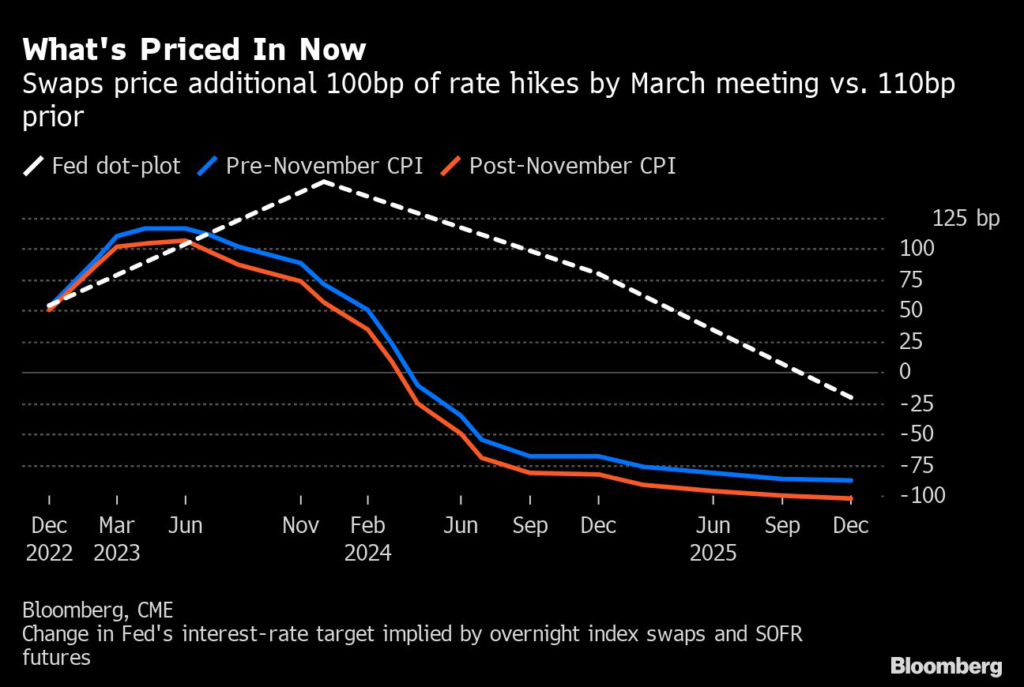
The Federal Open Market Committee raised its benchmark rate by 50 basis points to a 4.25% to 4.5% target range. Powell left the door open to a similar hike at the next meeting in February or a step down, while pushing back on bets for reversing course next year.

Swaps traders expect policy makers to continue on the slower path as it did Wednesday, with Fed-dated contracts pricing in 33 basis points of hikes at the next meeting and peak around 4.87% by May, broadly in line with Tuesday’s close.

On Thursday’s economic front in Asia, China is due to release a raft of data including industrial production and retail sales as a closely watched economic policy meeting in Beijing is set to start. Also on traders’ watchlists are Australian employment and Japanese trade figures.

Later, policy decisions will be front and center in Europe, with the Bank of England and European Central Bank seen following the Fed with half-point hikes in rates.

Key events this week:

  • China medium-term lending, property investment, retail sales, industrial production, surveyed jobless, Thursday
  • ECB rate decision and ECB President Lagarde briefing, Thursday
  • Rate decisions for UK BOE, Mexico, Norway, Philippines, Switzerland, Taiwan, Thursday
  • US cross-border investment, business inventories, empire manufacturing, retail sales, initial jobless claims, industrial production, Thursday
  • Eurozone S&P Global PMI, CPI, Friday

Some of the main moves in markets as of 7:41 a.m. Tokyo time:

Stocks

  • The S&P 500 fell 0.6%
  • The Nasdaq 100 fell 0.8%
  • Nikkei 225 futures fell 0.6%
  • Australia’s S&P 200 Index futures fell 0.8%
  • Hang Seng Index futures rose 0.1%

Currencies

  • The euro was little changed at $1.0681
  • The Japanese yen was little changed at 135.45 per dollar
  • The offshore yuan fell 0.1% to 6.9519 per dollar

Cryptocurrencies

  • Bitcoin was little changed at $17,824.92
  • Ether was little changed at $1,311.26

Bonds

  • The yield on 10-year Treasuries declined two basis points to 3.48%
  • Australia’s 10-year yield advanced two basis points to 3.38%

Commodities

  • Spot gold was little changed

This story was produced with the assistance of Bloomberg Automation.

–With assistance from Georgina Mckay and Rheaa Rao.

More stories like this are available on bloomberg.com

©2022 Bloomberg L.P.
US, Africa Firms Seal $15 Billion of Deals at Washington Summit

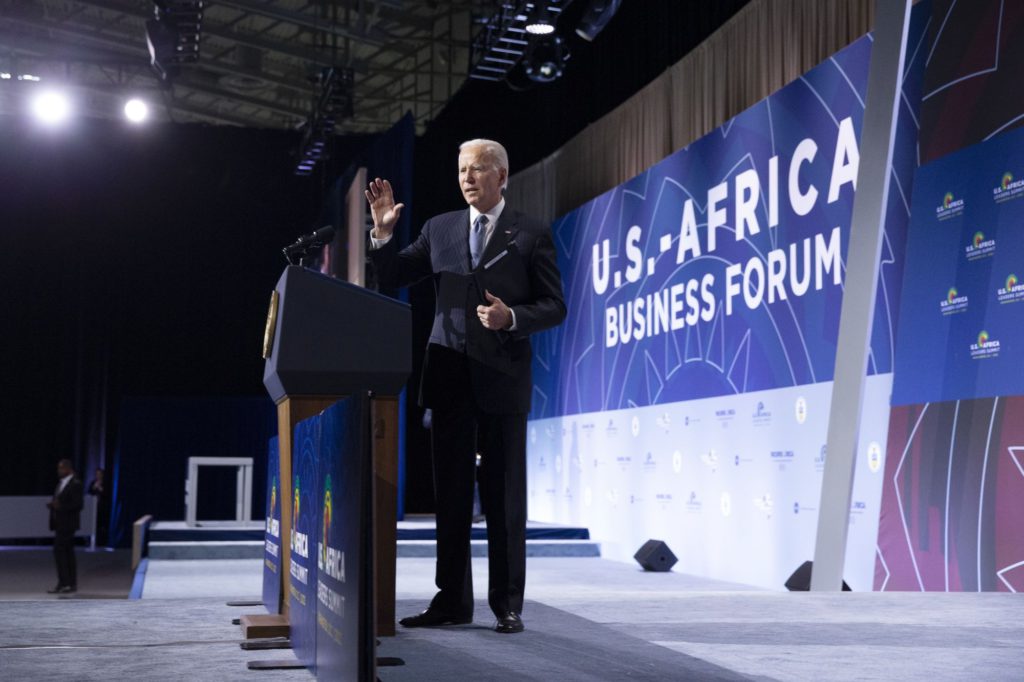
(Bloomberg) — American and African firms reached more than $15 billion in new commitments and deals at a summit hosted by President Joe Biden as the US moves to increase its commercial ties with the continent through investments rather than aid.  

The commitments cover sustainable energy, health systems, agribusiness, digital connectivity, infrastructure, and finance, the White House said in a statement Wednesday.

Presidents from more than 40 African nations are in Washington for the three-day summit, the first of its kind in eight years. The US is trying to deepen its ties with the continent as it competes for influence with rivals China, Africa’s largest trading partner and bilateral creditor, and Russia, which has successfully strengthened relations with the region in recent months as western nations tried to isolate it over its invasion of Ukraine.

The US government has helped close more than 800 two-way trade and investment deals across 47 African countries for a total estimated value of over $18 billion, and the American private sector has closed investment deals in the continent valued at $8.6 billion since 2021, the White House said. 

Some of the initiatives emerging from the summit’s business forum include: 

  • At least $170 million by Prosper Africa — the US government initiative to increase trade with the continent — to boost exports to the US by $1 billion over the next five years, and mobilize another $1 billion in US investment in Africa.
  • Cisco Systems Inc., the biggest maker of machines that run computer networks and the internet, is partnering with Cybastion, a diaspora-owned small business, for $800 million in new contracts to protect African countries from cyber threats.
  • The US-Africa Clean Tech Energy Network — a partnership between Prosper Africa and the US Agency for International Development’s Power Africa initiative — to facilitate up to $350 million investment in clean-tech energy companies within the next five years.

The Office of the US Trade Representative also signed a memorandum of understanding with the secretariat of the African Continental Free Trade Area “to support institutions to accelerate sustainable economic growth across the continent,” the White House said. 

The AfCFTA — which would be the world’s biggest free-trade zone by area when it kicks into full gear in 2030 — became operational in January last year and has a potential market of 1.3 billion people with a combined gross domestic product of $2.6 trillion.  

More stories like this are available on bloomberg.com

©2022 Bloomberg L.P.
Stocks Snap Two-Day Rally After Powell’s Remarks: Markets Wrap

(Bloomberg) — US stocks snapped a two-day rally after Federal Reserve Chair Jerome Powell reiterated his hawkish stance while also signaling the central bank is getting “close” to reaching the end of a tightening cycle that pushed rates from near zero to 4.5% since March.

While Wednesday’s volatile session saw the S&P 500 and the Nasdaq 100 swing between gains and losses, both indexes ended lower after the Fed raised rates by half a percentage point and signaled more increases are to come. Treasuries whipsawed, with the policy-sensitive two-year yield initially surging after the Fed’s decision, only to almost entirely erase that jump later in the day. The dollar dropped for a second session.

Powell indicated the Fed intends to keep at its battle with inflation, as officials projected rates would end next year at 5.1%. But his assertion that the cycle could be near an end was enough to ease the worst of the stock declines on Wednesday. The Fed also projects economic growth will slow next year, with inflation remaining well above its 2% target. 

Read More: Bond Traders Dismiss Fed’s Hawkish Tone, Bet on 2023 Rate Cuts

Read More: Powell Says Fed Still Has a ‘Ways to Go’ After Half-Point Hike

“Powell was crystal clear that the Fed is basically indifferent to inter-meeting moves in financial conditions but that they control those conditions over time,” said Gerard MacDonell of 22V Research.

Some investors saw the silver lining in Powell’s remarks. 

“The most encouraging of Powell’s comments is the acknowledgment of how core inflation is coming down more than expected, as evidenced by new rental leases coming at levels significantly below data being used to calculate core CPI,” said Bryce Doty, senior vice president at Sit Investment Associates. “This is a big deal given that housing is the largest component of core CPI. Therefore, we wouldn’t be surprised if Powell uses this as a primary reason for halting rate increases at their May meeting.”

Following the Fed, the European Central Bank will announce its rate decision Thursday. Markets will also contend with decisions from the Bank of England and monetary authorities in Mexico, Norway, the Philippines, Switzerland and Taiwan.

Key events this week:

  • China medium-term lending, property investment, retail sales, industrial production, surveyed jobless, Thursday
  • ECB rate decision and ECB President Lagarde briefing, Thursday
  • Rate decisions for UK BOE, Mexico, Norway, Philippines, Switzerland, Taiwan, Thursday
  • US cross-border investment, business inventories, empire manufacturing, retail sales, initial jobless claims, industrial production, Thursday
  • Eurozone S&P Global PMI, CPI, Friday

Some of the main moves in markets:

Stocks

  • The S&P 500 fell 0.6% as of 4 p.m. New York time
  • The Nasdaq 100 fell 0.8%
  • The Dow Jones Industrial Average fell 0.4%
  • The MSCI World index rose 1.1%

Currencies

  • The Bloomberg Dollar Spot Index fell 0.3%
  • The euro rose 0.4% to $1.0679
  • The British pound rose 0.5% to $1.2424
  • The Japanese yen rose 0.2% to 135.26 per dollar

Cryptocurrencies

  • Bitcoin was little changed at $17,772.42
  • Ether fell 0.9% to $1,308.22

Bonds

  • The yield on 10-year Treasuries declined three basis points to 3.47%
  • Germany’s 10-year yield advanced one basis point to 1.94%
  • Britain’s 10-year yield advanced one basis point to 3.31%

Commodities

  • West Texas Intermediate crude rose 2.7% to $77.42 a barrel
  • Gold futures fell 0.3% to $1,819.90 an ounce

This story was produced with the assistance of Bloomberg Automation.

–With assistance from Vildana Hajric and Emily Graffeo.

More stories like this are available on bloomberg.com

©2022 Bloomberg L.P.
Ex-Twitter Employee Convicted of Spying Gets 3 1/2 Years in Prison

(Bloomberg) — A former Twitter Inc. employee convicted of spying for Saudi Arabia was ordered to serve 3 1/2 years in prison, capping a yearslong case that showed how the social media giant was vulnerable to security breaches perpetrated from within its own ranks.

Ahmad Abouammo’s sentence handed down Wednesday by a federal judge in San Francisco falls about half way between the 7 1/4-year term prosecutors sought and what his lawyers asked for — home confinement or supervised release on probation.

Read More: Former Twitter Employee Convicted of Spying for Saudi Arabia

Abouammo, a US resident born in Egypt, was found guilty in August of charges that he acted as an agent for Saudi Arabia by turning over personal information of platform users critical of the Kingdom. He was also convicted of money laundering, conspiracy to commit wire fraud and falsifying records.

His conviction garnered national attention later that month when a former Twitter security chief-turned-whistle-blower told Congress that Abouammo’s spying reflected lax data security practices at the social media platform that posed a threat to national security.

“The seriousness of the offense is something that is prominent in this setting because of the nature of the trust that was violated” and potential serious consequences facing those who details were exposed to a regime that won’t tolerate dissent, US District Judge Edward Chen said at the sentencing hearing. 

Chen also said there were “personal attenuating circumstances” given that Abouammo, who never fled the US, hasn’t been able to secure employment and filed for bankruptcy as he struggles to support his family. One of Abouammo’s two co-defendants, who also worked at Twitter and was also accused of feeding the Saudi government information about the platform’s users, left the US before he was charged and remains at large.

Abouammo, who worked as a media partnership manager for Twitter in 2015, maintained he was simply doing his job promoting the nascent social media network in the Middle East and North Africa. Prosecutors alleged his relationship with a top aide to Mohammed bin Salman, or MBS, now the de-facto ruler of Saudi Arabia, went much further — and darker — to help the Crown Prince silence his critics.

The jury was shown evidence that Abouammo received a Hublot watch and $300,000 in wire transfers — which the US said were bribes from the MBS aide, Bader Al- Asaker, in exchange for confidential Twitter account information on Saudi dissidents.

Dressed in a black jacket and trousers with a white shirt, Abouammo sat by his attorneys with his hands folded tightly together as if he was praying before his sentencing hearing started.

“I’m sincerely saddened and remorseful about the entire case,” Abouammo said before Chen announced his sentence. He choked up as he spoke about how the case hurt his three children, his wife and parents.

Abouammo must be given a “resounding deterring sentence” to send a message to technology company workers in Silicon Valley that “selling out users” to foreign governments “will not be tolerated,” Assistant US Attorney Colin Sampson said. A spokesman for the US Attorney’s Office in San Francisco didn’t immediately respond to a request for comment on the sentence.

Abouammo’s attorney, Angela Chuang, told Chen it was unfair that the government has made the former Twitter employee a “proverbial whipping boy” for human rights abuses by Saudi Arabia. Chuang declined to comment on the sentence.

Twitter didn’t immediately respond to a request for comment.

Read More: US Says Accused Saudi Twitter Spy Vowed to ‘Delete Evil’

Prosecutors were prohibited by a court ruling from telling jurors explicitly that the US and human rights organizations believe Saudi Arabia under bin Salman has secretly detained and tortured its critics.

But they hinted at the brutal practices through an expert witness who testified about the changing politics and culture of Saudi Arabia, and through a woman who told jurors that her brother went silent in 2018 after he posted satirical criticism of the country on Twitter.

Federal public defenders who represented Abouammo argued for a sentence of probation because he had no criminal record and most of the behavior that got him convicted happened more than seven years ago. At that time, Abouammo was dealing with “serious upheavals” in his sister’s life, including specialized care for her newborn daughter and her sheltering at his home in an escape from an abusive husband.

The US said Abouammo’s crimes weren’t garden-variety business fraud; he was bribed by bin Salman’s right-hand man to “access, monitor, and convey the private user information of Saudi dissidents who criticized a powerful and repressive foreign government.”

Facing a serious sentence, Abouammo offers “a scintilla of remorse wrapped in numerous layers of blame, excuses, and minimization,” prosecutors said in a court filing. Prosecutors also sought three years of supervised release and a fine of $30,000.

The case is US v. Abouammo, 19-cr-00621, U.S. District Court, Northern District of California (San Francisco).

(Updates with details from hearing)

More stories like this are available on bloomberg.com

©2022 Bloomberg L.P.
How Blacklisting Companies Became a Trade War Weapon

(Bloomberg) — Terms of Trade is a daily newsletter that untangles a world embroiled in trade wars. Sign up here. 

Tariffs aren’t the only weapon in a trade war. Countries are also using blacklists to restrict the economic activities of certain foreign companies. While such measures are often described as necessary to preserve national security, they’re increasingly being deployed as policy tools to protect domestic constituencies or gain leverage in trade negotiations. 

1. Who is using blacklists?

The US is leading the way. In October 2022 President Joe Biden unveiled a sweeping set of restrictions on China’s ability to buy semiconductors and chipmaking equipment. Administration officials then began mulling a plan to add more than 30 other Chinese companies on the US Commerce Department’s “entity list” — a classification that restricts their ability to purchase American software, semiconductors and other strategic technologies. Companies on the Entity List are blocked from buying technology from US suppliers unless they get a special export license from Commerce. Biden’s blacklists build on efforts from former President Donald Trump who used the entity list to block critical components and software for China’s telecommunications darling Huawei Technologies Co. In response, China’s government has developing a blacklist of its own, targeting foreign companies, organizations and people it calls “unreliable entities.” Export powerhouses Japan and South Korea also have deployed trade restrictions in a renewal of a long feud dating back to Japan’s colonization of the Korean peninsula in the early 20th century.

2. Who is on the U.S. list?

Huwei is among the most prominent Chinese companies blacklisted by the US government. The telecommunications giant is at the forefront of fifth-generation, or 5G, mobile technology. Other companies include Yangtze Memory Technologies, which produces memory chips that go into smartphones and other computing devices in competition with the likes of Samsung Electronics Co. The Trump administration blacklisted another 28 Chinese companies for alleged human rights violations against Uighur Muslims in China’s far west Xinjiang province. Those companies include two of the world’s largest manufacturers of video surveillance products, Hangzhou Hikvision Digital Technology Co. and Zhejiang Dahua Technology Co.

3. What does it mean to be blacklisted by the U.S.?

Those on the U.S. entity list are prohibited from doing business with American companies without first obtaining a US government license. The list was created in 1997 as a way to sanction companies that helped build weapons of mass destruction. It’s since been expanded to cover activities considered “contrary to the national security or foreign policy interests of the United States.” Targets can be “businesses, research institutions, government and private organizations, individuals, and other types of legal persons,” according to the Commerce Department’s Bureau of Industry and Security, which administers the list as part of U.S. Export Administration Regulations.

4. How is China responding?

Policy makers in Beijing say they are developing a list of “unreliable entities,” which are defined as countries, companies or people who have “severely damaged the legitimate interests” of Chinese firms by failing to obey market rules, violating contracts or blocking or cutting off supply for noncommercial reasons. Those on the list may be subject to penalties such as trade restrictions, investment bans, visa restrictions and fines. They can apply to be removed from the list. Those targeted for the list may be given a grace period to rectify their alleged transgressions.

5. Who is on China’s list?

China hasn’t named anyone yet, but there are plenty of possible targets. HSBC Holdings Plc could make the list because of its participation in the U.S. investigation of Huawei. FedEx Corp. was previously under scrutiny after China accused it of mis-routing some parcels sent by Huawei. Chinese state media has raised the specter of backlash against US companies including General Dynamics Corp. and Honeywell International Inc. in connection with a proposed $2 billion U.S. arms sale to Taiwan. China also vowed retaliation against U.S. companies participating in a proposed $8 billion U.S. sale of Lockheed Martin Corp. F-16 fighter jets to Taiwan. China also has pledged to retaliate against Trump’s sanctions related to human rights violations. 

6. What explains the increased use of blacklists?

It’s part of what trade hawks in China and the US see as a generational fight for technological and economic supremacy of the 21st century. The Chinese government has leveraged its massive state resources to support industrial policies like “Made in China 2025,” and a 2017 development strategy that aims to make China the world’s primary artificial intelligence innovation center by 2030. The US government views this as a threat to America’s economic and national security and has actively sought to curb China’s technological ambitions. 

More stories like this are available on bloomberg.com

©2022 Bloomberg L.P.
FTX Executives Used ‘Korea’ Account to Mask Giant Alameda Liabilities

(Bloomberg) — A GitHub account bearing the name of former FTX executive Nishad Singh authored code that hid Alameda Research’s ballooning liabilities on the now-collapsed cryptocurrency exchange, according to internal documentation reviewed by Bloomberg News.

The documentation, in the form of comments associated with specific lines of code, offers clues to the origins of a mysterious account on FTX that a regulator alleges helped mask mounting debts of its sister trading firm Alameda Research. The relationship between the two firms, and alleged misuse of FTX customer funds, led to criminal charges against founder Sam Bankman-Fried.

Singh, who was FTX’s engineering director, has not been charged with a crime. GitHub is a programming code repository that companies and individual software developers use to store and share code. GitHub is frequently used to allow developers to work together. It wasn’t immediately clear whether any other FTX employees had access to the account. 

The GitHub account bearing his name annotated the code snippets reviewed by Bloomberg with comments including “Korea KYC” and “BD expenses accounts,” the documentation reviewed by Bloomberg News showed. The later was tied to a “Korea expenses” account. 

Alameda shunted debts, which soared to $8 billion, to an FTX customer account that wasn’t easily identifiable as belonging to Alameda, the US Commodity Futures Trading Commission alleged in a civil complaint Tuesday. Bankman-Fried, who founded Alameda and FTX, called it “our Korean friend’s account” and directed it to be created at least partially to mask Alameda’s gaping liabilities, the CFTC alledged.

The so-called Korean account enjoyed the same privileges of Alameda’s main account and sub-accounts, including exemptions from parts of FTX’s risk management policies, the lawsuit said.

Singh and representatives for Bankman-Fried and FTX didn’t immediately respond to requests for comment. Bankman-Fried is being held without bail at a jail in the Bahamas awaiting an extradition hearing in February.

Though Alameda enjoyed virtually unlimited access to FTX customer funds for its own trading purposes since the exchange was created, the firm began to spiral in May, after a $60 billion crypto ecosystem built on tokens TerraUSD and Luna collapsed, and lenders demanded payments. That led Alameda to ramp up its use of FTX customer funds, regulators alleged. 

Do Kwon, a South Korean national who was behind TerraUSD, is reportedly in Serbia. A South Korean court issued an arrest warrant for him in September on allegations that he violated capital-markets laws.

Months after the jarring round of margin calls began, Bankman-Fried contemplated closing down Alameda around September, according to the CFTC complaint. He drafted a Twitter thread to announce its closure, saying “I feel really uncertain what’s right!” But Alameda never shut.

Bankman-Fried was jailed Tuesday after US authorities brought eight criminal charges against him, including fraud and conspiracy to commit money laundering. The US Securities and Exchange Commission also sued him.

The CFTC complaint described the “Korean account” as a sub-account of Alameda that was not opened under an “alameda-research.com” identifier and not otherwise readily identifiable as being an Alameda-associated account.

–With assistance from Olga Kharif.

More stories like this are available on bloomberg.com

©2022 Bloomberg L.P.
Charter Falls a Record 16% as Spending Alarms Wall Street

(Bloomberg) — Charter Communications Inc. stock fell by largest percentage in its trading history after announcing a broadband expansion plan that will cost far more than analysts anticipated.

The second-largest US cable company unveiled a three-year network spending budget starting with $10.7 billion next year, $1 billion more than analysts estimated. The boost in spending will lead to “higher generational growth,” new chief executive officer, Chris Winfrey, told investors Tuesday evening.

The shift in spending toward infrastructure breaks from the industry’s lavish stock buyback trends and places a bigger bet on revenue growth that may be years away. Charter is also facing competition from fiber optic network operators and wireless home broadband providers.

“We see this as defensive relative to fiber,” Rosenblatt Securities analyst Barton Crockett wrote in a note Wednesday.

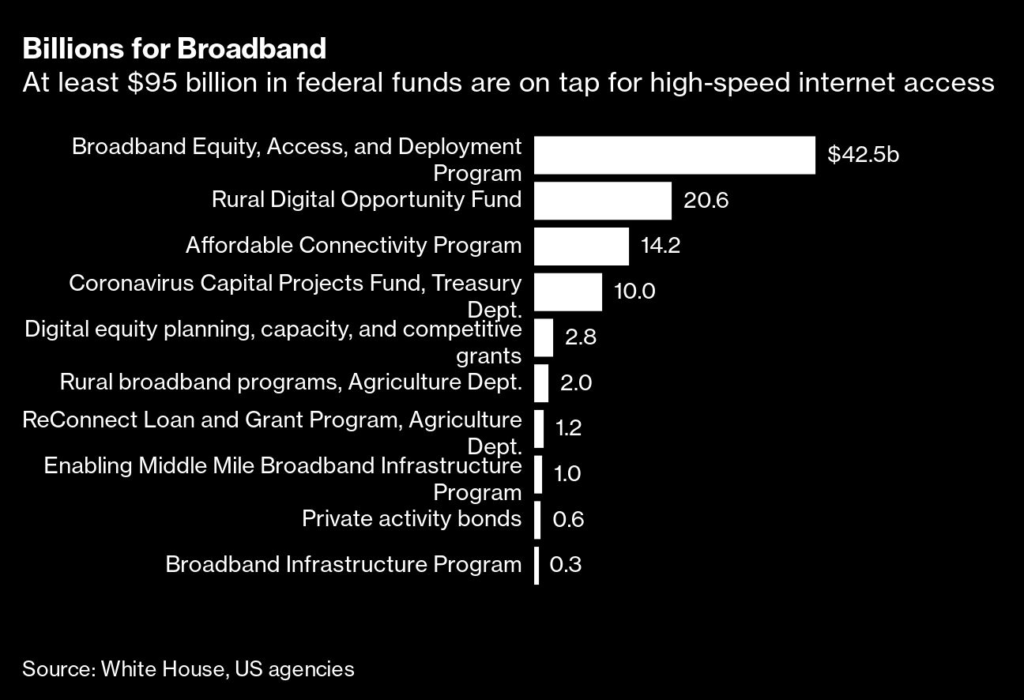
Cable, phone and satellite companies are vying for some of the $100 billion in federal funds aimed at expanding broadband service to poorer and more rural parts of the country. As past internet building booms have shown, one of the biggest risks to any venture is the high costs involved.

Charter fell 16.38% on Wednesday to $328.34 at the close in in New York. 

Charter and Comcast Corp., the largest US cable provider, have opted to take a different path than their telecom rivals. Instead of replacing their coaxial wires with higher-capacity fiber, the two companies have opted for a technology called DOCSIS 4.0 that uses amplifiers to allow existing cable systems to give customers multigigabit speeds.

Included in the overall capital spending plan is $5.5 billion over three years specifically for cable network upgrades to deliver higher-speed broadband connections to customers, Winfrey said.

The overhaul of the existing cable system is expected to cost about $100 per home passed and be completed by the end of 2024. Last month, Comcast said it would spend about $200 per home passed to upgrade its systems using amplifiers. That number compares with about $1,000 per home for laying new fiber optic cable lines. Neither amount includes the cost of connecting all the way to a home.

(Updates with share move staring in first paragraph.)

More stories like this are available on bloomberg.com

©2022 Bloomberg L.P.
Close Bitnami banner
Bitnami