Bloomberg

FTX’s LedgerX Is Up for Sale as Restructuring Process Picks Up

(Bloomberg) — LedgerX, one of the few solvent pieces of Sam Bankman-Fried’s crumbled FTX empire, is for sale and attracting interest from would-be buyers including crypto giants Blockchain.com and Gemini, according to people familiar with the matter.

The unit, which is registered with the US Commodity Futures Trading Commission as a derivatives exchange, was a cornerstone of Bankman-Fried’s efforts in Washington. It’s also considered one of the most valuable assets associated with FTX after more than 100 other entities filed for bankruptcy.  

New FTX Chief Executive Officer John J. Ray III and restructuring advisers have been poring over the company’s books in search of cash, cryptocurrency and assets that could be sold to help repay creditors. It’s unclear how much LedgerX, which had about $303 million in cash as of a Nov. 17 filing, may fetch in a sale.

In addition to Blockchain.com and Gemini, crypto exchange Bitpanda and event contracts trading platform Kalshi, which is also registered with the CFTC and uses LedgerX to clear trades, have expressed interest, the people said. There are about half a dozen other potential buyers and more could be added, said one of the people. 

Representatives for LedgerX, FTX, Blockchain.com, Gemini, Bitpanda and Kalshi didn’t immediately respond to requests for comment. In a sign that talks are becoming more serious, at least some of the parties have signed non-disclosure agreements, some of the people said.

After FTX US purchased it last year, LedgerX sought approval for a controversial plan to clear crypto derivatives trades without intermediaries. The firm withdrew its application with the CFTC as the corporate group of companies filed for bankruptcy. 

On Thursday, CFTC chairman Rostin Behnam told lawmakers his agency is in daily communication with LedgerX amid the FTX turmoil. The potential sale wasn’t discussed.  

–With assistance from Hannah Miller.

More stories like this are available on bloomberg.com

©2022 Bloomberg L.P.

Seaweed Plastic, Farming Startups Among 2022 Earthshot Prize Winners

(Bloomberg) — Potential fixes to the world’s most persistent environmental problems are often little-known and underfunded. That’s why in 2020, Britain’s Prince William launched the Earthshot Prize to encourage approaches that deserve more attention and scale by 2030.

The initiative today announced five winners of the £1 million ($1.2 million) annual prize, now in its second year. The winning organizations are working to improve people’s health, cut pollution and reduce greenhouse gas emissions.

Mukuru Clean Stoves was founded in 2017 by Charlot Magayi, who sold fuel charcoal as a child growing up in the Mukuru slum in Nairobi, Kenya, and who suffered respiratory infections from open-pit cooking. The company designed and sells $10 cookstoves that burn cleaner fuel, cutting 60% to 90% of the emissions from an open fire and decreasing fuel consumption by 30% to 60%. Some 700 million people use dirty fuels for cooking in Africa. 

Kheyti, an Indian startup, created what it calls a “greenhouse in a box,” a kit that lets smallholder farmers increase their yield sevenfold. It includes a greenhouse tent, seeds and fertilizer, a drip system that uses a small fraction of the usual water volume and less pesticide than the farmers would typically use. The company is currently working with more than 1,000 smallholder farmers in India, a country that has 100 million of them.

The Great Barrier Reef is under grave threats from climate change and other forms of pollution. Indigenous Women of the Great Barrier Reef has spent the past several years bringing ancient expertise to bear on reef preservation and monitoring — in the process training dozens of women to become rangers. 

A UK startup called Notpla wants to change the packaging industry by developing materials from seaweed and other plants. The company has already produced more than 1 million take-out food containers and has ambition to increase that number by a factor of 100. The plastics are bio-degradable and can hold anything from hot liquids to cosmetics.

Lifelong friends in Oman founded a company called 44.01 that mixes CO₂ with a mineral called peridotite that binds with it into rock. Mineralization locks the CO₂ away for geological eternity. A pilot project will store 1,000 metric tons of the main greenhouse gas a year, and 44.01 is looking to expand internationally. (The company’s name is the molecular weight of carbon dioxide.)

The winners were selected by a panel that included naturalist Sir David Attenborough, Queen Rania Al Abdullah of Jordan and actor Cate Blanchett. Short videos introducing the finalists can be found on PBS.org.

A global alliance of organizations back the awards, including the Bezos Earth Fund, Breakthrough Energy Foundation, Jack Ma Foundation, Paul G. Allen Family Foundation and Marc and Lynne Benioff. Bloomberg LP, the parent company of Bloomberg News, and Bloomberg Philanthropies are both members of the alliance; Michael Bloomberg is the majority owner of the former and the founder of the latter. 

More stories like this are available on bloomberg.com

©2022 Bloomberg L.P.

ABB Agrees to Pay $315 Million to End South African Bribe Probe

(Bloomberg) — ABB Ltd., a Swiss industrial company, agreed to pay $315 million to resolve a multinational investigation into bribery of a high-ranking official at Eskom Holdings SOC Ltd., the South African state-owned power utility, the US Justice Department said Friday.

ABB bribed the Eskom official between 2014 and 2017 to corruptly obtain confidential information and win lucrative contracts, Assistant Attorney General Kenneth A. Polite Jr. said in a statement. ABB engaged subcontractors associated with the official and made payments intended, “at least in part, as bribes,” the statement said. “ABB worked with these subcontractors despite their poor qualifications and lack of experience.”

“Corruption and bribery are not victimless acts,” said U.S. Attorney Jessica D. Aber for the Eastern District of Virginia. “They can create hazardous working conditions, hurt honest businesses, and erode trust and integrity in local and global governance.” 

The US charged ABB with violating the Foreign Corrupt Practices Act and with conspiracy to violate the FCPA, but will defer prosecution and drop the case in three years if the company makes required reforms. Two subsidiaries pleaded guilty Friday to conspiracy to violate the FCPA, prosecutors said in the statement.

The so-called deferred prosecution agreement comes as the company is resolving probes over its conduct in the US, South Africa, Switzerland and Germany, prosecutors said. The US will credit up to half of the $315 million penalty against payments by the company in the other three countries, according to the statement. 

The Justice Department has vowed in the past year to take a tougher stance with repeat corporate offenders.

In 2010, ABB agreed to pay about $58.3 million to resolve claims by US prosecutors and regulators that its units made corrupt payments to win business in Mexico and Iraq.

(Adds statement from US Attorney in third paragraph.)

More stories like this are available on bloomberg.com

©2022 Bloomberg L.P.

ABB Agrees to Pay $315 Million to End Eskom Bribe Probe

(Bloomberg) —

ABB Ltd., a Swiss industrial company, agreed to pay $315 million to resolve a multinational investigation into bribery of a high-ranking official at Eskom Holdings SOC Ltd., the South African state-owned power utility, the US Justice Department said Friday.

ABB bribed the Eskom official between 2014 and 2017 to corruptly obtain confidential information and win lucrative contracts, Assistant Attorney General Kenneth A. Polite Jr. said in a statement. ABB engaged subcontractors associated with the official and made payments intended, “at least in part, as bribes,” the statement said. “ABB worked with these subcontractors despite their poor qualifications and lack of experience.”

“Corruption and bribery are not victimless acts,” said U.S. Attorney Jessica D. Aber for the Eastern District of Virginia. “They can create hazardous working conditions, hurt honest businesses, and erode trust and integrity in local and global governance.” 

The US charged ABB with violating the Foreign Corrupt Practices Act and with conspiracy to violate the FCPA, but will defer prosecution and drop the case in three years if the company makes required reforms. Two subsidiaries pleaded guilty Friday to conspiracy to violate the FCPA, prosecutors said in the statement.

The so-called deferred prosecution agreement comes as the company is resolving probes over its conduct in the US, South Africa, Switzerland and Germany, prosecutors said. The US will credit up to half of the $315 million penalty against payments by the company in the other three countries, according to the statement. 

The Justice Department has vowed in the past year to take a tougher stance with repeat corporate offenders.

In 2010, ABB agreed to pay about $58.3 million to resolve claims by US prosecutors and regulators that its units made corrupt payments to win business in Mexico and Iraq.

(Adds statement from US Attorney in third paragraph.)

More stories like this are available on bloomberg.com

©2022 Bloomberg L.P.

The Oil Price Cap Looks Set to Keep Russian Oil Flowing

(Bloomberg) — The Group of Seven is set to impose a price cap on Russian oil that’s well above where it now trades. If there was ever any doubt what the premise of the cap was, it’s now clear: the US and its allies want Russia’s crude to keep flowing.

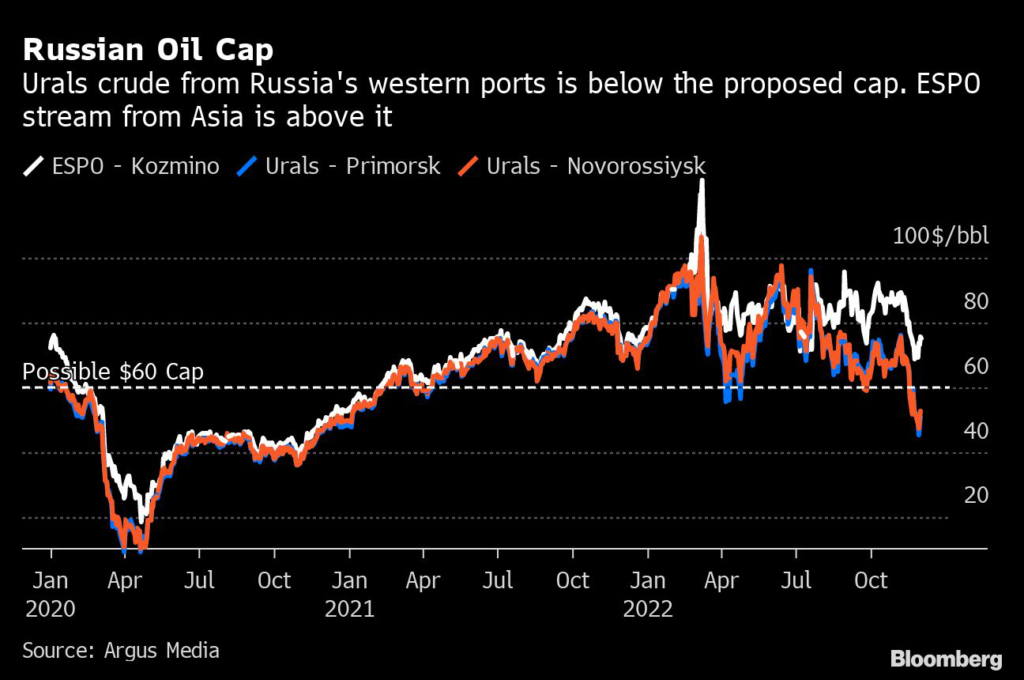
European Union ambassadors backed limiting the price of Russian oil, a key source of income for President Vladimir Putin’s war machine, at $60 a barrel after fraught talks that dragged into the night more than once. Crucially, that’s above the $50 that Russia’s flagship Urals grade already trades at, according to data from Argus Media.

“The key point in our view is the signal that the G-7 seeks to keep Russian oil on the market,” said Joel Hancock, an analyst at Natixis. “The market has shifted to a view that Russian crude oil exports will remain more resilient than previously expected and largely unaffected by the price cap.”

Now, Moscow’s reaction will be key. Russia has opposed the measure, and threatened to stop production in response. But on Thursday Russian Foreign Minister Sergei Lavrov said the cap was irrelevant, the strongest hint yet of a possible softening. With such a generous cap, buyers and sellers can easily claim it’s just business as usual.

“We don’t care what the price cap will be. We’ll negotiate with our partners directly,” Lavrov said. “And partners who continue working with us won’t look at those caps.”

The G-7 has mostly decided to stop its own imports of Russian crude so the move is aimed squarely at other big buyers such as China, India and Turkey. Those countries have not signed up, but the US hopes they will use the threshold as a bargaining chip. Crucially, if they don’t buy below the threshold, they won’t be able to access European insurance and shipping.

The plan, driven by the G-7, comes at a time when Europe is fighting high inflation and at risk of a recession. Companies and households are reeling from exorbitant energy bills triggered by Russia’s invasion of Ukraine, and the OPEC+ alliance is keeping a tight rein on supply. As governments spend billions to stave off a backlash from voters, increased economic risks are now being taken into account in political decision-making.

Read more: Europe Sets Russian Oil at $60 a Barrel: What Changes Now

“The price cap will encourage the flow of discounted Russian oil onto global markets and is designed to help protect consumers and businesses from global supply disruptions,” US Treasury Secretary Janet Yellen said in a statement Friday, after the G-7 announced its endorsement of the $60 level. She added that even if countries buy outside the cap coalition, it will “enable them to bargain for steeper discounts on Russian oil and benefit from greater stability in global energy markets.”

The EU sanctions agreed earlier this year had initially shocked many in the market for being so strict. The idea was to ban companies from providing insurance to transport Russian oil anywhere in the world. It would have meant even Chinese and Indian customers would have had to find their own insurance from Dec. 5.

The US argued that the sanctions risked provoking a spike in oil prices that would have been ruinous for the world economy, and also potentially end up even benefiting Putin. The price cap was a kind of off-ramp — those services would be available but only for oil sold under the designated level. The idea was to limit revenues but keep the oil flowing to the global economy.

“We think the number at $60 a barrel is appropriate” to balance limiting Moscow’s ability to profit and ensuring supply meets demand, John Kirby, spokesman for the US National Security Council, said Friday, adding that the cap can be adjusted going forward.

Some in Europe saw the US plan as a way to water down sanctions, and Poland led a group of countries pushing for the cap to be closer to production costs. Shipping nations wanted a more generous level, and the discussions were often fraught as countries’ interests didn’t always align. 

For its part, Ukraine said the level should be set as low as $30. 

First Doubts

“Given that Urals is currently traded far below the level of the cap, in principle it could be a good deal,” said Jorge Leon at Rystad Energy.

A complicating factor is that oil is priced very differently in Asia. There, the key ESPO grade is trading at over $70 a barrel. It’s not clear if all that crude will end up under the cap or not.

When the price cap was first floated as an idea, many thought it unworkable without key buyers such as India and Turkey on board, or extraterritorial penalties to deter breaches and incentivize adoption. 

Now it looks like the US can claim some kind of victory if Russia does sell under the ceiling. Washington also argues that if Russian oil is already trading at a deep discount, the threat of the price cap can take some of the credit. For its part, Poland, after long negotiations, has secured some extra conditions, including a review mechanism going into next year. 

Still, there remain questions over enforcement, as the EU has watered down its rules, and there are no secondary sanctions to add teeth. A spat over insurance in Turkey could still pose problems. And the Kremlin’s reaction remains a big unknown.

“There’s so much uncertainty really over just how much physical disruption we’ll see to Russian crude supplies,” Neil Beveridge, senior oil analyst at Sanford C. Bernstein, said in a Bloomberg television interview.

Price Cap on Russian Oil Risks Crisis It’s Meant to Prevent

–With assistance from Rachel Graham, Justin Sink, Grant Smith, Alex Longley, Alaric Nightingale, Josh Wingrove, Christopher Condon, Kevin Whitelaw and Daniel Flatley.

(Updates with Yellen statement in eighth paragraph.)

More stories like this are available on bloomberg.com

©2022 Bloomberg L.P.

Microsoft Is Ready to Fight For Its $69 Billion Activision Deal

(Bloomberg) — Microsoft Corp. is ready to fight for its $69 billion acquisition of gaming company Activision Blizzard Inc. if the US Federal Trade Commission files a lawsuit seeking to block the deal, according to a person familiar with the matter.

The Xbox maker hasn’t had conversations with the FTC about remedies or concessions aimed at getting the deal approved, said the person, who asked not to be identified discussing a confidential matter. FTC staff is wrapping up its investigation and is expected to make a recommendation soon, the person added. The FTC commissioners would then vote on whether to file a case.

In the event the FTC tries to block the case, Microsoft is gearing up to contest that decision in court, said the person, who asked not to be identified speaking about internal strategy. Bloomberg Intelligence antitrust analyst Jennifer Rie said it wouldn’t surprise her if the FTC files a lawsuit seeking to block the deal, but noted that a court fight would be hard for enforcers to win and Microsoft could prevail — though a legal battle could stretch beyond the deal’s end date. Microsoft has said it expects to close the transaction by June 30.

Microsoft’s other option would be to abandon the deal in the face of an FTC challenge. That’s what the company did in 1995 when the US government sued to block its acquisition of accounting software maker Intuit Inc., with Microsoft saying it didn’t want to contend with a long legal battle.

Microsoft’s best chance to win approval to buy Activision is to persuade the Biden administration to accept a settlement in which it pledges it won’t withhold its popular titles from rivals. 

But Biden’s antitrust enforcers aren’t fond of such agreements — especially after this month’s Ticketmaster blowup put the spotlight back on a failed 2010 Justice Department settlement with Live Nation Entertainment Inc. 

The FTC is taking an aggressive approach to mergers, especially when it comes to technology and digital markets, but hasn’t indicated whether it plans to sue to block the deal. 

In July, the agency sued to block Meta Platforms Inc. from buying virtual reality fitness app Within, claiming that the transaction could eliminate competition in a few market, referred to as “nascent competition.” 

Microsoft and the FTC declined to comment. Politico reported last week that the FTC is likely to challenge the deal.

The US is one of at least three jurisdictions where regulators are raising questions about the blockbuster transaction, which would dramatically alter the video game landscape and vault Microsoft to the No. 3 spot in the global games market behind Tencent Holdings Ltd. and Sony Group Corp. 

European and UK antitrust bodies have raised questions about whether the popular Call of Duty game franchise will remain available to gamers on Sony’s PlayStation console and whether the merger would allow Microsoft to take a dominant role in the burgeoning yet still tiny market for cloud-gaming services. 

Microsoft has offered Sony a deal in which it would make Call of Duty games available on the PlayStation for a decade, although the companies would need to work out financial terms for that agreement, the person said. 

The software giant has advised regulators of those discussions, but hasn’t formally made a remedy proposal because the review process hasn’t advanced to that stage, the person said. 

It doesn’t make financial or strategic sense for Microsoft to keep the bestselling game franchise from PlayStation because more copies of the games are sold on PlayStation than Xbox and because such a move would anger gamers in a way that could have negative impacts for Microsoft. In fact, the acquisition wouldn’t be financially viable for Microsoft if it cut off Call of Duty on PlayStation, the person said. 

Because of the different stages of the various probes around the world, Microsoft is likely to discuss this step first with the European Commission, which has set a March 23 deadline to complete its in-depth review of the deal. 

Microsoft is hoping the remedies it offers the EU will suffice globally, the person said. It’s possible that UK regulators could want additional steps from the company, however. 

The UK’s Competition and Markets Authority is currently in the midst of an in-depth probe of the deal after an initial investigation found concerns in the gaming consoles, multi-game subscription services and cloud gaming markets.

The watchdog said in an October document setting out the scope of its inquiry that it’s concerned the transaction could allow Microsoft to gain outsized market power that would allow it to cut off competitors like Sony. Although Microsoft has promised it wouldn’t do this due to reputational damage to Xbox or Call of Duty, the watchdog said it hadn’t identified “persuasive evidence” to believe those statements.

Scrutiny of big tech companies’ dominance has been ramped up by the UK agency since it gained new powers post-Brexit.

Microsoft and the CMA will both appear at a main party hearing in mid-December, a part of the UK merger process that will allow them to hash out and test the parties arguments. An interim decision by the agency is expected by January and the deadline for the full decision is March.

–With assistance from Emily Birnbaum and Stephanie Bodoni.

(Updates to add previous acquisition challenge in fourth paragraph.)

More stories like this are available on bloomberg.com

©2022 Bloomberg L.P.

Former FTX US Head Is Raising Money for Crypto Startup

(Bloomberg) — Former FTX US President Brett Harrison is raising money for a crypto startup, according to people familiar with the matter. 

Harrison has been seeking funding to create a crypto software company for more than a month and before Sam Bankman-Fried’s FTX filed for bankruptcy, according to the people, who spoke on the condition of anonymity because the discussions were private.

Various valuations were discussed over the course of weeks, and some people familiar with the matter said they were told the fund raising target could be as high as $10 million for a $100 million valuation. Harrison declined to comment.

The Information reported Harrison’s fund raising earlier Friday, adding that he was seeking $6 million at a valuation of $60 million. 

The proposed idea was for software that crypto traders could use to write algorithms for their strategies and to access different types of crypto markets, both centralized and decentralized, two of the people said. 

When Bankman-Fried’s crypto exchange FTX and more than 130 related entities — including the US arm Harrison formerly led — spiraled into bankruptcy last month, customers were left reeling. Bankman-Fried has been apologizing in a series of media appearances, blaming the implosion of FTX and its sister hedge fund Alameda Research on poor risk management and lax oversight. 

  • Read more: Sam Bankman-Fried Should Shut Up, Bernie Madoff’s Lawyer Says

Bankruptcy lawyers are sorting through the wreckage for anything left of value. LedgerX, a derivatives trading platform that was a prized piece of FTX US, is preparing to make $175 million available for use in the bankruptcy proceedings, Bloomberg reported. 

FTX’s collapse has shaken the broader virtual asset industry. US authorities are casting a wide net in their hunt for information about the failed exchange, asking crypto investors and trading firms that worked closely with FTX to volunteer information on Bankman-Fried and on Alameda’s former chief executive, Caroline Ellison.

  • Read more: US Presses FTX’s Backers, Top Users for Information on Firm 

Harrison’s surprise exit from FTX US came in late September, months before the public unraveling of Bankman-Fried’s empire began. At the time of his departure, Harrison had worked at FTX US for a little over a year. Earlier in his career he worked at Citadel Securities, and quantitative trading firm Jane Street, where he overlapped with Bankman-Fried.

–With assistance from Mark Tannenbaum.

More stories like this are available on bloomberg.com

©2022 Bloomberg L.P.

Salesforce Loses Cybersecurity Executive in Leadership Shuffle

(Bloomberg) — A Salesforce Inc. cybersecurity executive has left the company, another shake-up in the top ranks of the software maker that is struggling with slowing revenue growth.

The company announced internally in late November that Mark Carter, executive vice president of security, would depart, according to a person familiar with the issue who asked not to be identified because they weren’t authorized to talk about personnel matters. Carter’s exit from Salesforce’s security division hasn’t been publicly reported. He held leadership roles at Amazon.com Inc., Tesla Inc., and Alphabet Inc.’s Google, among other tech companies, before joining Salesforce a year ago, according to his LinkedIn biography. 

Salesforce has seen multiple high-ranking departures in recent months. It made a surprise announcement Wednesday that co-Chief Executive Officer Bret Taylor would step down at the end of January after just one year sharing CEO duties with co-founder Marc Benioff. One day later, Mark Nelson, head of the company’s Tableau unit, said he would be exiting as well. Chief Strategy Officer Gavin Patterson, announced earlier in November that he, too, would leave.

The company declined to comment Friday on Carter’s move.

Salesforce, the top provider of customer management software, has been battling slowing growth and investor pressure to improve profit. On Wednesday, the company reported its smallest year-over-year quarterly revenue increase since becoming a public company in 2004 and projected the sales gain would be even less in the current quarter ending in January 2023.

More stories like this are available on bloomberg.com

©2022 Bloomberg L.P.

Twitter’s Credit Rating Withdrawn by S&P on Lack of Information

(Bloomberg) — Twitter Inc.’s credit grade was withdrawn by S&P Global Ratings, which said it lacked sufficient information to continue covering the Elon Musk-owned social media company.

The rating firm, which is among the top in the US, said the action was “due to a lack of sufficient information to maintain the rating” in a release on Friday. At the time of the withdrawal, both Twitter and its debt were on “CreditWatch,” suggesting an imminent rating action. 

Twitter’s massive about $13 billion debt load was funded directly by banks led by Morgan Stanley when Musk’s $44 billion acquisition of the social media giant closed. Since then, Musk’s takeover of Twitter has brought sweeping changes to the company’s operations and product. Those changes included mass layoffs, changes in features and a raft of companies pulling advertising dollars from the platform. 

The group of banks that funded the buyout now face the challenge of syndicating the debt to investors, many of whom use rating companies to determine the risk involved in buying credit. 

S&P downgraded the company five notches to B- from BB+ on Nov. 1 as a result of its high leverage post-acquisition. The rating firm expected to “obtain more information regarding the final capital structure and any potential changes to the operating strategy,” according to the November research update.

Still, the rating firm said at the time, that “may not occur until the company’s new debt is syndicated.”

–With assistance from Brody Ford.

More stories like this are available on bloomberg.com

©2022 Bloomberg L.P.

A Heat Pump With DIY Installation Can Decarbonize Public Housing

(Bloomberg) — Dumping apartment buildings’ carbon-powered climate systems can mean massive costs, a huge challenge for lower-income housing. And environmentally friendly air-source heat pumps can struggle to work in the cold.

A possible solution: a small, apartment-friendly air heat pump that is designed to be easy to install and work well in chilly weather. San Francisco-based startup Gradient and Midea America, a unit of Chinese conglomerate Midea Group Co., each offers their version of the product, and New York City will be a test site to install the equipment in public housing next year.

“Several other cities and utility partners have shown a lot of interest in this concept, so we’re hopeful more partners get on board in the near future,” said Adam Schultz, residential air conditioning product manager for Midea America in Louisville, Kentucky, adding that it’s hard to assess what the potential market size might be. “The trend with these products is migrating to more heat pump technology, so we suspect other product families and categories will follow this lead.”

Heat pumps aren’t new — about 190 million of them were in operation in buildings worldwide in 2021, according to the International Energy Agency. The most commonly installed are air-source heat pumps, which work by absorbing heat from outside air and moving it to an indoor space. In warm weather the operation reverses and the device extracts heat from a room and moves it outdoors. The devices can deliver as much as three times more heat to a home than the electricity they consume, and the combination of energy efficiency and reduced fossil fuel use shrinks carbon footprints.

However, heat-pump systems for apartment buildings are complicated and expensive to install. The work requires a licensed professional and costs about $20,000 to $25,000 per apartment, said Dom Lempereur, chief of engineering at BlocPower, a Brooklyn-based startup that coordinates and finances retrofits of older residential buildings, including installing heat pumps and solar panels. “A lot of drilling needs to happen to connect these systems,” he said. “It is very disruptive for residents.” Window heat pumps have potential to play a big part in making electrification more accessible, he said.

The devices destined for NYC consist of a bracket that rests on a window sill that connects an outdoor mechanism with its indoor counterpart. Apartment dwellers can install the unit with about the same effort they already expend putting in an air conditioner. They aren’t yet commercially available. Gradient already sells other window heat pumps that cost about $2,000, and Lemperer estimates fitting them in a four-bedroom apartment could cost about $8,000 to $10,000.

“It is a system that lets us retrofit especially low-income and moderate-income buildings that are usually older, that are usually multifamily and lets us retrofit them faster,” said Vince Romanin, chief executive officer of Gradient. “It’s the platform for getting to zero carbon buildings and solving the climate problem.” 

Read more: Energy-efficient heat pumps can cool your house in the summer

Gradient and Midea are very different. The former, founded in 2017, has raised about $13 million from venture capital investors so far, and Romanin said it will soon close a Series A financing round. Midea has a market capitalization of $47 billion and operates in 195 countries selling household appliances from air conditioners to wine refrigerators, according to its website. 

The New York State Power Authority is taking a chance on both. It named them winners of a competition to provide heat pumps to the New York City Housing Authority, beating four other entrants. The challenge was designed to spur the development of a device that can provide heating and cooling without requiring extensive structural or electrical upgrades to buildings, said Paul DeMichele, spokesperson for the NYPA. “Heat pumps are a proven technology that have been used for decades all around the world, but there is not a packaged window heat pump on the market that can provide both heating and cooling for the New York area,” he said. 

Midea’s device can manage temperatures as low as -13F, better than the minimum of about 30F to 40F for traditional heat pumps, Schultz said. The difference lies in the unit’s larger sealed system and more complex systems and software. “It will give NYCHA the freedom to take antiquated boilers and radiators that have been mainstays in these buildings offline,” he said. 

Midea will submit its pilot units in the spring next year and install the remainder of units in 2024, he said. Romanin said Gradient will install test systems next year at the Woodside Houses public housing complex in Queens and assess their performance before rolling out more.

Residents there have been pleading for a permanent fix of the heating and hot water failures they’ve faced since Hurricane Ida flooded the basement boiler systems last year, forcing building managers to relocate the boilers to outdoor sheds. One tenant said his 87-year-old father, who has lived in the complex for over 50 years, will often sit in his heated car for two or three hours at a time when the systems in the building go out. 

“He’s always with two jackets on and a sweater, suffering from the cold,” said the resident, who didn’t want to be named discussing his building’s problems. “It’s the same situation for everyone else.”

New York City estimates it will need to install about 156,000 cold-climate window heat pumps in public housing to achieve its goal of reducing carbon emissions 80% by 2050 compared to 2005 levels. Buildings account for 10% of global energy-related CO2 emissions, according to IEA data, behind only electricity generation, industry and transportation.

A cheaper solution for an expensive area may be particularly useful — New York just tied with Singapore for first place as the world’s most expensive city, according to the Economist Intelligence Unit’s Worldwide Cost of Living report.

“In places like New York City and other dense American cities, buildings are — if not the biggest component — a major component of the climate puzzle,” said Alejandra Mejia Cunningham, a building decarbonization advocate at the Natural Resources Defense Council. Retrofitting US public housing, with its densely populated high rises, is no easy matter, and that’s where the window designs could come to the rescue, she said. Easy installation is a “key advantage.”

However, the public-housing-friendly cold-climate devices haven’t been tested in commercial markets. The NYPA’s DeMichele said the challenge was modeled on one from the 1990s that cut energy used by refrigerators. “That gave us the confidence that with some incentives, we can find a win-win solution for the manufacturers and our customers,” he said. If the pumps work, NYCHA will roll it out to more apartments.

Gradient’s Romanin said the company is already in talks with public housing authorities outside of New York City about new projects. It’s also working with the state of New York, California and the federal government to explore ways to manufacture its products in the US, in addition to tapping the IRA and other incentives.

The company wants to “make sure that we’re creating jobs and economic opportunity for the communities that we’re serving,” he said. “We ultimately believe that climate change solutions need to consider the communities that they’re designed for.”

(Updates to add cost of living ranking in 15th paragraph. An earlier version corrected organization name in 16th paragraph.)

More stories like this are available on bloomberg.com

©2022 Bloomberg L.P.

Close Bitnami banner
Bitnami