Chinese Business

Stocks, crude rise on hope China eases strict Covid measures

Stock markets and oil prices rebounded strongly Tuesday, while the haven dollar weakened, on speculation that China would further ease strict Covid containment measures.

Sentiment was boosted also after China avoided another night of protests, following a weekend of unrest in reaction to the Covid policy that is slowing growth in the world’s second biggest economy.

Stock market gains were led by big rallies in Hong Kong and Shanghai, with property firms enjoying a much-needed surge, also on moves to ease funding restrictions on troubled developers.

But sentiment was tempered by warnings from top Federal Reserve policymakers that US interest rates would rise further and could go higher than initially thought to fight decades-high inflation.

The remarks were partly to blame for big losses of more than one percent in Wall Street’s three main indices Monday.

Europe’s main stock markets were higher in early afternoon trading.

“Risk-on sentiment has lifted European equities, boosted by a rally overnight in China,” noted Victoria Scholar, head of investment at Interactive Investor.

Oil prices rebounded from 11-month lows, “boosted by improved sentiment towards demand from China”, she added.

Qatar announced Tuesday its first major deal to send liquefied natural gas to Germany as Europe scrambles to find alternatives to Russian energy sources.

Qatar’s Energy Minister Saad Sherida al-Kaabi said up to two million tons of gas a year would be sent for at least 15 years from 2026, and that state-run QatarEnergy was discussing other possible deals for Europe’s biggest economy.

Market focus was meanwhile turning to the United States, with a number of Fed officials due to speak, including boss Jerome Powell.

And Friday sees the release of key US jobs data, which could provide an idea about the central bank’s plans for monetary policy.

Bets on a slowdown in its pace of rate hikes have boosted markets for the past weeks, but some high-ranking members on Monday looked to play down the chances of a more dovish pivot.

– Key figures around 1200 GMT –

London – FTSE 100: UP 0.8 percent at 7,532.05 points

Frankfurt – DAX: UP 0.2 percent at 14,410.53

Paris – CAC 40: UP 0.3 percent at 6,686.05

EURO STOXX 50: UP 0.2 percent at 3,945.01

Tokyo – Nikkei 225: DOWN 0.6 percent at 28,027.84 (close)

Hong Kong – Hang Seng Index: UP 5.2 percent at 18,204.68 (close)

Shanghai – Composite: UP 2.3 percent at 3,149.75 (close)

New York – Dow: DOWN 1.5 percent at 33,849.46 (close)

Brent North Sea crude: UP 3.1 percent at $85.74 per barrel

West Texas Intermediate: UP 2.6 percent at $79.27 per barrel

Euro/dollar: UP at $1.0384 from $1.0347 on Monday

Dollar/yen: DOWN at 137.93 yen from 138.87 yen

Pound/dollar: UP at $1.2025 from $1.1952

Euro/pound: DOWN at 86.35 pence from 86.50 pence
Chinese cities under heavy policing after protests

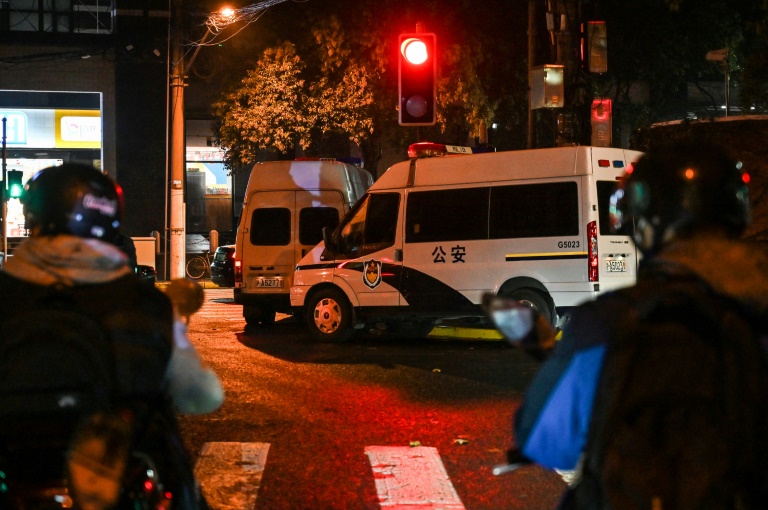
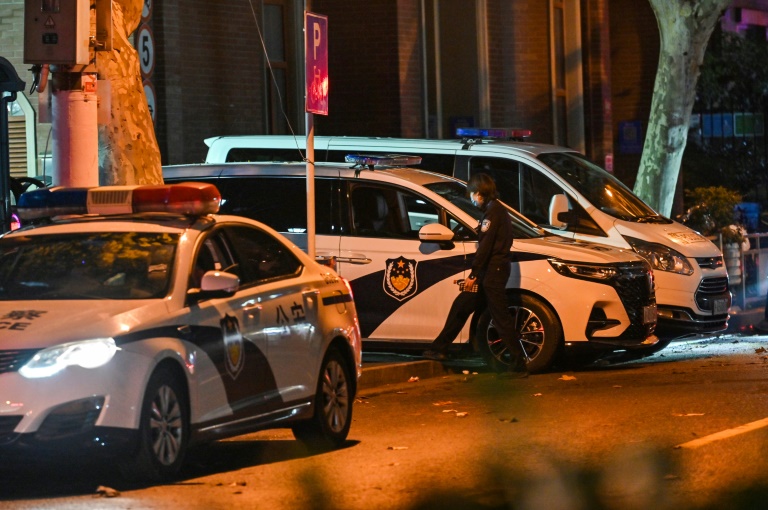
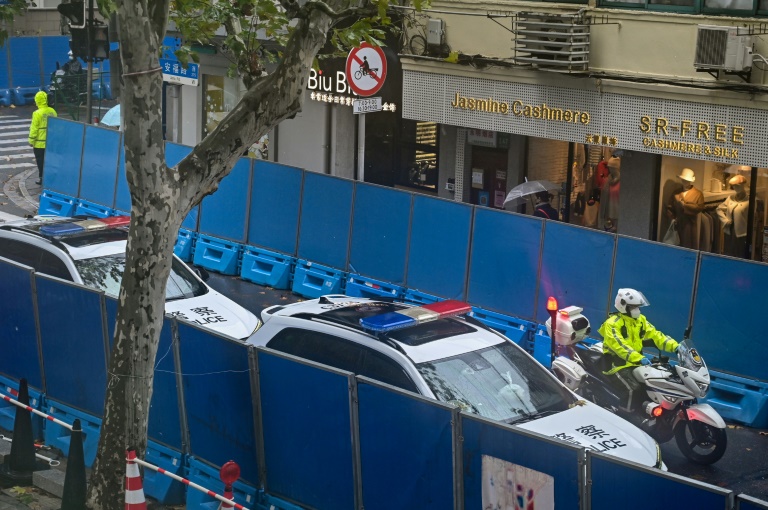
China’s major cities of Beijing and Shanghai were blanketed with security on Tuesday in the wake of nationwide rallies calling for political freedoms and an end to Covid lockdowns. 

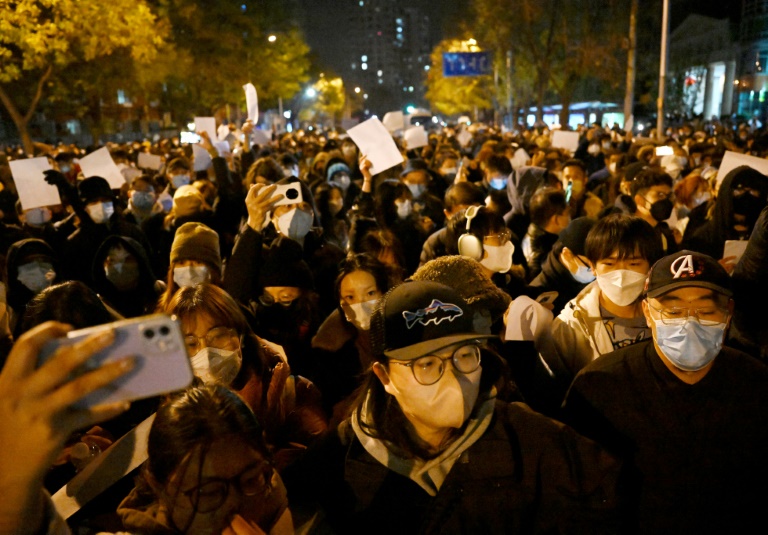
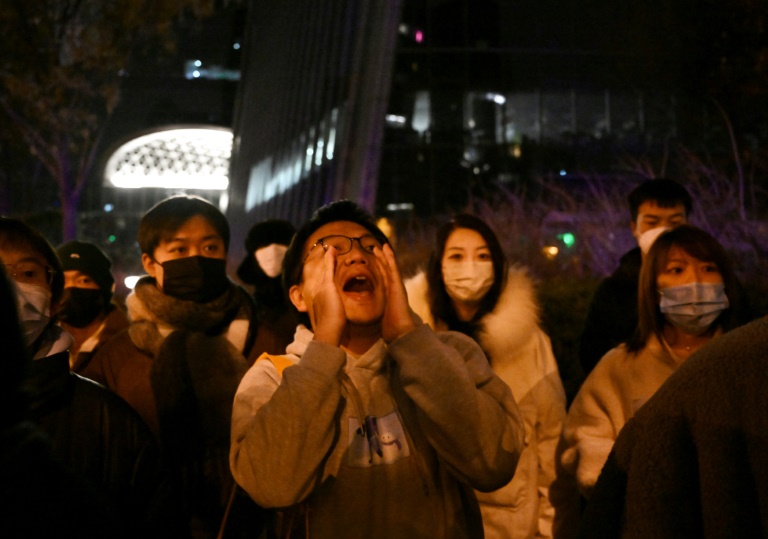
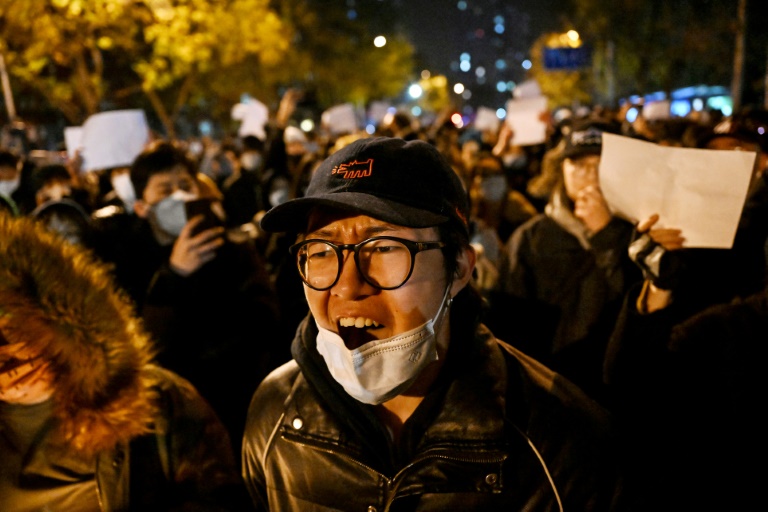
The country’s leadership faced a weekend of protests not seen in decades as anger over unrelenting lockdowns fuels deep-rooted frustration with its political system. 

A deadly fire last week in Urumqi, the capital of the northwestern region of Xinjiang, was the catalyst for the wave of outrage, with protesters taking to the streets in cities around China. 

The demonstrators said Covid-19 restrictions were to blame for hampering rescue efforts, claims the government has denied as it accused “forces with ulterior motives” of linking the fire deaths to the strict Covid controls.

Anger over lockdowns has widened to calls for political change, with protesters holding up blank sheets of paper to symbolise the censorship to which the world’s most populous country is subjected.

– ‘So many police’ –

More protests had been planned for Monday night but did not materialise. AFP journalists in Beijing and Shanghai noted a heavy police presence of hundreds of vehicles and officers on the streets.

People who had attended weekend rallies told AFP on Monday they had received phone calls from law enforcement officers demanding information about their movements.

In Shanghai, near a site where weekend protests saw bold calls for the resignation of President Xi Jinping, bar staff told AFP they had been ordered to close at 10:00 pm (1400 GMT) for “disease control”. 

Small clusters of officers were deployed to metro exits near the protest site.

AFP journalists saw officers detaining four people throughout Monday, releasing one later, with a reporter counting 12 police cars within 100 metres along Wulumuqi street in Shanghai, the focal point of Sunday’s rally.

Frustration with zero-Covid remained palpable despite the overwhelming police deployment.

“The (zero-Covid) policies now -– they’re just too strict. They kill more people than Covid,” one 17-year-old passerby, who asked to be identified only as Ray, told AFP.

He said he had been surrounded by police when passing through the area.

A man can be heard in an audio recording shared with AFP asking for his address. In response, Ray insists law enforcement officers do not “have the right” to demand it.

Some rallies did go ahead elsewhere on Monday night. 

In semi-autonomous Hong Kong, where mass democracy protests erupted in 2019, dozens gathered at the Chinese University to mourn the victims of the Urumqi fire.

“Don’t look away. Don’t forget,” protesters shouted.

In Hangzhou, just over 170 kilometres (105 miles) southwest of Shanghai, there was strict security and sporadic protests in the city’s downtown, with one attendee telling AFP that 10 people were detained. 

“The atmosphere was disorderly. There were few people and we were separated. There were lots of police, it was chaos,” she said.

– ‘Many died in vain’ –

Such widespread rallies are exceptionally rare, with authorities harshly clamping down on all opposition to the central government.

But China’s strict control of information and continued travel curbs have made verifying protester numbers across the vast country challenging.

US President Joe Biden is monitoring the unrest, the White House said Monday.

Solidarity protests also mushroomed around the world.

“Officials are borrowing the pretext of Covid, but using excessively strict lockdowns to control China’s population,” one 21-year-old Chinese participant in a Washington protest, who gave only his surname, Chen, told AFP. 

“They disregarded human lives and caused many to die in vain,” he said.

– ‘No longer afraid’ –

China’s leaders are committed to zero-Covid, which compels local governments to impose snap lockdowns and quarantine orders, and limit freedom of movement in response to minor outbreaks.

But there are signs that some local authorities are taking steps to relax some of the rules and dampen the unrest — and that authorities may be seeking a path out of the rigid policy.

Beijing has banned “the practice of barring building gates in closed-off residential compounds”, the official news agency Xinhua said on Sunday.

The practice has fuelled public anger as people found themselves locked in their homes during minor outbreaks. 

China’s National Health Commission announced on Tuesday a renewed effort to expand low vaccination rates among the elderly — long seen as a key obstacle to relaxing zero-Covid. 

Many fear that lifting the policy while swaths of the population remain not fully immunised could overwhelm China’s healthcare system and cause more than a million deaths.

Just 65.8 percent of people over 80 are fully vaccinated, NHC officials told a news conference.

China has also not yet approved mRNA vaccines, which are proven to be more effective, for public use.

They also said local efforts “inconsistent with national policies” had caused a “great impact on people’s work and life”, but did not suggest a change in policy was imminent.

Stocks, crude rise as China fears give way to Covid easing hopes

Equities rose with oil prices and the dollar weakened Tuesday as China avoided another night of protests after a weekend of unrest, with speculation growing that officials will announce a further easing of the country’s strict Covid containment measures.

The gains were led by a rally in Hong Kong and Shanghai, with property firms enjoying a much-needed surge on the back of moves to ease funding restrictions on troubled developers.

But sentiment was tempered by warnings from top Federal Reserve policymakers that US interest rates would rise further and could go higher than initially thought to fight inflation.

The remarks were partly to blame for big losses of more than one percent in Wall Street’s three main indexes.

China was rocked by demonstrations at the weekend calling for more political freedoms and an end to the country’s long-running and economically painful zero-Covid strategy that has seen millions thrown into lockdown for months.

Several arrests were made and security forces were out in force Monday to prevent a repeat of the protests, which were the most widespread since pro-democracy demonstrations were crushed in 1989.

The return of some calm helped Hong Kong stocks rally more than five percent and Shanghai more than two percent, with rumbling that the unrest could help push leaders to ease some of the strict containment measures. 

Beijing announced Tuesday afternoon a plan to speed up vaccinations of people aged 60 and older after seeing record daily case numbers in recent days.

Talk of a lighter approach to fighting the disease has helped reopening-linked firms rise, with retailers, cinema chains, Macau casinos and other tourism stocks benefiting.

Property firms were among the best performers after China said it would end a ban on firms raising cash by selling stocks, the latest measure to ease pressure on the sector, which has seen several companies collapse and threatens the wider economy.

Chinese investors were taking “a more pragmatic approach to the current Covid proceedings”, said SPI Asset Management’s Stephen Innes. “Indeed, a probable outcome is a quicker loosening of restrictions once the current Covid wave and numerous protest flash points subside.”

Sydney, Seoul, Singapore, Wellington, Bangkok, Mumbai, Taipei and Manila were also in positive territory, though Tokyo dipped with Jakarta.

London, Paris and Frankfurt all opened on the front foot.

The more upbeat mood saw the dollar drop against its peers, while oil prices rallied on the prospect of a pick-up in demand in China if leaders roll back some of their measures.

Attention is turning to the United States this week with a number of Fed officials due to speak, including boss Jerome Powell, while Friday sees the release of key jobs data, which could provide an idea about the bank’s plans for monetary policy.

Bets on a slowdown in its pace of rate hikes have boosted markets for the past weeks, but some high-ranking members on Monday looked to play down the chances of a more dovish pivot.

St. Louis Fed chief James Bullard warned “markets are underpricing a little bit the risk that the (policy board) will have to be more aggressive rather than less aggressive in order to contain the very substantial inflation that we have in the US”.

And Richmond Fed president Thomas Barkin added: “I’m very supportive of a path that is slower, probably longer and potentially higher than where we were before.”

The officials indicated borrowing costs would not likely come down until the end of next year or in 2024.

– Key figures around 0820 GMT –

Tokyo – Nikkei 225: DOWN 0.6 percent at 28,027.84 (close)

Hong Kong – Hang Seng Index: UP 5.2 percent at 18,204.68 (close)

Shanghai – Composite: UP 2.3 percent at 3,149.75 (close)

London – FTSE 100: UP 0.5 percent at 7,511.04

Euro/dollar: UP at $1.0356 from $1.0347 on Monday

Dollar/yen: DOWN at 138.20 yen from 138.87 yen

Pound/dollar: UP at $1.2024 from $1.1952

Euro/pound: DOWN at 86.13 pence from 86.50 pence

West Texas Intermediate: UP 1.6 at $78.46 per barrel

Brent North Sea crude: UP 1.8 percent at $84.68 per barrel

New York – Dow: DOWN 1.5 percent at 33,849.46 (close)

China cities under heavy policing after protests

China’s major cities of Beijing and Shanghai were blanketed with security on Tuesday in the wake of nationwide rallies calling for political freedoms and an end to Covid lockdowns.

The country’s leadership is facing a wave of protest not seen in decades, fuelled by anger over the unrelenting lockdowns as well as deep-rooted frustrations over China’s political direction.

A deadly fire last week in Urumqi, the capital of northwest China’s Xinjiang region, was the catalyst for public outrage, with protesters taking to the streets of cities around the country over the weekend.

The demonstrators said Covid restrictions were to blame for hampering rescue efforts — claims the government denied as it accused “forces with ulterior motives” of linking the fire to the strict virus measures.

– ‘So many police’ –

Several protests were planned for Monday night but did not materialise, with AFP journalists in Beijing and Shanghai noting a heavy police presence of hundreds of vehicles and officers on the streets.

People who had attended rallies over the weekend told AFP Monday they had received phone calls from law enforcement demanding information about their movements.

In Shanghai, near a site where weekend protests saw bold calls for the resignation of President Xi Jinping, bar staff told AFP they had been ordered to close at 10:00 pm (1400 GMT) for “disease control”. 

Small clusters of officers stood outside each metro exit.

Throughout the day AFP journalists saw officers detaining four people, later releasing one, with a reporter counting 12 police cars within 100 metres along Wulumuqi street in Shanghai, the focal point of Sunday’s rally.

“The atmosphere tonight is nervy. There are so many police around,” a man in his early 30s told AFP as evening fell.

And with police cars, foot patrols, a network of surveillance cameras, and aided by the icy wind, Beijing authorities also appeared Monday to have deterred fresh gatherings.

Elsewhere, some rallies did go ahead. In semi-autonomous Hong Kong, where mass democracy protests erupted in 2019, dozens gathered at the Chinese University to mourn the victims of the Urumqi fire.

“Don’t look away. Don’t forget,” protesters shouted.

And in Hangzhou, just over 170 kilometres (106 miles) southwest of Shanghai, there was strict security and sporadic protests in the city’s downtown, footage circulating on social media and partly geolocated by AFP showed.

– ‘Many died in vain’ –

China’s strict control of information and continued travel curbs has made verifying the numbers of protesters across the vast country challenging.

But such widespread rallies are exceptionally rare, with authorities harshly clamping down on all opposition to the central government.

US President Joe Biden is monitoring the unrest, the White House said Monday.

Around the world, solidarity protests have also mushroomed.

In the United States, Chinese-speaking and Uyghur communities came together in vigils.

“Officials are borrowing the pretext of Covid, but using excessively strict lockdowns to control China’s population,” one 21-year-old Chinese attendant who gave only his surname, Chen, told AFP.

“They disregarded human lives and caused many to die in vain,” he said.

– ‘No longer afraid’ –

China’s leaders have remained steadfast in their commitment to zero-Covid, which compels local authorities to impose snap lockdowns, quarantine orders, and limit freedom of movement in response to minor outbreaks.

But there are signs that some local authorities are taking steps to relax some of the rules and dampen the unrest.

In Urumqi, an official said Tuesday the city would give a one-off payment of 300 yuan ($42) to each person with “low income or no income”, and announced a five-month rent exemption for some households. 

People in the city of four million, some of whom have been confined to their homes for weeks on end, can also travel around on buses to run errands within their home districts starting Tuesday, officials said.

In Beijing, state media reported authorities had apologised for delayed deliveries to residents as online shopping demand surges due to repeated lockdowns.

The city has also banned “the practice of barring building gates in closed-off residential compounds”, Xinhua said on Sunday.

The practice has fuelled public anger as people found themselves locked in their homes during minor outbreaks. 

And an influential state media commentator suggested that Covid controls could be further relaxed — while insisting the public “will soon calm down”.

“I can give an absolute prediction: China will not become chaotic or out of control,” Hu Xijian, a columnist with the state-run tabloid Global Times said on Twitter, which is banned in China.

“China may walk out of the shadow of Covid-19 sooner than expected.”

Asian markets mostly rise after calm night in China

Asian equities rose and the dollar weakened Tuesday as China avoided another night of protests after a weekend of unrest across the country fuelled uncertainty in the world’s number two economy.

The gains were led by a rally in Hong Kong and Shanghai, with property firms enjoying a much-needed surge on the back of moves to ease funding restrictions on troubled developers.

However, sentiment was tempered by warnings from top Federal Reserve policymakers that US interest rates would rise further and could go higher than initially thought to fight inflation.

The remarks were partly to blame for big losses of more than one percent in Wall Street’s three main indexes.

China was rocked by demonstrations at the weekend calling for more political freedoms and an end to the country’s long-running and economically painful zero-Covid strategy that has seen millions thrown into lockdown for months.

Several arrests were made and security forces were out in force Monday to prevent a repeat of the protests, which were the most widespread since pro-democracy demonstrations were crushed in 1989.

The return of some calm helped Hong Kong stocks rally more than three percent and Shanghai more than one percent, with some commentators suggesting the unrest could actually help push leaders to ease some of the strict containment measures. 

Property firms were among the best performers after China said it would end a ban on firms raising cash by selling stocks, marking the latest measure to ease pressure on the sector, which has seen several companies collapse and threatens the wider economy.

Sydney, Seoul, Singapore, Wellington, Taipei and Jakarta were also in positive territory, though Tokyo dipped with Manila.

Attention is turning to the United States this week with a number of Fed officials due to speak, including boss Jerome Powell, while Friday sees the release of key jobs data, which could provide an idea about the bank’s plans for monetary policy.

Bets on a slowdown in its pace of rate hikes have boosted markets for the past weeks, but some high-ranking members on Monday looked to play down the chances of a more dovish pivot.

St. Louis Fed chief James Bullard warned “markets are underpricing a little bit the risk that the (policy board) will have to be more aggressive rather than less aggressive in order to contain the very substantial inflation that we have in the US”.

And Richmond Fed president Thomas Barkin added: “I’m very supportive of a path that is slower, probably longer and potentially higher than where we were before.”

The officials indicated borrowing costs would not likely come down until the end of next year or in 2024.

– Key figures around 0230 GMT –

Tokyo – Nikkei 225: DOWN 0.6 percent at 27,999.82 (break)

Hong Kong – Hang Seng Index: UP 3.6 percent at 17,920.01

Shanghai – Composite: UP 1.6 percent at 3,128.24

Euro/dollar: UP at $1.0357 from $1.0347 on Monday

Dollar/yen: DOWN at 138.85 yen from 138.87 yen

Pound/dollar: UP at $1.1992 from $1.1952

Euro/pound: DOWN at 86.40 pence from 86.50 pence

West Texas Intermediate: FLAT at $77.24 per barrel

Brent North Sea crude: UP 0.2 percent at $83.34 per barrel

New York – Dow: DOWN 1.5 percent at 33,849.46 (close)

London – FTSE 100: DOWN 0.2 percent at 7,474.02 (close)

Global equities slide on China unrest

Global stocks fell Monday as protests across China in opposition to the government’s hardline zero-Covid policy fueled uncertainty about the world’s number-two economy.

Hundreds of people took to the streets in China at the weekend, in a wave of demonstrations not seen since pro-democracy rallies in 1989 were crushed.

China-linked stocks took the brunt of selling in Asia, with Hong Kong’s Hang Seng Index closing down more than one percent and Shanghai off 0.8 percent. 

Paris, London and Frankfurt all ended in the red Monday while Wall Street also began a heavy week of economic data releases deeply in negative territory.

After last week’s advance, all three major US indices lost at least 1.5 percent.

“Sentiment has turned sour as unrest across China grows,” said SPI Asset Management’s Stephen Innes.

“Risk of the situation escalating from here and short-term volatility remains high.”

A deadly fire in the Xinjiang region Thursday served as the catalyst for the public anger in China, with many blaming virus lockdowns for hampering rescue efforts.

People have taken to the streets in Beijing, Shanghai, Guangzhou and Chengdu, with many calling for an end to lockdowns after an easing of some measures had fueled hopes of a lighter pandemic approach.

Some demonstrators were even demanding the resignation of President Xi Jinping, who recently secured an unprecedented third term as the country’s leader.

The tightened containment measures were introduced as China battled record-high Covid infections.

Beijing’s zero-Covid policy means the threat of more growth-choking lockdowns, City Index analyst Fawad Razaqzada said in a note.

“This is going to hold back the yuan and Chinese stocks, and potentially risk assets outside of China,” added Razaqzada.

The prospect of a hit to demand in the world’s biggest crude importer also hammered oil prices early in the day. But the commodity later rebounded following a rumor that oil exporters could trim production.

– Eyes on Fed boss –

The weakness “isn’t just about China. The reports out of China have also become a good excuse to take some money off the table following a big run by the market,” Briefing.com analyst Patrick O’Hare said in a note.

The selling has taken a bit out of recent gains across markets, sparked by hopes of a slowdown in the Federal Reserve’s interest rate hikes, with US inflation finally showing signs of softening.

However, some observers said the protests might provide long-term benefits as they could force President Xi to shift away from his strict, economically damaging measures sooner.

Investors are also looking ahead to the release of US jobs data at the end of the week, which could provide clues about the Fed’s next moves, while watching for speeches by central bank boss Jerome Powell and other key policymakers.

– Key figures around 2130 GMT –

New York – Dow: DOWN 1.5 percent at 33,849.46 (close)

New York – S&P 500: DOW 1.5 percent at  3,963.94 (close)

New York – Nasdaq: DOWN 1.6 percent at 11,049.50 (close)

London – FTSE 100: DOWN 0.2 percent at 7,474.02 (close)

Frankfurt – DAX: DOWN 1.1 percent at 14,383.36 (close)

Paris – CAC 40: DOWN 0.7 percent at 6,665.20 (close)

EURO STOXX 50: DOWN 0.7 percent at 3,935.51 (close)

Tokyo – Nikkei 225: DOWN 0.4 percent at 28,162.83 (close)

Hong Kong – Hang Seng Index: DOWN 1.6 percent at 17,297.94 (close)

Shanghai – Composite: DOWN 0.8 percent at 3,078.55 (close)

Euro/dollar: DOWN at $1.0347 from $1.0395 on Friday

Dollar/yen: DOWN at 138.87 yen from 139.19 yen

Pound/dollar: DOWN at $1.1952 from $1.2092

Euro/pound: UP at 86.50 pence from 85.96 pence

West Texas Intermediate: UP 1.3 percent at $77.24 per barrel

Brent North Sea crude: DOWN 0.5 percent at $83.19 per barrel

Equities, oil prices slide on China unrest

Stocks and oil prices fell Monday on concerns about protests across China calling for political freedoms and an end to the government’s hardline zero-Covid policy, fuelling uncertainty in the world’s number-two economy.

Hundreds of people took to the streets in China at the weekend in the country’s biggest demonstrations since pro-democracy rallies in 1989 were crushed.

“Unrest in major cities in China has destabilised risk-on markets including oil which is under pressure, pushing BP and Shell towards the bottom of the UK index,” noted Victoria Scholar, head of investment at Interactive Investor.

China-linked stocks took the brunt of selling in Asia, with Hong Kong’s Hang Seng Index closing down more than one percent and Shanghai off 0.8 percent. The yuan slipped by around one percent.

Paris, London and Frankfurt all ended in the red Monday while Wall Street also lost ground.

“Sentiment has turned sour as unrest across China grows,” said SPI Asset Management’s Stephen Innes. 

“Risk of the situation escalating from here and short-term volatility remains high.”

A deadly fire in the Xinjiang region Thursday served as the catalyst for the public anger in China, with many blaming virus lockdowns for hampering rescue efforts.

People have taken to the streets in Beijing, Shanghai, Guangzhou and Chengdu calling for an end to lockdowns, after an easing of some measures had fuelled hopes of a lighter pandemic approach.

Some demonstrators were even demanding the resignation of China’s President Xi Jinping, who was recently re-appointed to a precedent-breaking third term as the country’s leader.

The latest targeted containment measures have been introduced as the country sees record-high Covid infections.

China’s “zero covid policy means the threat of more growth-choking lockdowns are there. This is going to hold back the yuan and Chinese stocks, and potentially risk assets outside of China – not least crude oil, as we have seen”, City Index analyst Fawad Razaqzada said in a note.

The prospect of a hit to demand in the world’s biggest crude importer hammered oil prices.

The price of the Brent crude, the main international oil contract, was down 0.4 percent later Monday.

– Eyes on Fed boss –

The weakness “isn’t just about China. The reports out of China have also become a good excuse to take some money off the table following a big run by the market”, Briefing.com analyst Patrick J O’Hare said in a note.

The selling has taken a bit out of recent gains across markets sparked by hopes of a slowdown in the Federal Reserve’s interest rate hikes, with inflation finally showing signs of softening.

However, some observers said the protests could provide long-term benefits as they could force President Xi to shift away from his strict, economically damaging measures sooner.

Investors were also looking ahead to the release of US jobs data at the end of the week, which could provide clues about the Fed’s next moves, while speeches by central bank boss Jerome Powell and other key policymakers will also be pored over.

– Key figures around 1700 GMT –

New York – Dow: DOWN 0.7 percent at 34,096.43 points

London – FTSE 100: DOWN 0.2 percent at 7,474.02 (close)

Frankfurt – DAX: DOWN 1.1 percent at 14,383.36 (close)

Paris – CAC 40: DOWN 0.7 percent at 6,665.20 (close)

EURO STOXX 50: DOWN 0.7 percent at 3,935.51

Tokyo – Nikkei 225: DOWN 0.4 percent at 28,162.83 (close)

Hong Kong – Hang Seng Index: DOWN 1.6 percent at 17,297.94 (close)

Shanghai – Composite: DOWN 0.8 percent at 3,078.55 (close)

Euro/dollar: DOWN at $1.0377 from $1.0403 on Friday

Dollar/yen: DOWN at 138.82 yen from 139.03 yen

Pound/dollar: DOWN at $1.2020 from $1.2087

Euro/pound: UP at 86.32 pence from 86.03 pence

West Texas Intermediate: UP 0.7 percent at $76.84 per barrel

Brent North Sea crude: DOWN 0.4 percent at $83.31 per barrel

Equities, oil prices slide on China unrest

Stocks and oil prices fell Monday on concerns about protests across China calling for political freedoms and an end to the government’s hardline zero-Covid policy, fuelling uncertainty in the world’s number-two economy.

Hundreds of people took to the streets in China at the weekend in the country’s biggest demonstrations since pro-democracy rallies in 1989 were crushed.

“Unrest in major cities in China has destabilised risk-on markets including oil which is under pressure, pushing BP and Shell towards the bottom of the UK index,” noted Victoria Scholar, head of investment at Interactive Investor.

China-linked stocks took the brunt of selling in Asia, with Hong Kong’s Hang Seng Index closing down more than one percent and Shanghai off 0.8 percent. The yuan slipped by around one percent.

The unrest also left Wall Street and European markets in a sea of red.

“Sentiment has turned sour as unrest across China grows,” said SPI Asset Management’s Stephen Innes. 

“Risk of the situation escalating from here and short-term volatility remains high.”

A deadly fire in the Xinjiang region Thursday served as the catalyst for the public anger in China, with many blaming virus lockdowns for hampering rescue efforts.

People have taken to the streets in Beijing, Shanghai, Guangzhou and Chengdu calling for an end to lockdowns, after an easing of some measures had fuelled hopes of a lighter pandemic approach.

Some demonstrators were even demanding the resignation of China’s President Xi Jinping, who was recently re-appointed to a precedent-breaking third term as the country’s leader.

The latest targeted containment measures have been introduced as the country sees record-high Covid infections.

China’s “zero covid policy means the threat of more growth-choking lockdowns are there. This is going to hold back the yuan and Chinese stocks, and potentially risk assets outside of China – not least crude oil, as we have seen”, City Index analyst Fawad Razaqzada said in a note.

The prospect of a hit to demand in the world’s biggest crude importer hammered oil prices, with both main contracts down more than two percent.

– Eyes on Fed boss –

The weakness “isn’t just about China. The reports out of China have also become a good excuse to take some money off the table following a big run by the market”, Briefing.com analyst Patrick J O’Hare said in a note.

The selling has taken a bit out of recent gains across markets sparked by hopes of a slowdown in the Federal Reserve’s interest rate hikes, with inflation finally showing signs of softening.

However, some observers said the protests could provide long-term benefits as they could force President Xi to shift away from his strict, economically damaging measures sooner.

Investors were also looking ahead to the release of US jobs data at the end of the week, which could provide clues about the Fed’s next moves, while speeches by central bank boss Jerome Powell and other key policymakers will also be pored over.

– Key figures around 1430 GMT –

London – FTSE 100: DOWN 0.3 percent at 7,467.53 points

Frankfurt – DAX: DOWN 0.8 percent at 14,424.03

Paris – CAC 40: DOWN 0.7 percent at 6,666.43

EURO STOXX 50: DOWN 0.6 percent at 3,938.64

New York – Dow: DOWN 0.2 percent at 34,272.70

Tokyo – Nikkei 225: DOWN 0.4 percent at 28,162.83 (close)

Hong Kong – Hang Seng Index: DOWN 1.6 percent at 17,297.94 (close)

Shanghai – Composite: DOWN 0.8 percent at 3,078.55 (close)

Euro/dollar: UP at $1.0443 from $1.0403 on Friday

Dollar/yen: DOWN at 138.59 yen from 139.03 yen

Pound/dollar: DOWN at $1.2046 from $1.2087

Euro/pound: UP at 86.66 pence from 86.03 pence

West Texas Intermediate: DOWN 2.3 percent at $74.50 per barrel

Brent North Sea crude: DOWN 2.7 percent at $81.35 per barrel

Equities, oil prices slide on China unrest

Stocks and oil prices slid Monday on concerns about protests across China calling for political freedoms and an end to the government’s hardline zero-Covid policy, fuelling uncertainty in the world’s number-two economy.

“Unrest in major cities in China has destabilised risk-on markets including oil which is under pressure, pushing BP and Shell towards the bottom of the UK index,” noted Victoria Scholar, head of investment at Interactive Investor.

China-linked stocks took the brunt of selling in Asia, with Hong Kong’s Hang Seng Index closing down more than one percent and Shanghai off 0.8 percent. The yuan slipped more than one percent.

Europe’s main stock markets were all lower nearing the half-way stage.

“Sentiment has turned sour as unrest across China grows,” said SPI Asset Management’s Stephen Innes. 

“Risk of the situation escalating from here and short-term volatility remains high.”

Hundreds of people took to the streets in China at the weekend in the country’s biggest demonstrations since pro-democracy rallies in 1989 were crushed.

A deadly fire in the Xinjiang region Thursday served as the catalyst for the public anger, with many blaming virus lockdowns for hampering rescue efforts.

People have taken to the streets in Beijing, Shanghai, Guangzhou and Chengdu calling for an end to lockdowns, after an easing of some measures had fuelled hopes of a lighter pandemic approach.

Some demonstrators were even demanding the resignation of China’s President Xi Jinping, who was recently re-appointed to a precedent-breaking third term as the country’s leader.

The latest targeted containment measures have been introduced as the country sees record-high infections.

The prospect of a hit to demand in the world’s biggest crude importer hammered oil prices, with both main contracts down around three percent.

The selling has taken a bit out of recent gains across markets sparked by hopes of a slowdown in the Federal Reserve’s interest rate hikes, with inflation finally showing signs of softening.

However, some observers said the protests could provide long-term benefits as they could force President Xi to shift away from his strict, economically damaging measures sooner.

Investors were also looking ahead to the release of US jobs data at the end of the week, which could provide clues about the Fed’s next moves, while speeches by central bank boss Jerome Powell and other key policymakers will also be pored over.

– Key figures around 1130 GMT –

London – FTSE 100: DOWN 0.3 percent at 7,461.60 points

Frankfurt – DAX: DOWN 0.8 percent at 14,419.04

Paris – CAC 40: DOWN 0.8 percent at 6,656.50

EURO STOXX 50: DOWN 0.7 percent at 3,933.93

Tokyo – Nikkei 225: DOWN 0.4 percent at 28,162.83 (close)

Hong Kong – Hang Seng Index: DOWN 1.6 percent at 17,297.94 (close)

Shanghai – Composite: DOWN 0.8 percent at 3,078.55 (close)

New York – Dow: UP 0.5 percent at 34,347.03 (close)

Euro/dollar: UP at $1.0495 from $1.0403 on Friday

Dollar/yen: DOWN at 137.85 yen from 139.03 yen

Pound/dollar: UP at $1.2098 from $1.2087

Euro/pound: UP at 86.72 pence from 86.03 pence

West Texas Intermediate: DOWN 3.1 percent at $73.94 per barrel

Brent North Sea crude: DOWN 3.0 percent at $81.14 per barrel

Equities and crude drop as China hit by protests

Stocks and oil prices sank Monday on concerns about protests across China calling for political freedoms and an end to the government’s hardline zero-Covid policy, fuelling uncertainty in the world’s number-two economy.

Hundreds of people took to the streets at the weekend in the country’s biggest demonstrations since pro-democracy rallies in 1989 were crushed.

A deadly fire in the Xinjiang region on Thursday served as the catalyst for the public anger, with many blaming virus lockdowns for hampering rescue efforts.

People have taken to the streets in Beijing, Shanghai, Guangzhou and Chengdu calling for an end to lockdowns, after an easing of some measures had fuelled hopes of a lighter pandemic approach.

Some demonstrators were even demanding the resignation of China’s President Xi Jinping, who was recently re-appointed to a precedent-breaking third term as the country’s leader.

The latest targeted containment measures have been introduced as the country sees record-high infections.

China-linked stocks took the brunt of selling, with Hong Kong’s Hang Seng Index down more than one percent and Shanghai off 0.8 percent. The yuan slipped more than one percent.

There were also losses in Tokyo, Sydney, Seoul, Singapore, Taipei, Jakarta, Bangkok and Wellington.

London, Paris and Frankfurt opened with losses.

“Sentiment has turned sour as unrest across China grows,” said SPI Asset Management’s Stephen Innes. “Protest of this extent is rare in the country and raises many uncertainties.

“The best scenario is further easing and reopening, but the speed (of) how things deteriorated over the weekend suggests the government needs to act fast. The risk of the situation escalating from here and short-term volatility remains high.”

Ken Cheung of Mizuho Bank added: “It appears that the zero-Covid policy is reaching its tipping point. More easing or refinement on the Covid measures will be needed to curb discontent.”

The prospect of a hit to demand in the world’s biggest crude importer hammered oil prices, with both main contracts down more than two percent.

The selling has taken a bit out of recent gains across markets sparked by hopes of a slowdown in the Federal Reserve’s interest rate hikes, with inflation finally showing signs of softening.

However, some observers said the protests could provide long-term benefits as they could force President Xi Jinping to shift away from his strict, economically damaging measures sooner.

Teneo Holdings’ Gabriel Wildau said: “I don’t expect Xi to publicly admit error or show weakness, but this wave of protests could cause the leadership to decide privately that the exit needs to proceed more quickly than previously planned.”

Investors are now looking ahead to the release of US jobs data at the end of the week, which could provide clues about the Fed’s next moves, while speeches by central bank boss Jerome Powell and other key policymakers will also be pored over.

“While the likes of Federal Reserve Governor Christopher Waller can talk about the fact that the (policy board) is not going to react based on one consumer price index print from October — when the headline number came in below expectations at 7.7 percent — the inescapable fact remains that US CPI has been rising at a slower rate since June,” said Michael Hewson of CMC Markets.

– Key figures around 0710 GMT –

Tokyo – Nikkei 225: DOWN 0.4 percent at 28,162.83 (close)

Hong Kong – Hang Seng Index: DOWN 1.6 percent at 17,297.94 (close)

Shanghai – Composite: DOWN 0.8 percent at 3,078.55 (close)

London – FTSE 100: DOWN 0.6 percent at 7,439.90

Euro/dollar: DOWN at $1.0387 from $1.0403 on Friday

Dollar/yen: DOWN at 138.22 yen from 139.03 yen

Pound/dollar: DOWN at $1.2065 from $1.2087

Euro/pound: UP at 86.12 pence from 86.03 pence

West Texas Intermediate: DOWN 2.5 percent at $74.40 per barrel

Brent North Sea crude: DOWN 2.4 percent at $81.67 per barrel

New York – Dow: UP 0.5 percent at 34,347.03 (close)

Close Bitnami banner
Bitnami