Chinese Business

Markets mixed as investors digest ECB hike, US data

Volatile markets were mostly trading up on Thursday after the ECB announced an expected hike to interest rates in the face of sky-high inflation and the US economy posted positive figures.

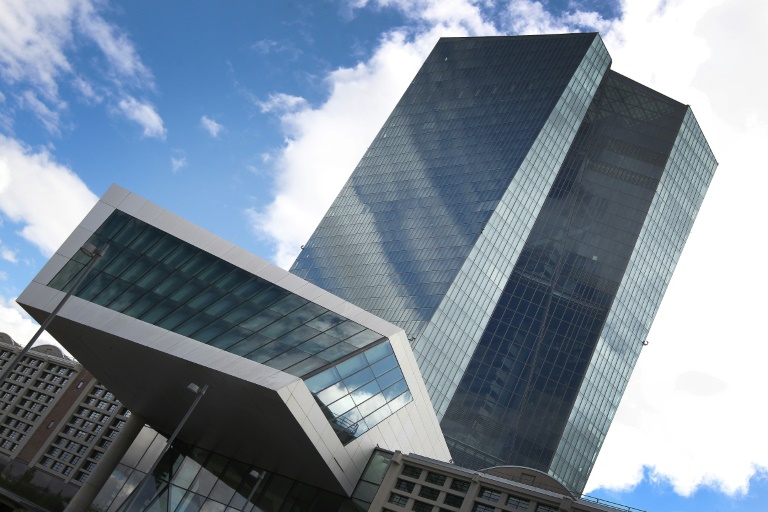
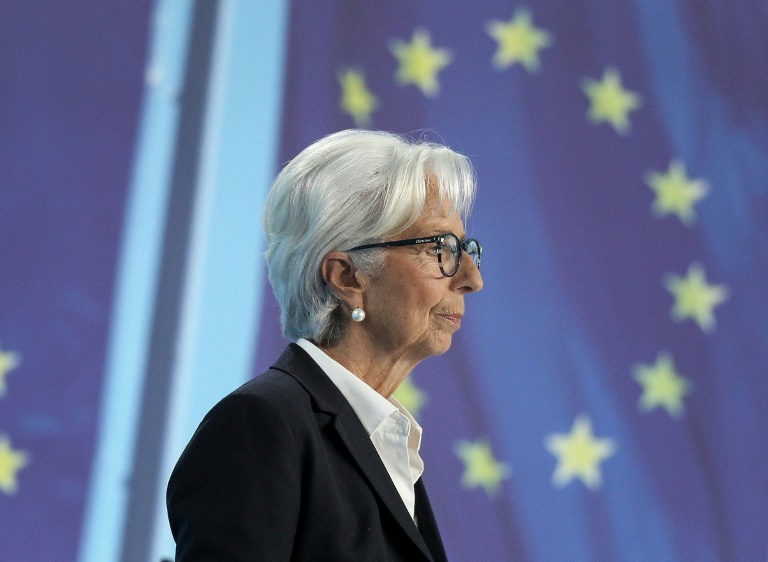
The European Central Bank rolled out another increase of 75 basis points, despite growing concern the eurozone is hurtling towards a painful recession.

President Christine Lagarde defended criticism of the hikes and said there would be “further rate increases in the future” to bring down inflation.

After fluctuating for much of the day, Eurozone stocks were flat by late afternoon trading.

The ECB hike was widely expected and comes as the Frankfurt institution faces pressure to rein in record-high inflation, mainly driven by skyrocketing energy costs in the wake of Russia’s war in Ukraine.

Markets.com analyst Neil Wilson said the hike was “in line with consensus but (a) less hawkish tone overall, indicative of fewer rate hikes required to tackle inflation.”

Eurozone inflation stood at 9.9 percent in September, nearly five times the ECB’s two-percent target.

The euro lost against the greenback on Thursday, after having traded above one dollar for the first time since last month on Wednesday.

“Overall, we should not forget that the recession risks increase globally, the policy tightening continues in major economies, and there is no sign that inflation is easing,” said Ipek Ozkardeskaya, analyst at Swissquote bank.

– Mixed US picture –

The New York Dow was up around one percent after the US commerce department data showed gross domestic product rose at an annual rate of 2.6 percent between July and September.

The latest GDP figures reflect “increases in exports, consumer spending” and government spending, according to the government.

But it warned of risks ahead, as households grapple with soaring prices and draw down on their savings.

“The US GDP grew faster than expected, yet looking closely, we see that the exports boosted the headline figure, while imports fell — meaning that the domestic demand from the US weakened despite a significant appreciation of the US dollar,” said Ozkardeskaya.

“The headline figures mask what is happening beneath the surface,” added Fiona Cincotta, Senior Financial Markets Analyst at City Index.

“The reality is that consumer growth, which accounts for more than two-thirds of the US economy, is slowing.”

– Credit Suisse shares slide –

Traders globally continued to digest earnings updates amid a slew of results from some of the world’s biggest companies.

Shares in Credit Suisse slumped some 18 percent after Switzerland’s second-biggest bank announced a string of radical measures Thursday aimed at turning around the beleaguered lender.

Credit Suisse revealed huge third quarter losses and said it would revamp its investment banking unit, slashing 9,000 jobs and raising fresh capital.

But the world’s top brewer ABInBev posted its best quarter of the year as sales volumes rose. 

And London’s benchmark FTSE 100 stocks index climbed, boosted by strong share-price gains for energy heavyweights BP and Shell following the latter’s bumper third-quarter profits on high oil and gas prices.

French giant TotalEnergies said net profits had soared 43 percent on last year to $6.6 billion — adding fuel to the raging debate over windfall taxes on energy firms due to the spike in prices thanks to Russia’s invasion of Ukraine.

– Key figures around 1530 GMT –

Euro/dollar: DOWN at $0.9987 from $1.0087 on Wednesday

Pound/dollar: DOWN at $1.1578 from $1.1621 

Dollar/yen: DOWN at 145.87 yen from 146.39 yen

Euro/pound: DOWN at 86.19 pence from 86.77 pence

New York – Dow: UP 1.2 percent at 32,210.68 

EURO STOXX 50: FLAT at 3,618.73

London – FTSE 100: UP 0.3 percent at 7,073.69 (close)

Frankfurt – DAX: UP 0.1 percent at 13,211.23 (close)

Paris – CAC 40: DOWN 0.5 percent at 6,244.03 (close)

Tokyo – Nikkei 225: DOWN 0.3 percent at 27,345.24 (close)

Hong Kong – Hang Seng Index: UP 0.7 percent at 15,427.94 (close)

Shanghai – Composite: DOWN 0.6 percent at 2,982.90 (close)

Brent North Sea crude: UP 1.3 percent at $94.98 per barrel

West Texas Intermediate: UP 1.8 percent at $89.52 per barrel

burs-rox/bp
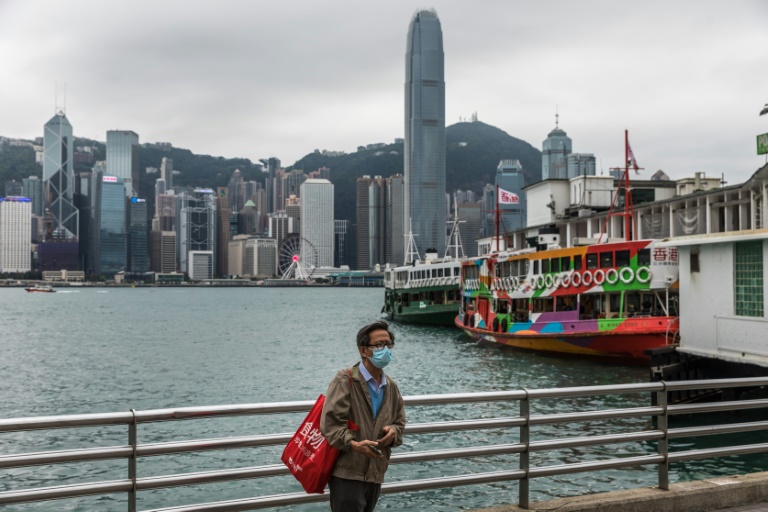
US lawmakers urge bank chiefs to reconsider Hong Kong meeting

US lawmakers on Thursday asked executives of major banks to reconsider attendance at a major conference next week in Hong Kong, saying their presence legitimizes China’s clampdown in the city.

Heads of some 30 big financial institutions are expected for the conference in Hong Kong, which is keen to show it is open for business after isolation under one of the world’s strictest Covid policies.

But the event also comes after China cracked down during the pandemic on the city’s pro-democracy movement, arresting activists and effectively shutting down independent media after imposing a draconian national security law in 2020.

“Business as usual in Hong Kong is the wrong choice for these companies,” said Senator Jeff Merkley and Representative Jim McGovern, Democrats who head the bipartisan Congressional-Executive Commission on China, which assesses human rights.

“Their presence only serves to legitimize the swift dismantling of Hong Kong’s autonomy, free press and the rule of law by Hong Kong authorities acting along with the Chinese Communist Party,” they said in a statement.

The lawmakers warned US financial executives they could draw “pertinent congressional concern” if they expand investments that further harm Hong Kong’s autonomy.

The lawmakers also accused Hong Kong’s Beijing-appointed leader, John Lee, of refusing to cooperate with US-led sanctions on Russia over its invasion of Ukraine.

The event will include panel talks featuring the CEOs of Goldman Sachs, Morgan Stanley and Citigroup.

Top executives from HSBC, Standard Chartered, JPMorgan Chase and BlackRock will also attend.

China promised to allow a separate system in Hong Kong before Britain returned the territory in 1997 but President Xi Jinping has solidified control after massive and sometimes violent protests against Beijing’s role.

Germany reviewing possible Chinese takeover of chip factory

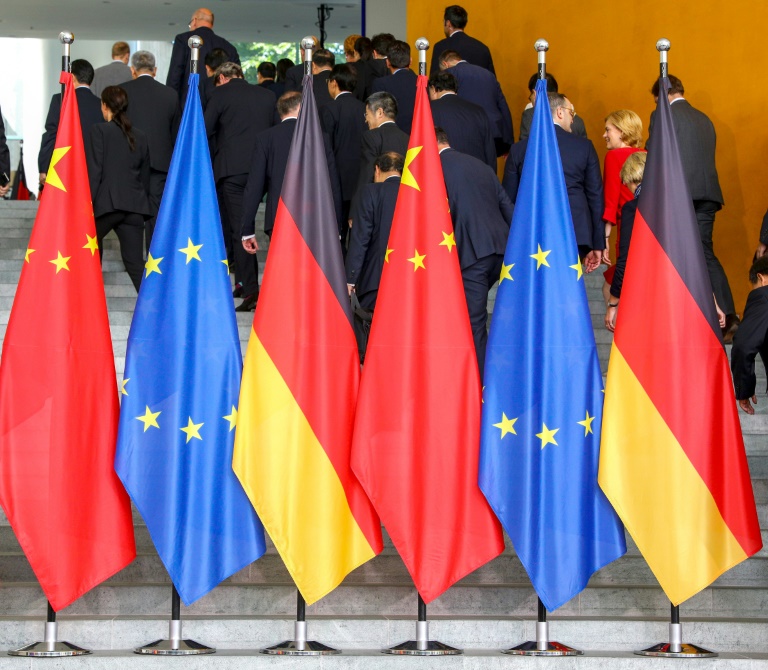
The German government is reviewing a possible sale of a local chip factory to a Chinese-owned firm, sources said Thursday, despite the reported concerns of intelligence agencies.

Government officials speaking on condition of anonymity told AFP that they were assessing the potential impact of a takeover of Dortmund-based Elmos by Sweden’s Silex, a unit of Chinese company Sai MicroElectronics.

“There is an ongoing investment review procedure,” one official said. “The checks have begun, are continuing and are not finished.”

The overture by the Chinese firm comes ahead of Chancellor Olaf Scholz’s visit to China next week as the first European Union leader to make the trip since November 2019.

And it coincides with growing fears within his coalition government and among intelligence officials about the risks of critical infrastructure and intellectual property falling into foreign hands.

Business daily Handelsblatt had reported earlier that Berlin intends to green-light the deal, possibly as early as next week.

In contrast with other recent controversial acquisitions, the chancellery and the economy ministry are in agreement on Elmos and inclined to approve the takeover as the company’s technology is not state of the art, according to the report.

However the domestic security watchdog, the Office for the Protection of the Constitution, warned against the sale, saying that Chinese control of key production capacity was enough to allow Beijing to apply pressure on Germany, Handelsblatt reported.

The Office could not immediately be reached for comment.

– Security concerns –

Elmos, which primarily builds components for the automobile industry, said late last year it intended to sell the production facility at its headquarters.

Silex is seeking to buy the site and its supplies for 85 million euros (dollars), which would allow Elmos to shed its own production activities and sell its chips to manufacturing contractors.

Germany’s coalition government on Wednesday allowed a Chinese firm to buy a reduced stake in a Hamburg port terminal, after Scholz resisted calls to ban the disputed sale outright over security concerns.

Under a tenuous compromise agreed by Scholz’s cabinet, Chinese shipping giant Cosco has the go-ahead to buy a stake “below 25 percent” in the Tollerort container terminal owned by HHLA.

Germany, along with EU partners, has in recent years taken a closer look at Chinese investment in sensitive technologies and other areas, and reserves the right to veto acquisitions.

The issue has gained urgency in light of the breakdown in ties with Russia over the Ukraine war due to the once heavy dependence of Europe’s top economy on Moscow’s energy supplies.

Euro holds above dollar parity before ECB

The euro held above parity with the dollar Thursday but eurozone stocks dropped as the European Central Bank prepares to announce another big hike to interest rates in the face of sky-high inflation.

The euro on Wednesday traded above one dollar for the first time since last month as the US currency slid also against the pound and yen on data showing cracks in the world’s biggest economy.

The dollar recovered some of the lost ground, however, ahead of Thursday’s key ECB decision.

“The European Central Bank will once again have to turn a blind eye on yet more recessionary signals in the eurozone, China and elsewhere as it battles to bring inflation back under control,” noted City Index market analyst Fawad Razaqzada.

“A 75-basis point rate hike appears to be a foregone conclusion, which means the reaction of the euro and European stocks will depend on more than just the rate decision itself.”

Markets will be looking for clues on the size of future ECB rate hikes in the press conference from the bank’s head Christine Lagarde, analysts said.

After a painful year for markets hit by central bank rate hikes to fight decades-high inflation, investors have taken heart from several weak US indicators — the latest on the services and real estate sectors — suggesting the economy is slowing.

That has led to speculation officials could be ready to tap the brakes on the increases, while some Fed policymakers have also raised the possibility of a slowdown.

The optimism was boosted Wednesday by news that the Bank of Canada had raised rates less than expected and signalled it is ready to wind down.

“The downshift at the Bank of Canada has further fanned the winds of a similar move by the Fed come December and comes after the (Australian central bank) slowed the pace of hikes to 25 basis points at its October meeting,” said National Australia Bank’s Taylor Nugent.

– Credit Suisse shares slide –

Traders continued to digest earnings updates from the world’s biggest companies.

Shares in Credit Suisse slumped nearly 11 percent after Switzerland’s second-biggest bank announced a string of radical measures Thursday aimed at turning around the beleaguered lender.

Credit Suisse revealed huge third quarter losses and said it would revamp its investment banking unit, slashing 9,000 jobs and raising fresh capital.

London’s benchmark FTSE 100 stocks index climbed, boosted by strong share-price gains for energy heavyweights BP and Shell following the latter’s bumper third-quarter profits on high oil and gas prices.

– Key figures around 1100 GMT –

Euro/dollar: DOWN at $1.0032 from $1.0087 on Wednesday

Pound/dollar: DOWN at $1.1562 from $1.1621 

Dollar/yen: DOWN at 146.32 yen from 146.39 yen

Euro/pound: DOWN at 86.74 pence from 86.77 pence

London – FTSE 100: UP 0.3 percent at 7,076.41 points

Frankfurt – DAX: DOWN 0.8 percent at 13,093.42

Paris – CAC 40: DOWN 0.8 percent at 6,229.06

EURO STOXX 50: DOWN 0.7 percent at 3,579.38

Tokyo – Nikkei 225: DOWN 0.3 percent at 27,345.24 (close)

Hong Kong – Hang Seng Index: UP 0.7 percent at 15,427.94 (close)

Shanghai – Composite: DOWN 0.6 percent at 2,982.90 (close)

New York – Dow: FLAT at 31,839.11 (close)

Brent North Sea crude: UP 0.6 percent at $96.24 per barrel

West Texas Intermediate: UP 0.6 percent at $88.41 per barrel

Ex-convict Samsung heir takes top job after pardon

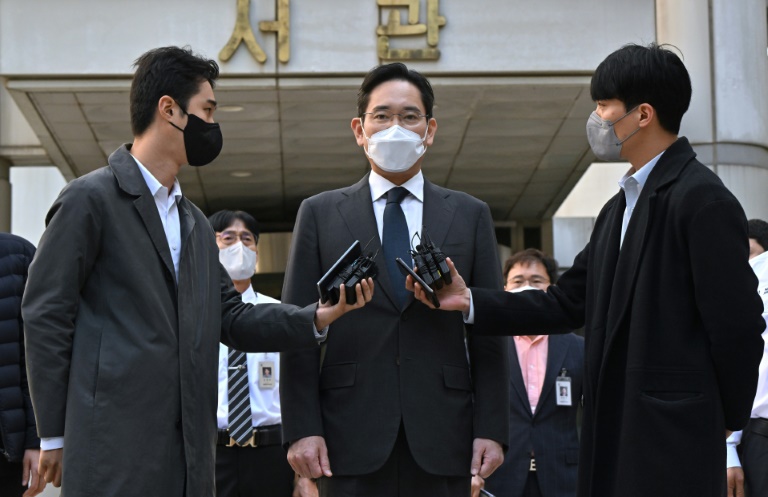
The once-disgraced heir to the sprawling Samsung empire was on Thursday named top executive of its most important business, two months after South Korea’s president pardoned him for embezzlement and corruption convictions.

The board of Samsung Electronics, one of the world’s biggest smartphone and chipmakers, confirmed Lee Jae-yong’s formal ascent — though he had already been de facto leader since his father’s heart attack in 2014.

Critics have said Lee taking the reins so soon after his year and a half in jail is yet another example in South Korea’s history of convicted business leaders getting off the hook on economic grounds.

The Samsung Electronics board promoted Lee to executive chairman to give the company “stronger accountability and business stability” due to the “current uncertain global business environment”, the company said in a statement Thursday.

Samsung is the most powerful of South Korea’s “chaebols”, family-controlled empires that dominate business, and it contributes an estimated fifth of the country’s GDP.

Lee was imprisoned after convictions for fraud and embezzlement following a sweeping investigation that also brought down President Park Geun-hye in 2017.

After serving 18 months, just over half of his original sentence, Lee was released on parole in August 2021.

He immediately returned to work at Samsung. 

In May, Lee was excused from a hearing in a separate fraud trial so he could host US President Joe Biden at a Samsung chip plant in South Korea.

Lee — who has a net worth of $7.2 billion, according to Forbes — received a presidential pardon in August 2022 with the expectation that he would “contribute to overcoming the economic crisis” in South Korea, the government said.

But critics slammed Lee’s elevation to chairman, with local civic group Solidarity for Economic Reform calling it “flawed on many fronts”. 

“It is a far cry from responsible management for him to be named Samsung Electronics’ chairman when his illegal acts brought considerable damage to the company even though he was pardoned by the president,” the group said in a statement.

– Legal woes not over –

Lee’s father Lee Kun-hee, who suffered a heart attack in 2014 and was bedridden until his death at age 78 in 2020, was credited with turning Samsung into a global tech giant.

He held the position of chairman until his death, and the post had been left vacant until the younger Lee’s promotion Thursday.

By taking his father’s old title, Lee sends a clear message that he will be “fully responsible” for Samsung’s management decisions, said Kim Dae-jong, professor of business at Sejong University in Seoul.

Samsung is trying to show its leadership is accountable, as part of a drive “to gain an upper hand in the global memory chip competition”, he told AFP.

The elder Lee was convicted twice, once in 1996 of bribing former president Roh Tae-woo, and then for embezzlement and tax evasion in a slush fund scandal in 2008.

But suspended sentences meant he never served time in jail, and he received two presidential pardons.

The elder Lee went on to spearhead his country’s successful efforts to secure the 2018 Winter Olympics.

On Thursday, Lee Jae-yong told Samsung Electronics employees he believed the company would not just survive the current global economic turmoil but emerge stronger.

“There has never been a time when we didn’t face a crisis. But depending on how we respond to it, we can turn it into an opportunity,” Lee said in a post on an internal bulletin board.

His legal woes are not over: he also faces a separate trial over accusations of accounting fraud in the 2015 merger of two Samsung firms.

EU chief calls for closer ties to Central Asia in Kazakhstan visit

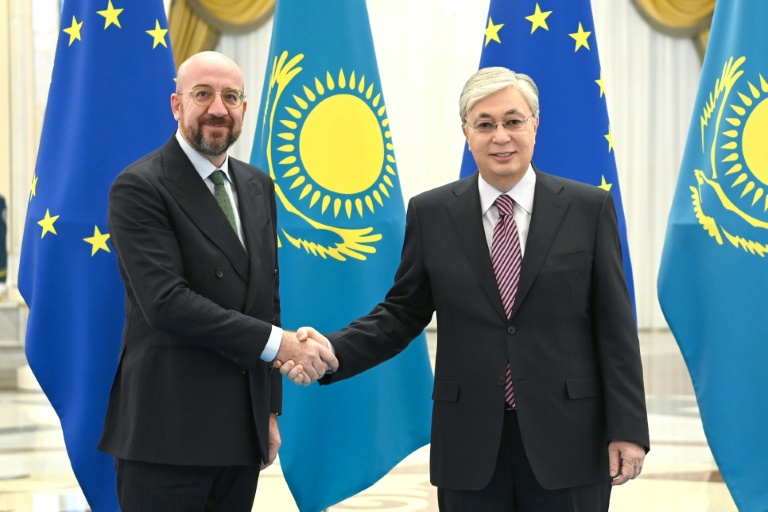
EU chief Charles Michel called on Thursday for closer ties with Central Asia on his first official visit to Kazakhstan, the main economic powerhouse in a region where Russia’s influence has come under question.

“Central Asia and Europe are coming closer together and becoming more and more connected,” Michel said at a press conference with Kazakh President Kassym-Jomart Tokayev in the capital Astana.

The head of the EU Council said Kazakhstan was a “crucial partner” and the EU hoped to “develop our cooperation”.

Michel’s visit comes eight months into Russia’s invasion of Ukraine, which has made Moscow’s former Soviet neighbours nervous and intensified the Kremlin’s clash with the West.

“My visit takes place at a difficult time for Europe and the wider region,” Michel said, condemning Moscow’s “war of aggression”. 

He is due to meet the leaders of all five Central Asian countries — Kazakhstan, Kyrgyzstan, Uzbekistan, Tajikistan and Turkmenistan — at 4:00 pm (1000 GMT). 

This is the first EU-Central Asia summit, a gathering Michel described as “much more than just a policy dialogue between two regions”.

“It’s a powerful symbol of our reinforced cooperation,” he said. 

He singled out Kazakhstan as a major trading partner for the EU and called for investment in transport infrastructure in the country, which has looked to reduce its dependence on Moscow since the latter sent troops to Ukraine. 

Michel’s visit comes two weeks after Astana hosted several summits attended by Russia — as well as by China and Turkey, who are also seeking to strengthen their influence in the region. 

Central Asian countries, traditional allies of Moscow, have trod a fine line on the Kremlin’s attack on Ukraine, neither condemning nor openly supporting it.

Tokayev even clashed with Russian President Vladimir Putin publicly in June, refusing to recognise the self-declared separatist republics controlled by pro-Moscow rebels in eastern Ukraine. 

Russia has since claimed to have annexed the regions.

Meanwhile Astana is seeking new routes for its oil exports, around three quarters of which transit Russia.

In early July, Tokayev pledged greater energy cooperation with the EU.

In a joint statement on Thursday, Tokayev and Michel said they discussed how to avoid “unintended negative impact on Kazakhstan’s economy” of EU sanctions against Russia, imposed over the Ukraine conflict.

They also discussed relocating to Kazakhstan “European manufacturing companies”, whose products are not subject to sanctions.

Rich in hydrocarbons and minerals, Kazakhstan lies at the heart of China’s massive new silk road project. 

Like Beijing, Turkey is also advancing its interest in the region, highlighting its ethno-linguistic and religious ties to Central Asia. 

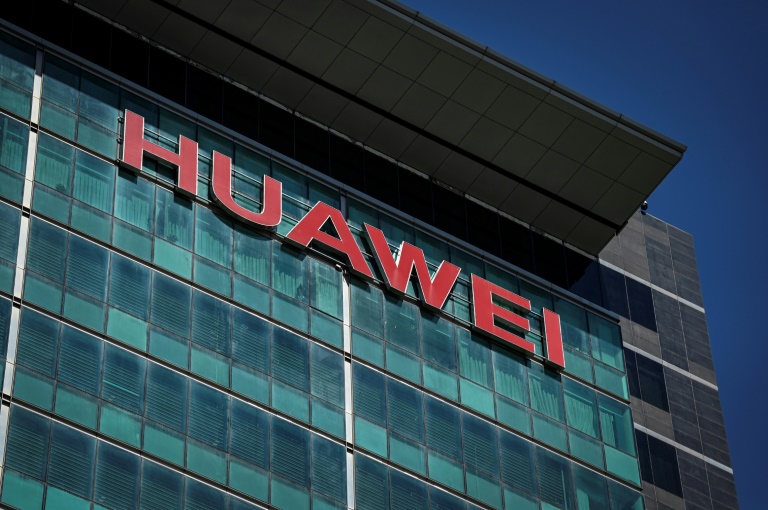
Huawei revenue down 2.2% in first three quarters of 2022

Revenue at Chinese telecom giant Huawei fell by 2.2 percent year on year in the first three quarters of 2022, company data showed Thursday, as Covid-19 and US sanctions dragged down sales.

Huawei made 445.8 billion yuan ($61.76 billion) in revenue in the first three quarters of 2022, a drop from 455.8 billion yuan in the same period a year ago, according to company data.

Huawei provided few specifics and did not include a breakdown of its data by business segment.

“Our device business was impacted by Covid-19 and global economic downturn,” a company spokesperson told AFP.

Eric Xu, Huawei’s rotating chairman, said in a statement that “overall performance was in line with forecast”. 

“The decline in our device business continued to slow down, and our ICT infrastructure business maintained steady growth,” Xu said.

A supplier of networking equipment, phones and other state-of-the-art gear, Huawei has struggled in the wake of a crackdown by the administration of former US president Donald Trump fuelled by cybersecurity and espionage concerns.

President Joe Biden’s administration has added to the pressure with the US Chip Act, which threatens Huawei’s access to global semiconductor supply chains. 

Its fifth-generation (5G) wireless network technology, meanwhile, has been blocked by major economies including the United States, Britain and Japan due to security concerns.

The company on Thursday said its profit margin for its main business from January to September was 6.1 percent, without revealing its net profit margin, which was 10.2 percent in the first three quarters of 2021.

The 2.2 percent fall in revenue in the first three quarters is significantly lower than the 32 percent revenue plunge it logged in the same period last year, showing slowing decline. 

– External ‘uncertainties’ –

The company’s smartphone sales have seen a slump in recent years after the United States cut Huawei off from key parts and barred it from using Google’s Android services.

It has rolled out its own Harmony operating system, which is now being used on 300 million Huawei devices mostly in China.

Huawei’s spokesperson on Thursday said the company was looking to focus on other devices.

It has expanded its enterprise and cloud computing business, and designed software and components for “smart” cars.

“Although there are uncertainties in the external environment, like Covid-19 and changes in the industry, we remain confident that we can meet our business targets for 2022,” the spokesperson said.

Huawei is not publicly listed and its accounts are not subject to the same audits as companies traded on the stock market.

Last year Huawei logged a record profit of 113.7 billion yuan despite a revenue slump, which the company attributed to “more efficient internal operations.”

Euro and pound hold gains, stocks mostly rise as rate fears ease

The euro, pound and yen all held their gains against the dollar Thursday and most equities rose as traders grow increasingly hopeful the Federal Reserve will slow its pace of interest rate hikes.

Hong Kong led the gains thanks to a surge in tech firms, extending a recovery from Monday’s rout that was fuelled by worries of Xi Jinping’s tightened grip on power in China.

After a painful year for markets hit by central bank rate hikes to fight soaring inflation, investors have taken heart from several weak US indicators — the latest on the services and real estate sectors — suggesting the economy is slowing.

That has led to speculation officials could be ready to tap the brakes on the increases, while some Fed policymakers have also raised the possibility of a slowdown.

The optimism was boosted Wednesday by news that the Bank of Canada had raised rates less than expected and signalled it is ready to wind down.

“The downshift at the Bank of Canada has further fanned the winds of a similar move by the Fed come December and comes after the (Australian central bank) slowed the pace of hikes to 25 basis points at its October meeting,” said National Australia Bank’s Taylor Nugent.

The news weighed on the dollar, which has surged against other currencies all year owing to the Fed’s rate drive, as US Treasury yields drop.

And on Thursday the euro held above parity with the greenback, a day after breaking the marker for the first time since last month and ahead of an expected European Central Bank rate hike.

The ECB meeting “really depends on not what (it) delivers, but what sort of guidance… President Christine Lagarde offers over future moves going forward for December, at a time when EU inflation is still showing little sign of slowing,” said Micahel Hewson of CMC Markets.

The yen held around 146 per dollar, having hit a 32-year low near 152 on Friday, and sterling was also holding above $1.16 after last month hitting a record low $1.0350 in reaction to then-prime minister Liz Truss’s debt-fuelled mini-budget.

The pound was also enjoying support after former finance minister Rishi Sunak became prime minister, giving hope for some stability after months of upheaval.

The positive performance was mirrored in equity markets, with Hong Kong rising one percent at one point thanks to a rally in beaten-down tech shares.

The Hang Seng Index’s advance follows a rout on Monday in response to Xi’s tighter grip on power and his decision to put in top posts loyalists who backed his zero-Covid strategy of lockdowns.

Among the standout performers, ecommerce giant Alibaba jumped more than eight percent and rival JD.com piled on more than 10 percent. The Hang Seng Tech Index was four percent higher.

The advances came after outsized gains for the firms’ New York-listed shares.

Sydney, Seoul, Singapore, Taipei, Manila, Bangkok, Mumbai, Jakarta and Wellington also rose. However, Tokyo and Shanghai slipped.

London edged up in the morning but Paris and Frankfurt eased back.

Analysts remain cautious owing to the fact inflation is stuck at multi-decade highs in various countries, while the Fed’s November meeting is now in focus.

“The Fed won’t blink next week and the risk of a 75 basis point hike in December should still remain on the table,” said OANDA’s Edward Moya.

“Cracks in the economy are here. Tighter financial conditions are not going away. Meanwhile, inflation and labour stats are not declining fast enough to support a Fed downshift just yet,” he said, adding that there was a risk of overtightening.

“The soft landing playbook just got thrown out the window and now Wall Street needs to gauge how bad of a recession will hit the economy next year.”

Oil prices dipped after Wednesday’s rally that came after US Secretary of State Antony Blinken warned that there was little scope for a new Iran nuclear deal, pointing to the clerical leadership’s conditions.

– Key figures around 0810 GMT –

Euro/dollar: DOWN at $1.0066 from $1.0087 on Wednesday

Pound/dollar: DOWN at $1.1600 from $1.1621 

Dollar/yen: DOWN at 145.72 yen from 146.39 yen

Euro/pound: UP at 86.84 pence from 86.77 pence

Tokyo – Nikkei 225: DOWN 0.3 percent at 27,345.24 (close)

Hong Kong – Hang Seng Index: UP 0.7 percent at 15,427.94 (close)

Shanghai – Composite: DOWN 0.6 percent at 2,982.90 (close)

London – FTSE 100: UP 0.2 percent at 7,071.42 

West Texas Intermediate: DOWN 0.4 percent at $87.55 per barrel

Brent North Sea crude: DOWN 0.4 percent at $95.27 per barrel

New York – Dow: FLAT at 31,839.11 (close)

Hong Kong finance chief contracts Covid ahead of banking summit

Hong Kong’s finance chief could have to miss an upcoming global banking summit in the city, after his office revealed Thursday he had tested positive for the coronavirus.

City authorities are eager for the international finance get-together to show Hong Kong is open for business, having been previously isolated by China’s zero-Covid policy.

Financial Secretary Paul Chan was scheduled to deliver speeches next Wednesday and Thursday at the conference, which is set to draw about 200 participants and the heads of 30 major financial institutions.

But it is now unclear if Chan will be able to attend.

He had been visiting Bahrain and Saudi Arabia to build trade ties and was scheduled to return Thursday.

But he tested positive under a rapid antigen test in Riyadh, his office said. 

“(Chan) has cancelled the remaining parts of the visit and will stay in Riyadh for a short while, and seek to comply with relevant health requirements and return to Hong Kong as soon as possible,” it said in a statement.

The office did not immediately respond to AFP questions about his updated itinerary.

Hong Kong has gradually relaxed its pandemic controls, including scrapping mandatory quarantine for new arrivals last month.

But it still maintains many strict curbs long abandoned by much of the world, including rival business hubs.

International arrivals must undergo multiple tests and cannot enter bars or restaurants for the first three days.

Under Hong Kong’s current rules, those who test positive for the coronavirus must isolate at home or in a hotel room, or a government isolation centre.

They may leave isolation after a week if they have tested negative on days six and seven.

Global banking chiefs will have a taste of Hong Kong’s existing pandemic curbs next week at the summit in the Four Seasons hotel, although certain rules will be relaxed.

Attendees will not be able to go to bars or restaurants during the first three days after arriving but will be able to socialise in a bubble within the hotel and attend an opening banquet at an art museum.

The event will include panel talks featuring the CEOs of Goldman Sachs, Morgan Stanley and Citigroup.

Top executives from HSBC, Standard Chartered, JPMorgan Chase and BlackRock will also attend.

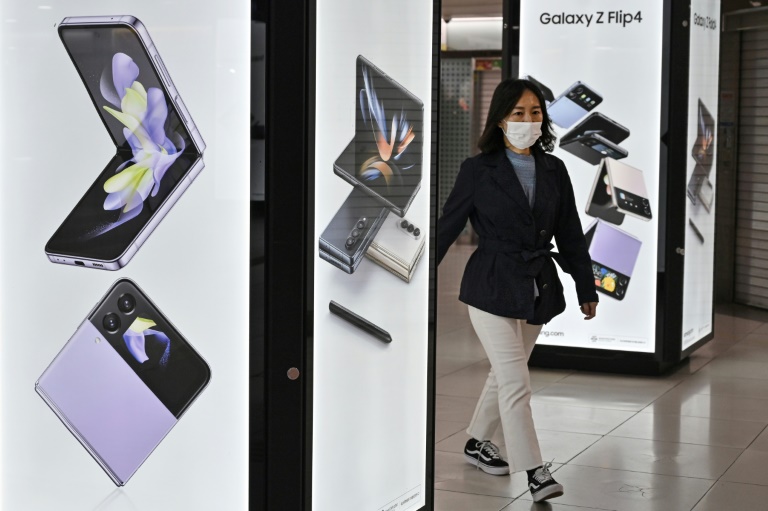
Samsung Electronics says Q3 operating profit down 31% on-year

South Korean tech giant Samsung Electronics on Thursday said its third-quarter operating profits were down 31.39 percent year on year after a global economic downturn hit demand for consumer electronics.

Earnings in its crucial memory chips division dropped, the company said in a statement, adding that “demand for consumer products remained weak”.

Operating profit for July to September 2022 fell to 10 trillion won ($7 billion), down from 15.8 trillion won for the same period last year, the company said.

The results were released the same day the company announced de facto leader Lee Jae-yong — who received a presidential pardon in August over a fraud conviction — would be promoted to chairman of Samsung Electronics.

“Our survival depends on future technologies,” Lee said in a message posted on the company’s internal forum after his promotion, Yonhap reported. “We can turn this crisis into opportunity.”

The third-quarter results are the first year-on-year decline in profit in nearly three years for Samsung Electronics, the world’s biggest smartphone maker.

But the company said it had seen an increase in sales, which were up by 3.79 percent from the same period last year to 76 trillion won.

The world’s biggest memory-chip maker is the flagship subsidiary of the giant Samsung group, by far the largest of the family-controlled empires known as chaebols that dominate business in South Korea, Asia’s fourth-largest economy.

The conglomerate is crucial to the country’s economic health — its overall turnover is equivalent to a fifth of the national gross domestic product.

Until the second quarter of this year, Samsung, along with other tech companies, significantly benefited from strong demand for electronic devices — as well as chips that power them — during the pandemic.

But the global economy is now facing multiple challenges, including soaring inflation, rising interest rates and the growing threat of a broad debt crisis.

The situation has been exacerbated by Russia’s invasion of Ukraine — which has spurred a surge in energy prices and pushed global food prices up — along with China’s adherence to a strict zero-Covid policy.

“In 2023, demand is expected to recover to some extent, but macroeconomic uncertainties are likely to persist,” Samsung Electronics said.

“In the Memory Business, after a dampened first half, demand is expected to rebound centering on servers as data center installations resume,” it added.

Analyst Park Sung-soon of Cape Investment & Securities told AFP he did not expect consumer demand for tech products to recover until the second half of 2023. 

“So the focus for Samsung will be adjusting its supply rather than relying on demand recovering anytime soon,” he said.

Samsung also said it had benefited from the strength of the US dollar against the Korean won, “resulting in an approximately 1.0 trillion won company-wide gain in operating profit compared to the previous quarter”.

– Geopolitics –

The vast majority of the world’s most advanced microchips are made by just two companies — Samsung and Taiwan’s TSMC — both of which are running at full capacity to alleviate a global shortage.

The supply of memory chips has become an issue of global geopolitical significance recently, with leading governments scrambling to secure supplies.

That was demonstrated in May when US President Joe Biden kicked off a South Korea tour by visiting Samsung’s sprawling Pyeongtaek chip plant.

Russia’s invasion of Ukraine has “further spotlighted the need to secure our critical supply chains”, Biden said at the plant, underscoring the importance of bolstering technology partnerships among “close partners who do share our values”.

Samsung employs about 20,000 people in the United States and work is under way to build a new semiconductor plant in Texas, scheduled to open in 2024.

The US also recently introduced new measures to limit China’s access to high-end semiconductors with military uses, a move that has wiped billions from chip companies’ valuations worldwide.

Close Bitnami banner
Bitnami