Chinese Business

IMF cuts 2023 global growth, warns major economies to stall

Global growth is expected to slow further next year, the IMF said Tuesday, downgrading its forecasts as countries grapple with the fallout from Russia’s invasion of Ukraine, spiraling cost-of-living and economic downturns.

The world economy has been dealt multiple blows, with the war in Ukraine driving up food and energy prices following the coronavirus outbreak, while soaring costs and rising interest rates threaten to reverberate around the globe.

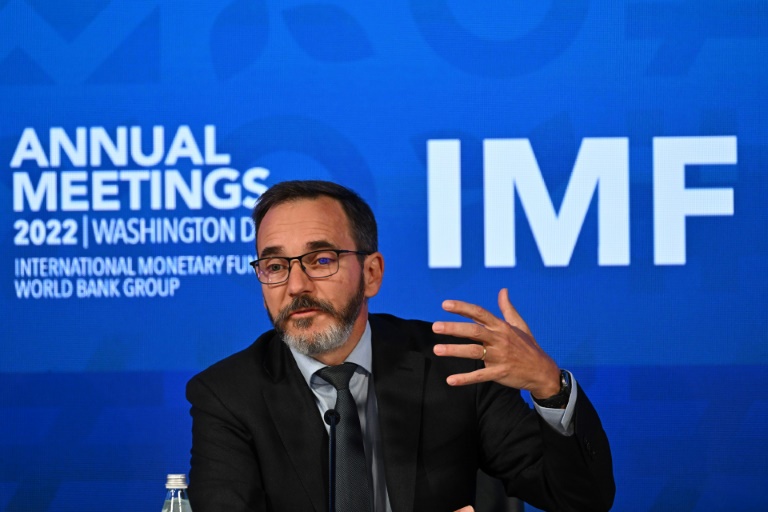
“This year’s shocks will re-open economic wounds that were only partially healed post-pandemic,” said International Monetary Fund economic counsellor Pierre-Olivier Gourinchas in a blog post accompanying the fund’s latest World Economic Outlook.

More than a third of the global economy is headed for contraction this year or next, and the three biggest economies –- the United States, European Union and China –- will continue to stall, he warned.

“The worst is yet to come and, for many people 2023 will feel like a recession,” said Gourinchas.

In its report, the IMF trimmed its 2023 global GDP forecast to 2.7 percent, 0.2 points down from July expectations.

Its world growth forecast for this year remains unchanged at 3.2 percent.

The global growth profile is its “weakest” since 2001, apart from during the global financial crisis and the worst of the pandemic, the IMF said.

This reflects slowdowns for the biggest economies, including a US GDP contraction in the first half of 2022 and continued lockdowns in China as it faces a property market crisis.

– Laser focus –

A key factor behind the slowdown is a shift in policy as central banks try to bring down soaring inflation, with higher interest rates starting to take the heat out of domestic demand.

Growing price pressures are the most immediate threat to prosperity, said Gourinchas in the report, adding that central banks are now “laser-focused on restoring price stability”.

Global inflation is expected to peak at 9.5 percent this year before dropping to 4.1 percent by 2024.

Misjudging the persistence of inflation could prove detrimental to future macroeconomic stability, he warned, “by gravely undermining the hard-won credibility of central banks.”

Asked about the Federal Reserve’s rate hikes, Gourinchas told a press briefing on Tuesday that the IMF is not calling for an acceleration, but this “doesn’t mean that they should pause on the path… that we’ve seen” either. 

This is because banks were starting from a point where rates were historically low as countries emerged from the pandemic, he said.

Current challenges do not mean a large downturn is inevitable, but the fund also warned many low-income countries are either in, or close to debt distress.

Progress toward debt restructurings for the hardest-hit is needed to avoid a wave of sovereign debt crisis.

“Time may soon be running out,” said Gourinchas.

While the G20 has agreed on a “common framework” for debt restructuring for the poorest countries, only three have qualified and “more progress is needed,” he told reporters.

– US slowdown –

The IMF has also cut forecasts for the world’s two biggest economies, the United States and China.

US economic growth for this year is now pegged at 1.6 percent, 0.7 points below the fund’s July forecast, due to an “unexpected real GDP contraction in the second quarter,” the IMF said.

“Declining real disposable income continues to eat into consumer demand, and higher interest rates are taking an important toll on spending,” the report added.

The Federal Reserve has been raising interest rates aggressively to tamp down surging inflation, which is slowing economic activity. And the central bank has said more increases are likely to come.

A slowdown in the Euro area is expected to deepen next year, with the German and Italian economies slightly contracting, the IMF projects.

China’s economy is expected to grow at only 3.2 percent this year — its lowest rate in decades, apart from the initial coronavirus outbreak.

The fund cautioned that a worsening of China’s property sector slump could spill over to the domestic banking sector and weigh heavily on growth.

Equities, oil prices slide on recession fears

Stock markets and oil prices slumped Tuesday as investors grow increasingly fearful that more big interest rate hikes will tip economies into deep recessions.

The mood darkened also on the worsening Ukraine war and weaker demand expectations in China.

With the focus on inflation, analysts said US consumer price index data released later this week will be crucial to the direction of risk assets. 

Another big reading could spark a fresh equity selloff and a surge in the dollar.

“There is growing pessimism in the markets now and with some big data points to come from the US this week, not to mention the start of earnings season,” noted Craig Erlam, analyst at OANDA trading group.

“Investors should probably brace for more volatility.”

Traders had hoped that bumper rate increases by the US Federal Reserve this year would begin to drag on the economy and slow runaway prices, allowing policymakers to reduce the pace of monetary tightening.

But a forecast-beating US jobs report on Friday highlighted the tough work the country’s central bank has slowing inflation from four-decade highs, and many observers warn recession is virtually inevitable.

– ‘Real danger’ –

World Bank chief David Malpass said there was a “real danger” of a global contraction next year, adding that the surge in the dollar was weakening the developing nations’ currencies and pushing their debt to “burdensome” levels.

And JP Morgan boss Jamie Dimon told CNBC that while the US economy was holding up, it faced several headwinds including rising rates, surging inflation, Fed tightening and the Ukraine war.

He added that he saw a US recession in six to nine months, and that the S&P 500 could fall another 20 percent.

Barings strategist Christopher Smart said: “It’s little wonder investors enter the week in a dreary mood, especially with headlines from Ukraine signalling a further escalation in geopolitical tensions.”

Chip manufacturers globally took a pounding from new US export controls aimed at restricting China’s ability to buy and make high-end chips with military applications.

The Philadelphia Stock Exchange Semiconductor Index saw its lowest close since late 2020, while Bloomberg News reported that $240 billion had been slashed from companies’ market values worldwide.

– Dollar dips –

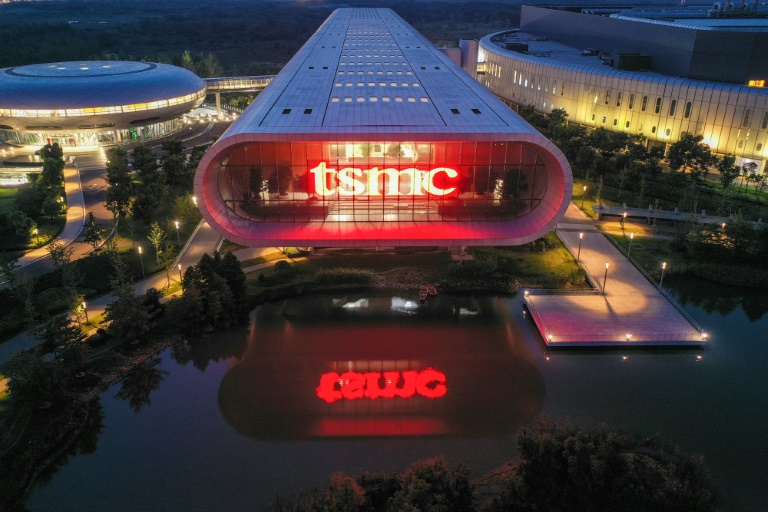
Taipei led the losses in Asia — diving more than four percent — as chip giant TSMC plunged 8.3 percent, while a hefty selloff in Samsung Electronics dragged Seoul down 1.6 percent. Tokyo was also sharply lower owing to a hit to tech firms.

All three markets had been closed Monday and were reacting to Friday’s US announcement for the first time.

On currency markets, the dollar dipped after recent strong gains as the United States heads the monetary tightening drive.

The pound nevertheless remained under pressure despite the Bank of England unveiling further measures to calm markets rocked by a UK budget, saying it would increase purchases of government bonds.

“Investors fear that the UK government is borrowing too much and that it won’t be able to balance its books,” said City Index and FOREX.com analyst Fawad Razaqzada.

Oil prices fell sharply, with concerns about Chinese demand front and centre.

“Covid cases are picking up in the country, and the Chinese Communist Party’s newspaper, the People’s Daily, ran a commentary saying the Covid Zero policy is ‘sustainable’, indicating that the country is likely to keep following it if not double down,” said Stephen Innes at SPI Asset Management. 

– Key figures around 1330 GMT –

London – FTSE 100: DOWN 0.8 percent at 6,903.83 points

Frankfurt – DAX: DOWN 0.6 percent at 12,198.54

Paris – CAC 40: DOWN 0.4 percent at 5,815.38

EURO STOXX 50: DOWN 0.6 percent at 3,336.12

New York – Dow: DOWN 0.3 percent at 29,114.89

Tokyo – Nikkei 225: DOWN 2.6 percent at 26,401.25 (close)

Hong Kong – Hang Seng Index: DOWN 2.2 percent at 16,832.36 (close)

Shanghai – Composite: UP 0.2 percent at 2,979.79 (close)

Euro/dollar: UP at $0.9716 from $0.9708 on Monday

Pound/dollar: UP at $1.1085 from $1.1059

Euro/pound: DOWN at 87.74 pence from 87.76 pence

Dollar/yen: DOWN at 145.68 yen from 145.72 yen

West Texas Intermediate: DOWN 2.0 percent at $89.03 per barrel

Brent North Sea crude: DOWN 1.8 percent at $94.45 per barrel

burs-rl/imm

Equities, oil prices slump on recession fears

Stock markets and oil prices slumped Tuesday as investors grow increasingly fearful that more big interest rate hikes will tip economies into deep recessions.

The mood darkened also on the worsening Ukraine war and weaker demand expectations in China.

With the focus on inflation, analysts said US consumer price index data released later this week will be crucial to the direction of risk assets. 

Another big reading could spark a fresh equity selloff and surge in the dollar.

“There is growing pessimism in the markets now and with some big data points to come from the US this week, not to mention the start of earnings season,” noted Craig Erlam, analyst at Oanda trading group.

“Investors should probably brace for more volatility.”

Traders had hoped that bumper rate increases by the US Federal Reserve this year would begin to drag on the economy and slow runaway prices, allowing policymakers to reduce the pace of monetary tightening.

But a forecast-beating US jobs report on Friday highlighted the tough work the country’s central bank has slowing inflation from four-decade highs, and many observers warn recession is virtually inevitable.

– ‘Real danger’ –

World Bank chief David Malpass said there was a “real danger” of a global contraction next year, adding that the surge in the dollar was weakening the developing nations’ currencies and pushing their debt to “burdensome” levels.

And JP Morgan boss Jamie Dimon told CNBC that while the US economy was holding up, it faced several headwinds including rising rates, surging inflation, Fed tightening and the Ukraine war.

He added that he saw a US recession in six to nine months, and that the S&P 500 could fall another 20 percent.

Barings strategist Christopher Smart said: “It’s little wonder investors enter the week in a dreary mood, especially with headlines from Ukraine signalling a further escalation in geopolitical tensions.

“Of course, markets are meant to look ahead, but it’s hard not to see the next few quarters bringing more of the same.”

Chip manufacturers globally took a pounding from new US export controls aimed at restricting China’s ability to buy and make high-end chips with military applications.

The Philadelphia Stock Exchange Semiconductor Index saw its lowest close since late 2020, while Bloomberg News reported that $240 billion had been slashed from companies’ market values worldwide.

– Dollar steady –

Taipei led the losses in Asia — diving more than four percent — as chip giant TSMC plunged 8.3 percent, while a hefty selloff in Samsung Electronics dragged Seoul down 1.6 percent. Tokyo was also sharply lower owing to a hit to tech firms.

All three markets had been closed Monday and were reacting to Friday’s US announcement for the first time.

On currency markets, the dollar steadied after recent strong gains as the US heads the monetary tightening drive.

The pound remained under pressure, despite the Bank of England unveiling further measures to calm markets rocked by a UK budget, saying it would extend purchases of government bonds.

– Key figures around 1045 GMT –

London – FTSE 100: DOWN 1.1 percent at 6,884.70 points

Frankfurt – DAX: DOWN 0.9 percent at 12,165.15

Paris – CAC 40: DOWN 0.7 percent at 5,801.48

EURO STOXX 50: DOWN 0.9 percent at 3,328.03

Tokyo – Nikkei 225: DOWN 2.6 percent at 26,401.25 (close)

Hong Kong – Hang Seng Index: DOWN 2.2 percent at 16,832.36 (close)

Shanghai – Composite: UP 0.2 percent at 2,979.79 (close)

New York – Dow: DOWN 0.3 percent at 29,202.88 (close)

Euro/dollar: UP at $0.9710 from $0.9708 on Monday

Pound/dollar: UP at $1.1060 from $1.1059 on Monday

Euro/pound: FLAT at 87.76 pence

Dollar/yen: DOWN at 145.68 yen from 145.72 yen

West Texas Intermediate: DOWN 2.4 percent at $88.98 per barrel

Brent North Sea crude: DOWN 2.2 percent at $94.10 per barrel

Equities drop on recession fears as inflation data looms

Markets mostly fell Tuesday as investors grow increasingly fearful that more big interest rate hikes will tip economies into deep recessions, with the mood also darkened by the worsening Ukraine war and worries over China’s outlook.

With the focus on inflation, analysts said consumer price index data released later this week will be crucial to the direction of risk assets — another big reading could spark a fresh equity selloff and surge in the dollar.

Investors had hoped that a series of bumper rate increases by the US Federal Reserve this year would begin to drag on the economy and slow runaway prices, allowing policymakers to slow down their pace of monetary tightening.

But a forecast-beating jobs report on Friday highlighted the tough work the central bank has in bringing inflation down from four-decade highs, and many observers warn a recession is virtually inevitable.

World Bank chief David Malpass said there was a “real danger” of a global contraction next year, adding that the surge in the dollar was weakening the developing nations’ currencies and pushing their debt to “burdensome” levels.

And JP Morgan boss Jamie Dimon told CNBC that while the US economy was holding up now, it faced several headwinds including rising rates, surging inflation, Fed tightening and the Ukraine war.

He added that he saw a US recession in six to nine months, and that the S&P 500 could fall another 20 percent.

Barings strategist Christopher Smart said: “It’s little wonder investors enter the week in a dreary mood, especially with headlines from Ukraine signalling a further escalation in geopolitical tensions.

“Of course, markets are meant to look ahead, but it’s hard not to see the next few quarters bringing more of the same.”

After another round of losses in New York, Asia again struggled.

Chip manufacturers globally took a pounding from new US export controls aimed at restricting China’s ability to buy and make high-end chips with military applications.

The Philadelphia Stock Exchange Semiconductor Index saw its lowest close since late 2020, while Bloomberg News reported that $240 billion had been slashed from companies’ market values worldwide.

– ‘Volatility ahead’ –

Taipei led the losses in Asia — diving more than four percent — as chip giant TSMC plunged 8.3 percent, while a hefty selloff in Samsung Electronics dragged Seoul down 1.6 percent. Tokyo was also sharply lower owing to a hit to tech firms.

All three markets had been closed Monday and were reacting to Friday’s US announcement for the first time.

Hong Kong fell more than two percent to below 17,000 points for the first time since late 2011, while Sydney, Singapore, Mumbai, Bangkok and Jakarta were also lower.

Shanghai, Wellington and Manila edged up slightly on bargain-buying.

London, Paris and Frankfurt also fell at the open.

“There is growing pessimism in the markets now and with some big data points to come from the US this week, not to mention the start of earnings season… investors should probably brace for more volatility ahead,” said OANDA’s Craig Erlam.

There was a glimmer of optimism for investors in comments from Fed vice chair Lael Brainard, who appeared to hint at a more cautious tone for policy as the hikes already announced work through the economy.

But SPI Asset Management’s Stephen Innes said traders were likely to be guarded in their reaction to the remarks.

“With the market in ‘fool me once, shame on me, fool me twice, shame on you’ mode, investors should be 100 percent defensive, erring to classical risk-off strategies as local conversations defer to risk-off,” he said in a commentary.

On currency markets, the dollar remained king as the United States lead the monetary tightening drive, and eyes are on the reaction in Tokyo as the yen drops towards the 145.90 level that last month saw massive government intervention.

The pound was also still under pressure, despite the Bank of England unveiling fresh measures to calm markets rocked by a UK budget, saying it would extend purchases of government bonds.

The news came as official data revealed British unemployment fell to a near 50-year low at 3.5 percent, although wages continue to be eroded by sky-high inflation.

– Key figures around 0810 GMT –

Tokyo – Nikkei 225: DOWN 2.6 percent at 26,401.25 (close)

Hong Kong – Hang Seng Index: DOWN 2.2 percent at 16,832.36 (close)

Shanghai – Composite: UP 0.2 percent at 2,979.79 (close)

London – FTSE 100: DOWN 0.8 percent at 6,902.56

Pound/dollar: DOWN at $1.1020 from $1.1059 on Monday

Euro/dollar: DOWN at $0.9699 from $0.9708

Euro/pound: UP at 88.00 pence from 87.76 pence

Dollar/yen: DOWN at 145.62 yen from 145.72 yen

West Texas Intermediate: DOWN 0.2 percent at $90.91 per barrel

Brent North Sea crude: DOWN 0.1 percent at $96.11 per barrel

New York – Dow: DOWN 0.3 percent at 29,202.88 (close)

Asian chipmakers plunge after US unveils China export controls

Chipmakers plunged in Asian trade Tuesday over new US measures to limit China’s access to high-end semiconductors with military uses, a move that wiped billions from companies’ valuations worldwide.

The announcement on Friday marked the latest volley in a long-running standoff between the two superpowers that has seen them face off over a range of issues including technology, trade, Hong Kong, Taiwan and human rights.

The US Department of Commerce said the measures include export restrictions on some chips used in supercomputing, and toughen requirements on the sale of semiconductor equipment.

The decision hammered chip manufacturers, with the Philadelphia Stock Exchange Semiconductor Index seeing its lowest close since late 2020, while Bloomberg News reported that $240 billion had been slashed from companies’ market values globally.

Taipei, Seoul and Tokyo markets were closed for holidays on Monday, and when trading resumed Tuesday, chipmakers sank.

Taipei-listed firms were among the worst hit with the Taiex stock index shedding more than four percent.

Taiwan Semiconductor Manufacturing Co. shed 8.3 percent and ASE Technology plunged nine percent, while United Microelectronics shed seven percent.

South Korean tech titan Samsung Electronics, a major semiconductor maker, fell more than one percent in Seoul where DB Hitek was off more than three percent.

And in Tokyo, Renesas Electronics shed almost six percent, with Tokyo Electron losing a similar amount.

The US measures are likely to complicate Beijing’s push to further its own semiconductor industry and develop advanced military systems.

They came days ahead of a major Communist Party congress in China at which President Xi Jinping is expected to secure a historic third term.

The rules were also announced just days after the Pentagon added 13 more Chinese firms including drone manufacturer DJI and surveillance firm Zhejiang Dahua Technology to a blacklist of Chinese military-linked companies.

“With the latest measure, it would become difficult for China to manufacture and develop semiconductors because most semiconductor equipment is dominated by the US and its allies,” said Chae Minsook, of Korea Investment & Securities.

“It is impossible to maintain the chip industry without adopting advanced equipment.”

'Dream come true': Japan reopens to tourists

Japan reopened its doors to tourists Tuesday after two-and-a-half years of tough Covid-19 restrictions, with officials hoping an influx of travellers enticed by a weak yen will boost the economy.

By mid-morning, tourists from Israel, France and Britain were already pouring in, including Chris Irwin, 38, on his first trip to Japan.

“We have always wanted to come to Japan, and it seemed like the stars just aligned,” said Irwin, who arrived at Haneda airport from Britain with his wife.

Adi Bromshtine, a 69-year-old retiree from Israel, said she had been “planning before Covid and waiting and waiting” for the chance to visit Japan.

“It’s a long, long dream come true,” she told AFP.

Japan slammed its borders shut early in the pandemic, at one point even barring foreign residents from returning, and has only recently begun cautiously reopening.

In June, it began allowing tourists to visit in groups accompanied by guides, a requirement that was further relaxed to include self-guided package tours.

From Tuesday, visa-free entry resumed for travellers from 68 countries and territories.

Japan also lifted a cap on the number of arrivals and ended the package tour requirement.

Tourists must still present either proof of vaccination or a negative coronavirus test taken three days before departure.

In 2019, a record 31.9 million foreign visitors came to Japan, putting the country on track for its goal of 40 million by 2020, when Tokyo was supposed to host the Summer Olympics.

But in 2021, the figure plummeted to just 250,000.

– Demand soaring –

In Japan, tourists will find a country that is still adhering to many of the health guidelines that helped it keep pandemic deaths to around 45,500, far lower than many other developed economies.

Masks are ubiquitous, and though not mandated by law, parliament is set to pass legislation allowing hotels to deny service to customers who refuse to wear one or flout other health rules.

Masks are worn not only indoors and on public transport, but outdoors as well, despite the government saying they are not necessary outside in uncrowded settings.

There is hand sanitiser at the entrance of most businesses, and plastic dividers are still often used in restaurants.

Many arriving tourists seemed unfazed by the rules though.

“We’re more excited to see Japan than we will be annoyed by the masks, so we’ll be fine with it,” said British traveller Irwin.

Another major change for tourists will be the weakness of the yen, which is hovering around 145 to the dollar, a level not seen for two decades.

The government has already had to intervene once to prop up the currency, and government spokesman Hirokazu Matsuno on Tuesday said officials are hoping rebounding tourism “will lead to recovery after the Covid pandemic and the revitalisation of communities.”

There is certainly no shortage of demand, according to Antoine Chanthavong, of Paris-based travel agency Destination Japan.

Since the reopening announcement, “we’ve been absolutely drowning, we don’t have enough time to deal with all the requests,” he told AFP.

Japanese carrier ANA has said reservations for international flights to the country surged five-fold after the reopening was announced.

For now, tickets are not coming cheap, with fuel prices soaring and airlines forced to take circuitous routes to avoid Russian airspace.

Itay Galili, a 22-year-old student arriving from Israel, said he wasn’t put off by the cost.

“As soon as I heard it was going to reopen on the 11th, I started planning. Tickets were expensive… but no price (is) too heavy,” he told AFP.

For all the rebound in demand though, there is little expectation that tourist numbers will quickly reach their 2019 levels.

Before the pandemic, travellers from Hong Kong and mainland China made up 37 percent of all foreign visitors to Japan, and 44 percent of tourism income.

But tough Covid restrictions in China make it unlikely visitors from there will be flocking back to Japan anytime soon.

Asian chipmakers plunge after US unveils China export controls

Chipmakers plunged in Asian trade Tuesday over new US measures to limit China’s access to high-end semiconductors with military uses, a move that wiped billions from companies’ valuations worldwide.

The announcement on Friday marked the latest volley in a long-running standoff between the two superpowers that has seen them face off over a range of issues including technology, trade, Hong Kong, Taiwan and human rights.

The US Department of Commerce said the measures include export restrictions on some chips used in supercomputing, and toughen requirements on the sale of semiconductor equipment.

The decision hammered chip manufacturers, with the Philadelphia Stock Exchange Semiconductor Index seeing its lowest close since late 2020, while Bloomberg News reported that $240 billion had been slashed from companies’ market values globally.

Taipei, Seoul and Tokyo markets were closed for holidays on Monday, and when trading resumed Tuesday, chipmakers sank.

Taipei-listed firms were among the worst hit.

Taiwan Semiconductor Manufacturing Co. and ASE Technology each plunged around eight percent, while United Microelectronics shed more than six percent.

South Korean tech titan Samsung Electronics, a major semiconductor maker, dived around three percent in Seoul where DB Hitek was off four percent.

And in Tokyo, Renesas Electronics shed almost six percent, with Tokyo Electron losing a similar amount.

The US measures are likely to complicate Beijing’s push to further its own semiconductor industry and develop advanced military systems.

They came days ahead of a major Communist Party congress in China at which President Xi Jinping is expected to secure a historic third term.

The rules were also announced just days after the Pentagon added 13 more Chinese firms including drone manufacturer DJI and surveillance firm Zhejiang Dahua Technology to a blacklist of Chinese military-linked companies.

“With the latest measure, it would become difficult for China to manufacture and develop semiconductors because most semiconductor equipment is dominated by the US and its allies,” said Chae Minsook, of Korea Investment & Securities.

“It is impossible to maintain the chip industry without adopting advanced equipment.”

Hong Kong leader says he 'laughs off' US sanctions

Hong Kong’s leader laughed off US sanctions against him Tuesday as he defended his government’s decision not to act against a superyacht reportedly owned by a Kremlin ally.

The Nord — a $500 million luxury vessel linked to Russian billionaire Alexei Mordashov — arrived in the Chinese territory’s waters last week.

Mordashov is among the oligarchs close to Russian President Vladimir Putin who have been targeted by Western sanctions following Moscow’s invasion of Ukraine.

On Saturday the United States warned Hong Kong could damage its business hub reputation after the city said it would not enforce sanctions on the superyacht.

Hong Kong chief executive John Lee himself is one of multiple Chinese officials sanctioned by the United States in 2020 for their roles in cracking down on political freedoms in the city.

Banks and other companies risk losing access to the US-dominated global markets if they do business with sanctioned officials, with Lee’s predecessor revealing she had to take most of her salary in cash as a result.

When asked about the impact of US sanctions against him on Tuesday, Lee told reporters: “It is a very barbaric act and I am not going to comment on the effect of such barbaric act.” 

“We will just laugh off the so-called sanctions.”

Some sanctioned oligarchs have had their luxury yachts seized in places such as Spain and Fiji, but Hong Kong said Friday that while it implements UN sanctions, it cannot enforce those imposed “unilaterally” by countries or blocs.

Lee repeated that argument on Tuesday, describing US and European sanctions as having “no legal basis”.

“We will comply with any UN resolution on sanctions because Hong Kong has the legal basis to enforce it,” he said.

But he added: “We cannot and will not do anything that has no legal basis”. 

Block 'busted': India's Bollywood faces horror show at box office

India’s Bollywood film industry, long part of the cultural fabric of the movie-mad country of 1.4 billion people, is facing its biggest-ever crisis as streaming services and non-Hindi language rivals steal its sparkle.

The South Asian giant churns out on average around 1,600 films each year, more than any other country, traditionally headlined by glitzy Bollywood, with fans worshipping movie stars like gods and crowds thronging premieres.

But now cinemas have fallen quiet, even in Bollywood’s nerve centre of Mumbai, with box-office receipts plunging since Covid curbs were lifted.

“This is the worst crisis ever faced,” veteran Mumbai theatre owner Manoj Desai told AFP. Some screenings were cancelled as the “public was not there”.

The usually bankable megastar Akshay Kumar had three back-to-back films tank. Fellow A-lister Aamir Khan, the face of some of India’s most successful films, failed to entice audiences with the “Forrest Gump” remake “Laal Singh Chaddha”.

Of the more than 50 Bollywood films released in the past year — fewer than normal because of the pandemic — just one-fifth have met or surpassed revenue targets, said media analyst Karan Taurani of Elara Capital. Pre-pandemic it was 50 percent.

In contrast, several Telugu-language aka Tollywood movies — a south Indian competitor to Hindi-language Bollywood — have soared to the top.

Embarrassingly, around half the box-office takings for Hindi-language films from January 2021 to August this year were dubbed southern offerings, said State Bank of India’s chief economic adviser Soumya Kanti Ghosh in a recent report.

“Bollywood, after decades of storytelling… seems to be at an inflection point unlike any other disruption it has faced before,” Ghosh wrote.

– ‘Out-of-touch’ –

Bollywood, like other movie industries, has been hurt by streaming’s rise, which started before the pandemic but took off when millions of Indians were forced indoors. 

Around half of India’s population has access to the internet and streaming services, including international players such as Netflix, Amazon Prime and Disney+ Hotstar have 96 million subscriptions, according to a government estimate.

Some films released during the Covid shutdown went straight to these platforms, while others hit small screens just weeks after debuting in theatres.

With streaming monthly subscriptions lower or comparable to the cost of one ticket — 100-200 rupees ($1.20-$2.50) at single-screen cinemas and higher at multiplexes — price-sensitive audiences were avoiding theatres, analysts said.

Times have been so hard that INOX and PVR, two of India’s biggest multiplex operators, announced their merger in March to “create scale”.

Subscribers were meanwhile exposed to local and global streaming content, including southern Telugu, Tamil, Malayalam and Kannada-language films that already had legions of devoted local fans.

“Regional cinema was not travelling beyond its borders. But now suddenly everyone was watching Malayalam cinema or Maharashtrian cinema and then you realise that… there are filmmakers who are telling more interesting stories,” film critic Raja Sen said.

“Then they see a Hindi blockbuster coming out with a star which is just like a rethread of a story they’ve heard a million times, then they’re not so impressed anymore.”

Critics also accused Bollywood of making niche or elitist films that do not resonate in a country where 70 percent of the population lives outside cities.

Aamir Khan admitted during media interviews for “Laal Singh Chaddha” that Hindi filmmakers’ “choice of what is relevant to them is perhaps not so relevant to a larger audience”.

At the same time, Tollywood mega-smash hits “Pushpa: The Rise” and “RRR” highlighted the heroics of common people while treating audiences to larger-than-life visual spectacles with catchy song-and-dance routines.

Such formulas have long been a Bollywood mainstay but film critics say the southern challengers were doing it bigger and better.

“To get people to cinemas we need to create an experience for storytelling that cannot be replicated at home,” multi-theatre operator and trade analyst Akshaye Rathi said.

“What we need to do is respect their time, money and effort. And whenever we do that, for a particular movie, they come out in big numbers.”

– Wake-up call –

Ensuring box-office success by having a star as your protagonist was now no longer guaranteed, said Taurani, who described Bollywood’s recent struggles as “alarming”.

“I think audiences obviously want the star, but the audience wants the star to feature in a film which has got compelling content,” he added.

Kumar — nicknamed a “one-man industry” for being so prolific — said he was going back to the drawing board.

“If my films are not working, it is our fault, it is my fault. I have to make the changes, I have to understand what the audience wants,” the Indian Express reported Kumar as saying in August.

– Boycott –

Adding to Bollywood’s woes have been repeated social media campaigns against certain films by Hindu right-wingers, including the “Forrest Gump” remake.

Most recently, there were calls for new release “Brahmastra” to be boycotted over star Ranbir Kapoor’s beef-eating comments some years ago. Cows are considered sacred by Hindus.

But while creating unwelcome noise, analysts say there appeared to be no material impact on box-office returns. “Brahmastra” has in fact done well.

The real issue, movie-goers told AFP outside one cinema in Mumbai, was that many Bollywood films were simply not good enough.

“The story should be good (and) the content should be good, so that people want to watch,” said student Preeti Sawant, 22.

“So that’s why people are not coming to watch movies.”

Asian markets swing on recession fears as inflation data looms

Most markets fluctuated in Asian trade Tuesday as traders grow increasingly fearful that more big interest rate hikes will tip economies into deep recessions, with the mood also darkened by the worsening Ukraine war and worries over China’s outlook.

With the focus on inflation, analysts said consumer price index data released later this week will be crucial to the direction of risk assets — another big reading could spark a fresh equity selloff and surge in the dollar.

Investors had hoped that a series of bumper rate increases by the US Federal Reserve this year would begin to drag on the economy and slow runaway prices, allowing policymakers to slow down their pace of monetary tightening.

But a forecast-beating jobs report on Friday highlighted the tough work the central bank has in bringing inflation down from four-decade highs, and many observers warn a recession is virtually inevitable.

World Bank chief David Malpass said there was a “real danger” of a global contraction next year, adding that the surge in the dollar was weakening the developing nations’ currencies and pushing their debt to “burdensome” levels.

And JP Morgan boss Jamie Dimon told CNBC that while the US economy was holding up now, it faced several headwinds including rising rates, surging inflation, Fed tightening and the Ukraine war.

He added that he saw a US recession in six to nine months, and that the S&P 500 could fall another 20 percent.

Barings strategist Christopher Smart said: “It’s little wonder investors enter the week in a dreary mood, especially with headlines from Ukraine signalling a further escalation in geopolitical tensions.

“Of course, markets are meant to look ahead, but it’s hard not to see the next few quarters bringing more of the same.”

After another round of losses in New York, Asia again struggled.

Tokyo shed more than two percent as traders returned from a long weekend to play catch-up with Monday’s retreat, while Hong Kong was hit again by hefty selling in tech firms, dropping the Hang Seng Index below 17,000 points for the first time since late 2011.

Seoul was off more than two percent, while Taipei tanked as semiconductor firms including TSMC were hammered by new US export controls aimed at restricting China’s ability to buy and make high-end chips with military applications. Jakarta was also down.

Still, bargain-buyers helped push gains in Shanghai, Singapore, Wellington and Manila. Sydney was flat.

There was a glimmer of optimism for investors in comments from Fed vice chair Lael Brainard, who appeared to hint at a more cautious tone for policy as the hikes already announced work through the economy.

But SPI Asset Management’s Stephen Innes said traders were likely to be guarded in their reaction to the remarks.

“With the market in ‘fool me once, shame on me, fool me twice, shame on you’ mode, investors should be 100 percent defensive, erring to classical risk-off strategies as local conversations defer to risk-off,” he said in a commentary.

On currency markets, the dollar remained king as the United States lead the monetary tightening drive, and eyes are on the reaction in Tokyo as the yen drops towards the 145.90 level that last month saw massive government intervention.

– Key figures around 0300 GMT –

Tokyo – Nikkei 225: DOWN 2.3 percent at 26,480.97 (break)

Hong Kong – Hang Seng Index: DOWN 1.3 percent at 16,985.14

Shanghai – Composite: UP 0.1 percent at 2,976.98

Pound/dollar: DOWN at $1.1048 from $1.1059 on Monday

Euro/dollar: DOWN at $0.9690 from $0.9708

Euro/pound: DOWN at 87.71 pence from 87.76 pence

Dollar/yen: DOWN at 145.67 yen from 145.72 yen

West Texas Intermediate: DOWN 0.3 percent at $90.84 per barrel

Brent North Sea crude: DOWN 0.2 percent at $96.00 per barrel

New York – Dow: DOWN 0.3 percent at 29,202.88 (close)

London – FTSE 100: DOWN 0.5 percent at 6,959.31 (close) 

Close Bitnami banner
Bitnami