Chinese Business

'Dream come true': Japan reopens to tourists

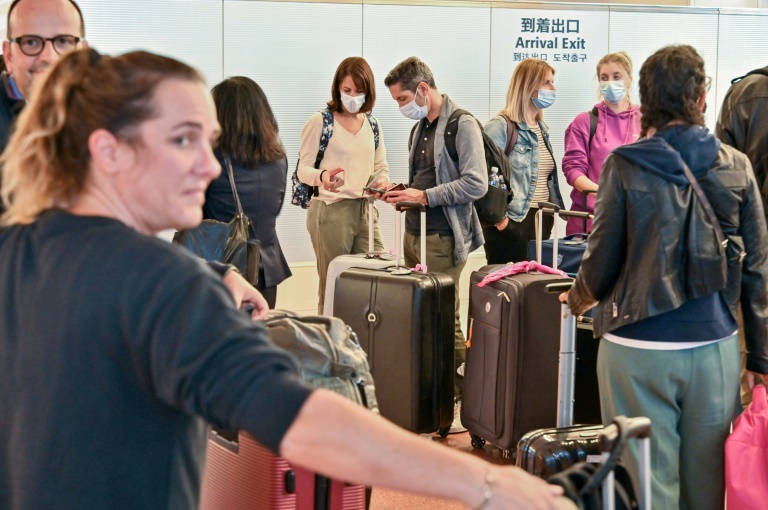
Japan reopened its doors to tourists Tuesday after two-and-a-half years of tough Covid restrictions, with officials hoping an influx of travellers enticed by a weak yen will boost the economy.

By mid-morning, tourists from Israel, France and Britain were already pouring in.

“It’s a long, long dream come true,” said 69-year-old Adi Bromshtine, a retiree arriving at Tokyo’s Haneda airport from Israel.

“We were planning before Covid and waiting and waiting,” she told AFP.

Itay Galili, a 22-year-old student also arriving from Israel, said he had been closely monitoring the news for word of the border reopening.

“As soon as I heard it’s going to reopen on the 11th, I started planning. Tickets were expensive… but no price (is) too heavy,” he told AFP.

Japan slammed its borders shut early in the pandemic, at one point even barring foreign residents from returning, and has only recently begun cautiously reopening.

In June, it began allowing tourists to visit in groups accompanied by guides, a requirement that was further relaxed to include self-guided package tours.

From Tuesday, visa-free entry resumed for travellers from 68 countries and territories.

Japan is also lifting a cap on the number of arrivals and ending the package tour requirement.

Some rules remain, with tourists required to present either proof of vaccination or a negative coronavirus test taken three days before departure.

Before Covid, Japan’s government was on track to achieve a goal of 40 million visitors by 2020, the year Tokyo was supposed to host the Summer Olympics.

Japan received a record 31.9 million foreign visitors in 2019, but that plummeted to just 250,000 in 2021.

– Demand soaring –

In Japan, tourists will find a country that is still adhering to many of the health guidelines that helped it to keep pandemic deaths to around 45,500, lower than many other developed economies.

Masks are ubiquitous, and though not mandated by law, parliament is set to pass legislation allowing hotels to deny service to customers who refuse to wear one or observe other health rules.

Masks are worn not only indoors and on public transport, but even outdoors, despite the government saying they are not necessary outside in uncrowded settings.

Hand sanitiser is placed at the entrance of most businesses, while plastic dividers are also often used in restaurants.

Another major change for tourists will be the weakness of the yen, which is hovering around 145 to the dollar, a level not seen for two decades.

The government has already had to intervene once to prop up the currency, and Prime Minister Fumio Kishida cited the yen’s weakness as a factor he hoped would draw tourists when he announced the reopening.

There is certainly no shortage of demand, according to travel agents.

Since the September announcement of the planned reopening, “we’ve been absolutely drowning, we don’t have enough time to deal with all the requests,” said Antoine Chanthavong, of Paris-based travel agency Destination Japan.

Still, for now at least, tickets are not coming cheap, with fuel prices soaring and airlines forced to take circuitous routes to avoid Russian airspace.

And for all the rebound in demand, there is little expectation that tourist numbers will soon reach their 2019 levels.

Before the pandemic, travellers from Hong Kong and China made up 37 percent of all foreign visitors to Japan, and 44 percent of tourism income.

But tough Covid restrictions in China make it unlikely visitors from there will be flocking back to Japan anytime soon.
Dollar extends 2022 surge as market awaits key US inflation data

The dollar extended its banner run of 2022 on Monday, pushing higher following the latest solid US jobs data as equities retreated in both New York and Europe.

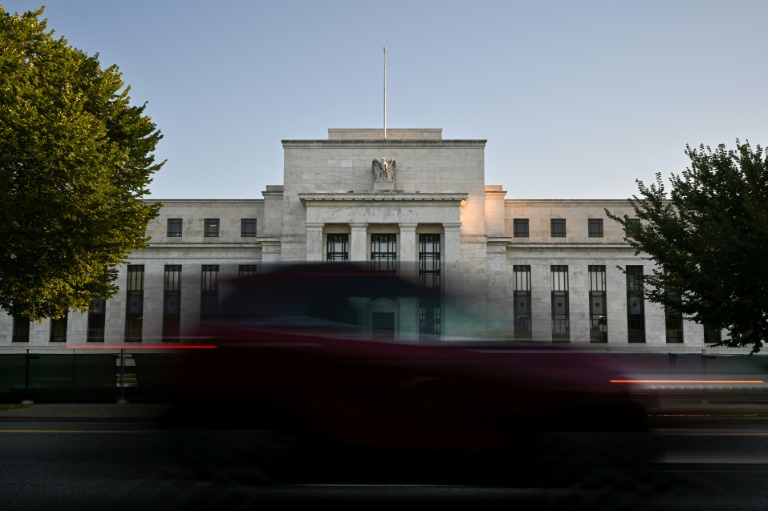
The US currency, which has already struck multi-year highs against the euro and other leading currencies, rose as investors bet that the latest round of US employment data released Friday will confirm a Federal Reserve plan to continue aggressively hiking interest rates.

This week’s calendar includes the latest US consumer price index data, which will give an updated reading on inflation that has prompted a 180-degree turn from the Fed’s easy-money policies to a streak of significant interest rate hikes.

“Inflation remaining stubbornly elevated would threaten to upset the market apple cart and buoy the dollar,” said a note from Joe Manimbo of Convera.

Analysts said Monday’s gains by the greenback also reflected the worsening Russia-Ukraine conflict, which has bolstered the dollar’s standing as a “refuge” investment.

US stocks finished a choppy session lower, joining European bourses in retreating.

This week’s calendar also includes retail sales for September, as well earnings from Delta Air Lines, JPMorgan and others. 

Investors are cautious ahead of the earnings period, with rising costs expected to cut into corporate profits. 

Analysts now project the S&P 500 companies scored an earnings increase of 2.9 percent per share, down from the 10.5 percent that had been forecast in June, according to CFRA Research.

“We’re seeing mild risk aversion in the markets at the start of the week, perhaps some apprehension ahead of what could be a big few days for the US,” said market analyst Craig Erlam at OANDA.

Elsewhere the pound won little support from Britain ramping up efforts to calm markets after a heavily criticised budget.

In what was seen as coordinated action, the government brought forward the release date of key economic forecasts and the Bank of England boosted liquidity.

“With the pound remaining weak and (UK) government borrowing costs inching up again towards worrying levels, the UK government and the Bank of England have launched a two-pronged attempt to calm markets,” noted Susannah Streeter, senior investment and markets analyst at Hargreaves Lansdown.

Oil prices meanwhile fell after the biggest weekly gain since March that followed last week’s decision by OPEC and allied producers led by Russia to slash crude output by two million barrels per day.

The drop Monday came also on demand concerns caused by China’s Covid flare-ups and more weak data out of Beijing owing to lockdowns.

– Key figures around 2030 GMT –

New York – Dow: DOWN 0.3 percent at 29,202.88 (close)

New York – S&P 500: DOWN 0.8 percent at 3,612.39 (close)

New York – Nasdaq: DOWN 1.0 percent at 10,542.10 (close)

London – FTSE 100: DOWN 0.5 percent at 6,959.31 (close) 

Frankfurt – DAX: FLAT at 12,272.94 (close)

Paris – CAC 40: DOWN 0.5 percent at 5,840.55 (close)

EURO STOXX 50: DOWN 0.6 percent at 3,356.88 (close)

Hong Kong – Hang Seng Index: DOWN 3.0 percent at 17,216.66 (close) 

Shanghai – Composite: DOWN 1.7 percent at 2,974.15 (close)

Tokyo – Nikkei 225: Closed for a holiday

Pound/dollar: DOWN at $1.1059 from $1.1086 on Friday

Euro/dollar: DOWN at $0.9708 from $0.9745

Euro/pound: DOWN at 87.76 pence from 87.90 pence

Dollar/yen: UP at 145.72 yen from 145.25 yen

West Texas Intermediate: DOWN 1.6 percent at $91.13 per barrel

Brent North Sea crude: DOWN 1.8 percent at $96.19 per barrel

burs-jmb/bfm

Stocks slip, dollar rises as US rate hikes seen

Global stocks slid on Monday as investors braced for more large interest rate hikes from the Federal Reserve.

The prospect of higher yields on debt was a boon for the dollar, however, which gained on its main rivals.

“We’re seeing mild risk aversion in the markets at the start of the week, perhaps some apprehension ahead of what could be a big few days for the US,” said market analyst Craig Erlam at OANDA.

Last week closed out with news that the US firms created a net 263,000 jobs in September.

While that was down from August it was more than expected, indicating that the US economy is not yet slowing considerably and inflationary pressures likely remain.

That sent stocks sharply lower as it means the Fed is unlikely to relent on interest rate hikes that are meant to tame inflation.

Stocks took a beating in August and September as monetary policymakers made clear they would keep raising interest rates in order to bring down inflation, even at the cost of a recession.

Last week, however, they briefly rallied on hope that the US jobs data would show the economy is already slowing, meaning the Fed could relent on interest rate hikes.

Some investors “may still be hoping that this week’s inflation data will swing the central bank but given previous comments, that doesn’t appear realistic unless we see a significant miss to the downside,” added Erlam.

Adding to the stress is the upcoming corporate earnings season, which many fear will show that companies are feeling the pain of tightening monetary policies.

Elsewhere on Monday, the Moscow stock exchange plunged nearly 12 percent following a weekend explosion that partially destroyed the bridge connecting Crimea to Russia.

Meanwhile, the pound won little support from Britain ramping up efforts to calm markets after a heavily criticised budget.

In what was seen as co-ordinated action, the government brought forward the release date of key economic forecasts and the Bank of England boosted liquidity.

“With the pound remaining weak and (UK) government borrowing costs inching up again towards worrying levels, the UK government and the Bank of England have launched a two-pronged attempt to calm markets,” noted Susannah Streeter, senior investment and markets analyst at Hargreaves Lansdown.

Oil prices meanwhile fell after the biggest weekly gain since March that followed a decision by OPEC and allied producers led by Russia to slash crude output by two million barrels per day.

The drop Monday came also on demand concerns caused by China’s Covid flare-ups and more weak data out of Beijing owing to lockdowns.

– Key figures around 1530 GMT –

New York – Dow: DOWN 0.3 percent at 29,202.02 points

EURO STOXX 50: DOWN 0.6 percent at 3,356.88

London – FTSE 100: DOWN 0.5 percent at 6,959.31 (close) 

Frankfurt – DAX: FLAT at 12,272.94 (close)

Paris – CAC 40: DOWN 0.5 percent at 5,840.55 (close)

Hong Kong – Hang Seng Index: DOWN 3.0 percent at 17,216.66 (close) 

Shanghai – Composite: DOWN 1.7 percent at 2,974.15 (close)

Tokyo – Nikkei 225: Closed for a holiday

Pound/dollar: DOWN at $1.1034 from $1.1082 on Friday

Euro/dollar: DOWN at $0.9689 from $0.9743

Euro/pound: DOWN at 87.79 pence from 87.97 pence

Dollar/yen: UP at 145.77 yen from 145.38 yen

West Texas Intermediate: DOWN 0.5 percent at $92.20 per barrel

Brent North Sea crude: DOWN 0.6 percent at $97.29 per barrel

burs-rl/pvh

Record quarterly profit for Indian software giant TCS

India’s largest software exporter Tata Consultancy Services on Monday shrugged off global economic turmoil to report a record profit for any quarter, with figures that beat analyst estimates.

TCS is India’s second-most-valuable company by market capitalisation and earns more than 80 percent of its revenues from Western markets.

It has been at the forefront of an IT boom that has seen India become a back office to the world as firms in North America and Europe subcontract work, taking advantage of a skilled English-speaking workforce.

More recently, technology companies have benefited from a boost in demand for digital services since the pandemic.

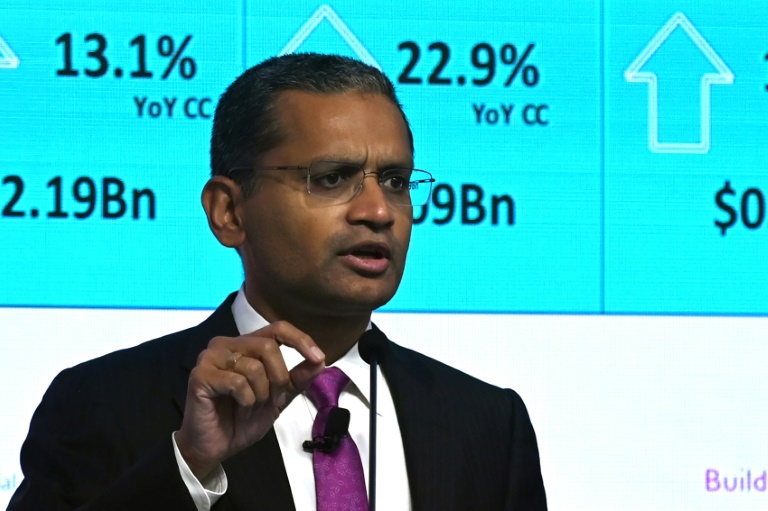
Net profit at the IT giant rose 8.4 percent year-on-year in the three months to September to reach 104.3 billion rupees ($1.26 billion), with revenues up 18 percent to 553.1 billion rupees.

The net profit figure was 1.4 billion rupees ahead of analysts’ average estimate, according to Bloomberg News.

“This is a milestone quarter for us,” chief executive officer Rajesh Gopinathan told a media briefing, pointing to net profit surpassing 100 billion rupees for the first time.

“Of course, the environment is challenging and it requires all of us to remain very vigilant,” he said, adding that customers were relying on TCS’s diversified services to manage volatile market conditions.

Its overseas growth in the quarter was led by North America, which contributed half of its business and saw revenue growth of 17.6 percent.

The company — one of India’s largest private employers — slowed its hiring despite its attrition rate rising to 21.5 percent.

Competition for employees has driven up salaries and weighed on operating margins in recent quarters, but TCS said attrition — a key metric for IT companies — has “peaked” and will “taper down from this point”.

Operating margins at the Mumbai-headquartered company contracted 1.6 percentage points to 24 percent, while its order book stood steady at $8.1 billion at the end of September.

Shares in the firm closed 1.84 percent higher in Mumbai ahead of the release of the results.

Stocks down, dollar up as markets expect more big US rate hikes

Stock markets mostly retreated and the dollar firmed Monday as forecast-beating US jobs data fanned expectations for more large interest rate hikes from the Federal Reserve.

A rally across equity trading floors last week has given way to gloom as investors grow increasingly worried that central bank rate hikes to tame runaway prices will plunge the global economy into recession.

Adding to the stress is the upcoming corporate earnings season, which many fear will show that companies are feeling the pain of tightening monetary policies.

European and Asian equities mostly suffered Monday following heavy losses Friday on Wall Street.

Last week closed out with news that the United States created a net 263,000 jobs in September.

While that was down from August it was more than expected, highlighting the tough job Fed officials face in their battle against decades-high inflation. 

With the spotlight on a US consumer price index reading later in the week, policymakers continue to take a hawkish tone, warning they will not ease up on their rate hikes even if that means causing a recession.

Elsewhere on Monday, the Moscow stock exchange plunged nearly 12 percent following multiple strikes on Ukrainian cities and a weekend explosion that partially destroyed the bridge connecting Crimea to Russia.

In foreign exchange and amid a strong dollar, the pound won little support from Britain ramping up efforts to calm markets after a heavily criticised budget.

In what was seen as co-ordinated action, the government brought forward key economic forecasts and the Bank of England boosted liquidity.

“With the pound remaining weak and (UK) government borrowing costs inching up again towards worrying levels, the UK government and the Bank of England have launched a two-pronged attempt to calm markets,” noted Susannah Streeter, senior investment and markets analyst at Hargreaves Lansdown.

Oil prices meanwhile fell after the biggest weekly gain since March that followed a decision by OPEC and allied producers led by Russia to slash crude output by two million barrels per day.

The drop Monday came also on demand concerns caused by China’s Covid flare-ups and more weak data out of Beijing owing to lockdowns.

– Key figures around 1030 GMT –

London – FTSE 100: DOWN 0.4 percent at 6,967.02 points

Frankfurt – DAX: UP 0.4 percent at 12,319.65

Paris – CAC 40: DOWN 0.4 percent at 5,842.82

EURO STOXX 50: DOWN 0.3 percent at 3,365.99

Hong Kong – Hang Seng Index: DOWN 3.0 percent at 17,216.66 (close) 

Shanghai – Composite: DOWN 1.7 percent at 2,974.15 (close)

Tokyo – Nikkei 225: Closed for a holiday

New York – Dow: DOWN 2.1 percent at 29,296.79 (close)

Pound/dollar: DOWN at $1.1058 from $1.1082 on Friday

Euro/dollar: DOWN at $0.9703 from $0.9743

Euro/pound: DOWN at 87.75 pence from 87.97 pence

Dollar/yen: UP at 145.46 yen from 145.38 yen

West Texas Intermediate: DOWN 0.5 percent at $92.16 per barrel

Brent North Sea crude: DOWN 0.7 percent at $97.22 per barrel

China moves to stamp out Covid outbreaks before Communist Party Congress

China recorded more than 2,000 Covid cases on Monday, its highest level for a month, as officials imposed new lockdowns and restrictions to stop outbreaks from spreading to the capital ahead of the Communist Party Congress.

Although the latest case numbers are small by global standards, Beijing’s strict zero-Covid policy means any outbreaks must be immediately eradicated.

President Xi Jinping, who is expected to secure a historic third term in office, has championed the policy, and any significant outbreak ahead of Sunday’s Congress opening would prove highly embarrassing for the party.

In Shanghai, tens of thousands of people were under lockdown on Monday, after multiple neighbourhoods were suddenly closed off over the weekend, following the discovery on Friday of 23 new infections.

Over 2,100 households in the financial hub were affected because of just one infection on Sunday, according to a government briefing.

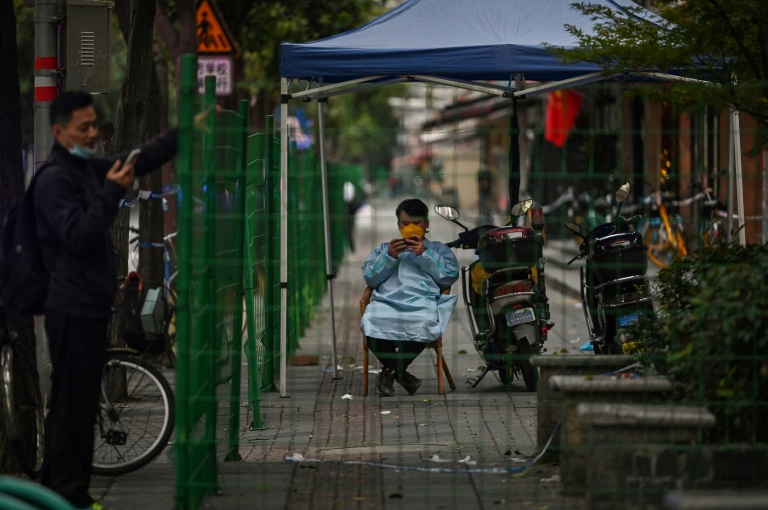
Residents reacted in shock as green fences were erected around buildings, recalling the city’s harsh two-month lockdown in spring, which saw widespread complaints over shortages of food and medical treatment.

As of Monday, Shanghai has nine “medium-risk” locked-down neighbourhoods across six districts, authorities said, but there are likely many more lockdowns of individual buildings that have not been announced officially.

“After hearing about some situations, most people feel that it seems to have returned to April and May,” said one resident surnamed Li.

– Travel chaos –

Other Chinese cities were also affected.

On Friday, Yongji city in northern Shanxi province ordered a two-day lockdown of its three million residents after cases were found in a neighbouring city — despite Yongji itself recording no new infections at all.

Some travellers arriving in Beijing reported receiving a notification on their Covid tracking app which required them to undergo multiple PCR tests to access public spaces — even though they had come from areas without cases.

And some Beijing residents who had travelled during last week’s long public holiday were stranded after receiving a Covid tracking app notification which prevented them from boarding trains or flights back to the city.

Many left desperate pleas for help on the Weibo page of the official Beijing citizens’ helpline, but these comments were censored by Monday.

Several tourist hotspots imposed lockdowns last week, including Haikou city in tropical Hainan province and Xishuangbanna in the southern province of Yunnan, where hundreds of angry tourists were stranded at an airport after flights were abruptly cancelled.   

Northwestern China’s Xinjiang also banned all people from leaving the region last week after an outbreak was detected, as local authorities made a rare public admission of failure in controlling the virus.

One recent news report about a Shanghai tourist stranded in Xinjiang who took up a grape-picking job was later censored, while officials in one district last week urged tourists to “consider” taking up local employment.

Domestic tourism revenues and daily passenger trips during the October public holiday have fallen over 55 percent and 58 percent respectively from pre-pandemic levels, Nomura analysts wrote in a note. 

Markets sink as US jobs data fan rate hike bets

Stock markets sank Monday as forecast-beating US jobs data fanned expectations for another big Federal Reserve interest rate hike, while traders are now focusing on an upcoming inflation report.

A brief rally across trading floors last week gave way to gloom as investors grow increasingly worried that central bank efforts to tame runaway prices will plunge the global economy into recession.

Adding to the stress is the upcoming corporate earnings season, which many fear will show that companies are feeling the pain of tightening monetary policies, and fresh China-US tensions.

All three main indexes tumbled Friday — with the Nasdaq off almost four percent — following news that a net 263,000 US jobs were created in September.

While that was down from August it was more than expected and showed that the labour market remained robust and highlighted the tough job Fed officials face in their battle against four-decade-high inflation. 

With the spotlight on a consumer price index reading later in the week, policymakers continue to take a hawkish tone, warning they will not ease up on their rate hikes even if that means causing a recession.

Asia tracked the US losses, with Hong Kong down three percent and hefty selling in Sydney, Singapore, Mumbai, Bangkok, Manila, Jakarta and Wellington. 

Shanghai dropped as traders returned from a week-long holiday, with rising Covid numbers in the country leading to worries of more economically painful lockdowns ahead of a key Communist Party gathering.

Chinese tech firms were also hit after Washington on Friday announced new export controls aimed at restricting China’s ability to buy and make high-end chips with military applications, adding to tensions between the countries.

London, Paris and Frankfurt all fell in the morning, while Moscow stocks plunged nearly 12 percent following a series of strikes on cities across Ukraine and after the bridge connecting Crimea to Russia was hit by an explosion at the weekend.

Tokyo, Seoul and Taipei were closed.

“The sell-off in equities and the rally in the dollar following Friday’s US employment report reflects the concern that the hurdle for a Fed pause is high,” said SPI Asset Management’s Stephen Innes.

“The rising unemployment rate needed to help bring down CPI inflation will require job losses despite the political fallout that is bound to ensue. Regardless, tightening monetary policy until job losses materialize is on the cards.”

He added that there was also nervousness about earnings.

“Unlike June, where earnings were poised to beat expectations, investors are biased towards hitting the sell button as concern around lagged effects of tightening hitting bottom lines now permeate expectations,” he said in a note.

The prospect of higher US borrowing costs sent the dollar rallying Friday and it held most of those gains in early Asian trade.

Investors are keeping an eye on the yen, which is edging back to the lows touched last month when the government stepped in with a massive cash injection to support the currency.

The pound weakened even as the Bank of England said it was launching a temporary facility aimed at easing liquidity pressures that arose after the UK government’s budget shocked markets last month.

It said it was ready to increase the size of its UK government bond purchases under an emergency measure due to end Friday.

The pound has been hammered — at one point hitting a record low versus the dollar — since finance minister Kwasi Kwarteng unveiled a debt-fuelled tax-cutting mini-budget.

Oil prices edged down after seeing their biggest weekly gain since March in reaction to a decision by OPEC and other major producers led by Russia to cut output by two million barrels a day.

The drop Monday came on demand concerns caused by China’s Covid flare-ups and more weak data out of Beijing caused by recent lockdowns.

“A slew of weak macroeconomic data that China has released shows that there is very limited room for an economic rebound in the short term, which is hard to provide support for earnings and market confidence,” Shen Meng, at investment bank Chanson & Co in Beijing, said.

– Key figures around 0810 GMT –

Hong Kong – Hang Seng Index: DOWN 3.0 percent at 17,216.66 (close) 

Shanghai – Composite: DOWN 1.7 percent at 2,974.15 (close)

Tokyo – Nikkei 225: Closed for a holiday

London – FTSE 100: DOWN 0.7 percent at 6,944.90

Pound/dollar: UP at $1.1074 from $1.1082 on Friday

Euro/dollar: DOWN at $0.9703 from $0.9743

Euro/pound: DOWN at 87.62 pence from 87.97 pence

Dollar/yen: DOWN at 145.35 yen from 145.38 yen

West Texas Intermediate: DOWN 0.4 percent at $92.27 per barrel

Brent North Sea crude: DOWN 0.5 percent at $97.44 per barrel

New York – Dow: DOWN 2.1 percent at 29,296.79 (close)

— Bloomberg News contributed to this story —

Asian markets sink as US jobs data fan rate hike bets

Asian markets sank Monday as forecast-beating US jobs data fanned expectations for another big Federal Reserve interest rate hike, while traders are now focusing on an upcoming inflation report.

A brief rally across trading floors last week gave way to gloom as investors grow increasingly worried that central bank efforts to tame runaway prices will plunge the global economy into recession.

Adding to the stress is the upcoming corporate earnings season, which many fear will show that companies are feeling the pain of tightening monetary policies.

All three main indexes tumbled Friday — with the Nasdaq off almost four percent — following news that a net 263,000 US jobs were created in September.

While that was down from August it was more than expected and showed that the labour market remained robust and highlighted the tough job Fed officials face in their battle against four-decade-high inflation. 

With the spotlight on a consumer price index reading later in the week, policymakers continue to take a hawkish tone, warning they will not ease up on their rate hikes even if that means causing a recession.

“The real question for the market is whether one step down in core CPI will be enough to change the tone around inflation,” said SPI Asset Management’s Stephen Innes.

“Given the sharp increase in cross-asset correlations and breakdown in risk assets, it seems like that would be too much to hope for.”

Asia tracked the US losses, with Hong Kong down more than two percent, while there was also hefty selling in Sydney, Singapore, Manila, Jakarta and Wellington. 

Shanghai dropped as traders returned from a weeklong holiday, with rising Covid numbers in the country leading to worries of more economically painful lockdowns ahead of a key Communist Party gathering.

Tokyo, Seoul and Taipei were closed.

Innes added that there was also nervousness about earnings.

“Unlike June, where earnings were poised to beat expectations, investors are biased towards hitting the sell button as concern around lagged effects of tightening hitting bottom lines now permeate expectations,” he said in a note.

The prospect of higher US borrowing costs sent the dollar rallying Friday and it held most of those gains in early Asian trade.

Investors are keeping an eye on the yen, which is edging back to the lows touched last month when the government stepped in with a massive cash injection to support the currency.

Oil prices edged down after seeing their biggest weekly gain since March in reaction to a decision by OPEC and other major producers led by Russia to cut output by two million barrels a day.

The drop Monday came on demand concerns caused by China’s Covid flare-ups and more weak data out of Beijing caused by recent lockdowns.

“A slew of weak macroeconomic data that China has released shows that there is very limited room for an economic rebound in the short term, which is hard to provide support for earnings and market confidence,” Shen Meng, at investment bank Chanson & Co in Beijing, said.

– Key figures around 0230 GMT –

Hong Kong – Hang Seng Index: DOWN 2.4 percent at 17,316.13 

Shanghai – Composite: DOWN 0.7 percent at 3,003.77

Tokyo – Nikkei 225: Closed for a holiday

Pound/dollar: UP at $1.1102 from $1.1082 on Friday

Euro/dollar: UP at $0.9747 from $0.9743

Euro/pound: DOWN at 87.79 pence from 87.97 pence

Dollar/yen: UP at 145.43 yen from 145.38 yen

West Texas Intermediate: DOWN 0.5 percent at $92.19 per barrel

Brent North Sea crude: DOWN 0.5 percent at $97.47 per barrel

New York – Dow: DOWN 2.1 percent at 29,296.79 (close)

London – FTSE 100: DOWN 0.1 percent at 6,991.09 (close)

— Bloomberg News contributed to this story —

Vietnam's VinFast targets US market in 'preposterously hard' gamble

Having conquered most industries at home, optimistic chiefs at conglomerate Vingroup are setting their sights much higher as they ramp up plans to sell the first ever Vietnamese car in the mighty US market.

The pivot is a bold move by chairman Pham Nhat Vuong — Vietnam’s richest man — who started out selling dried noodles in the former Soviet Union before amassing his $5 billion fortune in a range of sectors including real estate, tourism and education.

His firm’s auto unit VinFast already has electric vehicles (EVs) on the streets of Hanoi, though the attraction of the lucrative United States market is too good to ignore.

However, the firm admits that competing in the crowded and difficult US market, which is dominated by Tesla, will be a huge but worthwhile task.

“If we can make it there, we can make it anywhere,”  CEO Le Thi Thu Thuy told AFP from the factory site where the finishing touches were being made to the VF8, a mid-size SUV with a sleek design by Italy’s Pininfarina, which worked with Ferrari for decades. 

But, she added, “we want to show people who might not have the correct understanding of Vietnam that Vietnam today is quite different to Vietnam during the war, or even to Vietnam 10 years ago”.

While the aim of getting Americans driving its cars by Christmas may seem a huge ask, Vingroup — Vietnam’s biggest private firm — has a track record of delivering.

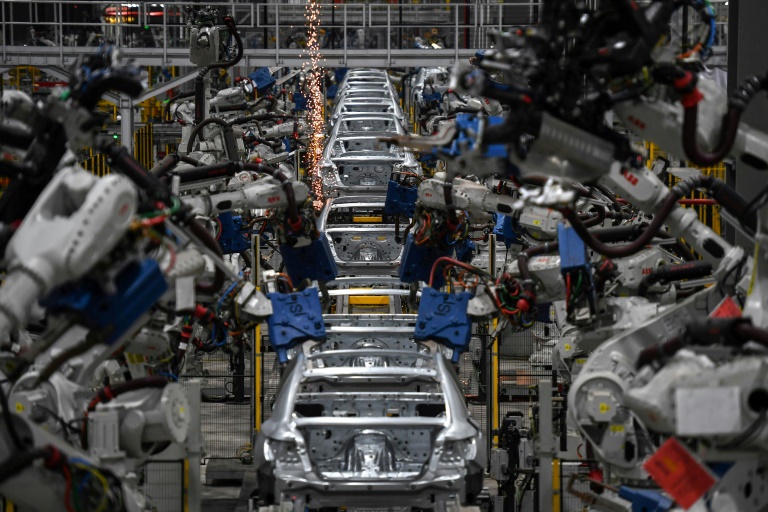
Within two years, Pham transformed a muddy patch of swampland near the northern port city of Haiphong into a state-of-the-art factory — complete with 1,200 robots, German, Japanese and Swedish machinery, and a global team from auto giants including BMW and General Motors. 

– Public scepticism –

The company has already invested heavily in its American dream.

In July, VinFast opened six showrooms in California, including a flagship store at one of the trendiest malls in upmarket Santa Monica, though for now it is only taking orders as vehicles are not yet available.

It plans 30 in total by the end of the year, while it has also broken ground on a $2 billion electric vehicle and battery plant in North Carolina that it says will produce 150,000 cars a year when it is fully up and running.

The factory aims to create more than 7,000 new jobs, prompting US President Joe Biden himself to tweet the announcement back in March.

“I always joke that he is the best salesperson we have,” says Thuy.

But the American public will likely be far more sceptical, said Karl Brauer, a Los Angeles-based analyst with iSeeCars.com, a vehicle comparison site.

“It’s been typical for it to take a couple of decades for brand new automakers to the US market to become ingrained,” he said, referencing South Korea’s Hyundai and Kia, which struggled through the 90s and early 2000s.

They are now among the most popular car makers in the United States. 

Americans’ perception may be “this is some unheard-of-brand I’ve never had any experience with, and I’m not sure I have any faith in the quality”, he added. 

– Push into Europe –

To hook customers, VinFast is pushing a highly unusual monthly battery-leasing model for the two cars headed to the United States — the VF8 and VF9 — lowering the cost of the upfront payment to $42,000 and $57,500 respectively. Tesla’s SUVs start at around $65,000.

Once the battery life goes down to 70 percent, VinFast replaces it for free, and aims to repurpose or recycle the old one.

“The theory behind that is we’re giving you a vehicle that is priced similarly to an internal combustion engine vehicle,” Thuy explained. 

The scale of VinFast’s ambition, which extends to Europe, where they plan to open the first of 20 showrooms by the end of the year, has stunned many in the business.

“It is preposterously hard to build a car and sell it, at least to a global audience, as seems to be the ambitions of VinFast,” said Matthew Degen, senior editor at Kelley Blue Book, a car shopping and research site. 

“It usually takes years and years to get a car from a design on paper into something that’s in your hands and you’re actually driving it.”

However, VinFast developed three cars in just 21 months.

And although the regular car market is already saturated, he says, there may be a “brief window” for them to make their mark in the still developing electric vehicle sector.

For Brauer, VinFast’s success will largely come down to millennials. 

They will “have trouble with people over 50 years old… but younger consumers in this country are getting more and more open to new vehicles”.

US says Hong Kong risks reputation over yacht linked to Putin ally

Hong Kong could damage its reputation as a financial hub if it gives haven to sanctions dodgers, the United States cautioned Saturday, after the city said it would not act against a superyacht reportedly owned by a Kremlin ally.

The Nord — a US$500 million, 142-metre (466-foot) luxury vessel linked to Russian billionaire Alexei Mordashov — arrived in the Chinese territory’s waters this week.

Mordashov is among the oligarchs who are close to Russian President Vladimir Putin and have been targeted by Western sanctions following Moscow’s invasion of Ukraine.

Some of them have had their luxury yachts seized in places such as Spain and Fiji, but Hong Kong said Friday that while it implements UN sanctions, it cannot enforce those imposed “unilaterally” by countries or blocs.

“The possible use of Hong Kong as a safe haven by individuals evading sanctions from multiple jurisdictions further calls into question the transparency of the business environment,” a US State Department spokesperson told AFP in response.

“Hong Kong’s reputation as a financial centre depends on adherence to international laws and standards.”

Yachts owned by those close to Putin have become targets for Ukraine’s Western allies, who are hunting for the assets of sanctioned figures as they seek to punish Moscow for the Ukraine invasion.

In March, Italy seized the Lady M, a yacht belonging to Mordashov, citing European Union sanctions.

China has conspicuously not condemned the invasion of Ukraine, and said it has a “no-limits” relationship with Russia.

A spokesperson for Mordashov told Bloomberg News this week that the billionaire was in Moscow and declined to comment on the yacht’s movements.

The Nord — which boasts two helipads, a cinema and more than a dozen luxury cabins — switched its flag from the Cayman Islands to Russia in June.

It was anchored in the eastern Russian port of Vladivostok before making its way to Hong Kong.

Close Bitnami banner
Bitnami