Chinese Business

Stocks mostly retreat, pound drops

Equity markets mostly fell Thursday and the pound retreated once more against the dollar on lingering recession fears despite hopes that the US Federal Reserve will tame the pace of aggressive interest rate hikes.

Oil prices also dropped, failing to power ahead after OPEC and other major producers led by Russia decided to slash output by two million barrels per day.

The cut, the biggest since the pandemic struck, was viewed by traders as an attempt to boost prices.

The Kremlin on Thursday said the OPEC+ decision was designed to stabilise global oil markets.

And Washington said it was a concession to Moscow. The United States has been lobbying to hold down fuel prices and isolate Russia over its Ukraine aggression.

The European Union has proposed introducing a price cap on Russian oil as part of new sanctions over Ukraine.

Moscow has said a price cap on its oil would have a “detrimental effect” on global markets and warned it would not supply crude to countries that introduce it.

Shares in Shell slid about 4.5 percent in Thursday trading after the British energy giant revealed that its third-quarter profit would be hit by a slump in refining margins.

“Shell enjoyed record profits in the first and second quarter spurred by a surge in underlying oil and gas prices following Russia’s invasion of Ukraine,” noted Victoria Scholar, head of investment at Interactive Investor.

“However, since June, oil has posted four consecutive months of declines, with Brent crude down by around 25 percent.”

Scholar said Shell was “grappling with a dysfunctional and volatile gas market as well as expectations of softening oil demand, particularly from China as the global economy cools”.

– Awaiting US jobs –

Markets remained on guard over the economic outlook awaiting the release of US non-farm payroll jobs Friday.

The pound was down about half-a-percent against the dollar after Fitch ratings agency lowered the outlook for British debt to negative from stable.

This after the government of new Prime Minister Liz Truss recently announced a budget packed with debt-fuelled tax cuts.

Ahead of the downgrade Wednesday, sterling had plunged more than two percent after Truss failed to reassure investors with a speech at her Conservative party conference.

The pound, however, has recovered since reaching a record-low close to parity against the dollar at the end of September.

– Key figures around 1100 GMT –

London – FTSE 100: DOWN 0.6 percent at 7,008.78 points

Frankfurt – DAX: DOWN 0.3 percent at 12,484.16

Paris – CAC 40: DOWN 0.5 percent at 5,957.14

EURO STOXX 50: DOWN 0.3 percent at 3,438.49

Tokyo – Nikkei 225: UP 0.7 percent at 27,311.30 (close)

Hong Kong – Hang Seng Index: DOWN 0.4 percent at 18,012.15 (close)

Shanghai – Composite: Closed for a holiday

New York – Dow: DOWN 0.1 percent at 30,273.87 (close)

Pound/dollar: DOWN at $1.1263 from $1.1326 on Wednesday

Euro/dollar: DOWN at $0.9887 from $0.9889

Euro/pound: UP at 87.72 pence from 87.29 pence

Dollar/yen: UP at 144.75 yen from 144.59 yen

Brent North Sea crude: DOWN 0.3 percent at $93.07 per barrel

West Texas Intermediate: DOWN 0.5 percent at $87.32 per barrel
Markets mostly up as focus turns to key US jobs report

Equity markets rose Thursday as traders fought to extend this week’s global rally, though concerns about the impact of a huge oil output cut on inflation tempered hopes that central banks could soon ease their rate hike campaigns.

The mood on trading floors has been a little lighter this week, sending equities surging and weighing on the dollar, after weak readings on US factory activity and job openings fed speculation that the Federal Reserve’s strict tightening drive was having an effect.

But confidence took a knock Wednesday from a better-than-expected read on private jobs hiring and a report showing the key services sector holding up more than expected.

The figures highlighted the resilience of the US economy in the face of multiple rate hikes and point to the long road ahead for the Fed in fighting decades-high inflation.

Fed officials have lined up for weeks to insist that they will not budge from lifting borrowing costs until prices are tempered — even at the cost of a recession — while some have warned traders not to expect any cuts next year.

“After an increase in expectations of an imminent Fed pivot given the softer than expected US (factory data), the strength in the services (sector) not only eases concerns of an imminent US recession, it also refutes any notion that the Fed will look to take its foot off the tighten pedal any time soon,” said National Australia Bank’s Rodrigo Catril.

The latest US data came as OPEC and other major producers led by Russia decided to slash output by a massive two million barrels a day — the biggest reduction since the pandemic struck.

Moscow said a possible price cap by the European Union on Russian crude would have a “detrimental effect” on the global oil sector, saying Moscow would not sell to countries that introduced it.

The news gave already elevated oil prices another leg up, with both contracts piling on more than one percent Wednesday.

It also fuelled concerns that energy costs — a major driver of the spike in global inflation since Russia’s invasion of Ukraine — will drive higher again.

“All the developments we have seen on the supply side at this point very much sets the stage for what we believe will be higher prices into the end of this year,” Damien Courvalin, at Goldman Sachs, told Bloomberg Television.

“With this cut and the winter seasonal demand, inventories will continue to fall.”

– UK ratings warning –

Still, crude edged up only slightly in Asia, and SPI Asset Management’s Stephen Innes said: “So far, the oil market appears to be priced to post OPEC+ perfection. The current WTI move should not impact US inflation significantly nor raise eyebrows at the Fed just yet.”

All three main indexes on Wall Street ended in the red but stronger than earlier in the day but Asia fared better on Thursday.

Tokyo, Sydney, Singapore, Seoul, Taipei, Mumbai, Bangkok and Jakarta all rose again but Hong Kong dipped after blasting almost six percent higher Wednesday.

Sydney and Manila were also slightly lower. Shanghai is closed all week for a holiday.

London, Paris and Frankfurt were marginally up in the morning.

But commentators remained on guard over the outlook, with eyes now on the release of US non-farm payroll jobs on Friday, warning that an above-forecast reading could spark another major selloff.

On currency markets, the dollar, which bounced Wednesday after suffering a sell-off for most of the week, was slightly down again in Asian business.

Even sterling managed to resume its gains despite news that Fitch had lowered the outlook for British debt from stable to negative after the government of new Prime Minister Liz Truss announced a mini-budget packed with debt-fueled tax cuts.

The pound plunged more than two percent earlier as Truss failed to reassure investors with a speech at her Conservative party conference where she insisted she would stick to her fiscal plan.

– Key figures around 0810 GMT –

Tokyo – Nikkei 225: UP 0.7 percent at 27,311.30 (close)

Hong Kong – Hang Seng Index: DOWN 0.4 percent at 18,012.15 (close)

Shanghai – Composite: Closed for a holiday

London – FTSE 100: FLAT at 7,053.31

Pound/dollar: UP at $1.1350 from $1.1326 on Wednesday

Euro/dollar: UP at $0.9920 from $0.9889

Euro/pound: UP at 87.40 pence from 87.29 pence

Dollar/yen: UP at 144.61 yen from 144.59 yen

West Texas Intermediate: UP 0.3 percent at $88.05 per barrel

Brent North Sea crude: UP 0.4 percent at $93.72 per barrel

New York – Dow: DOWN 0.1 percent at 30,273.87 (close)

Asian markets drift as global rally peters, focus now on US jobs

Asian markets were mixed Thursday as this week’s global rally ran out of juice, with concerns about a huge oil output cut’s impact on inflation tempering hopes that central banks could soon ease back on their rate hike campaigns.

The mood on trading floors has been a little lighter this week, sending equities surging and weighing on the dollar, after weak readings on US factory activity and job openings feeding speculation that the Federal Reserve’s strict tightening drive was having an effect.

But the confidence took a knock Wednesday from a better-than-expected read on private jobs hiring and a report showing the key services sector holding up more than expected.

The figures highlighted the resilience of the US economy in the face of multiple rate hikes and point to the long road ahead for the Fed in fighting decades-high inflation.

Fed officials have lined up for weeks to insist that they will not budge from lifting borrowing costs until prices are tempered — even at the cost of a recession — while some have warned traders not to expect any cuts next year.

“After an increase in expectations of an imminent Fed pivot given the softer than expected US (factory data), the strength in the services (sector) not only eases concerns of an imminent US recession, it also refutes any notion that the Fed will look to take its foot off the tighten pedal any time soon,” said National Australia Bank’s Rodrigo Catril.

The latest US data came as OPEC and other major producers led by Russia had decided to slash output by a massive two million barrels a day — the biggest reduction since the pandemic struck. 

Moscow said a possible price cap by the European Union on Russian crude would have a “detrimental effect” on the global oil sector, saying Moscow would not sell to countries that introduced it.

The news gave already elevated oil prices another leg up, with both contracts piling on more than one percent, and fuelling concerns that energy costs — a major driver of the spike in global inflation since Russia’s Ukraine invasion — will drive higher again.

“All the developments we have seen on the supply side at this point very much sets the stage for what we believe will be higher prices into the end of this year,” Damien Courvalin, at Goldman Sachs, told Bloomberg Television.

“With this cut and the winter seasonal demand, inventories will continue to fall.”

All three main indexes on Wall Street ended in the red, though they managed to claw back most of their earlier losses thanks to a late rally, though Asian markets fared a little better.

Tokyo, Singapore, Seoul, Taipei and Jakarta all rose again, but Hong Kong retreated after blasting almost six percent higher Wednesday. Sydney, Wellington and Manila were also slightly lower.

But commentators remained on guard over the outlook, with eyes now on the release of US non-farm payroll jobs on Friday, warning that an above-forecast reading could spark another major selloff.

On currency markets the dollar, which bounced Wednesday after suffering a sell-off for most of the week, was slightly down again in Asian business. 

Even sterling managed to resume its gains despite news that Fitch had lowered the outlook for British debt from stable to negative after the government of new Prime Minister Liz Truss announced a mini-budget packed with debt-fueled tax cuts.

The pound plunged more than two percent earlier as Truss failed to reassure investors with a speech at her Conservative party conference where she insisted she would stick to her fiscal plan.

– Key figures around 0230 GMT –

Tokyo – Nikkei 225: UP 0.9 percent at 27,370.37 (break)

Hong Kong – Hang Seng Index: DOWN 0.6 percent at 17,983.43

Shanghai – Composite: Closed for a holiday

Pound/dollar: UP at $1.1353 from $1.1326 on Wednesday

Euro/dollar: UP at $0.9910 from $0.9889

Euro/pound: DOWN at 87.27 pence from 87.29 pence

Dollar/yen: UP at 144.65 yen from 144.59 yen

West Texas Intermediate: UP 0.2 percent at $87.92 per barrel

Brent North Sea crude: UP 0.2 percent at $93.55 per barrel

New York – Dow: DOWN 0.1 percent at 30,273.87 (close)

London – FTSE 100: DOWN 0.5 percent at 7,051.60 (close) 

OPEC+ angers US with major oil output cut

Saudi Arabia, Russia and other top oil producers agreed on a major cut in production on Wednesday to boost crude prices — a move denounced by the United States as a concession to Moscow that will further hurt the global economy.

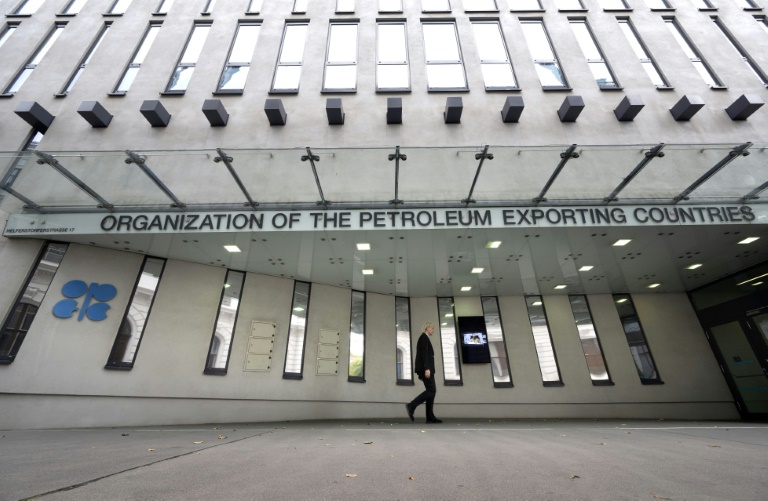
The 13-nation OPEC cartel headed by Riyadh and its 10 allies led by Moscow agreed to reduce output by two million barrels per day from November at a meeting in Vienna, the group said in a statement.

It is the biggest cut since the height of the Covid pandemic in 2020, raising fears that it will turbocharge oil prices at a time when countries are already facing soaring energy-fuelled inflation.

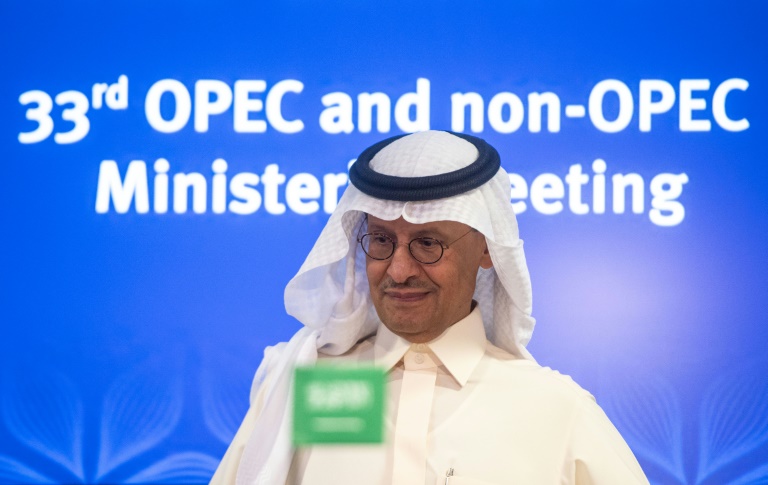
Saudi Arabia’s energy minister, Prince Abdulaziz bin Salman, defended the move, saying the cartel’s priority was “to maintain a sustainable oil market”, at a press conference following OPEC+’s first in-person meeting since March 2020.

But the decision drew a swift rebuke from US President Joe Biden, who had made a controversial trip to Saudi Arabia in July under pressure as Americans faced rising prices at fuel stations.

The timing is also bad for Biden’s political agenda as it comes ahead of US midterm elections next month.

“It’s clear that OPEC+ is aligning with Russia with today’s announcement,” White House Press Secretary Karine Jean-Pierre said aboard Air Force One.

National Security Advisor Jake Sullivan and top economic advisor Brian Deese said in a statement that Biden was “disappointed by the shortsighted decision by OPEC+”.

Western allies led by the United States have tried to isolate Russia’s economy, which relies heavily on energy exports, in retaliation for the invasion of Ukraine.

– Oil prices rise –

OPEC+ decided to slash its output as oil prices fell below $90 per barrel in recent months over concerns about the global economy, after soaring to $140 in the wake of Russia’s invasion of Ukraine earlier this year.

The international benchmark, Brent North Sea crude, was up at $93.43 following Wednesday’s announcement.

The oil production cut could give sanctions-hit Russia a boost ahead of a European Union ban on most of its crude exports later this year and as the Group of Seven wealthy democracies mull a cap on the country’s oil prices.

Russian deputy prime minister Alexander Novak, who is under US sanctions and attended the OPEC+ meeting, said a price cap would have a “detrimental effect” on the global oil sector.

He warned that Russian companies would “not supply oil to those countries” that introduce such a cap.

“There is a reason why Russia is ready to participate with an OPEC cut — because they are not sure whether they will find somebody to buy this oil,” Patrick Pouyanne, chairman of French oil giant TotalEnergies, said at a London oil industry conference.

Collectively known as OPEC+, the alliance drastically slashed output by almost 10 million barrels per day (bpd) in April 2020 to reverse a massive drop in crude prices caused by Covid lockdowns.

OPEC+ began to raise production last year after the market improved. Output returned to pre-pandemic levels this year, but only on paper as some members have struggled to meet their quotas.

The group agreed last month on a small, symbolic cut of 100,000 bpd from October, the first in more than a year.

Consumer countries had pushed for months for OPEC+ to open taps more widely to bring down prices, but the group ignored them again.

Biden travelled to Saudi Arabia in July in part to convince the kingdom to loosen the production taps. The trip saw Biden meet Crown Prince Mohammed bin Salman despite his promise to make Riyadh a “pariah” following the 2018 killing of journalist Jamal Khashoggi.

While the cut was not welcomed by the United States, several OPEC+ nations have struggled to meet their quotas in the first place.

The next ministerial OPEC meeting will be on December 4. In recent months, the cartel and its partners met online each month. 

burs-jza/

Oil prices climb as OPEC+ cuts output

Oil prices climbed Wednesday as OPEC and Russia-led allies announced a major cut in output, while a stocks rally ran out of gas.

The pound, meanwhile, continued to suffer against the dollar over fears for Britain’s recession-threatened economy, falling around two percent to slide under $1.13.

In Vienna, ministers from the 13-nation OPEC cartel and its 10 Russian-led allies agreed to reduce two million barrels per day from November.

It is the biggest cut since the height of the Covid pandemic in 2020, and came despite concerns it could fuel inflation further and push central banks to further hike interest rates and therefore increase the chances of a global recession.

Oil prices had slid back to their levels before the war in Ukraine in recent weeks on concerns of a global slowdown, but have surged in recent days on expectations of the production cut.

The main international crude contract, Brent, jumped two percent following the decision.

“Oil futures are expected to continue their rally in the short and medium term, but continued concerns over a global recession and rising inflation are likely to limit the long-term upside,” said Srijan Katyal, Global Head of Strategy and Trading Services at the international brokerage ADSS.

Swissquote analyst Ipek Ozkardeskaya warned that the big cut could “backfire” on OPEC+ if investors fear that it will push inflation higher and force central banks to hike interest rates so much that it will trigger a recession.

“The higher the energy prices, the sharper the central banks must kill demand to pull the prices lower,” she said before the decision was announced.

“Therefore, a big cut in OPEC production could well backfire, and trigger profit taking and fall in oil prices today,” she added.

– Rally loses steam –

Meanwhile, a stocks rally triggered by disappointing US data on Monday that fuelled hopes the US Federal Reserve could let up in its campaign of aggressive interest rate hikes to tame inflation has petered out.

European stocks finished lower across the board, and Wall Street’s main indices were down sharply in late morning trading.

“Market participants are being forced to contend with the possibility that the Fed won’t acquiesce to the stock market’s hopeful wishes,” said analyst Patrick O’Hare at Briefing.com.

In currency trading, the pound took another beating as a speech by British Prime Minister Liz Truss failed to reassure investors about her controversial fiscal plans. 

“As Prime Minister Liz Truss took to the stage to try and shore up her support among her party and the country, the pound fell further back and government borrowing costs rose slightly,” said market analyst Susannah Streeter at Hargreaves Lansdown brokerage. 

“The speech will do little to quell dissent over worries that public services will bear the brunt of the tax cuts plans” she added.

– Key figures around 1530 GMT –

Brent North Sea crude:  UP 1.8 percent at $93.46 per barrel

West Texas Intermediate: UP 1.6 percent at $87.93 per barrel

New York – Dow: DOWN 1.1 percent at 29,994.41 points

EURO STOXX 50: DOWN 1.1 percent at 3,445.42

London – FTSE 100: DOWN 0.5 percent at 7,051.60 (close) 

Frankfurt – DAX: DOWN 1.2 percent at 12,516.22 (close)

Paris – CAC 40: DOWN 1.0 percent at 5,981.06 (close)

Tokyo – Nikkei 225: UP 0.5 percent at 27,120.53 (close)

Hong Kong – Hang Seng Index: UP 5.9 percent at 18,087.97 (close)

Shanghai – Composite: Closed for a holiday

Pound/dollar: DOWN at $1.1249 from $1.1477 on Tuesday

Euro/dollar: DOWN at $0.9858 from $0.9992

Euro/pound: UP at 87.61 pence from 87.03 pence

Dollar/yen: UP at 144.79 yen from 144.09 yen

burs-rl/lcm

OPEC+ agrees major oil output cut

OPEC and its Russia-led allies agreed on a major cut in oil production on Wednesday, a move to prop up prices that could bolster sanction-hit Moscow’s coffers and irk Washington.

The 13-nation OPEC cartel and its 10 Russian-led allies agreed to reduce two million barrels per day from November at a meeting in Vienna, said Iran’s OPEC Governor Amir Hossein Zamaninia.

It is the biggest cut since the height of the Covid pandemic in 2020.

Such a move could turbocharge crude prices, further aggravating inflation which has reached decades-high levels in many countries and is contributing to a global economic slowdown.

It could also give Russia a boost ahead of a European Union ban on most of its crude exports later this year and a bid by the Group of Seven wealthy democracies to cap the country’s oil prices.

US President Joe Biden personally appealed to Saudi leaders in July to boost production in order to tame prices which soared following Russia’s invasion of Ukraine earlier this year. 

But crude price have fallen in recent months on concerns over dwindling demand and fears over a possible global recession.

“With consumers only just breathing a sigh of relief after being forced to pay record prices at the pump, today’s cut is not going to go down well,” said Craig Erlam, an analyst at trading platform OANDA, ahead of the meeting. 

When asked how the United States would react to a cut, the energy minister of the United Arab Emirates, Suhail al-Mazrouei, insisted that OPEC was merely a “technical organisation”.

Alexander Novak, the Russian deputy prime minister in charge of energy who is under US sanctions, remained mum as he arrived for the group’s first in-person meeting at its Vienna headquarters since March 2020.

– Geopolitical tensions –

Collectively known as OPEC+, the alliance drastically slashed output by almost 10 million barrels per day (bpd) in April 2020 to reverse a massive drop in crude prices caused by Covid lockdowns.

OPEC+ began to raise production last year after the market improved. Output returned to pre-pandemic levels this year, but only on paper as some members have struggled to meet their quotas.

The group agreed last month on a small, symbolic cut of 100,000 bpd from October, the first in more than a year.

Consumer countries had pushed for months for OPEC+ to open taps more widely to bring down prices, but the group ignored them again.

“Knowing that Russia is willing to cut output, the move could also be perceived as another escalation of the geopolitical tensions” between Moscow and the West, said Ipek Ozkardeskaya, a Swissquote bank analyst.

– US elections –

Biden made a controversial trip to Saudi Arabia in July in part to convince the kingdom to loosen the production taps. The trip saw Biden meet Crown Prince Mohammed bin Salman despite his promise to make Riyadh a “pariah” following the 2018 killing of journalist Jamal Khashoggi.

The OPEC+ decision comes ahead of a midterm congressional elections in the United States next month, and a surge in prices for Americans at fuel stations would not help Biden’s cause.

White House press secretary Karine Jean-Pierre said on Tuesday that “we will continue to take steps to protect American consumers”, declining to comment on the OPEC discussions directly.

While the cut will not be welcomed by the United States, several OPEC+ nations have struggled to meet their quotas in the first place.

Prices soared close to $140 per barrel in the aftermath of Russia’s invasion of Ukraine in late February but fell as low as below $90 more recently.

After rallying earlier this week on speculation over the OPEC+ cut, the international benchmark, Brent North Sea crude, seesawed on Wednesday at around $92.

burs-jza/lth

Oil prices wobble awaiting OPEC output cut

Oil prices wobbled Wednesday as investors waited to learn the amount of an expected major cut in output by OPEC and Russia-led allies.

In equity action, a stocks rally that had been fuelled by hopes the US Federal Reserve could ease off rate hikes ran out of gas.

The pound, meanwhile, continued to suffer against the dollar over fears for Britain’s recession-threatened economy, losing around 1.6 percent to slide under $1.13.

In Vienna, ministers from the OPEC+ alliance gathered for their first in-person meeting since March 2020 to discuss a cut in oil production, a move that could anger the United States as nations battle energy-fuelled inflation.

“There will be a lot of attention on just how big this cut is,” said AJ Bell investment director Russ Mould.

“Speculation they could be double the volume previously flagged… has been behind the recent surge in crude.”

Crude prices have shot higher in recent days following reports that OPEC+  is considering a reduction of up to two million barrels per day.

But crude oil prices began to wobble as oil ministers began to meet, amid reports that US officials are lobbying Middle Eastern officials against making a big production cut that would boost inflation and increase risks of a global recession.

A White House official played down the reports.

“We are always talking to partners on supply meeting demand and OPEC+ meetings happen once every month like clock work,” the official told AFP on condition of anonymity.

Swissquote analyst Ipek Ozkardeskaya warned that a big cut could “backfire” on OPEC+ if investors fear that it will push inflation higher and force central banks to hike interest rates so much that it will trigger a recession.

“The higher the energy prices, the sharper the central banks must kill demand to pull the prices lower,” she said.

“Therefore, a big cut in OPEC production could well backfire, and trigger profit taking and fall in oil prices today,” she added.

– Rally loses steam –

In other markets, European stocks were down across the board in afternoon trading, and Wall Streets main indices opened lower.

Stocks had rallied after disappointing US data on Monday fuelled hopes that the US Federal Reserve could let up in its campaign of aggressive interest rate hikes to tame inflation.

“Market participants are being forced to contend with the possibility that the Fed won’t acquiesce to the stock market’s hopeful wishes,” said analyst Patrick O’Hare at Briefing.com.

“That is sapping some of the rebound momentum and feeding a reversal in other markets, too,” he added.

In a reminder of the global economic turmoil, the World Trade Organization dramatically lowered its global trade forecast for 2023.

“Today the global economy faces multi-prong crises. Monetary tightening is weighing on growth across much of the world,” WTO Director-General Ngozi Okonjo-Iweala told reporters in Geneva.

Presenting a revision of their annual trade forecast, WTO economists said they still anticipated global economic growth rising 2.8 percent this year.

– Key figures around 1330 GMT –

Brent North Sea crude:  UP 0.8 percent at $92.55 per barrel

West Texas Intermediate: UP 0.7 percent at $87.12 per barrel

London – FTSE 100: DOWN 0.7 percent at 7,039.04 points

Frankfurt – DAX: DOWN 1.3 percent at 12,509.72

Paris – CAC 40: DOWN 1.0 percent at 5,977.64

EURO STOXX 50: DOWN 1.2 percent at 3,443.25

New York – Dow: DOWN 0.9 percent at 30,030.14

Tokyo – Nikkei 225: UP 0.5 percent at 27,120.53 (close)

Hong Kong – Hang Seng Index: UP 5.9 percent at 18,087.97 (close)

Shanghai – Composite: Closed for a holiday

Pound/dollar: DOWN at $1.1291 from $1.1477 on Tuesday

Euro/dollar: DOWN at $0.9880 from $0.9992

Euro/pound: UP at 87.49 pence from 87.03 pence

Dollar/yen: UP at 144.54 yen from 144.09 yen

burs-rl/lth

Oil prices rise awaiting OPEC output cut

Oil prices rose Wednesday as OPEC and Russia-led allies prepare to announce a big cut in output.

Stocks markets diverged following Tuesday’s surge on hopes the US Federal Reserve could temper its rate hike campaign.

The pound continued to suffer against the dollar over fears for Britain’s recession-threatened economy, losing around one percent. 

The main focus has been the oil market. “There will be a lot of attention on just how big this (oil output) cut is,” said AJ Bell investment director Russ Mould.

“Speculation they could be double the volume previously flagged… has been behind the recent surge in crude.”

Major oil producers led by Saudi Arabia and Russia were on Wednesday expected to announce a large cut in output to prop up prices despite Western concerns over energy-fuelled inflation.

The 13-nation OPEC cartel and its 10 Russian-led allies are reportedly considering a reduction of up to two million barrels per day at a meeting in Vienna — the biggest cut since 2020.

In a reminder of the global economic turmoil, the World Trade Organization (WTO) dramatically lowered its global trade forecast for 2023.

“Today the global economy faces multi-prong crises. Monetary tightening is weighing on growth across much of the world,” WTO Director-General Ngozi Okonjo-Iweala told reporters in Geneva.

Presenting a revision of their annual trade forecast, WTO economists said they still anticipated global economic growth rising 2.8 percent this year.

Hong Kong stocks soared Wednesday following a public holiday, catching up with the previous day’s global rally.

In corporate news, Elon Musk has offered to push through with his buyout of Twitter at the original agreed price.

The world’s richest man said in a filing with the Securities and Exchange Commission that he sent Twitter a letter vowing to honour the contract.

The latest twist in the long-running saga came ahead of the high-stakes court battle launched by Twitter in an attempt to hold the Tesla chief to the $44-billion deal he signed in April.

– Key figures around 1100 GMT –

Brent North Sea crude: UP 0.9 percent at $92.57 per barrel

West Texas Intermediate: UP 0.7 percent at $87.10 per barrel

London – FTSE 100: DOWN 1.0 percent at 7,016.57 points

Frankfurt – DAX: DOWN 0.8 percent at 12,570.82

Paris – CAC 40: DOWN 0.7 percent at 5,996.54

EURO STOXX 50: DOWN 0.8 percent at 3,456.56

Tokyo – Nikkei 225: UP 0.5 percent at 27,120.53 (close)

Hong Kong – Hang Seng Index: UP 5.9 percent at 18,087.97 (close)

Shanghai – Composite: Closed for a holiday

New York – Dow: UP 2.8 percent at 30,316.32 (close)

Pound/dollar: DOWN at $1.1372 from $1.1477 on Tuesday

Euro/dollar: DOWN at $0.9926 from $0.9992

Euro/pound: UP at 87.27 pence from 87.03 pence

Dollar/yen: UP at 144.34 yen from 144.09 yen

burs-bcp/rfj/lcm

OPEC+ expected to slash oil output

Major oil producers led by Saudi Arabia and Russia were expected Wednesday to agree on a major cut in output to prop up prices despite Western concerns over energy-fuelled inflation.

The 13-nation OPEC cartel and its 10 Russian-led allies is reportedly considering a reduction of up to two million barrels per day at a meeting in Vienna — the biggest cut since 2020.

Such a move could turbocharge crude prices, further aggravating inflation which has reached decades-high levels in many countries and is contributing to a global economic slowdown.

US President Joe Biden personally appealed to Saudi leaders in July to boost production in order to tame prices which soared following Russia’s invasion of Ukraine earlier this year. 

But crude price have fallen in recent months on concerns over dwindling demand and fears over a possible global recession.

“With consumers only just breathing a sigh of relief after being forced to pay record prices at the pump, today’s cut is not going to go down well,” said Craig Erlam, an analyst at trading platform OANDA. 

Ministers from the Saudi-led Organization of the Petroleum Exporting Countries and its partners will discuss their next move at their first in-person meeting at the group’s headquarters in Vienna since March 2020.

They were tight-lipped as they arrived for the gathering on Tuesday.

“Let’s wait… We will have to listen to the technical team,” the energy minister of the United Arab Emirates, Suhail al-Mazrouei, told reporters, adding that the group was still reviewing market data.

– Geopolitical tensions –

Collectively known as OPEC+, the alliance drastically slashed output by almost 10 million barrels per day (bpd) in April 2020 to reverse a massive drop in crude prices caused by Covid lockdowns.

OPEC+ began to raise production last year after the market improved. Output returned to pre-pandemic levels this year, but only on paper as some members have struggled to meet their quotas.

The group agreed last month on a small, symbolic cut of 100,000 bpd from October, the first in more than a year.

Bloomberg, the financial news agency, said OPEC+ officials were discussing the removal of about two million bpd out of the market from November, twice as much as earlier predictions.

Consumer countries have pushed for months for OPEC+ to open taps more widely to bring down prices — calls that the group has largely ignored.

“Knowing that Russia is willing to cut output, the move could also be perceived as another escalation of the geopolitical tensions” between Moscow and the West, said Ipek Ozkardeskaya, a Swissquote bank analyst.

The OPEC+ discussion also comes as Western nations mull imposing a price cap on Russian oil while an EU ban on most crude from Russia comes into effect in December. 

– US elections –

Biden made a controversial trip to Saudi Arabia in July in part to convince the kingdom to loosen the production taps. The trip saw Biden meet Crown Prince Mohammed bin Salman despite his promise to make Riyadh a “pariah” following the 2018 killing of journalist Jamal Khashoggi.

A major cut now would be “something that will not be well received by the White House ahead of next month’s midterm elections,” said Tama Varga, analyst at PV Energy, referring to congressional elections.

While such a cut could anger Washington, several OPEC+ nations have struggled to meet their quotas in the first place.

Prices soared close to $140 per barrel in the aftermath of Russia’s invasion of Ukraine in late February but fell as low as below $90 more recently.

After rallying earlier this week on speculation over the OPEC+ cut, the international benchmark, Brent North Sea crude, was slightly down on Wednesday, hovering above $91.

According to UBS bank, a cut of at least 500,000 bpd would be necessary to stop the price plunge.

Oxfam warns of soaring inequality in Hong Kong

Inequality has dramatically worsened in Hong Kong, Oxfam warned Wednesday, placing further pressure on the financial hub’s leaders who have been ordered to reduce poverty by Chinese President Xi Jinping.

Hong Kong regularly tops the charts of the most expensive cities to live in, with world-beating levels of wealth inequality that have only worsened during the coronavirus pandemic.

The richest households in the city now make 47 times as much as the poorest — a sharp rise from before the pandemic when the wealthiest made 34 times as much, according to Oxfam’s calculations.

One in four Hong Kongers living in poverty was unemployed this year in what Oxfam’s Hong Kong Director General Kalina Tsang said was a “very severe” situation.

“The fifth wave of Covid has widened the gap between the rich and the poor in Hong Kong,” Tsang said, referring to the Omicron-fuelled outbreak this year that left Hong Kong with one of the world’s highest coronavirus death rates per capita.

Hong Kong has hewed to a looser version of China’s zero-Covid strategy that has had a profound impact on the economy.

The city is currently in recession in part because it has maintained painful pandemic rules while rivals such as Singapore have reopened. 

“Because of the freezing of the minimum wage, the salary can’t catch up with inflation and… because of the pandemic, many low-skilled jobs are not viable right now,” Tsang added.

The elderly were among the most affected, she said — one out of two people aged 65 or above who do not have a job is poor.

In the first quarter of this year, 1.09 million out of Hong Kong’s population of 7.3 million were “economically inactive and poor”, including 466,000 elderly.

In a speech in July marking 25 years since Hong Kong returned to Chinese rule, President Xi gave a clear directive that the city’s government must solve livelihood problems and increase socio-economic mobility.

Hong Kong leader John Lee, who was chosen by a committee of Beijing loyalists in May, will deliver his first policy address this month.

Oxfam urged Lee to announce anti-poverty measures including raising the minimum wage and extending unemployment relief.

The group said Hong Kong’s hourly minimum wage, which has remained static at HK$37.5 (US$4.8) during the pandemic, should be raised to HK$45.4.

Close Bitnami banner
Bitnami