Chinese Business

Mongolia completes rail crossing with China to boost coal exports

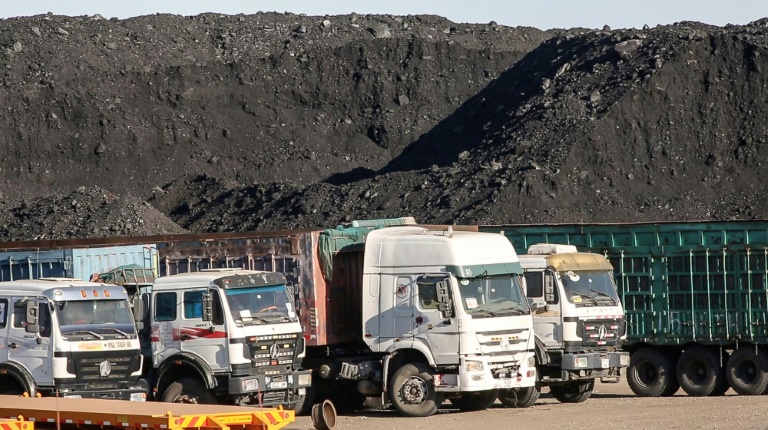
Mongolia has launched a rail line that could help boost coal exports to China to 50 million tonnes a year, the country’s president said, ending a decade-long wait for the crossing.

A ceremony to mark the launch of the rail service between the Tavan Tolgoi coal field and Gashuun Sukhait on the Chinese border was held on Friday.

Mongolian President Ukhnaa Khurelsukh was among the dignitaries in attendance, according to his website.

Heavily dependent on mining, Mongolia has long sought cheaper and more efficient ways to export its minerals abroad and has a national strategy to expand its rail network connections with Russia and China. 

Mining makes up a quarter of the country’s gross domestic product.

China has stepped up its investment in coal in the face of extreme weather, an economic slowdown and a global fuel crisis.

The 233-kilometre (145-mile) Tavan Tolgoi rail line has the capacity to export between 30 million and 50 million tonnes of coal to China annually, according to Tavantolgoi Railway LLC, the state agency that built the line. 

In 2020 the North Asian country exported 28.6 million tonnes of coal. Last year, exports fell to 15.9 million tonnes. 

The railway is also expected to lower the cost to transport coal to $8 per tonne, compared to $32 per tonne when coal is delivered by truck, according to the railway authority. 

Tavan Tolgoi is rich in coking coal, an essential ingredient in the steel-making process. 

For years coal has been transported in trucks to China, a process that has led to long queues at the border and frequent accidents. 

Mongolian governments have attempted to build a railway from Tavan Tolgoi to the Gashuun Sukhait border for more than a decade. 

Tavantolgoi LLC was formed in 2018 to complete the project. Ulaanbaatar-based Bodi International served as the general contractor. 

The Gashuun Sukhait-Gantsmod border crossing is now the second Mongolia-China border point with a rail crossing, with the other at Zamyn-Uud-Erlian. 

Progress Rail, a division of Caterpillar, agreed to supply 16 locomotives to support operations for the railway project. 

The new locomotives are designed to fit the 1,520 mm gauge used in Mongolia, Russia, and other former Soviet republics. 

Mongolia’s current 1,900 km rail network was almost entirely constructed during the 20th century with help from the Soviet Union. 

It consists mainly of the Trans-Mongolia line between Russia and China, and a spur line to the city of Erdenet.
Asian markets rally in early trading, building on US gains

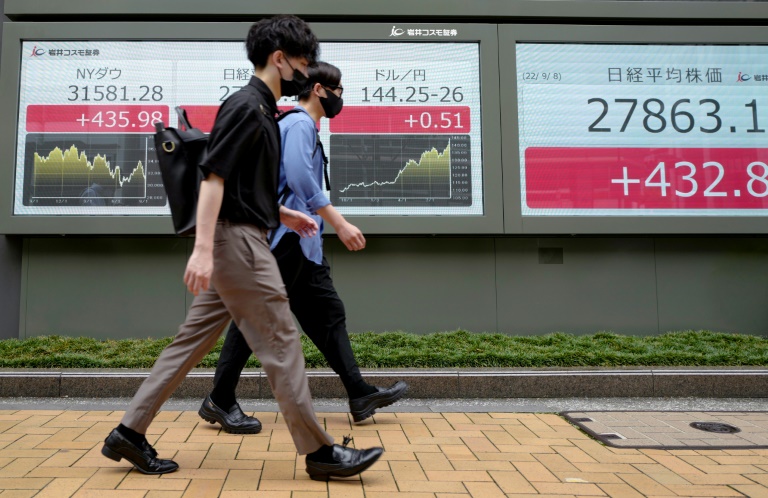
Asian markets rallied in early trading on Monday, building on the momentum of gains in the United States and Europe at the end of last week, as investors price in the expectation of further interest rate hikes aimed at taming inflation.

Equities in Japan, Australia, Singapore, Taiwan and Jakarta surged, while markets in Hong Kong, China and South Korea were closed for a public holiday.

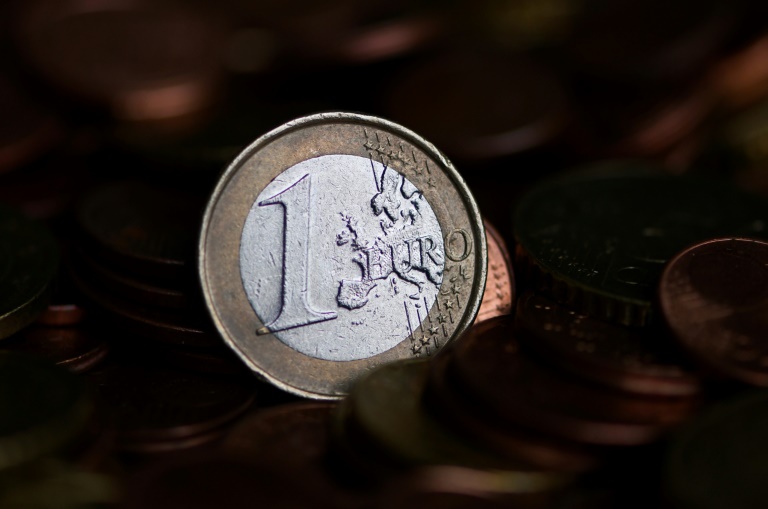
The euro continued to gain against the dollar, with investors in Europe weighing the prospect of the European Central Bank (ECB) following the US Federal Reserve’s lead and raising key rates.

On Sunday, German central bank president Joachim Nagel signalled the ECB would probably continue raising interest rates to curb runaway inflation.

Nagel predicted inflation in Europe might peak at more than 10 percent in December.

The ECB raised the key rate by a historic 75 basis points last week, and markets expect a similar-sized hike at an October meeting.

This week, investors worldwide will be closely watching US inflation data for August, due to be released on Tuesday, with the consumer price index (CPI) expected to ease slightly to eight percent — still well above the Fed’s two-percent target.

Traders expect the Fed to impose another large hike in interest rates next week, after two 75-basis-point increases already.

“A downside surprise in US CPI is likely more of a concern and that could see the dollar weakening further,” Charu Chanana, a strategist at Saxo Capital Markets, told Bloomberg Television.

“We’ve seen some glimpses of that… towards the end of last week. That could potentially be a risk to watch particularly this week.”

– ‘Soft landing’ hopes –

On Sunday, US Treasury Secretary Janet Yellen said she was hopeful the US economy could avoid a recession, but that the Fed would need to skilfully manage interest rates and also rely on “some good luck to achieve what we sometimes call a soft landing”.

“My hope is we will achieve a soft landing, but Americans know it’s essential to bring inflation down and, over the longer run, we can’t have a strong labour market without inflation under control,” she told CNN.

Yellen said that while the US economy’s growth rate was slowing, the labour market remained “exceptionally strong”, with almost two openings for every jobseeker.

In addition to the US CPI figures on Tuesday, traders will be closely watching UK CPI on Wednesday, and European CPI and China home sales, retail sales and industrial production data on Friday.

In Tokyo, stocks opened higher on Monday, driven by positive market sentiment off the back of last week’s gains and a weaker yen.

The dollar fetched 142.65 yen in early Asian trade, against 142.56 yen on Friday in New York.

“A cheaper yen is positive for corporate performances, despite recent media reports” that highlight the negative aspects of the weak yen, said chief strategist Masayuki Kubota of Rakuten Securities.

On Friday, Bank of Japan chief Haruhiko Kuroda met Prime Minister Fumio Kishida, saying the rapid weakening of the currency was “undesirable”, an indication of possible upcoming action to arrest the fall.

– Key figures at around 0300 GMT –

Tokyo – Nikkei 225: UP 1.1 percent at 28,528.90 

Hong Kong – Hang Seng Index: UP 2.7 percent at 19,362.25 (closed for public holiday Monday)

Shanghai – Composite: UP 0.8 percent at 3,262.05 (closed for public holiday Monday)

New York – Dow: UP 1.2 percent at 32,151.71 (close)

New York – S&P 500: UP 1.5 percent at 4,067.36 (close)

New York – Nasdaq: UP 2.1 percent at 12,112.31 (close)

London – FTSE 100: UP 1.2 percent at 7,351.07 (close)

Frankfurt – DAX: UP 1.4 percent at 13,088.21 (close)

Paris – CAC 40: UP 1.4 percent at 6,212.33 (close)

EURO STOXX 50: UP 1.6 percent at 3,570.04 (close)

Euro/dollar: UP at $1.0085 from $1.0046 

Pound/dollar: UP at $1.1609 from $1.1587  

Euro/pound: UP at 86.86 pence from 86.84 pence

Dollar/yen: UP at 142.65 yen from 142.56 yen 

Brent North Sea crude: DOWN 1.4 percent at $91.57 per barrel

West Texas Intermediate: DOWN 1.5 percent at $85.49 per barrel

After pulling out of TPP, US forges Asia trade framework

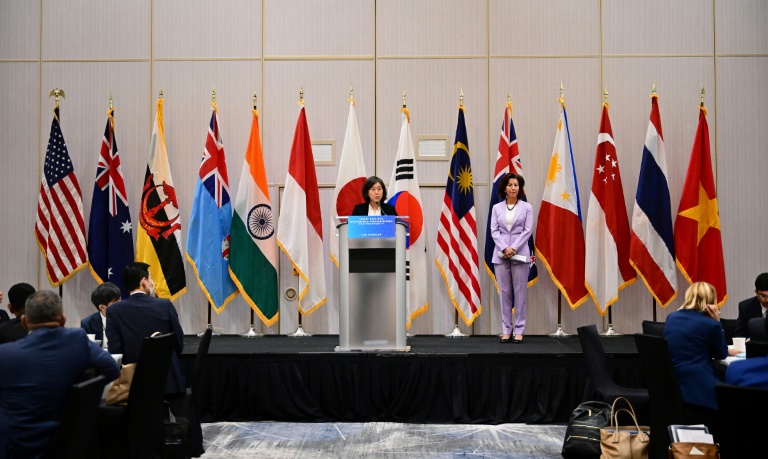
The United States and a group of Asian allies on Friday agreed on a set of negotiating targets, notably on trade and supply chains, as Washington looks to offer an alternative to the economic might of China in the region.

At the first ministerial for the Indo-Pacific Economic Prosperity Framework (IPEF), officials sketched the basis for common standards on key pillars, which also include green energy and the fight against corruption, in 14 countries accounting for 40 percent of the global economy.

“I feel very confident saying that IPEF will create jobs in the United States and will create jobs in other IPEF countries,” US Commerce Secretary Gina Raimondo said at the conclusion of the meeting.

“We were able to finalize all four of the ministerial statements, which lay out the full scope of the framework and provide a roadmap for future discussions.”

The initial meeting offered little flesh on the bones of the plans, which come several years after former president Donald Trump yanked the United States out of a much more comprehensive and hard-won regional trade block.

The Trans-Pacific Partnership (TPP), which has since gone ahead without Washington, was hailed as a “high quality” pact that offered a genuine bulwark to Chinese economic power.

But with US public opinion more wary of free trade agreements, which are seen as a threat to American jobs, President Joe Biden’s administration opted not to rejoin that pact.

The IPEF brings together the United States, Australia, Brunei, Fiji, India, Indonesia, Japan, South Korea, Malaysia, New Zealand, the Philippines, Singapore, Thailand and Vietnam.

Raimondo praised the “consensus and commitment among all” members, though she acknowledged that India had not signed onto agreements on trade and the digital economy.

Business leaders at the gathering said the frameworks agreed over two days of negotiations were worthwhile in the absence of a robust pact like the TPP.

“We were very supportive of the TPP but we’ve just moved on and we’re being realistic right now,” one business leader told AFP on condition of anonymity, adding that the focus is on “getting the best arrangement we can.”

“If the US remains absent from the region, that’s a risk,” the person said, noting how Beijing has frequently dangled sweeteners to regional players, in the form of infrastructure aid.

“Their help also comes with strings attached and in the long run, that can really hurt US companies in the region.”

The alliance is in theory an “open platform” that could eventually include other countries, but does not include Taiwan, a self-ruled island that Beijing claims as its own but that remains a US ally.

Biden says US must develop chips to keep up with China

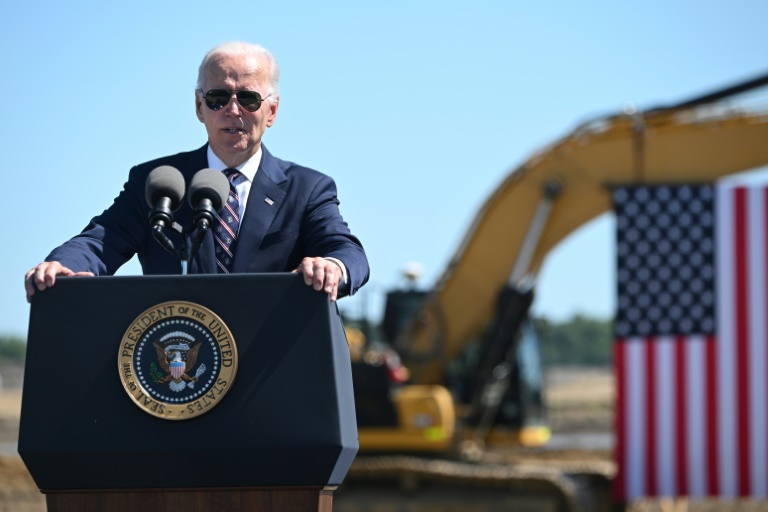
President Joe Biden said Friday at a ceremony to break ground on a semi-conductor plant that making sophisticated computer chips is an issue of US national security in the face of an assertive China.

“All of this is in our economic interest, and it’s in our national security interest as well,” Biden said at the site where Intel plans to build a $20 billion factory.

Biden made the trip to highlight recent legislation passed at his behest setting aside $52 billion to boost US semiconductor production. He said the initiative was part of the broader rivalry between the United States and China.

“It’s no wonder… that the Chinese Communist Party actively lobbied US business against this law,” Biden said, with heavy machinery looming in the background.

Biden said the US will need state-of-the-art engineering “for the weapon systems of the future that are only going to be more reliant on computer chips.”

“Unfortunately, we produce zero, zero of these advanced chips in America,” Biden said.

Biden’s visit here also had a political component as the US midterm elections of November approach.

Ohio is a Rust Belt state where blue collar factory workers historically tended to vote Democrat but turned to the Republican Party and Donald Trump as industries died out and workers felt left out by globalization.

Stocks and oil rally as dollar drops

Stock markets and oil prices rallied Friday, with investors largely pricing in more interest rate hikes aimed at taming runaway inflation.

The dollar slid as much as one percent versus the pound and euro after recent hefty gains.

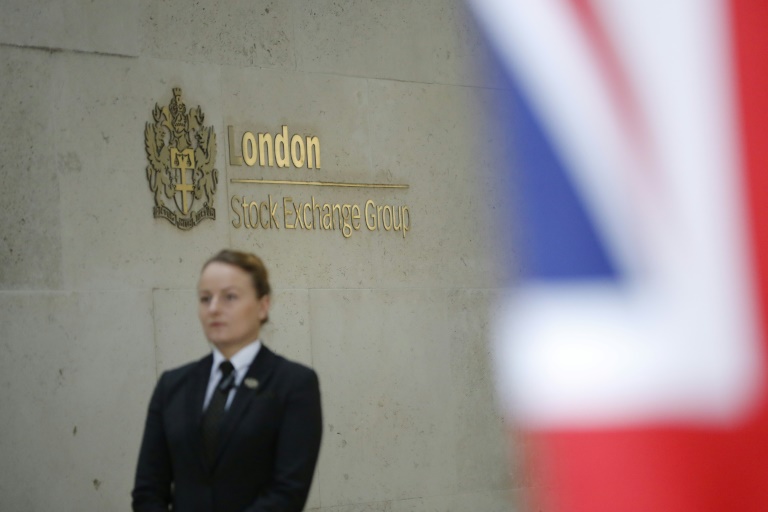
London’s stock market jumped 1.2 percent, mirroring advances in Paris and Frankfurt, while the British capital’s exchange mourned the death of Queen Elizabeth II.

“We are deeply saddened at the passing of Her Majesty Queen Elizabeth II,” the London Stock Exchange said in a message posted on its website.

The LSE is expected to shut on the day of the queen’s funeral following her death on Thursday.

“Markets are being very British about the whole thing, carrying on in a fashion that I suspect she would have approved of,” said IG analyst Chris Beauchamp.

– Dollar off highs –

The more confident mood across equity and oil markets was reflected in a cooler dollar, which had surged to multi-decade highs against major peers in recent weeks owing to the US Federal Reserve’s hawkish tilt to tighter monetary policy.

“There are hopes that the sharp rate increases from the Fed may already have dampened demand, causing US inflation to weaken,” said City Index and FOREX.com analyst Fawad Razaqzada. 

The greenback’s softness came even after Fed chief Jerome Powell reasserted the US central bank’s determination to keep hiking interest rates to fight prices, even at the cost of economic growth.

His warning that “we need to act now forthrightly, strongly” followed comments from his deputy Lael Brainard, who said policymakers would lift borrowing costs for as long as it takes to bring inflation down from 40-year highs.

Nevertheless, Wall Street has pushed higher on Thursday and Friday, putting markets on course for a weekly gain and easing some pressure after hefty losses in August caused by worries that rising rates would spark a recession.

In Asia, Hong Kong rose close to three percent heading into a long weekend.

Edward Moya, analyst at trading platform OANDA, said traders cheered as “Powell stuck to his hawkish script and affirmed the commitment to tighten policy until inflation is back towards their target.”

There was also some cheer from news that inflation in China had eased slightly in August, giving the government more room to introduce more economy-supporting measures, though the recovery remains hostage to leaders’ strict zero-Covid strategy of growth-sapping lockdowns.

A Thursday pledge by Britain’s new Prime Minister Liz Truss to freeze domestic energy bills for two years also helped temper inflation concerns and boosted sentiment about the economy.

The euro was holding well above parity with the dollar, one day after the European Central Bank announced its own 75 basis-point rise as it warned inflation was “far too high” and likely to stay above target for “an extended period”.

ECB chief Christine Lagarde suggested policy would continue to be tightened for some time.

The yen strengthened as officials began speaking up after the unit approached a 32-year low versus the greenback.

The pick-up came after Bank of Japan chief Haruhiko Kuroda met Prime Minister Fumio Kishida on Friday before saying “the rapid weakening of the yen is undesirable”. 

The talks were seen as a sign of intent to act in support of the currency if it continued to weaken. 

– Key figures at around 1530 GMT –

New York – Dow: UP 1.0 percent at 32,086.36 points

EURO STOXX 50: UP 1.2 percent at 3,570.04

London – FTSE 100: UP 1.2 percent at 7,351.07 (close)

Frankfurt – DAX: UP 1.4 percent at 13,088.21 (close)

Paris – CAC 40: UP 1.4 percent at 6,212.33 (close)

Tokyo – Nikkei 225: UP 0.5 percent at 28,214.75 (close)

Hong Kong – Hang Seng Index: UP 2.7 percent at 19,362.25 (close)

Shanghai – Composite: UP 0.8 percent at 3,262.05 (close)

Euro/dollar: UP at $1.0037 from $1.0001 on Thursday

Pound/dollar: UP at $1.1580 from $1.1500

Euro/pound: DOWN at 86.66 pence from 86.93 pence

Dollar/yen: DOWN at 142.52 yen from 144.07 yen 

Brent North Sea crude: UP 3.0 percent at $91.82 per barrel

West Texas Intermediate: UP 3.1 percent at $86.15 per barrel

burs-rl/lth

Stocks and oil prices rally, as dollar drops

Stock markets and oil prices rallied Friday, with investors largely pricing in more interest rate hikes aimed at taming runaway inflation.

The dollar slid one percent versus the pound and euro after recent hefty gains.

London’s stock market jumped more than 1.5 percent in morning deals, mirroring advances in Paris and Frankfurt, while the British capital’s exchange mourned the death of Queen Elizabeth II.

“We are deeply saddened at the passing of Her Majesty Queen Elizabeth II,” the London Stock Exchange said in a message posted on its website.

“Our sympathies and condolences are with The Royal Family.”

The LSE is expected to shut on the day of the queen’s funeral following her death on Thursday.

“Markets are being very British about the whole thing, carrying on in a fashion that I suspect she would have approved of,” said IG analyst Chris Beauchamp.

– Dollar off highs –

The more confident mood across equity and oil markets was reflected in a cooler dollar, which had surged to multi-decade highs against major peers in recent weeks owing to the Federal Reserve’s hawkish tilt to tighter monetary policy.

The greenback’s softness came even after Federal Reserve chief Jerome Powell reasserted the US central bank’s determination to keep hiking interest rates to fight prices, even at the cost of economic growth.

His warning that “we need to act now forthrightly, strongly” followed comments from his deputy Lael Brainard, who said policymakers would lift borrowing costs for as long as it takes to bring inflation down from 40-year highs.

Still, Wall Street ended in positive territory Thursday, putting markets on course for a weekly gain and easing some pressure after hefty losses in August caused by worries that rising rates would spark a recession.

New York’s rise filtered through to Asia, where Hong Kong rose close to three percent heading into a long weekend.

Edward Moya, analyst at trading platform OANDA, said traders cheered as “Powell stuck to his hawkish script and affirmed the commitment to tighten policy until inflation is back towards their target.

“Wall Street is expecting to see some pricing pressure relief with next week’s inflation report, but that shouldn’t derail the current 75 basis-point pace of tightening.”

There was also some cheer from news that inflation in China had eased slightly in August, giving the government more room to introduce more economy-supporting measures, though the recovery remains hostage to leaders’ strict zero-Covid strategy of growth-sapping lockdowns.

The euro was holding well above parity with the dollar, one day after the European Central Bank announced its own 75 basis-point rise as it warned inflation was “far too high” and likely to stay above target for “an extended period”.

ECB chief Christine Lagarde suggested policy would continue to be tightened for some time.

The yen strengthened as officials began speaking up after the unit approached a 32-year low versus the greenback.

The pick-up came after Bank of Japan chief Haruhiko Kuroda met Prime Minister Fumio Kishida on Friday before saying “the rapid weakening of the yen is undesirable”. 

The talks were used as a sign of intent to act in support of the currency if it continued to weaken. 

– Key figures at around 1045 GMT –

London – FTSE 100: UP 1.6 percent at 7,378.05 points

Frankfurt – DAX: UP 1.5 percent at 13,092.83

Paris – CAC 40: UP 1.8 percent at 6,233.32

EURO STOXX 50: UP 1.8 percent at 3,576.28

Tokyo – Nikkei 225: UP 0.5 percent at 28,214.75 (close)

Hong Kong – Hang Seng Index: UP 2.7 percent at 19,362.25 (close)

Shanghai – Composite: UP 0.8 percent at 3,262.05 (close)

New York – Dow: UP 0.6 percent at 31,774.52 (close)

Euro/dollar: UP at $1.0090 from $1.0001 on Thursday

Pound/dollar: UP at $1.1621 from $1.1500

Euro/pound: DOWN at 86.84 pence from 86.93 pence

Dollar/yen: DOWN at 142.13 yen from 144.07 yen 

Brent North Sea crude: UP 2.0 percent at $90.89 per barrel

West Texas Intermediate: UP 1.5 percent at $84.77 per barrel

burs/bcp/rfj/lth

Asian markets rally, dollar dips as traders price in policy tightening

Asian markets rallied Friday following a healthy performance on Wall Street, with investors largely pricing in more interest rate hikes aimed at taming runaway inflation.

The more confident mood was reflected in a dip in the dollar, which has surged in recent weeks to multi-decade highs against its major peers owing to the Federal Reserve’s hawkish tilt to tighter monetary policy.

The greenback’s softness came even after Fed chief Jerome Powell reasserted the bank’s determination to keep hiking rates to fight prices, even at the cost of economic growth.

His warning that “we need to act now forthrightly, strongly” followed comments from his deputy Lael Brainard, who said policymakers would lift borrowing costs for as long as it takes to bring inflation down from 40-year highs.

Still, Wall Street ended in positive territory, putting markets on course for a weekly gain and easing some pressure after hefty losses in August caused by worries that rising rates would spark a recession.

“The markets have finally digested the fact that rates are almost certain to go up by 75 basis points when the Fed moves next (on September 21),” JoAnne Feeney, at Advisors Capital Management, told Bloomberg TV.

“What we are seeing though is some recognition that perhaps the sell-off that we saw in the second half of August was a bit overdone,” she said.

New York’s rise filtered through to Asia, where Hong Kong rose close to three percent heading into a long weekend, while Tokyo, Sydney, Shanghai, Singapore, Wellington, Mumbai, Manila and Bangkok were also well up.

London, Paris and Frankfurt also rose in early trading.

OANDA’s Edward Moya said traders cheered as “Powell stuck to his hawkish script and affirmed the commitment to tighten policy until inflation is back towards their target.

“Wall Street is expecting to see some pricing pressure relief with next week’s inflation report, but that shouldn’t derail the current 75 basis-point pace of tightening.”

There was also some cheer from news that inflation in China had eased slightly in August, giving the government more room to introduce more economy-supporting measures, though the recovery remains hostage to leaders’ strict zero-Covid strategy of growth-sapping lockdowns.

On currency markets, the euro was holding well above parity with the dollar after the European Central Bank announced its own 75 basis-point rise as it warned inflation was “far too high” and likely to stay above target for “an extended period”.

ECB chief Christine Lagarde suggested policy would continue to be tightened for some time.

The yen strengthened as officials began speaking up after the unit approached a 32-year low versus the greenback.

The pick-up came after Bank of Japan chief Haruhiko Kuroda met Prime Minister Fumio Kishida on Friday before saying “the rapid weakening of the yen is undesirable”. 

The talks were used as a sign of intent to act in support of the currency if it continued to weaken. 

However, there is an expectation the Japanese unit will see more losses as the BoJ sticks rigidly to its ultra-loose policies despite the Fed’s increasingly hawkish moves.

Oil prices edged up after Thursday’s gains though they remain pressured by ongoing worries about the impact on demand from possible recessions caused by the rate hikes and inflation. 

Weakness in China’s economy and lockdowns in major cities were also cause for concern among commodities traders. 

Reports that President Joe Biden was considering releasing more crude from the US strategic reserves were also weighing on the market.

Washington is concerned that prices could spike in December when European Union sanctions on Russian supplies kick in.

– Key figures at around 0810 GMT –

Tokyo – Nikkei 225: UP 0.5 percent at 28,214.75 (close)

Hong Kong – Hang Seng Index: UP 2.7 percent at 19,362.25 (close)

Shanghai – Composite: UP 0.8 percent at 3,262.05 (close)

London – FTSE 100: UP 1.0 percent at 7,335.91

Euro/dollar: UP at $1.0096 from $1.0001 on Thursday

Pound/dollar: UP at $1.1628 from $1.1500

Euro/pound: DOWN at 86.81 pence from 86.93 pence

Dollar/yen: DOWN at 142.39 yen from 144.07 yen 

West Texas Intermediate: UP 1.2 percent at $84.54 per barrel

Brent North Sea crude: UP 1.3 percent at $90.32 per barrel

New York – Dow: UP 0.6 percent at 31,774.52 (close)

Asian markets rally, dollar dips as traders price in policy tightening

Asian markets rallied Friday following a healthy performance on Wall Street, with investors largely pricing in more interest rate hikes aimed at taming runaway inflation.

The more confident mood was reflected in a dip in the dollar, which has surged in recent weeks to multi-decade highs against its major peers owing to the Federal Reserve’s hawkish tilt to tighter monetary policy.

The greenback’s softness came even after Fed chief Jerome Powell reasserted the bank’s determination to keep hiking rates to fight prices, even at the cost of economic growth.

His warning that “we need to act now forthrightly, strongly” followed comments from his deputy Lael Brainard, who said policymakers would lift borrowing costs for as long as it takes to bring inflation down from 40-year highs.

Still, Wall Street ended in positive territory, putting markets on course for a weekly gain and easing some pressure after hefty losses in August caused by worries that rising rates will spark a recession.

“The markets have finally digested the fact that rates are almost certain to go up by 75 basis points when the Fed moves next (on September 21),” JoAnne Feeney, at Advisors Capital Management, told Bloomberg TV.

“What we are seeing though is some recognition that perhaps the sell-off that we saw in the second half of August was a bit overdone,” she said.

New York’s rise filtered through to Asia, where Hong Kong added more than two percent heading into a long weekend, while Tokyo, Sydney, Shanghai, Singapore, Wellington, Manila and Bangkok were all up.

OANDA’s Edward Moya said traders cheered as “Powell stuck to his hawkish script and affirmed the commitment to tighten policy until inflation is back towards their target.

“Wall Street is expecting to see some pricing pressure relief with next week’s inflation report, but that shouldn’t derail the current 75 basis-point pace of tightening.”

There was also some cheer from news that inflation in China had eased slightly in August, giving the government more room to introduce more economy-supporting measures, though the recovery remains hostage to leaders’ strict zero-Covid strategy of growth-sapping lockdowns.

On currency markets, the euro was holding well above parity with the dollar after the European Central Bank announced its own 75 basis-point rise as it warned inflation was “far too high” and likely to stay above target for “an extended period”.

ECB chief Christine Lagarde suggested policy would continue to be tightened for some time.

The yen was also slightly stronger, having been in danger of hitting a 32-year low versus the greenback, with senior Japanese officials hinting at possible action to curb its losses if the unit fell further.

However, there is an expectation that it will see more losses as the Bank of Japan sticks rigidly to its ultra-loose policies despite the Fed’s increasingly hawkish moves.

Oil prices extended Thursday’s gains though they remain pressured by ongoing worries about the impact on demand from possible recessions caused by the rate hikes and inflation. 

Weakness in China’s economy and lockdowns in major cities were also cause for concern among commodities traders. 

Reports that President Joe Biden was considering releasing more crude from the US strategic reserves were also weighing on the market.

Washington is concerned that prices could spike in December when European Union sanctions on Russian supplies kick in.

– Key figures at around 0320 GMT –

Tokyo – Nikkei 225: UP 0.6 percent at 28,219.70 (break)

Hong Kong – Hang Seng Index: UP 2.2 percent at 19,269.43

Shanghai – Composite: UP 0.7 percent at 3,258.94

Euro/dollar: DOWN at $1.0070 from $1.0001 on Thursday

Pound/dollar: DOWN at $1.1568 from $1.1500

Euro/pound: UP at 87.07 pence from 86.93 pence

Dollar/yen: DOWN at 143.70 yen from 144.07 yen 

West Texas Intermediate: UP 0.4 percent at $83.91 per barrel

Brent North Sea crude: UP 0.7 percent at $89.73 per barrel

New York – Dow: UP 0.6 percent at 31,774.52 (close)

London – FTSE 100: UP 0.3 percent at 7,262.06 (close) 

Recycling firm battles Jakarta's plastic waste emergency

As Indonesia’s capital Jakarta grapples with overflowing plastic waste and pollution pours into the sea, one burgeoning business is trying to turn rubbish into revenue.

Tridi Oasis Group, which employs 120 people, has recycled more than 250 million bottles since it was founded six years ago.

“I don’t see discarded plastic as trash. For me, it is a valuable material in the wrong place,” 35-year-old founder Dian Kurniawati told AFP.

Indonesia has pledged to reduce plastic waste by 30 percent over the next three years — a mammoth task in the Southeast Asian nation of nearly 270 million people where plastic recycling is rare.

The country generates approximately 7.8 million tonnes of plastic waste every year, with more than half mismanaged or disposed of improperly, according to the World Bank.

Kurniawati’s company receives plastic from recycling centres across the greater Jakarta area — which has 30 million people — at its factory in Banten province outside the city.

Then the company exports recycled plastic to European countries and also distributes it locally to be processed and used as packaging or textiles. 

Kurniawati resigned from her consultant job to start the firm, tackling head-on the massive challenges faced by the world’s fourth most populous country in dealing with the plastic crisis.

As one of the initiators of the “Beach Clean Up Jakarta” movement, she saw how Jakarta is littered with plastic waste and was frustrated that little was being done to change the situation.

– ‘Our problem’ – 

Hundreds of piles of crushed clear plastic bottles sit piled neatly in the Banten factory, ready to be sorted to make sure no labels or caps are left behind. 

The bottles are then cleaned thoroughly to eliminate contamination before being cut into small flakes, ready to be transported to clients for processing and reuse as packaging or textiles. 

Fajar Sarbini, a 24-year-old employee, hopes more Indonesians will start recycling.

“People throw away their waste mindlessly, they should at least sort out sharp materials so they won’t hurt garbage collectors,” he said.

Jakarta does not have a municipal collection system for household waste and has no incineration facilities.

With green trends rising and the will of younger generations to live more sustainably growing, the country is not without hope. 

“Indonesia is catching up and the acceleration is quite fast because we got help from social media and youth campaigns,” Kurniawati said. 

But she said the waste problem facing the country is enormous and the regulation to encourage plastic to be recycled is lacking.

“Plastic waste is our problem and solving it takes a concerted effort from everybody,” she said.

“It can’t be solved by just the government or recycling companies.” 

Euro slides as Fed chief steals ECB's rate hike thunder

The euro slid on Thursday against the dollar despite a record interest rate hike by the European Central Bank as Federal Reserve chief Jerome Powell also signaled a tough approach against inflation.

Meanwhile, the pound remained close to a 37-year low against the dollar that was struck Wednesday, as new British Prime Minister Liz Truss announced that she will freeze domestic fuel bills for two years to help ease the burden of a UK cost-of-living crisis.

The British currency did not move significantly on news of the death of Queen Elizabeth II after a 70-year reign.

The ECB warned Thursday that inflation was “far too high” and likely to stay above target for “an extended period” as it announced its record 0.75 percentage point hike.

ECB chief Christine Lagarde made clear interest rates were far from where they need be to bring inflation down.

“We actually took the decision today that we would continue to raise interest rates… because we believe that we are far away from the rate at which we hope we’ll see inflation return to the two percent medium term target,” she said.

Lagarde also warned the eurozone risks recession if Russia completely cuts off gas, which it has nearly done.

But comments by Fed chief Jerome Powell were seen as even more hawkish than those by Lagarde.

“We need to act now forthrightly, strongly as we have been doing and we need to keep at it until the job is done to avoid … the kind of very high social costs” of the surge in inflation in the 1970s and 1980s, Powell told a US think tank.

– Greenback ‘more attractive’ –

Chris Beauchamp, chief market analyst at online trading platform IG, said “Investors clearly believe that the Fed is more committed to higher rates than the ECB, while the stronger economic performance of the US means the greenback and not the euro seems the more attractive prospect.”

The euro, which had broken back above parity with the dollar, slid down as far as $0.9934 before recovering some ground.

The Fed has made it clear it plans to continue to aggressively raise interest rates to rein in surging inflation, even at the cost of causing some economic pain.

The dollar has moved ever higher against its major peers in recent weeks as investors flood into the currency hoping for better returns as the Fed raises rates and as they seek a haven in the face of economic turmoil.

The euro on Wednesday touched a fresh 20-year dollar low.

The Fed holds its next policy meeting on September 21, with a third successive 75-basis-point lift forecast.

In equities trading, eurozone stocks closed the day mostly higher, and Wall Street equities pushed higher following a choppy session.

Analysts said the hawkish central bank policy was largely in line with expectations.

“The resilience was construed as a sign that a lot of bad news, and worries about near-term rate hikes, have been priced in already,” said Briefing.com. 

– Key figures at around 2130 GMT –

New York – Dow: UP 0.6 percent at 31,774.52 (close)

New York – S&P 500: UP 0.7 percent at 4,006.18 (close)

New York – Nasdaq: UP 0.6 percent at 11,862.13 (close)

London – FTSE 100: UP 0.3 percent at 7,262.06 (close) 

Frankfurt – DAX: DOWN less than 0.1 percent at 12,904.32 (close)

Paris – CAC 40: UP 0.3 percent at 6,125.90 (close)

EURO STOXX 50: UP 0.3 percent at 3,512.38 (close)

Tokyo – Nikkei 225: UP 2.3 percent at 28,065.28 (close)

Hong Kong – Hang Seng Index: DOWN 1.0 percent at 18,854.62 (close)

Shanghai – Composite: DOWN 0.3 percent at 3,235.59 (close)

Euro/dollar: DOWN at $1.0001 from $1.0006 on Wednesday

Pound/dollar: DOWN at $1.1500 from $1.1533

Euro/pound: UP at 86.93 pence from 86.76 pence

Dollar/yen: UP at 144.07 yen from 143.74 yen 

West Texas Intermediate: UP 2.0 percent at $83.54 per barrel

Brent North Sea crude: UP 1.3 percent at $89.15 per barrel

burs-jmb/st

Close Bitnami banner
Bitnami