Chinese Business

Euro slides as Fed chief steals ECB's rate hike thunder

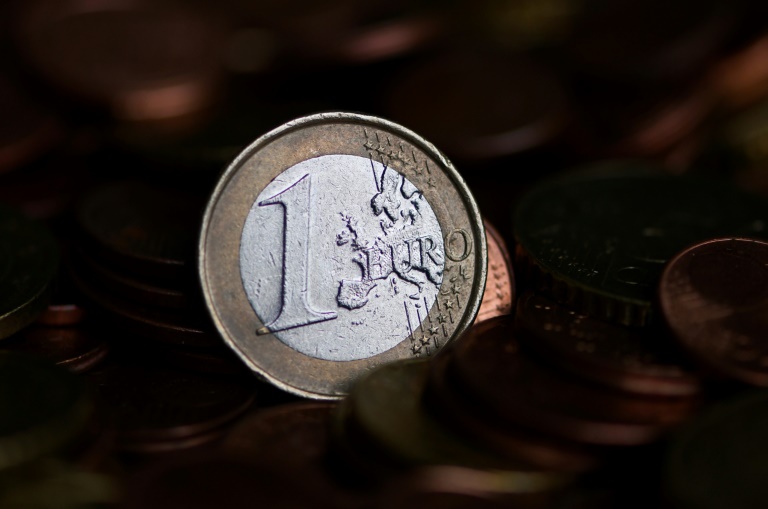
The euro slid on Thursday despite a record interest rate hike by the European Central Bank as US Fed chief Jerome Powell made hawkish comments.

Meanwhile, the pound remained close to a 37-year low against the dollar that was struck Wednesday, as new British Prime Minister Liz Truss announced that she will freeze domestic fuel bills for two years to help ease the burden of a UK cost-of-living crisis.

The ECB warned Thursday that inflation was “far too high” and likely to stay above target for “an extended period” as it announced its record 0.75 percentage point hike.

ECB chief Christine Lagarde made clear interest rates were far from where they need be to bring inflation down.

“We actually took the decision today that we would continue to raise interest rates… because we believe that we are far away from the rate at which we hope we’ll see inflation return to the two percent medium term target,” she said.

Lagarde also warned the eurozone risks recession if Russia completely cuts off gas, which it has nearly done.

But comments by Fed chief Jerome Powell were seen as even more hawkish than those by Lagarde.

“We need to act now forthrightly, strongly as we have been doing and we need to keep at it until the job is done to avoid … the kind of very high social costs” of the surge in inflation in the 1970s and 1980s, Powell told a US think tank.

– Greenback ‘more attractive’ –

Chris Beauchamp, chief market analyst at online trading platform IG, said “Investors clearly believe that the Fed is more committed to higher rates than the ECB, while the stronger economic performance of the US means the greenback and not the euro seems the more attractive prospect.”

The euro, which had broken back above parity with the dollar, slid down as far as $0.9934 before recovering some ground.

The Fed has made it clear it plans to continue to aggressively raise interest rates to rein in surging inflation, even at the cost of causing some economic pain.

The dollar has moved ever higher against its major peers in recent weeks as investors flood into the currency hoping for better returns as the Fed raises rates and as they seek a haven in the face of economic turmoil.

The euro on Wednesday touched a fresh 20-year dollar low.

The US unit is closing in on a 32-year peak against the yen owing to the Bank of Japan’s refusal to raise interest rates.

Observers expect the dollar to keep attracting strong interest as long as the Federal Reserve keeps ramping up US interest rates by sizeable amounts.

The Fed holds its next policy meeting on September 21, with a third successive 75-basis-point lift forecast.

In equities trading, eurozone stocks closed the day mostly higher, and Wall Street was also up in morning trading.

“It has been slow going, but stocks look like they are in a mood to continue yesterday’s rebound,” said IG’s Beauchamp.

“The selling of late August and early September seems to have been exhausted for now, although the broader outlook is still less than encouraging,” he added.

– Key figures at around 1530 GMT –

New York – Dow: UP 0.5 percent at 31,736.76 points

EURO STOXX 50: UP 0.3 percent at 3,512.38

London – FTSE 100: UP 0.3 percent at 7,262.06 (close) 

Frankfurt – DAX: DOWN less than 0.1 percent at 12,904.32 (close)

Paris – CAC 40: UP 0.3 percent at 6,125.90 (close)

Tokyo – Nikkei 225: UP 2.3 percent at 28,065.28 (close)

Hong Kong – Hang Seng Index: DOWN 1.0 percent at 18,854.62 (close)

Shanghai – Composite: DOWN 0.3 percent at 3,235.59 (close)

Euro/dollar: DOWN at $0.9960 from $1.0012 on Wednesday

Pound/dollar: DOWN at $1.1492 from $1.1535

Euro/pound: DOWN at 86.66 pence from 86.74 pence

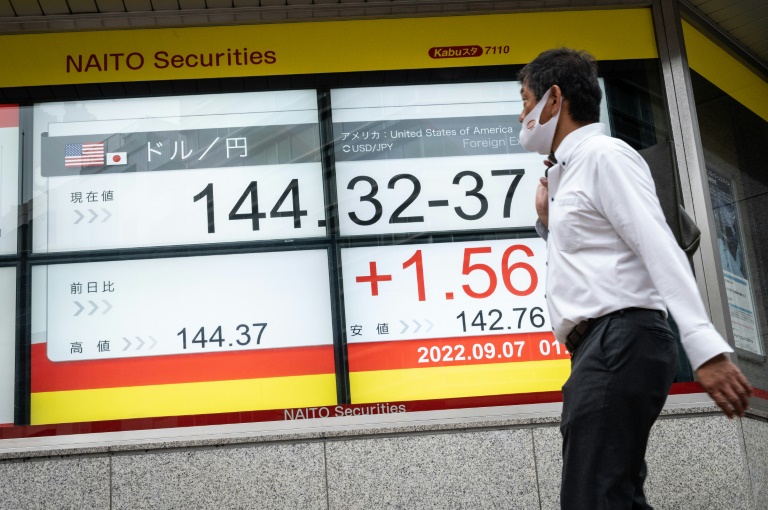
Dollar/yen: UP at 143.94 yen from 143.79 yen 

West Texas Intermediate: UP 1.7 percent at $83.29 per barrel

Brent North Sea crude: UP 1.0 percent at $88.87 per barrel

burs-rl/cdw
Japan says ready for 'necessary response' as yen dives

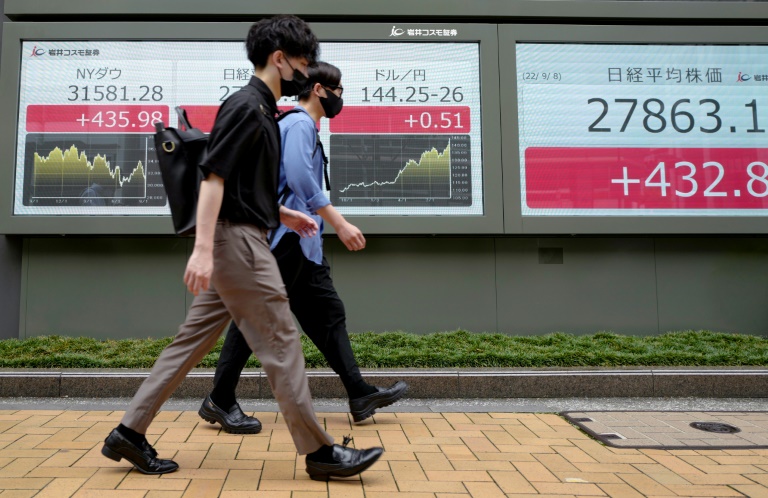
Japan is ready to take action if the yen’s plummeting value remains volatile, officials repeated on Thursday, after the currency hit 24-year lows.

The yen has tumbled from around 115 per dollar in March to lower than 140 last week, as the Bank of Japan (BoJ) sticks with its monetary easing policies in contrast to rate hikes from other central banks including the US Federal Reserve.

It has continued to drop fast, nearly touching 145 per dollar overnight in New York, as investors flooded into the US currency hoping for better returns and as a safe-haven hedge.

Japan has not announced any specific measures to bolster the yen, such as instructing the central bank to buy it against other currencies.

But on Thursday, officials from the BoJ, the finance ministry and the government’s fiscal services agency held a meeting while the yen hovered close to 144 per dollar.

“If (the yen) continues to fluctuate like this, the government is ready to take the necessary response in financial markets,” Masato Kanda, Vice-Minister of Finance for International Affairs, told reporters after the meeting.

“Various measures” are on the table, he said without giving details. His comments closely echoed remarks made Wednesday by Japan’s finance minister, who said rapid shifts in foreign exchange rates were “not desirable”.

Ray Attrill, head of FX strategy at National Australia Bank, said the rhetoric would have little effect.

“The market’s not buying what the Japanese officials are selling in terms of their public concerns about the moves in the yen. They’ve basically been singing from exactly the same hymn sheet,” he told AFP.

A weaker yen can help Japanese companies to sell products overseas, but “at these levels, the disadvantages of a weak yen are starting to outweigh the benefits,” with households and businesses facing higher import prices, Attrill said.

Inflation more broadly has risen to seven-year highs in Japan, partly due to the impact of the war in Ukraine on energy prices, but it is still less severe than in many major economies.

Prime Minister Fumio Kishida announced Thursday that the government will use 3.5 trillion yen ($24 billion) of reserve funds to address the domestic impact of inflation, and will deliver cash relief packages to low-income households.

European stocks diverge before major UK, ECB announcements

European stock markets traded mixed Thursday, ahead of major policy decisions from Britain and the European Central Bank aimed at tackling sky-high inflation.

The pound remained close to a 37-year low against the dollar that was struck Wednesday, as new British Prime Minister Liz Truss prepared to announce that she will freeze domestic fuel bills to help ease the burden of a UK cost-of-living crisis.

The euro steadied versus the greenback, with the ECB forecast to hike eurozone interest rates by a record-high 75 basis points.

Oil prices dropped further on fears of a global recession but losses were far less sharp than on Wednesday.

“There may be fresh storms brewing for the global economy but inflation is the tornado to tame and the drop in crude prices has lifted hopes in the US at least that the price spiral may be easier to control,” noted Susannah Streeter, senior investment and markets analyst at Hargreaves Lansdown.

Fears abound that global central bank moves to rein in runaway inflation by ratcheting up borrowing costs will spark recessions in leading economies.

The dollar has moved ever higher against its major peers in recent weeks as investors flood into the currency hoping for better returns and as they seek a haven in the face of economic turmoil.

The US unit is closing in on a 32-year peak against the yen owing to the Bank of Japan’s refusal to raise interest rates.

Observers expect the dollar to keep attracting strong interest as long as the Federal Reserve keeps ramping up US interest rates by sizeable amounts.

The Fed holds its next policy meeting on September 21, with a third successive 75-basis-point lift forecast.

“For years, central bank interest rate decisions used to be background noise, with investors confident that rates would stay low,” Russ Mould, investment director at AJ Bell, said Thursday.

“This year they’ve become must-watch events, with every word studied by the market. The current theme is not whether central banks will raise rates, but by how much.”

On the corporate front, shares in cyber security company Darktrace crashed around 30 percent after US private equity firm Thoma Bravo ended its takeover interest in the British group.

– Key figures at around 1000 GMT –

London – FTSE 100: UP 0.3 percent at 7,256.23 points

Frankfurt – DAX: DOWN 0.1 percent at 12,901.90

Paris – CAC 40: UP 0.4 percent at 6,130.18

EURO STOXX 50: DOWN 0.2 percent at 3,507.91

Tokyo – Nikkei 225: UP 2.3 percent at 28,065.28 (close)

Hong Kong – Hang Seng Index: DOWN 1.0 percent at 18,854.62 (close)

Shanghai – Composite: DOWN 0.3 percent at 3,235.59 (close)

New York – Dow: UP 1.4 percent at 31,581.28 (close)

Euro/dollar: DOWN at $0.9996 from $1.0012 on Wednesday

Pound/dollar: DOWN at $1.1486 from $1.1535

Euro/pound: UP at 87.01 pence from 86.74 pence

Dollar/yen: UP at 143.87 yen from 143.79 yen 

West Texas Intermediate: DOWN 0.6 percent at $81.43 per barrel

Brent North Sea crude: DOWN 0.3 percent at $87.71 per barrel

burs-bcp/rfj/cdw

Taiwan chip giant TSMC sees all-time high revenue in August

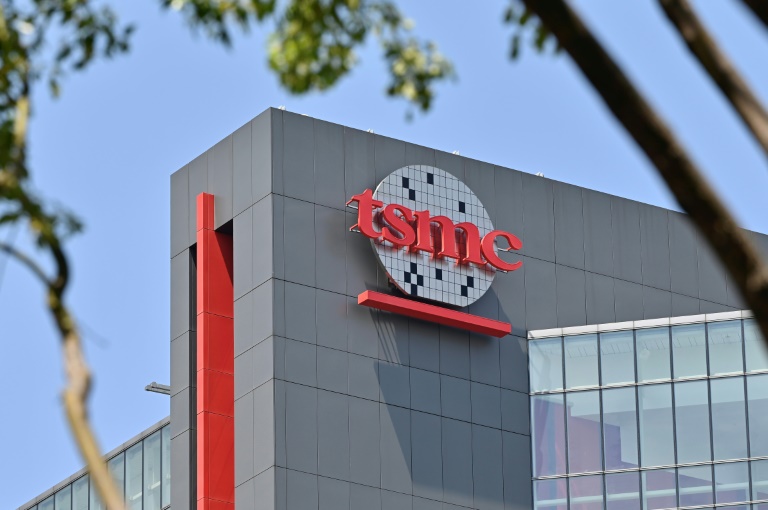
Taiwanese semiconductor giant TSMC said Thursday its August revenue rose nearly 60 percent to a record high of Tw$218.13 billion ($7.06 billion) on soaring global demand. 

Taiwan Semiconductor Manufacturing Company operates the world’s largest silicon wafer factories and produces some of the most advanced microchips used in everything from smartphones and cars to missiles. 

The vast majority of the world’s top-notch microchips are made by just two companies — TSMC and Samsung — both of which are running at full capacity to alleviate a global shortage. 

The Taiwanese firm controls more than half of global foundry output, with clients including Apple and Qualcomm.

Its August revenue rose 58.7 percent on-year and 16.8 percent from July to an all-time high of Tw$218.13 billion — the first time it has reached the Tw$200 billion mark, according to a company statement. 

Revenue for the first eight months of the year totalled Tw$1.4 trillion, a 43.5 percent increase on the same period in 2021. 

TSMC chief executive C.C. Wei told an investor conference in July that customer demand continued to exceed the company’s ability to supply and he expected capacity to remain tight throughout 2022. 

But he also expected “a few quarters of inventory adjustment” through the first half of 2023 due to softening demand for some products including smartphones and personal computers.

While Taiwan’s semiconductor and high-tech industry has shown impressive growth, other parts of the economy are showing signs of an impact from the general global slowdown. 

Taiwan’s exports in August grew at their slowest pace in more than two years by just two percent to $40.34 billion, the finance ministry said.

That compared to 14.2 percent growth in July and was the slowest pace of increase since July 2020’s 0.3 percent when exports were hammered by the emergence of the coronavirus pandemic.

Exports would have dropped 4.2 percent from a year earlier without the electronic components industry, which accounted for over 40 percent of overseas shipments in August, according to the ministry. 

Semiconductor exports rose 14.3 percent from a year earlier to $15.69 billion last month but a slowdown in demand for consumer electronic products saw shipments for information/communication, audio and video products drop 1.6 percent on-year. 

Exports in the “old economy sector” largely declined last month, with plastics/rubber falling by 21.8 percent while chemicals were down 17.1 percent on-year.

Markets see much-needed bounce, but nerves remain

Most markets enjoyed a rare advance on bargain-buying Thursday, tracking a Wall Street rally after a series of losses, while dovish comments on future interest rate hikes by Australia’s central bank boss provided a boost to sentiment.  

The dollar resumed its upward march with the Federal Reserve and European Central Bank expected to announce more bumper increases in borrowing costs.

Equities have been ravaged for weeks by fears that global central bank moves to rein in runaway inflation by ratcheting up borrowing costs will spark fresh recessions in some leading economies.

In turn, the greenback has moved ever higher against its major peers as investors flood into the currency hoping for better returns and as a safe-haven hedge against uncertainty and worldwide turmoil.

On Wednesday, the US unit hit a 37-year high against sterling, while it was also closing in on a 32-year peak above 147.60 yen owing to the Bank of Japan’s refusal to tighten its monetary policy, seen as the key driver of that rally.

Still, Japanese officials said they were tracking the price movements and hinted at possible action if things did not improve.

The euro dipped ahead of an expected hefty rate hike by the European Central Bank later in the day.

However, there was some light, where Reserve Bank of Australia head Philip Lowe said the case for a weaker pace of monetary tightening gained momentum as rates rise. The comments provided a little hope that central banks could be ready at some point for a change of course.

Australian bond yields and the country’s dollar fell, while US Treasury yields also slipped.

For now, observers are certain the US dollar will continue to attract strong interest for as long as the Fed keeps ramping up interest rates.

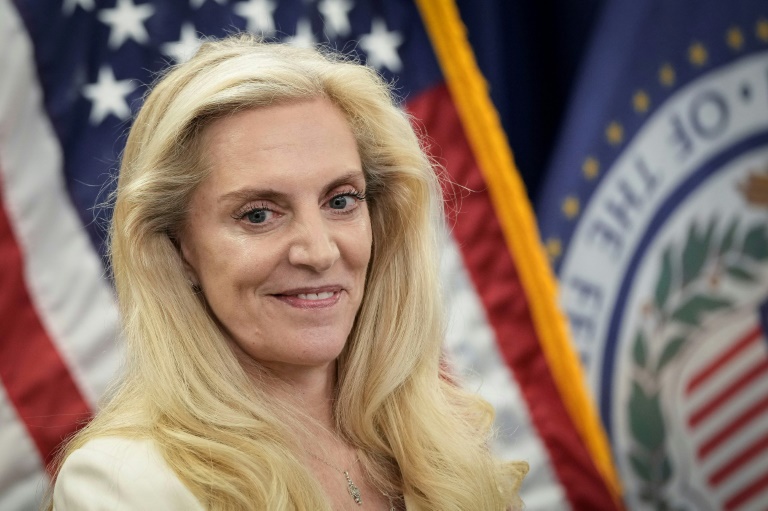
Those views were justified by Vice Chair Lael Brainard, who warned that policymakers would keep hiking rates until they have finally brought prices under control.

“We are in this for as long as it takes to get inflation down,” she said in comments prepared for a conference in New York, adding that she understood this would have a severe impact on families. 

The Fed holds its next policy meeting on September 21, with a third successive 75-basis-point lift forecast.

– ‘Dead-cat bounce’ –

Equity traders mostly followed their US counterparts in returning to buying, with many believing the market had fallen too far too fast.

Tokyo led the gains, helped by data showing the Japanese economy performed better than initially thought in the second quarter, while Sydney was also boosted by the prospect of a slowdown in the pace of Australian rate hikes.

There were also gains in Seoul, Singapore, Wellington, Taipei, Manila, Mumbai, Bangkok and Jakarta.

London rose ahead of an expected announcement by new Prime Minister Liz Truss that she will cap energy bills to fight a cost-of-living crisis. Paris and Frankfurt were also well up.

However, Hong Kong and Shanghai fell.

Still, the mood on trading floors remains downbeat, with OANDA’s Craig Erlam saying: “Given the economic backdrop, this could be nothing more than a dead-cat bounce. Of course, there may be more potential next week if the US delivers a favourable inflation report.”

News that China had extended a lockdown in the megacity of Chengdu added to worries about the world’s number-two economy as officials stick rigidly to their growth-killing zero-Covid strategy.

The shutdowns in China, which have impacted tens of millions across the country, were adding to hefty oil sales as traders fret over the impact on demand.

The commodity was already under pressure owing to bets on a recession caused by bank rate hikes, with both main contracts down around $50 from the peaks seen in the immediate aftermath of Russia’s invasion of Ukraine. They are now around eight-month lows.

And while Brent and WTI rose Thursday, they were nowhere near recovering the previous day’s rout of more than five percent, which came despite Russian President Vladimir Putin warning he would cut off energy to Europe if it imposed price cap sanctions.

“Some bargain-hunting buying is to be expected after a dive like” Wednesday’s, said Vandana Hari at Vanda Insights.

– Key figures at around 0810 GMT –

Tokyo – Nikkei 225: UP 2.3 percent at 28,065.28 (close)

Hong Kong – Hang Seng Index: DOWN 1.0 percent at 18,854.62 (close)

Shanghai – Composite: DOWN 0.3 percent at 3,235.59 (close)

London – FTSE 100: UP 0.3 percent at 7262.17

Dollar/yen: UP at 143.83 yen from 143.79 yen on Wednesday

Euro/dollar: DOWN at $0.9983 from $1.0012 

Pound/dollar: DOWN at $1.1487 from $1.1535

Euro/pound: UP at 86.90 pence from 86.74 pence

West Texas Intermediate: UP 0.7 percent at $82.49 per barrel

Brent North Sea crude: UP 0.5 percent at $88.42 per barrel

New York – Dow: UP 1.4 percent at 31,581.28 (close)

China's Chengdu extends Covid lockdown

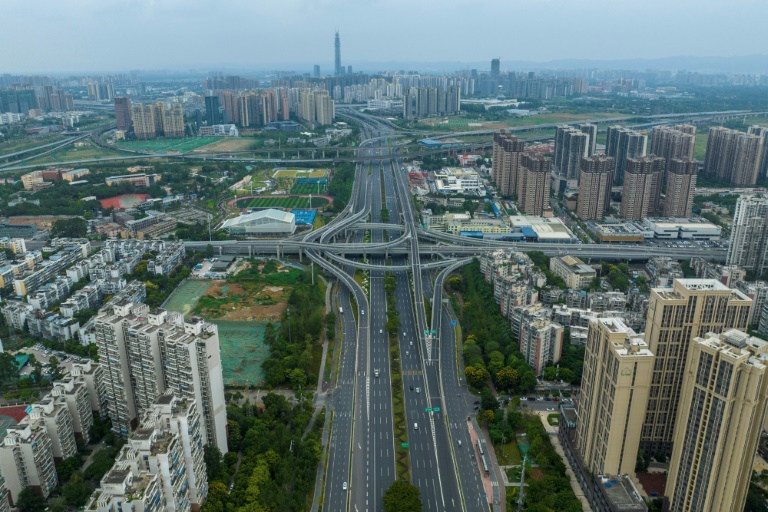
The Chinese megacity of Chengdu has extended a Covid-19 lockdown in most areas, maintaining curbs that have ground business to a halt and confined the majority of its 21 million residents to their homes.

China is the last major economy welded to a zero-Covid strategy, tamping down virus flare-ups through a combination of snap lockdowns, mass testing and lengthy quarantines.

Chengdu, the capital of southwestern Sichuan province, has been effectively under lockdown for a week since reporting several hundred Covid cases.

The measure was expected to be lifted on Wednesday, but the city government said in a notice that “the entire city will continue to deeply push forward our assault for zero community spread”.

Authorities would “strive hard for a week to realise the goal of zero community transmission in the whole city”, the government added.

“The fruits of the whole city’s anti-epidemic measures are beginning to become apparent, but the risk of community transmission still exists in some areas,” it said.

All residents under lockdown will be tested every day, and each household will be permitted to send out one person per day to purchase groceries and other supplies, according to the notice.

Chengdu logged 116 new local infections on Thursday, more than half of which showed no symptoms, according to figures from the provincial health commission.

Confined to their housing complexes, some residents were unable to flee when a strong earthquake in a nearby part of Sichuan reverberated through the city earlier this week, locals told AFP.

China’s government has shown few signs of backing away from a zero-Covid approach despite mounting criticism that it is harming growth in the world’s second-largest economy.

Businesses in Chengdu have been forced to temporarily close, with Swedish carmaker Volvo last week suspending production at a plant in the city that employs nearly 3,000 people.

Elsewhere, the southern business and technology hub of Shenzhen eased some curbs this week after a virus surge prompted authorities to order the city’s 18 million residents to refrain from leaving their homes.

Officials in Beijing have urged the capital to guard against a rebound in infections during the Mid-Autumn public holiday, which runs from Saturday to Monday and is a popular period for travel and social gatherings.

China reported 1,334 new domestic infections on Thursday, the majority of which were asymptomatic, according to the National Health Commission.

China's Chengdu extends Covid lockdown

The Chinese megacity of Chengdu has extended a Covid-19 lockdown in most areas, maintaining curbs that have ground business to a halt and confined the majority of its 21 million residents to their homes.

China is the last major economy welded to a zero-Covid strategy, tamping down virus flare-ups through a combination of snap lockdowns, mass testing and lengthy quarantines.

Chengdu, the capital of southwestern Sichuan province, has been effectively under lockdown for a week since reporting several hundred Covid cases.

The measure was expected to be lifted on Wednesday, but the city government said in a notice that “the entire city will continue to deeply push forward our assault for zero community spread”.

Authorities would “strive hard for a week to realise the goal of zero community transmission in the whole city”, the government added.

“The fruits of the whole city’s anti-epidemic measures are beginning to become apparent, but the risk of community transmission still exists in some areas,” it said.

All residents under lockdown will be tested every day, and each household will be permitted to send out one person per day to purchase groceries and other supplies, according to the notice.

Chengdu logged 116 new local infections on Thursday, more than half of which showed no symptoms, according to figures from the provincial health commission.

Confined to their housing complexes, some residents were unable to flee when a strong earthquake in a nearby part of Sichuan reverberated through the city earlier this week, locals told AFP.

China’s government has shown few signs of backing away from a zero-Covid approach despite mounting criticism that it is harming growth in the world’s second-largest economy.

Businesses in Chengdu have been forced to temporarily close, with Swedish carmaker Volvo last week suspending production at a plant in the city that employs nearly 3,000 people.

Elsewhere, the southern business and technology hub of Shenzhen eased some curbs this week after a virus surge prompted authorities to order the city’s 18 million residents to refrain from leaving their homes.

Officials in Beijing have urged the capital to guard against a rebound in infections during the Mid-Autumn public holiday, which runs from Saturday to Monday and is a popular period for travel and social gatherings.

China reported 1,334 new domestic infections on Thursday, the majority of which were asymptomatic, according to the National Health Commission.

Asian markets bounce after sell-off, dollar closes on new highs

Most Asian markets enjoyed a rare advance on bargain-buying Thursday, tracking a Wall Street rally after a series of losses, though the dollar resumed its upward march with the Federal Reserve expected to announce another bumper interest rate hike.

Equities have been ravaged for weeks by fears that global central bank moves to rein in runaway inflation by ratcheting up borrowing costs will spark fresh recessions in some leading economies.

In turn, the greenback has moved ever higher against its major peers as investors flood into the currency hoping for better returns and as a safe-haven hedge against uncertainty and worldwide turmoil.

On Wednesday, the US unit hit a 37-year high against sterling, while it was also closing in on a 32-year peak above 147.60 yen owing to the Bank of Japan’s refusal to tighten its monetary policy, seen as the key driver of that rally.

Still, Japanese officials said they were tracking the price movements and hinted at possible action if things did not improve.

The euro is holding its own for now, ahead of a hefty expected rate hike by the European Central Bank later in the day.

While the dollar saw a brief moment of weakness Wednesday, observers are certain it will continue to attract strong interest for as long as the Fed keeps ramping up interest rates.

Those views were justified by Vice Chair Lael Brainard, who warned that policymakers will keep hiking rates until they have finally brought prices under control.

“We are in this for as long as it takes to get inflation down,” she said in comments prepared for a conference in New York, adding that she understood this would have a severe impact on families. 

The rate “will need to rise further” and “policy will need to be restrictive for some time to provide confidence that inflation is moving down to target”, she said.

The Fed holds its next policy meeting on September 21, with a third successive 75-basis-point lift forecast.

– Oil under pressure –

Equity traders mostly followed their US counterparts in returning to buying, with many believing the market had fallen too far too fast.

Tokyo led the gains, helped by data showing the Japanese economy performed better than initially thought in the second quarter, while there were also gains in Shanghai, Sydney, Seoul, Singapore, Wellington, Taipei, Manila and Jakarta.

Hong Kong bucked the trend.

Still, the mood on trading floors remains downbeat, with news that China had extended a lockdown in the megacity of Chengdu adding to worries about the world’s number two economy as officials stick rigidly to their growth-killing zero-Covid strategy.

The shutdowns in China, which have impacted tens of millions across the country, were adding to hefty oil sales as traders fret over the impact on demand.

The commodity was already under pressure owing to bets on a recession caused by bank rate hikes, with both main contracts down around $50 from the peaks seen in the immediate aftermath of Russia’s invasion of Ukraine. They are now around eight-month lows.

And while Brent and WTI rose Thursday, they were nowhere near recovering the previous day’s rout of more than five percent, which came despite Russian President Vladimir Putin warning he would cut off energy to Europe if it imposed price cap sanctions.

“Some bargain-hunting buying is to be expected after a dive like” Wednesday’s, said Vandana Hari at Vanda Insights. 

Still, she added that “the approach of the September 21 Fed meeting, where another 75-basis-point rate hike is expected”, could add headwinds to crude.

– Key figures at around 0230 GMT –

Tokyo – Nikkei 225: UP 2.1 percent at 27,992.25 (break)

Hong Kong – Hang Seng Index: DOWN 0.3 percent at 18,993.00

Shanghai – Composite: UP 0.1 percent at 3,249.99

Dollar/yen: UP at 144.12 yen from 143.79 yen on Wednesday

Euro/dollar: DOWN at $0.9989 from $1.0012 

Pound/dollar: DOWN at $1.1509 from $1.1535

Euro/pound: UP at 86.79 pence from 86.74 pence

West Texas Intermediate: UP 0.8 percent at $82.61 per barrel

Brent North Sea crude: UP 0.7 percent at $88.64 per barrel

New York – Dow: UP 1.4 percent at 31,581.28 (close)

London – FTSE 100: DOWN 0.9 percent at 7,237.83 (close)

Countries growing 70% of world's food face 'extreme' heat risk by 2045

Blistering crop-withering temperatures that also risk the health of agricultural workers could threaten swathes of global food production by 2045 as the world warms, an industry analysis warned Thursday.

Climate change is already stoking heatwaves and other extreme weather events across the world, with hot spells from India to Europe this year expected to hit crop yields.

Temperature spikes are causing mounting concern for health, particularly for those working outside in sweltering conditions, which is especially dangerous when humidity levels are high. 

The latest assessment by risk company Verisk Maplecroft brings those two threats together to calculate that heat stress already poses an “extreme risk” to agriculture in 20 countries, including agricultural giant India.

But the coming decades are expected to expand the threat to 64 nations by 2045 — representing 71 percent of current global food production — including major economies China, India, Brazil and the United States. 

“With the rise in global temperatures and rise in global heat stress, we’re going to see crops in more temperate countries as well start being affected by this,” said Will Nichols, head of climate and resilience at Verisk Maplecroft. 

Rice is particularly at risk, the assessment said, with other crops like cocoa and even tomatoes also singled out as of concern.

– Growing risk –

Maplecroft’s new heat stress dataset, using global temperature data from the UK Met Office, feeds into its wider risk assessments of countries around the world. 

It is based on a worst-case emissions scenario leading to around 2 degrees Celsius of warming above pre-industrial levels as soon as 2045. 

However, the authors stress that in projections to mid-century, even scenarios that assume higher levels of carbon-cutting action could still result in temperatures nearing 2C.

India — responsible for 12 percent of global food production in 2020 and heavily reliant on outdoor labour productivity — is already rated as at extreme risk, the only major agricultural nation in that category at current temperatures. 

“There’s a very real worry that people in rural areas, which are obviously highly dependent on agriculture, are going to be much more vulnerable to these kinds of heat events going forward,” Nichols told AFP. 

That could impact productivity and in turn exports — and have potentially “cascading” knock-on effects on issues such as the country’s credit rating and even political stability, he said.

By 2045, the list grows much longer.   

Nine of the top ten countries affected in 2045 are in Africa, with the world’s second largest cocoa producer Ghana, as well as Togo and Central African Republic receiving the worst possible risk score.

The top 20 at-risk countries in the coming decades include key Southeast Asian rice exporters Cambodia, Thailand and Vietnam, the authors said, noting that rice farmers in central Vietnam have already taken to working at night to avoid the high temperatures.

The assessment highlights that major economies like the US and China could also see extreme risk to agriculture in 2045, although in these large countries the impacts vary by region.  

Meanwhile, Europe accounts for seven of the 10 countries set to see the largest increase in risk by 2045. 

“I think what it reinforces is that, even though a lot of us are sort of sitting in sort of Western countries, where we might think we’re a bit more insulated from some of these threats, actually we are not necessarily,” Nichols said.  

“Both in terms of the sort of physical risks that we’re facing, but also in terms of the kind of knock on effects down the supply chain.” 

Energy majors exaggerating green performance: analysis

Energy majors are exaggerating their green credentials in public messaging while continuing to allocate the majority of new investment to oil and gas projects, according to an industry analysis released Thursday.

Campaigners say this “significant misalignment” between communication strategies and business plans could allow five of the biggest privately-owned energy firms to continue to delay the decarbonisation needed to avoid the worst impacts of climate change. 

Industry watchdog InfluenceMap analysed the content of more than 3,400 public communications from BP, Chevron, ExxonMobil, Shell and TotalEnergies in 2021, from press releases, speeches and company and CEO social media accounts. 

They found that 60 percent of all messages contained at least one “green” claim — such as emissions reduction targets, transitioning the energy mix, or promoting fossil gas as part of a clean energy solution.

These public communications were found to contrast with the five’s planned capital expenditure for 2022, with just 12 percent of new investments earmarked for low-carbon activities. 

“You can see this real difference between a high use of green claims in public communications versus this ongoing strategy to kind of undermine and block climate policy,” report co-author and program manager Faye Holder told AFP.

She said the gap between what the majors advertised and what they were investing in was misleading the public as to their role in battling climate change.  

“Based on the public communications, and particularly social media, it would be fair enough if you walked away with the impression that these companies are acting to solve climate change, because that’s what you’re hearing from them,” she said.

– ‘Climate disinformation’ –

The analysis found that Shell had the largest disparity between its green talk and actual low-carbon investment. 

InfluenceMap said that 70 percent of Shell’s communications last year contained at least one green claim, compared with just 10 percent of planned investment in low-carbon activities this year.

A spokesman for Shell told AFP the major was already investing “billions of dollars in low-carbon energy”.

“To help alter the mix of energy Shell sells, we need to grow these new businesses rapidly. That means letting our customers know through advertising or social media what lower-carbon solutions we offer now or are developing.”

The analysis found that 62 percent of TotalEnergies’ communications mentioned green activities, while it planned to allocate 25 percent of 2022 capital expenditure on low-carbon projects. 

A TotalEnergies spokeswoman countered that 30 percent of the firm’s investments are devoted to “decarbonised energy”.

“Our public announcements policy reflects the transformation of TotalEnergies in a multi-energy company,” she told AFP. 

An ExxonMobil spokesman said it “continues to mitigate emissions from its operations and achieved its 2025 emission-reduction plans four years earlier than planned”.

BP and Chevron did not respond to requests for comment. 

The analysis found that overall the five corporations had spent $750 million on climate-related messaging last year alone. 

Report co-author Ed Collins said that represented good business for the majors, as it was significantly cheaper than decarbonising their business models and would encourage governments to continue subsidising their products.

“The costs seem huge, but the investment is tiny in comparison to the potential reward in terms of favourable policy conditions and subsidisation of building assets,” he said. 

Some of the firms analysed plan to increase oil and gas production by 2026, something the analysts said would see their emissions “significantly overshoot” the International Energy Agency’s recommended net-zero pathway. 

Gwendoline Delbos-Corfield, a Greens member of the European Parliament, said Thursday’s analysis proved that the firms studied were engaged in “climate disinformation”.

“It shows the lengths oil and gas companies are willing to go to mislead citizens and protect their own interests.”

Close Bitnami banner
Bitnami