Chinese Business

Global stocks mixed as eurozone inflation hits record

Wall Street stocks shrugged off early weakness to begin the second half of 2022 on a solid note Friday, but record eurozone inflation underscored the potential for more turbulence ahead.

New York equities spent much of the morning in the red, absorbing an industry survey showing slowing growth in the manufacturing sector.

But US markets reversed course in the final hours of trading, rallying into the Independence Day holiday weekend amid hopes for a better second half of the year.

Investors are coming off the worst six-month start to a year for the S&P 500 since 1970.

Earlier, both Paris and Frankfurt stocks ended the day with small gains despite news of record-high eurozone inflation that reinforced expectations of a European Central Bank interest rate hike later this month.

The EU’s Eurostat data agency said annual consumer price inflation in the 19 countries that use the euro soared to 8.6 percent in June, up from the prior record of 8.1 percent in May.

“With eurozone inflation now becoming more broad-based in nature, the outlook for the eurozone for the rest of 2022 continues to look bleak,” warned Pushpin Singh, Economist at the Centre for Economics and Business Research.

“This comes amid a mounting possibility of a severe gas crisis in Europe, with Russia using gas exports as a means to counter sanctions,” he added.

The ECB stated last month that it will deliver its first interest rate hike in more than a decade in July to combat inflation. 

With the war in Ukraine showing no sign of ending — keeping energy costs elevated — there is an expectation that borrowing costs will continue to rise and send economies into recession.

Comments from top finance chiefs, including Federal Reserve boss Jerome Powell, suggest they are willing to endure the pain of a contraction as long as they can rein in prices — which are rising at their fastest pace in 40 years on both sides of the Atlantic.

“Investors know that inflation is high and is likely to push higher,” City Index analyst Fiona Cincotta told AFP.

“Instead, the market’s obsession is turning from inflation to recession fears. Given the steep declines in stock prices this week, much of the bad news is priced in for now, until it starts again next week,” she added.

The dollar, a safe-haven currency, advanced against the pound and the euro on rising expectations of a recession.

Oil rebounded on tight supplies despite persistent recession concerns.

– Key figures at around 2030 GMT –

New York – Dow: UP 1.1 percent at 31,097.26 (close)

New York – S&P 500: UP 1.1 percent at 3,825.33 (close)

New York – Nasdaq: UP 0.9 percent at 11,127.85 (close)

London – FTSE 100: FLAT at 7,168.65 (close) 

Frankfurt – DAX: UP 0.2 percent at 12,813.03 (close)

Paris – CAC 40: UP 0.1 percent at 5,931.06 (close)

EURO STOXX 50: DOWN 0.2 percent at 3,448.31 (close)

Tokyo – Nikkei 225: DOWN 1.7 percent at 25,935.62 (close)

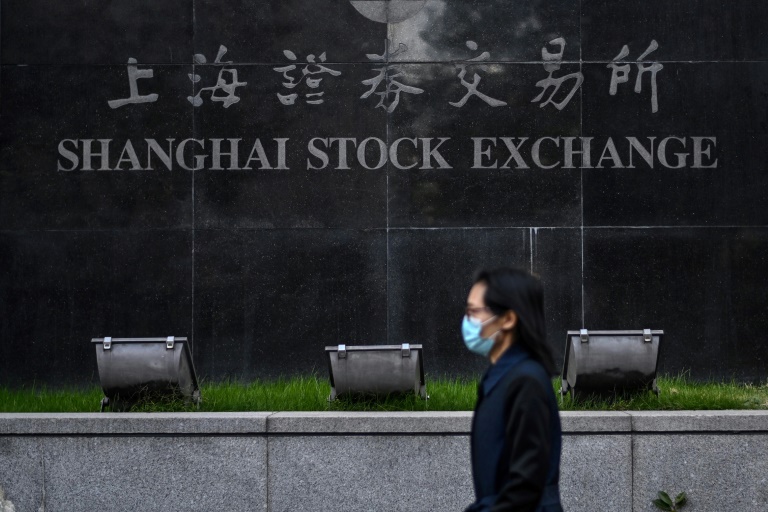
Shanghai – Composite: DOWN 0.3 percent at 3,387.64 (close)

Hong Kong – Hang Seng Index: Closed for a holiday

Brent North Sea crude: UP 2.4 percent at $111.63 per barrel

West Texas Intermediate: UP 2.5 percent at $108.43 per barrel

Euro/dollar: DOWN at $1.0433 from $1.0484 Thursday

Pound/dollar: DOWN at $1.2098 from $1.2178

Euro/pound: UP at 86.21 pence from 86.09 pence

Dollar/yen: DOWN at 135.28 yen from 135.72 yen

burs-jmb/to

Stocks choppy, dollar frothy

Stock markets wobbled on Friday while the dollar shot higher against the euro and pound as investors fretted about interest rate hikes and a possible recession.

Both Paris and Frankfurt stocks ended the day with small gains despite news of record-high eurozone inflation that reinforced expectations of a European Central Bank interest rate hike later this month.

The EU’s Eurostat data agency said annual consumer price inflation in the 19 countries that use the euro soared to 8.6 percent in June, up from the prior record of 8.1 percent in May.

“Today’s figures bolster the European Central Bank’s intended decision to start raising interest rates at its next Governing Council meeting in July,” noted economist Pushpin Singh at research group CEBR.

The ECB stated last month that it will deliver its first interest rate hike in more than a decade in July to combat inflation. 

Eurostat added Friday that core inflation — stripping out volatile components like energy and food — slowed to 3.7 percent from 3.8 percent, helping equities to calm heading into the weekend pause.

Wall Street’s main indices were marginally lower in late morning trading, having bounced around since the opening bell.

– ‘Another big leg lower’ – 

Chris Beauchamp, chief market analyst at online trading platform IG, said there was little buying interest at the start of the second half of the year, even though the sharp drops suffered by stocks in the first half open up the possibility for gains.

New York’s S&P 500 index suffered its worst first-half performance since 1970.

“There is a growing unease about the summer, especially with a potentially very gloomy (second-quarter) earnings season nearly upon us,” he said in a note to clients. 

“It really does look like we have another big leg lower before this bear market is done,” added Beauchamp.

With the war in Ukraine showing no sign of ending — keeping energy costs elevated — there is an expectation that borrowing costs will continue to rise and send economies into recession.

Losses across world markets this week come after a rally last week fuelled by hopes that an economic slowdown or signs of recession would lead central banks to ease off their monetary tightening drive.

But comments from top finance chiefs, including Federal Reserve boss Jerome Powell, suggest they are willing to endure the pain of a contraction as long as they can rein in prices — which are rising at their fastest pace in 40 years on both sides of the Atlantic.

“Investors know that inflation is high and is likely to push higher,” City Index analyst Fiona Cincotta told AFP.

“Instead, the market’s obsession is turning from inflation to recession fears. Given the steep declines in stock prices this week, much of the bad news is priced in for now, until it starts again next week,” she added.

The dollar, a safe-haven currency, jumped one percent against the pound and the euro on rising expectations of a recession.

“The US dollar looks set to end the week stronger against most major currencies, nearing its strongest level since 2002 as ‘risky’ assets remained under pressure,” said economist James Reilly at Capital Economics.

The euro slid to a low of $1.0369 before rebounding back above the $1.04 level. The pound touched a low of $1.1979.

Oil rebounded on tight supplies despite persistent recession concerns.

– Key figures at around 1530 GMT –

New York – Dow: DOWN 0.3 percent at 30,693.52 points

EURO STOXX 50: DOWN 0.2 percent at 3,448.31

London – FTSE 100: FLAT at 7,168.65 (close) 

Frankfurt – DAX: UP 0.2 percent at 12,813.03 (close)

Paris – CAC 40: UP 0.1 percent at 5,931.06 (close)

Tokyo – Nikkei 225: DOWN 1.7 percent at 25,935.62 (close)

Shanghai – Composite: DOWN 0.3 percent at 3,387.64 (close)

Hong Kong – Hang Seng Index: Closed for a holiday

Brent North Sea crude: UP 1.9 percent at $111.12 per barrel

West Texas Intermediate: UP 2.2 percent at $108.08 per barrel

Euro/dollar: DOWN at $1.0405 from $1.0484 Thursday

Pound/dollar: DOWN at $1.2037 from $1.2178

Euro/pound: UP at 86.46 pence from 86.09 pence

Dollar/yen: DOWN at 135.19 yen from 135.72 yen

burs-rl/imm

Europe stocks steady as eurozone inflation hits record high

European stock markets steadied Friday with traders digesting news of record-high eurozone inflation that reinforced expectations of a European Central Bank interest rate hike this month.

The dollar, the safe-haven currency, jumped one percent against the pound on rising expectations of a recession, while oil rebounded on tight supplies.

Eurozone inflation accelerated to another record high in June, official data showed Friday, fuelled by rising energy and food prices amid Russia’s war in Ukraine.

The EU’s Eurostat data agency said annual consumer price inflation in the 19 countries that use the euro soared to 8.6 percent in June, up from the prior record of 8.1 percent in May.

“Today’s figures bolster the European Central Bank’s intended decision to start raising interest rates at its next Governing Council meeting in July,” noted economist Pushpin Singh at research group CEBR.

The ECB stated last month that it will deliver its first interest rate hike in more than a decade in July to combat inflation. 

Eurostat added Friday that core inflation — stripping out volatile components like energy and food — slowed to 3.7 percent from 3.8 percent, helping equities to calm heading into the weekend pause.

Earlier Friday, Asian stock markets closed lower after another Wall Street selloff.

New York stocks opened little changed.

Data showing US consumers — the backbone of the world’s top economy — were growing increasingly reticent about spending dealt a fresh blow, with New York’s S&P 500 index suffering its worst first-half performance since 1970.

With the war in Ukraine showing no sign of ending — keeping energy costs elevated — there is an expectation that borrowing costs will continue to rise and send economies into recession.

Losses across world markets this week come after a rally last week fuelled by hopes that an economic slowdown or signs of recession would lead central banks to ease off their monetary tightening drive.

But comments from top finance chiefs, including Federal Reserve boss Jerome Powell, suggest they are willing to endure the pain of a contraction as long as they can rein in prices — which are rising at their fastest pace in 40 years on both sides of the Atlantic.

“Investors know that inflation is high and is likely to push higher,” City Index analyst Fiona Cincotta told AFP.

“Instead, the market’s obsession is turning from inflation to recession fears. Given the steep declines in stock prices this week, much of the bad news is priced in for now, until it starts again next week,” she added.

The grim global economic outlook has also weighed on bitcoin, which has dropped back under $20,000.

– Key figures at around 1330 GMT –

London – FTSE 100: UP less than 0.1 percent at 7,174.12 points

Frankfurt – DAX: FLAT at 12,780.98

Paris – CAC 40: UP 0.1 percent at 5,928.80

EURO STOXX 50: DOWN 0.4 percent at 3,441.87

New York – Dow: FLAT at 30,747.54

Brent North Sea crude: UP 2.4 percent at $111.68 per barrel

West Texas Intermediate: UP 2.6 percent at $108.53 per barrel

Tokyo – Nikkei 225: DOWN 1.7 percent at 25,935.62 (close)

Shanghai – Composite: DOWN 0.3 percent at 3,387.64 (close)

Hong Kong – Hang Seng Index: Closed for a holiday

Euro/dollar: DOWN at $1.0404 from $1.0484 Thursday

Pound/dollar: DOWN at $1.2010 from $1.2178

Euro/pound: UP at 86.66 pence from 86.09 pence

Dollar/yen: DOWN at 135.48 yen from 135.72 yen

burs-rl/lth

Europe stocks steady as eurozone inflation hits record high

European stock markets steadied Friday with traders having expected news of record-high eurozone inflation that reinforced expectations of an ECB interest rate hike this month.

On the upside, the haven dollar jumped one percent against the pound on rising expectations of a recession, while oil rebounded on tight supplies.

Eurozone inflation accelerated to another record high in June, official data showed Friday, fuelled by fallout from the Ukraine war.

The EU’s Eurostat data agency said annual consumer price inflation in the 19 countries that use the euro soared to 8.6 percent in June, up from the prior record of 8.1 percent in May.

“Today’s figures bolster the European Central Bank’s (ECB) intended decision to start raising interest rates at its next Governing Council meeting in July,” noted economist Pushpin Singh at research group CEBR.

The ECB stated last month that it will deliver its first interest rate hike in more than a decade in July to combat inflation. 

Eurostat added Friday that core inflation — stripping out volatile components like energy and food — slowed to 3.7 percent from 3.8 percent, helping equities to calm heading into the weekend pause.

Earlier Friday, Asian stock markets closed lower after another Wall Street selloff.

Data showing US consumers — the backbone of the world’s top economy — were growing increasingly reticent about spending dealt a fresh blow, with New York’s S&P 500 index suffering its worst first-half performance since 1970.

With the war in Ukraine showing no sign of ending — keeping energy costs elevated — there is an expectation that borrowing costs will continue to rise and send economies into recession.

Losses across world markets this week come after a rally last week fuelled by hopes that an economic slowdown or signs of recession would lead central banks to ease off their monetary tightening drive.

But comments from top finance chiefs, including Federal Reserve boss Jerome Powell, suggest they are willing to endure the pain of a contraction as long as they can rein in prices — which are rising at their fastest pace in 40 years on both sides of the Atlantic.

The grim global economic outlook has also weighed on bitcoin, which has dropped back under $20,000.

– Key figures at around 1100 GMT –

London – FTSE 100: DOWN 0.1 percent at 7,159.16 points

Frankfurt – DAX: FLAT at 12,785.72

Paris – CAC 40: UP 0.1 percent at 5,953.69

EURO STOXX 50: DOWN 0.2 percent at 3,448.68

Brent North Sea crude: UP 2.4 percent at $111.61 per barrel

West Texas Intermediate: UP 2.2 percent at $108.13 per barrel

Tokyo – Nikkei 225: DOWN 1.7 percent at 25,935.62 (close)

Shanghai – Composite: DOWN 0.3 percent at 3,387.64 (close)

Hong Kong – Hang Seng Index: Closed for a holiday

New York – Dow: DOWN 0.8 percent at 30,775.43 (close)

Euro/dollar: DOWN at $1.0456 from $1.0484 Thursday

Pound/dollar: DOWN at $1.2062 from $1.2178

Euro/pound: UP at 86.69 pence from 86.09 pence

Dollar/yen: DOWN at 135.32 yen from 135.72 yen

Japan warns on 'interests' after Russia gas project decree

Japan’s energy “interests must not be undermined”, Tokyo said Friday, after Moscow issued a decree transferring operations of a key oil and gas project to a new Russian company.

Japanese trading houses Mitsui and Mitsubishi Corp own 12.5 and 10 percent stakes respectively in the Sakhalin-2 project, but the future of their investments appears uncertain after the Russian move.

The decree calls for the establishment of a new Russian operator and requires existing foreign shareholders to apply for the right to participate in the new firm, with Moscow deciding on their inclusion.

Japanese government spokesman Seiji Kihara said Friday morning that Tokyo was “closely examining the impact on liquified natural gas (LNG) imports”.

“Speaking generally, we believe our resource interests must not be undermined,” he added, declining to give further comment.

Later Friday, Prime Minister Fumio Kishida said the government did not think the decree “will immediately stop LNG imports,” on which Japan is heavily dependent.

“We think we need to carefully monitor how the decree will affect our contract,” he told reporters.

Japan’s economy minister meanwhile said Tokyo would look into alternative suppliers.

“In the mid-to-long term, we will do everything we can to ensure a stable supply of energy, including through alternative procurement from LNG suppliers other than Russia, buying from the spot market, and reducing demand when necessary,” Koichi Hagiuda told journalists.

He said Japan would also look into boosting renewable and nuclear energy, which remains controversial in the country after the 2011 Fukushima disaster.

The Russian decree says the move is a reaction to the “unfriendly actions” of countries that are imposing “restrictive measures” on Russia over its invasion of Ukraine.

It warns the Russian government will carry out a “financial, environmental and technical audit” of foreign stakeholders and identify any “damages” they have caused.

Those accused of such damages may be obliged to pay unspecified compensation, it adds.

Energy resource-poor Japan relies heavily on LNG imports and had previously ruled out withdrawal from the Sakhalin-2 project despite joining Western-led energy sanctions on Russia over the invasion of Ukraine.

Spokesmen for Mitsubishi and Mitsui would say only that the firms were examining the details of the decree in coordination with the government.

The other major stakeholder in the project is oil giant Shell, which has already committed to selling its 27.5 percent stake.

“As a shareholder, Shell has always acted in the best interests of Sakhalin-2 and in accordance with all applicable legal requirements,” the British group said Friday. 

“We are aware of the decree and are assessing its implications,” it added.

Shell in May announced it had taken a hit totalling $1.6 billion linked to Sakhalin-2.

Japan is heavily dependent on imported fossil fuels, in part because many of its nuclear reactors have been offline since the Fukushima disaster.

Russia supplies nearly nine percent of Japan’s LNG demands, with Australian exports accounting for about 40 percent of the market.

Japan is currently sweltering through a record heatwave and the government has warned several times in recent days of a power crunch in the Tokyo region.

On Friday, it began a three-month period in which it is asking residents to conserve power, with fears of shortages during the summer heat.

burs-sah/bcp/rfj/ssy

Japan warns on 'interests' after Russia gas project decree

Japan’s energy “interests must not be undermined”, Tokyo said Friday, after Moscow issued a decree transferring operations of a key oil and gas project to a new Russian company.

Japanese trading houses Mitsui and Mitsubishi Corp own 12.5 and 10 percent stakes respectively in the Sakhalin-2 project, but the future of their investments appears uncertain after the Russian move.

The decree calls for the establishment of a new Russian operator and requires existing foreign shareholders to apply for the right to participate in the new firm, with Moscow deciding on their inclusion.

Japanese government spokesman Seiji Kihara said Friday morning that Tokyo was “closely examining the impact on liquified natural gas (LNG) imports”.

“Speaking generally, we believe our resource interests must not be undermined,” he added, declining to give further comment.

Later Friday, Prime Minister Fumio Kishida said the government did not think the decree “will immediately stop LNG imports,” on which Japan is heavily dependent.

“We think we need to carefully monitor how the decree will affect our contract,” he told reporters.

Japan’s economy minister meanwhile said Tokyo would look into alternative suppliers.

“In the mid-to-long term, we will do everything we can to ensure a stable supply of energy, including through alternative procurement from LNG suppliers other than Russia, buying from the spot market, and reducing demand when necessary,” Koichi Hagiuda told journalists.

He said Japan would also look into boosting renewable and nuclear energy, which remains controversial in the country after the 2011 Fukushima disaster.

The Russian decree says the move is a reaction to the “unfriendly actions” of countries that are imposing “restrictive measures” on Russia over its invasion of Ukraine.

It warns the Russian government will carry out a “financial, environmental and technical audit” of foreign stakeholders and identify any “damages” they have caused.

Those accused of such damages may be obliged to pay unspecified compensation, it adds.

Energy resource-poor Japan relies heavily on LNG imports and had previously ruled out withdrawal from the Sakhalin-2 project despite joining Western-led energy sanctions on Russia over the invasion of Ukraine.

Spokesmen for Mitsubishi and Mitsui would say only that the firms were examining the details of the decree in coordination with the government.

The other major stakeholder in the project is oil giant Shell, which has already committed to selling its 27.5 percent stake.

Japan is heavily dependent on imported fossil fuels, in part because many of its nuclear reactors have been offline since the Fukushima disaster.

Russia supplies nearly nine percent of Japan’s LNG demands, with Australian exports accounting for about 40 percent of the market.

Japan is currently sweltering through a record heatwave and the government has warned several times in recent days of a power crunch in the Tokyo region.

On Friday, it began a three-month period in which it is asking residents to conserve power, with fears of shortages during the summer heat.

burs-sah/ssy

Asian markets drop with traders gripped by recession fear

Asian markets struggled again Friday following another selloff on Wall Street fuelled by recession fears, with warnings of a bleak outlook for the global economy as central banks slam on the brakes to battle soaring inflation.

Data showing US consumers — the backbone of the world’s top economy — were growing increasingly reticent about spending dealt a fresh blow to equities Thursday, with the S&P 500 suffering its worst January-June since 1970.

With the war in Ukraine showing no sign of ending — keeping energy costs elevated — there is an expectation that borrowing costs will continue to rise and send economies into recession.

“If anyone thinks that equities can rally into the back of the year, they are making the assumption that the Fed is going to let go of its entire focus on price stability and step back from that,” Seema Shah, at Principal Global Investors, told Bloomberg Television.

“We have a very different view. We think things are going to get pretty tough.”

After a broad retreat on Thursday in Asia, markets battled to recover but with little conviction.

Tokyo, Shanghai, Seoul, Sydney, Mumbai, Singapore, Jakarta and Wellington all fell, though there were small gains in Bangkok.

Taipei shed more than three percent to fall into a bear market — a 20 percent drop from its recent peak.

Hong Kong was closed for a holiday.

London, Paris and Frankfurt extended losses at the open.

Losses across world markets this week come after a rally last week fuelled by hopes that an economic slowdown or signs of recession would lead central banks to ease off their monetary tightening drive.

But comments from top finance chiefs, including Federal Reserve boss Jerome Powell, suggest they are willing to endure the pain of a contraction as long as they can rein in prices — which are rising at their fastest pace in 40 years.

“With central banks shifting towards accepting that monetary tightening is impossible without some economic damage, the market narrative has swung 180 degrees this week,” said SPI Asset Management’s Stephen Innes.

He added that sharp rate hikes by the Fed and other central banks were being front-loaded in the hope inflation will ease earlier and allow them to cut borrowing costs more quickly.

“The hope is that by the November midterm elections, when the economy has chilled enough, it will be possible to pause or at least significantly slow further hikes to allow investors to enjoy a Santa Claus rally; otherwise, it could be a winter of discontent,” Innes said.

But markets strategist Louis Navellier suggested that the economy was not in as bad a shape as feared.

“The amazing thing is that we are not in an ‘earnings recession’ and the analyst community remains largely positive,” he said in a note.

“Frankly, the analyst community is smarter than the macro strategists that keep calling for a recession. The bottom line is fear sells, so negative news continues to overpower positive analyst comments.”

Oil prices fell, putting the commodity on course for a third successive week of losses owing to concerns that a recession will hit demand.

That has overshadowed a tight market caused by sanctions on Russia over its Ukraine invasion and an expected jump in demand from China as it emerges from its Covid lockdowns.

Innes added: “With energy bulls having a good run this year, investors seem more inclined to take money off the table in the face of growing uncertainty as the energy crisis moves onto the global recession phase.

“As the adage goes, the best cure for high prices is high prices.”

The grim economic outlook also weighed on Bitcoin, which was struggling below $20,000, having fallen as low as $18,632 earlier.

– Key figures at around 0720 GMT –

Tokyo – Nikkei 225: DOWN 1.7 percent at 25,935.62 (close)

Shanghai – Composite: DOWN 0.3 percent at 3,387.64 (close)

London – FTSE 100: DOWN 0.8 percent at 7,112.31

Hong Kong – Hang Seng Index: Closed for a holiday

West Texas Intermediate: DOWN 0.6 percent at $105.16 per barrel

Brent North Sea crude: DOWN 0.4 percent at $108.59 per barrel

Dollar/yen: DOWN at 134.85 yen from 135.75 yen Thursday

Euro/dollar: DOWN at $1.0453 from $1.0487 

Pound/dollar: DOWN at $1.2115 from $1.2177

Euro/pound: UP at 86.25 pence from 86.08 pence

New York – Dow: DOWN 0.8 percent at 30,775.43 (close)

John Lee: the former Hong Kong cop Beijing trusts is sworn in

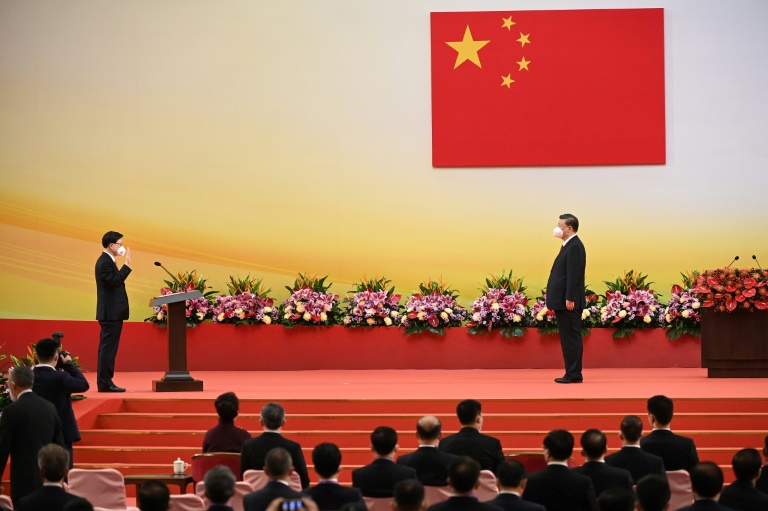
John Lee, a former beat cop who became Hong Kong’s security chief and played a key role in suppressing democracy protests, became the business hub’s new leader on Friday in a ceremony overseen by Chinese President Xi Jinping.

“It is the greatest honour for me today to shoulder this historic mission given to me by the central authorities and the people of Hong Kong,” Lee said in his inauguration speech, thanking Beijing for its support. 

Lee, 64, was anointed as Hong Kong’s next chief executive by a small committee in May, winning 99 percent of the votes in a choreographed, Beijing-blessed race in which no other candidates stood. 

Xi later said Lee’s government would deliver a “new chapter” for Hong Kong.

Lee’s elevation caps a remarkable rise for a man whose police career lifted him from a working-class family to the upper echelons of Hong Kong’s political establishment.

It also places a security official in the city’s top job for the first time, a man who was pivotal in the quashing of huge democracy protests in 2019 and Beijing’s subsequent political crackdown.

Insiders say Lee’s unwavering commitment to that role won China’s confidence at a time when other Hong Kong elite were seen as insufficiently loyal or competent.

“John Lee is the one that the central government knows the best, because he was in constant contact and interaction with the mainland,” pro-establishment lawmaker and prominent business figure Michael Tien told AFP earlier this year.

Lee, who is under US sanctions, spent 35 years in the police before jumping to the government in 2012, followed by a swift rise to the top.

Law and order remained his portfolio, with him serving in the Security Bureau and then leading it before becoming the city’s number two official last year.

– Flares and long hair –

Lee, a Catholic, grew up poor in Sham Shui Po — one of wealthy Hong Kong’s working-class districts — but made his way to an elite boys’ school run by Jesuits.

Peter Lai, a former banker and classmate, described him as a clever and fashionable teenager who grew long hair and wore flared trousers.

Most of his contemporaries went to university, but Lee turned down an offer to study engineering to join the police.

He later told a pro-Beijing newspaper he was motivated by being bullied by neighbourhood hooligans.

Two former classmates gave a more practical reason — the police force offered a stable career for Lee and his pregnant wife Janet.

Lee has not spoken much about his family and has dodged questions about whether his wife and two sons still hold British nationality, something he renounced when he joined the government.

As events began on Friday morning, Lee’s new social media accounts posted a picture of his wife fixing his tie, thanking her for “silently supporting me and taking care of the family over the years”.

– Business acumen? –

Given his security background, it seems unlikely Lee will reverse Beijing’s campaign against dissent.

Where he will enter less familiar territory is the world of business.

Hong Kong, once a vibrant, multicultural business hub, has been cut off internationally during the pandemic as it shadows Beijing’s strict zero-Covid strategy.

Its economy is struggling and there has been an exodus of talent. 

Danny Lau, a small business association leader, said Lee was not an ideal candidate but that he would reserve judgement.

“I hope he can consider Hong Kong’s international competitiveness and does not waste time on making laws unhelpful for the city’s economy,” Lau told AFP.

But others say Lee’s appointment confirms that China now puts Hong Kong’s political security ahead of business and livelihood issues. 

“In the past, China might compromise for some economic benefits,” Charles Mok, a former pro-democracy lawmaker now living overseas, told AFP.

“But now it seems Beijing wants its people to feel that the world is full of threats and it’s only safe to stick closely to the (Communist) Party.”

Bankrupt Sri Lanka's inflation jumps beyond 50%

Sri Lanka’s inflation hit a ninth consecutive record in June, official data showed Friday, rising to 54.6 percent a day after the IMF asked the bankrupt nation to rein in galloping prices and corruption.

It was the first time the increase in the Colombo Consumer Price Index (CCPI) crossed the psychologically important 50 percent mark, according to the department of census and statistics.

The figures came hours after the International Monetary Fund urged Sri Lanka to contain spiralling inflation and address corruption as part of efforts to salvage the troubled economy, which has been ravaged by a foreign exchange crisis.

The IMF ended 10 days of in-person discussions with Sri Lankan authorities in Colombo on Thursday following the country’s request for a possible bailout.

The CCPI has been setting new monthly highs since October, when year-on-year inflation stood at just 7.6 percent. In May it reached 39.1 percent.

The rupee has lost more than half its value against the US dollar this year.

Private economists say consumer prices are rising even faster than shown in official statistics.

According to an economist at Johns Hopkins university, Steve Hanke, who tracks price increases in the world’s troublespots, Sri Lanka’s current inflation is 128 percent, second only to Zimbabwe’s 365 percent.

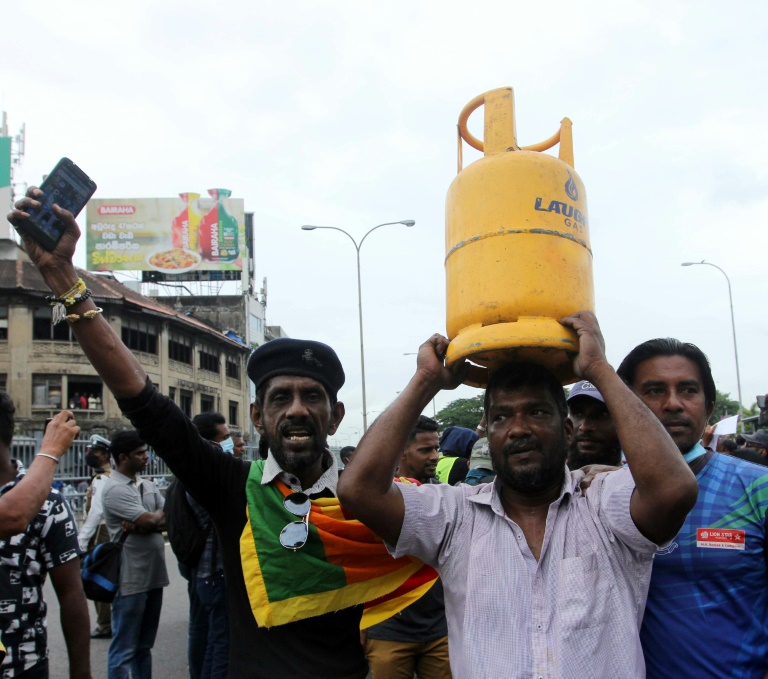
Faced with an acute energy shortage, Sri Lanka is observing a shutdown of non-essential state institutions for two weeks, along with the closure of schools to reduce commuting.

The country’s 22 million people have been enduring acute shortages of essentials — including food, fuel and medicines — for months.

Protests are continuing outside President Gotabaya Rajapaksa’s office demanding his resignation over the unprecedented economic turmoil and his mismanagement.

Sri Lanka went to the IMF in April after the country defaulted on its $51 billion external debt.

Asian markets struggle as traders gripped by recession fear

Asian markets struggled again Friday following another selloff on Wall Street fuelled by recession fears, with warnings of a bleak outlook for the global economy as central banks slam on the brakes to battle soaring inflation.

Data showing US consumers — the backbone of the world’s top economy — were growing increasingly reticent about spending dealt a fresh blow to equities Thursday, with the S&P 500 suffering its worst January-June since 1970.

With the war in Ukraine showing no sign of ending — keeping energy costs elevated — there is an expectation that borrowing costs will continue to rise and send economies into recession.

“If anyone thinks that equities can rally into the back of the year, they are making the assumption that the Fed is going to let go of its entire focus on price stability and step back from that,” Seema Shah, at Principal Global Investors, told Bloomberg Television.

“We have a very different view. We think things are going to get pretty tough.”

After a broad retreat on Thursday in Asia, markets battled to recover but with little conviction.

Tokyo, Shanghai, Seoul, Taipei and Bangkok all fell, though there were small gains in Sydney, Singapore, Manila and Jakarta.

Hong Kong was closed for a holiday.

Losses across world markets this week come after a rally last week fuelled by hopes that an economic slowdown or signs of recession would lead central banks to ease off their monetary tightening drive.

But comments from top finance chiefs, including Federal Reserve boss Jerome Powell, suggest they are willing to endure the pain of a contraction as long as they can rein in prices — which are rising at their fastest pace in 40 years.

“With central banks shifting towards accepting that monetary tightening is impossible without some economic damage, the market narrative has swung 180 degrees this week,” said SPI Asset Management’s Stephen Innes.

He added that sharp rate hikes by the Fed and other central banks were being front-loaded in the hope inflation will ease earlier and allow them to cut borrowing costs more quickly.

“The hope is that by the November midterm elections, when the economy has chilled enough, it will be possible to pause or at least significantly slow further hikes to allow investors to enjoy a Santa Claus rally; otherwise, it could be a winter of discontent,” Innes said.

However, markets strategist Louis Navellier suggested that the economy was not in as bad a shape as feared.

“The amazing thing is that we are not in an ‘earnings recession’ and the analyst community remains largely positive,” he said in a note.

“Frankly, the analyst community is smarter than the macro strategists that keep calling for a recession. The bottom line is fear sells, so negative news continues to overpower positive analyst comments.”

Oil prices ticked higher but still headed for a third successive week of losses owing to concerns that a recession will hit demand.

That has overshadowed a tight market caused by sanctions on Russia over its Ukraine invasion and an expected jump in demand from China as it emerges from its Covid lockdowns.

Innes added: “With energy bulls having a good run this year, investors seem more inclined to take money off the table in the face of growing uncertainty as the energy crisis moves onto the global recession phase.

“As the adage goes, the best cure for high prices is high prices.”

– Key figures at around 0230 GMT –

Tokyo – Nikkei 225: DOWN 0.9 percent at 26,159.53 (break)

Shanghai – Composite: DOWN percent at 3,394.99

Hong Kong – Hang Seng Index: Closed for a holiday

West Texas Intermediate: UP 0.5 percent at $106.26 per barrel

Brent North Sea crude: UP 0.6 percent at $119.66 per barrel

Dollar/yen: DOWN at 135.32 yen from 135.75 yen Thursday

Euro/dollar: DOWN at $1.0465 from $1.0487 

Pound/dollar: DOWN at $1.2144 from $1.2177

Euro/pound: UP at 86.18 pence from 86.08 pence

New York – Dow: DOWN 0.8 percent at 30,775.43 (close)

London – FTSE 100: DOWN 2.0 percent at 7,169.28 (close) 

Close Bitnami banner
Bitnami