Chinese Business

Japan's Kirin offloads Myanmar beer business over coup

Japanese drinks giant Kirin said Thursday it has agreed to a buyout of its shares in a Myanmar joint venture with a junta-linked conglomerate, completing its exit from the market over the 2021 coup.

Days after the putsch in February 2021, Kirin announced it would end its joint venture Myanmar Brewery with the junta-linked MEHPCL, saying it was “deeply concerned by the recent actions of the military in Myanmar”.

But it struggled to disentangle itself from the secretive conglomerate and contested a bid by MEHPCL to dissolve the joint venture as it feared liquidation proceedings would not be fair.

Kirin said Thursday that a share buyback agreement worth about 22.4 billion yen ($164 billion) had been reached to transfer its 51 percent stake back into the subsidiary, ending the joint venture.

“We are relieved to settle this matter within the announced deadline by the most appropriate means among several options,” Yoshinori Isozaki, Kirin’s president and CEO, said in a statement.

According to figures published by Kirin in 2018, Myanmar Brewery — whose beverages include the ubiquitous Myanmar Beer brand — boasted a market share of nearly 80 percent.

But Kirin had been under pressure even before the coup over its ties to the military, and launched an investigation after rights groups called for transparency into whether money from its joint venture had funded rights abuses.

Investors piled into Myanmar after the military relaxed its iron grip in 2011, paving the way for democratic reforms and economic liberalisation.

They poured money into telecoms, infrastructure, manufacturing and construction projects — before the coup upended the democratic interlude and damaged the economy.

But a raft of foreign companies have exited the market since the military seized power from Aung San Suu Kyi’s government, including oil giants TotalEnergies and Chevron and Norwegian telecoms operator Telenor.

Kirin’s Myanmar business generated 32.6 billion yen ($240 million at today’s rates) in revenue in 2019-20, less than two percent of the firm’s annual sales.

Services, manufacturing rebound in China after Covid curbs eased

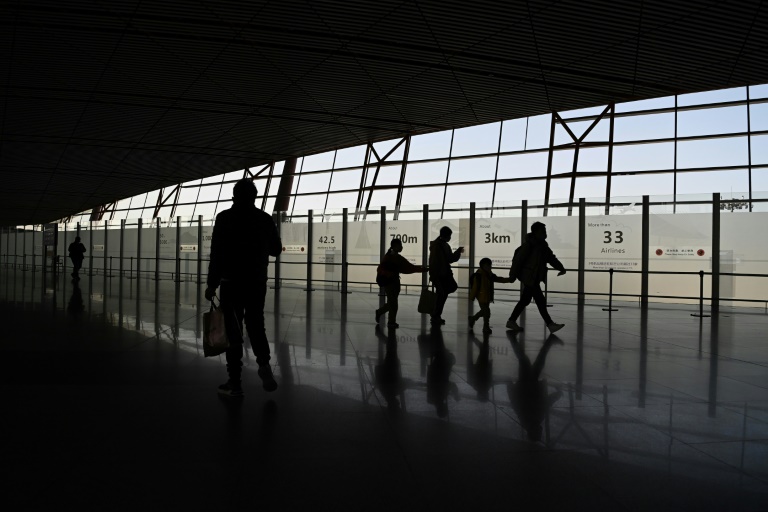
China’s factory and services activity picked up in June, official data showed Thursday, fuelled by the easing of Covid-19 restrictions in major cities such as Shanghai and Beijing.

The non-manufacturing Purchasing Managers’ Index (PMI), a key gauge of activity in the world’s second-biggest economy, defied expectations and surged to 54.7 points in June after three months of sluggish performance.

It was the first time since February that the reading was above the 50-point mark separating growth from contraction. It sat at 47.8 in May.

“As the situation of domestic epidemic prevention and control continued to improve and a package of policies… to stabilise the economy was implemented at a quicker pace, the overall recovery of our country’s economy has accelerated,” National Bureau of Statistics (NBS) senior statistician Zhao Qinghe said in a statement.

In particular, business activity in industries severely hit by the pandemic such as rail and air transport picked up in June, the statement said.

Construction activity also helped fuel the PMI boost.

But the “surprisingly rapid recovery in services” likely reflects a one-off boost from reopening, said Julian Evans-Pritchard, senior China economist at Capital Economics.

Manufacturing PMI rose to 50.2 points in June — similar to analyst expectations — up from 49.6 in May.

As work resumed after Covid lockdowns, production and demand in the sector picked up and delivery times improved, according to the NBS.

China is the only major economy still pursuing a zero-Covid approach of eliminating outbreaks as they emerge, using snap lockdowns and mass testing.

While the country is shortening quarantine times for new international arrivals, President Xi Jinping warned this week that China “would have faced unimaginable consequences” had it adopted a herd immunity or hands-off approach, signalling the government would persist with its current policy.

The approach has taken a harsh toll on the economy, with shops and factories forced to stop operations and supply chains strained.

The non-manufacturing rebound in June was “mainly due to more construction activity”, said Iris Pang, chief economist for Greater China at ING.

“We think that it will be challenging for the government to achieve the 5.5 percent GDP target set in March. There will need to be a lot more infrastructure activity if the government is to achieve this target.”

Asian markets mostly down but China data offers some light

Most Asian markets fell again Thursday as traders fear that hefty rate hikes to rein in soaring inflation will spark a recession, though a slight improvement in Chinese data did provide some cheer.

The rally enjoyed across the world last week appears to have given way to nervousness about the economic outlook, while the Ukraine war continues to sow uncertainty.

The surge in inflation to multi-decade highs has forced central banks to swiftly tighten pandemic-era monetary policies, dealing a hefty blow to equities, particularly tech firms who are susceptible to higher borrowing costs.

The Federal Reserve has already sharply lifted rates and is expected to announce a second successive 75-basis-point lift next month.

There had been hope that policymakers would ease off their hikes as economies show signs of slowing, but analysts say some officials are less concerned about a recession than letting prices run out of control.

Fed boss Jerome Powell this month admitted the moves could lead to a contraction, suggesting he was not averse to it.

On Wednesday, Cleveland Fed chief Loretta Mester said was keen to see the benchmark rate hit 3-3.5 percent this year and “a little bit above four percent next year”.

“There are risks of recession,” she told CNBC. “We’re tightening monetary policy. My baseline forecast is for growth to be slower this year.”

The threat of an extended period of elevated inflation and rate hikes has left traders weary, and markets in the red.

While Wall Street ended on a tepid note Wednesday it was unable to bounce back from the previous day’s plunge.

And Asia also struggled, with Tokyo, Sydney, Seoul, Singapore, Taipei, Manila and Wellington all down.

– China support hope –

However, Hong Kong and Shanghai edged up. That came after official figures showed a forecast-beating improvement in China’s services sector thanks to the easing of painful Covid-19 restrictions in major cities including Shanghai and Beijing.

The non-manufacturing Purchasing Managers’ Index surged to 54.7 points in June, the first time it has been above the 50-point growth mark since February.

The manufacturing gauge hit 50.2, which was also its first time in growth since February and provided some hope that the world’s number two economy could be picking up after the pain caused by lockdowns.

“As the situation of domestic epidemic prevention and control continued to improve and a package of policies… to stabilise the economy was implemented at a quicker pace, the overall recovery of our country’s economy has accelerated,” National Bureau of Statistics statistician Zhao Qinghe said.

And SPI Asset Management strategist Stephen Innes added that the government and People’s Bank of China could now have some room to provide growth support.

“With (consumer price) inflation low in China relative to its peers, there is plenty of scope for monetary and fiscal conditions to loosen in the second half of the year, supporting activity,” he said in a note.

Crude fluctuated after dropping on Wednesday as data showed demand in the United States appeared to be softening even as the driving season gets under way, and as recession fears begin to kick in.

“The higher price environment appears to be doing its job when it comes to demand,” Warren Patterson, of ING Groep NV, said.

The drop comes as OPEC and other major producers including Russia prepare to meet on their output agreement, with most predicting they are unlikely to open the taps further.

“I am not expecting any surprises from the group. I would imagine it will be a fairly quick meeting,” Patterson said.

– Key figures at around 0300 GMT –

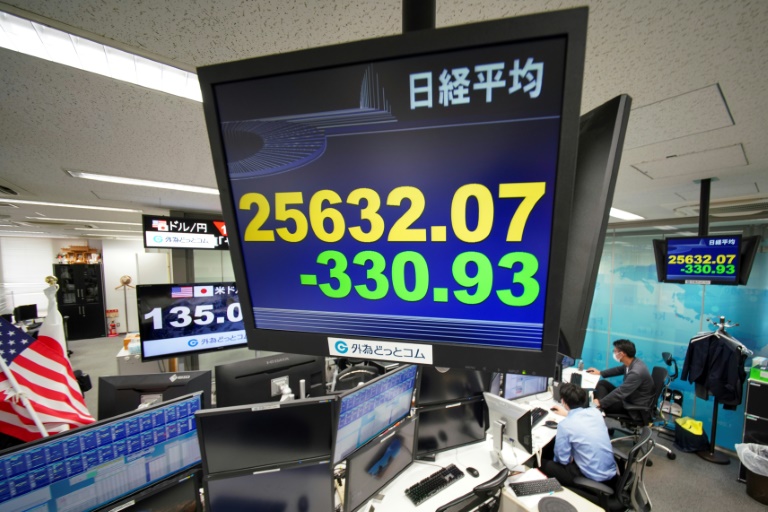
Tokyo – Nikkei 225: DOWN 0.9 percent at 26,561.05 (break)

Hong Kong – Hang Seng Index: UP 0.3 percent at 22,048.60

Shanghai – Composite: UP 0.8 percent at 3,387.96

West Texas Intermediate: UP 0.2 percent at $109.95 per barrel

Brent North Sea crude: DOWN 0.4 percent at $115.77 per barrel

Dollar/yen: DOWN at 136.56 yen from 136.66 yen Wednesday

Euro/dollar: UP at $1.0456 from $1.0444 

Pound/dollar: UP at $1.2139 from $1.2119

Euro/pound: DOWN at 86.13 pence from 86.15 pence

New York – Dow: UP 0.3 percent at 31,029.31 (close)

London – FTSE 100: DOWN 0.2 percent at 7,312.32 (close)

Recession fears haunt markets

Asian and European stock markets nursed losses Wednesday on resurgent fears that sharp interest rate hikes, aimed at tackling runaway inflation, could spark recession, dealers said.

The losses came after a gloomy US consumer confidence report had sent Wall Street tumbling on Tuesday.

US stocks stabilised on Wednesday, with the Dow adding 0.2 percent while the S&P 500 and the tech-heavy Nasdaq dipped slightly, as fresh data showed consumers pulling back on spending.

European sentiment was rocked also by data showing Spanish inflation rocketed to a 37-year peak of 10.2 percent in June on rising energy and food prices. 

The news sent the Madrid stock market down 1.6 percent, with Frankfurt falling 1.7 percent. Paris gave up 0.9 percent and London shed 0.2 percent.

“So much for the big stock market comeback. Another day, another sea of red on the market,” said AJ Bell investment director Russ Mould.

“It does look like we are still in the first phase of this bear market, where indices are prepared to drop on the slightest bit of bad news, and any rally is short-lived,” said Chris Beauchamp at online trading platform IG.

The selloff followed more than a week of global gains caused by hopes that any signs of contraction could give central banks room to ease up on their pace of monetary tightening.

But New York stocks tanked Tuesday on data showing confidence among US consumers — a key driver of the world’s top economy — had fallen to its lowest level in more than a year.

The data re-ignited stubborn worries over the strength of the world economy, and eclipsed news of a surprise move by China to slash the quarantine period for incoming travellers.

That had raised hopes for further relaxations that can allow the country’s giant economy to recover more quickly.

Updated first quarter US GDP data released Wednesday chopped the personal consumption growth figure to 1.8 percent, from 3.1 percent, in an indication that even at the beginning of the year consumers were feeling crimped by rising prices.

– ‘Down the drain’ –

“With signs that consumer confidence is seeping away, worries that global growth will go down the drain have returned to rattle financial markets,” said Susannah Streeter, senior investment and markets analyst at Hargreaves Lansdown.

“Covid restrictions may have eased for international travellers to China as infections rates slow, but one global problem is being replaced by another — fear that recessions are looming around the world.”

Fed officials on Tuesday tried to play down the chances of a recession, expressing hope of a soft landing.

City Index analyst Fawad Razaqzada said there is a threat of high inflation and recession, a phenomenon economists call stagflation.

“That is where the global economy is headed, and central banks won’t be able to do much about it,” he said in a note to clients. 

“If they fasten their belts too tightly, this will hit GDP, while if they loosen their belts again, this will only fuel inflationary pressures further.”

Oil prices advanced on expectations of demand growth as China lifts Covid restrictions and owing to tight supplies following bans on Russian imports.

Observers warned that G7 plans for a price cap on Russian crude was unlikely to have a massive impact on benchmark values.

– Key figures at around 1530 GMT –

New York – Dow: UP 0.2 percent at 31,008.81 points

EURO STOXX 50: DOWN 1.0 percent at 3,512.29

London – FTSE 100: DOWN 0.2 percent at 7,312.32 (close)

Frankfurt – DAX: DOWN 1.7 percent at 13,003.35 (close)

Paris – CAC 40: DOWN 0.9 percent at 6,031.48 (close)

Tokyo – Nikkei 225: DOWN 0.9 percent at 26,804.60 (close)

Hong Kong – Hang Seng Index: DOWN 1.9 percent at 21,996.89 (close)

Shanghai – Composite: DOWN 1.4 percent at 3,361.52 (close)

Brent North Sea crude: UP 0.3 percent at $118.29 per barrel

West Texas Intermediate: UP 0.3 percent at $112.12 per barrel

Euro/dollar: DOWN at $1.0468 from $1.0519 Tuesday

Pound/dollar: DOWN at $1.2125 from $1.2184

Euro/pound: UP at 86.35 pence from 86.33 pence

Dollar/yen: UP at 136.73 yen from 136.14 yen

burs-rl//pvh

Philippines' Ressa says 'business as usual' despite news outlet's shutdown order

Philippine journalist Maria Ressa’s news company Rappler was continuing to work “as usual”, the Nobel Peace Prize winner said on Wednesday, after it was ordered to shut down by authorities ahead of President Rodrigo Duterte’s last day in office.

Ressa has been a vocal critic of Duterte and the deadly drug war he launched in 2016, triggering what media advocates say is a grinding series of criminal charges, probes and online attacks against her and Rappler.

The latest blow was delivered by the Philippine Securities and Exchange Commission. 

In a statement Wednesday, it confirmed the “revocation of the certificates of incorporation” of Rappler for violating “constitutional and statutory restrictions on foreign ownership in mass media”.

Rappler said the decision  “effectively confirmed the shutdown” of the company and vowed to appeal, describing the proceedings as “highly irregular”.

But Ressa was characteristically defiant, vowing the news site would continue to operate as they followed the legal process.

“We continue to work, it is business as usual,” Ressa told reporters, adding “we can only hope for the best” under Duterte’s successor Ferdinand Marcos Jr.

Marcos Jr, the son of the Philippines’ former dictator who presided over widespread human rights abuses and corruption, takes over from Duterte on Thursday.

Activists fear Marcos Jr’s presidency could worsen the situation for human rights and freedom of speech in the country.

– ‘Retaliation’ –

Rappler has had to fight for survival as Duterte’s government accused it of violating a constitutional ban on foreign ownership in securing funding, as well as tax evasion. 

It has also been accused of cyber libel — a new criminal law introduced in 2012, the same year Rappler was founded.

Duterte has attacked the website by name, calling it a “fake news outlet”, over a story about one of his closest aides.

The news organisation is accused of allowing foreigners to take control of its website through its parent company Rappler Holdings’ issuance of “depositary receipts”.

Under the constitution, investment in media is reserved for Filipinos or Filipino-controlled entities.

The case springs from a 2015 investment from the US-based Omidyar Network, which was established by eBay founder Pierre Omidyar.  

Omidyar Network later transferred its investment in Rappler to the site’s local managers to stave off efforts by Duterte to shut it down.

“Let the law take its course, and allow the Securities and Exchange Commission (to) perform its mandate,” presidential spokesman Martin Andanar said.

“Rappler may avail of remedies accorded to it by law.”

Ressa, who is also a US citizen, and Russian journalist Dmitry Muratov were awarded the Nobel Peace Prize in October for their efforts to “safeguard freedom of expression”.

Ressa is fighting at least seven court cases, including an appeal against a conviction in a cyber libel case, for which she is on bail and faces up to six years in prison. 

Rappler faces about eight cases, Ressa said.

– ‘Legal harassment’ –

Human Rights Watch said the website was facing “retaliation for its fearless reporting”.

The International Center For Journalists (ICFJ) urged the Philippine government to reverse its order to shut down Rappler. 

“This legal harassment not only costs Rappler time, money and energy. It enables relentless and prolific online violence designed to chill independent reporting,” ICFJ said on Twitter. 

The future of Rappler and its battle in the country’s highly politicised legal system under Marcos Jr’s presidency is uncertain. 

The president-elect has given few clues about his views on the website and the broader issue of freedom of speech. 

He has largely shunned media interviews and press conferences, preferring to communicate via his press secretary and through social media.

US Second Gentleman Douglas Emhoff, who is heading a delegation to the Philippines for Marcos Jr’s inauguration, would not comment on the Rappler case.

He told reporters in Manila that the US administration had a “deep commitment towards freedom of speech, freedom of expression, human rights”.

Aquaculture drives aquatic food yields to new high

The production of wild and farm-raised fish, shellfish and algae reached record levels in 2020, and future increases could be vital to fighting world hunger, the Food and Agriculture Organization said Wednesday.

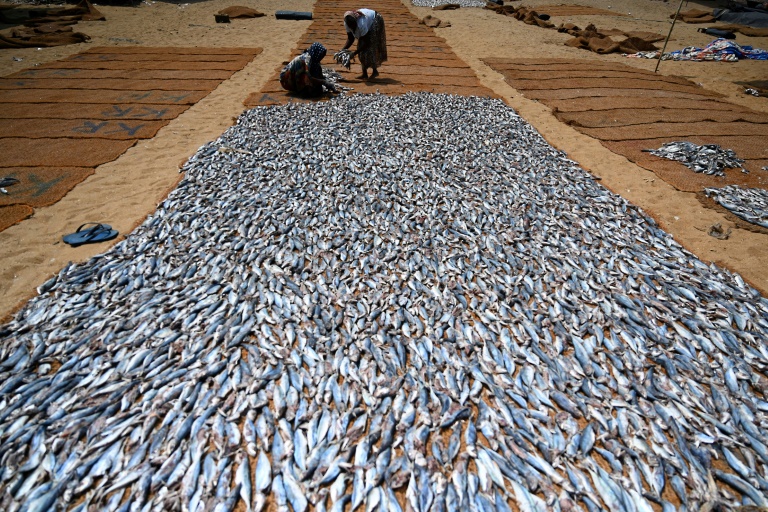
Driven by sustained growth in aquaculture, global fisheries and aquatic farming together hauled in 214 million tonnes, the UN agency said in a report.

The total first-sale value of 2020 production topped $400 million, with $265 million coming from aquaculture, a sector poised for further expansion.

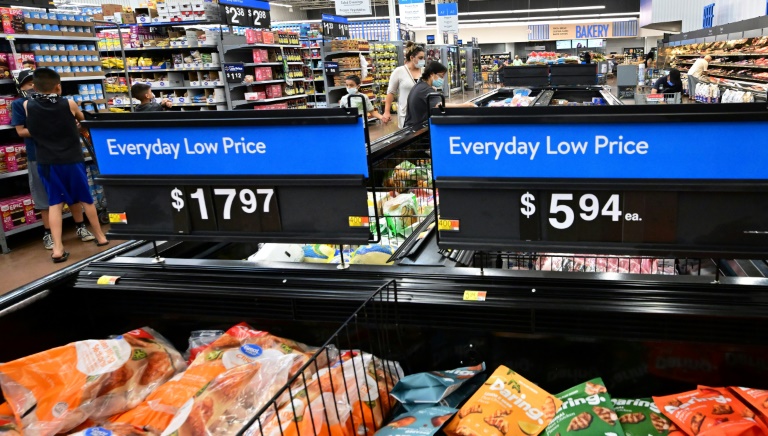
These trend lines are good news for a world facing price hikes and food shortages due to the war in Ukraine, disrupted supply chains, and inflation. 

“The growth of fisheries and aquaculture is vital in our efforts to end global hunger and malnutrition,” said FAO director Qu Dongyu. 

But overfished oceans, climate change and pollution — if left unaddressed — could threaten that potential, the UN agency warned.

“Aquaculture growth has often occurred at the expense of the environment,” Qu noted. 

Many shrimp farms in Vietnam, China and Cambodia, for example, have displaced mangrove forests that are nurseries for marine life and critical barriers against storm surges. 

Climate change poses additional challenges, experts say. 

“Warming waters will create environments where there’s more likelihood of bacterial disease,” said Josh Madeira, director of fisheries and aquaculture policy at the Monterey Bay Aquarium.

That means a sector already highly reliant on antibiotics will likely become even more so, he told AFP.

Production of aquatic animals in 2020 — totalling 178 million tonnes — was evenly divided between fisheries and aquaculture, according to the FAO report.

The remaining 36 million tonnes was algae production.

– Overfished stocks –

Yields of fish, shrimp and other shellfish destined for human consumption are more than 60 percent higher than during the 1990s, far outpacing population growth, according to the report, released during the UN Ocean Conference in Lisbon.

On average, people worldwide consume over 20 kilos (44 pounds) of aquatic foods per year today, more than double the amount 50 years ago.

Globally, 17 percent of the protein consumed by humans comes from aquatic sources. In many Asian and African countries, that figure rises to more than 50 percent.

Wild and farmed food from the seas and inland waters are also a critical source of essential omega-3 fatty acids and micronutrients, recent research has shown.

“Aquatic foods are increasingly recognised for their key role in food security and nutrition,” Qu said. 

Nearly 90 percent of aquatic animal production is for human consumption, with the rest destined for non-food uses such as fishmeal and fish oil.

Asian countries were the source of 70 percent of the world’s fisheries and aquaculture of aquatic animals in 2020.

China remaines by far the top fisheries producer, followed by Indonesia, Peru, Russia, the United States and Vietnam.

So-called capture fisheries of commercial species in the wild — including tuna, cod, salmon and especially anchoveta — dropped by four percent in 2020 compared to the average of the previous three years.

Part of the drop can be attributed to covid-related disruptions, but long-term decline is due to the pressures of overfishing, experts say. 

Catch levels peaked in the mid-1990s, and have — with fluctuations — stagnated since then.

“The FAO estimates that 34 percent of caught fish come from overfished stocks,” University of British Columbia economist and fisheries expert Rashid Sumaila told AFP.

“But they are very conservative,” he added. “Independent studies put that figure at 50 percent.”

Aggravating the problem is some $34 billion dollars annually in government subsidies. 

Earlier this month, the World Trade Organization (WTO) took preliminary steps to reduce these handouts to industry, but experts say the measures will have limited effect and take years to implement.

World equities slide on recession fear

Global stock markets nursed steep losses Wednesday on resurgent fear that sharp interest rate hikes, aimed at tackling runaway inflation, could spark recession, dealers said.

Asia and Europe slumped after a gloomy US consumer confidence report had sent Wall Street tumbling on Tuesday.

European sentiment was rocked also by data showing Spanish inflation rocketed to a 37-year peak of 10.2 percent in June on rising energy and food prices. 

The news sent the Madrid stock market down 1.8 percent, mirroring losses in Frankfurt and Hong Kong.

“So much for the big stock market comeback. Another day, another sea of red on the market,” said AJ Bell investment director Russ Mould.

The selloff followed more than a week of global gains caused by hopes that any signs of contraction could give central banks room to ease up on their pace of monetary tightening.

But New York stocks tanked Tuesday on data showing confidence among US consumers — a key driver of the world’s top economy — had fallen to its lowest level in more than a year.

The data re-ignited stubborn worries over the strength of the world economy, and eclipsed news of a surprise move by China to slash the quarantine period for incoming travellers.

That had raised hopes for further relaxations that can allow the country’s giant economy to recover more quickly.

– ‘Down the drain’ –

“With signs that consumer confidence is seeping away, worries that global growth will go down the drain have returned to rattle financial markets,” said Susannah Streeter, senior investment and markets analyst at Hargreaves Lansdown.

“Covid restrictions may have eased for international travellers to China as infections rates slow, but one global problem is being replaced by another — fear that recessions are looming around the world.”

Fed officials on Tuesday tried to play down the chances of a recession, expressing hope of a soft landing.

Oil prices advanced on expectations of demand growth as China lifts Covid restrictions and owing to tight supplies following bans on Russian imports.

Observers warned that G7 plans for a price cap on Russian crude was unlikely to have a massive impact on benchmark values.

– Key figures at around 1100 GMT –

London – FTSE 100: DOWN 0.5 percent at 7,288.04 points

Frankfurt – DAX: DOWN 1.9 percent at 12,985.01

Paris – CAC 40: DOWN 1.2 percent at 6,012.53

EURO STOXX 50: DOWN 1.3 percent at 3,504.94

Tokyo – Nikkei 225: DOWN 0.9 percent at 26,804.60 (close)

Hong Kong – Hang Seng Index: DOWN 1.9 percent at 21,996.89 (close)

Shanghai – Composite: DOWN 1.4 percent at 3,361.52 (close)

New York – Dow: DOWN 1.6 percent at 30,946.99 (close)

Brent North Sea crude: UP 0.6 percent at $118.65 per barrel

West Texas Intermediate: UP 0.7 percent at $112.55 per barrel

Euro/dollar: UP at $1.0525 from $1.0519 Tuesday

Pound/dollar: DOWN at $1.2159 from $1.2184

Euro/pound: UP at 86.57 pence from 86.33 pence

Dollar/yen: UP at 136.48 yen from 136.14 yen

How long will it take to get over the inflation hump?

Inflation has surged back to levels not seen in many developed economies since the 1970s and 1980s. Economists and central bankers at the European Cental Bank’s conference in Portugal warn it will take time before price rises cool.

– How did we get here? –

For the ECB, established in 1998 to oversee the European single currency, the burst of inflation is without precedent.

“The current levels of food and industrial goods inflation have not been seen since the mid-1980s,” ECB President Christine Lagarde said in her remarks at the conference on Tuesday.

Likewise, the “increase in the relative price of energy in recent months is much higher than the individual spikes that occurred in the 1970s” during the oil shock, Lagarde said.

The take-off in inflation, over eight percent in the eurozone in May, was at the end of a “a sequence that happens in a chaotic world”, Richard Baldwin, an economics professor at the Graduate Institute of Geneva, told AFP.

The supply shock caused by the the outbreak of the coronavirus pandemic in 2020 had been followed by a “demand twist” where people used their money more on goods, Baldwin said.

Instead of seeing this fading, the Russian invasion in Ukraine is causing “a huge spike in fuel and food prices” and heaping pressure on inflation, he said.

But it is not just energy. As health restrictions fall away, consumers are turning back to services, while the pent-up demand for tourism is being released, Lagarde noted.

“There is no playbook for this inflation,” said economist Baldwin.

– How long will it stay like this? –

With no end in sight for the war in Ukraine, the disruptions caused to the supply of energy could keep prices high for some time to come.

Domestic factors could also prop up high inflation rates, with workers demanding higher and higher compensation to make up for the rising cost of living.

Adding to the pressure are low unemployment rates, handing more leverage to workers looking for pay rises.

– What can central banks do? – 

The message put out by central banks is one of their most powerful tools to calm markets and control prices.

But the task at hand “has become quite difficult in view of high inflation numbers” and as “people feel high inflation every day when they’re buying food or going to the gas station”, Isabel Schnabel, a member of the ECB’s executive board, told AFP.

“We can do little about current inflation, but we will take decisive measures so that inflation returns to our (two-percent) target over the medium term,” Schnabel said.

“Once inflation is there and it starts to increase the expectations and wages, monetary policy should act,” Sebnem Kalemli-Ozcan, an economic professor at the University of Maryland, told AFP.

That is what the ECB has planned to do, announcing an interest rate hike for July, its first in over a decade. But the Frankfurt-based institution has to be careful not to completely choke off sputtering growth.

“The question is not if the prices will go down after some time, but what will happen to growth,” Kalemli-Ozcan said.

That is why comparisons are being made with the 1970s and the “stagflation type of situation” where inflation persisted while growth rates faltered, she said. “In Europe there is a risk of stagflation.”

Aquaculture drives aquatic food yields to new high

The amount of fish, shellfish and algae caught in the wild and farmed in aquaculture hit a record 214 million tonnes in 2020, the Food and Agriculture Organization said Wednesday.

Driven by a sustained surge in aquaculture, the new record is good news for a world facing price hikes and food shortages due to the war in Ukraine, disrupted supply chains, and inflation. 

“The growth of fisheries and aquaculture is vital in our efforts to end global hunger and malnutrition,” said FAO director Qu Dongyu.

But overfished oceans, climate change and pollution — if left unaddressed — could threaten that potential, the UN agency warned in its 2022 state of the world fisheries report.

“Aquaculture growth has often occurred at the expense of the environment,” it said. 

“Sustainable aquaculture development remains critical to supply the growing demand for aquatic food.”  

Production of aquatic animals in 2020 — totalling 178 million tonnes — was evenly divided between fisheries and aquaculture.

The remaining 36 million tonnes was algae production.

Yields of fish, shrimp and other shellfish destined for human consumption is more than 60 percent higher than during the 1990s, far outpacing population growth, according to the report, released during the UN Ocean Conference in Lisbon.

On average, people worldwide consume over 20 kilos (44 pounds) of aquatic foods per year today, more than double the amount 50 years ago.

Globally, 17 percent of the protein consumed by humans comes from aquatic sources. In many Asian and African countries, that figure rises to more than 50 percent, according to the report.

Wild and farmed food from the seas and inland waters are also a critical source of essential omega-3 fatty acids and micronutrients, recent research has shown.

“Aquatic foods are increasingly recognised for their key role in food security and nutrition,” Qu said. 

Nearly 90 percent of aquatic animal production is for human consumption, with the rest destined for non-food uses such as fishmeal and fish oil.

Asian countries were the source of 70 percent of the world’s fisheries and aquaculture of aquatic animals in 2020. 

China remaining by far the top fisheries producer, followed by Indonesia, Peru, Russia, the United States and Vietnam.

So-called capture fisheries in the wild — which have stagnated since the mid-1990s — dropped by four percent in 2020 compared to the average of the previous three years.

Part of the drop can be attributed to disruptions caused by the Covid pandemic, but long-term decline is due to overfishing.

“The FAO estimates that 34 percent of caught fish come from overfished stocks,” University of British Columbia economist and fisheries expert Rashid Sumaila told AFP.

“But they are very conservative,” he added. “Independent studies put that figure at 50 percent.”

Equity market losses driven by recession, inflation fears

Fears of a recession caused by sharp interest rate hikes aimed at fighting soaring inflation sent Asian and European markets tumbling Wednesday, tracking a sharp drop on Wall Street.

The hefty selling came after more than a week of gains across the world caused by hopes that any signs of contraction could give central banks room to ease up on their pace of monetary tightening.

The fluctuations on trading floors show how tough it has become for investors to find their feet, just as financial policymakers struggle to find a balance between containing prices and maintaining economic growth.

Wednesday’s selling came after New York’s three main indexes tanked in reaction to data showing confidence among US consumers — who are a crucial driver of the world’s top economy — had fallen to its lowest level in more than a year.

The mood-sapping reading was partly driven by a feeling inflation would persist, suggesting consumers are not sure the Federal Reserve’s aggressive efforts to tame inflation will work.

The news overshadowed a surprise move by China to slash the quarantine period for incoming travellers, raising hopes for further relaxations that can allow the country’s giant economy to recover more quickly.

Hong Kong led losses as tech firms took a beating, while Tokyo, Shanghai, Sydney, Seoul, Mumbai, Manila, Taipei, Jakarta, Bangkok and Wellington were also well down.

London, Paris and Frankfurt all fell in the morning.

Top Fed officials on Tuesday tried to play down the chances of a recession, with the heads of the Fed in San Francisco and New York saying they were upbeat a soft landing could be achieved.

“I see us tapping on the brakes to slow to a more sustainable pace, rather than slamming on the brakes, going over the handlebars and having the proverbial recession,” San Francisco’s Mary Daly told an online event hosted by LinkedIn.

“I wouldn’t be surprised, and it’s actually in my forecast, that growth will slip below two percent, but it won’t actually pivot down into negative territory for a long period of time.”

– ‘Not looking pretty’ –

But analysts were more sceptical, with Sim Moh Siong at Bank of Singapore saying “low US consumer expectations suggest weaker growth in (the second half of 2022) as well as growing risk of recession by year end”.

The Conference Board’s chief economist Dana Peterson warned the United States will likely see a recession in late 2022.

And Emily Weis, at State Street Corp, said: “The Fed still believes it can thread that very fine line between tightening financial conditions while not hurting the economy too much.

“We’re still not sure they’re going to be able to pull that off. That’s what we’ve seen reflected in the markets over the last month or so.”

Meanwhile there was a word of warning for the outlook as companies begin to feel the pinch.

“With investors laser-focused on US growth and inflation data, both of which tanked stocks (Tuesday), do not forget earnings cuts are now coming through — the red ink is flowing through stocks, sectors, and aggregated strategy models,” said Stephen Innes at SPI Asset Management.

“All regions, countries, industries, and stocks are getting printed red with broad strokes. It is not looking pretty.” 

Oil prices dipped though remain elevated following a run-up in recent days on expectations that demand will continue to rise — despite recessionary talk — and supplies remain tight owing to the ban on imports from Russia.

And while G7 leaders agreed to work on a price cap for Russian oil as part of efforts to cut the Kremlin’s revenues, observers warned that will not likely have a massive impact on prices.

“The easing of China’s zero-Covid policy helped oil to the third day of gains following a decent correction in recent weeks,” said Craig Erlam at OANDA. 

“As did reports that the UAE and Saudi Arabia are producing near capacity, in stark contrast to claims that both are holding back and could do more.”

He added that OPEC and other major producers were 2.7 million barrels per day below target in May, “taking the total shortfall under the agreement to more than half a billion”.

“Even sanctions being lifted on Iran and Venezuela can’t do much against that backdrop. It may well take a recession to return oil prices to sustainable levels any time soon,” he warned.

– Key figures at around 0810 GMT –

Tokyo – Nikkei 225: DOWN 0.9 percent at 26,804.60 (close)

Hong Kong – Hang Seng Index: DOWN 1.9 percent at 21,996.89 (close)

Shanghai – Composite: DOWN 1.4 percent at 3,361.52 (close)

London – FTSE 100: DOWN 0.4 percent at 7,296.70

Dollar/yen: DOWN at 136.10 yen from 136.20 yen Friday

Pound/dollar: DOWN at $1.2191 from $1.2187

Euro/dollar: DOWN at $1.0513 from $1.0525

Euro/pound: DOWN at 86.23 pence from 86.32 pence

West Texas Intermediate: DOWN 0.3 percent at $111.47 per barrel

Brent North Sea crude: DOWN 0.4 percent at $117.55 per barrel

New York – Dow: DOWN 1.6 percent at 30,946.99 (close)

Close Bitnami banner
Bitnami