US Business

Time magazine names Ukraine's Zelensky 'Person of the Year'

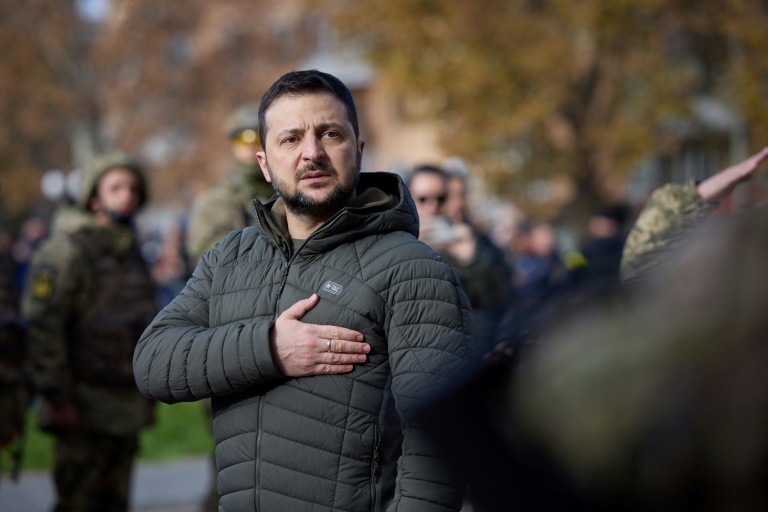
Time magazine named President Volodymyr Zelensky as well as “the spirit of Ukraine” as its 2022 person of the year on Wednesday, for the resistance the country has shown in the face of Russia’s invasion.

Calling Zelensky’s decision to remain in Kyiv and rally his country “fateful,” Time editor in chief Edward Felsenthal said this year’s decision was “the most clear-cut in memory.”

Since Russia’s February 24 invasion, Zelensky has delivered daily speeches that are followed not only by Ukrainians but by citizens and governments around the globe. 

He has appeared on the front lines and recently celebrated in the streets of Kherson when Ukraine pushed Russia from the critical southern city.

“His information offensive shifted the geopolitical weather system, setting off a wave of action that swept the globe,” Felsenthal wrote in announcing the winner.

“Whether the battle for Ukraine fills one with hope or with fear, Volodymyr Zelensky galvanized the world in a way we haven’t seen in decades,” Felsenthal added.

Zelensky’s response to the Russian invasion has transformed the 44-year-old former comedian from an embattled leader of a struggling European outlier to a global household name.

He has also become the standard-bearer of opposition to Russian leader Vladimir Putin, who himself was Time’s person of the year in 2007.

Zelensky, who was born in the southern industrial city of Kryviy Rig in the heart of a mainly Russian-speaking region, has presented his country as the front line in a broader conflict.

His appeals to the West for military and financial support, at times echoing the words of British wartime leader Winston Churchill, have helped Ukraine first halt Russia’s advance and then recapture swathes of territory.

Zelensky shares the 2022 title with “the spirit of Ukraine,” which Felsenthal said was embodied by the “countless individuals inside and outside the country” who are fighting behind the scenes, including everyday people such as chefs and surgeons.

Time’s cover artwork for the edition features Zelensky in his now iconic green fatigues, surrounded by dozens of individuals, including demonstrators bearing the Ukrainian flag, who together represent that spirit.

Among those depicted are Iryna Kondratova, who helped deliver babies during shelling, Kyiv chef Levgen Klopotenko, who turned his restaurant into a relief canteen, and Kyiv Independent editor in chief, Olga Rudenko.

“The Russians need to understand… They will have no forgiveness. They will have no acceptance in the world,” Zelensky says in an interview published in the issue.

Time first presented its Person of the Year award in 1927.

Last year’s honoree was Tesla and SpaceX chief Elon Musk, who has since made major headlines with his high-profile purchase of Twitter.
China's Xi arrives in Saudi Arabia for energy-focused visit

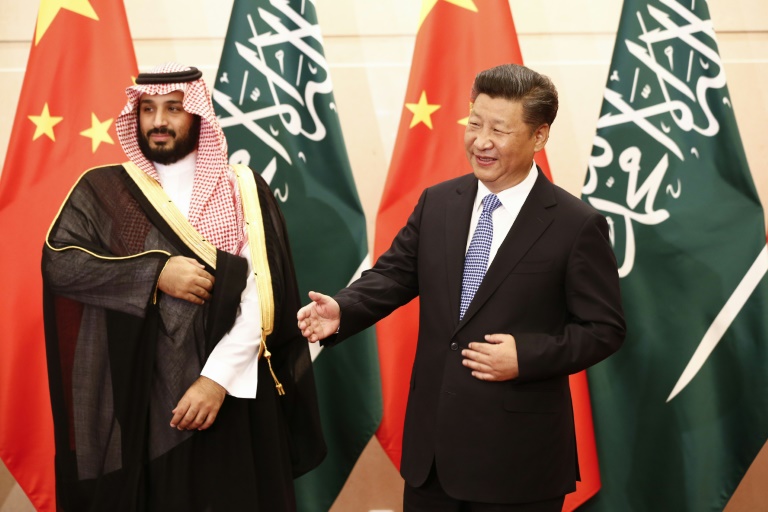
Chinese President Xi Jinping touched down in Saudi Arabia on Wednesday for a visit that is likely to focus on energy ties but also follows months of tensions with the United States.

Xi, recently reanointed as leader of the world’s second biggest economy, arrived in the capital Riyadh, Chinese and Saudi state media said, for a three-day visit that will include talks with the Saudi rulers and other Arab leaders.

Saudi Foreign Minister Prince Faisal bin Farhan and Riyadh Governor Prince Faisal bin Bandar were among those who welcomed Xi at the airport, where a ceremonial purple carpet was laid out from the steps of the plane. 

On major roads in Riyadh, the red-and-gold Chinese flag alternated with the green Saudi emblem. 

China is the top customer for oil from Saudi Arabia, the leading exporter of crude, and both sides appear keen to expand their relationship at a time of economic turmoil and geopolitical realignment.

The trip — only Xi’s third overseas journey since the coronavirus pandemic began, and his first to Saudi Arabia since 2016 — comes after US President Joe Biden’s visit in July, when he pleaded in vain for higher oil production.

It will feature bilateral meetings with Saudi King Salman and Crown Prince Mohammed bin Salman, the de facto ruler, as well as a summit with the six-member Gulf Cooperation Council and a wider China-Arab summit.

– Oil markets –

The programme represents the “largest-scale diplomatic activity between China and the Arab world since the founding of the PRC”, or People’s Republic of China, foreign ministry spokeswoman Mao Ning said on Wednesday.

The official Saudi Press Agency said the kingdom accounted for more than 20 percent of Chinese investment in the Arab world between 2005 and 2020, “making it the biggest Arab country to receive Chinese investments during that period”. 

Oil markets are expected to be a top agenda item for talks between China and Saudi Arabia, especially given the turbulence the markets have experienced since Russia invaded Ukraine in February.

The G7 and European Union on Friday agreed to a $60-per-barrel price cap on Russian oil in an attempt to deny the Kremlin war resources, injecting further uncertainty into the markets.

On Sunday, the OPEC+ oil cartel led jointly by Saudi Arabia and Russia opted to keep in place production cuts of two million barrels per day approved in October.

Saudi and Chinese officials have provided scant information about the agenda, though Ali Shihabi, a Saudi analyst close to the government, said he expected “a number of agreements to be signed”.

Beyond energy, analysts say leaders from the two countries will likely discuss potential deals that could see Chinese firms become more deeply involved in mega-projects that are central to Prince Mohammed’s vision of diversifying the Saudi economy away from oil.

They include a futuristic $500 billion megacity known as NEOM, a so-called cognitive city that will depend heavily on facial recognition and surveillance technology.

– Tensions with Washington –

The OPEC+ production cuts approved in October represented the latest blow to the longtime partnership between Saudi Arabia and the United States, which said they amounted to “aligning with Russia” on the war in Ukraine. 

Xi’s visit is expected to be closely watched in Washington, which entered into what is often described as an oil-for-security partnership with Saudi Arabia towards the end of World War II.

While the Biden administration has smarted over the production cuts, Riyadh has at times accused the United States of failing to hold up the security end of the bargain, notably after strikes in September 2019 claimed by Yemen’s Huthi rebels temporarily halved the kingdom’s crude output.

China and Saudi Arabia already work together on arms sales and production. 

Yet analysts say Beijing cannot provide the same security assurances Washington does — nor does it wish to. 

Nevertheless, if the Saudis are “looking to extract more security guarantees from the US… signalling that they have the opportunity of strengthening ties with China is something that suits them well,” said Torbjorn Soltvedt, of the risk intelligence firm Verisk Maplecroft.

The GCC-China summit will be held in Riyadh on Friday, the bloc said in a statement. 

Turkey seeks proof of insurance from Russian oil tankers

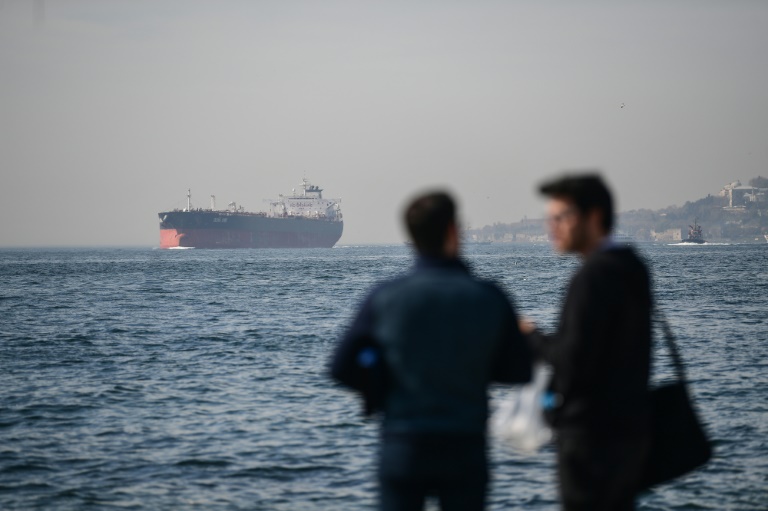
Turkey said Wednesday it has started requesting proof of insurance from tankers loaded with Russian crude oil after Western powers imposed a price cap to punish the Kremlin for its war on Ukraine.

But a Turkish official denied that the measure was slowing the passage of oil ships to world markets through the Bosphorus and Dardanelle straits.

The European Union and the Group of Seven leading industrialised nations agreed last week to block Western insurers from covering ships that intend to sell Russian oil for more than $60 a barrel.

Australia has also joined the new sanctions aimed at depriving Russia of one of its main sources of revenue.

The TankerTracker.com industry monitor said early Wednesday that Russian seaborne crude oil exports had halved in the past 48 hours.

One source told AFP that Turkish officials began requesting proof of insurance from tankers passing from Russia at the start of the month.

An official source told AFP on condition of anonymity that authorities “want to be sure about the coverage” because Western insurers have started to cancel it.

An unnamed Turkish official told the Anadolu state news agency that “the majority of international insurers” no longer provide coverage for Russian crude.

“God forbid, if an accident happens in the straits, who would cover the damages that can reach billions of dollars? Who would be responsible?” the Turkish official asked.

But the official also rejected Western media reports suggesting that Turkey’s new rules have created a logjam of tankers in the two straits.

The official said there were no “significant” changes to marine traffic and that Turkey could take extra measures to “prevent congestion”.

– ‘Blanket promise’ –

A 1936 treaty guarantees the freedom of navigation to merchant vessels passing through Turkey’s two straits.

But it also gives Turkey the right to regulate security — a provision it is now using to make sure the oil ships are insured against spillage and other accidents.

The Financial Times reported that Russia has assembled a separate “shadow fleet” of more than 100 vessels that try to circumnavigate the Western sanctions regime.

These ships are reportedly using non-Western insurers and selling oil at higher prices to countries that have not subscribed to the new sanctions.

The Financial Times said Turkey was waving through these ships but holding up the ones with Western insurance coverage.

Turkish officials did not immediately respond to the report.

Istanbul-based marine traffic analyst Yoruk Isik said Turkey was now requesting physical proof of so-called “protection and indemnity” insurance from all ships departing Russian ports.

He said Western insurers balked at Turkey’s demand to provide a “blanket promise to cover everything that happens in the Bosphorus”.

“But Russian (protection and indemnity insurers) just started issuing the paper,” Isik said.

“So it became a de facto situation that more reputable honest merchants cannot mitigate the transit… but Russian (insurers) are issuing the papers and those ships are transiting,” he said.

Stocks fall as recession fears overshadow China reopening hope

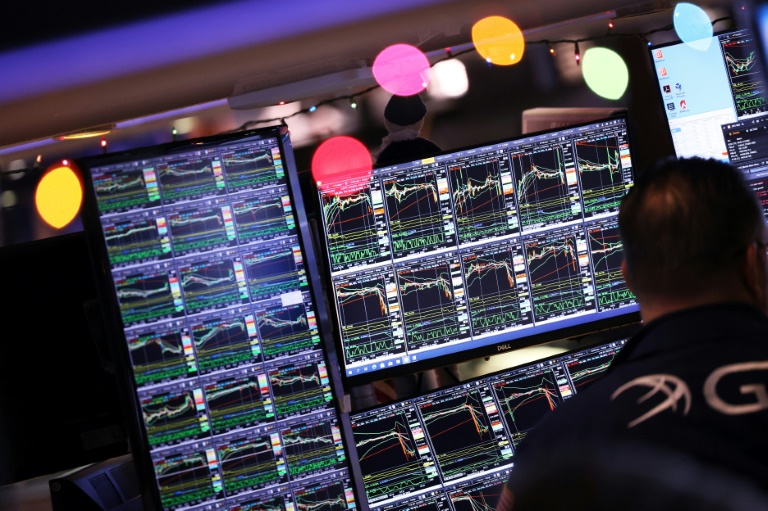
Major stock markets suffered more selling Wednesday on growing fears that Federal Reserve monetary tightening will tip the US economy into recession.

The drop followed more steep losses on Wall Street Tuesday after the heads of leading US banks warned of tough times ahead in 2023.

JPMorgan Chase chief Jamie Dimon tipped a “mild to hard recession” and Goldman Sachs’ David Solomon said jobs and pay would be hit, while Morgan Stanley and Bank of America were also uneasy about the outlook.

The comments added to the downbeat mood that has coursed through trading floors at the start of the week, after forecast-beating reports on jobs and the giant US services sector fanned worries the Fed would have to push interest rates higher than hoped.

Markets had been rising healthily after a weaker-than-expected inflation reading for October suggested the almost year-long tightening campaign was finally affecting prices.

“Any hopes that the Fed would turn more dovish in the months ahead have been dashed significantly as the vast US services industry is where sticky inflation hangs out,” said SPI Asset Management’s Stephen Innes.

He added that the latest readings suggest rates would go above five percent before the Fed stops hiking, while several observers have suggested they will not be reduced until 2024.

– China easing on Covid –

The sombre outlook overshadowed China’s moves to wind back some of its harsh Covid rules that traders hope will kickstart the world’s number two economy, which has been battered this year by months of lockdowns and other containment measures.

In a sign of the impact the zero-Covid strategy has had, data Wednesday showed that imports and exports plunged far more than expected in November.

On Wednesday, officials announced for the first time a nationwide loosening of restrictions, including a reduction in mandatory PCR tests and allowing some positive cases to quarantine at home.

But while the country edges back to normality, Zhiwei Zhang, of Pinpoint Asset Management, warned that it would take time.

“The zero-Covid policy has been loosened, but mobility has not recovered much on the national level,” he said. “I expect exports will stay weak in the next few months as China goes through a bumpy reopening process.

“As global demand weakens in 2023, China will have to rely more on domestic demand.”

Other observers said the recent rally fuelled by the reopening may have gone too far and traders were now taking a step back as they contemplate a likely spike in infections in the country.

Oil prices remained stuck at lows not seen for around a year as demand expectations tumble.

Brent on Tuesday sank below $80 for the first time since January, while WTI struck its lowest since December, having plunged from the 14-year highs of around $140 touched in March after Russia invaded Ukraine. 

“The crude demand outlook is getting crushed as we are in a slowdown basically across all the major economies,” said OANDA’s Edward Moya.

“Supplies seem plentiful over the near term and that has everyone hesitating on what was one of the easiest trades of the year.”

– Key figures around 1145 GMT –

London – FTSE 100: DOWN 0.1 percent at 7,516.42 points

Frankfurt – DAX: DOWN 0.4 percent at 14,293.02

Paris – CAC 40: DOWN 0.4 percent at 6,661.54

EURO STOXX 50: DOWN 0.3 percent at 3,946.83

Tokyo – Nikkei 225: DOWN 0.7 percent at 27,686.40 (close)

Hong Kong – Hang Seng Index: DOWN 3.2 percent at 18,814.82 (close)

Shanghai – Composite: DOWN 0.4 percent at 3,199.62 (close)

New York – Dow: DOWN 1.0 percent at 33,596.34 (close)

Euro/dollar: UP at $1.0498 from $1.0470 on Tuesday

Dollar/yen: UP at 137.64 yen from 137.04 yen

Pound/dollar: UP at $1.2156 from $1.2133

Euro/pound: UP at 86.34 pence from 86.26 pence

Brent North Sea crude: UP 0.2 percent at $79.48 per barrel

West Texas Intermediate: UP 0.1 percent at $74.35 per barrel

Avatar's James Cameron on art, AI and outrage

From “Terminator” to “Titanic” to “Avatar”, director James Cameron has pushed Hollywood’s technical wizardry to new limits, but human emotion must always come first, he told AFP. 

In an era when special effects are much more accessible to filmmakers, and studios are willing to regularly spend hundreds of millions of dollars on blockbusters, it is the artistic talent that makes the difference, Cameron said during a visit to Paris.

Whether he can still strike the balance will be tested as the world finally gets to see “Avatar: The Way of Water” next week — a sequel to his groundbreaking extraterrestrial epic that has been 13 years in the making. 

“Anybody could buy a paintbrush. Not everybody can paint a picture,” the Canadian director said. “The technology doesn’t create art. Artists create art — that’s important.” 

It was originally hoped that a first sequel would be out in 2014, but Cameron’s gargantuan ambitions led to repeated delays. 

He does not come across like the sort of megalomaniac director of Hollywood lore — describing his sets as “a big hippie commune with a bunch of really great artists.” 

But these hippies are armed with some powerful computers. 

“We had over 3,200 shots, which is a lot to maintain high quality, high quality control,” Cameron said.

“We brought in machine deep learning and plugged AI into various stages of the process to assist us… not to take the place of the actors at all but actually to be more truthful to what they had done,” he said.

– ‘Connection to nature’ –

The challenge was managing to draw emotion out of performances that were largely shot in front of green screens, and where most of the scenery and props would only appear later in the effects booths. 

“The heart, the soul, the emotion, the conflict, creativity… all that happens first, and then all the technical work begins,” he said.

Cameron has always justified the vast sums he has asked of studios — “Titanic” was both the most expensive and most profitable film of all time following its release in 1997, only to be topped by “Avatar” in 2009 — and he feels that responsibility “every day”. 

“I can’t be whimsical or impulsive, I have to be very focused and dedicated to creating something that’s both pleasing to me artistically, and that I think will be pleasing to the public and commercial enough to make some money,” he said. 

“It can’t be too intellectual, but I can make it satisfying to me by putting in secondary and tertiary levels of meaning that I know are there.”

Clearly, much of the impulse of the Avatar series is drawing attention to humanity’s impact on nature, but the sequel also focuses on Cameron’s aquatic interests. 

Long fascinated by the sea, from 1989’s “The Abyss” to “Titanic”, Cameron became a deep ocean explorer for National Geographic in the 2000s and was the first solo human to visit the deepest underwater trench, the Mariana Trough, in a purpose-built submarine.

He sees “Avatar” as “awakening that thing in all of us, that connection to nature. 

“The movie asks you to feel something for nature… It’s about maybe feeling a sense of outrage,” Cameron said. 

“These Navi characters… they don’t look like us, they’re blue, they’ve got the ears and tails. But they represent the better angels of our nature. 

“Maybe for 10 minutes after the movie’s over, you see the world a little differently,” he added.

French foie gras in short supply, forcing farmers to adapt

Foie gras pate, the consummate delicacy of French holiday tables, might be harder to find this year and certainly pricier due to a bird flu outbreak that ravaged farms across the west and south last winter.

After millions of ducks and geese were culled to halt the epidemic, some farmers say they are having to take an unprecedented step — using females to produce the luxury treat.

The taste is the same, but female livers are much smaller and harder to work with, and the impact on a producer’s bottom line is inescapable.

“It was double or nothing, but either we just sat and waited — which is not in our nature — or we try to offer a product that respects our consumers,” said Benjamin Constant in Samatan, southwest France.

President of the foie gras marketing board for the Gers department, Constant warned that it was only a stop-gap measure, especially for higher-quality fresh foie gras.

Most livers have veins that must be removed, but those of female livers are much bigger and require more effort to extract, which puts off clients seeking the smooth texture of fresh foie gras that is either seared in a pan, or used to make pate.

“A significant amount cannot be sold fresh, which penalises the producers who sell at public markets,” Constant said.

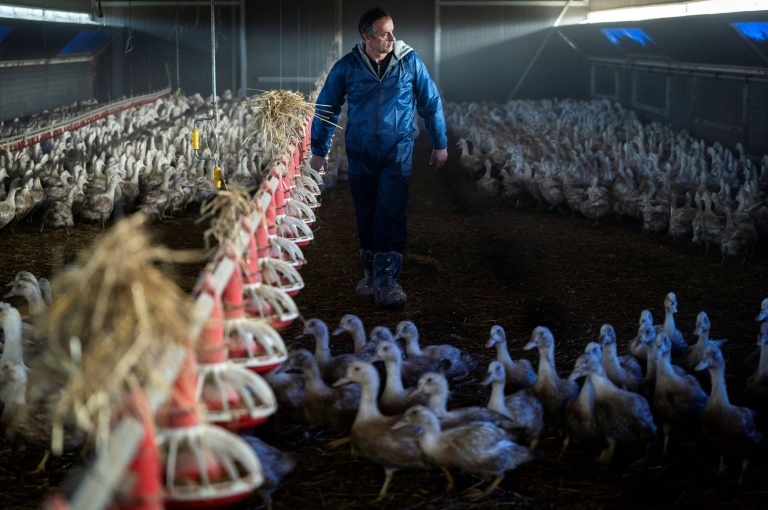
Jacques Candelon, who has been raising ducks in the rolling plains of nearby Sarrant since 1998, said this is the first year the majority of his 26,000 birds are females, which are usually reserved to produce meat for export.

“80 percent are females — it was either that or nothing,” the 52-year-old told AFP at his farm, dressed head to toe in protective gear to prevent any contamination of his animals.

– Bigger stretch –

Animal rights activists have long denounced the force-feeding of ducks and geese to make foie gras, calling it an unnecessary cruelty despite producers’ claims of introducing measures to make the process more humane.

France remains the world’s largest producer and consumer, usually raising some 30 million ducks alone each year, even though some French cities have banned it from official functions.

But two brutal bird flu outbreaks in recent years decimated flocks as authorities imposed culls, with just 21 million ducks raised in 2021, a number expected to plunge to 15 million for 2022, according to the CIFOG producers’ association.

More problematic was the impact on breeding farms, which found themselves with only scant numbers of male chicks to offer producers this year.

Labeyrie, the brand that dominates sales among mass retailers, expects a shortage of 30 to 40 percent this holiday season, by far the most important time of the year for the sector. 

Spiralling energy and feed prices, fallout from Russia’s invasion of Ukraine, will also make foie gras more of a stretch for family budgets.

“There will be enough for the holidays but in limited quantities,” CIFOG director Marie-Pierre Pe told AFP in September. “We’re hoping that people are going to be reasonable and will share what little there is.”

– ‘Big effort’ –

Old habits die hard, however, and at the bustling weekly duck market at Samatan, a foie gras bastion near Toulouse in the heart of Gers, much of the crowd wanted only the pale, plump male livers.

“Females are much, much smaller and after force-feeding, the livers are smaller and less attractive visually,” said Didier Villate, a veterinarian who has overseen the Samatan market for over 40 years.

Next to a tray of glistening male livers, many of the female livers had red blotches with thick dark veins, “which is unfortunately something we find quite often” even though it doesn’t change the taste or texture, Villate said.

“Clients are surprised, so we have to make a big effort to explain to consumers that there is no danger — It’s purely visual, you can buy and eat them just the same,” he said.

But male or female, prices have spiked to between 55 and 60 euros a kilogramme ($26 to $29 a pound), or “15 to 20 euros more than normal,” said Constant, calling 2022 “catastrophic for the sector.”

For Gilberte Bru, who like dozens of others rushed in at the market’s opening whistle to stock up for the holidays, the decision was easy — she picked the male livers.

“Yes, because they are bigger,” she said.

EU starts WTO action against China over Lithuania, patents

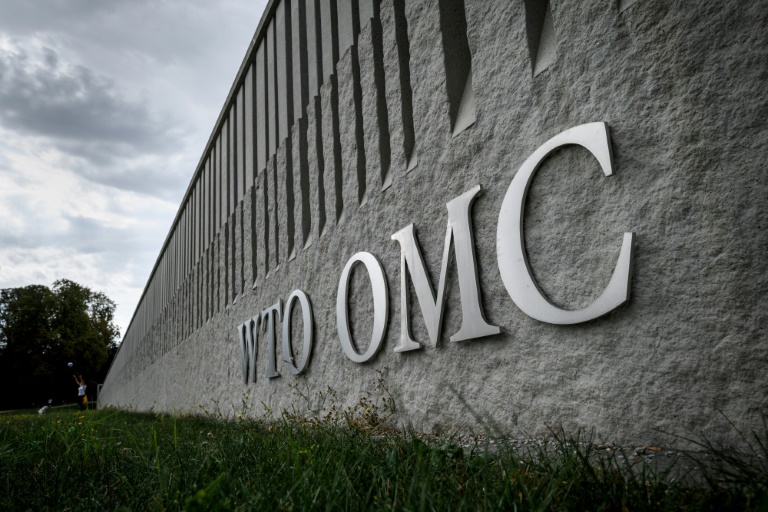
The EU on Wednesday escalated disputes with China to the WTO, requesting panels be assembled to hear two cases, one over trade restrictions on Lithuania and the other on legal recourses for EU patent holders.

“In both cases, the Chinese measures are highly damaging to European businesses” and, in the Lithuania case, “impact the functioning of the EU internal market,” the European Commission said in a statement.

China is the European Union’s biggest trading partner, and the litigation burdens the World Trade Organization with a thorny challenge at a time its dispute settlement system is badly weakened. 

The Lithuania case is over trade restrictions China has been applying to that EU member country because of Lithuania’s strengthening ties with Taiwan, which China views as part of its territory.

Beijing has denied taking coercive measures against Lithuania.

But Lithuanian exports to China have dropped 80 percent over the past year, ever since Chinese authorities started rejecting many Lithuanian imports.

The commission said that Chinese claims made in February that bans on Lithuanian alcohol, beef, dairy products, logs, peat and wheat were on health grounds were not justified.

Consultations with China early this year failed to address that issue, the commission said.

On the patents matter, the European Union is challenging decisions made by Chinese courts in August 2020 that barred EU owners of high-tech patents from turning to EU courts to protect their intellectual property.

The commission said that “Chinese manufacturers requested these anti-suit injunctions to pressure patent right holders to grant them cheaper access to European technology”.

– ‘Litigation stage’ –

An EU official briefing details to journalists on condition of anonymity said: “By requesting a panel, we’re essentially taking these two cases to the litigation stage.”

He added that “one of the reasons that we’re taking this course of action is because we see that they (Chinese authorities) take their WTO obligations seriously and we see that they have a good record of compliance”.

The WTO’s dispute settlement body will discuss the EU’s request for the panels on December 20. China can oppose it, but the EU can then renew its request, and the panels would then be established on January 30 next year.

A panel is the first WTO port of call for countries wanting to have a dispute adjudicated. They are typically composed of three experts but can have five in some cases. 

The commission said the panels’ deliberations could last up to a year and a half.

The WTO’s dispute settlement system, however, is in a fragile state after the United States, under then president Donald Trump, in 2019 blocked the appointment of new judges to the body’s appeals tribunal.

Current US President Joe Biden has not lifted the block, insisting that the WTO must reform to be more efficient.

To ensure disputes can still be appealed, 16 WTO member countries in 2020 set up a separate and temporary appeal system called the Multiparty Interim Appeal Arbitration Arrangement (MPIA), to which China is a party.

The United States is seeking to get the European Union onside with its harsher stance against China, over trade, human rights and Beijing’s increasingly assertive military posture.

Washington has pledged to give Taiwan the military means to defend itself in the event of a Chinese invasion. 

It has also barred Chinese telecom and tech companies from US networks.

The EU official briefing journalists said the United States, as well as Australia, Britain, Canada, Japan and Taiwan had sought to join the consultation phase of its disputes with China, but Beijing refused.

Those countries can ask to join the panels phase of the dispute as third parties, however, and China does not have the power to stop them.

“We would expect a reasonable number of WTO members to come in as third parties,” the official said.

China announces nationwide loosening of Covid restrictions

China announced Wednesday a nationwide loosening of its hardline Covid restrictions that had hammered the world’s second biggest economy and ignited rare protests against the ruling Communist Party.

The new rules are a major relaxation of President Xi Jinping’s signature zero-Covid policy, three years into the pandemic and long after the rest of the world had largely learnt to live with the virus.

However, with vaccination rates remaining low among China’s elderly and a health system still regarded as ill-prepared for a wave of infections, Xi has not abandoned travel curbs and heavy testing completely.

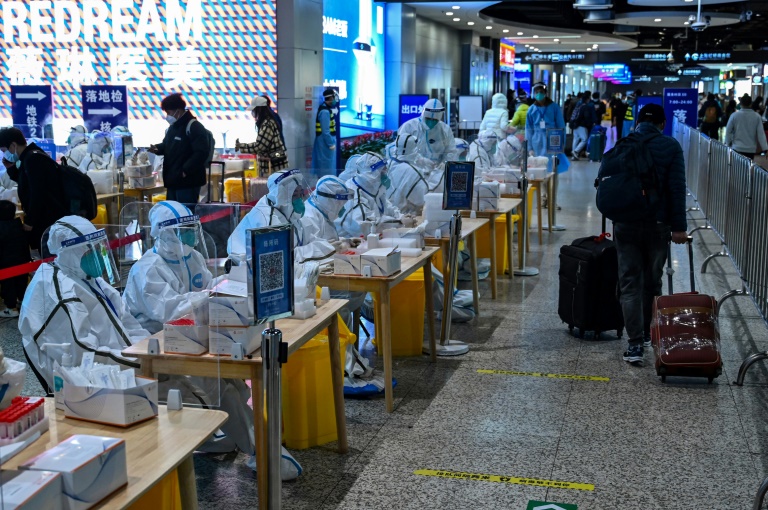
Under the new guidelines announced by the National Health Commission, the frequency and scope of PCR testing — long a tedious mainstay of life in zero-Covid China — will be reduced.

Lockdowns — a major source of public anger — will also be limited to as small a scope as is feasible, and authorities are required to free areas that show no positive cases after five days.

People with non-severe Covid infections can isolate at home instead of centralised government facilities.

And people will no longer be required to show a green health code on their phone to enter public buildings and spaces, except for “nursing homes, medical institutions, kindergartens, middle and high schools”.

China will also accelerate vaccination of the elderly, the health commission said, long seen as a major obstacle to the relaxation of zero-Covid.

Beijing said the new rules would serve to “correct pronounced problems faced by pandemic prevention and control currently”.

Past policy had “received strong response from the public”, National Health Commission expert Li Bin told a press conference Wednesday.

– ‘It’s about time’ –

Until recently, Xi and the Chinese propaganda apparatus had hailed zero-Covid as a triumph of communist rule that had kept deaths low compared with democratic countries such as the United States.

But rare demonstrations against the strategy broke out across China late last month, with people railing against the restrictions.

The protests expanded into calls for more political freedoms, with some even calling for Xi to resign, turning into the most widespread opposition to communist rule since the 1989 democracy uprising that the military crushed.

All the while, a stream of data showed the massive impacts of zero-Covid on China’s economy — with spill on effects for the world.

The government released data just before Wednesday’s announcement stating imports in November had fallen 10.6 percent year-on-year, the biggest drop since May 2020. Exports fell 8.7 percent over the same period.

Authorities quickly cracked down on the demonstrations, sending security forces into the streets and deploying its high-tech surveillance system against protesters.

However they also began easing restrictions, with some Chinese cities tentatively rolling back mass testing and curbs on movement.

And once dominated by coverage of the dangers of the virus and scenes of pandemic chaos abroad, China’s state-run media dramatically shifted tone to support a moving away from zero-Covid.

There were immediate signs of relief in China following Wednesday’s announcement.

“It’s about time to open up, it’s been three years already, we should open up fully,” one Beijing resident who asked to remain anonymous told AFP.

“People need to work and eat, you can’t just tell people not to leave their homes anymore,” they added.

“If people are worried now, they should stay home and avoid coming out, other people need to work and get on with life.”

Others were more nervous about an outbreak.

“We are very worried, now we fully open up, the government doesn’t care anymore, what should we do if the epidemic situation becomes more serious?” migrant worker Meng Qingcheng, 60, told AFP.

“It will make it harder for us to find a job,” he added. “We are also afraid, we don’t want to be infected.”

Searches on the country’s biggest travel app, Ctrip, for flight tickets ahead of Chinese New Year hit a three-year-high, state-run media outlet The Paper reported.

Analysts at Japanese firm Nomura said they projected China’s GDP would rebound next year in the wake of the relaxations.

But, they warned, China “does not appear to be well prepared for a massive wave of Covid infections”.

“It may have to pay for its procrastination on embracing a ‘living with Covid’ approach,” they said in an email.

Chinese flags flutter in Saudi capital ahead of Xi visit

The Saudi capital was bedecked with Chinese flags ahead of President Xi Jinping’s visit on Wednesday that is likely to focus on energy ties but also follows months of tensions with the United States.

The red-and-gold Chinese emblem alternated with the green flag of Saudi Arabia along major roads in Riyadh, while Xi was pictured on the front pages of newspapers that highlighted the trip’s potential economic benefits.

China, the world’s second-biggest economy, is the top customer for oil from Saudi Arabia, the leading exporter of crude, and both sides appear keen to expand their relationship at a time of economic turmoil and geopolitical realignment.

The three-day trip — only Xi’s third overseas journey since the coronavirus pandemic began, and his first to Saudi Arabia since 2016 — comes after US President Joe Biden’s visit in July, when he pleaded in vain for higher oil production.

It will feature bilateral meetings with Saudi King Salman and Crown Prince Mohammed bin Salman, the de facto ruler, as well as a summit with the six-member Gulf Cooperation Council and a wider China-Arab summit.

The programme represents the “largest-scale diplomatic activity between China and the Arab world since the founding of the PRC”, or People’s Republic of China, foreign ministry spokeswoman Mao Ning said on Wednesday.

The official Saudi Press Agency said the kingdom accounted for more than 20 percent of Chinese investment in the Arab world between 2005 and 2020, “making it the biggest Arab country to receive Chinese investments during that period”. 

Oil markets are expected to be a top agenda item for talks between China and Saudi Arabia, especially given the turbulence the markets have experienced since Russia invaded Ukraine in February.

The G7 and European Union on Friday agreed to a $60-per-barrel price cap on Russian oil in an attempt to deny the Kremlin war resources, injecting further uncertainty into the markets.

On Sunday, the OPEC+ oil cartel led jointly by Saudi Arabia and Russia opted to keep in place production cuts of two million barrels per day approved in October.

Saudi and Chinese officials have provided scant information about the agenda, though Ali Shihabi, a Saudi analyst close to the government, said he expected “a number of agreements to be signed”.

Beyond energy, analysts say leaders from the two countries will likely discuss potential deals that could see Chinese firms become more deeply involved in mega-projects that are central to Prince Mohammed’s vision of diversifying the Saudi economy away from oil.

They include a futuristic $500 billion megacity known as NEOM, a so-called cognitive city that will depend heavily on facial recognition and surveillance technology.

– Tensions with Washington –

The OPEC+ production cuts approved in October represented the latest blow to the longtime partnership between Saudi Arabia and the United States, which said they amounted to “aligning with Russia” on the war in Ukraine. 

Xi’s visit is expected to be closely watched in Washington, which entered into what is often described as an oil-for-security partnership with Saudi Arabia towards the end of World War II.

While the Biden administration has smarted over the production cuts, Riyadh has at times accused the United States of failing to hold up the security end of the bargain, notably after strikes in September 2019 claimed by Yemen’s Huthi rebels temporarily halved the kingdom’s crude output.

China and Saudi Arabia already work together on arms sales and production. 

Yet analysts say Beijing cannot provide the same security assurances Washington does — nor does it wish to. 

Nevertheless, if the Saudis are “looking to extract more security guarantees from the US… signalling that they have the opportunity of strengthening ties with China is something that suits them well,” said Torbjorn Soltvedt, of the risk intelligence firm Verisk Maplecroft.

The GCC-China summit will be held in Riyadh on Friday, the bloc said in a statement. 

Turkey seeks proof of insurance from Russian oil tankers

Turkey said Wednesday it has started requesting proof of insurance from tankers loaded with Russian crude oil after Western powers imposed a price cap to punish the Kremlin for its war on Ukraine.

But a Turkish official denied that the measure was slowing the passage of oil ships to world markets through the Bosphorus and Dardanelle straits.

The European Union and the Group of Seven leading industrialised nations agreed last week to block Western insurers from covering ships that intend to sell Russian oil for more than $60 a barrel.

Australia has also joined the new sanctions aimed at depriving Russia of one of its main sources of revenue.

The TankerTracker.com industry monitor said early Wednesday that Russian seaborne crude oil exports had halved in the past 48 hours.

One source told AFP that Turkish officials began requesting proof of insurance from tankers passing from Russia at the start of the month.

“We want to be sure about the coverage because they have started to cancel it,” an official source told AFP on condition of anonymity.

An unnamed Turkish official told the Anadolu state news agency that “the majority of international insurers” no longer provide coverage for Russian crude.

“God forbid, if an accident happens in the straits, who would cover the damages that can reach billions of dollars? Who would be responsible?” the Turkish official asked.

But the official also rejected Western media reports suggesting that Turkey’s new rules have created a logjam of Russian ships in the two straits.

The official said there were no “significant” changes to marine traffic and that Turkey could take extra measures to “prevent congestion”.

A 1936 treaty guarantees the freedom of navigation to merchant vessels passing through Turkey’s two straits.

But it also gives Turkey the right to regulate security — a provision it is now using to make sure the oil ships are insured against spillage and other accidents.

The Financial Times reported that Russia has assembled a separate “shadow fleet” of more than 100 vessels that try to circumnavigate the Western sanctions regime.

These ships are reportedly using non-Western insurers and selling oil at higher prices to countries that have not subscribed to the new sanctions.

The Financial Times said Turkey was waving through these ships but holding up the ones with Western insurance coverage.

Turkish officials did not immediately respond to the report.

Close Bitnami banner
Bitnami