US Business

Sexuality and fame in focus as Sundance film festival returns to Utah

Documentaries exploring sexuality and fame via the life stories of supermodel Brooke Shields, singer Little Richard and author Judy Blume are among the lineup for next month’s Sundance film festival unveiled Wednesday.

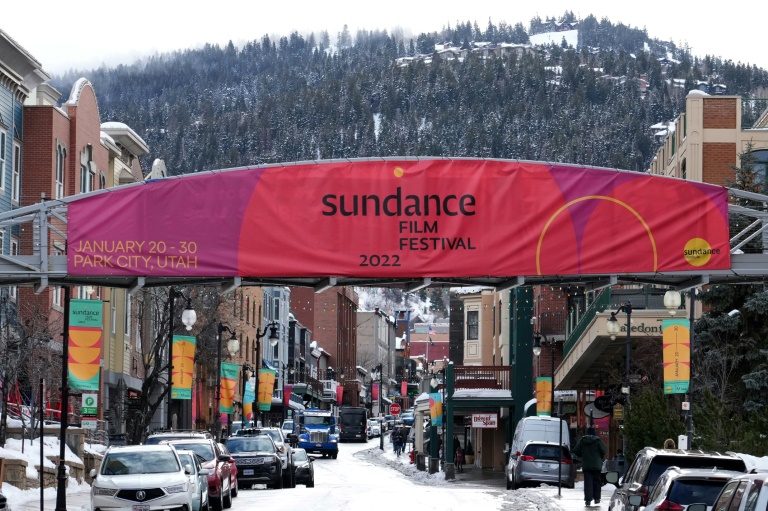
Co-founded by Robert Redford and renowned for launching major independent, art house and documentary films, the festival is set to return in-person to the mountains of Utah from January 19, after two previous editions were forced to take place online due to Covid.

Stars including Anne Hathaway, Emilia Clarke, Jason Momoa and Chiwetel Ejiofor all have feature films in the lineup, while Emilia Jones returns to the festival that first played her best picture Oscar winner “CODA,” with two new movies of her own.

On the documentary side, “Pretty Baby: Brooke Shields” tells the story of the global supermodel and actress who first achieved fame aged 12, and reflects on the objectification, sexualization and commodification of women and young girls.

“Judy Blume Forever” charts how the US young adult fiction author came under attack for sexual content and offensive language in the 1980s, leading her to take a stand against book banning and censorship.

Both films “reflect the trends that we’ve seen in the last few years of biographically driven work” which allows viewers “to reopen history and to look at it from a different perspective,” said Sundance senior programmer John Nein.

Similarly, “The Disappearance of Shere Hite” tracks the pioneering feminist author of “The Hite Report,” whose bestselling 1976 book on the female orgasm provoked a sexual revolution, but who was forced to vanish from the public eye afer drawing vicious criticism.

And documentary “Little Richard: I Am Everything” tackles the Black queer origins of rock ‘n’ roll via the late, flamboyant singer, who renounced homosexuality and became a born-again Christian in later years.

The films each provide “a chance to engage with history in a very different way” via “the framework of a notable person within the arts and culture field,” said Nein.

Another prominent and topical theme in the lineup is films by and about Iranian women.

Documentary “Joonam,” and feature films “The Persian Version” and “Shayda” all explore the stories of women in Iran and its diaspora communities, at a time when the country has been rocked by protests over its strict female dress code.

And Hollywood A-listers are expected to return to the festival in force after two years of virtual Q&As and Zoom interviews.

Former “Game of Thrones” star Clarke appears alongside Ejiofor in “The Pod Generation,” a near-future social satire in which a company has invented a detachable womb, enabling couples to share their pregnancy.

Hathaway and Thomasin McKenzie star in “Eileen,” about a young secretary working at a prison who befriends a glamorous counselor with a dark secret.

“Aquaman” star Momoa narrates a documentary about the deep ocean and a mysterious organization planning to extract metals from the seabed. 

And Jones stars in dramas “Cat Person,” adapted from a famous New Yorker short story, and “Fairyland,” based on a best-selling memoir about San Francisco’s AIDS crisis.

The 2023 Sundance Film Festival runs January 19–29.
No convictions sought in French court over 2009 Rio-Paris crash

French prosecutors said Wednesday it was “impossible” to convict Air France and plane maker Airbus over the 2009 crash of a Rio-Paris flight, enraging victims’ families after an eight-week trial.

In an unusual conclusion to proceedings, prosecutors said they could not recommend a guilty verdict for the two companies which have been charged with involuntary manslaughter over the air disaster.

Their guilt “appears to us to be impossible to prove,” prosecutor Pierre Arnaudin told the court in Paris. 

“We know that this view will most likely be difficult to hear for the civil plaintiffs, but we are not in a position to demand the conviction of Air France and Airbus,” he added.

The decision not to seek a conviction by prosecutors does not mean that the three-person team of judges overseeing the trial has to follow their advice. 

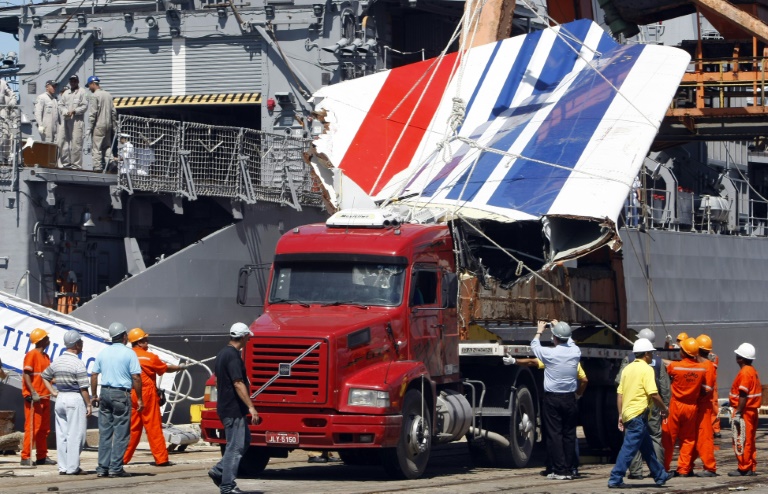
The two France-based companies went on trial in October to determine their responsibility for the worst aviation disaster in Air France’s history, which left 228 dead on board flight AF447.

Both denied the involuntary manslaughter charges that carry a maximum fine of 225,000 euros ($236,000).

Prosecutors initially dropped charges against the companies in 2019 in a decision that also infuriated victims’ families.

A Paris appeals court overturned this decision in 2021 and ordered the trial to go ahead. 

“We have a prosecutor who is supposed to defend the people who in the end is defending the multinational Airbus,” Daniele Lamy, the head of the Entraide et Solidarite AF447 association, told reporters on Wednesday.

She denounced a “trial skewed against the pilots”.

“I’m ashamed to be French,” one furious civil plaintiff said as they left the court on Wednesday. “What’s the justice system for?” asked another.

– Pilot error – 

At the heart of hearings in Paris has been the role of defective so-called Pitot tubes, which are used to measure the flight speed of aircraft.

The court heard how a malfunction with the tubes, which became blocked with ice crystals during a mid-Atlantic storm, caused alarms to sound in the cockpit of the Airbus A330 and the autopilot system to switch off.

Technical experts have highlighted how that, after the instrument failure, the pilots put the plane into a climb that caused the aircraft to lose upward lift from the air moving under its wings, thus losing altitude.

“For us, what led the crew to react in the way they did remains a mystery in most respects,” Air France representative Pascal Weil, a former test pilot, told the court on November 10. 

Airbus has also blamed pilot error as the main cause for the crash during proceedings.

But lawyers for victims’ families have emphasised how both companies were aware of the Pitot tube problem before the crash, and that the pilots were not trained to deal with a high-altitude emergency of this nature.

The court heard how 17 different incidents of defective Pitot tubes on Airbus aircraft were reported in the year before the crash, with Airbus and Air France previously warning their clients and pilots about the issue.

Air France’s reaction was “too slow and insufficient,” Thibault de Montbrial, a lawyer representing German victims, told the court on December 1.

He said at the time that the association he represented — HIOP — “feared for a long time … that there was a form of state interest in putting a lid over this case.”

– ‘Stall, stall’ –

Chief prosecutor Marie Duffourc acknowledged on Wednesday that the legal proceedings had been “far too long”, meaning the “suffering has been endlessly rekindled over these last 13 years.”

The model of Pitot tube used on the doomed Airbus plane, manufactured by French company Thales, was replaced on aircraft worldwide after the accident.

The crash also prompted an overhaul of training protocols across the industry, in particular to prepare pilots to handle the intense stress of unforeseen circumstances.

On October 17, lawyers and victims’ families were allowed to listen to the chilling in-flight voice recording of the pilots’ final minutes for the first time.

“We’ve lost our speeds,” one pilot is heard before a recorded warning sounds — “stall, stall, stall” — and the aircraft begins to plunge towards the Atlantic Ocean.  

It took nearly two years to recover the “black box” flight recorders which were found nearly 4,000 metres below sea level.

Elon Musk briefly loses top spot on Forbes billionaire list

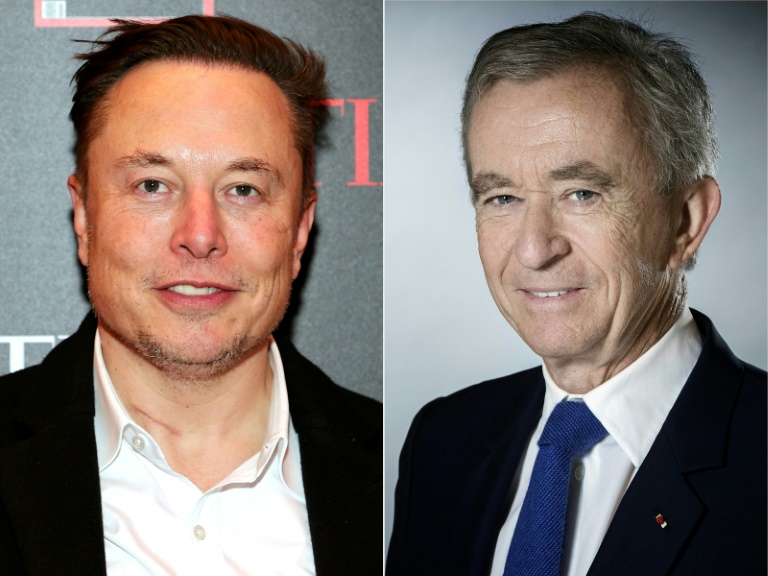
Tesla owner Elon Musk briefly lost the top spot on Forbes’ billionaire list Wednesday to Bernard Arnault, whose family owns the world’s leading luxury group, LVMH.

With US tech stocks sliding as interest rates and recession fears rise, Musk’s fortune briefly fell below that of the Arnault family. 

But around 1730 GMT Musk was back on top at $184.9 billion, followed by Arnault and his family at $184.7 billion.

Indian businessman Gautam Adani was in third place at $134.8 billion, with Amazon founder Jeff Bezos fourth at $111.3 billion.

Arnault had also topped the Forbes list for several hours in 2021.

His LVMH group, with includes dozens of brands including Louis Vuitton, Givenchy, and Kenzo, has continued to post strong revenue and profit growth despite the latest global economic headwinds.

Musk’s fortune is primarily tied to the share price of Tesla, and the entrepreneur has been at the centre of controversy after having taken over Twitter in late October.

The other major wealth ranking compiled by financial data provider Bloomberg also has Musk and Arnault running nearly neck-and-neck.

According to Bloomberg’s ranking, calculated after US markets closed on Tuesday, had Musk in the lead at $178.9 billion, followed by Arnault at $165.1 billion.

Putin warns of 'lengthy' Ukraine conflict

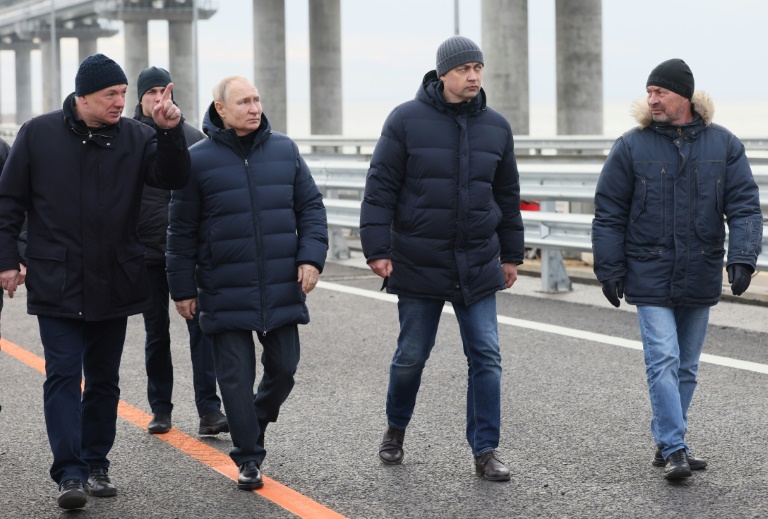
Russian President Vladimir Putin warned on Wednesday of a long military intervention in Ukraine but said Moscow would not use nuclear weapons first.

His comments came after Ukrainian President Volodymyr Zelensky said fresh Russian strikes on a market and filling station had killed six people and wounded several more in the frontline region of Donetsk.

With the one-year mark of the conflict approaching, Russian forces have missed most of their key military goals including toppling the Ukrainian government, capturing the Donbas region and annexing four territories.

Putin’s own menacing language, and the battlefield stalemate, have raised fears Russia could resort to its nuclear arsenal to achieve a military breakthrough.

On Wednesday, Putin warned that the threat of nuclear war was growing.

“Such a threat is rising. Why make a secret out of it here?” he said at a meeting of his human rights council.

He added however that Russia would use a nuclear weapon only in response to an enemy strike.

“When we are struck, we strike back,” he said, stressing that Moscow’s strategy was based on “so-called retaliatory strike” policy.

Moscow had expected fighting to last just days before Ukraine’s capitulation, but on Wednesday Putin warned results could be a long time coming.

“As for the long process of (seeing) results of the special military operation, of course, this is a lengthy process,” Putin said.

But he praised the announced annexation of four Ukrainian territories into Russia after Moscow proxies held referendums — denounced in the West as a sham — and announced their integration in September.

“New territories appeared — well, this is still a significant result for Russia and this is a serious issue,” Putin said.

The Russian leader formalised the annexation of the four southern and eastern territories — Donetsk, Lugansk, Kherson and Zaporizhzhia — at a ceremony in the Kremlin in September.

– Russian shelling on market – 

But Russian troops at no point entirely controlled any of the territories and last month were forced out from the capital of the southern Kherson region after a months-long Ukraine counter-offensive.

In September Putin announced Russia was mobilising hundreds of thousands of people to bolster Moscow’s struggling forces after a series of battlefield setbacks, particularly in the Kharkiv region in northeast Ukraine.

On Wednesday he said half the Russians called up for military service in September had been deployed to Ukraine.

“Out of 300,000 of our mobilised fighters, our men, defenders of the fatherland, 150,000 are in the area of operations,” said Putin, adding that about 77,000 were in combat units.

Since the capture of Kherson city, fighting in Ukraine has focused on the industrial Donbas region, where Russian forces have been pushing to capture the frontline city of Bakhmut.

Zelensky — after visiting the region this week — said Wednesday that Russian forces had killed six civilians and injured several in a recent bout of shelling. 

“Terrorists attacked the peaceful city of Kurakhove,” he said in a statement on social media.

“A market, a bus station, gas stations, and residential buildings came under fire. At least six civilians were killed, five were wounded.” 

The Donetsk region has been partially controlled by Russian forces since 2014, when Moscow-backed separatists wrested control of the Donbas near the Russian border and Moscow annexed the Crimean peninsula.

Stock markets slide as recession worries weigh on investors

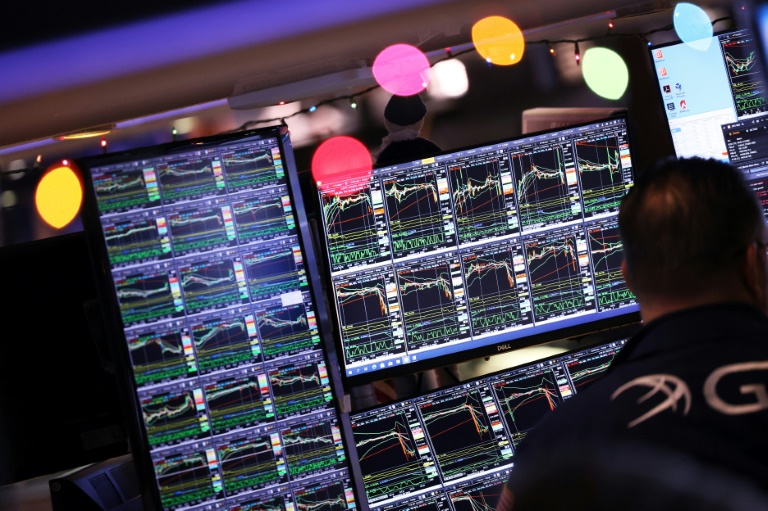
Major stock markets were hit by more selling Wednesday on growing fears that Federal Reserve monetary tightening will tip the US economy into recession, with Chinese trade data adding to the gloomy outlook.

Drops in Asia and Europe followed steep losses on Wall Street Tuesday after the heads of leading US banks warned of tough times ahead in 2023. 

JPMorgan Chase chief Jamie Dimon tipped a “mild to hard recession” and Goldman Sachs’ David Solomon said jobs and pay would be hit, while Morgan Stanley and Bank of America were also uneasy about the outlook.

The comments added to the downbeat mood that has coursed through trading floors at the start of the week, after forecast-beating reports on jobs and the giant US services sector fanned worries the Fed would have to push interest rates higher than hoped.

Markets had been rising healthily after a weaker-than-expected inflation reading for October suggested the almost year-long tightening campaign was finally affecting prices.

“Any hopes that the Fed would turn more dovish in the months ahead have been dashed significantly as the vast US services industry is where sticky inflation hangs out,” said SPI Asset Management’s Stephen Innes.

He added that the latest readings suggest rates would go above five percent before the Fed stops hiking, while several observers have suggested they will not be reduced until 2024.

“It would appear the recovery in stocks — bear-market rally, or otherwise — has run out of steam, and investors are left wondering whether what follows next is another test of the lows or simply a correction of that impressive two-month surge,” said market analyst Craig Erlam at trading platform OANDA.

Major Asian and European markets ended the day down.

On Wall Street, bargain-hunting sent the main indices higher at moments, but they were all lower as European markets closed.

– China easing on Covid –

The sombre outlook overshadowed China’s moves to wind back some of its harsh Covid rules that traders hope will kickstart the world’s number two economy, which has been battered this year by months of lockdowns and other containment measures.

In a sign of the impact the zero-Covid strategy has had, data Wednesday showed that imports and exports plunged far more than expected in November.

On Wednesday, officials announced a nationwide loosening of restrictions, including a reduction in mandatory PCR tests and allowing some positive cases to quarantine at home.

But while the country edges back to normality, Zhiwei Zhang, of Pinpoint Asset Management, warned that it would take time.

“The zero-Covid policy has been loosened, but mobility has not recovered much on the national level,” he said. 

“I expect exports will stay weak in the next few months as China goes through a bumpy reopening process.”

Other observers said the recent rally fuelled by the reopening may have gone too far and traders were now taking a step back as they contemplate a likely spike in infections in the country.

Oil prices remained stuck at lows not seen for around a year as demand expectations tumble.

Brent on Tuesday sank below $80 for the first time since January, and fell further on Wednesday. 

“Brent crude oil prices hit their lowest levels this year earlier today as rising recession risks outweighed any optimism over a reopening of the Chinese economy,” said market analyst Michael Hewson at CMC Markets.

– Key figures around 1630 GMT –

New York – Dow: DOWN 0.2 percent at 33,542.92 points

EURO STOXX 50: DOWN 0.5 percent at 3,920.90

London – FTSE 100: DOWN 0.4 at 7,489.19 (close)

Frankfurt – DAX: DOWN 0.6 percent at 14,261.19 (close)

Paris – CAC 40: DOWN 0.4 percent at 6,660.59 (close)

Tokyo – Nikkei 225: DOWN 0.7 percent at 27,686.40 (close)

Hong Kong – Hang Seng Index: DOWN 3.2 percent at 18,814.82 (close)

Shanghai – Composite: DOWN 0.4 percent at 3,199.62 (close)

Euro/dollar: UP at $1.0513 from $1.0470 on Tuesday

Dollar/yen: DOWN at 136.77 yen from 137.04 yen

Pound/dollar: UP at $1.2195 from $1.2133

Euro/pound: DOWN at 86.17 pence from 86.26 pence

Brent North Sea crude: DOWN 1.3 percent at $78.36 per barrel

West Texas Intermediate: DOWN 1.6 percent at $73.05 per barrel

burs-rl/rox

China's Xi arrives in Saudi Arabia for energy-focused visit

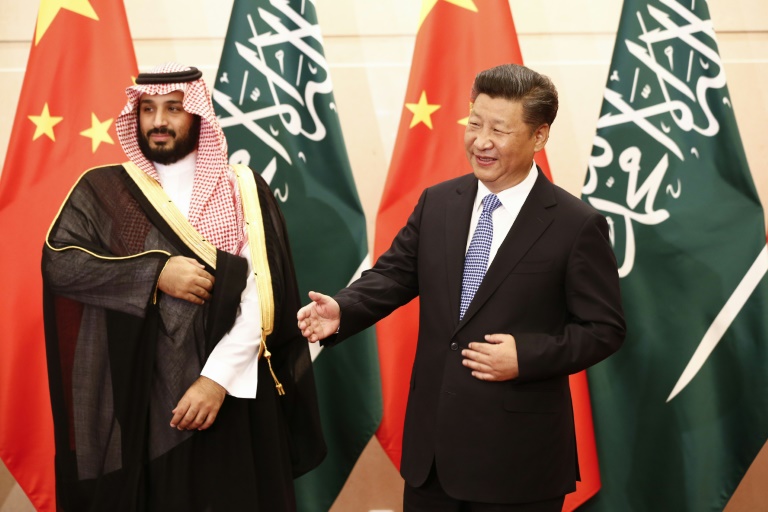
Chinese President Xi Jinping touched down in Saudi Arabia on Wednesday for a visit that is likely to focus on energy ties as Washington warned of Beijing’s growing influence.

Xi, recently reanointed as leader of the world’s second biggest economy, arrived in the capital Riyadh, Chinese and Saudi state media said, for a three-day visit that will include talks with Saudi and other Arab leaders.

Saudi Foreign Minister Prince Faisal bin Farhan and Riyadh Governor Prince Faisal bin Bandar were among those who welcomed Xi at the airport, where a ceremonial purple carpet was laid out from the steps of the plane. 

China is Saudi Arabia’s top oil customer, and both sides appear keen to expand their relationship at a time of economic turmoil and geopolitical realignment.

The trip — only Xi’s third overseas since the coronavirus pandemic began, and his first to the world’s top oil exporter since 2016 — comes after US President Joe Biden’s visit in July, when he pleaded in vain for higher oil production.

It will feature bilateral meetings with Saudi King Salman and Crown Prince Mohammed bin Salman, the de facto ruler, as well as a summit with the six-member Gulf Cooperation Council and a wider China-Arab summit.

Asked about the Xi visit, White House National Security Council spokesman John Kirby told reporters on Wednesday that Saudi Arabia remains a crucial US ally, but warned of “the influence that China is trying to grow around the world.”

“We believe that many of the things they’re trying to pursue and the manner in which they’re trying to pursue it are not conducive to preserving the international rules based order,” Kirby said, adding that Washington did not expect nations to choose between the two powers.

– Washington tensions –

Saudi Energy Minister Prince Abdulaziz bin Salman on Wednesday said that “Saudi Arabia will remain China’s credible and reliable partner” in the global oil market.

Bilateral “relations… are witnessing a qualitative leap,” the official Saudi Press Agency (SPA) quoted him as saying.

He said the two countries will endeavour to boost cooperation in energy supply chains by establishing a “regional centre” in Saudi Arabia for Chinese factories, according to SPA. 

SPA said the kingdom accounted for more than 20 percent of Chinese investment in the Arab world between 2005 and 2020, the largest share of any nation in the region.  

Oil markets are key to the bilateral talks, especially given the substantial market turbulence seen since Russia invaded Ukraine in February.

The G7 and European Union on Friday agreed to a $60-per-barrel price cap on Russian oil in an attempt to deny the Kremlin war resources, injecting further market uncertainty.

On Sunday, the OPEC+ oil cartel led jointly by Saudi Arabia and Russia opted to keep in place production cuts of two million barrels per day approved in October.

Washington said those cuts amounted to “aligning with Russia” on the war in Ukraine. 

The US has been engaged in what is often described as an oil-for-security partnership with Saudi Arabia since the tail-end of World War II.

While the Biden administration has smarted over the production cuts, Riyadh has at times accused the US of failing to hold up the security end of the bargain, notably after strikes in September 2019 claimed by Yemen’s Huthi rebels temporarily halved the kingdom’s crude output.

– Deals in pipeline –

Saudi and Chinese officials have provided scant information about the agenda of the bilateral talks, although Ali Shihabi, a Saudi analyst close to the government, said he expected “a number of agreements to be signed”.

Chinese foreign ministry spokeswoman Mao Ning said on Wednesday that Xi’s programme represents the “largest-scale diplomatic activity between China and the Arab world” since the People’s Republic of China was founded. 

Analysts say potential deals seeing Chinese firms become more deeply involved in mega-projects central to Prince Mohammed’s vision of economic diversification will likely be key talking points.

Key Saudi projects include the futuristic $500 billion megacity NEOM, a so-called cognitive city that will depend heavily on facial recognition and surveillance technology.

If the Saudis are “looking to extract more security guarantees from the US… signalling that they have the opportunity of strengthening ties with China is something that suits them well,” said Torbjorn Soltvedt, of the risk intelligence firm Verisk Maplecroft.

Canada central bank hikes key rate to 4.25%, hints at pause

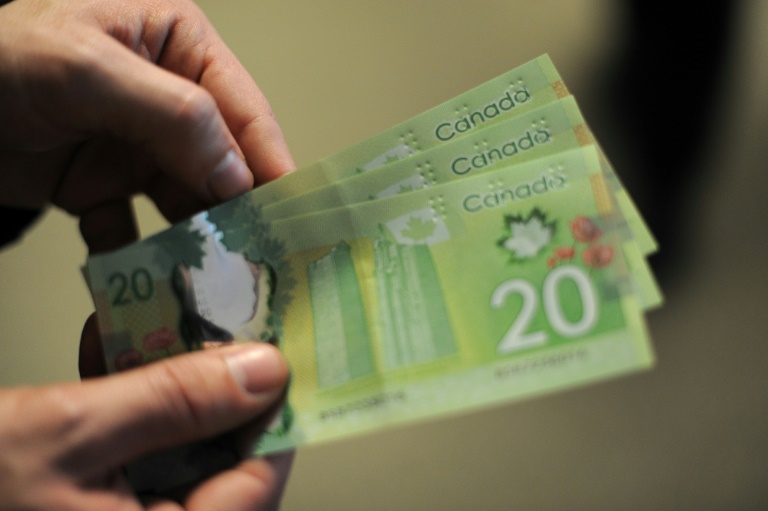
Canada’s central bank on Wednesday hiked its key lending rate by 50 basis points to 4.25 percent, saying its aggressive moves to rein in inflation were working but that the economy was still too hot.

This is the highest interest rate in 15 years, after having started 2022 with a record low of just 0.25 percent.

The Bank of Canada said economic growth was stronger than expected in the third quarter, bolstered by robust commodity exports.

But in a statement hinting that this was likely to be its last rate hike for now, it said “there is growing evidence that tighter monetary policy is restraining domestic demand.”

It pointed to consumption slowing as the year’s end approaches, a pullback in the housing market and other data that suggested “growth will essentially stall through the end of this year and the first half of next year.”

Desjardins analyst Royce Mendes noted that the size of the rate increase was “more hawkish than what was anticipated.”

Most economists had predicted the bank would announce a 25 basis point increase.

The bank, Mendes concluded in a research note, “continued to worry about inflation becoming entrenched and that’s what this rate hike is really about.”

“Policymakers,” he added, “seem a little less sure about what comes next.”

Looking ahead, the bank said its governing council would be “considering whether the policy interest rate needs to rise further to bring supply and demand back into balance and return inflation to target.”

The language was far softer than in previous notices that warned bluntly of more interest rate increases to come.

Analysts said this amounted to “a pivot” in the bank’s position, which was expected to be made clearer at its next meeting in January.

Inflation remained at 6.9 percent in October, with many of the goods and services Canadians regularly buy having increased in price. But it was down from an 8.1 percent peak in June.

Although “price pressures may be losing momentum,” the bank said inflation “is still too high and short-term inflation expectations remain elevated.”

The bank will need to assess whether its seven rate hikes this year have slowed demand as hoped, how supply challenges are resolving, and whether all of this is impacting inflation.

It is mandated to try to keep a lid on inflation — at around 2.0 percent.

Canada central bank hikes key lending rate 50 basis points to 4.25%

Canada’s central bank on Wednesday hiked its key lending rate by 50 basis points to 4.25 percent, saying its aggressive moves to rein in inflation were working but that the economy was still too hot.

The Bank of Canada said economic growth was stronger than expected in the third quarter, bolstered by robust commodity exports.

But in a statement hinting that this was likely to be its last rate hike for now, it said “there is growing evidence that tighter monetary policy is restraining domestic demand.”

It pointed to consumption slowing as the year’s end approaches, a pullback in the housing market and other data that suggested “growth will essentially stall through the end of this year and the first half of next year.”

Looking ahead, the bank said its governing council would be “considering whether the policy interest rate needs to rise further to bring supply and demand back into balance and return inflation to target.”

The language was softer than in previous notices that warned bluntly of more interest rate increases to come.

Inflation remained at 6.9 percent in October, with many of the goods and services Canadians regularly buy having increased in price.

Although “price pressures may be losing momentum,” the bank said inflation “is still too high and short-term inflation expectations remain elevated.”

The bank will need to assess whether its seven rate hikes this year have slowed demand as hoped, how supply challenges are resolving, and whether all of this is impacting inflation.

The bank is mandated to try to keep inflation at about 2.0 percent.

Stocks hesitant as recession fears overshadow China reopening hope

Major stock markets were hit by more selling Wednesday on growing fears that Federal Reserve monetary tightening will tip the US economy into recession.

Drops in Asia and Europe followed steep losses on Wall Street Tuesday after the heads of leading US banks warned of tough times ahead in 2023.

JPMorgan Chase chief Jamie Dimon tipped a “mild to hard recession” and Goldman Sachs’ David Solomon said jobs and pay would be hit, while Morgan Stanley and Bank of America were also uneasy about the outlook.

The comments added to the downbeat mood that has coursed through trading floors at the start of the week, after forecast-beating reports on jobs and the giant US services sector fanned worries the Fed would have to push interest rates higher than hoped.

Markets had been rising healthily after a weaker-than-expected inflation reading for October suggested the almost year-long tightening campaign was finally affecting prices.

“Any hopes that the Fed would turn more dovish in the months ahead have been dashed significantly as the vast US services industry is where sticky inflation hangs out,” said SPI Asset Management’s Stephen Innes.

He added that the latest readings suggest rates would go above five percent before the Fed stops hiking, while several observers have suggested they will not be reduced until 2024.

“It would appear the recovery in stocks — bear-market rally, or otherwise — has run out of steam, and investors are left wondering whether what follows next is another test of the lows or simply a correction of that impressive two-month surge,” said market analyst Craig Erlam at trading platform OANDA.

Major Asian markets ended the day down, while in Europe both Frankfurt and Paris were lower in afternoon trading, but London turned positive after Wall Street opened.

On Wall Street, the S&P 500 and Nasdaq Composite slid at the start of trading, while the Dow was flat. But they quickly pushed higher as bargain-hunters stepped in following days of selling.

– China easing on Covid –

The sombre outlook overshadowed China’s moves to wind back some of its harsh Covid rules that traders hope will kickstart the world’s number two economy, which has been battered this year by months of lockdowns and other containment measures.

In a sign of the impact the zero-Covid strategy has had, data Wednesday showed that imports and exports plunged far more than expected in November.

On Wednesday, officials announced a nationwide loosening of restrictions, including a reduction in mandatory PCR tests and allowing some positive cases to quarantine at home.

But while the country edges back to normality, Zhiwei Zhang, of Pinpoint Asset Management, warned that it would take time.

“The zero-Covid policy has been loosened, but mobility has not recovered much on the national level,” he said. “I expect exports will stay weak in the next few months as China goes through a bumpy reopening process.

“As global demand weakens in 2023, China will have to rely more on domestic demand.”

Other observers said the recent rally fuelled by the reopening may have gone too far and traders were now taking a step back as they contemplate a likely spike in infections in the country.

Oil prices remained stuck at lows not seen for around a year as demand expectations tumble.

Brent on Tuesday sank below $80 for the first time since January, while WTI struck its lowest since December, having plunged from the 14-year highs of around $140 touched in March after Russia invaded Ukraine. 

“The crude demand outlook is getting crushed as we are in a slowdown basically across all the major economies,” said OANDA’s Edward Moya.

“Supplies seem plentiful over the near term and that has everyone hesitating on what was one of the easiest trades of the year.”

– Key figures around 1430 GMT –

London – FTSE 100: FLAT at 7,519.98 points

Frankfurt – DAX: DOWN 0.4 percent at 14,291.81

Paris – CAC 40: DOWN 0.3 percent at 6,666.63

EURO STOXX 50: DOWN 0.3 percent at 3,926.83

New York – Dow: FLAT at 33,594.04

Tokyo – Nikkei 225: DOWN 0.7 percent at 27,686.40 (close)

Hong Kong – Hang Seng Index: DOWN 3.2 percent at 18,814.82 (close)

Shanghai – Composite: DOWN 0.4 percent at 3,199.62 (close)

Euro/dollar: UP at $1.0522 from $1.0470 on Tuesday

Dollar/yen: DOWN at 136.59 yen from 137.04 yen

Pound/dollar: UP at $1.2203 from $1.2133

Euro/pound: DOWN at 86.23 pence from 86.26 pence

Brent North Sea crude: UP 0.7 percent at $79.92 per barrel

West Texas Intermediate: UP 0.4 percent at $74.58 per barrel

burs-rl/rox

Barcelona-Marseille pipeline: an ambitious but risky project

A planned underwater hydrogen pipeline connecting Barcelona and Marseille is a risky project, but one that is key for the European Union’s energy independence.

Here’s what we know about the joint initiative by Madrid, Lisbon and Paris, which will be discussed on Friday on the sidelines of a summit of southern European Union nations in Spain:

– What is it? –

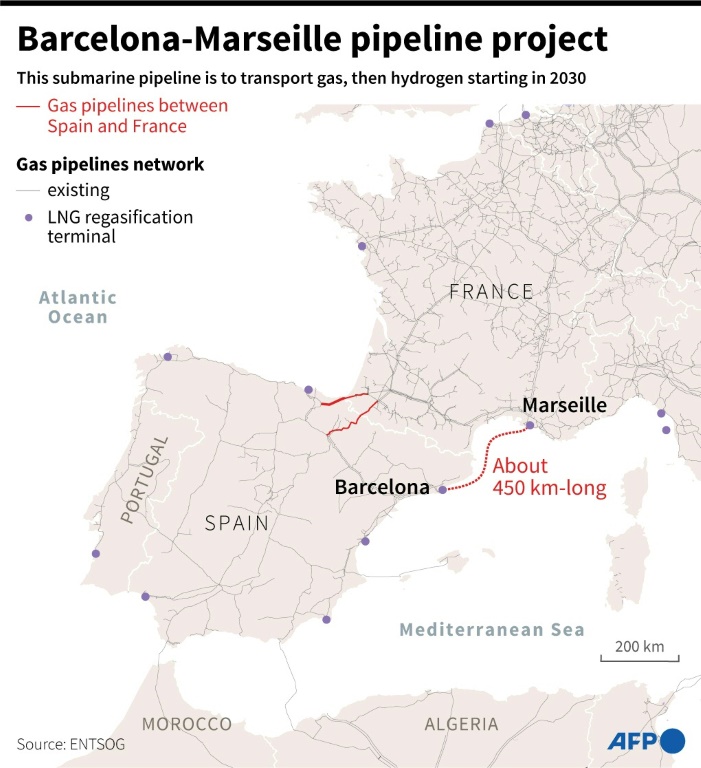
Dubbed “H2Med” or “BarMar” (from Barcelona and Marseille), the pipeline will connect the two ports that both have large oil and gas terminals, initially as a conduit for natural gas and later for green hydrogen, between Spain, France and the rest of Europe.

Announced at an EU summit in October, it offers an alternative to the defunct MidCat pipeline project launched in 2003 to carry gas across the Pyrenees from Spain to France that was eventually abandoned over profitability issues and objections from Paris and environmentalists.

– What are its goals? –

The pipeline aims to reduce Europe’s dependence on Russian energy by improving gas interconnections between the Iberian Peninsula and its neighbours.

Spain and Portugal account for 40 percent of Europe’s capacity to turn liquefied natural gas (LNG) that arrives in tankers back into gas form, but they are poorly connected to the rest of Europe.

The pipeline will also boost the decarbonisation of European industry, giving it access to clean energy on a large scale which Spain and Portugal hope to produce.

The two nations aim to become world leaders in green hydrogen thanks to their numerous wind and solar power farms.

– Why Barcelona and Marseille? –

According to the project’s backers, it is “the most direct and efficient way of linking the peninsula with central Europe”.

Barcelona “has one of the largest re-gasification plants in Europe” and occupies “a central place in Spain’s gas network,” said Jose Ignacio Linares, a professor at Madrid’s Pontificia Comillas University.

Marseille is also a key point in the French network and a gateway to the Rhone Valley, northern Italy and Germany — industrial regions that could become big consumers of green hydrogen.

– What route will it take? –

The route has not yet been decided, but “the most logical” option would be to run close to the shore to avoid deep waters, Linares told AFP.

If that’s the case, H2Med would extend some 450 kilometres (280 miles).

– When will it be ready? –

French Energy Minister Agnes Pannier-Runacher told Spain’s El Pais daily the pipeline could come online in 2030, while her Spanish counterpart Teresa Ribera said it could enter service in “five, six or seven years”.

– How much will it cost? –

The cost of the project has not been revealed. But the European Hydrogen Backbone (EHB), that groups European energy pipeline operators, estimates a two-billion-euro ($2.1-billion) price tag.

Madrid, Paris and Lisbon hope much of the project will be covered by EU funds.

– What are the obstacles? –

“An offshore hydrogen pipeline at this depth and distance has never been done before,” said Gonzalo Escribano, an energy expert at Madrid’s Real Instituto Elcano think tank. 

The innovative project faces certain technical challenges. 

One of the main problems is that hydrogen is made up of small molecules which can escape through the joints and cause corrosion, said Linares, an engineer by training.

But such problems could be overcome by “installing a membrane inside (the pipeline), a kind of plastic that prevents the hydrogen from escaping,” he said.

– What’s the outlook? –

The biggest risk is its economic viability, experts say.

“It is not clear when the green hydrogen market is going to take off and whether Spain will be in a position to produce enough to export it,” said Escribano.

But Linares said its construction would take so long “that we can’t afford to wait”. 

“If we do, we’ll end up with a huge volume of hydrogen that we won’t be able to export.”

Close Bitnami banner
Bitnami