US Business

South African GDP rebounds to scale new peak

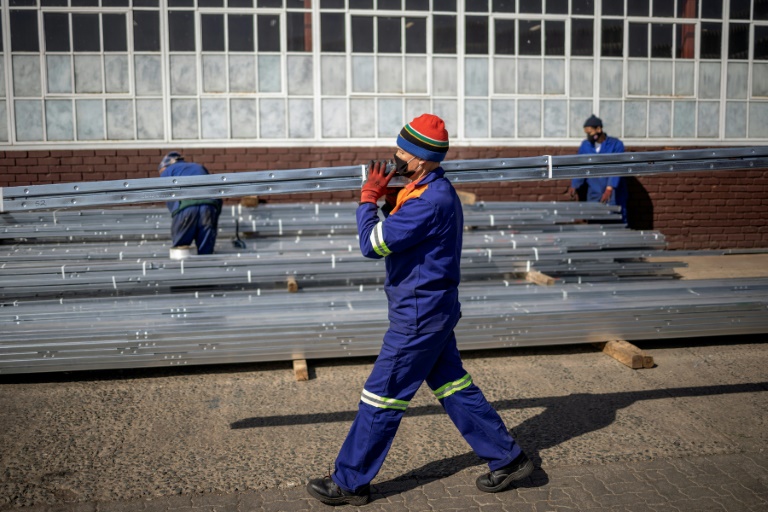
South Africa’s economy rebounded beyond pre-Covid levels in the third quarter of 2022 to reach its highest-ever peak, official data showed Tuesday.

Gross domestic product (GDP) expanded by 1.6 percent in the three months to September, following a 0.7 dip in the previous trimester, StatsSA said. 

“The size of the economy now exceeds pre-pandemic levels,” the official statistics agency said in a statement.

“Quarterly real GDP is now the highest it’s ever been, exceeding the previous peak of 1,152 billion (rand) ($66 billion) recorded in the fourth quarter of 2018.”

Agriculture, finance, transport and manufacturing were the main drivers, with demand benefiting from a rise in exports and government consumption, it said.

Africa’s most industrialised economy was badly hit by the Covid-19 pandemic, which amplified joblessness, poverty and inequality.

Economic growth was braked for about two years.

GDP returned to its pre-pandemic size only in the first quarter of 2022, on the back of six months of modest growth.

But some of those gains were lost in the second quarter, when economic activity was hit by floods in the southeastern KwaZulu-Natal province and power cuts caused by a prolonged energy crisis.

Biden celebrates giant semiconductor project

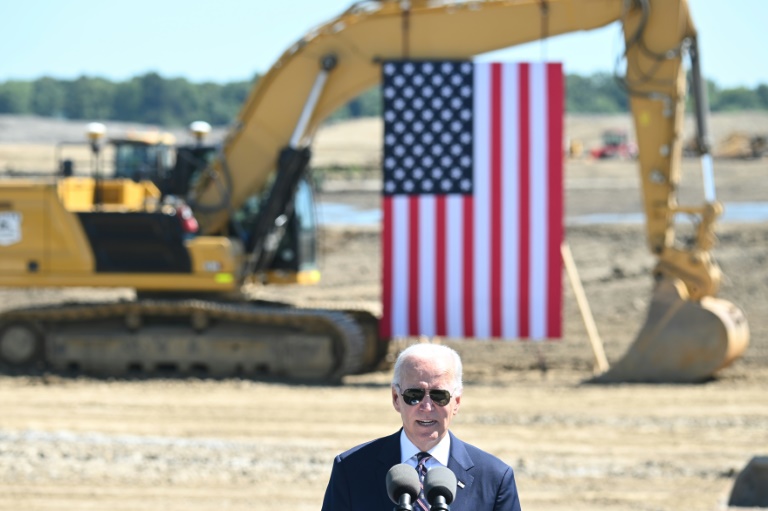
President Joe Biden flies Tuesday to Arizona to celebrate the mammoth expansion of a Taiwanese semiconductor plant, citing the project as proof that the United States is finally breaking dangerous dependency on foreign manufacturers for the vital component.

The White House announced that TSMC is unveiling plans to build a second facility in Phoenix by 2026, ballooning its investment from $12 billion to $40 billion.

The “major milestone” adds up to “the largest foreign direct investment in Arizona history and it’s one of the largest in US history,” White House National Economic Council Director Brian Deese told reporters.

Biden will speak at the TSMC site, accompanied by senior political figures and titans of the corporate world, including Apple CEO Tim Cook, TSMC’s founder Morris Chang and Micron CEO Sanjay Mehrotra.

The Democrat will seek to take credit for the investment influx, pointing to the effect of his signature CHIPS Act, which sets aside almost $53 billion for subsidies and research in the semiconductors sector. It’s a message he’ll be especially keen to spread in Arizona, which was long a Republican dominated state but has turned into a battleground where Democrats do increasingly well.

The plant expansion — which comes on top of other significant microchip manufacturing projects dotted around the country — is part of an overall strategy by the Biden administration to try to end reliance on foreign suppliers.

Although much of that supply comes from reliable US allies, particularly Taiwan, the Covid pandemic shutdown demonstrated how fragile those supply lines were in case of emergency. With China threatening to take control of Taiwan — and eyeing how to ensure its own semiconductor supplies — Washington wants to bring the vital gadgets home.

“Virtually every large tech firm, including automotive firms and any company that uses technology is sweating bullets that something’s going to happen between Taiwan and China. And so there’s a massive rush to shift manufacturing out of both countries,” technology analyst Rob Enderle said.

– Smaller the better –

In the high-stakes world of microchips, sheer quantity is important. The miniscule, hard-to-make gadgets are at the heart of almost every modern appliance, vehicle and advanced weapon.

But quality — and small size — is also increasingly important for sophisticated everyday devices like smartphones and there the White House says it has good news.

The new TSMC plant will produce tiny 3 nanometer chips, while the existing facility will start reducing the size of its current 5 nanometer chips to 4 nanometers.

Building a plant, or a “fab,” takes several years. But once “at scale, these two fabs could meet the entire US demand for advanced chips when they’re completed. That’s the definition of supply chain resilience,” Ronnie Chatterji, National Economic Council deputy director for industrial policy, told reporters.

Deese, one of Biden’s most senior advisors, said the broader message from the White House is that US industrial strategy is undergoing a rebirth.

For almost four decades, the idea was “trickle down,” where government would “get out the way” and cut taxes for big companies to attract investment, he said.

Instead, Biden’s policy — both through the CHIPS Act and the giant Inflation Reduction Act — uses public money to attract, or “crowd in” private investment.

The goal is not to exclude “private companies, but in fact, encouraging private investment at historic scale,” Deese said.

Biden celebrates giant semiconductor project

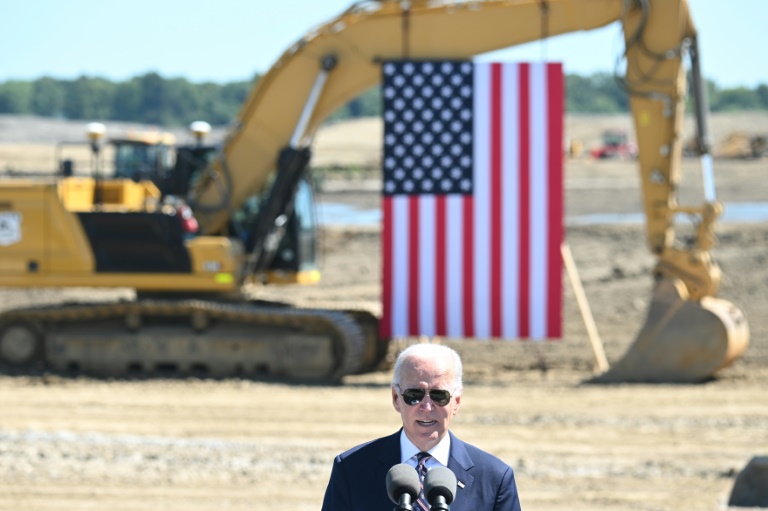
President Joe Biden flies Tuesday to Arizona to celebrate the mammoth expansion of a Taiwanese semiconductor plant, citing the project as proof that the United States is finally breaking dangerous dependency on foreign manufacturers for the vital component.

The White House announced that TSMC is unveiling plans to build a second facility in Phoenix by 2026, ballooning its investment from $12 billion to $40 billion.

The “major milestone” adds up to “the largest foreign direct investment in Arizona history and it’s one of the largest in US history,” White House National Economic Council Director Brian Deese told reporters.

Biden will speak at the TSMC site, accompanied by senior political figures and titans of the corporate world, including Apple CEO Tim Cook, TSMC’s founder Morris Chang and Micron CEO Sanjay Mehrotra.

The Democrat will seek to take credit for the investment influx, pointing to the effect of his signature CHIPS Act, which sets aside almost $53 billion for subsidies and research in the semiconductors sector. It’s a message he’ll be especially keen to spread in Arizona, which was long a Republican dominated state but has turned into a battleground where Democrats do increasingly well.

The plant expansion — which comes on top of other significant microchip manufacturing projects dotted around the country — is part of an overall strategy by the Biden administration to try to end reliance on foreign suppliers.

Although much of that supply comes from reliable US allies, particularly Taiwan, the Covid pandemic shutdown demonstrated how fragile those supply lines were in case of emergency. With China threatening to take control of Taiwan — and eyeing how to ensure its own semiconductor supplies — Washington wants to bring the vital gadgets home.

“Virtually every large tech firm, including automotive firms and any company that uses technology is sweating bullets that something’s going to happen between Taiwan and China. And so there’s a massive rush to shift manufacturing out of both countries,” technology analyst Rob Enderle said.

– Smaller the better –

In the high-stakes world of microchips, sheer quantity is important. The miniscule, hard-to-make gadgets are at the heart of almost every modern appliance, vehicle and advanced weapon.

But quality — and small size — is also increasingly important for sophisticated everyday devices like smartphones and there the White House says it has good news.

The new TSMC plant will produce tiny 3 nanometer chips, while the existing facility will start reducing the size of its current 5 nanometer chips to 4 nanometers.

Building a plant, or a “fab,” takes several years. But once “at scale, these two fabs could meet the entire US demand for advanced chips when they’re completed. That’s the definition of supply chain resilience,” Ronnie Chatterji, National Economic Council deputy director for industrial policy, told reporters.

Deese, one of Biden’s most senior advisors, said the broader message from the White House is that US industrial strategy is undergoing a rebirth.

For almost four decades, the idea was “trickle down,” where government would “get out the way” and cut taxes for big companies to attract investment, he said.

Instead, Biden’s policy — both through the CHIPS Act and the giant Inflation Reduction Act — uses public money to attract, or “crowd in” private investment.

The goal is not to exclude “private companies, but in fact, encouraging private investment at historic scale,” Deese said.

Al Jazeera submits slain journalist's case to ICC

TV network Al Jazeera submitted the case of slain journalist Shireen Abu Akleh to the International Criminal Court on Tuesday, saying she was killed by Israeli forces.

The Qatar-based channel said it had “unearthed new evidence” on the death of the Palestinian-American, shot while covering an Israel army raid in Jenin on May 11.

Any person or group can file a complaint to the ICC prosecutor for investigation, but the Hague-based court is under no obligation to take on such cases.

Al Jazeera said its submission highlighted “new witness evidence and video footage (that) clearly show that Shireen and her colleagues were directly fired at by the Israeli Occupation Forces.”

“The claim by the Israeli authorities that Shireen was killed by mistake in an exchange of fire is completely unfounded,” the channel said.

An AFP journalist saw a lawyer representing Al Jazeera’s case entering the ICC’s headquarters to hand over their submission.

The ICC last year launched a probe into war crimes in the Palestinian territories, but Israel is not an ICC member and disputes the court’s jurisdiction.

Israel said it would not cooperate with any external probe into Abu Akleh’s death.

“No one will investigate IDF (Israeli military) soldiers and no one will preach to us about morals in warfare, certainly not Al Jazeera,” Israeli Prime Minister Yair Lapid said in a statement.

The Israeli army conceded on September 5 that one of its soldiers had likely shot Abu Akleh after mistaking her for a militant. 

The veteran reporter, who was a Christian, was wearing a bulletproof vest marked “Press” and a helmet when she was shot in the head in the Jenin refugee camp, a historic flashpoint in the Israeli-Palestinian conflict.

After receiving complaints from individuals or groups, the ICC prosecutor decides independently what cases to submit to judges at the court.

Judges decide whether to allow a preliminary investigation by the prosecutor, which can then be followed by a formal investigation, and if warranted, charges. 

In the majority of cases such complaints do not lead to investigations, according to the ICC.

EU agrees ban on imports driving deforestation

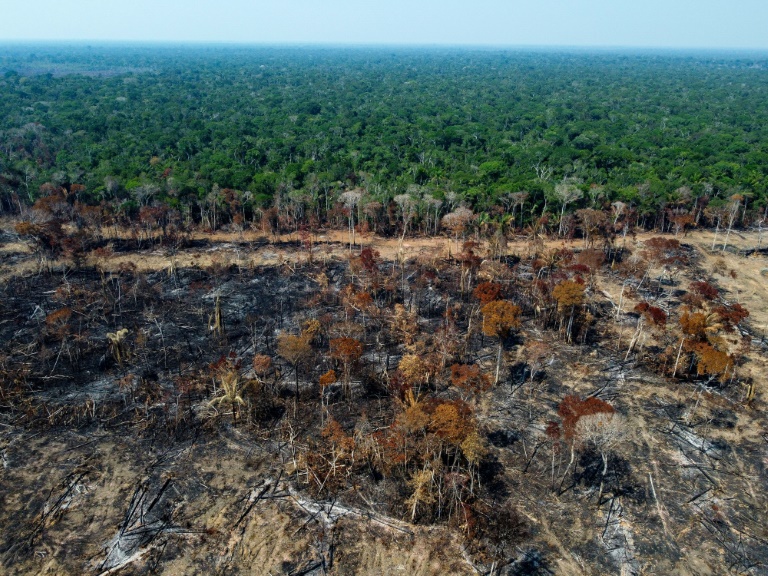
The European Union reached an agreement Tuesday to ban the import of products including coffee, cocoa and soy in cases where they are deemed to contribute to deforestation.

The draft law, which aims to ensure “deforestation-free supply chains” for the 27-nation EU, was hailed by environmental groups as “groundbreaking”.

It requires companies importing into the EU to guarantee products are not produced on land that suffered deforestation after December 31, 2020, and that they comply with all laws of the source country.

The scope encompasses palm oil, cattle, soy, coffee, cocoa, timber and rubber as well as derived products such as beef, furniture and chocolate.

Illegal production has spurred massive deforestation in countries such as Brazil, Indonesia,  Malaysia, Nigeria, the Democratic Republic of Congo, Ethiopia, Mexico and Guatemala.

The United Nations’ Food and Agriculture Organization estimates that an aggregate area of land bigger than the European Union, or some 420 million hectares (more than one billion acres), has been deforested around the world over the past three decades.

The European Union is the second-biggest market for consumption of the targeted products after China. 

Pascal Canfin, chairman of the European Parliament’s environment committee, hailed the agreement, and how its impact would feed through to everyday items Europeans consume.

“It’s the coffee we have for breakfast, the chocolate we eat, the coal in our barbecues, the paper in our books. This is radical,” he said.

– ‘Historic’ –

The environmental lobby group Greenpeace called the draft law, agreed between the European Parliament and EU member states, “a major breakthrough”.  

Another, WWF, called it “groundbreaking” and “historic”.

“This regulation is the first in the world to tackle global deforestation and will significantly reduce the EU’s footprint on nature,” the WWF said in a statement.

Both groups called on the EU to go further, by expanding the scope of the law to include savannahs, such as Brazil’s Cerrado, which are also under threat by encroaching ranchers and farmers.

Greenpeace noted that financial institutions extending services to importing companies would not initially come under the new law, but that they would come under review two years later.

Both the European Council — representing the EU countries — and the European Parliament now have to officially adopt the agreed law. Big companies would have 18 months to comply, while smaller ones would get a longer grace period.

“The new law will ensure that a set of key goods placed on the (European Union) market will no longer contribute to deforestation and forest degradation in the EU and elsewhere in the world,” the European Commission said in a statement. 

“The battle for climate and biodiversity is accelerating,” French President Emmanuel Macron tweeted.

– Big fines –

The parliament said in a statement that the law opened the way for technology such as satellite monitoring and DNA analysis to verify the provenance of targeted imports.

High-risk exporting countries would have nine percent of products sent to the EU checked, while lower-risk ones would have lower proportions scrutinised.

Companies found violating the law could be fined up to four percent of annual turnover in the EU.

The legislation would be reviewed one year after coming into force, to see whether it should be extended to other wooded land.

Another review at the two-year mark would have the commission considering whether to expand it to cover other ecosystems and commodities, as well as financial institutions.

Philippine lawmakers propose $4.9 bn sovereign wealth fund chaired by Marcos

Philippine lawmakers have proposed a $4.9 billion sovereign wealth fund to be chaired by President Ferdinand Marcos Jr to boost growth, but critics warn it will be prone to graft and risk Filipino pensions.

Congressmen Sandro Marcos and Martin Romualdez — the president’s son and cousin respectively — are among the six authors of the bill filed to the House of Representatives and will be examined by several committees before being debated in the house.

The “Maharlika Investments Fund” (MIF) would be seeded with 275 billion pesos from government financial institutions, including two pension funds and two banks, according to the latest version of the bill.

It would help the Marcos administration achieve its goals of getting the Philippine economy to “soar to greater heights in spite of external shocks”, the authors wrote.

The word “maharlika” is widely associated with Marcos Jr’s late dictator father and namesake, who presided over widespread human rights abuses and corruption during his two decades in power. He was ousted in 1986.

Marcos Sr claimed to have led an anti-Japanese guerrilla unit called Ang Mga Maharlika during World War II, but he has been accused of lying about his war record.

The MIF has been met with concern from business groups, economists, activists and opposition figures, who have questioned the need for a sovereign wealth fund in the debt-laden country.

They argue pension funds were already being invested and that diverting them to the MIF would expose them to additional risk.

Even the president’s own sister, Senator Imee Marcos, said it was “risky to gamble” retirement funds.

“We all know about our neighbour Malaysia where their 1MDB was a real disaster where the money was looted,” she said, referring to the graft scandal that involved billions of dollars of state funds.

A lack of safeguards also meant “the potential for corruption is almost limitless”, Vincent Lazatin, former executive director of the Transparency and Accountability Network, told AFP Tuesday.

– ‘A lot of questions’ – 

The bill’s proponents highlighted Indonesia as an example of a sovereign wealth fund successfully being used to attract direct investments into infrastructure and emerging industries.

But Natixis senior economist Trinh Nguyen said Indonesia’s fund has a “very clear” investment objective, while the Philippine proposal “lacks a direction”.

“There are a lot of questions… How is it going to benefit the longer-term development objective of the Philippines because it’s not very clear to me that it would,” she said.

Under the proposed bill, MIF funds would be “exempt from any regulatory restrictions”.

Investment options would include financial derivatives, equities, infrastructure projects and “other investments as may be approved by the Board”.

Congressman Joey Salceda, who leads the technical working group examining the bill, told AFP the fund’s governing board would be chaired by the president.

Former president Gloria Arroyo, who has backed the bill, said it was a “powerful statement that the highest official of the land will hold himself as ultimately accountable to the Filipino people for the performance of the Fund”.

But Lazatin noted that the country had a dismal record of punishing elected officials for corruption. 

“Our laws are good on paper, but in practice… we have not been able to hold public officials accountable,” he said.

An estimated $10 billion was stolen from state coffers over the course of Marcos Sr’s rule, while the family has been accused of owing more than $3.6 billion in estate taxes.

No one in the clan has been jailed.

Warmer noses are better at fighting colds: study

Chilly weather and common respiratory infections often go hand in hand.

Reasons for this include people gather inside more in winter, and viruses survive better in low-humidity indoor air. But there has been less certainty about whether lower temperatures actually impair human immunity and, if so, how.

Now, a new study published Tuesday in The Journal of Allergy and Clinical Immunology details a previously unknown way that the immune system attacks viral intruders inside the nose — and finds it works better when it’s warm.

These discoveries could pave the way for an eventual treatment against the common cold and other viruses, Mansoor Amiji, a pharmaceutical sciences professor at Northeastern University, who co-led the research, told AFP.

The starting point was previous research by Amiji and colleagues in 2018, which found that nasal cells released “extracellular vesicles” (EVs) —- a spray of tiny sacs that swarmed and destroyed bacteria upon inhalation.

“The best analogy that we have is a hornet’s nest,” said Amiji. Like hornets defending a nest from attack, EVs swarm, bind to, and kill invaders.

For the new research, the team set out to answer two questions: are EVs also secreted in the nose in the presence of viral infections? And, if they are, is the strength of their response linked to temperature?

To answer the first question, they used a test substance which mimics a viral infection to stimulate nasal mucosa  — a thin tissue that lines the nose — that was taken from volunteers who had surgery to remove polyps.

They found it did in fact produce EVs that target viruses.

In order to tackle the second question, they divided the nasal cell samples into two groups and cultured them in a lab, subjecting one set of samples to 37 degrees Celsius, and the other to 32C.

These temperatures were chosen based on a separate test that found the temperature inside the nose falls by about 5C when outside air drops from 23C to 4C.

Under regular body heat conditions, the EVs were successfully able to fight off viruses, by presenting them with “decoy” targets that they latch on to instead of the receptors they would otherwise target on cells. 

But under the reduced temperatures, fewer EVs were produced, and those that were made packed less punch against the invaders tested: two rhinoviruses and a non-Covid coronavirus, which are typically found in winter cold season.

“There’s never been a convincing reason why you have this very clear increase in viral infectivity in the cold months,” said co-author Benjamin Bleier, a surgeon at Harvard Medical School and Massachusetts Eye and Ear, in a statement.

“This is the first quantitative and biologically plausible explanation that has been developed.”

One of the most exciting aspects of the work is the potential to rev up the body’s natural production of virus-targeting EVs in order to fight or even fend off the cold — or even the flu and Covid, said Amiji.

“That’s an area of great interest for us and we certainly continue to pursue that,” he said.

Asian, European markets drop as Fed worries offset China Covid easing

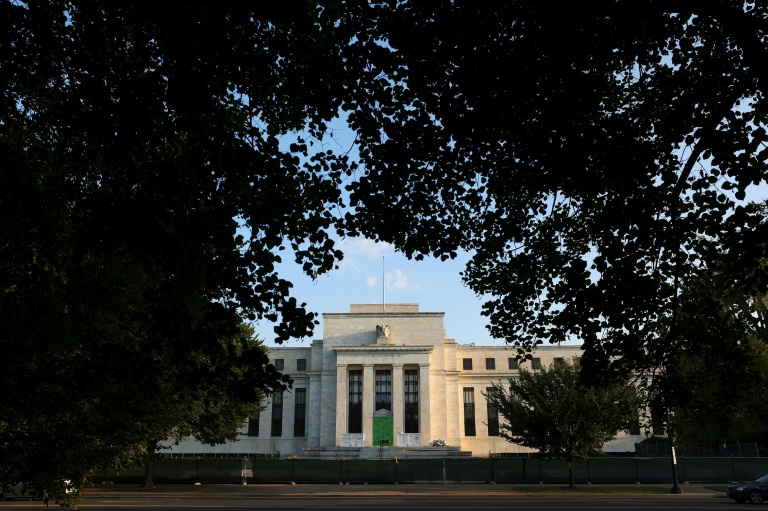
Most Asian and European markets fell Tuesday and the dollar rose as fresh fears that the US Federal Reserve will push interest rates higher than hoped overshadowed growing optimism over China’s economic reopening.

After a strong start to the week in Asia, traders tracked a big drop on Wall Street that came on the back of data showing a forecast-busting jump in activity in the US services sector last month.

The news — combined with Friday’s bigger-than-expected print on November jobs and wage increases — dented optimism that the Fed’s monetary tightening campaign was finally paying off, which would give it room to take a less hawkish approach into the new year.

Markets had been running higher ahead of the jobs figures after a surprise drop in inflation and comments from Fed boss Jerome Powell that the bank would likely raise rates at a slower pace.

“Outstanding news from the vast services-based US economy is devastating for market participants keen to see evidence of the US economic disintegration,” said SPI Asset Management’s Stephen Innes.

“Coming as it did on the heels of Friday’s jobs report, which indicated that the rumours of the US economic demise were greatly exaggerated, the market immediately moved into ‘good news is bad’ mode, which saw investors ride roughshod over the dovish pivot camp.”

Bets have increased on borrowing costs going higher than five percent next year — from the current 3.75 to 4.0 percent — before the bank pauses, with no cuts seen until 2024.

All three main indexes on Wall Street lost more than one percent and Asia struggled to maintain its recent momentum.

Hong Kong dropped after soaring around 15 percent over the past week on China’s easing of strict Covid containment measures.

Sydney, Seoul, Singapore, Wellington, Mumbai, Bangkok, Taipei and Jakarta were also in the red.

Shanghai was barely moved while Tokyo rose. Manila was up more than three percent as banks were boosted by a forecast-beating jump in inflation that ramped up expectations for a hike in interest rates.

London, Paris and Frankfurt all slipped at the open.

The dollar extended most of the gains made Monday after the services data release. The Australian dollar was among the biggest losers after the country’s central bank lifted interest rates to a decade high but by less than expected.

The mood in Asia remains largely positive owing to the prospect of China rolling back some of the harsh measures that have been in place for almost three years and have hammered the giant economy.

But analysts said the country would not likely see a complete end to the zero-Covid policy for several months.

Oil prices climbed Tuesday, having dropped heavily the two previous days, on expectations that a reopening will boost demand in the world’s biggest importer of the commodity.

– Key figures around 0820 GMT –

Tokyo – Nikkei 225: UP 0.2 percent at 27,885.87 (close)

Hong Kong – Hang Seng Index: DOWN 0.4 percent at 19,441.18 (close)

Shanghai – Composite: FLAT at 3,212.53 (close)

London – FTSE 100: DOWN 0.1 percent at 7,562.19

Euro/dollar: DOWN at $1.0490 from $1.0495 on Monday

Dollar/yen: UP at 136.90 yen from 136.78 yen

Pound/dollar: UP at $1.2200 from $1.2186

Euro/pound: DOWN at 85.99 pence from 86.06 pence

West Texas Intermediate: UP 0.8 percent at $77.53 per barrel

Brent North Sea crude: UP 0.9 percent at $83.44 per barrel

New York – Dow: DOWN 1.4 percent at 33,947.10 (close)

Philippine lawmakers propose $4.9 bn sovereign wealth fund chaired by Marcos

Philippine lawmakers have proposed a $4.9 billion sovereign wealth fund to be chaired by President Ferdinand Marcos Jr to boost growth, but critics warn it will be prone to graft and risk Filipino pensions.

Congressmen Sandro Marcos and Martin Romualdez — the president’s son and cousin respectively — are among the six authors of the bill filed to the House of Representatives and will be examined by two committees before being debated in the house.

The “Maharlika Investments Fund” (MIF) would be seeded with 275 billion pesos from government financial institutions, including two pension funds and two banks, according to the latest version of the bill.

It would help the Marcos administration achieve its goals of getting the Philippine economy to “soar to greater heights in spite of external shocks”, the authors wrote.

The word “maharlika” is widely associated with Marcos Jr’s late dictator father, who presided over widespread human rights abuses and corruption during his two decades in power. He was ousted in 1986.

Marcos Sr claimed to have led an anti-Japanese guerrilla unit called Ang Mga Maharlika during World War II, but he has been accused of lying about his war record.

The MIF has been met with concern from business groups, economists, activists and opposition figures, who argue pension funds were already being invested and that diverting them to a sovereign wealth fund would expose them to additional risk.

Even the president’s own sister, Senator Imee Marcos, said it was “risky to gamble” retirement funds.

“We all know about our neighbour Malaysia where their 1MDB was a real disaster where the money was looted,” she said, referring to the graft scandal that involved billions of dollars of state funds.

The lack of safeguards also meant “the potential for corruption is almost limitless”, Vincent Lazatin, former executive director of the Transparency and Accountability Network, told AFP Tuesday.

Under the proposed bill, MIF funds would be “exempt from any regulatory restrictions”.

Investment options would include financial derivatives, equities and “other investments as may be approved by the Board”.

Congressman Joey Salceda, who leads the technical working group examining the bill, told AFP the fund’s governing board would be chaired by the president.

Former president Gloria Arroyo, who has backed the bill, said that was a “powerful statement that the highest official of the land will hold himself as ultimately accountable to the Filipino people for the performance of the Fund”. 

Ukraine races to restore power grid after Russia strikes

Ukraine worked to restore power on Tuesday after Russia’s latest wave of missile strikes caused power disruptions across the country, right as winter frost builds and temperatures plunge.

Out of the 70 missiles launched by Moscow, “most” were shot down, President Volodymyr Zelensky said, but the barrage still hit Ukraine’s already battered infrastructure. 

Fresh power cuts were announced in all regions “due to the consequences of shelling,” national electricity provider Ukrenergo said on Telegram.

The head of Ukrenergo said he had “no doubt that Russian military consulted with Russian power engineers during this attack”, judging by where the missiles landed. 

“The time that Russians chose for this attack was connected with their desire to inflict as much damage as possible,” Volodymyr Kudrytskyi told a Ukrainian news programme, explaining the attacks were launched as the country enters a “peak frost” period.

“Our repairmen will be working on the energy system restoration.”

Nearly half of Ukraine’s energy system has already been damaged after months of strikes on power infrastructure, leaving people in the cold and dark for hours at a time as outdoor temperatures drop below zero degrees Celsius (32 degrees Fahrenheit).

As missiles rained down on Kyiv, UN rights chief Volker Turk — who arrived over the weekend on a four-day visit — had to move his meetings with activists into an underground shelter. 

Zelensky announced in his nightly address that four were killed in Russia’s strikes.

But “our people never give up,” the president said in a video statement. 

Across the border in Russia’s Kursk region on Tuesday, an airfield saw a “drone attack”, said local governor Roman Starovoyt, without specifying where the drone originated. 

“As a result of a drone attack in the area of the Kursk airfield, an oil storage tank caught fire,” he said on social media, adding that there were no casualties. 

Tuesday’s incident comes a day after Moscow accused its neighbour of carrying out deadly drone strikes on two other airfields.

Russia also confirmed a “massive attack on Ukrainian military command systems and related defence, communications, energy and military facilities”.

– Moscow vows to keep fighting –

The latest violence comes just after Russia shrugged off a Western-imposed price cap on its oil exports, warning the move would not impact its military campaign in Ukraine.

The $60-per-barrel cap agreed by the European Union, G7 and Australia aims to restrict Russia’s revenue while making sure Moscow keeps supplying the global market.

“Russia’s economy has all the necessary potential to fully meet the needs and requirements of the special military operation,” Kremlin spokesman Dmitry Peskov told reporters, using Moscow’s term for its Ukraine offensive.

“These measures will not affect this,” he said.

Russia “will not recognise” the measures, which amounted to “a step towards destabilising the global energy markets”, he added.

The market price of a barrel of Russian Urals crude is currently around $65 dollars, just slightly higher than the $60 cap — suggesting the measure may have only a limited impact in the short term.

The cap is the latest in a number of measures spearheaded by Western countries and introduced against Russia — the world’s second-largest crude oil exporter — after Moscow sent troops into Ukraine over nine months ago.

It comes on top of an EU embargo on seaborne deliveries of Russian crude oil that came into force on Monday.

The embargo will prevent maritime shipments of Russian crude to the European Union, which account for two-thirds of the bloc’s oil imports from Russia, potentially depriving Moscow of billions of euros.

Kyiv had initially welcomed the price ceiling, but later said it would not do enough damage to Russia’s economy. 

Meanwhile, Russian state media released footage of President Vladimir Putin driving a Mercedes car across the Crimea bridge — the closest the 70-year-old leader has come to the frontline in Ukraine.

The bridge connects the annexed peninsula to the Russian mainland, and was damaged in a blast in October.

– ‘Impossible to prepare’ –

The G7 nations — Britain, Canada, France, Germany, Italy, Japan and the United States — along with Australia have said they are prepared to adjust the price ceiling of oil if necessary.

In recent months, gas prices have skyrocketed since Moscow halted deliveries to the EU in suspected retaliation for Western sanctions and the bloc struggled to find alternative energy suppliers.

In the Ukrainian town of Borodianka, outside Kyiv, where snow has already coated the ground, locals recently gathered around wood-fired stoves inside tents to keep warm and cook food during the blackouts. 

“We are totally dependent on electricity… One day we had no electricity for 16 hours,” Irina, who had come to the tent with her child, told AFP. 

Volunteer Oleg said it was hard to say how Ukraine would manage in the coming winter months. 

“It is impossible to prepare for this winter because no one has lived in these conditions before,” he said. 

Close Bitnami banner
Bitnami