US Business

German inflation unexpectedly slows in November

German inflation unexpectedly slowed in November after months of increases, preliminary data showed Tuesday, as sky-high energy prices begin to ease.

The inflation rate in Europe’s top economy fell back to 10 percent this month, federal statistics agency Destatis said, after hitting a record high of 10.4 percent in October.

Analysts surveyed by Factset had expected an acceleration of 10.5 percent in November.

The surprise dip comes as “energy prices have eased slightly”, Destatis said, although it noted they were still 38.4 percent higher than a year earlier.

As in other countries across Europe, Germany’s recent consumer price hikes have been fuelled by soaring food and energy costs in the wake of Russia’s war in Ukraine.

The German government has unveiled a 200-billion-euro ($207-billion) energy fund to shield households and businesses from price shocks, and has raced to diversify supplies after Russia cut gas deliveries.

Tuesday’s inflation data offered a “very small breather” for a country bracing for a difficult winter, said ING bank economist Carsten Brzeski. 

But he cautioned it was too soon to hope inflation was on a downhill path.

“The pass-through of higher wholesale gas prices is still in full swing. Many households will see the first price increase only as of January 1,” he said.

European Central Bank President Christine Lagarde echoed that sentiment Monday, when she said the eurozone had not yet reached peak inflation.

Like other central banks around the world the ECB has moved aggressively to curb red-hot inflation, lifting its key interest rates by two percentage points since July.

Lagarde has repeatedly said the bank would continue to raise rates in its battle to bring inflation back to its two-percent target.

The next rate hike is expected at the ECB’s upcoming December 15 meeting.

China's nuclear arsenal to more than triple by 2035: Pentagon

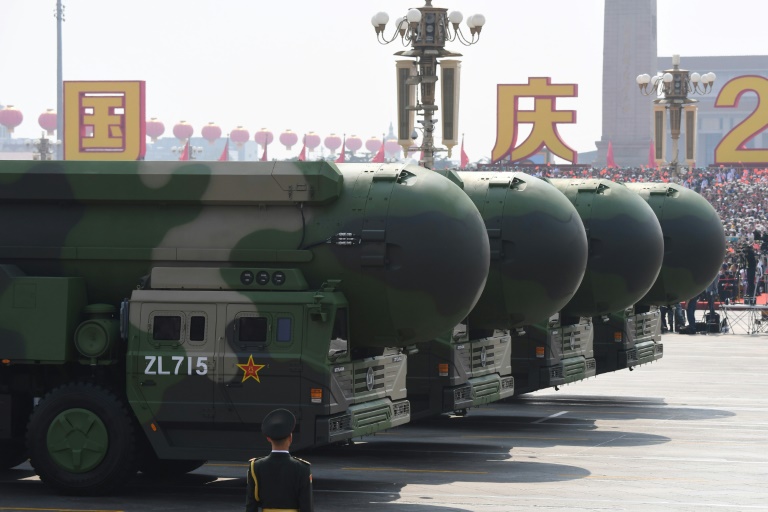
China’s nuclear arsenal is likely to more than triple to 1,500 warheads by 2035, the Pentagon said in a Tuesday report that also highlighted the increasing sophistication of the country’s air force.

Washington has identified Beijing as the most consequential challenge to the United States, and the annual report on China’s military emphasized improvements to both its nuclear and conventional forces.

“The Department of Defense estimates that (China’s) operational nuclear warheads stockpile has surpassed 400,” the report said. “If China continues the pace of its nuclear expansion, it will likely field a stockpile of about 1,500 warheads” by 2035.

That figure would still however lag far behind the arsenals of the United States and Russia, which each include several thousand nuclear warheads.

China “probably intends to develop new nuclear warheads and delivery platforms that at least equal the effectiveness, reliability and/or survivability” of those under development by the United States and Russia, the report said.

Pentagon Press Secretary Brigadier General Pat Ryder said Tuesday that an increased Chinese nuclear arsenal would be a source of instability.

“The more proliferation there is, the more concerning it is, the more destabilizing to the region it is,” Ryder told journalists.

The report also said Beijing is working to modernize its ballistic missile arsenal, launching some 135 in testing during 2021 — “more than the rest of the world combined,” excluding those fired in conflicts.

China is “developing new intercontinental ballistic missiles (ICBMs) that will significantly improve its nuclear-capable missile forces,” the report said.

And Beijing’s air force — the third-largest in the world with more than 2,800 aircraft — is making strides.

– ‘New normal’ –

It is “rapidly catching up to Western air forces and continues to modernize with the delivery of domestically built aircraft and a wide range of UAVs,” according to the report.

“This trend is gradually eroding longstanding and significant US military technical advantages… in the air domain.”

A senior US defense official, speaking before the report’s release, said the Chinese air force is “trying to… progress rapidly on all fronts,” including on the equipment it operates as well as its pilots and other personnel.

The report takes aim at the way in which China is employing its military in the Asia-Pacific region, saying it has “adopted more coercive and aggressive actions.”

“Throughout 2021 and into 2022, (Chinese) vessels and aircraft have exhibited a sharp increase in unsafe and unprofessional behavior,” risking “a major incident or accident,” the report said — an issue US Defense Secretary Lloyd Austin raised in a recent meeting with his Chinese counterpart Wei Fenghe.

China’s military “increased provocative and destabilizing actions” during 2021 around Taiwan, the self-governing democratic island Beijing claims as its own.

Beijing lashes out at any diplomatic action that might lend Taiwan legitimacy, and responded to an August 2022 visit by US House Speaker Nancy Pelosi by holding its largest and most aggressive exercises around the island since the 1990s.

Both sides have since moved to lower the temperature, but the senior defense official said that while Chinese military activity around Taiwan has decreased, it is still higher than before.

Beijing is “establishing kind of a new normal in terms of the level of military activity around Taiwan following the speaker’s visit,” the official said.

“Even though we don’t see an imminent invasion, obviously, that sort of an elevated level of… intimidating and coercive activity around Taiwan” is a source of concern.

China's nuclear arsenal to more than triple by 2035: Pentagon

China’s nuclear arsenal is likely to more than triple to 1,500 warheads by 2035, the Pentagon said in a Tuesday report that also highlighted the increasing sophistication of the country’s air force.

Washington has identified Beijing as the most consequential challenge to the United States, and the annual report on China’s military emphasized improvements to both its nuclear and conventional forces.

“The Department of Defense estimates that (China’s) operational nuclear warheads stockpile has surpassed 400,” the report said. “If China continues the pace of its nuclear expansion, it will likely field a stockpile of about 1,500 warheads” by 2035.

That figure would still however lag far behind the arsenals of the United States and Russia, which each include several thousand nuclear warheads.

China “probably intends to develop new nuclear warheads and delivery platforms that at least equal the effectiveness, reliability and/or survivability” of those under development by the United States and Russia, the report said.

Beijing is also working to modernize its ballistic missile arsenal, launching some 135 in testing during 2021 — “more than the rest of the world combined,” excluding those fired in conflicts.

China is “developing new intercontinental ballistic missiles (ICBMs) that will significantly improve its nuclear-capable missile forces,” the report said.

And Beijing’s air force — the third-largest in the world with more than 2,800 aircraft — is making strides.

It is “rapidly catching up to Western air forces and continues to modernize with the delivery of domestically built aircraft and a wide range of UAVs,” according to the report.

– ‘New normal’ –

“This trend is gradually eroding longstanding and significant US military technical advantages… in the air domain.”

A senior US defense official, speaking before the report’s release, said the Chinese air force is “trying to… progress rapidly on all fronts,” including on the equipment it operates as well as its pilots and other personnel.

The report takes aim at the way in which China is employing its military in the Asia-Pacific region, saying it has “adopted more coercive and aggressive actions.”

“Throughout 2021 and into 2022, (Chinese) vessels and aircraft have exhibited a sharp increase in unsafe and unprofessional behavior,” risking “a major incident or accident,” the report said — an issue US Defense Secretary Lloyd Austin raised in a recent meeting with his Chinese counterpart Wei Fenghe.

China’s military “increased provocative and destabilizing actions” during 2021 around Taiwan, the self-governing democratic island Beijing claims as its own.

Beijing lashes out at any diplomatic action that might lend Taiwan legitimacy, and responded to an August 2022 visit by US House Speaker Nancy Pelosi by holding its largest and most aggressive exercises around the island since the 1990s.

Both sides have since moved to lower the temperature, but the senior defense official said that while Chinese military activity around Taiwan has decreased, it is still higher than before.

Beijing is “establishing kind of a new normal in terms of the level of military activity around Taiwan following the speaker’s visit,” the official said.

“Even though we don’t see an imminent invasion, obviously, that sort of an elevated level of… intimidating and coercive activity around Taiwan” is a source of concern.

Ukraine urges allies to speed up support for winter of war

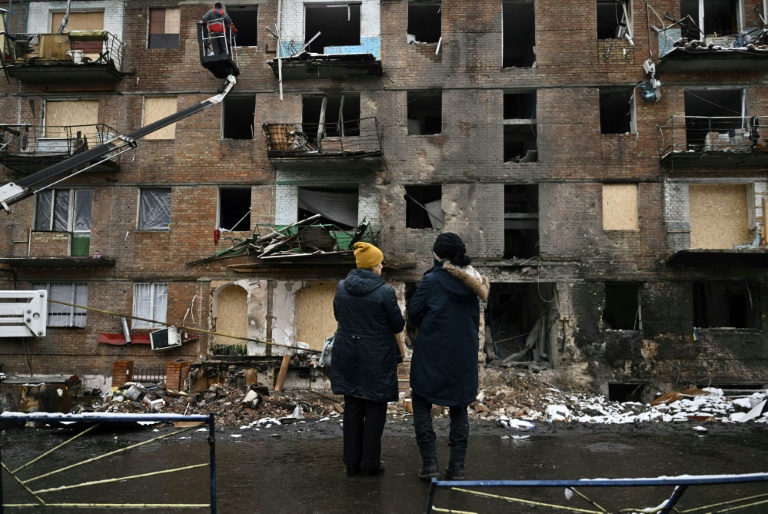
Ukraine urged NATO members Tuesday to speed up weapons deliveries and help restore its shattered power grid, as Western allies vowed to bolster support to aid Kyiv through winter in the face of Russia’s attacks. 

Moscow has unleashed waves of strikes against Ukraine’s energy infrastructure as its troops are pushed back on the ground, plunging millions of people into darkness. 

Ukraine’s Foreign Minister Dmytro Kuleba called for supplies of weapons, especially advanced air defence systems, to come “faster, faster, faster” as he joined a two-day meeting of NATO foreign ministers in the Romanian capital Bucharest.  

“When we have transformers and generators, we can restore our system, our energy grid, and provide people with decent living conditions,” Kuleba said. 

“When we have air defence systems, we will be able to protect this infrastructure from the next Russian missile strikes.”

“In a nutshell, Patriots and transformers is what Ukraine needs the most”, he said, referring to the US-made Patriot missile defence system. 

The appeal came as NATO chief Jens Stoltenberg accused Russian President Vladimir Putin of targeting infrastructure in a bid to use the winter as “a weapon of war” against Ukraine. 

Stoltenberg said NATO allies had pledged more support for Ukraine to fix its infrastructure and would keep on sending arms and air defences to help it better protect itself.

He said there was an “ongoing discussion” on supplying the Patriot systems that Washington and others have been so far refused to give to Kyiv.

“NATO is not a party to the war. But we will continue to support Ukraine. For as long as it takes, we will not back down,” Stoltenberg said. 

He said he expected Russia to carry out more attacks on Ukraine’s grid as the Kremlin suffers defeats on the ground and warned Europe should “be prepared for more refugees”. 

US Secretary of State Antony Blinken has announced a package worth $53 million “to support acquisition of critical electricity grid equipment” by Kyiv. 

A senior US official said the assistance would not be the last and pointed out that the Biden administration had budgeted $1.1 billion for energy spending in Ukraine and neighbouring Moldova.

– ‘Keep calm, give tanks’ –

“This targeting of civilian infrastructure, of energy infrastructure is obviously designed to try and freeze the Ukrainians into submission,” said British Foreign Secretary James Cleverly. 

“I don’t think it’ll be successful.”

Allies have given arms worth billions of dollars to Ukraine, but Kyiv is pleading for more air defence, tanks and longer-range missiles to push the Kremlin’s forces back.

But there are growing concerns that weapon stores in some NATO countries are running low as stockpiles have been diverted to Ukraine. 

Lithuanian Foreign Minister Gabrielius Landsbergis said his request to fellow NATO ministers was simple: “Keep calm and give tanks”. 

Germany, which currently chairs the G7, convened a meeting on the sidelines of the NATO gathering to discuss the energy crisis caused by the war in Ukraine.

Germany’s foreign minister Annalena Baerbock said the participants had looked to “better understand and prioritise the most urgent needs” ahead of an international conference in Paris on December 13. 

Separately, German Chancellor Olaf Scholz spoke to Ukrainian President Volodymyr Zelensky and said Germany would dispatch 350 generators and provide financial assistance to repair energy infrastructure worth 56 million euros ($57 million).

– ‘Door is open’ –

NATO said the meeting in Bucharest has showcased its unity on continuing to support Ukraine as Moscow’s war against its neighbour drags into its tenth month. 

The alliance did not, however, make any progress on Ukraine’s request to join, despite reiterating it remained committed to its pledge made some 14 years ago that Kyiv would one day become a member.

Stoltenberg insisted that the “door is open” to new members but said the focus now was on assisting Ukraine in its fight with Moscow. 

“We are discussing how to further strengthen our partnership with Ukraine, and also help them move towards a NATO membership,” he said. 

NATO has bolstered its eastern flank in the face of Russia’s war by sending more troops and equipment to countries neighbouring Ukraine, like Romania.

Non-NATO Moldova, which has also seen blackouts caused by the fallout from the attacks on neighbouring Ukraine, will attend the alliance’s talks on Wednesday along with Bosnia and Georgia. 

Besides the war in Ukraine, the ministers will take stock of progress in the accession of NATO candidates Finland and Sweden, already ratified by 28 of the 30 member countries but which remains suspended awaiting a green light from Hungary and Turkey.

The Finnish, Swedish and Turkish foreign ministers met on the sidelines of the meeting, but Ankara did not signal that there had been any steps forward. 

Trade tensions overshadow Macron's showy White House visit

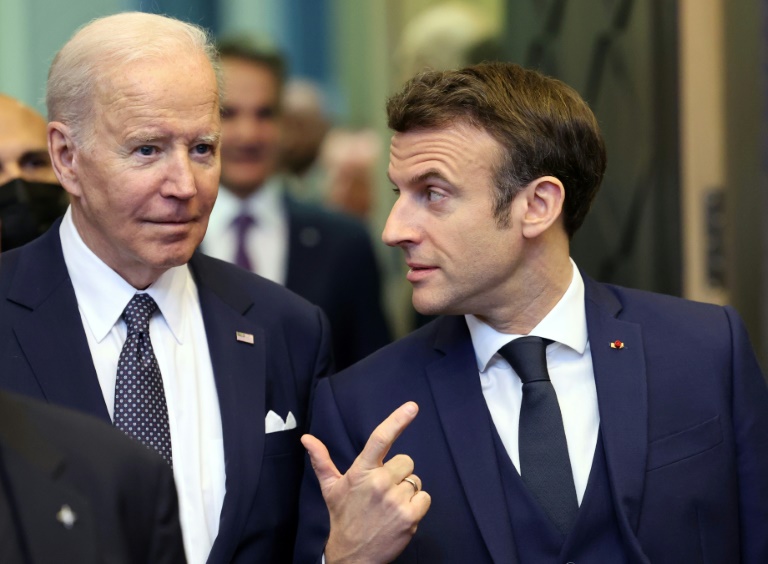
French President Emmanuel Macron was set to arrive in Washington Tuesday for a rare state visit hosted by Joe Biden, but hard-nosed disagreements about US-EU trade will loom over the pomp and ceremony at the White House.

Due to Covid delays, this is the first formal state visit of Biden’s presidency and US officials say the choice of France for the honor reflects both deep historical ties and their intense current partnership in confronting Russia over its war in Ukraine.

Biden will host Macron with a full ceremonial military welcome, a poignant visit to Arlington National Cemetery, an Oval Office sit down, a private dinner with their spouses Wednesday and the state banquet on Thursday, where Grammy-award winning American musician Jon Batiste will perform.

Compared to Macron’s edgy first experience of a state visit as the guest of Donald Trump in 2018, this trip — concluding with a stop Friday to the once-French city of New Orleans — will be a carefully choreographed display of transatlantic friendship.

Certainly the diplomatic furor that erupted last year when Australia canceled a deal for French submarines and instead signed up for US nuclear subs is now buried.

But even with little risk of Trump-style fireworks, Macron has major grievances to air.

– Trade war? –

Top of these is tension over Biden’s signature green industry policy, the Inflation Reduction Act, or IRA, which will pump billions of dollars into climate-friendly technologies, with strong backing for American-made products.

Europeans fear an unfair US advantage in the rapidly emerging sector just as they are reeling from the economic consequences of the Ukraine war and Western attempts to end reliance on Russian energy supplies.

Talk in Europe is now increasingly on whether the bloc should respond with its own subsidies for homegrown products, effectively starting a trade war.

“China favors its own products, America favors its own products. It might be time for Europe to favor its own products,” French Finance Minister Bruno Le Maire told France 3 radio on Sunday.

Martin Quencez, deputy director of the Paris office of think-tank GMF, said Macron will tell Biden “there’s a contradiction between an administration that constantly talks of alliances… and at the same time takes a decision like the IRA that will impact allies’ economies.” 

Another gripe in Europe is the high cost for US liquid natural gas exports — surged to try and replace canceled Russian deliveries.

Responding to accusations that the United States is effectively profiteering from the Ukraine war, a senior US administration official said this was a “false claim.”

The official also played down IRA-related tensions, saying a “very constructive set of conversations” is underway on how to prevent European companies from being shut out.

To underline the importance of the issue for Paris, Macron met with dozens of business executives ahead of his departure to Washington, urging them to keep investing in France. These included representatives from US giants Goldman Sachs and McDonald’s.

– Strategizing on China, Ukraine –

The breadth of Macron’s entourage — including the foreign, defense and finance ministers, as well as business leaders and astronauts — illustrates the importance Paris has put on the visit.

However, at the White House, a senior official said the main goal is to nurture the “personal relationship, the alliance relationship” with France — and between Biden and Macron.

That more modest sounding goal will include improving coordination on helping Ukraine to repel Russia and the even more vexing question of how to manage the rise of the Chinese superpower.

“We are not allies on the same page,” one adviser to Macron told AFP, forecasting “challenging” talks with Biden.

Despite his strong support for Kyiv, Macron’s insistence on continuing to maintain dialogue with Russian President Vladimir Putin has irked American diplomats.

The China question — with Washington pursuing a more hawkish tone and EU powers trying to find a middle ground — is unlikely to see much progress.

“Europe has since 2018 its own, unique strategy for relations with China,” tweeted French embassy spokesman Pascal Confavreux in Washington.

A senior US official said even if their approaches were “not identical,” they should be at least “speaking from a common script.”

Trade tensions overshadow Macron's showy White House visit

French President Emmanuel Macron was set to arrive in Washington Tuesday for a rare state visit hosted by Joe Biden, but hard-nosed disagreements about US-EU trade will loom over the pomp and ceremony at the White House.

Due to Covid delays, this is the first formal state visit of Biden’s presidency and US officials say the choice of France for the honor reflects both deep historical ties and their intense current partnership in confronting Russia over its war in Ukraine.

Biden will host Macron with a full ceremonial military welcome, a poignant visit to Arlington National Cemetery, an Oval Office sit down, a private dinner with their spouses Wednesday and the state banquet on Thursday, where Grammy-award winning American musician Jon Batiste will perform.

Compared to Macron’s edgy first experience of a state visit as the guest of Donald Trump in 2018, this trip — concluding with a stop Friday to the once-French city of New Orleans — will be a carefully choreographed display of transatlantic friendship.

Certainly the diplomatic furor that erupted last year when Australia canceled a deal for French submarines and instead signed up for US nuclear subs is now buried.

But even with little risk of Trump-style fireworks, Macron has major grievances to air.

– Trade war? –

Top of these is tension over Biden’s signature green industry policy, the Inflation Reduction Act, or IRA, which will pump billions of dollars into climate-friendly technologies, with strong backing for American-made products.

Europeans fear an unfair US advantage in the rapidly emerging sector just as they are reeling from the economic consequences of the Ukraine war and Western attempts to end reliance on Russian energy supplies.

Talk in Europe is now increasingly on whether the bloc should respond with its own subsidies for homegrown products, effectively starting a trade war.

“China favors its own products, America favors its own products. It might be time for Europe to favor its own products,” French Finance Minister Bruno Le Maire told France 3 radio on Sunday.

Martin Quencez, deputy director of the Paris office of think-tank GMF, said Macron will tell Biden “there’s a contradiction between an administration that constantly talks of alliances… and at the same time takes a decision like the IRA that will impact allies’ economies.” 

Another gripe in Europe is the high cost for US liquid natural gas exports — surged to try and replace canceled Russian deliveries.

Responding to accusations that the United States is effectively profiteering from the Ukraine war, a senior US administration official said this was a “false claim.”

The official also played down IRA-related tensions, saying a “very constructive set of conversations” is underway on how to prevent European companies from being shut out.

To underline the importance of the issue for Paris, Macron met with dozens of business executives ahead of his departure to Washington, urging them to keep investing in France. These included representatives from US giants Goldman Sachs and McDonald’s.

– Strategizing on China, Ukraine –

The breadth of Macron’s entourage — including the foreign, defense and finance ministers, as well as business leaders and astronauts — illustrates the importance Paris has put on the visit.

However, at the White House, a senior official said the main goal is to nurture the “personal relationship, the alliance relationship” with France — and between Biden and Macron.

That more modest sounding goal will include improving coordination on helping Ukraine to repel Russia and the even more vexing question of how to manage the rise of the Chinese superpower.

“We are not allies on the same page,” one adviser to Macron told AFP, forecasting “challenging” talks with Biden.

Despite his strong support for Kyiv, Macron’s insistence on continuing to maintain dialogue with Russian President Vladimir Putin has irked American diplomats.

The China question — with Washington pursuing a more hawkish tone and EU powers trying to find a middle ground — is unlikely to see much progress.

“Europe has since 2018 its own, unique strategy for relations with China,” tweeted French embassy spokesman Pascal Confavreux in Washington.

A senior US official said even if their approaches were “not identical,” they should be at least “speaking from a common script.”

Stocks diverge as investors caught between hope, caution

Stocks diverged Tuesday after big rallies in Asian markets failed to trigger a similar reaction in Europe and on Wall Street as investors remain cautious before key US data and speeches later in the week.

Sentiment was boosted in Asia after China avoided another night of protests, following a weekend of unrest sparked by the tough anti-Covid policy that is weighing on growth in the world’s second biggest economy.

There were big rallies in Hong Kong and Shanghai, with property firms enjoying a much-needed surge, also on moves to ease funding restrictions on troubled developers.

But sentiment was tempered by warnings from top Federal Reserve policymakers that US interest rates would climb further and could go higher than initially thought to fight decades-high inflation.

Europe’s main stock markets were mixed at the end of the day’s trading as all three main indices on Wall Street slid Tuesday.

London closed up 0.5 percent, boosted by HSBC’s announcement Tuesday that it would sell its Canadian division to Royal Bank of Canada for US$10.1 billion, which led to the bank’s share price rising over four percent.

German inflation also unexpectedly slowed in November to 10 percent from a record high of 10.4 percent in October, preliminary data showed Tuesday.

Economists however cautioned against assuming inflation was now on a downhill path as households will likely face higher energy costs from January.

US consumers appeared equally gloomy about the state of the American economy after a closely watched consumer confidence index dipped to 100.2 in November, down two points from the month before, data showed Tuesday.

“Investors will need to be made of stern stuff going into the new year,” Danni Hewson, AJ Bell financial analyst, said in a note.

“Volatility has been a hallmark of 2022 and the word looks set to remain an analyst favourite into the New Year and beyond.”

– Looking to the Fed –

Market focus is turning to the United States, with a number of Fed officials due to speak, including boss Jerome Powell.

Noting that there has not been “any carryover momentum from the Chinese markets” on Wall Street Tuesday, Patrick J. O’Hare of Briefing.com said it “suggests… market participants are more attuned for the time being to happenings closer to home” including Powell’s speech Wednesday.

“Sure, the latest developments have helped temper some of yesterday’s selling activity, but they have not ignited buying efforts,” he said.

Friday sees the release of key US jobs data, which could provide an idea about the central bank’s plans for monetary policy.

Bets on a slowdown in its pace of rate hikes have boosted markets for the past weeks, but some high-ranking members on Monday looked to play down the chances of a more dovish pivot.

– Key figures around 1700 GMT –

New York – Dow: DOWN 0.3 percent at 33,733.05

EURO STOXX 50: FLAT at 3,934.44

London – FTSE 100: UP 0.5 percent at 7,512.00 (close)

Frankfurt – DAX: DOWN 0.2 percent at 14,355.45 (close)

Paris – CAC 40: FLAT at 6,668.97 (close)

Tokyo – Nikkei 225: DOWN 0.6 percent at 28,027.84 (close)

Hong Kong – Hang Seng Index: UP 5.2 percent at 18,204.68 (close)

Shanghai – Composite: UP 2.3 percent at 3,149.75 (close)

Brent North Sea crude: UP 0.8 percent at $83.87 per barrel

West Texas Intermediate: UP 1.4 percent at $78.34 per barrel

Euro/dollar: DOWN at $1.0345 from $1.0347 on Monday

Dollar/yen: DOWN at 138.45 yen from 138.87 yen

Pound/dollar: UP at $1.1980 from $1.1952

Euro/pound: DOWN at 86.33 pence from 86.50 pence

burs-raz/ah

UK removes China from Sizewell nuclear project, takes joint stake

Britain on Tuesday removed China General Nuclear from construction of its new Sizewell C power station, announcing it would take a joint stake alongside French partner EDF as relations sour with Beijing.

The CGN announcement came after Prime Minister Rishi Sunak warned the “golden era” of UK-China links was “over” and said the Asian giant posed a “systemic challenge” to UK interests and values.

Tuesday’s news comes also with a diplomatic storm brewing over the arrest and alleged assault of a BBC journalist covering widespread protests against Covid restrictions in a rare defiance of the Chinese authorities.

Sunak’s Conservative government is stripping CGN of its controversial 20-percent Sizewell stake, and forming a joint venture with EDF.

The UK will invest £700 million ($843 million) in the project, a figure that was matched by EDF.

Sizewell C, which is under development on the Suffolk coast in eastern England, will comprise two EPRs or European Pressurized Reactors that will power the equivalent of about six million homes. 

It is expected to start producing electricity from 2035.

– ‘Energy sovereignty’ –

Nuclear and renewables, such as offshore wind, are seen as critical to ramp up Britain’s energy security, after key producer Russia’s invasion of Ukraine sent gas and electricity bills rocketing across Europe.

EDF, which is in the process of being fully nationalised amid the region’s worsening energy crisis, confirmed Tuesday it is still working with CGN to build Hinkley Point power station in southwestern England.

Hinkley, which has been blighted by delays and soaring costs, will be Britain’s first new nuclear power plant in more than two decades and aims to provide seven percent of UK power needs.

Tuesday’s news nevertheless further curbs UK ties with the world’s second biggest economy.

London last month ordered a Chinese-owned company to divest most of Britain’s biggest semiconductor maker — a leading industrial asset — after a national security probe. 

And in 2020, Chinese telecoms giant Huawei was banned from involvement in the roll-out of the country’s superfast 5G broadband network, after US concerns about spying.

The UK’s “stake in Sizewell C is positioned at the heart of the new blueprint to Britain’s energy sovereignty”, the Department for Business, Energy and Industrial Strategy (BEIS) said in a statement.

The move “also allows for China General Nuclear’s exit from the project, including buy-out costs, any tax due and commercial arrangements”, it added. 

The UK says Sizewell will deliver cleaner energy than fossil fuels and create 10,000 jobs for the local area and national economy.

Greenpeace UK policy director Doug Parr, however, slammed the nuclear push.

“Several academic institutes have shown we can have a 100-percent renewable system that would be cheaper than those based on nuclear or fossil fuels,” said Parr.

“And it has the added benefit of not creating millennia of worry over the nuclear waste that future generations will end up dealing with.”

Local campaign group Stop Sizewell C added that the project “can neither lower energy bills nor give the UK energy independence” and would cost “a huge amount of money”.

– UK support ‘essential’ –

The news meanwhile comes as some of EDF’s EPR nuclear reactors have been dogged by maintenance issues and delays.

“The support of the UK government through its direct participation… is essential” to Sizewell, EDF Energy chief executive Simone Rossi told AFP in an interview.

“This decision is a sign of confidence in the nuclear industry — and in the French nuclear industry.”

Business and Energy Secretary Grant Shapps said Sizewell would move Britain “towards greater energy independence and away from the risks that a reliance on volatile global energy markets for our supply comes with”.

The UK has 15 nuclear reactors at eight sites but many are approaching the end of their lifespan.

Sizewell comprises two power plants: Sizewell A, which opened in the 1960s and shut in 2006. Sizewell B, which opened in 1995, is still in operation.

Britain is turning to new plants also to help meet its long-running target of net zero carbon emissions by 2050.

The government added on Tuesday it would create Great British Nuclear, a body overseeing development of more projects.

Sunak’s administration is meanwhile partially subsidising household energy bills — which have pushed UK inflation to a 41-year peak — to cushion a cost-of-living crisis.

burs-rfj/phz/raz

Macron courts Central Asian strongmen in quest for influence

French President Emmanuel Macron is making an eye-catching drive to strengthen partnerships with Central Asian states, seeking to boost Europe’s influence in a strategic region where China, Russia, Turkey and the United States are already jostling for supremacy.

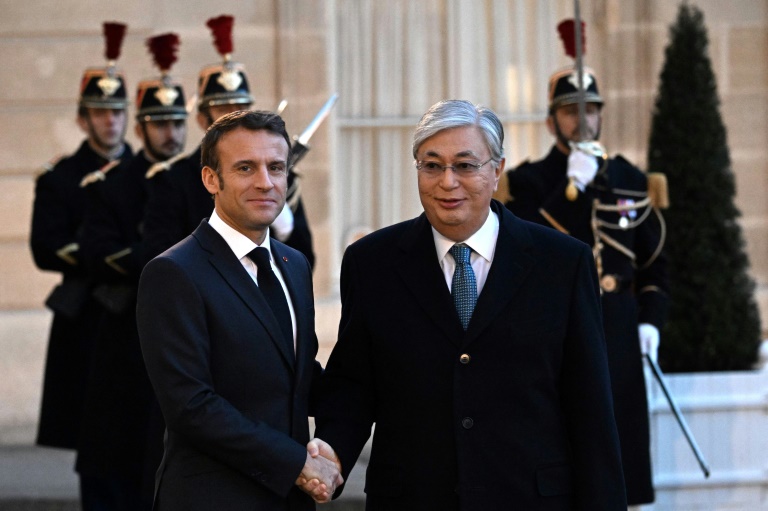
Macron held talks in Paris earlier this month with Uzbekistan President Shavkat Mirziyoyev, who was making a rare visit to a Western capital, and on Tuesday hosted Kazakh President Kassym-Jomart Tokayev at the Elysee Palace.

Last year, Macron hosted Tajik President Emomali Rahmon in Paris in an extremely unusual visit and also held telephone talks with the leader of Tajikistan on Saturday.

The flurry of diplomacy between Paris and the key Central Asian capitals come as France reassesses its ties with the former Soviet region in the wake of Russia’s invasion of Ukraine.

Macron had previously sought to cultivate a viable relationship with Russian President Vladimir Putin.

Astana, Dushanbe and Tashkent have taken an at best ambivalent stance on the invasion. They have shown no enthusiasm but have stopped short of full-throated condemnation that would irritate their ex-Soviet masters in Moscow.

Their ties with Russia are also of interest to Paris, which is keeping an eye on a possible negotiated solution to the invasion of Ukraine. 

Tokayev held talks in Moscow with Putin the day before travelling to Paris.

Tokayev’s visit aims to “consolidate our relationship and expand our dialogue in a context that is also difficult for the countries of Central Asia”, said a French presidential official who asked not to be named.

“We continue to … show our Central Asian partners the importance we attach to their region, wedged between China and Russia, and which needs to open up new horizons,” added the official.

– ‘Lacking competitiveness’ –

A Kazakh government source told AFP: “We firmly support the territorial integrity of Ukraine” in the face of the invasion.

“We don’t support sanctions as a matter of principle. But we are not allowing our territories to be used for evading sanctions,” the source added.

Meanwhile the Russian-led Collective Security Treaty Organisation (CSTO), a regional military alliance of which Kazakhstan is a member, is also in crisis. 

A CSTO summit in Armenia earlier this month collapsed in near acrimony.

Cultivating such ties means Paris is also hosting leaders who are under fire for rights violations at home.

Tokayev comes to Paris fresh from an election in which he won a second term with a crushing 81.3 percent. 

The Organisation for Security and Cooperation in Europe said the vote “took place in a political environment lacking competitiveness”.

Around 230 people were killed when Tokayev violently suppressed protests in January over living costs.

Mirziyoyev is meanwhile credited with opening up Uzbekistan after the death of its post-Soviet leader Islam Karimov.

He has pushed through significant economic and social reforms but his regime is accused by aid organisations of trampling on people’s basic rights.

– Diversify partnerships –

In a typical French touch, the visits by Rahmon and Mirziyoyev have both been accompanied by blockbuster exhibitions of cultural treasures rarely seen outside Tajikistan and Uzbekistan.

While China and the US have vied with Russia for influence in the region since the fall of the USSR, Turkey has in recent years shown an awakened interest in nations with which it shares close cultural and linguistic ties.

Ankara has revived a body known now as the Organisation of Turkic States and President Recep Tayyip Erdogan, with whom Macron has a tense relationship, has been a regular visitor to the region.

Analysts say that in the short term Europe is keen to promote energy ties with Central Asia, especially with hydrocarbon-rich Kazakhstan, as supplies from Russia dwindle. It also values the region’s role as a key pipeline hub.

“What interests the Europeans in Central Asia are energy resources while Russian hydrocarbons are under embargo … and the transport corridors between China and the European Union,” said Michael Levystone, associate researcher at the IFRI think tank. 

“(Meanwhile) the sanctions against the Russian economy encourage the countries of Central Asia to diversify their partnerships on the international scene,” added Levystone, whose Paris-based organisation specialised in Central Asia.

The Kazakh source said: “In light of the current uncertainties regarding energy security in Europe, Kazakhstan is determined to continue to play a role as a reliable and trustworthy energy partner.”

Stocks, crude rise on hope China will ease strict Covid measures

Stocks and oil prices rebounded strongly Tuesday, while the haven dollar weakened, on speculation that China would further ease strict Covid measures but investors remain cautious ahead of key US data and speeches later in the week.

Sentiment was boosted also after China avoided another night of protests, following a weekend of unrest sparked by the tough anti-Covid policy that is weighing on growth in the world’s second biggest economy.

Stock market gains were led by big rallies in Hong Kong and Shanghai, with property firms enjoying a much-needed surge, also on moves to ease funding restrictions on troubled developers.

Europe’s main stock markets were mainly higher in late afternoon trading.

But sentiment was tempered by warnings from top Federal Reserve policymakers that US interest rates would climb further and could go higher than initially thought to fight decades-high inflation.

US stocks edged lower early Tuesday ahead of key releases on consumer health before the festive shopping season kicks off.

“Risk-on sentiment has lifted European equities, boosted by a rally overnight in China,” noted Victoria Scholar, head of investment at Interactive Investor.

Oil prices rebounded from 11-month lows, “boosted by improved sentiment towards demand from China”, she added.

Qatar announced Tuesday its first major deal to send liquefied natural gas to Germany as Europe scrambles to find alternatives to Russian energy sources.

Qatar’s Energy Minister Saad Sherida al-Kaabi said up to two million tons of gas a year would be sent for at least 15 years from 2026, and that state-run QatarEnergy was discussing other possible deals for Europe’s biggest economy.

German inflation also unexpectedly slowed in November to 10 percent from a record high of 10.4 percent in October, preliminary data showed Tuesday.

Economists however cautioned against assuming inflation was now on a downhill path as households will likely face higher energy costs from January.

Market focus was meanwhile turning to the United States, with a number of Fed officials due to speak, including boss Jerome Powell.

Noting that there has not been “any carryover momentum from the Chinese markets” on Wall Street Tuesday, Patrick J. O’Hare of Briefing.com said it “suggests to us that market participants are more attuned for the time being to happenings closer to home” including Powell’s speech Wednesday.

“Sure, the latest developments have helped temper some of yesterday’s selling activity, but they have not ignited buying efforts,” he added.

Friday sees the release of key US jobs data, which could provide an idea about the central bank’s plans for monetary policy.

Bets on a slowdown in its pace of rate hikes have boosted markets for the past weeks, but some high-ranking members on Monday looked to play down the chances of a more dovish pivot.

– Key figures around 1445 GMT –

London – FTSE 100: UP 0.6 percent at 7,522.52 points

Frankfurt – DAX: DOWN 0.1 percent at 14,361.21

Paris – CAC 40: UP 0.2 percent at 6,678.44

EURO STOXX 50: FLAT at 3,937.97

New York – Dow: DOWN 0.1 percent at 33,801.67

Tokyo – Nikkei 225: DOWN 0.6 percent at 28,027.84 (close)

Hong Kong – Hang Seng Index: UP 5.2 percent at 18,204.68 (close)

Shanghai – Composite: UP 2.3 percent at 3,149.75 (close)

Brent North Sea crude: UP 2.7 percent at $85.48 per barrel

West Texas Intermediate: UP 2.4 percent at $79.07 per barrel

Euro/dollar: DOWN at $1.0344 from $1.0347 on Monday

Dollar/yen: DOWN at 138.70 yen from 138.87 yen

Pound/dollar: UP at $1.1968 from $1.1952

Euro/pound: DOWN at 86.44 pence from 86.50 pence

Close Bitnami banner
Bitnami