US Business

UK defends Brexit deal despite economic woes

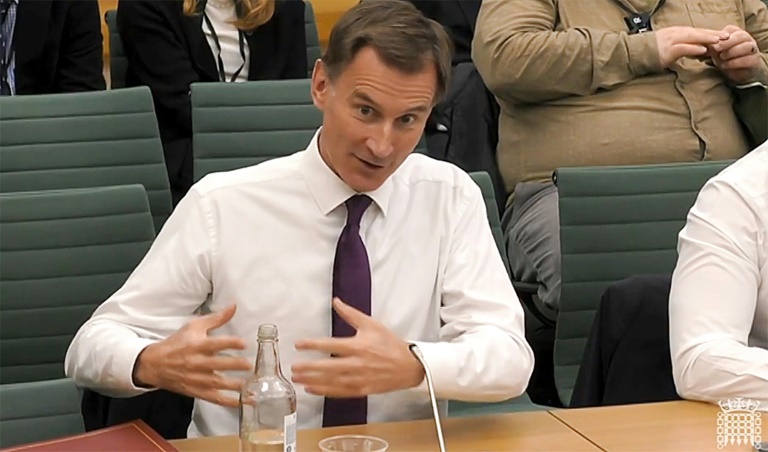
Finance minister Jeremy Hunt on Wednesday defended the UK’s post-Brexit trade deal with the EU, despite growing criticism about its economic impact, and rejected claims he was pushing for closer European ties.

Hunt, who voted to remain in the European Union at the 2016 referendum, was rumoured to be the source of a report last weekend that the government was eyeing a “Swiss-style” deal with Brussels.

But he scotched talk he was the “senior government figure” quoted in the article, which has threatened to reopen deep divisions in the ruling Conservatives over the form Brexit should take.

The government supports the trade and cooperation agreement (TCA) struck with the EU, he told the influential cross-party Treasury Committee in parliament.

“We think it is an excellent agreement,” he added.

“We do not support, we would not contemplate, I do not support, I have never contemplated, any agreement which means moving away from the TCA.

“That means we are not negotiating or deciding the regulations that we want as sovereign equals, paying unnecessary money to the EU or indeed compromising on freedom of movement.

“That has always been my position as Chancellor (of the Exchequer).”

He added: “With respect to the story in the Sunday Times, if you’re saying was the Treasury, was I, the source for any suggestion we should seek to renegotiate the TCA to move it towards an agreement more like the agreement with Switzerland, the answer is no.”

– Tough going –

Former UK prime minister Theresa May proposed a similar deal, which was roundly rejected by lawmakers, and which contributed to her downfall in 2019.

May’s successor, Boris Johnson, railroaded his own “harder” Brexit deal through parliament on the back of a landslide 2019 general election win fought on a campaign to “get Brexit done”.

But despite promises of greater freedoms to set policy and chart its own course in the world, the UK has found post-Brexit life tough going, even without the shock of the Covid pandemic.

The Bank of England and the government’s independent spending watchdog have both said Brexit has hurt the UK economy and plunged it to the brink of recession.

On Tuesday, the Organisation for Economic Co-operation and Development forecast the UK economy would contract more than any of the world’s seven most advanced nations next year.

Many critics have partly blamed the fallout from Brexit, which saw the UK withdraw from the European single market and customs union, and end free movement between member states.

Switzerland has far closer ties with the bloc through bilateral agreements allowing access to the single market, a high degree of free movement and by paying into EU coffers.

But on Monday, British Prime Minister Rishi Sunak ruled out pursuing “any relationship with Europe that relies on alignment with EU laws” as eurosceptic Tories warned of backsliding.

The European Commission says no Swiss-style deal is on the table.

Hunt last week hiked taxes and slashed spending, to try to reverse unfunded tax cuts by his predecessor Kwasi Kwarteng, under short-lived premier Liz Truss, that sparked markets chaos and worsened a cost-of-living crisis of high energy bills and inflation.

Hunt also suggested on Wednesday that support for householders would not be extended beyond early 2024, even if energy bills remain elevated.


Embattled Credit Suisse expects Q4 pre-tax loss

Credit Suisse predicted a surprise fourth-quarter pre-tax loss of up to $1.6 billion as the beleaguered bank undertakes a radical overhaul, sending stocks tumbling again on Wednesday.

Shaken by repeated scandals, Switzerland’s second-biggest bank unveiled a rejig in late October but accepted its accounts would take a hit of up to 1.5 billion Swiss francs ($1.6 billion) in the final three months of the year.

At the close, the group’s shares were down 6.1 percent at 3.62 Swiss francs, while the Swiss stock exchange’s main SMI index was up 0.2 percent.

At an extraordinary general meeting, shareholders approved capital increases worth around four billion Swiss francs in order to fund the restructuring plan.

Chairman Axel Lehmann called it an “important step in our journey to build the new Credit Suisse”.

“This vote confirms confidence in the strategy, as we presented it in October, and we are fully focused on delivering our strategic priorities to lay the foundation for future profitable growth,” he said.

The increase in share capital is expected to boost Credit Suisse’s CET1 ratio, which compares a bank’s capital to its risk-weighted assets.

The bank suffered a net loss of 273 million Swiss francs in the first quarter, then nearly 1.6 million in the second quarter and four billion in the third.

The scale of fourth-quarter losses “will depend on a number of factors including the investment bank’s performance for the remainder of the quarter, the continued exit of non-core positions, any goodwill impairments, and the outcome of certain other actions, including potential real-estate sales”, the Zurich-based bank said in a statement.

Credit Suisse said in October that it expected to incur restructuring charges and software and property impairments of around 250 million Swiss francs in the fourth quarter as part of its overhaul.

– Question of trust –

The bank’s reorganisation is aimed at dramatically reducing the scale of its investment bank, in a bid to repair the damage following a series of scandals.

In addition to revamping its investment banking unit, the bank announced measures including slashing 9,000 jobs and a capital injection from the Saudi National Bank.

However, the restructuring takes place in an unfavourable context for the banking sector.

Its investment bank suffered the backlash of the “substantial industry-wide slowdown” in capital markets and reduced activity in the sales and trading markets, it said.

“The bank expects these market conditions to continue in the coming months.”

Andreas Venditti, an analyst at Swiss investment managers Vontobel, said the “massive net outflows” in wealth management — the bank’s core business alongside its Swiss domestic banking — “are deeply concerning — even more so as they have not yet reversed.

“Credit Suisse needs to restore trust as fast as possible — but that is easier said than done.”

Flora Bocahut, an analyst at the US investment bank Jefferies, added: “Today’s update confirms our concerns that the Credit Suisse ship is yet to stabilise, and it’ll get worse before it potentially gets better.”

– Archegos, Greensill shocks –

Credit Suisse’s capital-guzzling investment banking arm has been the source of heavy losses which plunged its accounts into the red — eclipsing its more stable activities such as wealth management or its Swiss domestic banking services.

Credit Suisse’s investment bank suffered a loss of 3.7 billion Swiss francs in 2021 and backed that up with a 992 million Swiss franc loss in the first half of 2022.

It was hit by the implosion of US fund Archegos, which cost Credit Suisse more than $5 billion.

Meanwhile its asset management branch was rocked by the bankruptcy of British financial firm Greensill, in which some $10 billion had been committed through four funds.

Credit Suisse is one of 30 banks globally deemed too big to fail, forcing it to set aside more cash to weather a crisis.

While many industry experts think a bankruptcy highly improbable, these rumours helped drag its share price down to a low of 3.158 Swiss francs on October 3.

European, US stocks held back by economic gloom

European and US stocks made modest gains on Wednesday on news that major economies contracted in November and as traders looked ahead to Federal Reserve committee minutes.

Paris and London closed in positive territory and Wall Street gained around 0.2 percent in early deals, while Frankfurt ended flat.

The eurozone’s composite purchasing managers index (PMI), a key economic indicator, improved from 47.3 in October to 47.8 in November, S&P Global said.

But activity languished under 50 — signifying the fifth consecutive month of economic contraction as inflation spikes and dampening the outlook for the fourth quarter.

The United States’ composite PMI hit a three-month low of 46.3 in November, down from the October figure of 48.2, with services business activity and manufacturing output data also falling.

Traders were expecting the results of a meeting of the influential Federal Open Market Committee in the United States.

“It’s been a fairly lacklustre session as investors weigh up the release of tonight’s FOMC minutes against a backdrop of a weakening economic outlook,” noted Michael Hewson, chief market analyst at CMC Market UK.

“Stock markets have remained supported as optimism over a less hawkish Fed is outweighing growth concerns. But I can’t imagine investors will continue to take excessive risk heading into a potential recession,” said City Index analyst Fawad Razaqzada.

– ‘Recession is inevitable’ –

Britain’s composite PMI was fractionally higher, from 48.2 to 48.3 in November, but that marked the fourth straight contraction.

The news comes after the UK government recently confirmed that the nation’s economy was in recession, with inflation sitting at a 41-year high.

“Both data suggest that recession is inevitable in both eurozone and UK economies, with the UK likely to be designated officially before the eurozone due to the weaker Q3 data,” Monex Europe analyst Maria Marcos told AFP.

Oil prices slid on disappointing US data and fears of more painful Covid lockdowns in China that could ravage the Asian giant’s energy demand.

The main American oil contract, West Texas Intermediate, briefly sank by more than five percent on Wednesday on China concerns and the underwhelming US data.

Reports that the European Union is considering a price cap on Russian crude and pessimistic global growth forecasts by the OECD are also holding back prices, according to analysts.

“With China also grappling with record numbers of Covid cases the macro-outlook has continued to deteriorate for oil this week, with prices on course to decline for the third week in a row,” said Hewson.

The dollar sank more than one percent against the British pound and weakened against other rival currencies as investors mulled mixed earnings and economic data.

“The US dollar fell sharply again today as concerns intensified that the economy is heading for a recession after a poor set of PMI numbers came out from the services and manufacturing sectors,” said Razaqzada.

“An economic slowdown is expected to weigh on inflation, reducing the need for the Fed to maintain an aggressive tightening stance.”

– Key figures around 1630 GMT –

London – FTSE 100: UP 0.2 percent at 7,465.24 points (close)

Paris – CAC 40: UP 0.3 percent at 6,679.09 (close)

Frankfurt – DAX: FLAT at 14,427.59 (close)

EURO STOXX 50: UP 0.4 percent at 3,946.44

New York – Dow: UP 0.2 percent at 34,175.97

Hong Kong – Hang Seng Index: UP 0.6 percent at 17,523.81 (close)

Shanghai – Composite: UP 0.3 percent at 3,096.91 (close)

Tokyo – Nikkei 225: closed for a holiday

Euro/dollar: UP at $1.0367 from $1.0304 on Tuesday

Dollar/yen: DOWN at 139.69 yen from 141.23 yen

Pound/dollar: UP at $1.2071 from $1.1886

Euro/pound: DOWN at 85.89 pence from 86.69 pence

West Texas Intermediate: DOWN 4.5 percent at $77.30 per barrel

Brent North Sea crude: DOWN 3.8 percent at $84.34 per barrel

Musicians in French-speaking Africa eye global market through streaming

The wildfire popularity of streaming platforms has hoisted Nigerian and other artists from English-speaking Africa to unprecedented popularity around the world.

Musicians from the continent’s francophone countries are now looking to cash in on the boom. 

Africa’s streaming leader is Boomplay, whose library of 80 million tracks is almost in the same ballpark as those of Deezer and Spotify.  

But Boomplay’s big difference with the global giants is a catalogue that focuses intensively on African music rather than a broader range of genres.

The app was created in Nigeria in 2015 and is now present in six African countries, said Paola Audrey, manager of Boomplay’s Ivory Coast branch.

“We offer a very large library which helps you to discover many local artists,” she said.

Funded by advertising and free for the user, Boomplay has blazed a trail internationally for Nigerian Afro-pop and now hopes to do the same for francophone African stars.

“At the moment it’s much easier to highlight Nigerian artists in the French-speaking world, but we’re doing some experiments in the reverse direction, such as the Ivorian rapper Didi B,” said Audrey.

“There are small niche markets, and our role is to promote artists so that they can find an audience on a bigger scale.” 

For industry experts who met last week in Abidjan at the African Music Industry Fair, the digital revolution promises glittering opportunities for West African artists.  

Revenue from African music streaming is expected to more than triple in five years, from $92.9 million in 2021 to $314.6 million in 2026, according to research firm Dataxis.

– Digital dawn –

“Everything began with digital platforms,” said Akotchaye Okio, in charge of international development for Africa at Sacem, a rights group representing artists.

“Look at the success of the South African song ‘Jerusalema’ or ‘Calm Down’ by Rema,” a Nigerian singer whose hit has notched up 50 million streams in France alone, he said.

Magali Palmira Wora, a francophone Africa specialist at US distributor The Orchard, pointed however to a learning curve.

“Artists in French-speaking Africa have to learn to put themselves forward on platforms,” she said.

“Spotify for example has got an Afro-pop playlist — you have to explain to artists why it’s important to be on it.”

Good exposure on the platforms smashes down the barriers to bigger markets, and opens the way to a career that is far more international than would have been previously possible.  

“Wherever you are, you can listen to my songs in one click. With digital technology, access to information is much more extensive. It allows local music industries to develop and as an artist it gives us exposure,” said Ivorian rapper Suspect 95.  

“We no longer need to go through networks which made it hard to get my CD to this or that country.”  

– Copyright issue –

Five countries — South Africa, Egypt, Nigeria, Algeria and Morocco — account for 86 percent of African streaming revenues today, according to Dataxis. 

But the 400 million potential listeners in French-speaking sub-Saharan Africa, two-thirds of whom are under the age of 25, are a promising untapped market. 

Ensuring that up-and-coming independent artists can make money from the dominant platforms will be a key challenge.  

“Obviously, if you’re signed up with a major (music company), it’s easier — you are using an established network” for getting copyright payments, said Suspect 95, who is signed to Universal.

“For independent artists, it’s harder, for now.”

“The big platforms which use massively use our songs aren’t yet paying the rights they should in Ivory Coast,” said Karim Ouattara, director general of the Ivorian Copyright Office.

“But we are in negotiations and should see progress by the end of the year.” 

New home sales in US post surprise jump in October

New home sales in the US defied expectations and rose in October, government data showed Wednesday, despite mortgage rates remaining high.

Although sales surged during the pandemic, the sector cooled with the central bank raising the benchmark lending rate multiple times this year to ease demand and tamp down soaring inflation.

But sales of new single-family houses picked up 7.5 percent to a seasonally adjusted annual rate of 632,000 in October, said the Commerce Department, despite analyst expectations of a dip as higher rates bite.

The median sales price for a new home in October rose to $493,000 as well, up from September’s revised figure of $455,700.

Monthly data can be volatile, and some observers have pointed to a rush to lock in mortgage deals before rates increased further as a reason that sales surged previously.

Another factor analysts have cited is a lack of existing inventory, nudging buyers into the market for new property, supporting sales.

In October, the sales pace remained below that of the same period in 2021.

The latest figures come as the US’s much bigger existing home sales market slipped for a record nine consecutive months.

“The increase in sales came despite a rise in new home prices,” said Nancy Vanden Houten of Oxford Economics in an analysis.

But she noted that this reflected a shift in composition of sales, towards homes priced above the median.

“We expect sales to remain under pressure going forward as the erosion in affordability this year keeps many buyers on the sidelines,” she said.

Home sales have eased “sharply” overall, added economist Rubeela Farooqi of High Frequency Economics.

“Pressure is likely to persist in the near term as low inventories, still-high prices and elevated mortgage rates weigh on activity,” she added in an analysis.

New home sales in US post surprise jump in October

New home sales in the US defied expectations and rose in October, government data showed Wednesday, despite mortgage rates remaining high.

Although sales surged during the pandemic, the sector cooled with the central bank raising the benchmark lending rate multiple times this year to ease demand and tamp down soaring inflation.

But sales of new single-family houses picked up 7.5 percent to a seasonally adjusted annual rate of 632,000 in October, said the Commerce Department, despite analyst expectations of a dip as higher rates bite.

The median sales price for a new home in October rose to $493,000 as well, up from September’s revised figure of $455,700.

Monthly data can be volatile, and some observers have pointed to a rush to lock in mortgage deals before rates increased further as a reason that sales surged previously.

Another factor analysts have cited is a lack of existing inventory, nudging buyers into the market for new property, supporting sales.

In October, the sales pace remained below that of the same period in 2021.

The latest figures come as the US’s much bigger existing home sales market slipped for a record nine consecutive months.

“The increase in sales came despite a rise in new home prices,” said Nancy Vanden Houten of Oxford Economics in an analysis.

But she noted that this reflected a shift in composition of sales, towards homes priced above the median.

“We expect sales to remain under pressure going forward as the erosion in affordability this year keeps many buyers on the sidelines,” she said.

Home sales have eased “sharply” overall, added economist Rubeela Farooqi of High Frequency Economics.

“Pressure is likely to persist in the near term as low inventories, still-high prices and elevated mortgage rates weigh on activity,” she added in an analysis.

Walmart employee kills six in US mass shooting

A Walmart employee shot dead six people at a store bustling with Thanksgiving holiday shoppers, before turning the pistol on himself, police said Wednesday, in America’s second mass shooting in four days.

Four other people remained hospitalized in unknown condition following the Tuesday night rampage in Chesapeake, Virginia, police chief Mark Solesky said.

Solesky told a news conference the gunman was believed to have died of a “self-inflicted gunshot wound,” and that the motive behind the country’s latest deadly outburst of gun violence was not immediately known.

President Joe Biden condemned “yet another horrific and senseless” attack, mourning the fact “there are now even more tables across the country that will have empty seats this Thanksgiving.”

He added: “There are now more families who know the worst kind of loss and pain imaginable.”

The assault two days before the quintessential American family holiday, marked this year on November 24, followed a weekend gun attack at an LGBTQ club in Colorado that killed five people.

It was also the second mass shooting in the state of Virginia this month: three students at the University of Virginia who played on its football team were killed November 13 by a classmate after a field trip.

Emergency calls were first made just after 10:00 pm Tuesday (0300 GMT Wednesday) while the store was still open.

Officers arrived in a matter of two minutes and entered the Walmart two minutes later, Solesky said.

US media reported that the gunman opened fire in a room where employees take meal breaks but the police chief said he could not confirm this.

In the hours afterwards, news footage showed a major police presence around the Walmart, which is located about 150 miles (240 kilometers) southeast of the US capital Washington.

– ‘Senseless violence’ –

Gun attacks in grocery stores in America have become increasingly common in recent years. A teenage gunman killed 10 people, most of them Black, at a grocery store in Buffalo, New York in May.

Last year a shooting at a supermarket in Boulder, Colorado also left 10 dead. And in a particularly gruesome attack in 2019, a young gunman killed 23 and wounded 26 as he stalked shoppers at a Walmart in El Paso, Texas.

An advocacy group called Guns Down America has reported that from January 1, 2020 to May 14 of this year there were 448 “gun incidents” and 137 deaths at 12 large national retailers.

In Chesapeake, local resident Edna Dunham told CBS news after the shooting, “That could have been me.”

“It could’ve been any of us because we go there so much. It could’ve been any of us,” Dunham said.

Walmart, the largest retailer in the United States, issued a statement early Wednesday saying: “We are shocked at this tragic event.” 

The company added that it was “praying for those impacted, the community and our associates. We’re working closely with law enforcement, and we are focused on supporting our associates.”

Virginia state Senator Louise Lucas, who represents the Chesapeake region, said she was “heartbroken that America’s latest mass shooting took place… in my district.”

“I will not rest until we find the solutions to end this gun violence epidemic in our country that has taken so many lives,” she wrote on Twitter.

Congressman Bobby Scott of Virginia tweeted: “Tragically, our community is suffering from yet another incident of senseless gun violence just as families are gathering for Thanksgiving.” 

The incident occurred three nights after a gunman opened fire inside an LGBTQ nightclub in Colorado Springs, killing five people and injuring at least 18, in what is being investigated as a possible hate crime.

Authorities said that suspect, identified as 22-year-old Anderson Lee Aldrich, had used a long rifle at the club, where partygoers were marking the Transgender Day of Remembrance, which pays tribute to trans people targeted in violent attacks.

So far in 2022, the Gun Violence Archive website has tracked more than 600 mass shootings in the United States — defined as an incident with four or more people shot or killed, not including the shooter. 

Walmart employee kills six in US mass shooting

A Walmart employee shot dead six people at a store bustling with Thanksgiving holiday shoppers, before turning the pistol on himself, police said Wednesday, in America’s second mass shooting in four days.

Four other people remained hospitalized in unknown condition following the Tuesday night rampage in Chesapeake, Virginia, police chief Mark Solesky said.

Solesky told a news conference the gunman was believed to have died of a “self-inflicted gunshot wound,” and that the motive behind the country’s latest deadly outburst of gun violence was not immediately known.

President Joe Biden condemned “yet another horrific and senseless” attack, mourning the fact “there are now even more tables across the country that will have empty seats this Thanksgiving.”

He added: “There are now more families who know the worst kind of loss and pain imaginable.”

The assault two days before the quintessential American family holiday, marked this year on November 24, followed a weekend gun attack at an LGBTQ club in Colorado that killed five people.

It was also the second mass shooting in the state of Virginia this month: three students at the University of Virginia who played on its football team were killed November 13 by a classmate after a field trip.

Emergency calls were first made just after 10:00 pm Tuesday (0300 GMT Wednesday) while the store was still open.

Officers arrived in a matter of two minutes and entered the Walmart two minutes later, Solesky said.

US media reported that the gunman opened fire in a room where employees take meal breaks but the police chief said he could not confirm this.

In the hours afterwards, news footage showed a major police presence around the Walmart, which is located about 150 miles (240 kilometers) southeast of the US capital Washington.

– ‘Senseless violence’ –

Gun attacks in grocery stores in America have become increasingly common in recent years. A teenage gunman killed 10 people, most of them Black, at a grocery store in Buffalo, New York in May.

Last year a shooting at a supermarket in Boulder, Colorado also left 10 dead. And in a particularly gruesome attack in 2019, a young gunman killed 23 and wounded 26 as he stalked shoppers at a Walmart in El Paso, Texas.

An advocacy group called Guns Down America has reported that from January 1, 2020 to May 14 of this year there were 448 “gun incidents” and 137 deaths at 12 large national retailers.

In Chesapeake, local resident Edna Dunham told CBS news after the shooting, “That could have been me.”

“It could’ve been any of us because we go there so much. It could’ve been any of us,” Dunham said.

Walmart, the largest retailer in the United States, issued a statement early Wednesday saying: “We are shocked at this tragic event.” 

The company added that it was “praying for those impacted, the community and our associates. We’re working closely with law enforcement, and we are focused on supporting our associates.”

Virginia state Senator Louise Lucas, who represents the Chesapeake region, said she was “heartbroken that America’s latest mass shooting took place… in my district.”

“I will not rest until we find the solutions to end this gun violence epidemic in our country that has taken so many lives,” she wrote on Twitter.

Congressman Bobby Scott of Virginia tweeted: “Tragically, our community is suffering from yet another incident of senseless gun violence just as families are gathering for Thanksgiving.” 

The incident occurred three nights after a gunman opened fire inside an LGBTQ nightclub in Colorado Springs, killing five people and injuring at least 18, in what is being investigated as a possible hate crime.

Authorities said that suspect, identified as 22-year-old Anderson Lee Aldrich, had used a long rifle at the club, where partygoers were marking the Transgender Day of Remembrance, which pays tribute to trans people targeted in violent attacks.

So far in 2022, the Gun Violence Archive website has tracked more than 600 mass shootings in the United States — defined as an incident with four or more people shot or killed, not including the shooter. 

European, US stocks waver on economic gloom

European and US stock markets wavered Wednesday on news that the eurozone and UK economies shrank in November but by less than the previous month.

In mid-afternoon trading, Frankfurt equities fell 0.1 percent and London won 0.2 percent, while Paris and New York flatlined.

Oil prices slid on fears of more painful Covid lockdowns in China that could ravage the Asian giant’s energy demand.

The eurozone’s composite purchasing managers index (PMI), a key economic indicator, improved from 47.3 in October to 47.8 in November, S&P Global said.

However, activity languished under 50 — signifying the fifth consecutive month of economic contraction as inflation spikes. 

Britain’s composite PMI was also fractionally higher, from 48.2 to 48.3 in November, but that marked the fourth straight contraction.

– ‘Recession is inevitable’ –

The news comes after the UK government recently confirmed that the nation’s economy was in recession, with inflation sitting at a 41-year high.

“Both data suggest that recession is inevitable in both eurozone and UK economies, with the UK likely to be designated officially before the eurozone due to the weaker Q3 data,” Monex Europe analyst Maria Marcos told AFP.

“Despite the early volatility, all indices across the eurozone currently sit close to their opening levels, suggesting that the positive surprise in the data wasn’t enough to provide good news for investors.”

Elsewhere, Asian stocks rose on hopes that the Federal Reserve will carry out smaller US rate hikes at its next few meetings after inflation cooled in the world’s biggest economy.

But there is growing concern that a surge in China’s Covid-19 cases will see officials impose more economically-damaging restrictions.

Traders were also keeping tabs on protests at the world’s largest iPhone factory in China as Foxconn workers grow increasingly angry at the country’s long-running Covid curbs.

The US dollar sank more than one percent against the British pound as investors also mulled mixed earnings and economic data, while the euro steadied against the dollar and yen.

“An economic slowdown is expected to weigh on inflation, reducing the need for the Fed to maintain an aggressive tightening stance,” said City Index analyst Fawad Razaqzada.

– Key figures around 1430 GMT –

London – FTSE 100: UP 0.2 percent at 7,463.70 points

Paris – CAC 40: FLAT at 6,657,20

Frankfurt – DAX: DOWN 0.1 percent at 14,403.30

EURO STOXX 50: UP 0.1 percent at 3,934.20

New York – Dow: FLAT at 34,080.30

Hong Kong – Hang Seng Index: UP 0.6 percent at 17,523.81 (close)

Shanghai – Composite: UP 0.3 percent at 3,096.91 (close)

Tokyo – Nikkei 225: closed for a holiday

Euro/dollar: UP at $1.0332 from $1.0304 on Tuesday

Dollar/yen: DOWN at 140.87 yen from 141.23 yen

Pound/dollar: UP at $1.1977 from $1.1886

Euro/pound: DOWN at 86.25 pence from 86.69 pence

West Texas Intermediate: DOWN 3.2 percent at $78.38 per barrel

Brent North Sea crude: DOWN 2.8 percent at $85.24 per barrel

Uniper rescue to cost Germany an extra 25 bn euros

Troubled gas giant Uniper on Wednesday said the German government would need to spend an additional 25 billion euros under a planned nationalisation to stave off the firm’s collapse in the wake of Russia’s war in Ukraine.

The German government agreed in September to nationalise the debt-laden company after Moscow’s closure of a key gas pipeline and sky-high energy prices left Uniper facing bankruptcy.

But the initial 8-billion-euro cash injection from the government “will not be sufficient to stabilise Uniper”, the company said in a statement.

Another capital increase to the tune of 25 billion euros ($26 billion) will be needed to help cover “the enormous additional costs of the Russian gas cuts that continue to be primarily borne by Uniper”, CEO Klaus-Dieter Maubach said.

The revised figure comes after Berlin scrapped a controversial plan to make German consumers pay a gas levy to help importers cope with rising prices, which would have covered some of Uniper’s costs.

The government will finance the rescue out of a 200-billion-euro “special fund” designed to cushion the impact of the energy crisis on households and businesses.

Uniper said it would ask shareholders to formally approve the rescue deal on December 19.

As Germany’s biggest gas importer, Uniper has been hit especially hard by the fallout from the Ukraine war, which forced it to buy gas at significantly higher prices on the open market.

It has reported a 40-billion-euro net loss for the first nine months of the year, one of the biggest losses in German corporate history.

Germany’s government stepped in to save the company on fears that its collapse could endanger gas supplies and wreak havoc on Europe’s biggest economy.

Germany, which was heavily reliant on Russian gas imports before the war, has raced to find alternative suppliers and fill reserves before the colder winter weather arrives.

The country announced last week that its gas storage facilities were 100 percent full.

Close Bitnami banner
Bitnami