US Business

Looming freight train strike could derail Biden political momentum

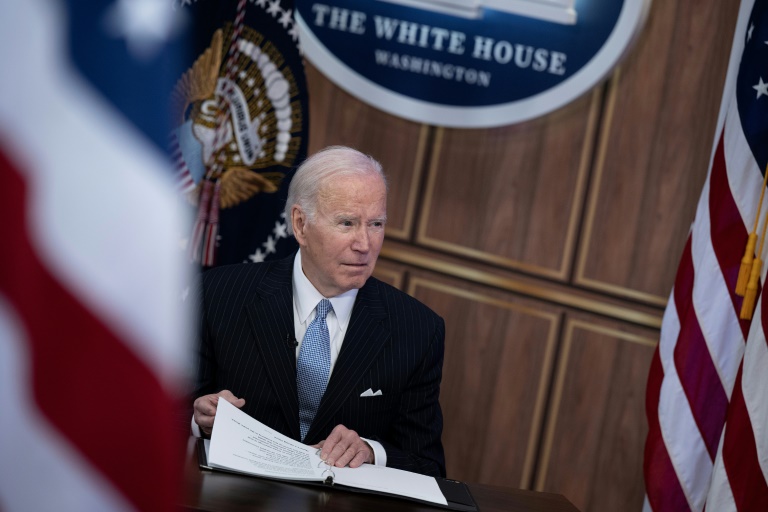
Joe Biden faces the prospect of a crippling strike by railroad unions that could stall transport of fuel, corn and drinking water, dramatically complicate holiday season train travel, and dent the US president’s political standing.

If an agreement is not reached by December 9 at the latest, the world’s largest economy could see nearly 7,000 freight trains grind to a halt, at a cost of more than $2 billion a day, according to the American Association of Railroads.

Biden himself has got “involved directly” in the negotiations aimed at averting a work stoppage, White House spokeswoman Karine Jean-Pierre said Tuesday.

“I don’t want to get into details at this time, but he has been involved,” she said.

In a country where some 28 percent of all goods are transported by rail, according to 2019 statistics, “a shutdown is unacceptable because of the harm… imposed on jobs, families, farms, businesses, and communities” nationwide, Jean-Pierre added.

A large-scale strike would affect multiple sectors, even the supply of drinking water, given than many of the chemicals used in treatment plants are transported by train.

A freight freeze would also impact passenger service, because some passenger trains run on tracks owned by freight companies.

The stoppage threat is the result of a complex negotiation involving members of 12 unions and their employers, with Biden weighing in to flex his political muscle.

– Too soon? –

The risk of a major labor dispute actually has existed for months, with the White House narrowly averting a strike in September.

In a self-congratulatory move, the president welcomed labor leaders to the Oval Office on September 15 to celebrate an agreement in principle, after hours of intense negotiations that had stalled in particular on the issue of sick leave.

Biden at the time went as far as to hail “a big win for America” during a speech in the Rose Garden.

The presidential celebration now appears premature. That agreement still required the ratification from members of the 12 unions in question, but four of the labor groups do not support it.

There are still two weeks to reach a deal. In the end, if only one of the unions goes on strike, the others will follow suit.

The impasse is a difficult one for Biden. He is a huge supporter of rail transportation who as a US senator traveled by train daily between Washington and his family living in the state of Delaware, and throughout his career has rarely missed an opportunity to express support for labor unions.

But with US inflation sky high, and holidays fast approaching, he can hardly afford such transport woes.

As the 79-year-old Democrat mulls a re-election bid in 2024, a rail strike could jeopardize the political momentum he has earned since the November 8 midterm elections, when his party averted major losses to Republicans.

One possibility is the intervention of Congress, which has the power under the 1926 Railway Labor Act to keep the railroads operating. 
Looming freight train strike could derail Biden political momentum

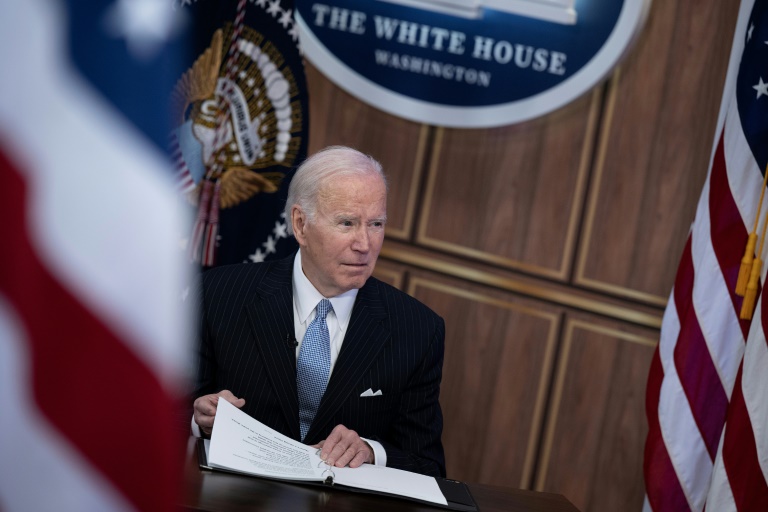
Joe Biden faces the prospect of a crippling strike by railroad unions that could stall transport of fuel, corn and drinking water, dramatically complicate holiday season train travel, and dent the US president’s political standing.

If an agreement is not reached by December 9 at the latest, the world’s largest economy could see nearly 7,000 freight trains grind to a halt, at a cost of more than $2 billion a day, according to the American Association of Railroads.

Biden himself has got “involved directly” in the negotiations aimed at averting a work stoppage, White House spokeswoman Karine Jean-Pierre said Tuesday.

“I don’t want to get into details at this time, but he has been involved,” she said.

In a country where some 28 percent of all goods are transported by rail, according to 2019 statistics, “a shutdown is unacceptable because of the harm… imposed on jobs, families, farms, businesses, and communities” nationwide, Jean-Pierre added.

A large-scale strike would affect multiple sectors, even the supply of drinking water, given than many of the chemicals used in treatment plants are transported by train.

A freight freeze would also impact passenger service, because some passenger trains run on tracks owned by freight companies.

The stoppage threat is the result of a complex negotiation involving members of 12 unions and their employers, with Biden weighing in to flex his political muscle.

– Too soon? –

The risk of a major labor dispute actually has existed for months, with the White House narrowly averting a strike in September.

In a self-congratulatory move, the president welcomed labor leaders to the Oval Office on September 15 to celebrate an agreement in principle, after hours of intense negotiations that had stalled in particular on the issue of sick leave.

Biden at the time went as far as to hail “a big win for America” during a speech in the Rose Garden.

The presidential celebration now appears premature. That agreement still required the ratification from members of the 12 unions in question, but four of the labor groups do not support it.

There are still two weeks to reach a deal. In the end, if only one of the unions goes on strike, the others will follow suit.

The impasse is a difficult one for Biden. He is a huge supporter of rail transportation who as a US senator traveled by train daily between Washington and his family living in the state of Delaware, and throughout his career has rarely missed an opportunity to express support for labor unions.

But with US inflation sky high, and holidays fast approaching, he can hardly afford such transport woes.

As the 79-year-old Democrat mulls a re-election bid in 2024, a rail strike could jeopardize the political momentum he has earned since the November 8 midterm elections, when his party averted major losses to Republicans.

One possibility is the intervention of Congress, which has the power under the 1926 Railway Labor Act to keep the railroads operating. 

European, US stocks up despite China Covid fears

Global stocks mostly rose Tuesday, shrugging off worries about inflation and the potential reinstatement of severe China Covid-19 restrictions ahead of the kickoff of the holiday shopping season.

London, Paris and Frankfurt closed in the green while Wall Street secured solid gains following a rally in beaten-down tech shares such as Facebook parent Meta and Google parent Alphabet that have lagged the broader market for much of 2022.

Briefing.com analyst Patrick O’Hare said Tuesday’s rally reflected “the vicissitudes of a holiday market” two days before the Thanksgiving break when there were few major economic indicators.

Analysts also cited good results from Best Buy and some other retailers which offered hope that a resilient American consumer will keep spending during the critical shopping season that begins on “Black Friday.”

But analysts continued to monitor the state of play in China, which over the weekend reported its first Covid-19 fatalities in months.

“Some investors are convinced that China’s reopening is a formality and will be catalysed by the WHO downgrading Covid to an endemic. We know China’s reopening will be laced with fits and starts,” said Stephen Innes of SPI Asset Management.

Traders are fearful that Chinese authorities will revert to highly restrictive Covid containment measures that have already dealt a chilling blow to its economy this year. 

“Renewed crackdowns in the world’s second largest economy raise the prospect of a global recession,” City Index analyst Fiona Cincotta told AFP.

World oil prices also clawed back ground, having tumbled on Monday to lows unseen since January, with the rebound attributed in part to the Saudi Arabian denial of a report of a possible OPEC production boost.

The dollar slid against main rivals ahead of minutes from the Federal Reserve’s latest policy meeting that saw it carry out another big hike to US interest rates.

Hopes that the central bank will begin to take its foot off the pedal were boosted earlier this month by figures showing US inflation slowed more than expected, suggesting a series of hikes were beginning to bite.

The OECD forecast Tuesday that world economic growth will slow sharply from 3.1 percent this year to 2.2 percent next year on high inflation.

And it warned of “serious headwinds” including rising interest rates, surging energy prices and Russia’s war on Ukraine.

Among individual companies, Manchester United soared 14.7 percent following a Sky News report that the team’s US-based owners, the Glazer family, could sell the venture.

The report came as the team announced that Portuguese star Cristiano Ronaldo was leaving the club immediately following a broadcast interview in which he sharply criticized the Glazer family.

Late Tuesday, Manchester United released a statement saying its board is “commencing a process to explore strategic alternatives for the club,” including a possible sale.

– Key figures around 2200 GMT –

New York – Dow: UP 1.2 percent at 34,098.10 (close)

New York – S&P 500: UP 1.4 percent at 4,003.58 (close)

New York – Nasdaq: UP 1.4 percent at 11,174.84 (close)

London – FTSE 100: UP 1.0 percent at 7,452.84 (close)

Paris – CAC 40: UP 0.4 percent at 6,657.53 (close)

Frankfurt – DAX: UP 0.3 percent at 14,422.35 (close)

EURO STOXX 50: UP 0.5 percent at 3,929.90 (close)

Tokyo – Nikkei 225: UP 0.6 percent at 28,115.74 (close)

Hong Kong – Hang Seng Index: DOWN 1.3 percent at 17,424.41 (close)

Shanghai – Composite: UP 0.1 percent at 3,088.94 (close)

Euro/dollar: UP at $1.0305 from $1.0242 on Monday

Dollar/yen: DOWN at 141.20 yen from 142.14 yen

Pound/dollar: UP at $1.1886 from $1.1823

Euro/pound: UP at 86.66 pence from 86.63 pence

Brent North Sea crude: UP 1.0 percent at $88.36 per barrel

West Texas Intermediate: UP 1.1 percent at $80.95 per barrel

European, US stocks up despite China Covid fears

Global stocks mostly rose Tuesday, shrugging off worries about inflation and the potential reinstatement of severe China Covid-19 restrictions ahead of the kickoff of the holiday shopping season.

London, Paris and Frankfurt closed in the green while Wall Street secured solid gains following a rally in beaten-down tech shares such as Facebook parent Meta and Google parent Alphabet that have lagged the broader market for much of 2022.

Briefing.com analyst Patrick O’Hare said Tuesday’s rally reflected “the vicissitudes of a holiday market” two days before the Thanksgiving break when there were few major economic indicators.

Analysts also cited good results from Best Buy and some other retailers which offered hope that a resilient American consumer will keep spending during the critical shopping season that begins on “Black Friday.”

But analysts continued to monitor the state of play in China, which over the weekend reported its first Covid-19 fatalities in months.

“Some investors are convinced that China’s reopening is a formality and will be catalysed by the WHO downgrading Covid to an endemic. We know China’s reopening will be laced with fits and starts,” said Stephen Innes of SPI Asset Management.

Traders are fearful that Chinese authorities will revert to highly restrictive Covid containment measures that have already dealt a chilling blow to its economy this year. 

“Renewed crackdowns in the world’s second largest economy raise the prospect of a global recession,” City Index analyst Fiona Cincotta told AFP.

World oil prices also clawed back ground, having tumbled on Monday to lows unseen since January, with the rebound attributed in part to the Saudi Arabian denial of a report of a possible OPEC production boost.

The dollar slid against main rivals ahead of minutes from the Federal Reserve’s latest policy meeting that saw it carry out another big hike to US interest rates.

Hopes that the central bank will begin to take its foot off the pedal were boosted earlier this month by figures showing US inflation slowed more than expected, suggesting a series of hikes were beginning to bite.

The OECD forecast Tuesday that world economic growth will slow sharply from 3.1 percent this year to 2.2 percent next year on high inflation.

And it warned of “serious headwinds” including rising interest rates, surging energy prices and Russia’s war on Ukraine.

Among individual companies, Manchester United soared 14.7 percent following a Sky News report that the team’s US-based owners, the Glazer family, could sell the venture.

The report came as the team announced that Portuguese star Cristiano Ronaldo was leaving the club immediately following a broadcast interview in which he sharply criticized the Glazer family.

Late Tuesday, Manchester United released a statement saying its board is “commencing a process to explore strategic alternatives for the club,” including a possible sale.

– Key figures around 2200 GMT –

New York – Dow: UP 1.2 percent at 34,098.10 (close)

New York – S&P 500: UP 1.4 percent at 4,003.58 (close)

New York – Nasdaq: UP 1.4 percent at 11,174.84 (close)

London – FTSE 100: UP 1.0 percent at 7,452.84 (close)

Paris – CAC 40: UP 0.4 percent at 6,657.53 (close)

Frankfurt – DAX: UP 0.3 percent at 14,422.35 (close)

EURO STOXX 50: UP 0.5 percent at 3,929.90 (close)

Tokyo – Nikkei 225: UP 0.6 percent at 28,115.74 (close)

Hong Kong – Hang Seng Index: DOWN 1.3 percent at 17,424.41 (close)

Shanghai – Composite: UP 0.1 percent at 3,088.94 (close)

Euro/dollar: UP at $1.0305 from $1.0242 on Monday

Dollar/yen: DOWN at 141.20 yen from 142.14 yen

Pound/dollar: UP at $1.1886 from $1.1823

Euro/pound: UP at 86.66 pence from 86.63 pence

Brent North Sea crude: UP 1.0 percent at $88.36 per barrel

West Texas Intermediate: UP 1.1 percent at $80.95 per barrel

US Senate candidate challenged by abortion accuser before runoff

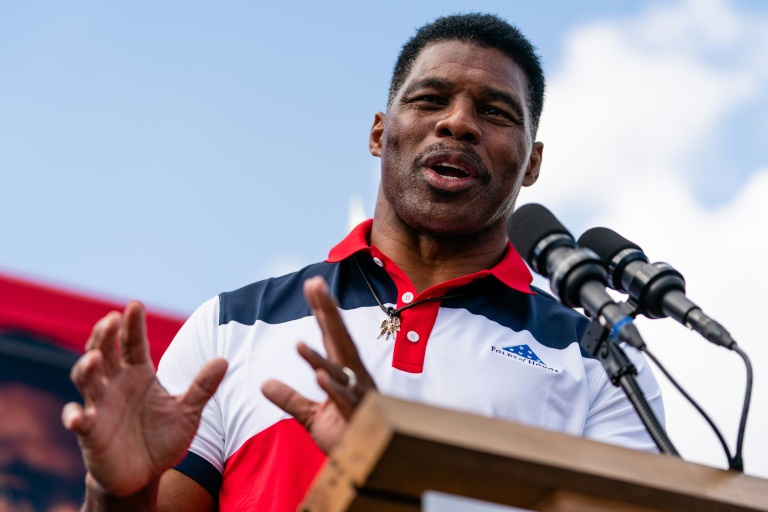
A US woman who says anti-abortion Republican Senate candidate Herschel Walker pressured her into terminating her pregnancy has challenged him to deny her story face-to-face, before next month’s runoff election in Georgia.

Walker has previously denied even knowing the woman, who is one of two to come forward alleging they had intimate relations with the former American football star and that he paid for abortions after impregnating them.

The challenge comes as the one-time Dallas Cowboys star prepares to face off again with Democratic Senator Raphael Warnock, after neither earned a simple majority of votes in Georgia to win the seat in this month’s midterm election.

“Herschel, I never thought you would deny knowing me, or our relationship,” said the anonymous accuser at a Los Angeles press conference Tuesday.

“Are you really willing to do anything — including lying to the voters in Georgia — to become a senator?”

“Do you have the guts to meet with me in person, in public, look me in the eye, and tell me to my face that you don’t know me?”

The woman says she began her relationship with Walker, who was married, in November 1987, and learned she was pregnant in April 1993.

She alleges that Walker drove her back to an abortion clinic after she initially went to get the procedure alone but hesitated.

The Trump-endorsed Walker has made an anti-abortion stance a key plank of his campaign for one of Georgia’s two seats in the US Senate. 

At Tuesday’s press conference, celebrity attorney Gloria Allred presented additional evidence of the alleged relationship, including handwritten letters and diary entries.

Allred played a voicemail audio message in which a man claimed to be Walker is heard saying: “This is your stud farm calling, you big sex puppy.”

Walker’s campaign has been beset by controversy, including allegations of past domestic abuse, an exaggerated resume, and fathering children outside of his marriage.

Last month, a different woman came forward to accuse Walker of paying for her 2009 abortion. Walker has denied both allegations.

The Republicans have already failed to win the Senate, but a defeat for Walker in the tight race on December 6 would see the Democrats extend their razor-thin majority in the upper house of Congress.

Allred challenged Walker to meet his accuser in a public place “at a time and date of your choosing prior to December 6 to respond to the evidence we have presented.”

“If you don’t agree… we think it is fair for the voters in Georgia to conclude that Jane Doe is telling the truth and that you are not being transparent and honest with the voters in Georgia.”

The anonymous accuser added: “I think it’s up to the voters of Georgia to decide who they want to represent them, and who to believe.”

Walker did not immediately respond.

New York judge sets fraud trial date for Trump

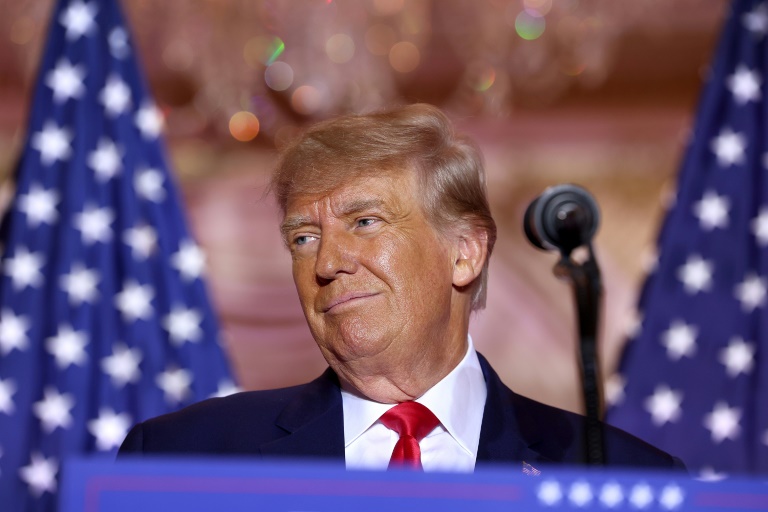
Donald Trump and his three eldest children will go on trial late next year in a civil lawsuit brought by New York’s attorney general that accuses them of fraud, a judge ruled Tuesday.

Justice Arthur Engoron of the Manhattan Supreme Court set a trial date of October 2, 2023 in the case that alleges Trump and his family members misstated the value of properties to enrich themselves.

The trial — and a host of criminal, civil and congressional probe cases that Trump is facing — will likely complicate the ex-president’s run for a second term in office, which he announced last week.

The date, which Trump attorneys are likely to try to delay, would come close to the start of primaries season for the 2024 Republican presidential nomination.

Top New York prosecutor Letitia James sued Trump, Donald Trump Jr, Eric Trump, Ivanka Trump and the Trump Organization in September alleging they lied to tax collectors, lenders and insurers for years.

She says they provided fraudulent statements of Trump’s net worth and false asset valuations “to obtain and satisfy loans, get insurance benefits, and pay lower taxes.”

James, a Democrat, has requested that Trump pay at least $250 million in penalties — a sum she says he made from the fraud — and that his family be banned from running businesses in the state. 

Her office does not have the power to file criminal charges in the case.

Trump, 76, says the lawsuit is politically motivated. He has repeatedly tried to have it dismissed.

– Tax returns –

He endured another legal blow Tuesday when the Supreme Court cleared the way for his tax returns to be handed over to a committee of the Democratic-majority House of Representatives.

Unlike presidents since the 1970s, Trump refused to release the records while in office and took to the courts to block the congressional request.

That legal fight appeared to hit the end of the road when the justices ruled without comment that the returns should be handed over to the House Ways and Means Committee.

The committee has been seeking tax returns from Trump and his related business entities for 2015 to 2020.

The handover of the returns to the committee does not necessarily mean they will become publicly available.

The move comes with just a few weeks remaining in the term of the current Congress, and Republican lawmakers will take over the House in January after winning a slight majority in the November 8 midterm elections. 

Although the Supreme Court was overhauled by Trump, its justices have never ruled in his favor in this area, notably authorizing in 2020 the transfer of his tax records and business documents to the Manhattan district attorney’s office.

Manhattan prosecutors have charged the Trump Organization with hiding compensation it paid to top executives between 2005 and 2021.

Trump is also facing legal scrutiny for his efforts to overturn the results of the November 2020 election and over the January 6, 2021 attack on the US Capitol by his supporters.

French regulator approves state bid to renationalise power giant

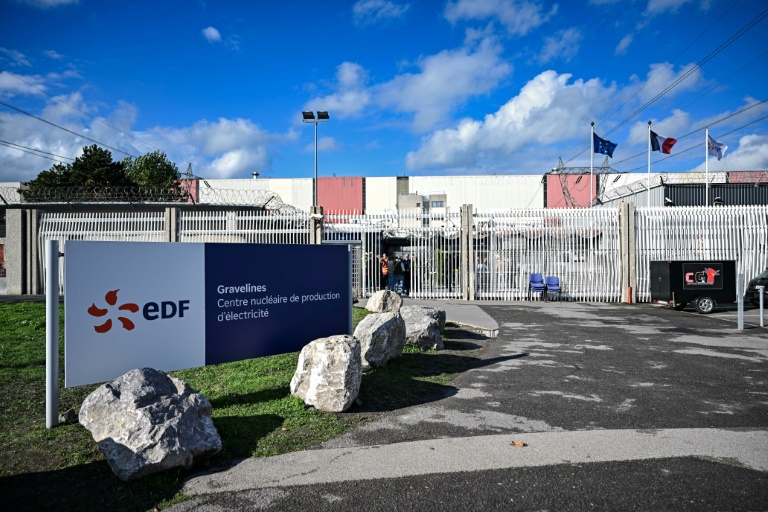
France’s financial markets regulator on Tuesday approved the state’s plan to fully control heavily indebted national power utility EDF that is to spearhead efforts to relaunch the French nuclear industry.

The French state, which already owns 84 percent of EDF, filed a takeover offer with the regulator in October with a view to acquiring the remaining capital at 12 euros ($12) per share.

The Financial Markets Authority (AMF) in a Tuesday statement said the offer complied with stock market rules.

The acquisition of the shares is due to take place up to December 8. If the French state takes its holding to 90 percent, it can force other shareholders to sell.

The entire takeover operation is expected to cost 9.7 billion euros.

The French government in July signalled its intention to fully reabsorb EDF, which could be saddled with a record debt of 60 billion euros by the end of the year.

It wants to build six new-generation nuclear reactors with an option to acquire eight others, with the strategic full acquisition of EDF aiming to send a signal of confidence.

France relies heavily on nuclear power for its electricity generation, but its oldest reactors are reaching the end of their service lives.

EDF’s efforts to build a new generation of nuclear power plants have faced massive delays and cost overruns, with some of its facilities unavailable due to corrosion problems, scheduled maintenance and strikes.

A price shield that protects French consumers from excessively high energy price hikes has also contributed to its financial struggles.

Small shareholders, mostly former and current staff, have disputed the takeover bid, asking for at least 15 euros per share, but their legal action has so far been unsuccessful.

'Hardcore' Musk drives into a culture clash at Twitter

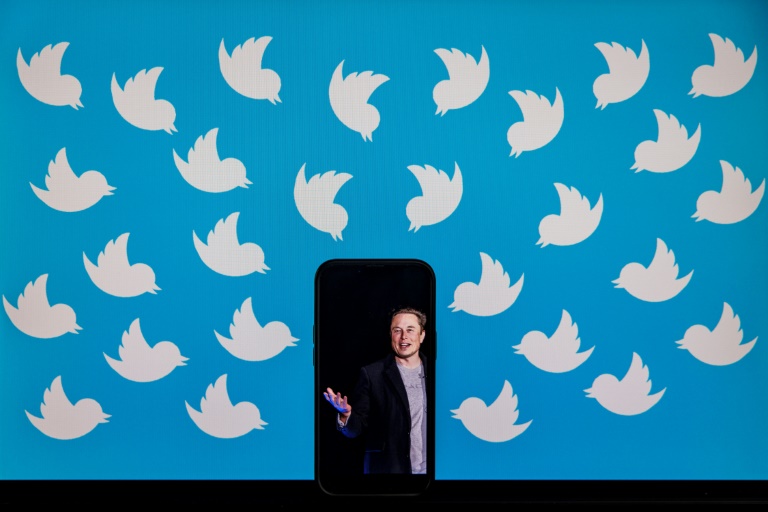
After snapping up Twitter, one of Silicon Valley’s most iconic companies, Elon Musk swiftly introduced his no-holds-barred work ethic, setting up a bitter culture clash with thousands of workers who still believed in the platform’s higher mission.

In less than a month, Musk sacked half the company’s 7,500 employees, axed executives and engineers who disagreed with him and finally imposed an ultimatum: work “extremely hardcore” or leave. 

The style is reminiscent of what Musk pushed through at Tesla, SpaceX and his other companies, where the multi-billionaire drove his teams hard, seeing their personal sacrifice as the key to success. 

After an initial willingness to wait and see, Musk’s style has proved disconcerting in a company culture that valued ethics and a strong sense of community, even when worked hard.

“I have the impression that Musk really likes humanity but not so much humans,” said Emmanuel Cornet, a software engineer who was among the first to be fired from the social media company after the acquisition on October 27.

Before that, he’d been one of the many employees genuinely curious to see the successful entrepreneur at work, despite his propensity for provocation that has delighted so many of his fans.

“I think we had blinkers on. Most of the employees tried to give him the benefit of the doubt for as long as possible, and also because finding another job is not necessarily easy,” he said.

But Musk, beyond the big smiles and enthusiastic declarations, has lived up to his reputation, with those remaining having no choice but to give their job their all.

“His behavior is still of the bully on the playground, firing anyone who tells him he’s wrong,” said Sarah Roberts, a social media professor at UCLA. “Any kind of criticism with his wildly inaccurate … statements gets you fired.”

– No ‘respect’ –

Cornet was particularly shocked by what he called a lack of respect from the richest man in the world. 

“In the long term, objectively, he seems to be trying to help the planet, with electric cars, in particular,” he said. “But the people around him seem disposable.”

Musk brings “this kind of swashbuckling bravado from being an entrepreneur interested in things like rockets and cars and big hardware that has impressive performance and really wows people,” said John Wihbey, a media professor at Northeastern University.

“The Twitter culture is much more low key. It has a politically progressive, geeky, pro-social vibe,” he said.

The libertarian entrepreneur has long had close ties with Silicon Valley, where he co-founded Tesla.

But he has since disavowed politically liberal California, railing against health restrictions during the pandemic and becoming a hero to conservative libertarians online. 

At the end of 2021, he moved the headquarters of his flagship company to Texas, a majority conservative state. 

Twitter was founded by Jack Dorsey, who “is very much this kind of Zen guru, sort of a spiritual seeker vibe,” said Wihbey.

Employees of the network were “proud to work there”, he said. “They really believed in the product.”

Cornet worked 14 years at Google before going to Twitter, two groups which, at the time, did not seem “obsessed with profits.” 

“The sense of community at Twitter is so strong it continues after” the layoffs, he said with admiration. Ex-employees gather on Discord, WhatsApp, signal and other platforms to support each other and be nostalgic.

– ‘Badge of honor’ –

Many former “tweeps” said they were okay with working hard, but not just for bombastic promises, like “building a revolutionary Twitter 2.0”, and at the mercy of brutal decision-making. 

When an employee asked during a meeting about the risk of attrition, Musk replied that he had no “great answer.” 

“I can tell you what works at Tesla is people being in the office and being hardcore,” he said.

The mercurial leader abhors work from home –- which is very popular with computer engineers –- and loves to tell how he slept on site at Tesla when his company was “on the verge of bankruptcy.” 

“He was able to drive things hard at Neuralink, Tesla, or Solar City because they had technologies that were on the frontier or, in the case of Tesla, far enough ahead of most other commercial automakers. He has a highly committed workforce there,” said Jeffrey Sonnenfeld, professor at Yale University. 

At Twitter, on the other hand, the massive layoffs, the new culture of coercion and Musk’s “whims” are not likely to rally the staff, said Sonnenfeld, a specialist in corporate governance. 

“At this stage,” said Sarah Roberts, “for many it’s a badge of honor to have been fired by Elon.”

European, US stocks up despite China Covid fears

European and US stocks rose and oil prices recovered from heavy losses on Tuesday despite fresh concern that China’s latest Covid-19 outbreaks could herald a global recession.

London, Paris and Frankfurt closed in the green while Wall Street was also up even as worries grew over the economic fallout of Beijing’s efforts to contain rising infections in the world’s second-largest economy.

“China remains entirely polarising,” noted Stephen Innes of SPI Asset Management.

“Some investors are convinced that China’s reopening is a formality and will be catalysed by the WHO downgrading Covid to an endemic. We know China’s reopening will be laced with fits and starts,” he added.

“You cannot rule out more intermittent lockdowns in the near term, but in a more targeted way instead of widespread.”

Traders are fearful that Chinese authorities will revert to highly restrictive Covid containment measures that have already dealt a chilling blow to its economy this year. 

“Renewed crackdowns in the world’s second largest economy raise the prospect of a global recession,” City Index analyst Fiona Cincotta told AFP.

Craig Erlam, senior market analyst at OANDA trading platform, cautioned that this week “may just be a void in an otherwise turbulent year” thanks to a lack of major events and the US Thanksgiving public holiday.

World oil prices also clawed back ground, having tumbled on Monday to lows unseen since January on forecasts of a hit to Chinese demand, although analysts warned the recovery could be constrained.

“The upside potential is being limited by a general sense of uncertainty brought by China’s unclear demand prospects while also being impacted by the ongoing Russia-Ukraine conflict,” said Walid Koudmani, chief market analyst at XTB.

Erlam added that the rejection by OPEC+ members of reports they would boost oil production aided the commodity’s rally.

The dollar slid against main rivals ahead of minutes from the Federal Reserve’s latest policy meeting that saw it carry out another big hike to US interest rates.

Hopes that the central bank will begin to take its foot off the pedal were boosted earlier this month by figures showing US inflation slowed more than expected, suggesting a series of hikes were beginning to bite.

– ‘Serious headwinds’ –

The OECD forecast Tuesday that world economic growth will slow sharply from 3.1 percent this year to 2.2 percent next year on high inflation.

And it warned of “serious headwinds” including rising interest rates, surging energy prices and Russia’s war on Ukraine.

Global stock markets began November with a rally on easing inflation concerns and signs China was edging towards a looser approach to the disease.

However, the optimism has been given a massive jolt since the country announced its first virus deaths in six months.

Case numbers have surged across China, just a week after it said it would begin rolling back some of the strict Covid rules that have been in place since the pandemic started in 2020.

– Key figures around 1630 GMT –

London – FTSE 100: UP 1.0 percent at 7,452.84 points (close)

Paris – CAC 40: UP 0.4 percent at 6,657.53 (close)

Frankfurt – DAX: UP 0.3 percent at 14,422.35 (close)

EURO STOXX 50: UP 0.5 percent at 3,929.90

New York – Dow: UP 0.8 percent at 33,959.30

Tokyo – Nikkei 225: UP 0.6 percent at 28,115.74 (close)

Hong Kong – Hang Seng Index: DOWN 1.3 percent at 17,424.41 (close)

Shanghai – Composite: UP 0.1 percent at 3,088.94 (close)

Euro/dollar: UP at $1.0271 from $1.0242 on Monday

Dollar/yen: DOWN at 141.43 yen from 142.14 yen

Pound/dollar: UP at $1.1865 from $1.1823

Euro/pound: DOWN at 86.55 pence from 86.63 pence

Brent North Sea crude: UP 1.5 percent at $88.80 per barrel

West Texas Intermediate: UP 1.5 percent at $81.22 per barrel

European, US stocks up despite China Covid fears

European and US stocks rose and oil prices recovered from heavy losses on Tuesday despite fresh concern that China’s latest Covid-19 outbreaks could herald a global recession.

London, Paris and Frankfurt closed in the green while Wall Street was also up even as worries grew over the economic fallout of Beijing’s efforts to contain rising infections in the world’s second-largest economy.

“China remains entirely polarising,” noted Stephen Innes of SPI Asset Management.

“Some investors are convinced that China’s reopening is a formality and will be catalysed by the WHO downgrading Covid to an endemic. We know China’s reopening will be laced with fits and starts,” he added.

“You cannot rule out more intermittent lockdowns in the near term, but in a more targeted way instead of widespread.”

Traders are fearful that Chinese authorities will revert to highly restrictive Covid containment measures that have already dealt a chilling blow to its economy this year. 

“Renewed crackdowns in the world’s second largest economy raise the prospect of a global recession,” City Index analyst Fiona Cincotta told AFP.

Craig Erlam, senior market analyst at OANDA trading platform, cautioned that this week “may just be a void in an otherwise turbulent year” thanks to a lack of major events and the US Thanksgiving public holiday.

World oil prices also clawed back ground, having tumbled on Monday to lows unseen since January on forecasts of a hit to Chinese demand, although analysts warned the recovery could be constrained.

“The upside potential is being limited by a general sense of uncertainty brought by China’s unclear demand prospects while also being impacted by the ongoing Russia-Ukraine conflict,” said Walid Koudmani, chief market analyst at XTB.

Erlam added that the rejection by OPEC+ members of reports they would boost oil production aided the commodity’s rally.

The dollar slid against main rivals ahead of minutes from the Federal Reserve’s latest policy meeting that saw it carry out another big hike to US interest rates.

Hopes that the central bank will begin to take its foot off the pedal were boosted earlier this month by figures showing US inflation slowed more than expected, suggesting a series of hikes were beginning to bite.

– ‘Serious headwinds’ –

The OECD forecast Tuesday that world economic growth will slow sharply from 3.1 percent this year to 2.2 percent next year on high inflation.

And it warned of “serious headwinds” including rising interest rates, surging energy prices and Russia’s war on Ukraine.

Global stock markets began November with a rally on easing inflation concerns and signs China was edging towards a looser approach to the disease.

However, the optimism has been given a massive jolt since the country announced its first virus deaths in six months.

Case numbers have surged across China, just a week after it said it would begin rolling back some of the strict Covid rules that have been in place since the pandemic started in 2020.

– Key figures around 1630 GMT –

London – FTSE 100: UP 1.0 percent at 7,452.84 points (close)

Paris – CAC 40: UP 0.4 percent at 6,657.53 (close)

Frankfurt – DAX: UP 0.3 percent at 14,422.35 (close)

EURO STOXX 50: UP 0.5 percent at 3,929.90

New York – Dow: UP 0.8 percent at 33,959.30

Tokyo – Nikkei 225: UP 0.6 percent at 28,115.74 (close)

Hong Kong – Hang Seng Index: DOWN 1.3 percent at 17,424.41 (close)

Shanghai – Composite: UP 0.1 percent at 3,088.94 (close)

Euro/dollar: UP at $1.0271 from $1.0242 on Monday

Dollar/yen: DOWN at 141.43 yen from 142.14 yen

Pound/dollar: UP at $1.1865 from $1.1823

Euro/pound: DOWN at 86.55 pence from 86.63 pence

Brent North Sea crude: UP 1.5 percent at $88.80 per barrel

West Texas Intermediate: UP 1.5 percent at $81.22 per barrel

Close Bitnami banner
Bitnami