US Business

Europe stocks mostly drop before UK budget

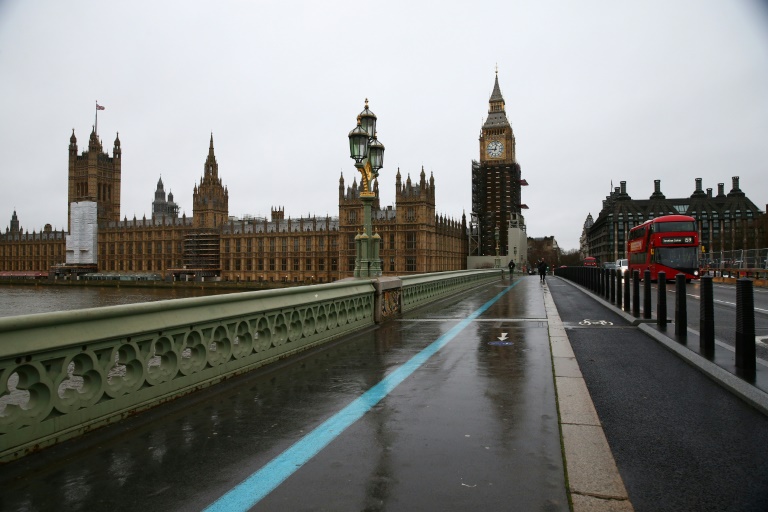
European equities mostly fell Thursday with London on tenterhooks before a painful UK budget set to rip up the country’s economic forecasts.

The British stock market slid 0.6 percent and the pound fell versus the dollar as finance minister Jeremy Hunt readied a budget that will hike taxes and slash spending in a bid to balance the books.

In the eurozone, Paris lost 0.5 percent but Frankfurt won 0.2 percent on upbeat Siemens results, and after a mixed Asian session.

Investors also tracked fresh Russian strikes that hit cities across Ukraine, having been spooked Wednesday by a deadly missile blast in Poland.

Thursday’s focus remains squarely on Britain’s announcement which is scheduled for 1130 GMT.

Traders fear the budget will worsen Britain’s cost-of-living crisis after inflation spiked to a 1981 peak of 11.1 percent, as the economy heads toward recession. 

“Hunt is poised to unveil a raft of spending cuts and tax increases to plug the estimated £55 billion ($65 billion) fiscal black hole,” said Interactive Investor analyst Victoria Scholar.

“With a recession on the horizon and the 41-year high inflation there are concerns that we are heading back to an era of austerity and that could add to the woes facing consumers and businesses,” she warned.

The UK government will also give fresh estimates for the country’s growth and inflation.

Elsewhere, Wall Street was hit Wednesday after retailer Target posted weak results and warned of a poor festive shopping season.

Two reports showing inflation easing in the world’s top economy provided a springboard for world markets over much of the past week as investors took the readings to mean almost a year of monetary tightening was finally kicking in.

But on Wednesday the commerce department said retail sales jumped far more than expected last month, suggesting Americans are still able to weather the higher inflation and interest rate environment.

That was compounded by comments from a top Fed official that she did not see the bank stopping rate hikes, indicating she was willing to push borrowing costs above five percent, from the current 3.75 to 4.0 percent.

Traders have for months grown increasingly fearful that the Fed’s hawkish tilt will cause a recession, and policymakers have made clear they are willing to keep lifting even if that means hurting the economy.

The Bank of England, which is also raising interest rates to combat sky-high inflation, says Britain is probably already in recession after its economy shrank in the third quarter and will do so again in the final three months of 2022.

– Key figures around 1000 GMT –

London – FTSE 100: DOWN 0.6 percent at 7,309.46 points

Paris – CAC 40: DOWN 0.5 percent at 6,573.74

Frankfurt – DAX: UP 0.2 percent at 14,262.63

EURO STOXX 50: DOWN 0.2 percent at 3,876.21

Tokyo – Nikkei 225: DOWN 0.4 percent at 27,930.57 (close)

Hong Kong – Hang Seng Index: DOWN 1.2 percent at 18,045.66 (close)

Shanghai – Composite: DOWN 0.2 percent at 3,115.43 (close)

New York – Dow: DOWN 0.1 percent at 33,553.83 points (close)

Pound/dollar: DOWN at $1.1878 from $1.1914 on Wednesday

Euro/dollar: DOWN at $1.0360 from $1.0395

Dollar/yen: UP at 139.67 yen from 139.54 yen

Euro/pound: FLAT at 87.21 pence

Brent North Sea crude: DOWN 0.4 percent at $92.46 per barrel

West Texas Intermediate: DOWN 0.8 percent at $84.94 per barrel
S. Korea, Saudi Arabia agree to boost energy and defence ties

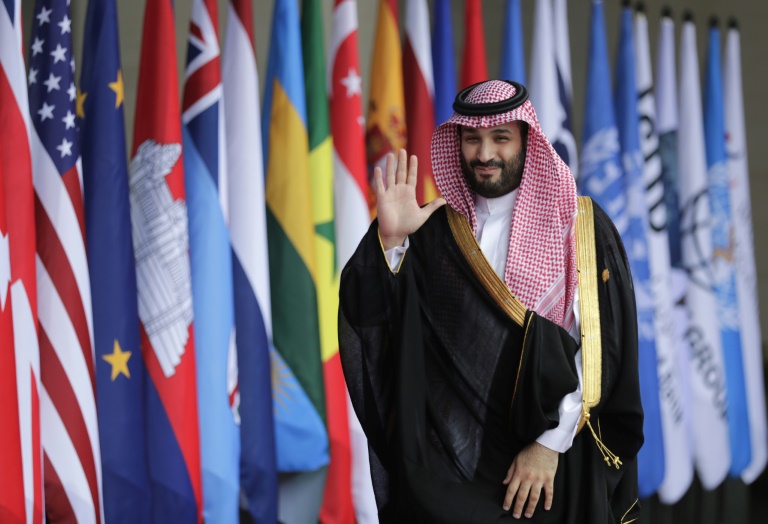
The leaders of South Korea and Saudi Arabia agreed Thursday to boost ties in key sectors such as energy and defence, with the oil-rich kingdom signing a slew of deals including a $6.7 billion petrochemical agreement.

President Yoon Suk-yeol met with Saudi Arabia’s Crown Prince Mohammed bin Salman in the South Korean capital Thursday, with the pair announcing a plan to transform bilateral ties into a “strategic partnership”.

Bin Salman, the kingdom’s 37-year-old de facto ruler, often referred to as MBS, arrived in Seoul late Wednesday after attending the Group of 20 summit in Bali, Indonesia.

He is on a multi-stop Asian tour, in a likely bid to shore up the Gulf nation’s ties with its biggest energy market.

The trip comes as Riyadh feuds with Washington over the OPEC+ oil cartel’s October decision to cut production by two million barrels per day.

Yoon and bin Salman agreed to elevate ties into a “future oriented strategic partnership,” Yoon’s office said in a statement.

The South Korean president wants to see local companies join key Saudi projects such as the NEOM smart city project, and boost cooperation in the defence and energy sectors.

Bin Salman “especially expressed his wish for a significant increase in cooperation in energy, defence and construction industries,” Yoon’s office said.

During the visit, the two governments and companies from both countries — including some of Seoul’s top conglomerates — signed about 20 deals in areas from agriculture to railways. 

Among the agreements was Saudi investment for South Korean refiner S-OIL’s Shaheen project, which would build petrochemical production facilities in South Korea worth $6.7 billion, Yoon’s office said.

Bin Salman, who was officially made Prime Minister in September, has shaken up the ultraconservative oil titan with economic, social and religious reforms since his meteoric rise to power.

He gained global notoriety in connection with the 2018 killing of dissident Saudi journalist Jamal Khashoggi in the kingdom’s Istanbul consulate.

Last year, US President Joe Biden declassified an intelligence report that found Prince Mohammed had approved the operation against Khashoggi, an assertion Saudi authorities deny.

Ukraine grain export deal extended for four months

An agreement allowing Ukraine to export grain through the Black Sea and aimed at relieving global food insecurity has been extended for 120 days, officials said on Thursday.

Ukraine is a top world exporter of grain, but Russia’s invasion in late February stopped shipments. 

The deal between the two warring sides, brokered by Turkey and the UN in July, has helped transport more than 11 million tonnes of grain and other agricultural products from Ukrainian ports since the start of August. It had been due to expire on Saturday.

On Thursday Ukrainian and Turkish officials announced that the agreement would be extended by four months under existing conditions.

“#BlackSeaGrainInitiative will be prolonged for 120 days,” Ukrainian Infrastructure Minister Oleksandr Kubrakov said on Twitter, while a senior Turkish official confirmed to AFP that the deal had been extended “under current terms”.

“I welcome the agreement by all parties to continue the Black Sea Grain Initiative to facilitate the safe navigation of export of grain, foodstuffs and fertilizers from Ukraine,” UN Secretary General Antonio Guterres said in a statement released by the Istanbul-based Joint Coordination Center (JCC) that has been overseeing the agreement. 

-‘Discreet diplomacy’-

The grain deal “continues to demonstrate the importance of discreet diplomacy in the context of finding multilateral solutions,” he said.

The UN chief also sought to allay Moscow’s concerns that a second agreement that was also signed in July, exempting Russian fertilisers from sanctions, had not been implemented.

“The United Nations is also fully committed to removing the remaining obstacles to exporting food and fertilisers from the Russian Federation,” Guterres said.

Both agreements were  “essential to bring down the prices of food and fertiliser and avoid a global food crisis.”

On Wednesday Turkish President Recep Tayyip Erdogan — who has maintained good relations with both Moscow and Kyiv — predicted that the deal would remain in force. 

“I am of the opinion that it (the deal) will continue. There’s no problem there,” he told journalists at the G20 summit in Indonesia. 

“Because the path to peace passes through dialogue,” he said.

The agreement allows Ukrainian grain ships to sail along safe corridors that avoid mines in the Black Sea. 

Ukraine is one of the world’s top grain producers, and Russia’s invasion  blocked 20 million tonnes of grain in its ports before the United Nations and Turkey brokered the deal in July.

burs-fo/yad

Chinese spy jailed for 20 years for economic espionage

A Chinese intelligence officer was sentenced to 20 years in prison by a US court Wednesday for stealing technology from US and French aerospace firms, the Justice Department said.

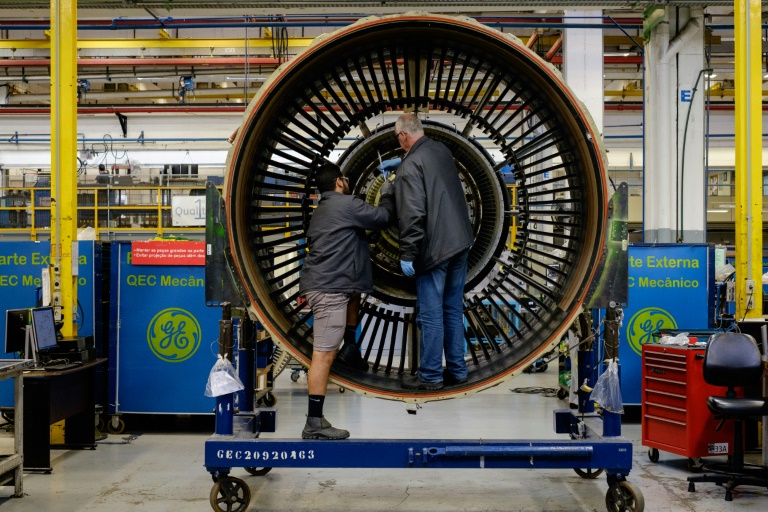
Xu Yanjun was accused of playing a leading role in a five-year Chinese state-backed scheme to steal commercial secrets from GE Aviation, one of the world’s leading aircraft engine manufacturers, and France’s Safran Group, which was working with GE on engine development.

Xu was one of 11 Chinese nationals, including two intelligence officers, named in October 2018 indictments in federal court in Cincinnati, Ohio where GE Aviation is based.

The Chinese Ministry of State Security intelligence officer was arrested in April 2018 in Belgium, where he had apparently been lured into a counter-intelligence operation — he had planned to secretly meet a GE employee on the trip.

He was extradited to the United States, where he was convicted in a jury trial on November 5, 2021 of attempted economic espionage, attempted trade secret theft, and two related conspiracy charges.

“Xu targeted American aviation companies, recruited employees to travel to China, and solicited their proprietary information, all on behalf of the government of the People’s Republic of China,” the Justice Department said in a statement.

“This case sends a clear message: we will hold accountable anyone attempting to steal American trade secrets,” said Ohio federal prosecutor Kenneth Parker.

China’s foreign ministry on Thursday called the charges against Xu “pure fabrication”.

“We ask the US to handle the case fairly, in accordance with the law, and protect the legitimate rights and interests of Chinese citizens,” foreign ministry spokeswoman Mao Ning said at a regular press conference.

Markets hurt as rate hike woes return to the fore

Trading was subdued on Thursday as the optimism that characterised recent sessions was dealt a blow by data showing a resilience among US consumers that gives the Federal Reserve room to keep hiking interest rates.

Two reports showing inflation easing in the world’s top economy provided a springboard for world markets over much of the past week as investors took the readings to mean almost a year of monetary tightening was finally kicking in.

But on Wednesday the commerce department said retail sales jumped far more than expected last month, suggesting Americans are still able to weather the higher inflation and interest rate environment.

That was compounded by comments from a top Fed official that she did not see the bank stopping interest rate hikes, indicating she was willing to push borrowing costs above five percent, from the current 3.75 to 4.0 percent.

San Francisco Fed President Mary Daly told CNBC: “Somewhere between 4.75 and 5.25 seems a reasonable place to think about as we go into the next meeting.

“And so that does put it in the line of sight that we would get to a point where we would raise and hold.”

“Pausing is off the table right now, it’s not even part of the discussion. Right now the discussion is, rightly, in slowing the pace,” she added.

Traders have for months grown increasingly fearful that the hawkish tilt by the central bank will cause a recession, and policymakers have made clear they are willing to keep lifting even if that means hurting the economy.

JPMorgan Chase said the United States would tip into a “mild” recession in 2023 owing to the rate increases, adding that it saw the Fed easing policy the following year in 2024.

“Every time equity and bond markets are thinking the Fed is done and start taking off in a rally, the Fed gets out and starts talking that back down again,” Cheryl Smith, of Trillium Asset Management, told Bloomberg Television.

Hong Kong lost more than one percent, hit by profit-taking after a 14 percent surge between Friday and Tuesday, while there were also losses in Shanghai.

Still, observers said there were signs of optimism in Chinese markets after Beijing moved to ease some of its strict Covid restrictions and provide much-needed help to the property sector.

Tokyo, Seoul, Taipei, Mumbai and Bangkok also fell, though Singapore, Sydney, Wellington, Jakarta and Manila edged up.

The pound edged back against the dollar as Britain prepares for what is expected to be a grim budget later in the day by Finance Minister Jeremy Hunt, who has flagged a jump in taxes and spending cuts.

The announcement comes a day after figures showed UK inflation spiked at 11.1 percent in October, the highest since 1981, as the country is hammered by a cost-of-living crisis.

London opened slightly lower, while Paris and Frankfurt rose.

– Key figures around 0820 GMT –

Tokyo – Nikkei 225: DOWN 0.4 percent at 27,930.57 (close)

Hong Kong – Hang Seng Index: DOWN 1.2 percent at 18,045.66 (close)

Shanghai – Composite: DOWN 0.2 percent at 3,115.43 (close)

London – FTSE 100: DOWN 0.1 percent at 7,345.30

Pound/dollar: UP at $1.1933 from $1.1914 on Wednesday

Euro/dollar: DOWN at $1.0389 from $1.0395

Dollar/yen: DOWN at 139.18 yen from 139.54 yen

Euro/pound: DOWN at 87.05 pence from 87.21 pence

West Texas Intermediate: DOWN 0.7 percent at $85.02 per barrel

Brent North Sea crude: DOWN 0.2 percent at $92.65 per barrel

New York – Dow: DOWN 0.1 percent at 33,553.83 points (close)

N. Korea fires missile hours after warning of 'fiercer' response

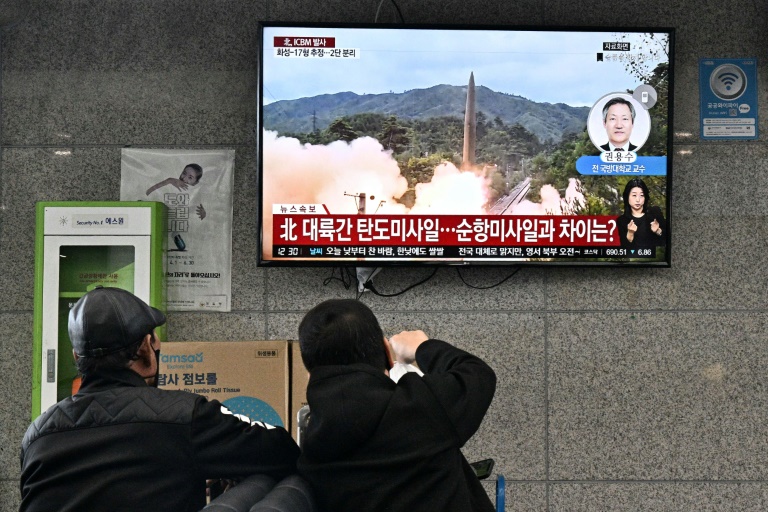
North Korea fired a short-range ballistic missile Thursday, Seoul’s military said, the latest in a record blitz of launches as Pyongyang warned of a “fiercer” military response to the United States and its allies.

Washington has been seeking to boost regional security cooperation and ramp up joint military drills in response to increasing provocations from the nuclear-armed North, which views all such moves as evidence of US aggression.

US President Joe Biden discussed North Korea’s recent missile tests with Chinese counterpart Xi Jinping earlier this week, and also spoke with leaders from Tokyo and Seoul, as fears grow that the reclusive regime will soon carry out its seventh nuclear test.

Washington’s moves to bolster its “extended deterrence” and stage joint exercises with regional security allies are “foolish acts”, North Korea’s minister of foreign affairs, Choe Son Hui, said Thursday in a statement carried by state news agency KCNA.

The more Washington boosts security cooperation with Tokyo and Seoul, “the fiercer the DPRK’s military counteraction will be”, Choe said, referring to the North by its official name of the Democratic People’s Republic of Korea.

South Korea’s Joint Chiefs of Staff said the military had “detected around 10:48 am (0148 GMT) one short-range ballistic missile fired from the Wonsan area in Kangwon province”.

The missile flew approximately 240 km (150 miles) at an altitude of 47 km and speed of Mach 4, the military said. 

“South Korea and the US reaffirmed their strong joint defense posture through joint missile defense drill conducted today,” it said, referring to a planned exercise.

Japan also confirmed North Korea had fired a missile, with the prime minister’s office saying Pyongyang’s actions “including repeated launches of ballistic missiles threaten the peace and safety of our country and the regional and international communities”.

Experts said Thursday’s missile launch was timed to coincide with the statement from Pyongyang’s foreign minister. Cheong Seong-chang, a researcher at the Sejong Institute, told AFP it was an attempt to send a message to the United States and Japan.

– UN gridlock –

North Korea conducted a flurry of launches earlier this month, including a November 2 barrage in which it fired 23 missiles — more than during the whole of 2017, the year of “fire and fury” when leader Kim Jong Un traded barbs with then US president Donald Trump.

That blitz came as hundreds of US and South Korean warplanes, including B-1B heavy bombers, participated in joint air drills. Such exercises draw strong reactions from the North, which sees them as rehearsals for an invasion.

Experts say North Korea is seizing the opportunity to conduct banned missile tests, confident of escaping further UN sanctions due to Ukraine-linked gridlock at the United Nations.

China, Pyongyang’s main diplomatic and economic ally, joined Russia in May in vetoing a US-led bid at the UN Security Council to tighten sanctions on North Korea.

Pyongyang has also been under a self-imposed coronavirus blockade since early 2020, which experts say would limit the impact of any additional external sanctions.

Biden pushed China’s Xi to use his influence to rein in North Korea when the pair met on the sidelines of the G20 meeting in Bali, Indonesia.

Washington has responded to North Korea’s sanctions-busting missile tests by extending exercises with the South and deploying a strategic bomber.

“Choe Son Hui’s threatening statement and North Korea’s most recent missile launch are attempts to signal that Pyongyang won’t back down under international pressure,” said Leif-Eric Easley, a professor at Ewha University in Seoul.

Biden also held talks with his South Korean counterpart Yoon Suk-yeol and Japanese Prime Minister Fumio Kishida on Sunday to discuss ways to address the threat posed by the North.

Easley said it was clear that Biden, Yoon and Kishida had taken “substantive steps on trilateral coordination”, even as Xi ended his Covid-linked isolation with a “relative charm offensive” at the G20 summit.

“At some point, Chinese interests will prefer exerting pressure on Pyongyang rather than face a more strategically united US, South Korea and Japan,” Easley said.

Republicans take control of US House, Congress split: projections

Republicans on Wednesday took control of the US House of Representatives from Democrats, networks said, narrowly securing a legislative base to oppose President Joe Biden’s agenda for the final two years of his term –- and leaving power in Congress split.

The slim Republican majority in the lower house of the US legislature will be far smaller than the party had been banking on, and Republicans also failed to take control of the Senate in a historically weak performance in the November 8 midterm elections.

NBC and CNN projected the victory for Republicans with at least 218 seats in the 435-member House of Representatives — the magic number needed to take control. This came a week after millions of Americans went to the polls for the midterms, which typically deliver a rejection of the party in the White House.

Biden congratulated top House Republican Kevin McCarthy “on Republicans winning the House majority” and added that he was “ready to work with House Republicans to deliver results for working families.”

Last week’s vote, he said, was “a strong rejection of election deniers, political violence and intimidation” and demonstrated “the strength and resilience of American democracy.”

Tweeting soon after the projection was called, McCarthy said that “Americans are ready for a new direction, and House Republicans are ready to deliver.”

The news came one day after former president Donald Trump — who loomed large during the election cycle, and whose endorsement appears to have doomed some of his party’s candidates — announced a new run for the White House.

With inflation surging and Biden’s popularity ratings cratering, Republicans had hoped to see a “red wave” wash over America, giving them control of both houses and hence an effective block over most of Biden’s legislative plans.

But instead, Democratic voters — galvanized by the Supreme Court’s overturning of abortion rights and wary of Trump-endorsed candidates who openly rejected the result of the 2020 presidential election — turned out in force. 

And Republicans lost ground with candidates rejected by moderate voters as too extreme.

“In the next Congress, House Democrats will continue to play a leading role in supporting President Biden’s agenda — – with strong leverage over a scant Republican majority,” House speaker Nancy Pelosi said.

– ‘Officially flipped’ –

Biden’s party flipped a key Senate seat in Pennsylvania and held onto two more in battleground states Arizona and Nevada, giving them an unassailable majority in the upper chamber with 50 seats plus Vice President Kamala Harris’ tie-breaking vote.

A Senate runoff election in Georgia set for next month could see the Democrats ultimately improve their majority in the upper house.

The Senate oversees the confirmation of federal judges and cabinet members, and having the 100-seat body in his corner will be a major boon for Biden.

Meanwhile on Tuesday McCarthy won his party’s leadership vote by secret ballot, putting him in prime position to be the next speaker, replacing Democrat Nancy Pelosi.

The 57-year-old congressman from California, a senior member of House Republican leadership since 2014, fended off a challenge from Andy Biggs, a member of the influential far-right Freedom Caucus.

But potential far-right defections could yet complicate his path when the full chamber votes in January.

McCarthy now begins what is expected to be a grueling campaign to win the consequential floor vote on January 3, when the House of Representatives’ 435 newly elected members — Democrats and Republicans — choose their speaker, the third most important US political position after president and vice president.

McCarthy has raised eyebrows by saying that his party might not grant a “blank check” for continued multi-billion dollar US funding for Ukraine’s fight against the Russian invasion.

NATO believes Poland blast an 'accident', Kyiv assails Russia

Western leaders moved to calm fears of a dangerous escalation in Russia’s war in Ukraine on Wednesday, saying a missile blast in Poland was likely an accident, while Kyiv pushed back hard at the idea that its anti-aircraft fire was to blame.

Ukrainian leader Volodymyr Zelensky pointed the finger at Russia, but the United States, like NATO, firmly supported Warsaw’s assessment that the deadly missile was probably fired by Ukraine.

The missile killed two people when it struck the village of Przewodow near the Ukrainian border on Tuesday, shocking NATO member Poland. 

Both Warsaw and NATO have said the explosion was likely caused by a Ukrainian air defence missile launched to intercept a massive Russian barrage targeting civilian infrastructure — while stressing Moscow was ultimately to blame for starting the conflict.

The White House said it had “seen nothing that contradicts” Poland’s preliminary assessment — while also declaring that “the party ultimately responsible for this tragic incident is Russia”.

President Zelensky, however, said Kyiv had seen no proof the missile was Ukrainian, demanding to be part of any investigation and asking for access to the blast site as well as “all the data” on the projectile.

“I have no doubt that this is not our missile,” Zelensky said. “I believe that this was a Russian missile, based on our military reports.”

In the immediate aftermath, the incident sparked fears of a major escalation in the Ukraine conflict, with Hungary criticising Zelensky’s denial as setting “a bad example”.

But by Wednesday, Polish President Andrzej Duda called it an “unfortunate accident”, saying that while the projectile likely originated from Ukraine’s air defences, the blame lay with Russia because of its attacks.

“Nothing indicates that this was an intentional attack against Poland,” said Duda.

– Russia ‘bears responsibility’ –

EU diplomats meeting in Brussels praised Warsaw, one of Ukraine’s closest friends and Russia’s fiercest foes, for its measured response.

After crisis talks, NATO chief Jens Stoltenberg said “this is not Ukraine’s fault”. 

“Russia bears ultimate responsibility as it continues its illegal war against Ukraine.”

Stoltenberg said NATO had ramped up its defences along its eastern flank in response to the war in Ukraine and denied that the alliance’s air defences had failed.

The NATO chief said Poland had not invoked Article 4 of the Western alliance’s treaty, which would have obliged members to discuss whether “the territorial integrity, political independence or security of any of the Parties is threatened”.

NATO’s most powerful member, the United States, has hundreds of troops in Poland and leads the West in supplying weapons to support Zelensky’s government in Kyiv.

From Bali, where the G20 summit was held, US President Joe Biden said it was “unlikely” that the missile had been fired by Russia.

Moscow welcomed Washington’s “restraint”.

The Russian defence ministry said: “Photographs of the wreckage… were unequivocally identified by Russian military experts as fragments of a guided anti-aircraft missile of a Ukrainian S-300 air defence system.”

It insisted that its own strikes, involving scores of missiles, “were carried out on targets only on the territory of Ukraine and at a distance of no closer than 35 kilometres (about 20 miles) from the Ukrainian-Polish border”.

The explosion rocked the village of Przewodow in eastern Poland at 1440 GMT on Tuesday.

“I’m scared. I didn’t sleep all night,” Anna Magus, a 60-year-old elementary school teacher, told AFP near the scene.

–  ‘War crime’ –

Russia invaded Ukraine on February 24 and still holds swathes of territory despite a series of recent battlefield defeats.

The conflict has caused deep unease in neighbouring Poland, which shares a 530-kilometre (329-mile) border with Ukraine and where memories of Soviet domination remain raw.

The explosion came after a wave of Russian missiles hit cities across Ukraine on Tuesday, including western Lviv, near the Polish border.

General Mark Milley, the top US military officer, said the recent strikes may have been the heaviest of the war and condemned the targeting of civilian infrastructure.

“The deliberate targeting of the civilian power grid, causing excessive collateral damage and unnecessary suffering on the civilian population, is a war crime”, Milley said.

The strikes, which left at least one person dead in the capital Kyiv, caused widespread power cuts in Ukraine as well as in neighbouring Moldova. 

The blackouts temporarily cut Europe’s largest nuclear power facility — Zaporizhzhya — as well as other, smaller plants from accessing off-site electricity. 

“Yesterday’s power loss clearly demonstrates that the nuclear safety and security situation in Ukraine can suddenly take a turn for the worse, increasing the risk of a nuclear emergency,” Rafael Mariano Grossi, head of UN nuclear watchdog IAEA, said in a statement.

– Torture chambers –

Russia’s bombardment follows the withdrawal of its forces from the strategic Kherson region after an eight-month occupation. 

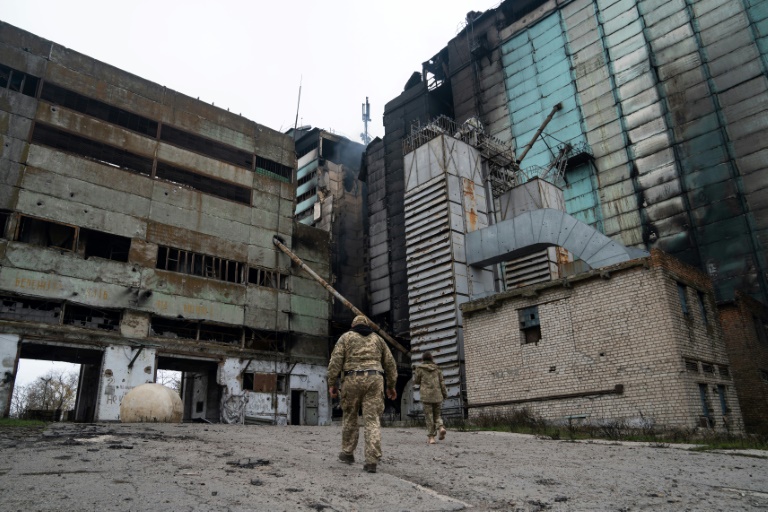
In the recaptured territory, Ukraine said it had found numerous landmines as well as several sites that appear to have been used for torturing prisoners. 

“The Russians kept local patriots who refused to cooperate with the enemy there in inhumane conditions. Kherson residents were interrogated and brutally tortured,” the Security Service of Ukraine (SBU) said. 

At the sites, the SBU and police officials found objects indicating they had been used for torture. 

“Eleven places of imprisonment were discovered, four of which show signs of being torture chambers,” said Ukrainian Minister of Internal Affairs Denys Monastyrskyi.

So far, 63 bodies had been found, he said.

“But we must understand that the search has only just begun, so many more torture chambers and burial places will be discovered.”

burs/lb/cwl

Two inmates convicted of murder executed in US

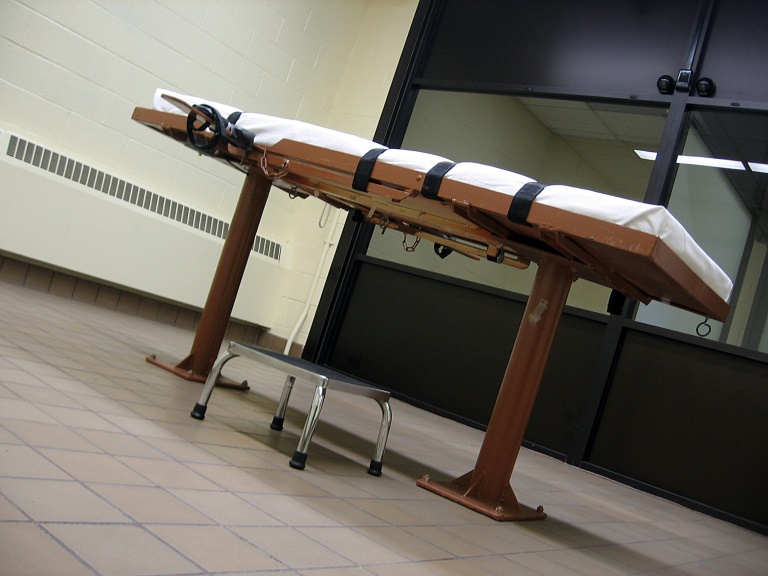
Two death row inmates convicted of murder were executed Wednesday in the United States.

One of them was a  septuagenarian put to death in Arizona nearly 40 years after he was sentenced to capital punishment over a double murder. The other man was executed in Texas for the 2006 killing of his ex-girlfriend and her young son. Both executions used lethal injection.

Murray Hooper, a 76-year-old African American, died in the Florence penitentiary, the state’s attorney general, Mark Brnovich, announced in a statement.

For “those who commit heinous crimes,” Brnovich said, “we must never forget the victims or cease to pursue what justice demands.”

US death row cases often are filled with aged convicts who have spent decades seeing their cases wind through the justice system. At the end of 2020, nearly a quarter of those on death row were over 60 years old, according to the Death Penalty Information Center (DPIC).

According to prosecutors, on New Year’s Eve 1980, Hooper and two accomplices broke into a house in Phoenix to rob it, tied up the three occupants and shot each of them in the head.

One man and his mother-in-law died, but his wife survived and later identified all three assailants. The three were sentenced to death in 1983, but the other two died in custody before being executed.

Hooper had maintained his innocence but never obtained an acquittal.

In Texas, prison authorities executed Stephen Barbee, 55, later Wednesday.

He was sentenced to death in 2006 for the murder of his ex-girlfriend, who was pregnant at the time, and her seven-year-old son.

As part of his final statement before dying, Barbee said, “I’m ready to go home. I’m ready warden, send me home,” according to the Texas Department of Criminal Justice.

“I just want everyone to have peace in their heart, make eternity with Jesus, give him the glory in everything you do. I’m ready,” it quoted Barbee as saying.

Barbee initially confessed to the crime, but recanted, saying he was coerced into a false confession by police.

Since his initial conviction, he has obtained two suspended sentences. 

His attorneys Tuesday filed a final appeal with the US Supreme Court, but the court rejected a stay.

The appeal had criticized local prison wardens for not having a written policy on the religious rights of prisoners in the execution chamber.

The Supreme Court’s conservative majority has little sympathy for the arguments of death row inmates, except sometimes in religious cases.

Barbee became the 15th death row inmate to be executed in the United States this year.

Trump kicks off White House run but top Republicans absent

The patriotic music, fiery rhetoric and adoring crowd were all there as Donald Trump announced another White House bid, but — in a sign his star has dimmed — top Republican officials and even family members were no-shows.

Trump’s announcement that he is running again in 2024 came exactly a week after a poor Republican showing in midterm elections, a performance some members of the party have blamed on questionable candidates backed by the former president.

The lackluster attendance may reflect a desire among some party leaders to turn the page on the divisive and legally challenged Trump and pick another candidate to carry the Republican banner two years from now.

Only a single Republican member of Congress was spotted in the crowd of several hundred people who attended Trump’s kickoff event in a gilded ballroom at his Mar-a-Lago resort in Florida.

And that lawmaker, Madison Cawthorn of North Carolina, lost his Republican primary in May.

Another diehard Trump supporter, Representative Matt Gaetz of Florida, said he planned to attend but bad weather prevented him from flying to Palm Beach.

Trump’s son Donald Jr was reportedly on a hunting trip out west and gave the same excuse.

As for Trump’s eldest daughter, Ivanka, who played a prominent role in her father’s 2016 and 2020 campaigns and his administration, she said she does “not plan to be involved in politics.”

“I love my father very much,” Ivanka Trump told Fox News Digital. “This time around, I am choosing to prioritize my young children and the private life we are creating as a family.”

Her husband, Jared Kushner, did show up along with Trump’s sons Eric and Barron.

Prominent Republicans who did attend were members of the far-right fringe of the party such as Roger Stone, a political consultant who was pardoned by Trump, and conspiracy theorists who voiced support for Trump’s baseless claims that he won the 2020 election over Democrat Joe Biden.

– ‘Unfit for office’ –

Three former members of Trump’s cabinet, ex-vice president Mike Pence, Mike Pompeo, who served as secretary of state, and Mark Esper, the defense secretary, made it clear on Wednesday they believe it is time to move on.

Pence told a CNN town hall event that he was proud of his time with Trump, a man he called “my friend,” but that he was not what the country needed anymore.

“I think it’s time for new leadership in this country that will bring us together around our highest ideals,” he said.

Though he refused definitively to rule out support of Trump if he were to become the Republican nominee, Pence said he felt the party’s primary process would offer alternatives.

“I honestly believe we’re gonna have better choices,” he said.

Pompeo, who, like Pence is a potential 2024 Republican nomination hopeful tweeted: “We need more seriousness, less noise, and leaders who are looking forward, not staring in the rearview mirror claiming victimhood.” 

Esper did not mince words in an interview with CNN.

“I think he’s unfit for office,” Esper said of Trump. “His actions are all about him and not about the country.

“I don’t think he’s an honest person,” he added. “We saw the falsehoods in the remarks that came out of his mouth last night.”

Larry Sabato, director of the University of Virginia’s Center for Politics, said there is clearly a “lack of enthusiasm for Trump’s third consecutive presidential campaign.”

“Trump has cost them three elections and they’d prefer not to let him ruin a fourth in 2024,” Sabato said.

Rupert Murdoch’s Fox News cut off its live coverage of Trump mid-speech and the conservative billionaire’s tabloid, the New York Post, carried a mocking headline on its front page: “Florida Man Makes Announcement.”

While ridiculing Trump, the Post has been promoting his leading rival for the 2024 Republican nomination, Florida Governor Ron DeSantis, who emerged as the big winner from the otherwise disastrous midterms.

– ‘Hard to beat’ –

Trump did draw support from longtime ally Lindsey Graham, the Republican senator from South Carolina, who praised his speech.

“If President Trump continues this tone and delivers this message on a consistent basis, he will be hard to beat,” Graham tweeted.

And analysts cautioned that Trump, who has defied the odds before, should not be counted out.

“The hard-core grassroots that have stood by Trump for six years will stand by him, for the most part,” Sabato said. “The party leadership is mainly in another place entirely.”

And for the time being, most polls show Trump leading DeSantis and other potential rivals for the Republican nomination.

Close Bitnami banner
Bitnami