US Business

Stocks push higher on reassuring US inflation data

Stocks mostly pushed higher on Tuesday, boosted by encouraging data and earnings suggesting inflation may be slowing, and resilience in the US economy.

Moves by China to shore up its economy also boosted sentiment, while the dollar continued to fall back following indications of a possible slowdown in the hiking of US interest rates.

Stocks have taken a beating in recent months as the US Federal Reserve and other central banks have aggressively hiked interest rates, and on statements by policymakers who say they are ready to push economies into recession if necessary to bring inflation down.

But stocks rallied last week as data suggested that US inflation may be moderating and policymakers have indicated that the pace of interest rate hikes may slow even if interest rates need to rise further.

Data released Tuesday suggested US inflation may be slowing.

Manufacturing prices rose just 0.2 percent month-on-month in October, and were flat when volatile food and energy prices are excluded.

“The key takeaway from the report is the clear signs of disinflation embedded in it,” said Patrick O’Hare at Briefing.com.

The data “will feed the market’s newfound belief that the Fed is apt to take a less aggressive rate-hike approach and ultimately settle on a lower terminal rate than previously thought,” he added.

Wall Street stocks snapped higher at the open of trading in New York, with the Dow rising 0.9 percent. The broader S&P 500 jumped 1.6 percent and the tech-heavy Nasdaq soared 2.4 percent.

A key US manufacturing survey released on Tuesday turned positive when analysts had expected it to continue pointing to a contraction, suggesting resilience in the economy despite the Fed interest rate hikes.

Meanwhile, top retailer Walmart, a bellwether for shifts in consumer activity, also posted better-than-expected third quarter results with rising sales volumes and increased earnings. 

A $20 billion share buyback helped send its shares rocketing 6.2 percent higher.

European stocks were mostly higher in afternoon trading, with an improvement in German investor sentiment helping eurozone stocks, while London’s blue-chip FTSE 100 index was penalised by the strong pound.

China’s move to ease some of its strict Covid-19 restrictions and provide much-needed support to its beleaguered property sector helped support sentiment in Asian trading.

Hong Kong rose more than four percent and Shanghai also closed in positive territory.

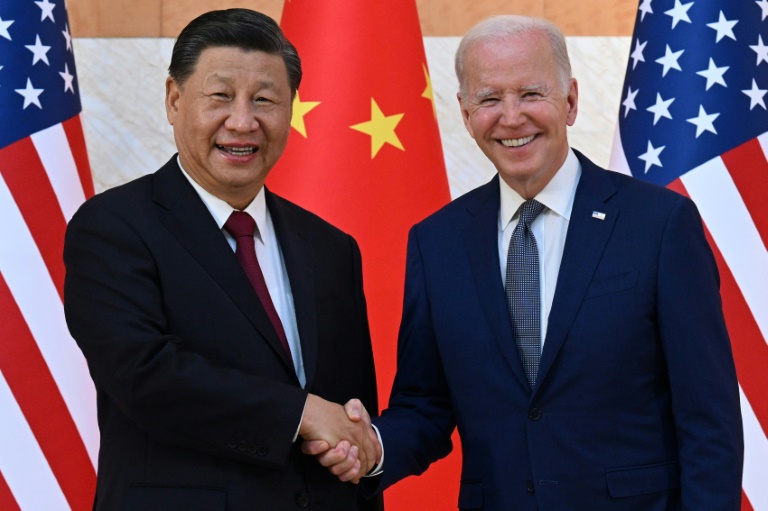
Optimism for a thawing in relations between Washington and Beijing was boosted after Biden and Xi’s extended talks on the sidelines of the G20 summit in Indonesia.

While there remain differences on hot-potato issues such as Taiwan, the two did find common ground on the Ukraine conflict, climate and the need to avoid another Cold War.

Oil prices slid as the International Energy Agency once again cut its demand growth forecasts given the fragile state of the global economy.

– Key figures around 1330 GMT –

London – FTSE 100: DOWN 0.3 percent at 7,366.09 points

Frankfurt – DAX: UP 0.4 percent at 14,367.91

Paris – CAC 40: UP 0.6 percent at 6,646.55

EURO STOXX 50: UP 0.7 percent at 3,913.49

New York – Dow: UP 0.9 percent at 33,821.25

Tokyo – Nikkei 225: UP 0.1 percent at 27,990.17 (close)

Hong Kong – Hang Seng Index: UP 4.1 percent at 18,343.12 (close)

Shanghai – Composite: UP 1.6 percent at 3,134.08 (close)

Euro/dollar: UP at $1.0422 from $1.0331 on Monday

Pound/dollar: UP at $1.1962 from $1.1751 

Dollar/yen: DOWN at 138.85 yen from 139.90 yen

Euro/pound: DOWN at 87.17 pence from 87.89 pence

West Texas Intermediate: DOWN 0.9 percent at $85.10 per barrel

Brent North Sea crude: DOWN 0.9 percent at $92.33 per barrel

burs-rl/lcm
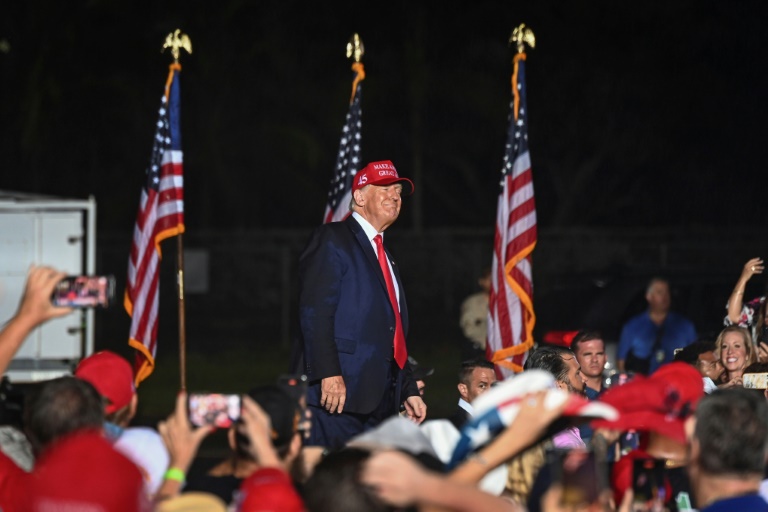
Trump poised to launch 2024 comeback bid

Former US president Donald Trump is expected to launch another White House bid Tuesday, even as another one of his fellow election deniers lost a key race in last week’s midterms.

The 76-year-old billionaire, whose 2016 win shocked America and the world, has summoned the press to his Florida mansion for a “very big announcement” at 9:00 pm Tuesday (0200 GMT Wednesday).

Known for his unpredictability, Trump could still change his mind at the last minute, but for months he has barely hidden his desire to vie for the presidency again in 2024.

And delaying the announcement now, as some of his advisers have reportedly suggested to him, would be awkward considering Trump’s repeated boast about the momentousness of his Tuesday address.

“Hopefully TODAY will turn out to be one of the most important days in the history of our Country!” Trump posted overnight on his Truth Social platform.

– ‘Red wave’ crashes –

But in a new sign that Trump and his hardcore followers do not lead the electoral juggernaut they once did, one of Trump’s  staunchest supporters, the election denier and establishment skeptic Kari Lake, was projected to lose her race to be governor of Arizona.

The results have emboldened Trump’s Republican detractors and sapped most of his political momentum heading into the expected Tuesday campaign launch.

In 2016, Trump and the Republicans swept into power, taking control of the White House and maintaining their majorities in both chambers of Congress.

But Democrats won back the House of Representatives in a 2018 landslide after campaigning largely against Trump’s caustic style.

They completed their trifecta of US political power by taking the Senate and the White House in 2020.

President Joe Biden, whose victory Trump has refused to acknowledge, recently revealed he is planning to run for a second term, although he said he will make a final decision next year.

Trump departed Washington in chaos two weeks after his partisans stormed the US Capitol, but he chose to remain in the political arena, continuing to fundraise and hold rallies around the country.

Leading up to last week’s midterm vote, in which Biden’s Democrats had been expected to lose handily, Trump made denial of the 2020 election results a key litmus test for candidates to win his influential political endorsement.

But the predicted Republican “red wave” failed to materialize, and Democrats will maintain their control of the Senate. 

In the still-undecided House, Republicans seem likely to eke out only a razor-thin majority.

Trump’s once-loyal wingman, former vice president Mike Pence, offered potent criticism late Monday, telling ABC News that Trump was “reckless” on the day of the January 6, 2021 insurrection at the US Capitol and that he had told the president they had no authority to unilaterally block certification of the election, as Trump sought.

But Pence declined to say directly whether Trump should be president again. “That’s up to the American people, but I think we’ll have better choices in the future,” he said in the interview.

– Florida showdown –

Part of the conservative world has already turned to another possible White House contender who, like Trump, is a resident of Florida: Governor Ron DeSantis.

The 44-year-old rising star of the hard right has emerged in strong form after his resounding re-election victory in the southeastern state and appears poised to challenge the former president.

Tuesday’s announcement is widely seen as a way for Trump to take the wind out of the sails of potential rivals, including DeSantis and Pence, who is publishing his memoir on the same day.

For the moment, Trump retains an undeniable popularity with his base, a tide of die-hard fans in red baseball caps who continue to flock to his rallies.

Most polls likewise give him the lead in a hypothetical Republican primary — despite being impeached twice by the House of Representatives and facing discontent from corners of the Republican Party.

His White House pursuit will be hampered too by multiple investigations into his conduct before, during and after his first term as president — which could ultimately result in his disqualification.

Those include allegations of fraud by his family business, his role in last year’s US Capitol attack and his handling of classified documents at Mar-a-Lago, his private Florida mansion, which was searched by the FBI in August.

UK set for new austerity budget

Britain will Thursday hike taxes and slash public spending in a government budget that signals a return to austerity despite a cost-of-living crisis and recession headwinds.

Conservative Prime Minister Rishi Sunak, who took office just three weeks ago, has vowed to fix the economic havoc created by his short-lived predecessor Liz Truss.

Even though he is mindful of soaring energy bills and food prices with UK inflation at a 40-year high and interest rates ballooning, the budget is widely seen as triggering a new era of austerity, similar to the one that followed the 2008 global financial crisis.

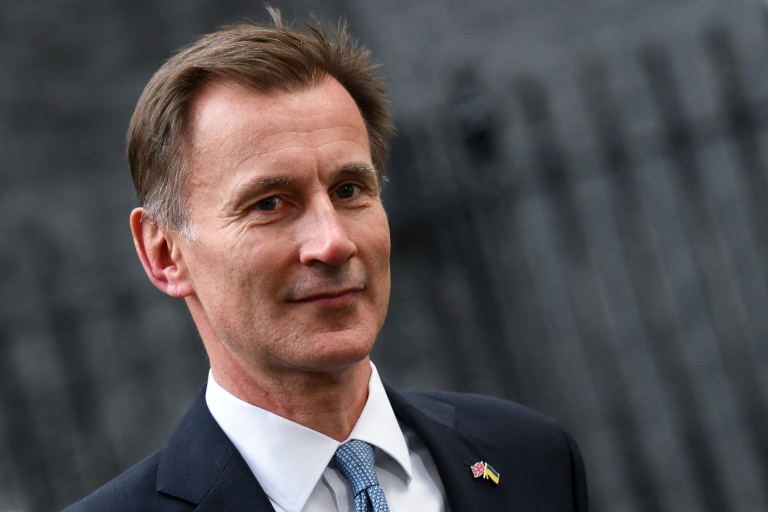
Finance minister Jeremy Hunt will present his crucial budget in parliament, alongside official growth and inflation forecasts unlikely to bring joy to an economy battered also by Brexit and costly government help during the Covid pandemic.

“Tackling inflation is my absolute priority and that guides the difficult decisions on tax and spending we will make,” Hunt said Tuesday. 

“Restoring stability and getting debt falling is our only option to reduce inflation and limit interest rate rises,” he added, after official data showed UK unemployment creeping up.

Chancellor of the Exchequer Hunt is expected to unveil tax hikes and spending cuts of up to £60 billion ($70.5 billion) to bring down debt, media reports suggested.

Heading into the budget, he has likened himself to the penny-pinching miser Ebenezer Scrooge in Charles Dickens’ festive favourite “A Christmas Carol”.

– Recession –

Britain is likely already in recession after its economy shrank in the third quarter and is set to do so again in the final three months of the year, according to the Bank of England.

The BoE, which is raising interest rates to combat sky-high inflation, has warned the UK economy may experience a record-long recession until mid-2024.

It comes after the central bank went on an emergency buying spree of UK government bonds after Truss’s unfunded tax-slashing budget sparked a collapse in the pound and an explosion in state borrowing costs during her 49-day tenure.

That cost her the leadership — but not before Truss had fired her finance minister Kwasi Kwarteng, replacing him with Hunt.

The new chancellor has set about reversing the much-criticised budget by curtailing a freeze in domestic fuel bills that have surged largely owing to the invasion of Ukraine by major energy producer Russia. 

He also reversed Truss’s plan to cut tax on company profits.

Reports suggest that Hunt will now go further, freezing income tax rate thresholds, meaning more people are dragged into higher tax brackets.

Speaking in parliament Tuesday, Hunt also hinted at raising municipal taxes.

To help the poorest with rocketing energy bills, the government is expected to ramp up a windfall tax on oil and gas giants, whose profits have surged on fallout from the Ukraine war.

The Financial Times on Tuesday added that Hunt is preparing a windfall tax on firms generating electricity, whose profits have also soared this year. 

– ‘Devastating consequences’ –

The pound and bond markets have regained somewhat of an even keel after Sunak took the helm and political turmoil subsided, but retail lenders’ mortgage rates remain elevated.

“I would really want people to be reassured that… all the decisions we make will have fairness and compassion at their heart,” Sunak said this week.

Hoping that Sunak sticks to his word, chief executives of Britain’s biggest supermarkets published an open letter Tuesday urging the government to offer free school meals to far more children than the very poorest.

“We are committed to doing all we can to support (children)…, with several actions set to be implemented in the coming months, but we cannot do this alone,” said the letter co-signed by bosses of supermarkets including Britain’s biggest retailer Tesco.

“We strongly urge you to consider the scale of children’s food insecurity across the UK and act without delay to prevent its devastating consequences.”

– ‘Austerity 2.0’ –

Britain’s main opposition Labour party has slammed Sunak, arguing that a second wave of austerity is not the answer.

“I don’t believe that austerity 2.0, after the austerity that we have gone through… is the right approach,” said Labour’s finance spokeswoman Rachel Reeves.

“Public services are already on their knees,” added Reeves, calling it a “badge of shame” that nurses were planning to strike this winter.

Tens of thousands of staff in various industries have already gone on strike across Britain this year as inflation erodes wages.

Russia under pressure as G20 voices unease over Ukraine war

Russia faced mounting diplomatic pressure Tuesday to end its war in Ukraine, as G20 allies and critics alike rued the painful global impact of nearly nine months of conflict.

A draft communique obtained by AFP showed the world’s 20 leading economies coming together to condemn the war’s effects, but still divided on apportioning blame.

The summit has shown that even Russia’s allies have limited patience with a conflict that has inflated food and energy prices worldwide and raised the spectre of nuclear war.

Risking diplomatic isolation, Russia was forced to agree that the “war in Ukraine” — which Moscow refuses to call a war — has “adversely impacted the global economy”.

It also agreed that “the use or threat of use of nuclear weapons” is “inadmissible”, after months of President Vladimir Putin making such threats.

The embattled Russian leader has skipped the summit, staying at home to reckon with a string of embarrassing battlefield defeats and a grinding campaign that threatens the future of his regime.

Rubbing salt in Russia’s wounds, Ukrainian leader Volodymyr Zelensky — fresh from a visit to liberated Kherson — delivered an impassioned video appeal to G20 leaders.

Zelensky told leaders from China’s Xi Jinping to America’s Joe Biden that they could “save thousands of lives” by pressing for a Russian withdrawal.

“I am convinced now is the time when the Russian destructive war must and can be stopped,” he said, sporting his now-trademark army-green T-shirt.

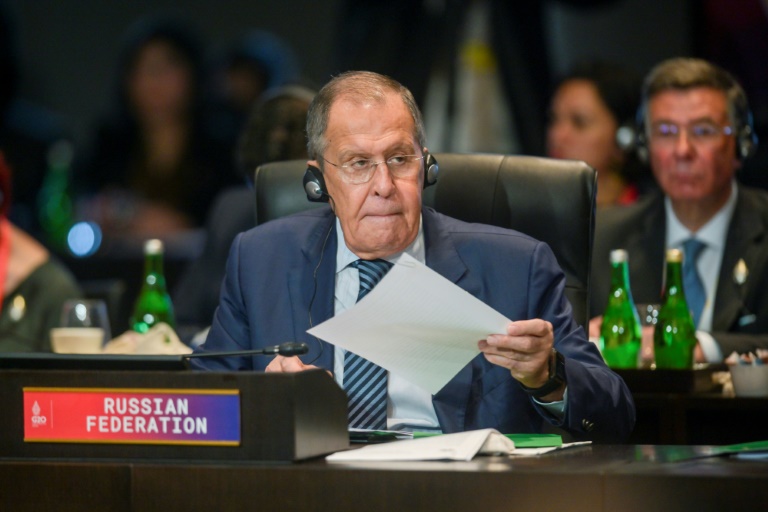
Putin’s delegate, Foreign Minister Sergei Lavrov, whose summit preparation was disrupted by two hospital health checks for an undiagnosed ailment, remained in the room throughout Zelensky’s address, diplomatic sources said.

His most notable diplomatic victory was an acknowledgement in the communique that while “most members” of the G20 condemned Putin’s invasion, “there were other views and different assessments”.

Leaders must now sign off on the final text before the summit ends on Wednesday. 

“All problems are with the Ukrainian side, which is categorically refusing negotiations and putting forward conditions that are obviously unrealistic,” Lavrov told reporters.

The foreign minister had a dinner with leaders before departing on Tuesday.

– ‘Immense’ suffering –

The United States and its allies used the summit to broaden the coalition against Russia’s invasion and scotch Moscow’s claims of a war of East versus West.

Many “see Russia’s war in Ukraine as the root source of immense economic and humanitarian suffering in the world”, said a senior US official.

Russia’s G20 allies China, India and South Africa refrain from publicly criticising Putin’s war, and the draft joint statement is replete with diplomatic fudges and linguistic gymnastics.

But it gives a growing sense of the worldwide impact of the war.

G20 members Argentina and Turkey are among the nations worst hit by food inflation worldwide, but there was scarcely a country around the table unaffected.

“The war is affecting everyone,” said Argentine Foreign Minister Santiago Cafiero. 

“In the northern hemisphere the merchants of death broker lethal arms sales, but in the southern hemisphere food is costly or scarce — what kills are not bullets or missiles, but poverty and hunger.”

There was also a hint at growing Chinese unease with Russia’s prosecution of the war when presidents Xi and Biden met late Monday.

“It’s clear that the Russians are very isolated,” said one Western official. “I think some countries engaged with Russia but… I did not see any gestures of great solidarity.”

– Grain corridor –

A deal expiring Saturday that allows Ukraine to export grain through the Black Sea is a focus of summit conversations, with leaders expected to urge its “full, timely and continued implementation”.

Ukraine is one of the world’s top grain producers, and the Russian invasion blocked 20 million tonnes of grain in its ports before the United Nations and Turkey brokered the deal in July.

The summit build-up focused heavily on Xi, who is making only his second overseas trip since the pandemic began and has stolen the spotlight as leaders line up to speak with him.

Xi and Biden cooled Cold War rhetoric during three hours of talks on Monday, taking some of the heat out of their simmering rivalry.

“The world expects that China and the United States will properly handle the relationship,” Xi told Biden.

Former US diplomat Danny Russel described the meeting as broadly positive. 

“We should beware of prematurely declaring the strategic rivalry over. However, we saw a deliberate effort to stabilise a dangerously overheated relationship.”

Stocks mixed on China moves, dollar drops

European and Asian stock markets were mixed Tuesday following losses on Wall Street and as China moves to shore up its economy.

A largely positive meeting between US President Joe Biden and his Chinese counterpart Xi Jinping indicated an easing of tensions and helped sentiment.

However, there remains a lot of trepidation that central bank interest rate hikes aimed at taming inflation will eventually send economies into a recession.

The US is still expected to carry on hiking interest rates, but cooling inflation in the world’s biggest economy means the Federal Reserve is set to pull back on aggressive tightening, weighing on the dollar.

Vice Fed chair Lael Brainard said that while it would probably be right to slow down the rate hikes, “we have additional work to do both on raising rates and sustaining restraint to bring inflation down”.

Those comments contributed to Wall Street’s three main indices falling Monday.

“European stock markets made tentative gains on Tuesday after a positive handover from Asia in spite of Wall Street snapping a two-day bounce following last week’s inflation reading,” noted Neil Wilson, chief market analyst at Finalto trading group.

There was more unrest in the tech sector, with Amazon preparing to lay off as many as 10,000 employees, The New York Times reported on Monday.

Asian traders were a little more upbeat, cheered by China’s move to ease some of its strict Covid-19 restrictions and provide much-needed support to its beleaguered property sector.

Hong Kong rose more than four percent and Shanghai also closed in positive territory.

Optimism for a thawing in relations between Washington and Beijing was boosted after Biden and Xi’s extended talks on the sidelines of the G20 summit in Indonesia.

While there remain differences on hot-potato issues such as Taiwan, the two did find common ground on the Ukraine conflict, climate and the need to avoid another Cold War.

After the talks, Chinese foreign minister Wang Yi described it as a “new starting point”, adding that Beijing hoped “to stop the tumbling of bilateral ties and to stabilise the relationship”.

After a painful year for markets across the planet, dealers are hopeful that there is finally light at the end of the tunnel.

“It’s certainly a time to be thinking about a recovery regime unfolding for markets,” said Kristina Hooper of Invesco.

“But it’s going to take a little time before we know if this really is something of a turning point for inflation and the Fed can be a lot more comfortable about hastening the end of tightening,” she told Bloomberg Radio.

– Key figures around 1145 GMT –

London – FTSE 100: FLAT at 7,384.31 points

Frankfurt – DAX: DOWN 0.2 percent at 14,285.17

Paris – CAC 40: UP 0.3 percent at 6,627.48

EURO STOXX 50: UP 0.2 percent at 3,893.36

Tokyo – Nikkei 225: UP 0.1 percent at 27,990.17 (close)

Hong Kong – Hang Seng Index: UP 4.1 percent at 18,343.12 (close)

Shanghai – Composite: UP 1.6 percent at 3,134.08 (close)

New York – Dow: DOWN 0.6 percent at 33,536.70 (close)

Euro/dollar: UP at $1.0415 from $1.0331 on Monday

Pound/dollar: UP at $1.1870 from $1.1751 

Dollar/yen: DOWN at 139.25 yen from 139.90 yen

Euro/pound: DOWN at 87.73 pence from 87.89 pence

West Texas Intermediate: DOWN 0.6 percent at $85.32 per barrel

Brent North Sea crude: DOWN 0.4 percent at $92.80 per barrel

US probe of journalist's death 'important step': Abu Akleh family

The family of Al Jazeera journalist Shireen Abu Akleh, who was likely killed by an Israeli soldier, on Tuesday praised a US decision to open a probe into her death.

“This is an important step,” a statement from the Palestinian-American family said, voicing hope for a “truly independent, credible and thorough probe”.

Abu Akleh was killed while covering an Israeli army raid in the occupied West Bank on May 11.

The veteran reporter, who was a Christian, was wearing a bulletproof vest marked “Press” and a helmet when she was shot in the head in the Jenin refugee camp, a historic flashpoint in the Israeli-Palestinian conflict.  

The Israeli army conceded on September 5 that one of its soldiers had likely shot Abu Akleh after mistaking her for a militant. 

The Abu Akleh family noted that it had been asking for a US probe “since the beginning”.

“It is what the United States should do when a US citizen is killed abroad, especially when they were killed, like Shireen, by a foreign military.”

Defence Minister Benny Gantz said Israel “will not cooperate with an external investigation”.

“The decision taken by the US Justice Department to conduct an investigation into the tragic passing of Shireen Abu Akleh, is a mistake. The IDF (Israeli army) has conducted a professional, independent investigation, which was presented to American officials with whom the case details were shared,” Gantz said in a statement. 

The Israeli human rights group B’Tselem, which works to end the occupation, said it always believed “some form of international intervention” would be required to secure justice for Abu Akleh’s death. 

“We never thought Israel could, or was willing to, investigate itself,” spokeswoman Dror Sadot told AFP. 

But she noted that US experts had collaborated in previous investigations which had not led to Israel taking steps towards accountability. 

“So, let’s say, for the FBI, we’ll believe it when we see it,” Sadot said. 

– No prosecution –

The Federal Bureau of Investigation has refused to confirm or deny the investigation.

But Politico reported that the FBI was probing the May 11 shooting. 

Just days after her death, dozens of Democratic party lawmakers wrote to Secretary of State Antony Blinken and FBI Director Christopher Wray demanding an inquiry, saying the US government had a “duty to protect Americans reporting abroad”. 

The Israeli army’s top lawyer has said that criminal charges against the soldier likely involved in the shooting were not merited, as the individual was acting in what Israel considered to be an active combat zone. 

Prime Minister Yair Lapid has also rejected suggestions the soldier should be prosecuted.

“I will not allow an IDF soldier that was protecting himself from terrorist fire to be prosecuted just to receive applause from abroad,” Lapid told a military ceremony.

Last week, Abu Akleh’s family and colleagues told UN investigators that she had been deliberately targeted as part of Israel’s “wide-scale war” on Palestinian media workers, and called for accountability and justice.

Doha-based Al Jazeera and the Qatari state have also alleged the Abu Akleh was deliberately targeted by Israeli soldiers. 

Rich nations target $20 bn to wean Indonesia off coal

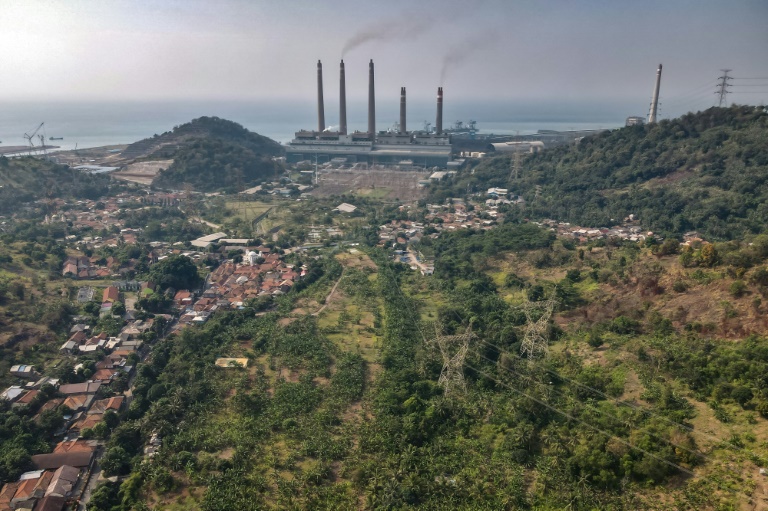
Rich nations pledged Tuesday to raise at least $20 billion to help wean Indonesia off coal and reach carbon neutrality by 2050, a decade earlier than planned, the White House said.

The United States, Japan, Canada and six European countries signed the accord with Jakarta on the sidelines of the G20 summit in Bali to ensure a “just power sector transition” away from Indonesia’s coal-dependent economy, they said in a statement released by the White House.

Under the deal, Indonesia, home to the world’s third-largest rainforest, pledges to be carbon-neutral by 2050, — 10 years earlier than previously planned — and to almost double its renewable energy generation by 2030.

Indonesian President Joko Widodo hailed the deal, which follows a similar agreement for South Africa last year, as a model that could be replicated in other countries to meet the world’s climate goals.

“Indonesia is committed to using our energy transition to achieve a green economy and drive sustainable development,” he said, pledging the deal would help “accelerate this transition”.

Sponsors of the agreement said Jakarta had committed to an ambitious shift to clean energy in return for $10 billion in public sector finance and $10 billion in private funding over three to five years.

The financing included “grants, concessional loans, market-rate loans, guarantees and private investments” for the country, which has one of the largest coal reserves in the world.

US President Joe Biden said the deal showed “countries can dramatically cut emissions and increase renewable energy while… creating quality jobs and protecting livelihoods and communities.”

– ‘Work in progress’ –

Indonesia has at times questioned climate deals, including a 2021 agreement to end deforestation by 2030 it signed, warning it could hinder the country’s economic development.

But despite the new incentives, experts cautioned that a lot of work remained for Indonesia to meet the demands of the partnership.

“It’s a work in progress. But Indonesia has gotten to enough comfort level with the scale of finance that they want to go ahead with it. There will be a lot of follow up work,” said Friederike Roder, senior director for EU and G20 at NGO Global Citizen.

But he warned: “There is concern that the finance is not adequate for the total transformation that is needed”.

Indonesian officials welcomed the pact despite the worries.

The deal shows “we can create a more sustainable world for our grandchildren, our citizens, and the future generation,” Indonesia’s coordinating minister of maritime and investment affairs Luhut Binsar Pandjaitan told a press conference.

The donor pledge announced on Tuesday was part of a slew of projects announced under an infrastructure partnership — aimed as a counter-balance to China’s Belt and Road Initiative — to provide support to developing nations.

They ranged from funding for digital projects in the Pacific to investment in the sustainable mining of nickel and cobalt in Brazil and powering solar projects in Honduras.

Russia under pressure as G20 voices unease over Ukraine war

Russia faced mounting diplomatic pressure Tuesday to end its war in Ukraine, as G20 allies and critics alike rued the painful global impact of nearly nine months of conflict.

A draft communique obtained by AFP showed the world’s 20 leading economies coming together to condemn the war’s effects, but still divided on apportioning blame.

The summit has shown that even Russia’s allies have limited patience with a conflict that has inflated food and energy prices worldwide and raised the spectre of nuclear war.

Risking diplomatic isolation, Russia was forced to agree that the “war in Ukraine” — which Moscow refuses to call a war — has “adversely impacted the global economy”.

It also agreed that “the use or threat of use of nuclear weapons” is “inadmissible”, after months of President Vladimir Putin making such threats.

The embattled Russian leader has skipped the summit, staying at home to reckon with a string of embarrassing battlefield defeats and a grinding campaign that threatens the future of his regime.

Rubbing salt in Russia’s wounds, Ukrainian leader Volodymyr Zelensky — fresh from a visit to liberated Kherson — delivered an impassioned video appeal to G20 leaders.

Zelensky told leaders from China’s Xi Jinping to America’s Joe Biden that they could “save thousands of lives” by pressing for a Russian withdrawal.

“I am convinced now is the time when the Russian destructive war must and can be stopped,” he said, sporting his now-trademark army-green T-shirt.

Putin’s delegate, Foreign Minister Sergei Lavrov, whose summit preparation was disrupted by two hospital health checks for an undiagnosed ailment, remained in the room throughout Zelensky’s address, diplomatic sources said.

His most notable diplomatic victory was an acknowledgement in the communique that while “most members” of the G20 condemned Putin’s invasion, “there were other views and different assessments”.

“All problems are with the Ukrainian side, which is categorically refusing negotiations and putting forward conditions that are obviously unrealistic,” Lavrov told reporters.

Leaders must now sign off on the final text before the summit ends on Wednesday. 

– ‘Immense’ suffering –

The United States and its allies used the summit to broaden the coalition against Russia’s invasion and scotch Moscow’s claims of a war of East versus West.

Many “see Russia’s war in Ukraine as the root source of immense economic and humanitarian suffering in the world”, said a senior US official.

Russia’s G20 allies China, India and South Africa refrain from publicly criticising Putin’s war, and the draft joint statement is replete with diplomatic fudges and linguistic gymnastics.

But it gives a growing sense of the worldwide impact of the war.

G20 members Argentina and Turkey are among the nations worst hit by food inflation worldwide, but there was scarcely a country around the table unaffected.

“The war is affecting everyone,” said Argentine Foreign Minister Santiago Cafiero. 

“In the northern hemisphere the merchants of death broker lethal arms sales, but in the southern hemisphere food is costly or scarce — what kills are not bullets or missiles, but poverty and hunger.”

There was also a hint at growing Chinese unease with Russia’s prosecution of the war when presidents Xi and Biden met late Monday.

“It’s clear that the Russians are very isolated,” said one Western official. “I think some countries engaged with Russia but… I did not see any gestures of great solidarity.”

– Grain corridor –

A deal expiring Saturday that allows Ukraine to export grain through the Black Sea is a focus of summit conversations, with leaders expected to urge its “full, timely and continued implementation”.

Ukraine is one of the world’s top grain producers, and the Russian invasion blocked 20 million tonnes of grain in its ports before the United Nations and Turkey brokered the deal in July.

The summit build-up focused heavily on Xi, who is making only his second overseas trip since the pandemic began and has stolen the spotlight as leaders line up to speak with him.

Xi and Biden cooled Cold War rhetoric during three hours of talks on Monday, taking some of the heat out of their simmering rivalry.

“The world expects that China and the United States will properly handle the relationship,” Xi told Biden.

Former US diplomat Danny Russel described the meeting as broadly positive. 

“We should beware of prematurely declaring the strategic rivalry over. However, we saw a deliberate effort to stabilise a dangerously overheated relationship.”

UK budget predicted to be a nightmare before Christmas

Britain will Thursday hike taxes and slash public spending in a government budget that signals a return to austerity despite a cost-of-living crisis and recession headwinds.

Conservative Prime Minister Rishi Sunak, who took office just three weeks ago, has vowed to fix the economic havoc created by his short-lived predecessor Liz Truss.

Even though he is mindful of soaring energy bills and food prices with UK inflation at a 40-year high and interest rates ballooning, the budget is widely seen as triggering a new era of austerity, similar to the one that followed the 2008 global financial crisis.

Finance minister Jeremy Hunt will present his crucial budget in parliament, alongside official growth and inflation forecasts unlikely to bring joy to an economy battered also by Brexit and costly government help during the Covid pandemic.

“Tackling inflation is my absolute priority and that guides the difficult decisions on tax and spending we will make,” Hunt said Tuesday. 

“Restoring stability and getting debt falling is our only option to reduce inflation and limit interest rate rises,” he added after official data showed UK unemployment creeping up.

Chancellor of the Exchequer Hunt is expected to unveil tax hikes and spending cuts of up to £60 billion ($70.5 billion) to bring down debt, media reports suggested.

Heading into the budget, he has likened himself to the penny-pinching miser Ebenezer Scrooge in Charles Dickens’ festive favourite “A Christmas Carol”.

– Recession –

Britain is likely already in recession after its economy shrank in the third quarter and is set to do so again in the final three months of the year, according to the Bank of England.

The BoE, which is raising interest rates to combat sky-high inflation, has warned the UK economy may experience a record-long recession until mid-2024.

It comes after the central bank went on an emergency buying spree of UK government bonds after Truss’s unfunded tax-slashing budget sparked a collapse in the pound and an explosion in state borrowing costs during her 49-day tenure.

That cost her the leadership, but not before Truss had fired her finance minister Kwasi Kwarteng, replacing him with Hunt.

The new chancellor has set about reversing the much-criticised budget by curtailing a freeze in domestic fuel bills that have surged largely owing to the invasion of Ukraine by major energy producer Russia. 

Reports suggest that Hunt will now go further, freezing income tax rate thresholds, meaning more people are dragged into higher tax brackets.

To help the poorest with rocketing energy bills, the government is expected to ramp up a windfall tax on oil and gas giants, whose profits have surged on fallout from the Ukraine war.

The Financial Times on Tuesday added that Hunt is preparing a windfall tax on firms generating electricity, whose profits have also soared this year. 

– ‘Devastating consequences’ –

The pound and bond markets have regained somewhat of an even keel after Sunak took the helm and political turmoil subsided, but retail lenders’ mortgage rates remain elevated.

“I would really want people to be reassured that… all the decisions we make will have fairness and compassion at their heart,” Sunak said this week.

Hoping that Sunak sticks to his word, chief executives of Britain’s biggest supermarkets published an open letter Tuesday urging the government to offer free school meals to far more children than the very poorest.

“We are committed to doing all we can to support (children)…, with several actions set to be implemented in the coming months, but we cannot do this alone,” said the letter co-signed by bosses of supermarkets including Britain’s biggest retailer Tesco.

“We strongly urge you to consider the scale of children’s food insecurity across the UK and act without delay to prevent its devastating consequences.”

– ‘Austerity 2.0’ –

Britain’s main opposition Labour party has slammed Sunak, arguing that a second wave of austerity is not the answer.

“I don’t believe that austerity 2.0, after the austerity that we have gone through… is the right approach,” said Labour’s finance spokeswoman Rachel Reeves.

“Public services are already on their knees,” added Reeves, calling it a “badge of shame” that nurses were planning to strike this winter.

Tens of thousands of staff in various industries have already gone on strike across Britain this year as inflation erodes wages.

British PM raises oil with Saudis as Biden shuns crown prince

British Prime Minister Rishi Sunak called Tuesday for efforts to stabilise oil markets in talks with Saudi Arabia’s crown prince, who was shunned by US President Joe Biden over an output cut.

The new British prime minister met separately with Crown Prince Mohammed bin Salman, the oil-rich kingdom’s effective ruler, as they gathered for the Group of 20 summit on the Indonesian resort island of Bali.

“In light of the global increase in energy prices sparked by Russia’s invasion of Ukraine, the prime minister said he hoped the UK and Saudi Arabia could continue to work together to stabilise energy markets,” a Downing Street spokesperson said.

The engagement contrasts with the cold shoulder by Biden, with US officials saying they were not planning any meeting with the prince, known by his initials MBS, even on a lower level.

Biden was outraged after the Saudi-led OPEC+ oil cartel decided to cut production by two million barrels a day from November, adding pressure to global prices and potentially boosting revenue for energy exporter Russia, counteracting the US-led campaign to isolate Moscow over its invasion of Ukraine.

Biden warned Saudi Arabia of consequences over the move, which some of his aides saw as an effort to boost the rival Republican Party days ahead of US congressional elections in which inflation was a top issue.

Saudi Arabia insisted it was only considering economic factors but the move infuriated Biden as he had taken political risks in June by visiting the kingdom on a mission to ensure the flow of oil.

Biden as a candidate had vowed to make Prince Mohammed, a close ally of former US president Donald Trump, a pariah over human rights.

Declassified US intelligence said that the prince ordered the killing and dismemberment of US-based Saudi journalist Jamal Khashoggi.

The Downing Street spokesperson said Sunak raised with Prince Mohammed “the importance of further progress on social reforms, including on women’s rights and freedoms” in the ultra-conservative kingdom.

They also discussed the “destabilising activity” of Iran, Saudi Arabia’s regional rival, the spokesperson said.

Close Bitnami banner
Bitnami