US Business

Iran admits sending Russia drones but says before Ukraine war

Iran has admitted for the first time that it sent drones to Russia but insisted they were supplied to its ally before Moscow’s invasion of Ukraine.

Kyiv and its Western allies have accused Russia of using Iranian-made drones in recent weeks to carry out attacks. 

Tehran has repeatedly denied the claims but on Saturday foreign minister Hossein Amir-Abdollahian was quoted as saying that drones had been sent to Russia before the invasion began in late February.

“We supplied Russia with a limited number of drones months before the war in Ukraine,” Amir-Abdollahian said, according to Iran’s official news agency IRNA.

But he again denied Iran had supplied missiles to Russia, calling the accusations “completely false”.

For weeks, Russian forces have rained missiles and explosive drones onto Ukraine’s infrastructure, as a major Ukrainian ground offensive — propelled by Western arms deliveries — has pushed Russian troops back in swathes of the country.

Kyiv claims around 400 Iranian drones have already been used against the civilian population of Ukraine and that Moscow has ordered around 2,000.

President Volodymyr Zelensky on Saturday accused Iranian officials of lying about its drone deliveries to Moscow.

“They decided to admit that they did supply drones for Russian terror. But even in this confession they lie,” he said.

“We shoot down at least 10 Iranian drones every day, and the Iranian regime claims that it allegedly gave little and even before the start of a full-scale invasion.”

Earlier Ukraine’s foreign ministry spokesman had warned Iran that “the consequences of complicity” with Moscow would be “greater than the benefit from Russia’s support.”

Britain and the European Union have imposed sanctions on three Iranian generals and an arms firm accused of supplying Russia with drones.

– ‘Deportations’ –

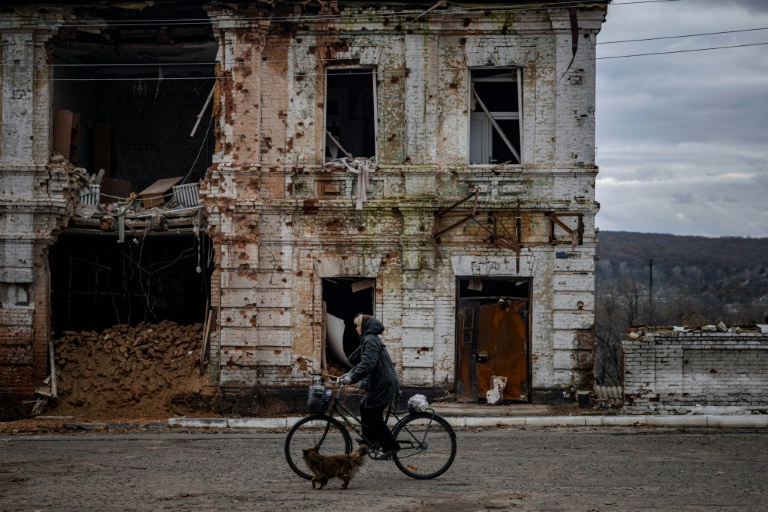
Russian strikes over the past month have destroyed around a third of Ukraine’s power stations and the government has urged Ukrainians to conserve electricity as much as possible.

Ukraine’s state energy company on Saturday announced additional power rationing in Kyiv and several other regions of the country.

Ukrainian and Russian forces appear to be gearing up for a fierce battle in Kherson, a southern city with a population of around 288,000 people before the conflict.

It was the first major Ukrainian city to fall to Russian forces following Moscow’s invasion.

Russia has been pulling civilians out of the Kherson region, with President Vladimir Putin saying residents must be “removed” from danger zones. 

But Kyiv has likened the departures to Soviet-style “deportations”.

Meanwhile, soldiers in northern Ukraine are watching out for a fresh attack along the border with Russia and Belarus.

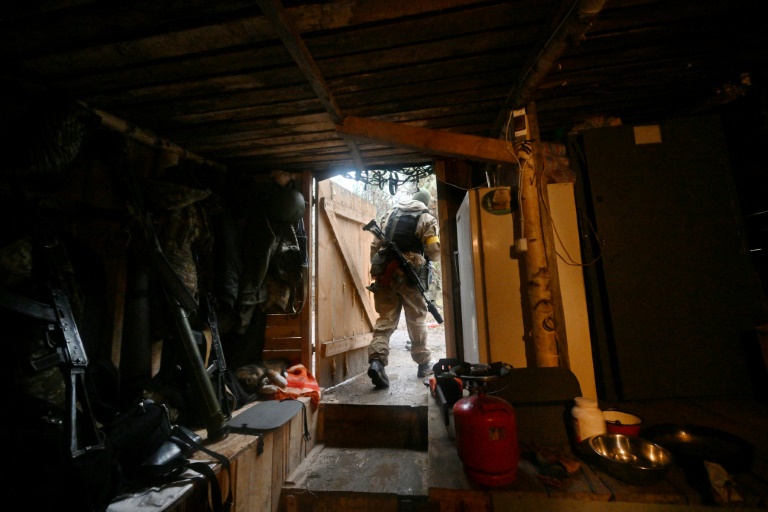
Guards have been scanning the horizon at a remote outpost near the Senkivka border crossing, where Russia’s 90th armoured division swept in when the war started, cutting through Ukrainian territory.

Inside the well-fortified dugout set up after the Russian pullback in April, a guard in his 30s nicknamed “Lynx” spoke to AFP. 

“Since autumn began, the enemy has become more active,” he said, a machine gun slung over his shoulder.

“Everything is more serious now… we have thought through all the possible options to avoid a repeat of what happened before.”

– ‘De-communism drive’ – 

In the southern Ukrainian city of Melitopol, Moscow’s occupying authorities said Saturday they had brought back a statue of Lenin, seven years after it was taken down following Kyiv’s pro-EU revolution. 

The Moscow-installed head of the Zaporizhzhia region, Vladimir Rogov, posted a photograph of workers in the city reinstating the tribute to the Bolshevik leader.

Almost all cities in Russia have a statue of the founder of the Soviet Union in their central squares.

But Ukraine dismantled Lenin statues across the country after its 2014 revolution overthrew a Moscow-backed regime, as part of its “de-communisation drive.”

It was seen as an effort to break away from Russian and Soviet influence. 

Meanwhile tens of thousands of people marched through Italy’s capital on Saturday calling for peace in Ukraine — and urging the government to stop sending weapons to fight Russia’s invasion.

“No to war. No to sending weapons”, read one banner carried by protesters in Rome, as a vast crowd broke into cries of “give peace a chance”.

Some politicians, including former prime minister Giuseppe Conte, have said Italy should be stepping up negotiations. 

But new far-right Prime Minister Giorgia Meloni has vowed to keep supporting Ukraine and the government has said it expects to send more weapons soon.
Pilot strike disrupts Kenya Airways flights

Kenya Airways pilots went on strike Saturday, grounding nearly two dozen flights and stranding thousands of passengers, exacerbating woes facing the beleaguered carrier.

The airline, part owned by the government and Air France-KLM, is one of the biggest in Africa, connecting multiple countries to Europe and Asia, but it is facing turbulent times, including years of losses.

The Kenya Airline Pilots Association (KALPA) said no Kenya Airways flight flown by its members had departed Nairobi’s Jomo Kenyatta International Airport from 6:00 am (0300 GMT) onwards on Saturday.

The pilots announced the strike in defiance of a court order against industrial action and gave no indication of how long it will last.

The airline’s managing director and CEO, Allan Kilavuka, said 23 flights had been cancelled as of 11:00 am due to “the unlawful strike”, affecting over 9,000 passengers.

He urged the protesting pilots, who make up 10 percent of the workforce, to return to work by 10:30 am on Sunday.

“Failure to do so will lead to immediate disciplinary action,” he warned.

The Kenya Aviation Workers Union (KAWU) subsequently announced that ground staff would also strike from 2:00 pm onwards in a separate, long-running dispute with the Kenya Airports Authority (KAA) over salary increases.

“The Union has no option but to commence the industrial action,” it said on Twitter, citing a court order supporting its members’ right to strike until negotiations with the KAA are concluded.

– ‘Negotiate in good faith’ –

But the KAA later said it had appealed the court order. “Our staff have reported on duty and operations at all our airports are normal,” it insisted.

Kenya’s newly appointed Transport Minister Kipchumba Murkomen told reporters that the pilots’ strike was unwarranted and “akin to economic sabotage”.

“I am not saying their concerns are not valid,” he said, appealing to the “goodwill of the pilots to terminate” what he described as drastic action.

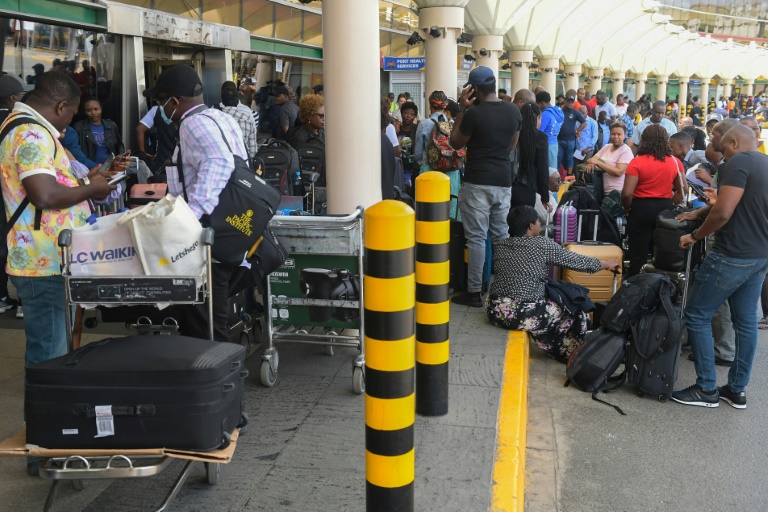
Frustrated passengers described huge queues at the airport, with many only learning their flights were cancelled when they arrived to check in.

“We have been told nothing,” US tourist Jill Lee told AFP as she waited in line after her flight to Tanzania’s financial capital Dar es Salaam was cancelled at the last minute.

The 65-year-old was booked to go on safari but said she had no idea where she would spend the night after her connecting flight from Nairobi was cancelled.

“Many people here have nowhere to go. It’s pretty horrible.”

On Saturday, KALPA blamed “the hardline stance adopted by” the airline’s management for throwing thousands of travellers’ plans into disarray.

It urged them to “come to the table and negotiate in good faith, if they truly sympathise with the plight of Kenya Airways passengers.”

– Injunction – 

The pilots are pressing for the reinstatement of contributions to a provident fund and payment of all salaries stopped during the Covid-19 pandemic.

On Monday, the airline won a court injunction stopping the strike, but an official at KALPA, which has 400 members, told AFP the pilots “were acting within the provisions of the law” and that they were yet to be served with a court order.

The carrier warned earlier this week that the strike would jeopardise its recovery, estimating losses at $2.5 million per day if the pilots went ahead with their plans.

The airline was founded in 1977 following the demise of East African Airways and flies more than four million passengers to 42 destinations annually.

But its slogan “The Pride of Africa” rings hollow as it operates thanks to state bailouts following years of losses.

The carrier saw its revenue nosedive after the pandemic grounded planes worldwide because of stringent travel restrictions, devastating the aerospace and tourism industries.

In August, the airline reported a $81.5 million half-year loss citing high fuel costs, despite the Kenyan government injecting some $520 million to keep it afloat.

On Wednesday, the airline’s management said it was on a path to recovery, flying at least 250,000 passengers each month, and aiming to cut its overall operating costs by 10 percent before the end of next year.

Biden, Obama, Trump target key US state in countdown to midterms

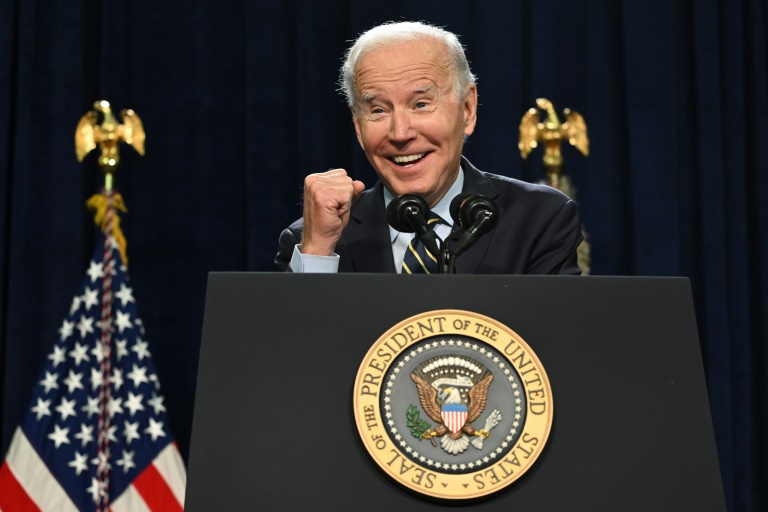
US President Joe Biden and his two predecessors converged on the state of Pennsylvania Saturday, making closing pitches in a key battleground state for next week’s midterm election.

Biden was set to rally alongside his old boss Barack Obama as the Democrats deployed their big guns to build the energy they hope will spread nationwide and reverse the late rightward-shift in polling.

And in a split-screen preview of a potential rematch of the 2020 presidential contest, the midwestern state is also playing host to Biden’s predecessor and bitter political rival Donald Trump.

Obama was the first to appear Saturday, lashing out before a crowd in Pittsburgh at what he said were Republican plans to cut government spending.

“They want to gut social security. They want to gut medicare. They want to give rich folks and big corporations more tax cuts,” Obama said.

Obama — still the party’s most bankable star six years after leaving the White House — threw his support behind Democratic candidate John Fetterman, who is in a dead heat against Republican TV physician Mehmet Oz in their crucial Senate race.

Biden and Obama were to appear later in the day in Philadelphia, the historic cradle of US independence where the 44th and 46th presidents will woo voters from the suburbs that make for a crucial base of Democratic support.

Hours before the rally was scheduled to begin, hundreds of people lined up to enter the Liacouras Center to attend the event.

“It’s very important that democrats stay in the position they’re already in,” said Jennifer Hahn, 57, a clinical psychologist from the town of Audubon, outside Philadelphia. “The biggest issues facing us are climate change, gun violence and our rights being stripped away.”

The Keystone State backed Trump over Hillary Clinton for president in 2016 but preferred Biden to Trump in 2020.

Strategists from both parties believe the side that wins the post vacated by retiring Republican Pat Toomey will hold the majority in the upper chamber of Congress next year.

Fetterman and Oz sparred for an hour in state capital Harrisburg 10 days ago, with Fetterman still struggling with communication issues after a stroke in May upended his campaign.

– ‘Chipping away’ –

“The month-to-month shifts in support for Oz are not statistically significant,” said Patrick Murray, director of the independent Monmouth University Polling Institute.

“The overall trend suggests he has been chipping away with some voters who have not been completely comfortable with him, but that mainly happened prior to the debate.”

Just a few miles east of Pittsburgh in Latrobe, Trump — the one-term 45th president with ambitions to return as the 47th — will seek to firm up support in a region that delivered him big margins in 2016 and 2020. 

Pennsylvania is seen as a must-win not just for control of the Senate, but also for the balance of power among the country’s 50 state governors, influential officials that weigh in on most aspects of voters’ lives, from education and health care to voting rights.

Democratic gubernatorial nominee Josh Shapiro has been spotlighting the fringe views of state senator Doug Mastriano, his far-right opponent who was involved in Trump’s attempts to overturn the 2020 election.

A victory for Trump-backed Mastriano would give the prominent election denier oversight of the state’s voting system for the 2024 presidential race.

Like Biden, Trump has visited Pennsylvania twice this year, rallying for Oz and Mastriano most recently in Wilkes-Barre in early September.

The 76-year-old tycoon has already claimed baselessly that the state’s elections have been “rigged,” echoing his false claims that his own 2020 defeat was the result of widespread fraud. 

“As Biden’s approval rating plummets, Pennsylvania crime spikes, and Pennsylvanians grapple with a 74 percent hike in heating oil, coupled with record inflation, just weeks away from winter,” Trump’s office said in a statement. 

“The America First Movement offers the Keystone State an alternative vision for America: safe streets, cheap gas, low inflation, and a thriving American economy.”

Powerball fever hits US as drawing nears for $1.6 bn jackpot

Powerball mania hit the United States on Saturday hours before a drawing for a $1.6 billion jackpot, a world record.

“I’m winning #Powerball tonight so y’all can just relax,” wrote Twitter user Glen McClure.

The Powerball jackpot is the biggest ever amassed and it set many minds spinning about what they would do with such wealth.

“Dream homes, travel, help family and friends,” said Dontel Ducksworth, a 28-year-old visiting a 7-Eleven convenience store in the US capital. “But you gotta take care of yourself first.”

A steady stream of customers were snapping up Powerball tickets in the run-up to the drawing at 10:59 pm (0259 GMT) Saturday.

“I keep saying, ‘Good luck!'” said Bezu Wondi, the 28-year-old 7-Eleven cashier.

He’s hoping that a winning ticket might be purchased by a customer visiting his store.

“They say, if they win, ‘I’ll give you money,'” Wondi said. “They make promises,” he added, giggling.

Odds of winning the jackpot are 1 in 292.2 million, the Powerball organizers said. And if there are duplicate winners who select the same combination of numbers, they would share the jackpot.

“I don’t know how to play it,” said Yoss Aguilar, a 25-year-old cashier at a Wawa convenience store. But she’s seen the stream of people buying Powerball tickets at a vending machine inside her store adorned with a big sign: “Lots of people WIN.”

It costs $2 to buy a Powerball ticket, and a winner could choose a lump sum payment, calculated for Saturday’s jackpot at $782.4 million. Or they could opt for payments over 30 years.

“I wonder how much they really get after taxes?” asked Aguilar.

Still a lot, even with US tax authorities taking around 40 percent.

Ducksworth, the actor, and his friend, Karl Holland, a 28-year-old artist, debated how they’d deal with such huge winnings.

“It could be overwhelming,” said Holland.

“There’s never too much,” responded Ducksworth.

“There IS always too much money. You become a target,” Holland said, adding that all kinds of friends would hit him up for cash. “I don’t say ‘no’ too easily.”

Twitter layoffs before US midterms fuel misinformation concerns

Twitter’s new owner Elon Musk has pledged the platform will not devolve into a “free-for-all hellscape,” but experts warn that mass layoffs may deeply impair the social network’s ability to curb misinformation.

Twitter on Friday fired roughly half of its 7,500-strong workforce, only days before next week’s midterm elections in the United States, when a spike in fake content is expected across social media.

The cuts, which come after Musk’s blockbuster $44 million buyout of the company, hit multiple divisions, including trust and safety teams that manage content moderation as well as engineering and machine learning, US reports said.

“I would be real careful on this platform in the coming days… about what you retweet, who you follow, and even your own sense of what’s going on,” said Kate Starbird, a disinformation researcher and assistant professor at the University of Washington.

Starbird warned in her own Twitter post of an increased risk of “impersonation” attempts, “coordinated disinformation by manipulators” and “hoaxes that attempt to get you to spread falsehoods.”

Jessica Gonzalez, co-chief executive officer at the nonpartisan group Free Press, said she was concerned that Twitter’s content-moderation efforts could potentially slacken prior to the election, “when we know social media goes off the rails to misinform, intimidate and harm voters of color.”

“Twitter was already a hellscape before Musk took over, and his actions… will only make it worse,” said Gonzalez.

Yoel Roth, Twitter’s head of safety and integrity, sought to soothe those concerns, saying the platform’s front-line moderation staff were least impacted by the cuts and combating harmful misinformation during the midterms was a “top priority.”

“While we said goodbye to incredibly talented friends and colleagues… our core moderation capabilities remain in place,” Roth tweeted.

– ‘Deeply troubling’ –

Free Press is part of a coalition of more than 60 civil society groups that on Friday called on advertisers to boycott the platform until it committed to being a “safe place.”

Members of the coalition met with Musk earlier this week after academic studies reported a dramatic increase in hate speech, Nazi memes and racist slurs after his acquisition of the company.

One study by Montclair State University found that Twitter’s acquisition by Musk, a self-professed free-speech absolutist, had “created the perception by extremist users that content restrictions would be alleviated.” 

“We  met with Elon Musk earlier this week to express our profound concerns about some of his plans and the spike in toxic content after his acquisition,” said the coalition, which uses the hashtag “Stop Toxic Twitter.”

“Since that time, hate and disinformation have continued to proliferate, and Musk has taken actions that make us fear that the worst is yet to come,” the group said in a statement.

But Musk rejected that assessment, tweeting that “we have actually seen hateful speech at times this week decline *below* our prior norms,” though he offered up no data to back up this assertion.

“To be crystal clear, Twitter’s strong commitment to content moderation remains absolutely unchanged,” Musk wrote on Friday.

Musk had promised to reduce Twitter’s content restrictions, and since the acquisition has announced plans to create a “content moderation council” that will review company policies.

“While Musk has publicly committed to transparency, his decision to lay off the staff members dedicated to this work is deeply troubling,” said Zeve Sanderson, executive director of the New York University’s Center for Social Media and Politics.

Musk insisted that the layoffs were necessary as the company was losing more than $4 million per day.

Twitter has long struggled to generate profit and has failed to keep pace with Facebook, Instagram and TikTok in gaining new users.

Pilot strike disrupts Kenya Airways flights

Kenya Airways pilots went on strike Saturday, grounding nearly two dozen flights and stranding thousands of passengers, as ground workers followed suit throwing the country’s aviation sector into chaos.

The airline, part owned by the government and Air France-KLM, is one of the biggest in Africa, connecting multiple countries to Europe and Asia, but it is facing turbulent times, including years of losses.

The Kenya Airline Pilots Association (KALPA) said no Kenya Airways flight flown by its members had departed Nairobi’s Jomo Kenyatta International Airport from 6:00 am (0300 GMT) onwards on Saturday.

The pilots announced the strike in defiance of a court order against industrial action and gave no indication of how long it will last.

The airline’s managing director and CEO, Allan Kilavuka, said 23 flights had been cancelled as of 11:00 am due to “the unlawful strike”, affecting over 9,000 passengers.

He urged the protesting pilots, who make up 10 percent of the workforce, to return to work by 10:30 am on Sunday.

“Failure to do so will lead to immediate disciplinary action,” he warned.

The Kenya Aviation Workers Union (KAWU) subsequently announced that ground staff would also strike from 2:00 pm onwards in a separate, long-running dispute with the Kenya Airports Authority (KAA) over salary increases.

– ‘Negotiate in good faith’ –

“The Union has no option but to commence the industrial action,” it said on Twitter, citing a court order supporting its members’ right to strike until negotiations with the KAA are concluded.

Kenya’s newly appointed Transport Minister Kipchumba Murkomen told reporters that the pilots’ strike was unwarranted and “akin to economic sabotage”.

“I am not saying their concerns are not valid,” he said, appealing to the “goodwill of the pilots to terminate” what he described as drastic action.

Frustrated passengers described huge queues at the airport, with many only learning their flights were cancelled when they arrived to check in.

“We have been told nothing,” US tourist Jill Lee told AFP as she waited in line after her flight to Tanzania’s financial capital Dar es Salaam was cancelled at the last minute.

The 65-year-old was booked to go on safari but said she had no idea where she would spend the night after her connecting flight from Nairobi was cancelled.

“Many people here have nowhere to go. It’s pretty horrible.”

On Saturday, KALPA blamed “the hardline stance adopted by” the airline’s management for throwing thousands of travellers’ plans into disarray.

It urged them to “come to the table and negotiate in good faith, if they truly sympathise with the plight of Kenya Airways passengers.”

– Injunction – 

The pilots are pressing for the reinstatement of contributions to a provident fund and payment of all salaries stopped during the Covid-19 pandemic.

On Monday, the airline won a court injunction stopping the strike, but an official at KALPA, which has 400 members, told AFP the pilots “were acting within the provisions of the law” and that they were yet to be served with a court order.

The carrier warned earlier this week that the strike would jeopardise its recovery, estimating losses at $2.5 million per day if the pilots went ahead with their plans.

The airline was founded in 1977 following the demise of East African Airways and flies more than four million passengers to 42 destinations annually.

But its slogan “The Pride of Africa” rings hollow as it operates thanks to state bailouts following years of losses.

Like other carriers around the world, Kenya Airways saw its revenue nosedive after the pandemic grounded planes worldwide because of stringent travel restrictions, devastating the aerospace and tourism industries.

In August, the airline reported a $81.5 million half-year loss citing high fuel costs, despite the Kenyan government injecting some $520 million to keep it afloat.

On Wednesday, the airline’s management said it was on a path to recovery, flying at least 250,000 passengers each month, and aiming to cut its overall operating costs by 10 percent before the end of next year.

Iran admits sending Russia drones but says before Ukraine war

Iran admitted for the first time on Saturday that it had sent drones to Russia but insisted they were supplied to its ally before Moscow’s invasion of Ukraine.

Kyiv and its Western allies have accused Russia of using Iranian-made drones in recent weeks to carry out attacks in Ukraine. 

Tehran has repeatedly denied the claims but on Saturday Foreign Minister Hossein Amir-Abdollahian was quoted as saying that drones had been sent to Russia before the invasion began in late February.

“We supplied Russia with a limited number of drones months before the war in Ukraine,” the official news agency IRNA quoted Amir-Abdollahian as saying.

For weeks, Russian forces have rained missiles and explosive drones onto Ukraine infrastructure, as a major Ukrainian ground offensive — propelled by Western arms deliveries — has pushed Russian troops back in swathes of the country.

Russian strikes over the past month have destroyed around a third of Ukraine’s power stations and the government has urged Ukrainians to conserve electricity as much as possible.

Ukraine’s state energy company on Saturday announced additional power rationing in Kyiv and several other regions of the country.

“In a telephone conversation with the Ukrainian foreign minister last week, we agreed that if there was evidence (of Moscow’s use of Iranian drones), he would provide it to us,” Amir-Abdollahian said.

“If the Ukrainian side keeps its promise, we can discuss this issue in the coming days and we will take into account their evidence,” he added.

And he again denied Iran had supplied missiles to Russia, calling the accusations “completely false”.

In response Ukraine’s foreign ministry spokesman warned Iran Saturday in a post on Facebook that “the consequences of complicity” with Moscow would be “greater than the benefit from Russia’s support.”

– ‘Deportations’ – 

Kyiv claims around 400 Iranian drones have already been used against the civilian population of Ukraine and that Moscow has ordered around 2,000.

Britain and the European Union have imposed sanctions on three Iranian generals and an arms firm accused of supplying Russia with drones.

Ukrainian and Russian forces appear to be gearing up for a fierce battle in Kherson, a southern city with a population of around 288,000 people before the conflict.

It was the first major Ukrainian city to fall to Russian forces after the Moscow invasion.

Russia has been pulling civilians out of the Kherson region, with President Vladimir Putin saying residents must be “removed” from danger zones. 

But Kyiv has likened the departures to Soviet-style “deportations” of its people.

The Ukrainian presidency has accused the Russians of “trying to identify residents who refuse to be evacuated” to Moscow-occupied areas further away from the front line.

A judge in a Ukrainian town controlled by Moscow was in a “serious” condition after surviving an assassination attempt, a separatist leader in Donetsk said Saturday.

– ‘Ready to fight’ – 

Blaming Kyiv, the rebel leader of the self-proclaimed republic, Denis Pushilin, said on Telegram that the attack took place on Friday evening in the town of Vuhlehirsk, in the eastern Donetsk region.

Pushilin said the judge had been “giving sentences to Nazi war criminals,” referring to the terminology for Ukrainians used by the Kremlin to justify its invasion of Ukraine. 

“His condition is assessed by doctors to be stable but serious,” Pushilin added.

Meanwhile, at a remote outpost in northern Ukraine, a border guard scanned the horizon to the border with Russia and Belarus just a few kilometres to the north.

“Our main objective is to prevent a (new) invasion. But if that happens again here, we’ll be ready to stop the enemy at the border and prevent them from coming in,” the 33-year-old told AFP, not giving his name.

Inside the well-fortified dugout that was set up after the Russian pullback in April, a border guard in his 30s who goes by the nickname “Lynx” says he thinks there’s a “50-50 chance” of a new Russian offensive. 

“The likelihood of an attack will always be high here near the border, with a neighbour like that,” he says, a machine gun slung over his shoulder. 

But some 30 kilometres to the south in Gorodnia — the first town occupied by the Russians on the first morning of the invasion — Mayor Andriy Bogdan told AFP the situation “is completely different” from what it was back then when his town was “almost completely unprotected”. 

“We are relying on our border guards and all our defence forces. Today they are here and ready to fight,” Bogdan says. 

Surveillance 'existential' danger of tech: Signal boss

The mysticism that has allowed tech firms to make billions of dollars from surveillance is finally clearing, the boss of encrypted messaging app Signal told AFP.

Meredith Whittaker, who spent years working for Google before helping to organise a staff walkout in 2018 over working conditions, said tech was “valorised” and “fetishised” when she first began in the industry in 2006.

“The idea that technology represented the apex of innovation and progress was fairly pervasive in government circles and popular culture,” she said in an interview on the sidelines of the Web Summit tech conference in Lisbon this week.

But legislators and users were now reckoning with the “well-documented harms of allowing a handful of large corporations have the power to surveil almost every aspect of human life”.

She said people were now seeking out apps like Signal because they appreciated the “real existential dangers of placing their most intimate thoughts, their locations, their friend networks in the hands of corporate and state surveillance actors”.

Whittaker, who established the AI Now Institute at New York University in 2017 and has advised US government regulators, has emerged as a prominent critic of the business models built on extraction of personal data to use for targeted advertising.

– ‘Punching above our weight’ –

She became president of Signal two months ago and is pushing hard for the app to become a genuine alternative to the likes of WhatsApp and Apple’s iMessage.

“We want to make sure that everyone in the world can pick up their device, quickly open Signal, use it to communicate with anyone else,” she said.

The odds are stacked against her firm –- WhatsApp, she says, has around 1,000 engineers and many thousands of support staff, while her company has just 40 people in total.

The app is governed by a non-profit organisation, the Signal Foundation, and is just beginning to ask users for small donations to keep it going.

The company’s David vs Goliath act was laid bare in January when co-founder Moxie Marlinspike left his post as CEO, detailing how hard it had been to keep the app going.

“I was writing all the Android code, was writing all of the server code, was the only person on call for the service, was facilitating all product development, and was managing everyone,” he wrote in a blog at the time.

Yet Signal has been downloaded more than 100 million times and, although Whittaker will not confirm the figures, reports last year estimated it has 40 million regular users.

And she is undaunted by the task, arguing that having talented staff helps close the gap with competitors.

“We have a small team that are extremely competent and yet we’re punching way way above our weight,” she said.

– ‘Gold standard’ –

Signal has increasing numbers of friends in the pro-privacy sector.

Email services like Proton, search engine DuckDuckGo and countless data analytics firms all market themselves as privacy-focused apps.

And Whittaker stressed that Signal was producing a “gold standard” open-source encryption protocol that is used by WhatsApp among others.

But the goal is not to emulate the other players in the field and push for evermore flashy new features.

“Our growth ambitions are not of the same nature as the ambitions of for-profit surveillance companies,” she said.

The aim instead was to create a “network effect of encryption”.

That would help to make sure “everyone in the world has the option of actually communicating privately without being subject to pervasive surveillance by states and corporations”.

Kenya Airways flights disrupted due to pilot strike

Kenya Airways flights were disrupted Saturday as a strike by its pilots demanding better working conditions grounded over a dozen planes, affecting thousands of passengers, the country’s transport minister said.

The airline, part owned by the government and Air France-KLM, is one of the biggest in Africa, connecting multiple countries to Europe and Asia, but it is facing turbulent times, including years of losses.

The Kenya Airlines Pilots Association (KALPA) said that no Kenya Airways flight flown by its members had departed Nairobi’s Jomo Kenyatta International Airport starting from 6:00 am (0300 GMT) on Saturday.

“The strike is fully in force,” KALPA union secretary general Murithi Nyagah said in a statement released on Saturday.

The pilots announced the strike in defiance of a court order against the industrial action and have given no indication of how long it will last.

Kenya’s newly appointed Transport Minister Kipchumba Murkomen told reporters at the airport on Saturday that the strike was unwarranted and “akin to economic sabotage”.

He said around 10,000 passengers had been affected by the strike, which had led to the grounding of 15 planes.

“I am not saying their concerns are not valid,” he said, but added that their actions were drastic as he appealed to the “goodwill of the pilots to terminate the strike.”

Frustrated passengers described huge queues at the airport, with many travellers only learning about their cancelled flights when they showed up to check in.

“We have been told nothing,” American tourist Jill Lee told AFP as she waited in line to figure out her next course of action after her flight to Dar es Salaam was cancelled at the last minute.

The 65-year-old had booked a safari in Tanzania but said she had no idea where she would spend the night after her connecting flight from Nairobi was cancelled.

“Many people here have nowhere to go. It’s pretty horrible.”

– ‘Soften its stance’ –

Kenya Airways on Saturday reported high call volumes at its service centre due to the “ongoing unlawful industrial action”, urging customers to only contact the airline if they were travelling in the next 48 hours.

The pilots, who have had a particularly fraught relationship with management, are pressing for the reinstatement of contributions to a provident fund.

They also want back payment of all salaries stopped during the Covid-19 pandemic.

KALPA representatives said Friday that a series of meetings with airline management had failed to resolve grievances.

“Kenya Airways management’s actions have left us with no other option,” Nyagah said, adding that a 14-day notice on the industrial action had ended without a solution.

“We had hoped that the management of the airline would soften its stance and engage in negotiation on the issues raised.”

On Monday, the airline won a court injunction stopping the strike, but an official at KALPA, which has 400 members, told AFP the pilots “were acting within the provisions of the law” and that they were yet to be served with a court order.

The carrier warned earlier this week that the strike would jeopardise its recovery, estimating losses at $2.5 million per day if the pilots went ahead with their plans.

The airline was founded in 1977 following the demise of East African Airways and flies more than four million passengers to 42 destinations annually.

But its slogan “The Pride of Africa” rings hollow as it operates thanks to state bailouts following years of losses.

Like other carriers around the world, Kenya Airways saw its revenue nosedive after the pandemic grounded planes worldwide because of stringent travel restrictions, devastating the aerospace and tourism industries.

China doubles down on zero-Covid after reopening rumours boosted markets

China said on Saturday that it would “unswervingly” stick to its zero-Covid policy, dampening the outlook for global markets following their recent surge on hopes that Beijing would cast aside some of its economically damaging virus curbs.

China is the last major economy wedded to a strategy of extinguishing outbreaks as they emerge, imposing snap lockdowns, mass testing and lengthy quarantines despite the widespread disruption to businesses and international supply chains.

Stock markets climbed on Friday in part on unsubstantiated rumours that Beijing was poised to announce significant changes to the policy or even lay out a path towards a full reopening.

But authorities poured cold water on the speculation, with National Health Commission (NHC) spokesperson Mi Feng confirming on Saturday that Beijing would “stick unswervingly to… the overall policy of dynamic zero-Covid”.

“At present, China is still facing the dual threat of imported infections and the spread of domestic outbreaks”, Mi said at a press briefing.

“The disease control situation is as grim and complex as ever,” he said. “We must continue to put people and lives first.”

China recorded 3,659 new infections on Saturday, the majority of which were asymptomatic, according to the NHC.

The thousands of domestic cases logged in the past week represent a tiny fraction of the country’s vast population, but have been enough for officials to take drastic action — sometimes with unpopular or tragic consequences.

A lockdown of the world’s biggest iPhone factory in the central city of Zhengzhou prompted large numbers of workers to flee on foot, alleging food shortages, inadequate medical care and poor treatment from their employer, Taiwanese tech giant Foxconn.

On Thursday, authorities in the northwestern city of Lanzhou made a rare apology after a three-year-old boy died of carbon monoxide poisoning following his denial of medical treatment during a weeks-long Covid lockdown.

Officials on Saturday criticised the use of “excessively layered” and “one-size-fits-all” policies in some locales but insisted the overall zero-tolerance virus approach was “correct”.

– Reopening rumours –

Chinese stocks jumped on Friday in part on rumours that China might loosen the policies, which include a ten-day quarantine for inbound travellers and a “circuit-breaker” on Covid-affected international passenger flights.

The Hang Seng Index closed up more than 5 percent, while bourses in Shanghai and Shenzhen rose 2.4 percent and 3.2 percent respectively.

But a reopening still appears to be a long way off, with areas contributing over 10 percent of China’s overall gross domestic product under some form of enhanced virus curbs as of Thursday, according to a calculation by Nomura.

The Japanese bank also warned that the impact of any policy easing “would likely be very limited” and said it foresaw a “very small probability to materially ending (zero-Covid) before March 2023”.

China’s year-on-year economic growth rebounded to 3.9 percent in the third quarter of this year, but analysts still expect Beijing to miss its stated goal of around 5.5 percent annual GDP growth by a wide margin.

President Xi Jinping, who has made fighting the pandemic a cornerstone of the ruling Communist Party’s legitimacy, lauded zero-Covid’s “significant positive results” at a congress last month as he sealed a precedent-busting third term in power.

Close Bitnami banner
Bitnami