US Business

Cement giant Lafarge fined $778 mn for working with Islamic State in Syria

French cement giant Lafarge SA was slapped with a $778 million fine Tuesday for making millions in payments to the Islamic State and another jihadist group to build its business in Syria.

The US Justice Department said the company and its Syrian subsidiary actively sought the Islamic State (IS) group’s help to squeeze out competitors when the radical Islamists controlled large parts of Syria and Iraq in 2013-2014, operating an effective “revenue sharing agreement” with them.

It also paid access and protection money to associates of IS and the similarly radical Al-Nusrah Front, ultimately earning some $70 million in revenues during the period, with a Lafarge executive saying the cooperation was “to share the cake.”

Lafarge agreed to the fine and to plead guilty to one count of conspiring to provide material support to US-designated foreign terrorist organizations, the first time a corporation has faced the charge.

– ‘Unthinkable choice’ –

US officials said Lafarge, now owned by Swiss giant Holcim Group, made itself a handmaiden to terror for profits.

“In the midst of a civil war, Lafarge made the unthinkable choice to put money into the hands of ISIS, one of the world’s most barbaric terrorist organizations, so that it could continue selling cement,” US prosecutor Breon Peace said, using another acronym for IS.

“This unprecedented charge and resolution reflect the extraordinary crimes committed and demonstrates that corporations that take actions in contravention of our national security interests in violation of the law will be held to account,” Peace said.

In a statement, Lafarge said the company and its defunct subsidiary Lafarge Cement Syria “have accepted responsibility for the actions of the individual executives involved.”

“We deeply regret that this conduct occurred and have worked with the US Department of Justice to resolve this matter.”

Holcim, which took over Lafarge in 2015 without knowledge of the Syria business dealings, said it had been cleared of any wrongdoing by US authorities.

“None of the conduct involved Holcim, which has never operated in Syria, or any Lafarge operations or employees in the United States,” it said.

Holcim shares traded in Switzerland were suspended temporarily when the announcement was made but ended the day up 2.8 percent at 42.82 Swiss francs ($43.07). 

– Millions in payments –

Lafarge began operating a 680 million euro ($670 million) cement plant in  northern Syria in 2010, the year IS swept the region with a brutal campaign to establish its extremist “caliphate.”

That sparked a counter-offensive by the Iraq military and Syrian Kurdish forces backed by the US-led international coalition in the region.

The US designated IS and Al-Nusrah terror organizations, threatening tough penalties against anyone working with them.

Rather than withdraw like other companies, Lafarge kept working to market its cement, the Justice Department said.

From 2013 to 2104, it paid IS and Al-Nusrah around $5.9 million, some for raw materials, some as payments based on the volume of cement sold and some simply as monthly “donations.”

Lafarge paid another $1.1 million to intermediaries between the two groups.

It also worked out a deal with IS to make it harder for cheaper Turkish cement suppliers to sell their goods in the same area, allowing Lafarge to keep its prices higher.

– Sharing ‘the cake’ –

Company executives knew of the arrangement, the Justice Department said.

In 2014, a senior supervisory official who reported directly to Lafarge’s chief executive wrote to officials in the Syria subsidiary about negotiations with IS.

“We have to maintain the principle that we are ready to share the ‘cake,’ if there is a ‘cake,'” he wrote, defining cake as “profit.” 

Lafarge “negotiated and made unlawful payments at a time when these groups were gaining territory and brutalizing innocent civilians in Syria and elsewhere and were actively plotting against Americans,” said US Assistant Attorney General Matthew Olsen.

Lafarge still faces charges in France for complicity in crimes against humanity.

In May, a French appeals court approved the charge, opening the door for a trial of the company and eight executives, including former CEO Bruno Lafont.

Lafarge continues to fight that case, but now faces the possibility of the introduction of evidence from the US prosecution.

Unlike in the United States, it does not have the option of negotiating a settlement, which is disallowed under French anti-terrorism statutes.
US midterm election: Republicans put Ukraine on the ballot

US Republicans said Tuesday they will not write “a blank check” to war-torn Ukraine if they make the widely expected gains needed to take control of the House of Representatives in the midterm elections.

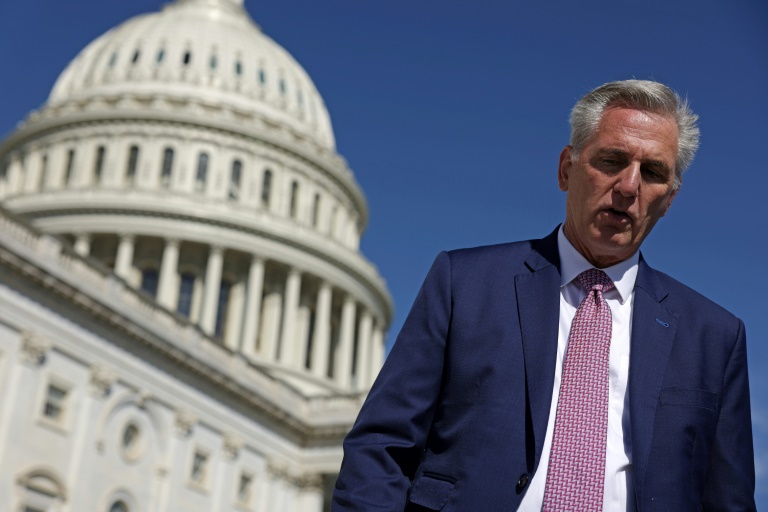
The warning from House minority leader Kevin McCarthy is the first official signal that Kyiv could be facing a tougher fight for funding as it fends off Russia’s invasion, with bipartisan support beginning to wane in the United States.

“I think people are going to be sitting in a recession and they’re not going to write a blank check to Ukraine. They just won’t do it,” McCarthy told online politics outlet Punchbowl News. 

McCarthy hopes to become House speaker — the third-most senior position in US politics behind the president and vice president — if Republicans take over the House next year.

He said he expected voters to punish the Democrats in November’s elections for neglecting domestic priorities such as a growing immigration crisis at the southern border. 

“Ukraine is important, but at the same time it can’t be the only thing they do and it can’t be a blank check,” McCarthy said.

The 57-year-old from California spoke out as Kyiv announced almost 1,200 towns and villages had been left without power after 10 days of Russian strikes that have destroyed one-third of the country’s power stations, with winter approaching.

– ‘Spending spree’ –

Since the start of Russia’s expanded invasion in February, President Joe Biden’s administration has allocated $17.6 billion in military aid to Ukraine — although this is a fraction of the total bill including humanitarian assistance. 

There has been cross-party support in Congress for the handouts, although a significant section of the Republicans’ “America First” hard-right has objected. 

Some analysts suggested that McCarthy’s announcement was a concession to the party’s right wing as he looks for votes to become speaker. 

Others said his remarks may be aimed at juicing turnout among the traditionally isolationist support base of former president Donald Trump, with Republican strategists fearing many plan to stay home on Election Day. 

“The Democrat spending spree never, ever ends. Biden needs to understand that we are the USA not the US-ATM,” far right congresswoman Lauren Boebert tweeted last month.

All but a handful of House members voted against a $12.3 billion spending bill in September that included $3 billion for arms, supplies and salaries for Ukraine’s military.

Democrats said McCarthy’s interview demonstrated that Republicans could not be trusted with US foreign policy. 

“Cutting off Ukraine in the middle of the biggest war in Europe since WWII indicates just how over his head McCarthy would be as Speaker,” tweeted Ben Rhodes, a deputy national security advisor in Barack Obama’s administration.

UK PM Truss battles to stay in power after tax reforms trashed

Britain’s Liz Truss on Tuesday battled to salvage her position as prime minister, after market turmoil at her tax-slashing plans forced a series of humiliating U-turns that have put her job in jeopardy.

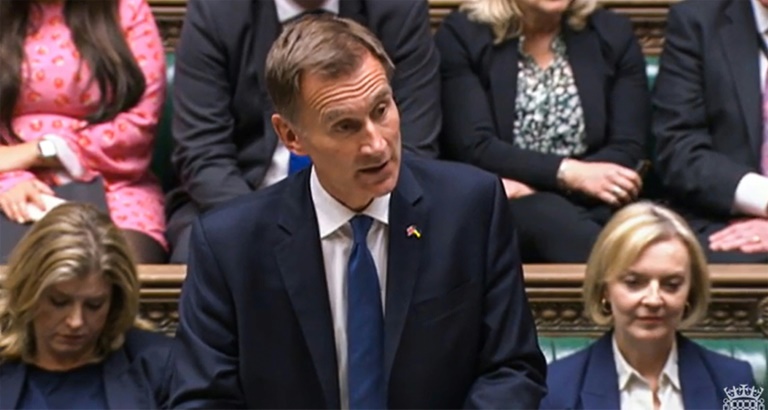
The beleaguered leader — only six weeks into her tenure — met senior ministers for their weekly cabinet, the day after new chancellor of the exchequer Jeremy Hunt announced almost all her debt-fuelled tax cuts would be reversed.

Truss reiterated her government “had gone too far and too fast” in its mini-budget unveiled last month, her office said, as she bids to stabilise weeks of economic and political tumult sparked by the package.

Hunt — who replaced her sacked ally Kwasi Kwarteng last Friday — urged ministers “to look at finding ways to save taxpayers’ money,” ahead of detailing the government’s revised medium-term fiscal plans on Halloween.

“The cabinet are fully supportive of the prime minister and it was an effective and in-depth discussion,” Truss’s spokesman told reporters, denying there were any calls for the embattled premier to resign.

But even Conservative MPs are publicly joining opposition lawmakers in declaring her position untenable, with the 47-year-old’s credibility seemingly in tatters.

Less than two months after electing her Tory leader, a new YouGov poll of the party’s membership found a stunning reversal in her fortunes, with a majority now saying she should go.

The pollster also found she was the most unpopular leader it has ever tracked, scoring a net favourability of -70.

“Unprecedented unpopularity,” tweeted YouGov’s Patrick English.

– Spending cuts –

The government’s September 23 mini-budget sent bond yields spiking and the pound collapsing to a record dollar-low on fears of rocketing UK debt.

Truss had already staged two embarrassing U-turns, scrapping tax cuts for the richest earners and on company profits, before then firing close friend Kwarteng.

On Monday, his replacement Hunt announced that not only would the remaining tax curbs be reversed, but a previously two-year cap on consumer energy bills would now be limited to six months.

He estimated all the changes would raise about £32 billion ($36 billion) per year, after economists estimated the government faced a £60-billion black hole. Hunt also warned of tough spending cuts.

His interventions sent the British pound soaring against the dollar and euro, while bond yields dipped.

The International Monetary Fund said in a statement Tuesday that recent announcements by UK authorities “signal commitment to fiscal discipline” and help align policies in the fight against inflation.

At its annual meetings last week, the IMF had urged London to maintain “coherent and consistent” policies.

Truss sought to draw a line under the largely self-inflicted crisis by apologising in a BBC interview Monday — but she insisted she would remain in office.

It followed a day branded farcical by critics, in which she failed to turn up to an urgent question tabled by the leader of the main Labour opposition in parliament, instead sending cabinet colleague Penny Mordaunt.

She is set to return to the House of Commons on Wednesday for a session of Prime Minister’s Questions seen as a crucial, possibly last, opportunity to reassert her authority.

– ‘Ghost PM’ –

Following Monday’s performance, The Sun tabloid branded Truss “the Ghost PM”, while left-wing tabloid The Mirror called the situation a “catastrophic humiliation”.

Even The Daily Telegraph, typically loyal to Conservatives, questioned her future. 

“It’s hard to conceive of a more serious political and economic crisis in recent times than that which Britain now faces,” its editorial said.

The paper added she faced “the ignominy” of becoming the country’s second shortest-serving prime minister in history.

Under current party rules, she cannot be challenged internally through a no-confidence vote in the first year, but speculation is rife they could be changed to allow for a ballot.

Conservative MP Roger Gale said Monday Hunt had become “de facto prime minister”, as several MPs publicly urged her to resign.

“I think her position is untenable,” Conservative MP Charles Walker told Sky News.

Armed forces minister James Heappey said Tuesday that Truss had “owned” her mistake but cautioned that she could not repeat such errors.

“Given how skittish our politics are… I don’t think that there’s the opportunity to make any more mistakes,” he told Sky News.

Cement giant Lafarge fined $778 mn for working with Islamic State in Syria

French cement giant Lafarge SA was slapped with a $778 million fine Tuesday for making millions in payments to the Islamic State and another jihadist group to build its business in Syria.

The US Justice Department said the company and its Syrian subsidiary actively sought the Islamic State (IS) group’s help to squeeze out competitors when the radical Islamists controlled large parts of Syria and Iraq in 2013-2014, operating an effective “revenue sharing agreement” with them.

It also paid access and protection money to associates of IS and the similarly radical Al-Nusrah Front, ultimately earning some $70 million in revenues during the period, with a Lafarge executive saying the cooperation was “to share the cake.”

Lafarge agreed to the fine and to plead guilty to one count of conspiring to provide material support to US-designated foreign terrorist organizations, the first time a corporation has faced the charge.

– ‘Unthinkable choice’ –

US officials said the company, now owned by Swiss giant Holcim Group, made itself a handmaiden to terror for profits.

“In the midst of a civil war, Lafarge made the unthinkable choice to put money into the hands of ISIS, one of the world’s most barbaric terrorist organizations, so that it could continue selling cement,” Justice Department prosecutor Breon Peace said, using another acronym for IS.

“This unprecedented charge and resolution reflect the extraordinary crimes committed and demonstrates that corporations that take actions in contravention of our national security interests in violation of the law will be held to account,” Peace said.

In a statement, Lafarge said the company and its defunct subsidiary Lafarge Cement Syria “have accepted responsibility for the actions of the individual executives involved.”

“We deeply regret that this conduct occurred and have worked with the US Department of Justice to resolve this matter.”

Holcim, which took over Lafarge in 2015 without knowledge of the Syria business dealings, said it had been cleared of any wrongdoing by US authorities.

“None of the conduct involved Holcim, which has never operated in Syria, or any Lafarge operations or employees in the United States,” it said in a separate statement.

– Millions in payments –

Lafarge began operating a 680 million euro ($670 million) cement plant in the Jalabiyeh region of Northern Syria in 2010, the year IS swept the region with a brutal campaign to establish its extremist “califate.”

That sparked a counter-offensive by the Iraq military and Syrian Kurdish forces backed by the US-led international coalition in the region.

The US designated IS and Al-Nusrah terror organizations, threatening tough penalties against anyone who worked with them.

Rather than withdraw like other companies, Lafarge kept working to market its cement, the Justice Department said.

From 2013 to 2104, it paid IS and Al-Nusrah around $5.9 million, some for raw materials, some as payments based on the volume of cement sold and some simply as monthly “donations,” the department said.

Lafarge paid another $1.1 million to intermediaries facilitating business with the two groups.

The firm also worked out a deal with IS to make it harder for cheaper Turkish cement suppliers to sell their goods in the same area, effectively allowing Lafarge to keep its prices higher, according to US authorities.

– Sharing ‘the cake’ –

Company executives knew of the arrangement, the Justice Department said.

In 2014, a senior supervisory official who reported directly to Lafarge’s chief executive wrote to officials in the Syria subsidiary about negotiations with IS.

“We have to maintain the principle that we are ready to share the ‘cake,’ if there is a ‘cake,'” he wrote, defining cake as “profit.” 

Lafarge “negotiated and made unlawful payments at a time when these groups were gaining territory and brutalizing innocent civilians in Syria and elsewhere and were actively plotting against Americans,” said US Assistant Attorney General Matthew Olsen in a New York press conference.

Lafarge still faces trial in France on a charge of complicity in crimes against humanity.

In May, a French appeals court approved the charge, opening the door for a trial of the company and eight executives, including former CEO Bruno Lafont.

Lafarge continues to fight that case.

Rights activists hope the case will serve as a bellwether for prosecuting multinationals accused of turning a blind eye to human rights violations as they operate in war-torn countries.

Cement giant Lafarge fined $778 mn for working with Islamic State in Syria

French cement giant Lafarge SA was slapped with a $778 million fine Tuesday for making millions in payments to the Islamic State and another jihadist group to build its business in Syria.

The US Justice Department said the company and its Syrian subsidiary actively sought the Islamic State (IS) group’s help to squeeze out competitors when the radical Islamists controlled large parts of Syria and Iraq in 2013-2014, operating an effective “revenue sharing agreement” with them.

It also paid access and protection money to associates of IS and the similarly radical Al-Nusrah Front, ultimately earning some $70 million in revenues during the period, with a Lafarge executive saying the cooperation was “to share the cake.”

Lafarge agreed to the fine and to plead guilty to one count of conspiring to provide material support to US-designated foreign terrorist organizations, the first time a corporation has faced the charge.

– ‘Unthinkable choice’ –

US officials said the company, now owned by Swiss giant Holcim Group, made itself a handmaiden to terror for profits.

“In the midst of a civil war, Lafarge made the unthinkable choice to put money into the hands of ISIS, one of the world’s most barbaric terrorist organizations, so that it could continue selling cement,” Justice Department prosecutor Breon Peace said, using another acronym for IS.

“This unprecedented charge and resolution reflect the extraordinary crimes committed and demonstrates that corporations that take actions in contravention of our national security interests in violation of the law will be held to account,” Peace said.

In a statement, Lafarge said the company and its defunct subsidiary Lafarge Cement Syria “have accepted responsibility for the actions of the individual executives involved.”

“We deeply regret that this conduct occurred and have worked with the US Department of Justice to resolve this matter.”

Holcim, which took over Lafarge in 2015 without knowledge of the Syria business dealings, said it had been cleared of any wrongdoing by US authorities.

“None of the conduct involved Holcim, which has never operated in Syria, or any Lafarge operations or employees in the United States,” it said in a separate statement.

– Millions in payments –

Lafarge began operating a 680 million euro ($670 million) cement plant in the Jalabiyeh region of Northern Syria in 2010, the year IS swept the region with a brutal campaign to establish its extremist “califate.”

That sparked a counter-offensive by the Iraq military and Syrian Kurdish forces backed by the US-led international coalition in the region.

The US designated IS and Al-Nusrah terror organizations, threatening tough penalties against anyone who worked with them.

Rather than withdraw like other companies, Lafarge kept working to market its cement, the Justice Department said.

From 2013 to 2104, it paid IS and Al-Nusrah around $5.9 million, some for raw materials, some as payments based on the volume of cement sold and some simply as monthly “donations,” the department said.

Lafarge paid another $1.1 million to intermediaries facilitating business with the two groups.

The firm also worked out a deal with IS to make it harder for cheaper Turkish cement suppliers to sell their goods in the same area, effectively allowing Lafarge to keep its prices higher, according to US authorities.

– Sharing ‘the cake’ –

Company executives knew of the arrangement, the Justice Department said.

In 2014, a senior supervisory official who reported directly to Lafarge’s chief executive wrote to officials in the Syria subsidiary about negotiations with IS.

“We have to maintain the principle that we are ready to share the ‘cake,’ if there is a ‘cake,'” he wrote, defining cake as “profit.” 

Lafarge “negotiated and made unlawful payments at a time when these groups were gaining territory and brutalizing innocent civilians in Syria and elsewhere and were actively plotting against Americans,” said US Assistant Attorney General Matthew Olsen in a New York press conference.

Lafarge still faces trial in France on a charge of complicity in crimes against humanity.

In May, a French appeals court approved the charge, opening the door for a trial of the company and eight executives, including former CEO Bruno Lafont.

Lafarge continues to fight that case.

Rights activists hope the case will serve as a bellwether for prosecuting multinationals accused of turning a blind eye to human rights violations as they operate in war-torn countries.

Biden attempts to put abortion battle at center of midterms

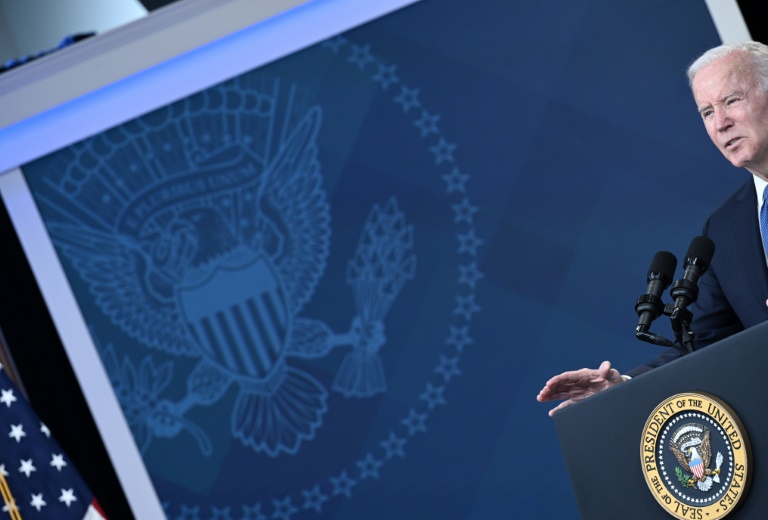
President Joe Biden vowed Tuesday to make a law enshrining nationwide abortion rights his top priority if Democrats win their uphill battle for Congress in looming midterm elections — and to veto any Republican attempt at a national ban.

Biden’s speech in Washington marked a newly intensified push by the White House to lift the party ahead of November 8, when Democrats hope to defy historical trends by retaining their razor-thin control of Congress.

Midterm votes typically see the party in the White House punished and this year the Democrats face a potential tsunami of discontent over inflation, an unpopular president, and fierce cultural wars around schools, gender issues and abortion.

In abortion, however, Biden sees a potential game-changer, with anger seething over the Supreme Court’s shock decision to overturn Roe v. Wade, the historic ruling from half a century ago that enshrined access to abortions nationwide.

“Women all across the country, starting in my house, lost a fundamental right,” Biden said.

Citing the “chaos and the heartache” for women seeking to terminate pregnancies, Biden said that in the wake of the Supreme Court ruling abortion bans had now been put in place by Republicans in 16 states, home to 26.5 million women.

And he cast the election as setting the stage for a momentous fight next year in the new Congress.

If Republicans win, any attempt to pass a national abortion ban will be stopped at his desk, Biden said. “I’ll veto it.”

If Democrats hold on, the top priority would be a national abortion rights law, effectively overturning the Supreme court ruling. “The first bill I’ll send to Congress will be to codify Roe v. Wade,” Biden said, calling this a “promise.”

“I’ll sign it in January, 50 years after Roe was first decided the law of the land.”

– Passion yes, but votes? –

There’s no questioning the passion swirling around abortion on the political stage.

Roe v. Wade made the procedure legal everywhere, while the Supreme Court decision handed power back to individual state governments, prompting Republican leaderships across the country to swiftly move to impose draconian restrictions or bans, in line with years of “right to life” campaigning.

The issue is potent, but there’s no guarantee it will move the needle in three weeks.

Democratic officials, including Biden, have repeatedly suggested the possibility of an electoral uprising led by women.

“The court and extreme Republicans who have spent decades trying to overturn Roe are about to find out,” Biden said. “They ain’t seen nothing yet.”

He referred to a surprisingly strong rejection by Kansas voters in August of a plan to strip abortion rights from the state’s constitution. “Come this November we’re going to see what happens all over America,” Biden said.

The bad news for Democrats, however, is that polls show abortion is far down the list of concerns motivating most voters.

A New York Times/Siena poll out this week showed that of likely voters, 26 percent named the economy as the top issue and 18 percent listed inflation, which is running at the highest rates in four decades.

Abortion scored a lowly five percent of likely voters.

Worryingly for Democrats, the poll also found a stunning shift from women independent voters.

In September, this group backed Democrats over Republicans by 14 points. The latest poll shows them backing Republicans by 18 points.

Amazon workers reject union in latest US warehouse vote

Workers at an Amazon warehouse near Albany voted decisively against establishing a union, US officials announced Tuesday, dealing a setback to the fledgling labor drive at the e-commerce behemoth.

The tally was 406 against Amazon Labor Union’s (ALU) proposal and 206 in support of the organization, said a spokeswoman for the National Labor Relations Board.

The election marks the second straight defeat for the ALU, which surged to prominence in April following its upset win at a large Staten Island warehouse that voted to become Amazon’s first US facility to unionize.

The ALU did not immediately respond to a request for comment, but the group’s president, Christian Smalls, said on Twitter before the counting that he was “proud” of the effort regardless of the outcome.

“Taking on a Trillion dollar company can never be a loss for workers,” Smalls tweeted. 

“We will continue to empower all workers to give them the right to unionize. You miss 100% of the shots you don’t take!”

Amazon, which has continued to contest its defeat in the first Staten Island vote, said it was pleased with Tuesday’s outcome.

“We’re glad that our team in Albany was able to have their voices heard, and that they chose to keep the direct relationship with Amazon as we think that this is the best arrangement for both our employees and customers,” said spokesperson Kelly Nantel. 

The elections at Amazon have come amid a wave of labor drives at consumer-facing companies, including Starbucks, Apple, REI and Chipotle, all of which have voted to unionize one or more store or restaurant. 

But Amazon’s initial victory in Staten Island was on a much bigger scale, providing a jolt to the US labor movement while propelling Smalls and other ALU leaders to prominence. 

Smalls, a former Staten Island Amazon worker, and other current and ex-employees established the group  2021, denouncing Amazon’s rigid workforce practices during the pandemic and arguing a union was the way towards better pay and benefits.

But after prevailing in the 8,000 employee JFK8 warehouse, the ALU had also lost a second election in May at the smaller LDJ5 warehouse, which is also in Staten Island.

Besides trying to spread the ALU to new Amazon sites, the union’s leaderships is also facing barriers in getting Amazon to come to the bargaining table to recognize the union and negotiate a contract.

Amazon has refused to accept the election outcome in the first Staten Island vote, arguing the results should be tossed out in light of alleged improprieties.

Last month, an NLRB official rejected Amazon’s claims as groundless after a 24-day hearing on the e-commerce giant’s claims.

But Amazon has said it plans to appeal that decision.

Amazon workers reject union in latest US warehouse vote

Workers at an Amazon warehouse near Albany voted decisively against establishing a union, US officials announced Tuesday, dealing a setback to the fledgling labor drive at the e-commerce behemoth.

The tally was 406 against Amazon Labor Union’s (ALU) proposal and 206 in support of the organization, said a spokeswoman for the National Labor Relations Board.

The election marks the second straight defeat for the ALU, which surged to prominence in April following its upset win at a large Staten Island warehouse that voted to become Amazon’s first US facility to unionize.

The ALU did not immediately respond to a request for comment, but the group’s president, Christian Smalls, said on Twitter before the counting that he was “proud” of the effort regardless of the outcome.

“Taking on a Trillion dollar company can never be a loss for workers,” Smalls tweeted. 

“We will continue to empower all workers to give them the right to unionize. You miss 100% of the shots you don’t take!”

Amazon, which has continued to contest its defeat in the first Staten Island vote, said it was pleased with Tuesday’s outcome.

“We’re glad that our team in Albany was able to have their voices heard, and that they chose to keep the direct relationship with Amazon as we think that this is the best arrangement for both our employees and customers,” said spokesperson Kelly Nantel. 

The elections at Amazon have come amid a wave of labor drives at consumer-facing companies, including Starbucks, Apple, REI and Chipotle, all of which have voted to unionize one or more store or restaurant. 

But Amazon’s initial victory in Staten Island was on a much bigger scale, providing a jolt to the US labor movement while propelling Smalls and other ALU leaders to prominence. 

Smalls, a former Staten Island Amazon worker, and other current and ex-employees established the group  2021, denouncing Amazon’s rigid workforce practices during the pandemic and arguing a union was the way towards better pay and benefits.

But after prevailing in the 8,000 employee JFK8 warehouse, the ALU had also lost a second election in May at the smaller LDJ5 warehouse, which is also in Staten Island.

Besides trying to spread the ALU to new Amazon sites, the union’s leaderships is also facing barriers in getting Amazon to come to the bargaining table to recognize the union and negotiate a contract.

Amazon has refused to accept the election outcome in the first Staten Island vote, arguing the results should be tossed out in light of alleged improprieties.

Last month, an NLRB official rejected Amazon’s claims as groundless after a 24-day hearing on the e-commerce giant’s claims.

But Amazon has said it plans to appeal that decision.

Thousands strike in France for higher wages

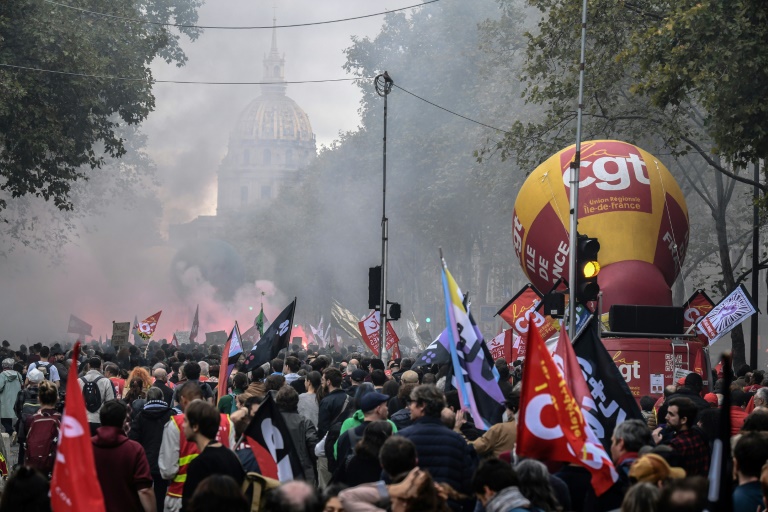
Striking workers held rallies across France on Tuesday to demand higher wages in response to soaring inflation, amplifying a protest by refinery workers that has emptied petrol stations and caused headaches for millions of motorists.

The strike caused fewer transport disruptions than feared, though unions have vowed further action against President Emmanuel Macron in coming weeks — in particular over a hostly contested pensions reform.

“It’s a shame it had to come to blockades for something to happen,” said Nadine, a 45-year-old employee in the metalworking industry who was among more than 1,000 demonstrators in Strasbourg, northeast France.

“But today if we don’t block anything, no one listens,” she said.

Among a crowd of some 1,800 marching in the southern city of Montpellier, Magali Mallet, a medical secretary, said she was there because many workers were “living on a knife’s edge”.

The interior ministry said 107,000 people took part in marches across the country, including 13,000 in Paris — an estimate far below the 70,000 reported by the CGT union.

Anti-capitalist “black bloc” protesters also joined the demo in the capital, spraying graffiti and smashing windows at a bank and a BMW dealership before being dispersed by riot police.

The ministry said 11 people were arrested in Paris and nine officers injured in clashes with the protesters, with four arrests elsewhere.

The broader strike came after workers at several oil refineries and depots operated by energy giant TotalEnergies voted to extend walkouts that are now in their third week.

The blockades have seriously disrupted fuel distribution across the country, particularly in northern and central France and the Paris region.

“We’re going to seek a 10 percent pay hike. With the cost of living rising, and energy costs, we need it — there are more and more poor workers,” said Laurent Leger, 59, at the Paris march.

– ‘Serious consequences’ –

Prime Minister Elisabeth Borne said that less than a quarter of petrol stations nationwide were experiencing shortages, down from 30 percent previously.

Her government used requisition powers to order some of the workers back to fuel depots, a move that infuriated unions but has so far been upheld in the courts.

But officials are also pushing bosses to acknowledge the wage demands, with Interior Minister Gerald Darmanin saying Tuesday that there was “a salary problem” in France, and urging employers “to increase pay when possible”.

Workers have also been striking in the nuclear power sector, potentially hampering efforts to restart reactors down for maintenance or safety work.

Power grid operator RTE warned Tuesday that “any extension of the social movement” at the nuclear power stations would have “serious consequences” on electricity provision this winter.

Macron said last week only 30 out of 56 nuclear reactors were online, while the country hoped to have 45 working by January.

But French state energy provider EDF said Saturday that it was postponing plans to bring five of the halted reactors back on stream.

– Tense autumn? –

Beyond transport and other public-sector workers, unions had hoped to bring out staff in industries such as food and healthcare.

The education ministry said less than six percent of its workers had walked out, though that rate reached 23 percent for vocational schools.

The strike could herald a tense autumn and winter as Macron also seeks to implement his flagship domestic policy of raising the French retirement age to 64 or 65, up from 62 currently.

The economic squeeze partly caused by Russia’s invasion of Ukraine, along with the failure of Macron’s party to secure an overall majority in June legislative polls, could also inflame public anger.

A poll by the Elabe group found that one in three French people would be prepared to take part in a strike or protest in the coming weeks to demand pay increases as inflation soars. 

sl-burs/ah/js/rox

Ukraine warns situation 'critical' after Russia attacks power grid

Ukraine warned Tuesday of an emerging “critical” risk to its power grid after President Volodymyr Zelensky said that repeated Russian bombardments had destroyed one-third of the country’s power facilities as winter approaches.

The warning came as Russian forces claimed to have retaken territory from Ukrainian troops in the eastern Kharkiv region, Moscow’s first announced capture of a village there since being nearly entirely pushed out of the region last month.

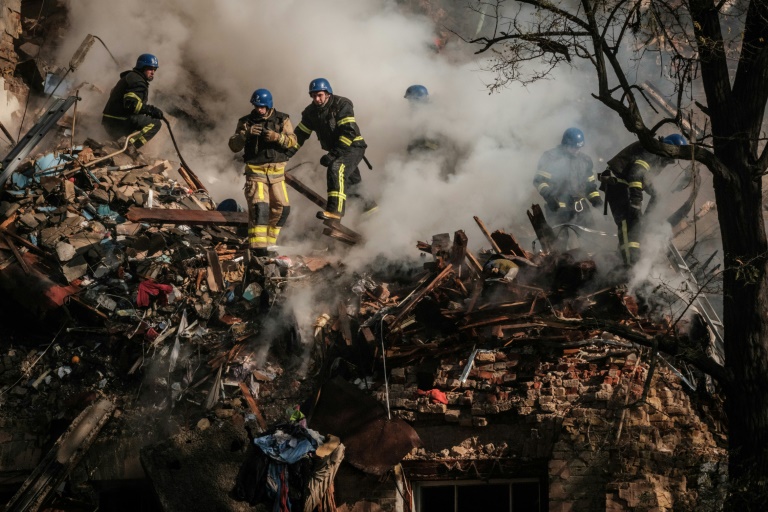
At the same time, Russian attacks rocked energy facilities in Kyiv and urban centres across the country, causing blackouts and disrupting water supplies, one day after the capital was bombarded with a swarm of suicide drones.

“The situation is critical now across the country. It’s necessary for the whole country to prepare for electricity, water and heating outages,” Kyrylo Tymoshenko, the deputy head of the Ukrainian president’s office, told Ukrainian television.

The strikes in the early hours of Tuesday hit Kyiv, Kharkiv in the east, Mykolaiv in the south and central regions of Dnipro and Zhytomyr, where officials said hospitals were running on backup generators.

But drones also bombarded Kyiv on Monday — the second in a row — leaving five dead, officials said, in what the presidency described as an attack of desperation after a string of battlefield losses.

Zelensky called the repeated targeting of energy infrastructure “another kind of Russian terrorist attacks”.

“Since October 10, 30 percent of Ukraine’s power stations have been destroyed, causing massive blackouts across the country,” the Ukrainian leader said on Twitter. 

– Hospitals on back-up power –

Many towns and cities in the Zhytomyr region, west of Kyiv, and parts of the city of Dnipro in central Ukraine were without electricity, while power was restored to the southern city of Mykolaiv after strikes overnight. 

“Now the city is cut off from electricity and water supplies. Hospitals are working on backup power,” the mayor of Zhytomyr, Sergiy Sukhomlyn, said in a statement online.

The national emergency services said that after 10 days of strikes on energy facilities, some 1,162 towns and villages in nine regions had been left without power and more than 70 people were killed and 290 injured.

Kyiv mayor Vitali Klitschko said three people had been killed in Tuesday’s strikes.

Zelensky earlier said the fresh wave of nationwide strikes — which he said had damaged a residential building and flower market in Mykolaiv — was a Russian attempt to “terrorise and kill civilians.”

– Kremlin denies Iran drone use –

Following the wave of kamikaze drone attacks against Kyiv on Monday, Foreign Minister Dmytro Kuleba demanded EU sanctions on Iran, accusing Tehran of providing Russia with drones.

But on Tuesday, he said Ukraine should cut diplomatic ties with Iran, citing the “death” and “destruction” caused by the drones.

The Kremlin said on Tuesday it had no knowledge of its army using Iranian drones in Ukraine.

“Russian tech is being used,” Kremlin spokesman Dmitry Peskov said, referring other questions to the defence ministry.

The defence ministry did however confirm strikes on energy facilities over the past 24 hours, saying it had used long-range and precision weapons.

Iran has denied exporting any weapons to either side, but the United States warned it would take action against companies and nations working with Tehran’s drone programme following the strikes in Kyiv.

Western officials however said it was “increasingly evident that Russia is pursuing a deliberate strategy of trying to destroy heating, electrical networks” and that Iranian drones were playing an “increasingly significant role” in the conflict.

Senior presidential aide Mykhaylo Podolyak meanwhile called for Russia to be excluded from the upcoming G20 summit.

With fighting ongoing across a sprawling frontline in east and southern Ukraine, its military said that over the past 24 hours it had shot down 38 Iranian-made Shahed-136 unmanned aerial vehicles.

Russia announced a rare battlefield victory Tuesday, in the eastern Kharkiv region, saying its forces had captured the village of Gorobiivka.

It was the first claim of victory since Ukrainian forces in September reclaimed huge swathes of the east in a string of embarrassing battlefield defeats.

Moscow’s forces have also been pushing towards Bakhmut in the eastern Donetsk region, and with the fight edging closer, locals’ allegiances are spilling out into the public.

One shopper, Yulia, said she believed Ukrainian forces bombed cities that were about to be captured by Russia — repeating a conspiracy theory popular on social media.

“I don’t understand why Ukraine is destroying cities,” said the 46-year-old, who declined to give her surname saying that she was afraid of reprisals for her views.

Separately on Tuesday, Russian investigators said initial indications suggest that the crash of a military plane into a residential building near Ukraine was due to a technical malfunction.

Investigators said they were questioning the pilots of the Sukhoi Su-34, who managed to parachute out of the plane before it crashed on Monday evening into the nine-storey building, engulfing it in flames.

Close Bitnami banner
Bitnami