US Business

'Hey Buddha': Japan researchers create AI enlightenment tool

What is the meaning of happiness? Why not ask AI Buddha, a tool made by Japanese researchers that brings spiritual guidance from ancient scriptures to your smartphone.

The software, co-developed by a team of religion and computing academics at Kyoto University, has been programmed to memorise around 1,000 teachings from Buddhist texts such as the Sutta Nipata and Dhammapada.

Users seeking enlightenment can question a Buddha avatar that pops up on their phone screen.

“Sharpen your observations and explore the various reasons behind the doom. Only then can you experience happiness,” was the answer AFP received to the question above.

An augmented reality backdrop shows the pint-sized Buddha sitting cross-legged within the real-life surroundings captured by the device’s camera.

And an artificial intelligence dialogue system dubbed “Buddhabot” is behind the tech, which is still in testing stages and not yet available to the general public.

Smartphone meditation apps have become hugely popular worldwide, offering specialised audio for situations from coping with bereavement to getting through a difficult day at work.

The AI Buddha, developed with the help of an IT company, is also intended as a therapeutic distraction from “the increasingly stressful real world”, from Covid-19 to the war in Ukraine, said Seiji Kumagai, a key developer of the software at Kyoto University.

“Buddhism scriptures represent the wisdom of ancient times,” the Buddhist and Tibetan studies associate professor told AFP.

“Our goal is for people to apply such old wisdom to their lives in this modern society, and seek ways to become happier,” he added.

Kumagai said the tool could be a step towards a metaverse-driven spiritual world — a potential alternative to Japan’s many temples, whose numbers are expected to decline because of depopulation.

But before the digital Buddha can be made public, more work is needed to improve grammar and contextual errors which sometimes make its answers nonsensical.

This could be misleading and even dangerous, Kumagai said, warning that in its current form, the software could “steer people on the wrong path”.

“What if, for example, people with suicidal thoughts consulted the Buddha avatar… and followed through on that impulse based on what they had been told?”

On Tuesday, a workshop was held at Kyoto University as part of the testing process, with students and faculty members invited to try out the tool.

Yuya Ohara, a 19-year-old student and football fan, asked the Buddha what makes an ideal football player, to which it answered: “Abandon your possessiveness.”

“I would’ve laughed it off if that answer came from my friends,” he told AFP.

“But since it was from Buddha, I was more open-minded.”
European stock markets climb on bright US earnings

European equities rose Tuesday on upbeat US earnings, with sentiment also soothed after Britain shredded its controversial budget.

Asian and Europe chased Wall Street higher after Bank of America became the latest US financial heavyweight to top estimates, following JPMorgan Chase and others that logged solid numbers Friday.

“Better-than-expected US earnings reports sparked a rally on Wall Street with positive momentum reverberating across European equities,” Interactive Investor analyst Victoria Scholar told AFP.

“Risk appetite is picking up after a volatile week for markets, as corporate results look to be the main driver of price action today.”

Later on Tuesday, investors will digest results from Goldman Sachs, Johnson & Johnson, Lockheed Martin and Netflix.

Analysts remain hopeful that an upbeat third-quarter results season could give a shot in the arm to markets which have been slammed this year on fears over inflation and Federal Reserve interest rate hikes.

Frankfurt stocks jumped more than one percent on Tuesday as a key survey showed German investor confidence climbed slightly in October, but it still held at a low level.

London gains were curbed after the Bank of England poured cold water on a newspaper report that it could delay the sale of government bonds again to help maintain market stability.

A BoE spokesperson described the Financial Times story as “inaccurate”.

The British pound retreated back under $1.13, after jumping Monday above $1.14 as the UK government sensationally ripped up its controversial debt-fuelled budget.

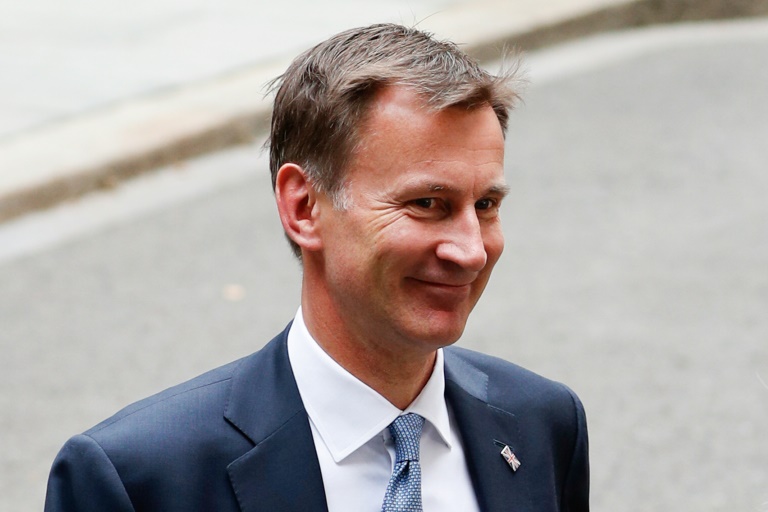
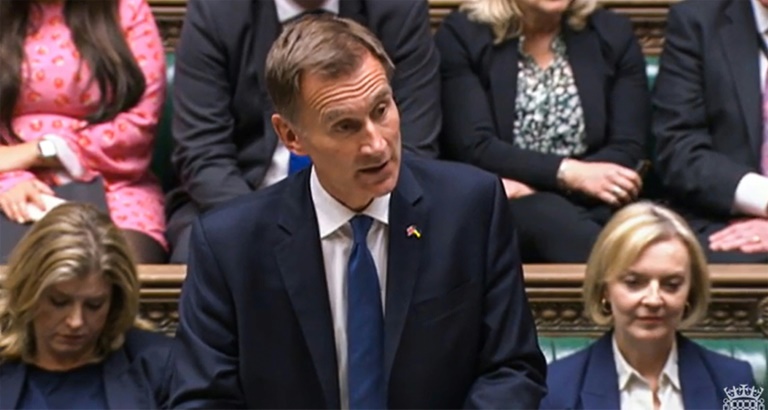
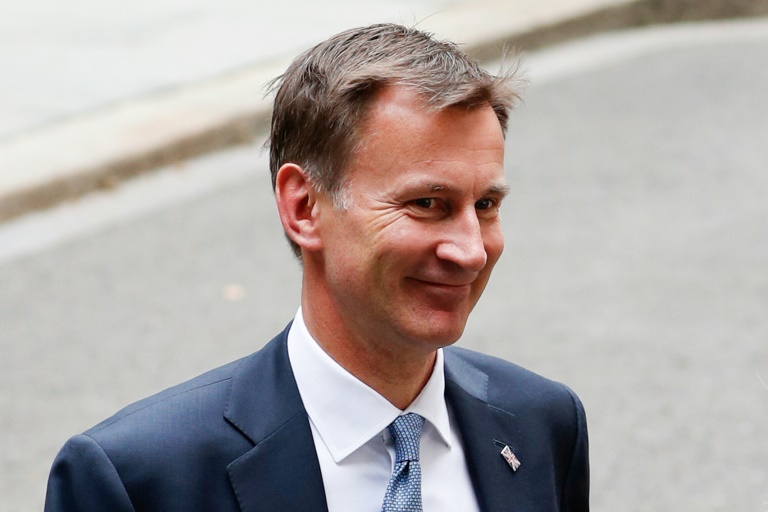
After a volatile few weeks during which the pound hit a record low, new finance minister Jeremy Hunt sought Monday to reassure investors as he scrapped tax cuts and warned of tough spending cuts.

Monday’s move, which dealt a blow to Prime Minister Liz Truss’s authority, sent sterling up as much as two percent at one point and the cost of government borrowing tumbled, while the FTSE 100 jumped.

“Investors continue to monitor the political and economic turbulence surrounding the UK,” noted XTB analyst Walid Koudmani.

Markets in China fluctuated a day after authorities delayed the release of third-quarter economic figures, which analysts said were likely to show the weakest growth since the pandemic owing to Covid-19 lockdowns.

The decision comes as the Communist Party holds a key gathering at which President Xi Jinping is expected to be handed a third term.

– Key figures around 1030 GMT –

London – FTSE 100: UP 0.9 percent at 6,979.19 points

Frankfurt – DAX: UP 1.2 percent at 12,794.07

Paris – CAC 40: UP 0.7 percent at 6,079.98

EURO STOXX 50: UP 0.9 percent at 3,474.10

Tokyo – Nikkei 225: UP 1.4 percent at 27,156.14 (close)

Hong Kong – Hang Seng Index: UP 1.8 percent at 16,914.58 (close)

Shanghai – Composite: DOWN 0.1 percent at 3,080.96 (close)

New York – Dow: UP 1.9 percent at 30,185.82 (close)

Pound/dollar: DOWN at $1.1275 from $1.1358 on Monday

Dollar/yen: UP at 149.11 yen from 149.04 yen

Euro/dollar: DOWN at $0.9835 from $0.9841

Euro/pound: UP at 87.21 pence from 86.64 pence

Brent North Sea crude: DOWN 0.2 percent at $91.47 per barrel

West Texas Intermediate: DOWN 0.2 percent at $85.28 per barrel

burs-rfj/rl

European stock markets climb on bright US earnings

European equities rose Tuesday on upbeat US earnings, with sentiment also soothed after Britain shredded its controversial budget.

Asian and Europe chased Wall Street higher after Bank of America became the latest US financial heavyweight to top estimates, following JPMorgan Chase and others that logged solid numbers Friday.

“Better-than-expected US earnings reports sparked a rally on Wall Street with positive momentum reverberating across European equities,” Interactive Investor analyst Victoria Scholar told AFP.

“Risk appetite is picking up after a volatile week for markets, as corporate results look to be the main driver of price action today.”

Later on Tuesday, investors will digest results from Goldman Sachs, Johnson & Johnson, Lockheed Martin and Netflix.

Analysts remain hopeful that an upbeat third-quarter results season could give a shot in the arm to markets which have been slammed this year on fears over inflation and Federal Reserve interest rate hikes.

Frankfurt stocks jumped more than one percent on Tuesday as a key survey showed German investor confidence climbed slightly in October, but it still held at a low level.

London gains were curbed after the Bank of England poured cold water on a newspaper report that it could delay the sale of government bonds again to help maintain market stability.

A BoE spokesperson described the Financial Times story as “inaccurate”.

The British pound retreated back under $1.13, after jumping Monday above $1.14 as the UK government sensationally ripped up its controversial debt-fuelled budget.

After a volatile few weeks during which the pound hit a record low, new finance minister Jeremy Hunt sought Monday to reassure investors as he scrapped tax cuts and warned of tough spending cuts.

Monday’s move, which dealt a blow to Prime Minister Liz Truss’s authority, sent sterling up as much as two percent at one point and the cost of government borrowing tumbled, while the FTSE 100 jumped.

“Investors continue to monitor the political and economic turbulence surrounding the UK,” noted XTB analyst Walid Koudmani.

Markets in China fluctuated a day after authorities delayed the release of third-quarter economic figures, which analysts said were likely to show the weakest growth since the pandemic owing to Covid-19 lockdowns.

The decision comes as the Communist Party holds a key gathering at which President Xi Jinping is expected to be handed a third term.

– Key figures around 1030 GMT –

London – FTSE 100: UP 0.9 percent at 6,979.19 points

Frankfurt – DAX: UP 1.2 percent at 12,794.07

Paris – CAC 40: UP 0.7 percent at 6,079.98

EURO STOXX 50: UP 0.9 percent at 3,474.10

Tokyo – Nikkei 225: UP 1.4 percent at 27,156.14 (close)

Hong Kong – Hang Seng Index: UP 1.8 percent at 16,914.58 (close)

Shanghai – Composite: DOWN 0.1 percent at 3,080.96 (close)

New York – Dow: UP 1.9 percent at 30,185.82 (close)

Pound/dollar: DOWN at $1.1275 from $1.1358 on Monday

Dollar/yen: UP at 149.11 yen from 149.04 yen

Euro/dollar: DOWN at $0.9835 from $0.9841

Euro/pound: UP at 87.21 pence from 86.64 pence

Brent North Sea crude: DOWN 0.2 percent at $91.47 per barrel

West Texas Intermediate: DOWN 0.2 percent at $85.28 per barrel

burs-rfj/rl

France faces delays as unions call transport strike

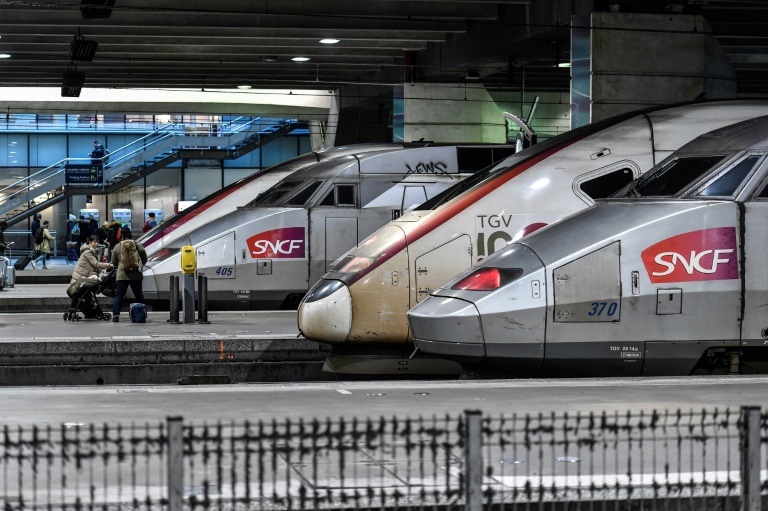
France faced disruptions on Tuesday after unions called a nationwide transport strike, as they remain in deadlock with the government over walkouts at oil depots that have sparked fuel shortages.

The effects were already visible at Paris hub Gare de Lyon early Tuesday, with packed suburban trains disgorging floods of passengers onto the platforms every 15 or even 20 minutes.

Commuter Leonore Lopez said her trip into Paris from a small town outside the capital had taken one hour more than usual.

“It was a bit of a pain,” she said.

The broader strike comes after workers at several oil refineries and depots operated by energy giant TotalEnergies voted to extend walkouts.

Their industrial action has seriously disrupted fuel distribution across the country but particularly in northern and central France and the Paris region.

Motorists have scrambled to fill tanks as the fuel strike, which has lasted for nearly three weeks, cripples supplies at around 30 percent of France’s service stations and has had a knock-on effect across all sectors of the economy.

– ‘Time for negotiation over’ –

President Emmanuel Macron’s government used requisitioning powers to force some strikers back to open fuel depots, a move that infuriated unions but has so far been upheld in the courts.

Finance Minister Bruno Le Maire earlier said it was necessary to use requisitioning powers to reopen the refineries and depots.

“The time for negotiation is over,” Le Maire told the BFMTV broadcaster. 

“There was an agreement,” he added, referring to the deal concluded last week between TotalEnergies and two majority unions, but which the hard-left CGT union rejects.

The CGT’s representative at TotalEnergies, Eric Sellini, told AFP that strikers would gather on Tuesday evening to decide their next move.

CGT boss Philippe Martinez suggested Monday that the government “get around a table” with the unions to discuss an increase in France’s minimum wage. 

– Trains cancelled –

The leftist CGT and FO unions called a nationwide strike Tuesday for higher salaries, and against government requisitions of oil installations, threatening to cripple public transport in particular.

The action is the unions’ biggest challenge to Macron since he won a new presidential term in May.

The Liberation newspaper on its front page published a caricature of Macron swept off his feet and clinging on to the edge of a giant megaphone blasting the message of angry protesters.

Unions in other industries and the public sector have also announced action to protest against the twin impact of soaring energy prices and overall inflation on the cost of living. 

Rail operator SNCF will see “severe disruptions” with half of train services cancelled, Transport Minister Clement Beaune said.

At the train station in the southwestern city of Toulouse, Frederic Mercier-Handisyde had turned up two hours early to travel to Paris.

“I thought there would likely be disruptions, so I planned ahead,” said the 58-year-old engineer, though adding he supported the strikers.

– ‘Real pay rises’ –

A poll by the Elabe group found 39 percent of French people supported Tuesday’s action, while 49 percent disapproved of it.

CGT boss Martinez told RTL radio that it would be “the workers who decide” whether the strike at SCNF continues into the busy late October school holiday period.

“Rail workers are determined to obtain real pay rises,” Laurent Brun, head of the CGT’s rail workers union, wrote on Twitter.

Suburban services in the Paris region and bus services would also be impacted, operator RATP said.

But the inner-Paris metro system appeared to be largely unaffected.

Beyond transport workers, unions hope to bring out staff in sectors such as the food industry and healthcare.

The education ministry said less than six percent of its workers had walked out, though that rate reached 23 percent for vocational schools.

Their action will kick off what is likely to be a tense autumn and winter as Macron also seeks to implement his flagship domestic policy of raising the French retirement age.

The economic squeeze partly caused by Russia’s invasion of Ukraine, along with the failure of Macron’s party to secure an overall majority in June legislative polls, only adds to the magnitude of the task.

sl-burs/ah/sjw/rl

Russian strikes pound Ukraine power sites

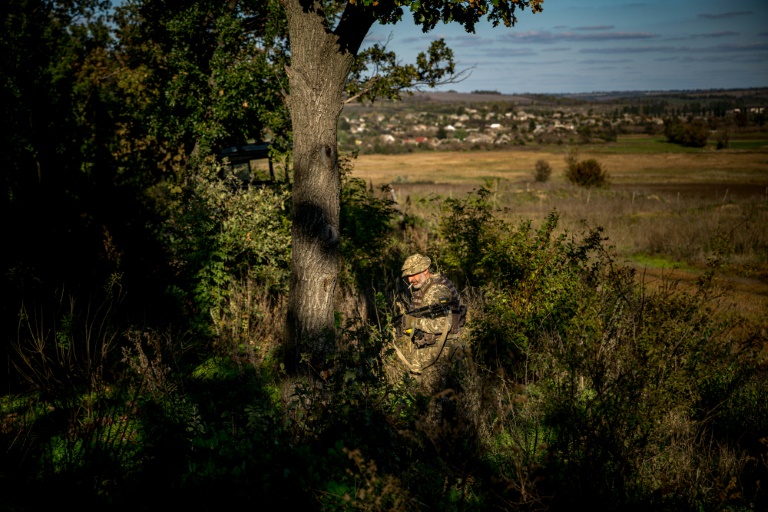
President Volodymyr Zelensky said Tuesday that Russian strikes had destroyed about 30 percent of his country’s power stations in one week, speaking hours after a fresh barrage cut electricity to cities across Ukraine.

Russian attacks rocked energy facilities in Kyiv and urban centres across the country, causing blackouts and disrupting water supplies, just one day after the capital was bombarded with a swarm of suicide drones.

The strikes in the early hours of Tuesday hit Kyiv, Kharkiv in the east, Mykolaiv in the south and central regions of Dnipro and Zhytomyr, where officials said hospitals were running on backup generators.

Drones bombarded Kyiv on Monday, destroying a residential building in the centre and killing five people in what the presidency described as an attack of desperation.

It was the second Monday in a row that Russia launched punitive strikes which military observers have said appear to be Moscow’s response to battlefield losses.

Zelensky described the repeated targeted of energy infrastructure as “another kind of Russian terrorist attacks”.

“Since October 10, 30 percent of Ukraine’s power stations have been destroyed, causing massive blackouts across the country,” the Ukrainian leader said on Twitter. 

– Hospitals on back-up power –

He said the attack meant that there was “no space left for negotiations with (President Vladimir) Putin’s regime”. 

Many settlements in the Zhytomyr region west of Kyiv and parts of the city of Dnipro in central Ukraine were without electricity, while power was restored to the southern city of Mykolaiv after strikes overnight. 

“Now the city is cut off from electricity and water supplies. Hospitals are working on backup power,” the mayor of Zhytomyr Sergiy Sukhomlyn said in a statement on line.

In the northeast meanwhile, Ukraine’s second-largest city of Kharkiv some 40 kilometres (25 miles) from the border with Russia was hit with eight missiles, the regional governor said.

Kharkiv’s mayor Igor Terekhov said an “industrial enterprise” had been hit.

In Kyiv, meanwhile, the DETK energy provider said its staff were “doing their best to restore electricity supply after the destruction of a critical infrastructure facility in Kyiv city.”

Zelensky earlier said the fresh wave of nationwide strikes — which he said had damaged a residential buidling and flower market in Mykolaiv — was a Russian attempt to “terrorize and kill civilians.”

“The terrorist state will not change anything for itself with these kind of actions. It will only confirm its destructive and murderous essence, for which it will certainly be held to account,” Zelensky said on social media.

There was no immediate reaction from Moscow, but it has said following similar attacks that assigned military targets were hit.

– Kremlin denies Iran drone use –

Following the wave of kamikaze drone attacks on Kyiv Monday, Foreign Minister Dmytro Kuleba demanded EU sanctions on Iran, accusing Tehran of providing Russia with drones.

The Kremlin said Tuesday it has no knowledge of its army using Iranian drones in Ukraine.

“Russian tech is being used,” Kremlin spokesman Dmitry Peskov said, referring other questions to the defence ministry.

Iran has denied exporting any weapons to either side, but the United States warned it would take action against companies and nations working with Tehran’s drone programme following the strikes in Kyiv.

Senior presidential aide Mykhaylo Podolyak meanwhile called for Russia to be excluded from the upcoming G20 summit.

With fighting ongoing across a sprawling frontline in east and southern Ukraine, its military said that over the past 24 hours it had shot down 38 Iranian-made Shahed-136 unmanned aerial.

Separately on Tuesday, Russian investigators said they intially believe that a military plane that crashed into a residential building in the south of the country near Ukraine was the result of a technical malfunction.

Investigators said they were questioning the pilots of the Sukhoi Su-34, who managed to parachute out of the plane before it crashed on Monday evening into the nine-storey building, engulfing it in flames.

China sees 'much faster timeline' on taking Taiwan, Blinken warns

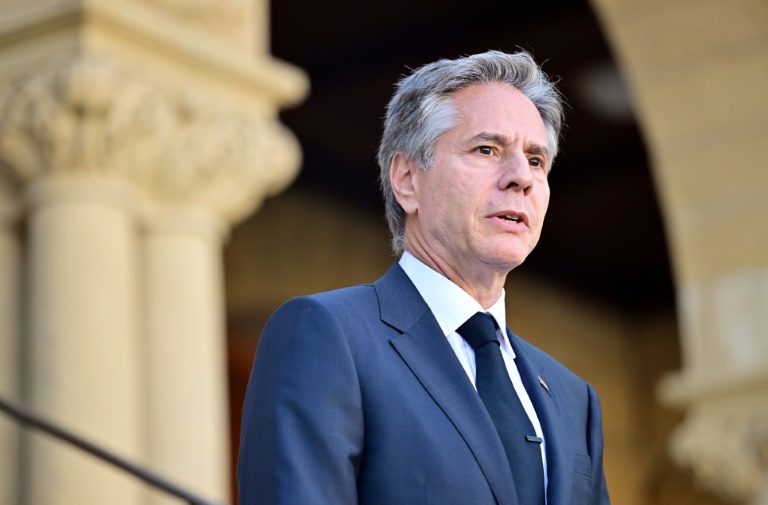
Beijing wants to seize Taiwan “on a much faster timeline” than previously considered, US Secretary of State Antony Blinken said Monday, warning that President Xi Jinping was leading China in a more aggressive direction.

Xi is on the cusp of securing a third five-year term at the helm of the world’s most populous nation, delivering a landmark Communist Party Congress speech on Sunday that hailed his decade in power and restated his vow to one day “reunify,” or forcefully take, Taiwan.

“We’ve seen a very different China emerge in recent years under Xi Jinping’s leadership,” Blinken told a forum at Stanford University with former secretary of state Condoleezza Rice.

“It is more repressive at home; it’s more aggressive abroad. And in many instances that poses a challenge to our own interests as well as to our own values,” he added.

Blinken accused Xi of “creating tremendous tension” by changing the approach toward self-ruled Taiwan, which China’s Communist Party has never controlled but claims as its own.

He said China had made a “fundamental decision that the status quo was no longer acceptable, and that Beijing was determined to pursue reunification on a much faster timeline,” though he gave no hard estimate or date.

Senior US military figures have previously sounded the alarm that China has expanded its military forces to the point where it could soon have the capability to pull off an invasion of Taiwan. 

China’s stance has long been that it seeks “peaceful reunification” with Taiwan but reserves the right to use force if necessary, especially if the island formally declares independence.

But the rhetoric and actions towards Taiwan have become more pronounced under Xi, China’s most assertive leader in a generation.

He has tied taking Taiwan to his vision of the “great rejuvenation of the Chinese nation” and has previously said the goal of reunification cannot continue to be passed indefinitely from generation to generation.

In Sunday’s speech, he repeated similar themes, saying the “wheels of history are rolling on towards China’s reunification” and that “we reserve the option of taking all measures necessary.”

– Shared interests –

Russia’s recent invasion of Ukraine, which China has not condemned, has also raised fears that Beijing might take similar moves against Taiwan’s 23 million people.

Ties between Washington and Beijing have been at a decade-low ebb under both the administrations of Donald Trump and his successor President Joe Biden, over a range of issues from trade to security and human rights. 

But Blinken said the world’s two largest economies should be willing to cooperate on shared interests.

He said the world “fundamentally expects” the two powers to work together on climate change, global health and possibly drug trafficking.

Beijing “just has to be responsive to demand signals that it’s getting from countries around the world to be a positive actor, not a negative actor, on issues that concern them.”

China cut cooperation with the United States on climate change and drug trafficking in August as part of its protest against US House Speaker Nancy Pelosi’s visit to Taiwan, which also saw Beijing launch its biggest military drills yet around the island.

Responding to Blinken’s speech, Chinese foreign ministry spokesman Wang Wenbin accused Washington of altering its own approach to Taiwan, citing examples such as Pelosi’s visit and recent arms sales.

“Peacefully resolving the Taiwan issue cannot coexist with Taiwan separatism,” Wang said. 

Xi is widely expected to meet Biden on the sidelines of a Group of 20 summit next month in Bali, their first meeting since the US leader took office.

UK PM Truss battles to stay in power after tax reforms trashed

British Prime Minister Liz Truss on Tuesday battled to stabilise her position after an economic crash forced her into humiliating U-turns on tax reforms, putting her future as leader in doubt.

“It’s hard to conceive of a more serious political and economic crisis in recent times than that which Britain now faces,” right-wing broadsheet The Daily Telegraph wrote in an editorial.

The paper, which previously supported Truss, wrote that she faced “the ignominy” of becoming the country’s second shortest-serving prime minister in history, unless her own MPs gave her “breathing space”.

Truss on Tuesday was to meet her cabinet and attempt to rally support among Conservative MPs, some of whom have publicly said she has no future as prime minister. 

She was set to face parliament on Wednesday for a session of Prime Minister’s Questions.

The right-wing Sun tabloid on Tuesday called Truss “The Ghost PM”, while left-wing tabloid The Mirror called the situation a “catastrophic humiliation”.

The embattled prime minister on Monday apologised in a BBC interview for going “too far and too fast” with reforms, a month after taking office.

This came after her new finance minister Jeremy Hunt in a brief televised statement on Monday axed almost all the debt-fuelled tax cuts announced last month in a budget by his sacked predecessor, Kwasi Kwarteng.

Hunt told parliament that he and Truss “agreed yesterday to reverse almost all the tax measures announced in the growth plan three weeks ago”, flanked by a grim-faced Truss.

The announcement came as Truss’s governing Conservative party tanked in the opinion polls amid the reversals and Britain’s worsening cost-of-living crisis.

– ‘Very British coup’ –

British media likened Hunt’s dramatic intervention to a coup, with The Telegraph depicting him in cartoon form as a bemedaled Generalissimo “taking temporary control to stabilise the situation”.

“It was a very British coup. So polite you could almost have missed it,” wrote left-wing broadsheet The Guardian.

Conservative MP Roger Gale said that Hunt had become “de facto prime minister” as several MPs publicly urged her to go and others reportedly plotted to unseat her.

“I think her position is untenable,” Conservative MP Charles Walker told Sky News.

“If she doesn’t go right now, it will not be her decision,” he warned.

Armed forces minister James Heappey assured British media on Tuesday morning that Truss had “owned” her mistake, while admitting she could not repeat such errors.

Asked by Sky News whether Truss was “prime minister in name only”, Heappey insisted: “She’s been very candid about the mistake that was made and she has apologised for that… There’s leadership in doing that”.

But he conceded that “given how skittish our politics are… I don’t think that there’s the opportunity to make any more mistakes.”

Truss fired her close friend Kwarteng on Friday after their tax-slashing budget sent bond yields spiking and the pound collapsing to a record dollar-low on fears of rocketing UK debt — fuelling intense speculation over her political future one month after taking office.

Truss had already staged two embarrassing budget U-turns, scrapping tax cuts for the richest earners and on company profits.

Hunt’s strategy reversals included reducing Truss’s announced £2,500 cap on energy bills for all British people from two years to six months, after which he promised a new approach.

Hunt estimated the tax changes would raise about £32 billion ($36 billion) per year, after economists estimated the government faced a £60-billion black hole. He also warned of tough spending cuts.

Hunt’s actions on Monday sent the British pound soaring against the dollar and euro, while bond yields dipped.

WWII munitions hinder Nord Stream pipeline probe

Investigations into the suspected sabotage of the Nord Stream gas pipelines linking Russia with Europe are “progressing well”, despite World War II munitions on the seabed, Denmark said Thursday.

“It’s a zone marked by the presence of munitions — used or not — from World War II,” Danish Defence Minister Morten Bodskov told reporters on the sidelines of a meeting of the NATO defence alliance in Brussels.

“There’s a lot of stuff at the bottom of the sea, so it’s not so easy.”

“But the work is continuing and going well,” he added.

The two Nord Stream pipelines were damaged by two explosions under the Baltic Sea at the end of September, causing major gas leaks.

Sweden has announced that preliminary underwater inspections backed up suspicions of probable sabotage.

“With Sweden and Germany, Denmark is carrying out an inquiry which is progressing well,” the minister said.

“What we discover will of course be made public.”

With fingers being pointed at Russia for the sabotage, Moscow demanded to be part of the investigations into the explosions which happened in international waters, but Copenhagen and Stockholm refused.

Russia’s ambassador to Copenhagen said the credibility of the inquiry was undermined by Moscow’s absence.

But Sweden’s outgoing Prime Minister Magdalena Andersson told Moscow to open its own investigation.

Both Moscow and Washington have denied responsibility for the gas leaks.

Taiwan's Foxconn unveils more electric vehicle prototypes

Taiwanese tech giant Foxconn unveiled two more electric vehicle prototypes on Tuesday, including a pickup truck, saying commercial production on two other designs would start later this year.

The world’s largest contract electronics maker, Foxconn already plays a lynchpin role in assembling gadgets for a host of top international brands including Apple’s iPhone.

The company has moved to diversify beyond electronics assembly and embraced the competitive but rapidly expanding EV business, unveiling three concept cars last year.

Foxconn chairman Young Liu showed off two more prototypes at Tuesday’s media event in Taipei — a sporty hatchback dubbed the Model B and a pickup, the Model V.

He also announced that commercial production would start by the end of the year on the group’s previously unveiled electric bus and a family sports utility vehicle.

“Foxconn has cut in half the design time and reduced development cost by a third in taking an EV from concept to production-ready,” Liu said.

Foxconn plans to do with electric vehicles what it did for gadgets — become a go-to contract builder.

Its strategy is to construct vehicles for clients rather than sell them under its own name, using the prototypes as a guide.

“I hope one day we can do Tesla cars for Tesla,” Liu told reporters, adding that Foxconn was aiming for five percent of the global EV market by 2025. 

Liu said one of its clients, Taiwanese automaker Luxgen, had received 15,000 customer pre-orders in under two days for its N7 car, which is based on the Foxconn Model C unveiled last year.

He added that various models will be put into production in Taiwan, Thailand and the United States while the company is also eyeing cooperation with Indonesia and India, without providing details.

Foxconn has also started building electric vehicles for Lordstown Motors after completing its purchase of a former General Motors plant in Lordstown, Ohio in May.

This month, it signed a memorandum of understanding with US-based INDIEV Inc to build the first INDI One prototype EV at its Ohio facility.

Its partners also include Fisker, one of a host of US-based electronic car startups hoping to someday challenge Tesla’s supremacy.

Fisker has recently reaffirmed plans to have Foxconn build its upcoming Fisker Pear model at the Ohio factory starting in 2024.

It has been widely reported for years that Apple has a secret electronic car project, something Foxconn could be in an ideal place to partner on given its existing relationship with the California-based giant.

Stocks, sterling extend gains after UK budget U-turn

Equities rose with sterling Tuesday after the UK government scrapped a controversial debt-funded mini-budget that had roiled markets, while traders were also cheered by a broadly positive start to earnings season.

After a volatile few weeks during which the pound hit a record low, new finance minister Jeremy Hunt sought Monday to reassure investors as he unveiled a new spending package, doing away with tax cuts and warning of much lower spending.

The move — which deals a blow to Prime Minister Liz Truss’s authority — sent sterling up as much as two percent at one point and the cost of government borrowing tumbled, while the FTSE 100 jumped.

The positive mood filtered through to other markets, with Wall Street enjoying a much-needed surge, including a more than three percent jump in the Nasdaq.

And most of Asia followed suit, with Tokyo, Hong Kong, Singapore, Mumbai, Bangkok, Sydney, Seoul, Wellington, Taipei, Manila and Jakarta all enjoying a pick-up, though Shanghai dipped.

London opened on the front foot along with Paris and Frankfurt.

The pound was also given an extra boost — at one point topping $1.14 — after a Financial Times report said the Bank of England will likely put off the sale of government bonds again as it looks to maintain market stability.

The Bank had been due to offload the gilts — bought to keep borrowing costs down during the pandemic — from October 6 but delayed that because of the turmoil sparked by the mini-budget, but the FT said it would likely delay again until financial conditions had calmed.

The market gains built on Monday’s rise, though analysts warned that the advances were unlikely to be sustained owing to broader worries about inflation and rising interest rates.

“The last couple of months have been tough for equity markets since peaking towards the end of the summer and a rebound of some kind was going to happen eventually,” said OANDA’s Craig Erlam. 

“I’m just not convinced there’s much substance behind it as the economic landscape looks treacherous and we don’t even know if we’re at peak inflation and interest rate pricing yet. Those are substantial headwinds that will make any stock market rebound extremely challenging.”

The latest data out of New Zealand showing inflation remained at a three-decade high underscored the tough job central banks have in bringing prices down, even after several rate hikes.

Commentators said traders have come to the conclusion that a recession is on the way in major economies, with the main question being how bad it will be.

“I think we can stop saying inflation is ‘hotter than expected’ and shift to ‘hotter than hoped’ — because it really does feel like we’re all just crossing our fingers and hoping prices come down,” said Matt Simpson at City Index.

“And in the few cases that they are, it is clearly not fast enough for anyone’s liking. Conversely to the adage about stock market prices, inflation seems to get the elevator up and the escalator down — but not before lingering around the top floor for an extended period of time.”

Markets in China fluctuated a day after authorities delayed the release of third-quarter economic figures, which analysts said were likely to show the weakest growth since the pandemic owing to Covid-19 lockdowns.

The decision comes as the Communist Party holds a key gathering at which President Xi Jinping is expected to be handed a third term.

“Whenever the release occurs, we should all be prepared for some global financial market reaction if the world’s two largest economies are both in recession this year. Especially, as the global economic slowdown remains ongoing,” said Clifford Bennett at ACY Securities.

“While in China, we have a slightly artificially generated risk of recession due to a zero-Covid policy.

“This policy has been confirmed to remain in place indefinitely. This means China will see further economic disruption over the coming year.”

– Key figures around 0810 GMT –

Tokyo – Nikkei 225: UP 1.4 percent at 27,156.14 (close)

Hong Kong – Hang Seng Index: UP 1.8 percent at 16,914.58 (close)

Shanghai – Composite: DOWN 0.1 percent at 3,080.96 (close)

London – FTSE 100: UP 1.1 percent at 6,994.87

Pound/dollar: UP at $1.1357 from $1.1351 on Monday

Dollar/yen: DOWN at 148.99 yen from 149.03 yen

Euro/dollar: UP at $0.9858 from $0.9840

Euro/pound: UP at 86.80 pence from 86.66 pence

West Texas Intermediate: UP 0.4 percent at $85.82 per barrel

Brent North Sea crude: UP 0.3 percent at $91.89 per barrel

New York – Dow: UP 1.9 percent at 30,185.82 (close)

— Bloomberg News contributed to this story —

Close Bitnami banner
Bitnami