US Business

Ex-head of US electric truck firm found guilty of fraud

The former head of Nikola, a start-up making electric- and hydrogen-powered trucks, was found guilty of fraud on Friday for misleading investors about his company’s alleged progress and capabilities in order to raise more money. 

After a trial that began in mid-September in a Manhattan federal courthouse, jurors found Trevor Milton, 40, guilty on three out of four counts.

“Trevor Milton lied to Nikola’s investors — over and over and over again,” said Damien Williams, US Attorney for the Southern District of New York. 

“That’s fraud, plain and simple, and this office has no patience for it… Let this case serve as a warning to anyone who plays fast and loose with the truth to get investors to part with their money. It won’t end well.”

Prosecutors accused the entrepreneur of having exaggerated the number of orders placed and the company’s ability to produce hydrogen and having lied about prototypes. 

They said instead of holding a traditional public offering, Nikola went public by merging with an already listed company (known as a Spac, or Special Purpose Acquisition Company) which meant there were fewer constraints about releasing important information.

Nikola made a splash when it debuted on Wall Street in June 2020 before sealing a promising partnership with General Motors in September, which seemed to confer legitimacy on the company based in Phoenix, Arizona. 

But the company was engulfed in a whirlwind of controversy days later when the investment firm Hindenburg Research claimed Nikola was “an intricate fraud built on dozens of lies over the course of its founder and executive chairman Trevor Milton’s career.”

Faced with charges filed by US authorities in July 2021, Milton pleaded not guilty. 

His lawyers argued that any exaggerated statements he made about Nikola were aimed at car enthusiasts and specialists rather than investors. 

Official documents presenting the company’s market strategy and submitted to the Security and Exchange Commission (SEC) have always been correct, Milton’s lawyers said. 

They attempted to show that the statements submitted as evidence by the prosecution had no significant impact on the share price. 

Nikola has already paid $125 million dollars to the SEC to settle similar lawsuits.

Ex-head of US electric truck firm found guilty of fraud

The former head of Nikola, a start-up making electric- and hydrogen-powered trucks, was found guilty of fraud on Friday for misleading investors about his company’s alleged progress and capabilities in order to raise more money. 

After a trial that began in mid-September in a Manhattan federal courthouse, jurors found Trevor Milton, 40, guilty on three out of four counts.

“Trevor Milton lied to Nikola’s investors — over and over and over again,” said Damien Williams, US Attorney for the Southern District of New York. 

“That’s fraud, plain and simple, and this office has no patience for it… Let this case serve as a warning to anyone who plays fast and loose with the truth to get investors to part with their money. It won’t end well.”

Prosecutors accused the entrepreneur of having exaggerated the number of orders placed and the company’s ability to produce hydrogen and having lied about prototypes. 

They said instead of holding a traditional public offering, Nikola went public by merging with an already listed company (known as a Spac, or Special Purpose Acquisition Company) which meant there were fewer constraints about releasing important information.

Nikola made a splash when it debuted on Wall Street in June 2020 before sealing a promising partnership with General Motors in September, which seemed to confer legitimacy on the company based in Phoenix, Arizona. 

But the company was engulfed in a whirlwind of controversy days later when the investment firm Hindenburg Research claimed Nikola was “an intricate fraud built on dozens of lies over the course of its founder and executive chairman Trevor Milton’s career.”

Faced with charges filed by US authorities in July 2021, Milton pleaded not guilty. 

His lawyers argued that any exaggerated statements he made about Nikola were aimed at car enthusiasts and specialists rather than investors. 

Official documents presenting the company’s market strategy and submitted to the Security and Exchange Commission (SEC) have always been correct, Milton’s lawyers said. 

They attempted to show that the statements submitted as evidence by the prosecution had no significant impact on the share price. 

Nikola has already paid $125 million dollars to the SEC to settle similar lawsuits.

Defiant Putin says Russia 'doing everything right' in Ukraine

Russian President Vladimir Putin said on Friday that Moscow was “doing everything right” in its nearly eight-month invasion of Ukraine despite a string of embarrassing defeats, as Kyiv said it was “stronger than ever” and would emerge victorious.

Putin’s comments came hours after Kremlin-installed officials in the southern region of Kherson urged residents to leave after Kyiv said its forces were advancing on the region’s eponymous main city.

Moscow also hinted at the extent of the damage dealt to the Crimea bridge — the sole land connection from its mainland to the annexed Ukrainian peninsula — following a blast, saying it could take many months to complete repairs.

“What is happening today is not pleasant. But all the same, (if Russia hadn’t attacked in February) we would have been in the same situation, only the conditions would have been worse for us,” Putin told reporters after a summit in the capital of Kazakhstan.

“So we’re doing everything right,” he insisted.

He did, however, acknowledge that Russia’s ex-Soviet allies were “worried.” 

Ukraine, which is clawing back territory in the east as well as in the south, feted its first Defenders Day public holiday since the start of Moscow’s invasion, pledging victory.

“On October 14, we express our gratitude… gratitude to everyone who fought for Ukraine in the past. And to everyone who is fighting for it now. To all who won then. And to everyone who will definitely win now,” President Volodymyr Zelensky said in a video address to mark the occasion.

“The world is with us, more than ever. This makes us stronger than ever in history,” Zelensky said, referring to unprecedented Western aid.

Putin has described the explosion on the Crimea bridge last Saturday as a “terrorist” act, and in retaliation battered Ukraine for two days with missiles that hit energy facilities and caused blackouts and disruption to water supplies.

He said on Thursday that “for now” there was no need to continue the massive salvo of missiles that hit cities — several far from the front line — and left at least 20 civilians dead. He explained the Russian military had other objectives.

– ‘Our aim is not to destroy Ukraine’ –

“Our aim is not to destroy Ukraine,” Putin added.

The Crimea bridge is logistically crucial for Moscow. It is a vital transport link for moving military equipment to Russian soldiers fighting in Ukraine.

But the bridge is also symbolically important to Putin, who inaugurated it in 2018, four years after he annexed the peninsula, drawing a chorus of Western condemnation. 

The missile barrage on Monday and Tuesday, he said, was direct retaliation for the blast on the bridge.

Russia’s cabinet, in a decree signed by Prime Minister Mikhail Mishustin, ordered the company tasked repairing the bridge to complete the work by July, 2023.

The date gives an indication of the extent of the damage. Russian officials have otherwise been circumspect about the lasting impact of the incident, beyond blaming Ukraine special forces.

Ukrainian forces mounted a counter-offensive in the south towards the end of the summer and have been pushing closer and closer to the main city in the Kherson region, also called Kherson.

On Friday, the Moscow-installed authorities in the region renewed a call for residents to temporarily leave.

– Advance on Kherson –

“The bombardments of the Kherson region are dangerous for civilians,” Kirill Stremousov, the deputy head of the pro-Russian regional administration said, and urged residents to take a trip for “rest and recreation” elsewhere.

But in the east, pro-Russian forces said they were closing in on the industrial city of Bakhmut after reporting the capture of two villages on the city’s outskirts this week.

An official of the so-called Lugansk People’s Republic, a pro-Kremlin breakaway region in east Ukraine, said “active hostilities were underway” within Bakhmut.

“Our forces are confidently marching and liberating this settlement,” the official, Andriy Marochko, was quoted as saying by Russia’s state-run TASS news agency.

An electric substation in the Russian city of Belgorod, near the border, was set on fire by a Ukrainian strike on Friday, local officials said..

UN envoy Pramila Patten told AFP in an interview that rapes and sexual assaults attributed to Moscow’s forces in Ukraine were part of a Russian “military strategy” and a “deliberate tactic to dehumanise the victims”. 

“When you hear women testify about Russian soldiers equipped with Viagra, it’s clearly a military strategy,” the UN special representative on sexual violence said on Thursday. “It is clearly a deliberate tactic to dehumanise the victims.”

Pound slides amid UK political drama

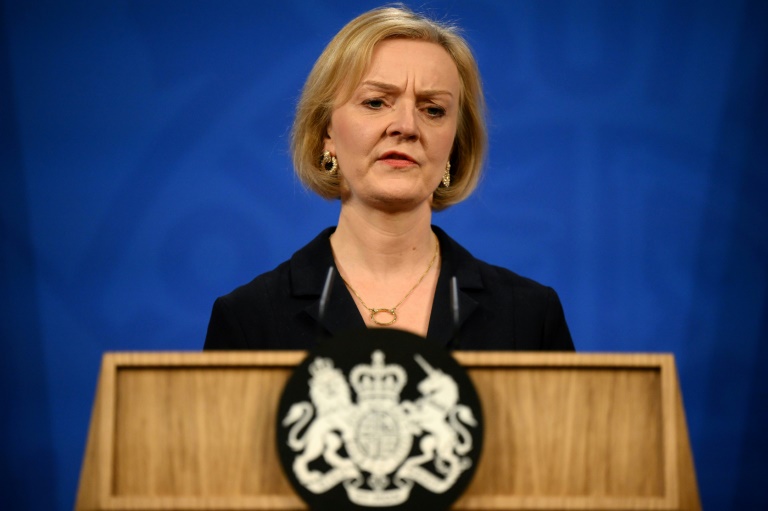
The pound fell on Friday after under-fire British Prime Minister Liz Truss sacked her finance minister and made a dramatic policy U-turn, while an equity rally ran out of steam.

The yen struck a new three-decade dollar low as a rise in US inflation expectations cemented expectations of more hefty Federal Reserve rate hikes.

Truss sacked finance minister Kwasi Kwarteng as pressure mounted on her government following last month’s big-spending, tax-slashing mini-budget, which spooked markets.

The September 23 budget sent the pound tumbling to a record dollar low, near parity with the greenback, and bond yields surged before stabilizing thanks to interventions by the Bank of England. 

Sterling sank more than one percent to under $1.12 after Truss dismissed Kwarteng. 

It fell even lower after Truss appointed Jeremy Hunt as her new finance minister and announced a dramatic policy U-turn, before clawing back some of its losses.

In her first Downing Street press conference, Truss stated the “need to act now to reassure the markets,” abandoned her plans to eliminate an increase in corporation tax and said spending would not increase as rapidly as planned.

“The soap opera that is UK politics continues to dominate FX (forex) markets Friday,” said Stephen Innes, managing partner at SPI Asset Management.

UK 10-year government bond yields rose after the Bank of England publicly stated it would end its costly market interventions on Friday.

“Unfortunately for Truss, her swift ability to spook markets with a swathe of unfunded spending plans is now being followed by yet another rise in yields, as markets wonder whether we could soon see another push to replace her,” said Joshua Mahony, senior market analyst at online trading platform IG.

London’s FTSE 100 ended the day with an increase of 0.1 percent, having given up most of its earlier gains because Truss’s U-turn left her position fragile.

Berenberg bank Senior Economist Kallum Pickering said “the policy U-turn is a major humiliation for Truss” and weakens her politically.

“It is not easy to see how Truss — whose personal mandate is now in tatters — can continue as PM for long,” he added.

While European markets ended higher, Wall Street failed to hold onto gains made on Thursday in a surprising rally despite data showing strong inflationary pressures in the United States.

After rising early on, US stocks resumed their downward spiral, with the S&P 500 losing 2.4 percent.

US retail sales in September were virtually unchanged from August at $684 billion, Commerce Department data showed in a report that revealed the drag on consumers from inflation.

Meanwhile, consumer sentiment data from the University of Michigan came in slightly better than expected, but the report cautioned of a “bumpy road ahead for consumers” due to uncertainty over inflation and the state of financial markets. 

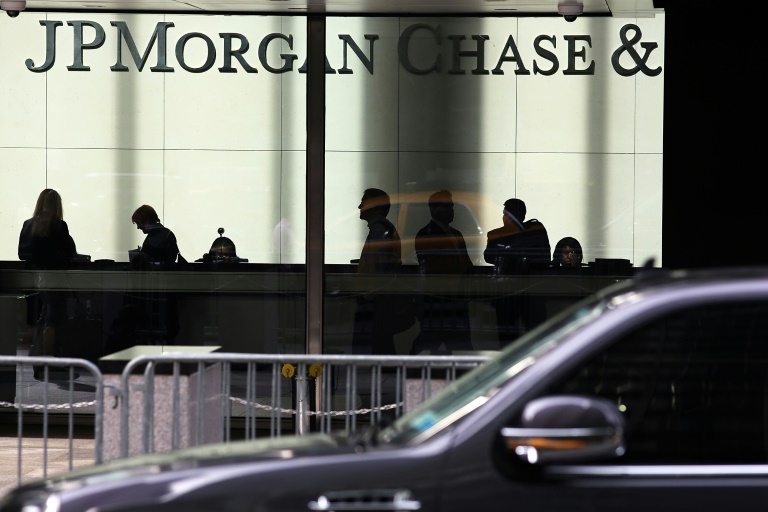
Third quarter earnings season got into full swing, with a number of large banks, including JPMorgan Chase and Citigroup, reporting lower earnings and setting aside more funds in preparation for a possible recession, although their performances topped analyst estimates.

– Key figures around 2100 GMT –

New York – Dow: DOWN 1.3 percent at 29,634.83 (close)

New York – S&P 500: DOWN 2.4 percent at 3,583.07 (close)

New York – Nasdaq: DOWN 3.1 percent at 10,321.39 (close)

London – FTSE 100: UP 0.1 percent at 6,858.79 (close) 

Frankfurt – DAX: UP 0.7 percent at 12,437.81 (close)

Paris – CAC 40: UP 0.9 percent at 5,931.92 (close)

EURO STOXX 50: UP 0.6 percent at 3,381.73 (close)

Tokyo – Nikkei 225: UP 3.3 percent at 27,090.76 (close)

Hong Kong – Hang Seng Index: UP 1.2 percent at 16,587.69 (close)

Shanghai – Composite: UP 1.8 percent at 3,071.99 (close)

Pound/dollar: DOWN at $1.1180 from $1.1326 Thursday

Dollar/yen: UP at 148.72 yen from 147.12 yen

Euro/dollar: DOWN at $0.9724 from $0.9776

Euro/pound: DOWN at 86.93 pence from 88.29 pence

Brent North Sea crude: DOWN 3.1 percent at $91.63 per barrel

West Texas Intermediate: DOWN 3.9 percent at $85.61 per barrel

burs-jmb/caw

Pound slides amid UK political drama

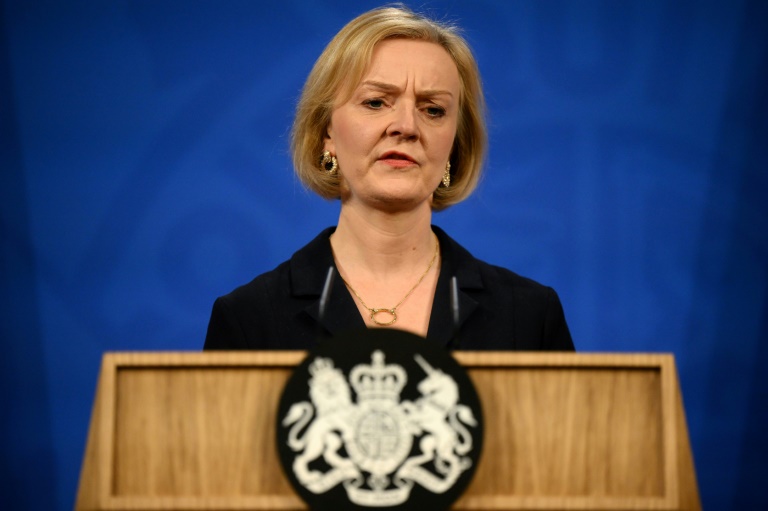
The pound fell on Friday after under-fire British Prime Minister Liz Truss sacked her finance minister and made a dramatic policy U-turn, while an equity rally ran out of steam.

The yen struck a new three-decade dollar low as a rise in US inflation expectations cemented expectations of more hefty Federal Reserve rate hikes.

Truss sacked finance minister Kwasi Kwarteng as pressure mounted on her government following last month’s big-spending, tax-slashing mini-budget, which spooked markets.

The September 23 budget sent the pound tumbling to a record dollar low, near parity with the greenback, and bond yields surged before stabilizing thanks to interventions by the Bank of England. 

Sterling sank more than one percent to under $1.12 after Truss dismissed Kwarteng. 

It fell even lower after Truss appointed Jeremy Hunt as her new finance minister and announced a dramatic policy U-turn, before clawing back some of its losses.

In her first Downing Street press conference, Truss stated the “need to act now to reassure the markets,” abandoned her plans to eliminate an increase in corporation tax and said spending would not increase as rapidly as planned.

“The soap opera that is UK politics continues to dominate FX (forex) markets Friday,” said Stephen Innes, managing partner at SPI Asset Management.

UK 10-year government bond yields rose after the Bank of England publicly stated it would end its costly market interventions on Friday.

“Unfortunately for Truss, her swift ability to spook markets with a swathe of unfunded spending plans is now being followed by yet another rise in yields, as markets wonder whether we could soon see another push to replace her,” said Joshua Mahony, senior market analyst at online trading platform IG.

London’s FTSE 100 ended the day with an increase of 0.1 percent, having given up most of its earlier gains because Truss’s U-turn left her position fragile.

Berenberg bank Senior Economist Kallum Pickering said “the policy U-turn is a major humiliation for Truss” and weakens her politically.

“It is not easy to see how Truss — whose personal mandate is now in tatters — can continue as PM for long,” he added.

While European markets ended higher, Wall Street failed to hold onto gains made on Thursday in a surprising rally despite data showing strong inflationary pressures in the United States.

After rising early on, US stocks resumed their downward spiral, with the S&P 500 losing 2.4 percent.

US retail sales in September were virtually unchanged from August at $684 billion, Commerce Department data showed in a report that revealed the drag on consumers from inflation.

Meanwhile, consumer sentiment data from the University of Michigan came in slightly better than expected, but the report cautioned of a “bumpy road ahead for consumers” due to uncertainty over inflation and the state of financial markets. 

Third quarter earnings season got into full swing, with a number of large banks, including JPMorgan Chase and Citigroup, reporting lower earnings and setting aside more funds in preparation for a possible recession, although their performances topped analyst estimates.

– Key figures around 2100 GMT –

New York – Dow: DOWN 1.3 percent at 29,634.83 (close)

New York – S&P 500: DOWN 2.4 percent at 3,583.07 (close)

New York – Nasdaq: DOWN 3.1 percent at 10,321.39 (close)

London – FTSE 100: UP 0.1 percent at 6,858.79 (close) 

Frankfurt – DAX: UP 0.7 percent at 12,437.81 (close)

Paris – CAC 40: UP 0.9 percent at 5,931.92 (close)

EURO STOXX 50: UP 0.6 percent at 3,381.73 (close)

Tokyo – Nikkei 225: UP 3.3 percent at 27,090.76 (close)

Hong Kong – Hang Seng Index: UP 1.2 percent at 16,587.69 (close)

Shanghai – Composite: UP 1.8 percent at 3,071.99 (close)

Pound/dollar: DOWN at $1.1180 from $1.1326 Thursday

Dollar/yen: UP at 148.72 yen from 147.12 yen

Euro/dollar: DOWN at $0.9724 from $0.9776

Euro/pound: DOWN at 86.93 pence from 88.29 pence

Brent North Sea crude: DOWN 3.1 percent at $91.63 per barrel

West Texas Intermediate: DOWN 3.9 percent at $85.61 per barrel

burs-jmb/caw

US banks report solid results but warn of rising recession risk

Large US banks reported a round of solid quarterly profits Friday, but cautioned of rising recession risks as the economy absorbs higher inflation and a dramatic shift is central bank policy.

Citing the uncertain economic outlook, JPMorgan Chase set aside $808 million in case of bad loans, while Citigroup reserved for $370 million in potential losses and Wells Fargo, $385 million.

These sums are much smaller than the reserves established at the start of the coronavirus pandemic. But they nonetheless point to a much changed environment from a year ago, when bank results were boosted by large releases of funds that had been set aside for loan defaults that did not materialize

Today’s litany of worries include stubborn inflation that has prompted significant central bank interest rate hikes; and geopolitical fallout from the Russian invasion of Ukraine, including uncertainty in the oil market and worries about European energy security this winter.

While the US consumer remains “very strong,” these obstacles elevate the risk of a downturn, said JPMorgan Chief Executive Jamie Dimon.

The end result could be “anywhere from a soft landing to a hard recession,” Dimon told reporters on a conference call. “If it is a hard recession, obviously it has implications for unemployment and business and reserves.”

Wells Fargo Chief Executive Charlie Scharf said the bank continues to see “historically low delinquencies,” but that it is “monitoring risks” tied to macroeconomic and geopolitical headwinds.

“While we do expect to see continued increases in delinquencies and ultimately credit losses,the timing is unclear,” Scarf said.

– Lower profits –

At JPMorgan, profits fell 17 percent to $9.7 billion on a 10 percent increase in revenues to $32.7 billion.

Higher interest rates helped boost the bank’s net interest income, but JPMorgan suffered a big drop in investment banking revenues in a period that has seen far fewer initial public offerings compared with a year ago.

Dimon said businesses “remain healthy,” but alluded to “significant headwinds immediately in front of us.” 

In an interview with CNBC earlier this week, Dimon said a US recession was likely in early-to-mid 2023 and that the stock market could fall another 20 percent.

At Citigroup, profits fell 25 percent to $3.5 billion, while revenues rose six percent of $18.5 billion.

Results were boosted by higher net interest income as well a gain from the sale of the bank’s Philippines business. These benefits were offset by lower revenues in investment banking and higher operating expenses. 

Citi opted to set aside reserves in light of rising recession risk. 

Under a “baseline” economic scenario, Citi sees unemployment rising to about four percent from the current 3.5 percent. Under a “downside” scenario, unemployment would be well above five percent, said Citi Chief Financial Officer Mark Mason on a conference call with journalists.

Even under a darker outcome, Mason said “I don’t think there’s a financial crisis coming anything close to the magnitude of what we’ve seen.”

At Wells Fargo, profits fell 31 percent to $3.5 billion, while revenues rose four percent to $19.5 billion.

Results were dented by $2 billion in fresh costs linked to “litigation, customer remediation and regulatory matters.” 

During a conference call with analysts, Scharf, who was named CEO in 2019 following a fake accounts scandal under earlier executive regimes, said the bank “still has open regulatory matters” related to earlier times and was looking to get past them “as quickly as we can.”

JPMorgan shares gained 1.7 percent to $111.19, while Citi rose 0.7 percent to $43.23 and Wells Fargo gained 1.9 percent to $43.17.

Broader coalition not needed for Russia oil price cap: US

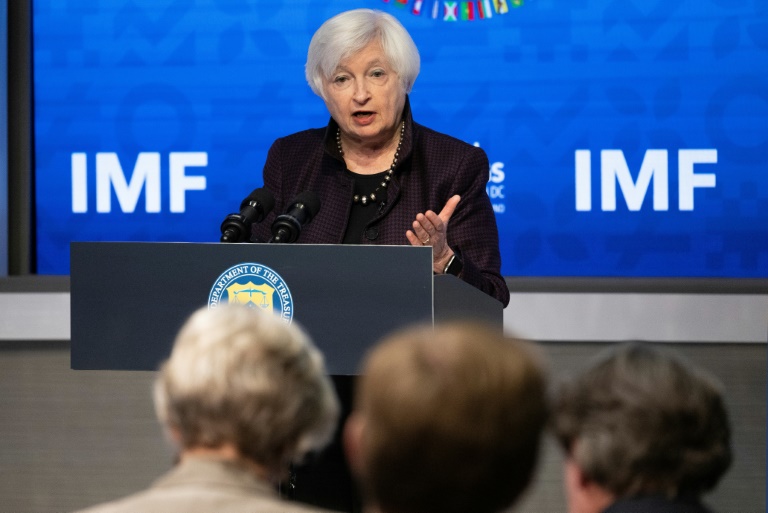
The G7 is still working on setting a price cap on Russian oil but enrolling more nations to the scheme is not necessary for it to succeed, US Treasury Secretary Janet Yellen said Friday.

Australia recently joined the Group of Seven wealthy democracies and the European Union in backing the move aimed at depriving Moscow of a key source of cash for its war in Ukraine as well as cooling soaring energy prices.

Yellen said a broader coalition was not needed as the cap would be set by requiring Western financial services and insurance firms to abide by a maximum price in contracts for Russian oil shipments.

“We are not trying to sign up additional countries to a coalition,” Yellen told a news conference at the IMF’s annual meetings in Washington.

The United States has imposed an embargo on Russian oil while the European Union will ban most imports from December.

“None of the coalition countries are buying Russian oil or will buy Russian oil,” Yellen said.

“And none of the countries outside the coalition are really important suppliers of any of these financial services,” she added.

Those countries will have access to services provided by Western insurance firms “as long as they purchase at the price below the cap,” Yellen explained.

“We need them to understand that that’s the condition they face for access to those services and that we will be making sure that Western firms abide by that, but we honestly are not asking other governments to do anything.”

Moscow has warned that it would cut off oil supplies to countries that impose such a cap.

Oil prices surged to almost $140 per barrel in March following the Russian invasion. The international benchmark, Brent, has since hovered around $90.

Western officials have said that the price for Russian crude would remain above the cost of production so that Moscow would still have an incentive to supply importing countries.

Yellen mentioned a $60 figure this week but she clarified on Friday that such a figure was under consideration.

“No decisions have been made,” she said.

Harry Potter's Hagrid, Robbie Coltrane, dies aged 72

Scottish actor Robbie Coltrane, who played Hagrid in the Harry Potter films, has died aged 72, his agent said on Friday.

Coltrane also played a former KGB agent-turned-Russian mafia boss in two James Bond films — “Goldeneye” (1995) and “The World Is Not Enough” (1999) — with Pierce Brosnan.

“My client and friend Robbie Coltrane OBE passed away on Friday October 14,” Belinda Wright said in a statement, calling him “a unique talent”.

“Robbie was one of the funniest people I’ve met and used to keep us laughing constantly as kids on set,” said Daniel Radcliffe, who played the title role in the Harry Potter series.

“I feel incredibly lucky that I got to meet and work with him and very sad that he’s passed.”

On the official James Bond Twitter account, franchise producers Michael G. Wilson and Barbara Broccoli, paid tribute to Coltrane as “an exceptional actor whose talent knew no bounds…

“We shall miss him as a dear friend. Rest in peace Robbie.”

– ‘Depth, power, talent’ –

Coltrane, who was born Anthony Robert McMillan on March 30, 1950, in Rutherglen, near Glasgow, forged a career as an actor, comedian and writer.

On television, he starred alongside Emma Thompson in the cult BAFTA-winning BBC mini-series “Tutti Frutti” in 1987.

He came to prominence and won more awards for his portrayal of the hard-drinking criminal psychologist Dr Eddie “Fitz” Fitzgerald in the ITV series “Cracker” (1993-2006).

He was the English author and lexicographer Samuel Johnson in the TV comedy series “Blackadder the Third” alongside “Mr Bean” star Rowan Atkinson and Hugh Laurie (“House”).

Frequent co-star Stephen Fry tweeted that he was “awe/terror/love struck all at the same time” when he first met Coltrane 40 years ago.

“Such depth, power & talent: funny enough to cause helpless hiccups & honking as we made our first TV show, ‘Alfresco’. Farewell, old fellow. You’ll be so dreadfully missed,” he wrote.

– An ‘incredible talent’ –

On the big screen, Coltrane had roles in the 1987 Neil Jordan crime drama “Mona Lisa” and teamed up with former Monty Python star Eric Idle in the 1990 comedy “Nuns on the Run”.

But he will best be remembered globally as Rubeus Hagrid, the half-giant half-human gamekeeper and Keeper of the Keys and Grounds of Hogwarts school in the film franchise of JK Rowling’s best-selling Harry Potter books.

The role “brought joy to children and adults alike all over the world, prompting a stream of fan letters every week for over 20 years”, said Wright.

“As well as being a wonderful actor, he was forensically intelligent, brilliantly witty,” she said.

Rowling tweeted that “I’ll never know anyone remotely like Robbie again. 

“He was an incredible talent, a complete one off, and I was beyond fortunate to know him, work with him and laugh my head off with him,” she wrote.

Coltrane is survived by his children Spencer and Alice and their mother Rhona Gemmell. 

No cause of death was given but Wright thanked medical staff at Forth Valley Royal Hospital in Larbert, central Scotland, “for their care and diplomacy”.

US extends battalion in Lithuania as Russia fears persist

The United States will extend its rotation of a heavy tank battalion in Lithuania, which sees no reduction in the threat from Russia since Moscow’s invasion of Ukraine, Lithuanian officials said Friday.

Lithuanian Defense Minister Arvydas Anusauskas said that the battalion, in the town of Pabrade since 2019, will stay at least until the start of 2026.

In a statement after meeting US Defense Secretary Lloyd Austin in Brussels, Anusauskas said the decision implements “one of the most essential objectives put forward by the sitting government: we have a persistent military US presence in Lithuania.”

Lithuania, along with neighboring Poland and fellow Baltic states Latvia and Estonia, has been at the forefront of support to Ukraine since Russia attacked on February 24.

The invasion renewed fears in nations formerly under Moscow’s control. They have cheered on recent Ukrainian successes in taking back land.

But a senior Lithuanian official said that Russian forces still had the capacity to attack the Baltic states — all members of the NATO alliance, which he said had insufficient forces in the area before the Ukraine war.

“In our assessment, they are not as weakened as much as would change our assessment of the threat level to the alliance,” said Kestutis Budrys, national security advisor to Lithuania’s president, said of Russian forces.

Speaking to reporters in Washington after talks with President Joe Biden’s national security advisor, Jake Sullivan, Budrys said the probability remained low that Russia would attack NATO nations.

“But the actions that we see that were done in Ukraine and also the attempts to bring even more Belarus into the active military offensive against Ukraine shouldn’t make us more calm,” he said.

Belarus, whose authoritarian leader Alexander Lukashenko is one of the closest allies of Russian President Vladimir Putin, has let Moscow use its territory for the invasion.

Lukashenko said earlier this week that Belarusian forces would deploy together with Russian ones but did not specify where, and insisted the move was defensive.

Low water level on Mississippi River hurts US grain shipping

A lack of rainfall in the central United States has brought the mighty Mississippi River to its lowest depth in years, causing headaches for shippers and squeezing farmers who rely on the busy waterway to take their product to the Gulf of Mexico.

According to the US Geological Survey (USGS), the river’s depth at shipping hub Memphis, Tennessee, is at its lowest level since 2011.

“Normally at this time of year we would see 40-plus barges moving in a tow configuration pushed by (a) towboat,” said Deb Calhoun, senior vice president of Waterways Council, a US river infrastructure advocacy group.

“Now you you’re only seeing about 24, 25… moving at one time, sometimes less, depending on how shallow the river is at any point.”

This year’s low water level is largely due to a lack of rain in the upper plains states of Kansas, Nebraska, South Dakota and North Dakota, through which the Mississippi’s major tributary, the Missouri River, flows.

In some areas, the US Army Corps of Engineers has been forced to do emergency dredging so that barges can pass through.

“It’s a very difficult time with harvest occurring now — really the worst possible time for this severe low water situation to occur,” Calhoun said.

Though the winter wheat season was largely wrapped up by early August, corn and soy harvests are in full swing, increasing as usual demand as usual cargo space.

US Department of Agriculture (USDA) figures show that about two-thirds of US sea-based grain exports last year departed from the Gulf of Mexico, most often after being shipped by barge down the Mississippi River.

One barge can carry the equivalent volume of 15 rail cars and 60 semi-trucks, according to industry representatives American Waterways Operators.

“We’re seeing a lot of inefficiencies,” said Calhoun, explaining that barges are having to be filled with less grain so they float higher.

“At this point, we are just very hopeful that rain will come.”

Meteorologists predict some rain will fall over the weekend in the southern states of Arkansas, Tennessee and Mississippi.

– Producers squeezed –

The decreased barge capacity has translated into higher shipping costs, with the USDA recording a fourfold increase in barge prices since late August.

At those levels, “we are pricing ourselves out of the export market,” said Michael Zuzolo, of Global Commodity Analytics and Consulting.

He noted that corn has been particularly hard hit, with barge traffic cut in half.

The squeeze on agricultural shipping also comes as wheat, corn and soybean yields are expected to be lower than anticipated, according to the USDA.

“It is already starting to impact the up-river prices by weakening them for the farmers,” said Zuzolo.

And as commercial storage begins to get tighter and tighter, “it’s going to start spreading into the middle part of the country that is not right near a river,” he adds.

The low-water headaches are similar to those experienced in 2012, and for some evoke memories of a historic crisis in 1988.

In 2012, Calhoun says, rocks sticking up out of the water had to be blown up by the US Army Corps of Engineers.

“We’re not there yet,” she said, but in a worst case scenario, authorities would “look at the possibility of releasing water from the Missouri River or upstate reservoirs.”

Close Bitnami banner
Bitnami