US Business

Putin vows more 'severe' attacks after Russian missiles batter Ukraine

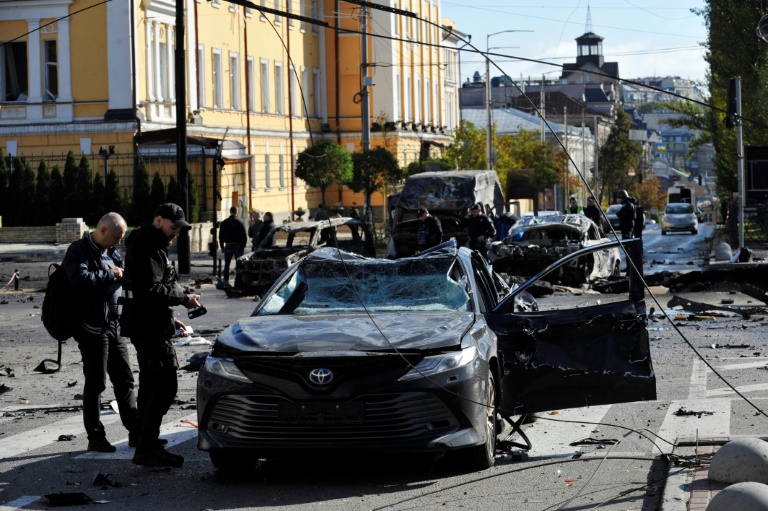
President Vladimir Putin threatened on Monday more “severe” attacks against Ukraine after Russian missiles rained down on the capital Kyiv and other Ukrainian cities in what Washington branded “utter brutality”.

The biggest wave of strikes across Ukraine in months killed at least 11 and wounded more than 80 in retaliation for an explosion this weekend that damaged a key bridge linking Russia to the Moscow-annexed Crimean peninsula.

“Let there be no doubt,” Putin said in televised comments addressed to his security council, “if attempts at terrorist attacks continue, the response from Russia will be severe.”

Kyiv said Russian forces had fired more than 80 missiles on cities across the country and that Russia had also used Iranian drones launched from neighbouring Belarus, spurring panic and damaging energy facilities throughout Ukraine.

Putin’s predecessor Dmitry Medvedev warned that the strikes were only “the first episode” of a response to explosion on the Kerch bridge.

But Ukraine’s foreign minister Dmytro Kuleba said the salvo showed Moscow was increasingly panicked about recent battlefield losses seven months into its invasion.

And his country’s closest allies slammed Russia, with US President Joe Biden saying they strikes “demonstrate the utter brutality” of Putin’s “illegal war.”

Ksenia Ryazantseva, a 39-year-old language teacher, told AFP she was awoken by the blasts.

“We saw the smoke, then the cars, and then we realised we didn’t have a window anymore,” she added. “There’s no military target or anything like that here. They’re just killing civilians”.

– ‘Demonstration of weakness’ –

Ukrainian President Volodymyr Zelensky said the strikes aimed to take down Ukrainian energy infrastructure and regional officials across the country confirmed widespread disruptions.

Russia’s defence ministry meanwhile confirmed it had targeted Ukrainian energy, military command and communications facilities, claiming the strikes had been a success and “achieved their aims”.

Kuleba said the attacks had not been “provoked” and that the onslaught was Moscow’s response to a series of embarrassing military losses in eastern Ukraine.

“Putin is desperate because of battlefield defeats and uses missile terror to try to change the pace of war in his favour,” minister Dmytro Kuleba wrote on social media. 

Zelensky said he had spoken with the leaders of France and Germany and urged them to “increase pressure” on Russia.

– Dozens injured –

US Secretary of State Antony Blinken weighed in on Twitter, writing: “We will continue to provide unwavering economic, humanitarian, and security assistance so Ukraine can defend itself and take care of its people.”

In Ukraine, the national police service said that at least 11 people had been killed nationwide and at least another 80 wounded.

Ukrainian officials said the central Shevchenkivsky district of the city was hit and that a university, museums and the philharmonic building had been damaged.

An AFP journalist in Kyiv said a projectile landed near a playground and saw smoke rising from a large crater at the impact site. Trees and benches were charred by the blast and a number of ambulances were at the scene.

In the western city of Lviv, mayor Andriy Sadovyi said there were disruptions to electricity and hot water services after bombardments targeted critical infrastructure.

AFP photographers there saw plumes of black smoke rising above the town’s skyline.

Moldova, west of Ukraine, said several Russian cruise missiles targeting Ukraine had crossed its airspace, and that it had summoned Moscow’s envoy to demand an explanation.

The ex-Soviet country, which is a candidate to join the European Union, has a small breakaway region, Transnistria, which is armed and supported by Russia.

– Crimean bridge attack –

Belarusian President Alexander Lukashenko, a close ally of Putin’s, meanwhile claimed Monday that Ukraine was preparing an attack on his country’s territory.

He said Russia and Belarus would “deploy” troops together, without specifying where.

The autocratic leader also accused Ukraine, alongside neighbouring Poland and Lithuania, of training Belarusian militants to carrying out attacks at home.

The strikes across Ukraine came a day after Moscow blamed Kyiv for the blast that damaged a bridge linking Crimea to Russia, leaving three people dead.

The blast that hit the bridge — a symbol of the Kremlin’s 2014 annexation of Crimea — sparked celebrations by Ukrainians and others on social media.

But Zelensky on Saturday did not directly mention the incident and officials in Kyiv have made no direct claim of responsibility.

The 19-kilometre (12-mile) bridge is also a vital supply link between Russia and the annexed Crimean peninsula.
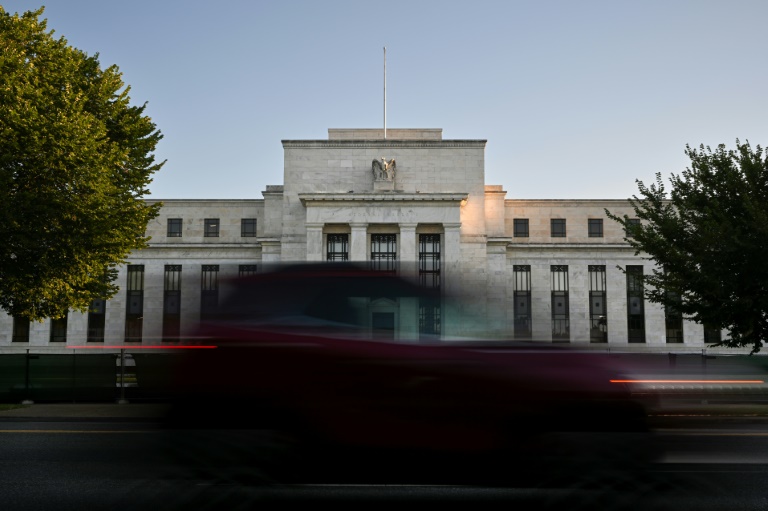
Stocks slip, dollar rises as US rate hikes seen

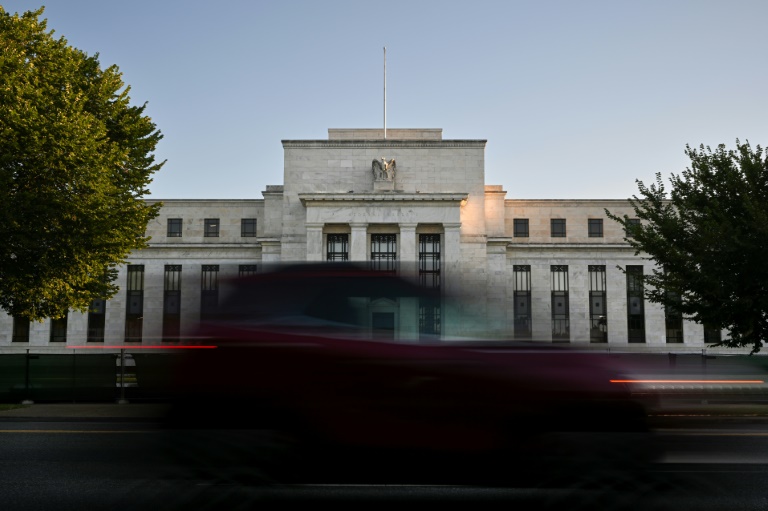
Global stocks slid on Monday as investors braced for more large interest rate hikes from the Federal Reserve.

The prospect of higher yields on debt was a boon for the dollar, however, which gained on its main rivals.

“We’re seeing mild risk aversion in the markets at the start of the week, perhaps some apprehension ahead of what could be a big few days for the US,” said market analyst Craig Erlam at OANDA.

Last week closed out with news that the US firms created a net 263,000 jobs in September.

While that was down from August it was more than expected, indicating that the US economy is not yet slowing considerably and inflationary pressures likely remain.

That sent stocks sharply lower as it means the Fed is unlikely to relent on interest rate hikes that are meant to tame inflation.

Stocks took a beating in August and September as monetary policymakers made clear they would keep raising interest rates in order to bring down inflation, even at the cost of a recession.

Last week, however, they briefly rallied on hope that the US jobs data would show the economy is already slowing, meaning the Fed could relent on interest rate hikes.

Some investors “may still be hoping that this week’s inflation data will swing the central bank but given previous comments, that doesn’t appear realistic unless we see a significant miss to the downside,” added Erlam.

Adding to the stress is the upcoming corporate earnings season, which many fear will show that companies are feeling the pain of tightening monetary policies.

Elsewhere on Monday, the Moscow stock exchange plunged nearly 12 percent following a weekend explosion that partially destroyed the bridge connecting Crimea to Russia.

Meanwhile, the pound won little support from Britain ramping up efforts to calm markets after a heavily criticised budget.

In what was seen as co-ordinated action, the government brought forward the release date of key economic forecasts and the Bank of England boosted liquidity.

“With the pound remaining weak and (UK) government borrowing costs inching up again towards worrying levels, the UK government and the Bank of England have launched a two-pronged attempt to calm markets,” noted Susannah Streeter, senior investment and markets analyst at Hargreaves Lansdown.

Oil prices meanwhile fell after the biggest weekly gain since March that followed a decision by OPEC and allied producers led by Russia to slash crude output by two million barrels per day.

The drop Monday came also on demand concerns caused by China’s Covid flare-ups and more weak data out of Beijing owing to lockdowns.

– Key figures around 1530 GMT –

New York – Dow: DOWN 0.3 percent at 29,202.02 points

EURO STOXX 50: DOWN 0.6 percent at 3,356.88

London – FTSE 100: DOWN 0.5 percent at 6,959.31 (close) 

Frankfurt – DAX: FLAT at 12,272.94 (close)

Paris – CAC 40: DOWN 0.5 percent at 5,840.55 (close)

Hong Kong – Hang Seng Index: DOWN 3.0 percent at 17,216.66 (close) 

Shanghai – Composite: DOWN 1.7 percent at 2,974.15 (close)

Tokyo – Nikkei 225: Closed for a holiday

Pound/dollar: DOWN at $1.1034 from $1.1082 on Friday

Euro/dollar: DOWN at $0.9689 from $0.9743

Euro/pound: DOWN at 87.79 pence from 87.97 pence

Dollar/yen: UP at 145.77 yen from 145.38 yen

West Texas Intermediate: DOWN 0.5 percent at $92.20 per barrel

Brent North Sea crude: DOWN 0.6 percent at $97.29 per barrel

burs-rl/pvh

Stocks slip, dollar rises as US rate hikes seen

Global stocks slid on Monday as investors braced for more large interest rate hikes from the Federal Reserve.

The prospect of higher yields on debt was a boon for the dollar, however, which gained on its main rivals.

“We’re seeing mild risk aversion in the markets at the start of the week, perhaps some apprehension ahead of what could be a big few days for the US,” said market analyst Craig Erlam at OANDA.

Last week closed out with news that the US firms created a net 263,000 jobs in September.

While that was down from August it was more than expected, indicating that the US economy is not yet slowing considerably and inflationary pressures likely remain.

That sent stocks sharply lower as it means the Fed is unlikely to relent on interest rate hikes that are meant to tame inflation.

Stocks took a beating in August and September as monetary policymakers made clear they would keep raising interest rates in order to bring down inflation, even at the cost of a recession.

Last week, however, they briefly rallied on hope that the US jobs data would show the economy is already slowing, meaning the Fed could relent on interest rate hikes.

Some investors “may still be hoping that this week’s inflation data will swing the central bank but given previous comments, that doesn’t appear realistic unless we see a significant miss to the downside,” added Erlam.

Adding to the stress is the upcoming corporate earnings season, which many fear will show that companies are feeling the pain of tightening monetary policies.

Elsewhere on Monday, the Moscow stock exchange plunged nearly 12 percent following a weekend explosion that partially destroyed the bridge connecting Crimea to Russia.

Meanwhile, the pound won little support from Britain ramping up efforts to calm markets after a heavily criticised budget.

In what was seen as co-ordinated action, the government brought forward the release date of key economic forecasts and the Bank of England boosted liquidity.

“With the pound remaining weak and (UK) government borrowing costs inching up again towards worrying levels, the UK government and the Bank of England have launched a two-pronged attempt to calm markets,” noted Susannah Streeter, senior investment and markets analyst at Hargreaves Lansdown.

Oil prices meanwhile fell after the biggest weekly gain since March that followed a decision by OPEC and allied producers led by Russia to slash crude output by two million barrels per day.

The drop Monday came also on demand concerns caused by China’s Covid flare-ups and more weak data out of Beijing owing to lockdowns.

– Key figures around 1530 GMT –

New York – Dow: DOWN 0.3 percent at 29,202.02 points

EURO STOXX 50: DOWN 0.6 percent at 3,356.88

London – FTSE 100: DOWN 0.5 percent at 6,959.31 (close) 

Frankfurt – DAX: FLAT at 12,272.94 (close)

Paris – CAC 40: DOWN 0.5 percent at 5,840.55 (close)

Hong Kong – Hang Seng Index: DOWN 3.0 percent at 17,216.66 (close) 

Shanghai – Composite: DOWN 1.7 percent at 2,974.15 (close)

Tokyo – Nikkei 225: Closed for a holiday

Pound/dollar: DOWN at $1.1034 from $1.1082 on Friday

Euro/dollar: DOWN at $0.9689 from $0.9743

Euro/pound: DOWN at 87.79 pence from 87.97 pence

Dollar/yen: UP at 145.77 yen from 145.38 yen

West Texas Intermediate: DOWN 0.5 percent at $92.20 per barrel

Brent North Sea crude: DOWN 0.6 percent at $97.29 per barrel

burs-rl/pvh

US trio, including ex-Fed chief Bernanke, win economics Nobel

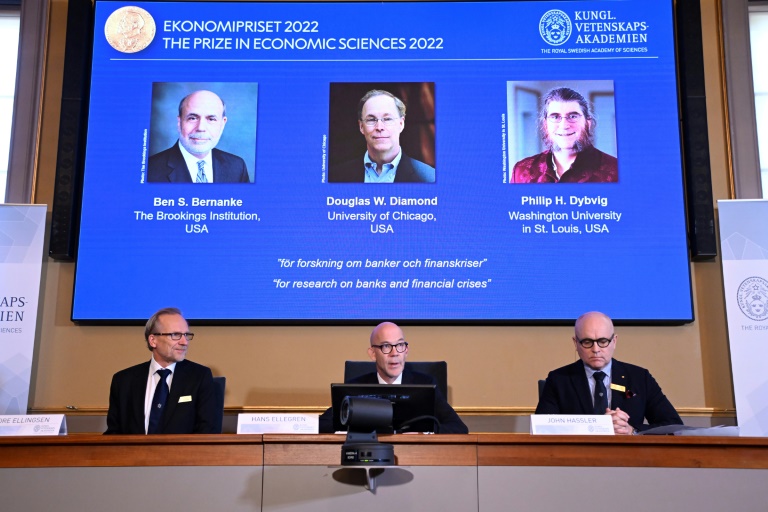
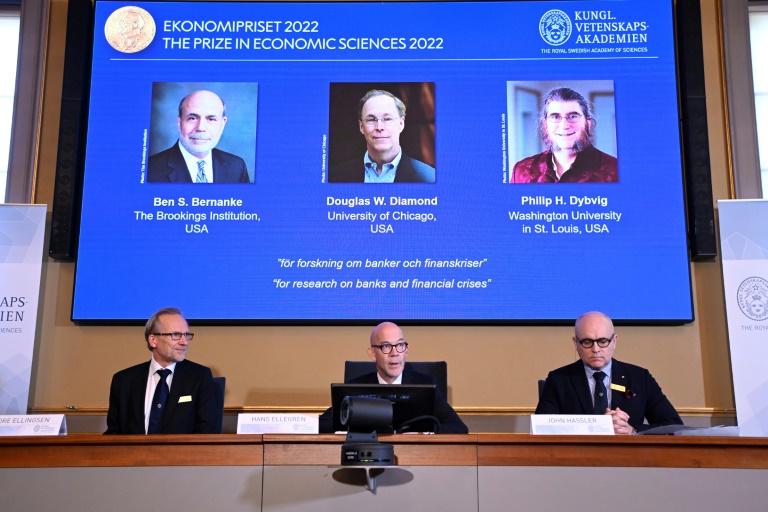
A US trio including ex-Federal Reserve chief Ben Bernanke, who played a key role battling the 2008 financial crisis, won the economics Nobel on Monday for research on banks in times of turmoil.

Bernanke, together with Douglas Diamond and Philip Dybvig, were honoured for having “significantly improved our understanding of the role of banks in the economy, particularly during financial crises, as well as how to regulate financial markets”, the jury said.

Bernanke, 68, has been both credited for spurring recovery after the 2008 recession and pilloried by critics for doing little to avert it, allowing investment bank Lehman Brothers to collapse.

He received the award for his analysis, conducted in the early 1980s, of the Great Depression in the 1930s, the worst economic crisis in modern history.

In particular, Bernanke showed “how failing banks played a decisive role in the global depression,” making the downturn “not only deep, but also long-lasting,” the Nobel jury noted.

In his role as chief of the central bank, Bernanke “was able to put knowledge from research into policy” during the financial crisis of 2008-2009, the Nobel Committee said.

Bernanke has been hailed for the Fed’s unorthodox response of slashing interest rates and flooding the financial system with liquidity.

– Bank runs –

Diamond, a professor at the University of Chicago born in 1953, and Dybvig, 67, a professor at Washington University in St. Louis, were honoured for showing how “banks offer an optimal solution” for channelling savings to investments by acting as an intermediary.

The pair also showed how these institutions were vulnerable to so called bank runs, where a large number of savers simultaneously withdraw their money leading to the bank’s collapse.

The committee added that this dangerous dynamic can be avoided by governments providing deposit insurance and giving banks a life-line by becoming a lender of last resort.

“In a nutshell, the theory says that banks can be tremendously useful but they are only guaranteed to be stable if they are properly regulated”, Tore Ellingsen, chair of the prize committee, said.

Diamond, speaking to reporters after the announcement, reflected Monday on the decision by US authorities not to bail out Lehman Brothers, as they later did other financial institutions.

The bank’s collapse sent shockwaves through financial markets when it filed for bankruptcy in September 2008.

“It would have been better to find a more accommodating way, a less unstable way and unexpected way to resolve Lehman Brothers,” Diamond said, stressing there were questions about what regulators were legally able to do at the time.

“Had they found a way, I think the world would have had less of a severe crisis than it did,” Diamond said.

Speaking in an interview with the Nobel Foundation, Diamond also praised the work of his fellow laureate.

“The world was incredibly lucky to have Ben Bernanke sitting in the Federal Reserve during the crisis,” Diamond said.

– Few women –

Of all the Nobels, the economics prize has the fewest number of female winners: just two since it was first awarded in 1969, Elinor Ostrom in 2009 and Esther Duflo in 2019.

This year, only two women were among the 12 individuals and two organisations honoured, Carolyn Bertozzi in chemistry and Annie Ernaux for literature.

Hans Ellegren, secretary general of the Royal Swedish Academy of Sciences, told AFP that since the science prizes generally honour research dating back decades, laureates who win “now reflect what the scientific community looked like back then.”

“I’m rather glad to be able to say that we have increased the proportion of women that get Nobel Prizes,” Ellegren said.

He noted that in the last five years, four women had been awarded the chemistry prize and two had received the physics prize, which has been a male-dominated field.

The economics prize, created by the Swedish central bank in 1968, was the only award not included when scientist Alfred Nobel created the prestigious awards in his 1895 will.

But like the other prizes it comes with a gold medal and an award sum of 10 million Swedish kronor (around $900,000).

The winners will receive the prize from King Carl XVI Gustaf at a formal ceremony in Stockholm on December 10, the anniversary of the 1896 death of scientist Alfred Nobel. 

US trio, including ex-Fed chief Bernanke, win economics Nobel

A US trio including ex-Federal Reserve chief Ben Bernanke, who played a key role battling the 2008 financial crisis, won the economics Nobel on Monday for research on banks in times of turmoil.

Bernanke, together with Douglas Diamond and Philip Dybvig, were honoured for having “significantly improved our understanding of the role of banks in the economy, particularly during financial crises, as well as how to regulate financial markets”, the jury said.

Bernanke, 68, has been both credited for spurring recovery after the 2008 recession and pilloried by critics for doing little to avert it, allowing investment bank Lehman Brothers to collapse.

He received the award for his analysis, conducted in the early 1980s, of the Great Depression in the 1930s, the worst economic crisis in modern history.

In particular, Bernanke showed “how failing banks played a decisive role in the global depression,” making the downturn “not only deep, but also long-lasting,” the Nobel jury noted.

In his role as chief of the central bank, Bernanke “was able to put knowledge from research into policy” during the financial crisis of 2008-2009, the Nobel Committee said.

Bernanke has been hailed for the Fed’s unorthodox response of slashing interest rates and flooding the financial system with liquidity.

– Bank runs –

Diamond, a professor at the University of Chicago born in 1953, and Dybvig, 67, a professor at Washington University in St. Louis, were honoured for showing how “banks offer an optimal solution” for channelling savings to investments by acting as an intermediary.

The pair also showed how these institutions were vulnerable to so called bank runs, where a large number of savers simultaneously withdraw their money leading to the bank’s collapse.

The committee added that this dangerous dynamic can be avoided by governments providing deposit insurance and giving banks a life-line by becoming a lender of last resort.

“In a nutshell, the theory says that banks can be tremendously useful but they are only guaranteed to be stable if they are properly regulated”, Tore Ellingsen, chair of the prize committee, said.

Diamond, speaking to reporters after the announcement, reflected Monday on the decision by US authorities not to bail out Lehman Brothers, as they later did other financial institutions.

The bank’s collapse sent shockwaves through financial markets when it filed for bankruptcy in September 2008.

“It would have been better to find a more accommodating way, a less unstable way and unexpected way to resolve Lehman Brothers,” Diamond said, stressing there were questions about what regulators were legally able to do at the time.

“Had they found a way, I think the world would have had less of a severe crisis than it did,” Diamond said.

Speaking in an interview with the Nobel Foundation, Diamond also praised the work of his fellow laureate.

“The world was incredibly lucky to have Ben Bernanke sitting in the Federal Reserve during the crisis,” Diamond said.

– Few women –

Of all the Nobels, the economics prize has the fewest number of female winners: just two since it was first awarded in 1969, Elinor Ostrom in 2009 and Esther Duflo in 2019.

This year, only two women were among the 12 individuals and two organisations honoured, Carolyn Bertozzi in chemistry and Annie Ernaux for literature.

Hans Ellegren, secretary general of the Royal Swedish Academy of Sciences, told AFP that since the science prizes generally honour research dating back decades, laureates who win “now reflect what the scientific community looked like back then.”

“I’m rather glad to be able to say that we have increased the proportion of women that get Nobel Prizes,” Ellegren said.

He noted that in the last five years, four women had been awarded the chemistry prize and two had received the physics prize, which has been a male-dominated field.

The economics prize, created by the Swedish central bank in 1968, was the only award not included when scientist Alfred Nobel created the prestigious awards in his 1895 will.

But like the other prizes it comes with a gold medal and an award sum of 10 million Swedish kronor (around $900,000).

The winners will receive the prize from King Carl XVI Gustaf at a formal ceremony in Stockholm on December 10, the anniversary of the 1896 death of scientist Alfred Nobel. 

No relief for French motorists as petrol strike hardens

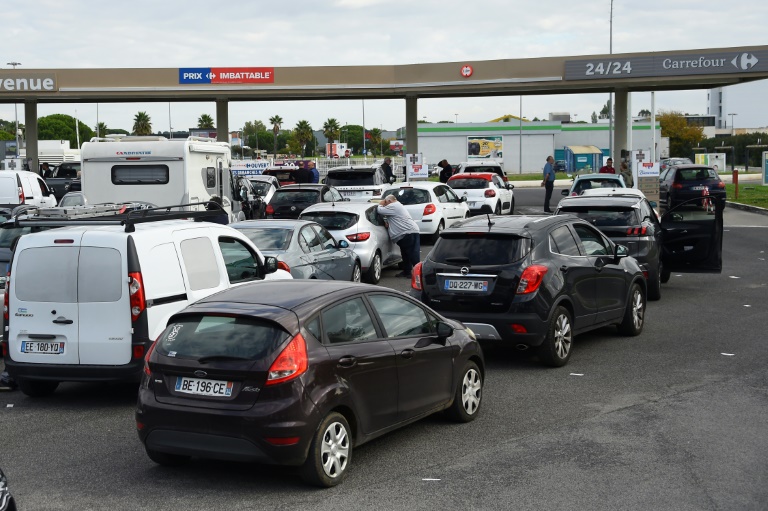
Filling stations across France were low on petrol on Monday as a strike by workers at energy giant TotalEnergies entered its third week despite government pressure to negotiate.

According to official estimates, around 30 percent of service stations were out of all or at least some fuel types, causing long queues for increasingly desperate motorists.

There had been hopes that the pay-related strike action at TotalEnergies, among the world’s biggest energy multinationals, would end rapidly after management on Sunday agreed to bring forward salary talks in return for workers resuming service.

But the hard-left CGT union declined the offer, accusing management of “blackmail”.

The union is demanding a wage rise of 10 percent for 2022, pointing to TotalEnergies’ exceptionally high first-quarter profit of $10.6 billion.

The boss of TotalEnergies’ European refineries, Jean-Marc Durand, countered that “it’s the French people who are being blackmailed”.

Stoppages continued at several refineries Monday, including France’s biggest near Le Havre in the north of the country, with the CGT renewing its strike call until Tuesday and extending strike action to more than a dozen service stations along French motorways.

Workers at the French branch of Esso-ExxonMobil were also still on strike, blocking two refineries. 

Members of the French government, including Prime Minister Elisabeth Borne, have called for both sides to find a negotiated settlement quickly, and on Monday President Emmanuel Macron weighed in.

“Blockades are no way to negotiate”, Macron said, calling for “an early conclusion of negotiations”. 

He said the current petrol shortages were unrelated to the war in Ukraine and “not the government’s doing”.

Borne, meanwhile, said she expected “the situation to improve in the course of this week”.

The petrol crisis comes at a time of high energy prices and inflation that are sapping French households’ purchasing power.

The left-wing opposition coalition Nupes has called for a “March against a high cost of living” in Paris and elsewhere on Sunday.

At the weekend, several prominent French people came out in support of the initiative, including this year’s winner of the Nobel Prize for Literature, Annie Ernaux.

Record quarterly profit for Indian software giant TCS

India’s largest software exporter Tata Consultancy Services on Monday shrugged off global economic turmoil to report a record profit for any quarter, with figures that beat analyst estimates.

TCS is India’s second-most-valuable company by market capitalisation and earns more than 80 percent of its revenues from Western markets.

It has been at the forefront of an IT boom that has seen India become a back office to the world as firms in North America and Europe subcontract work, taking advantage of a skilled English-speaking workforce.

More recently, technology companies have benefited from a boost in demand for digital services since the pandemic.

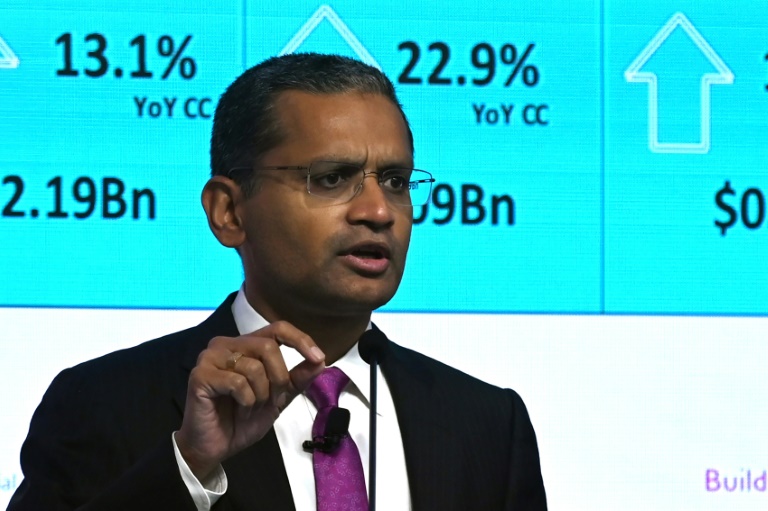
Net profit at the IT giant rose 8.4 percent year-on-year in the three months to September to reach 104.3 billion rupees ($1.26 billion), with revenues up 18 percent to 553.1 billion rupees.

The net profit figure was 1.4 billion rupees ahead of analysts’ average estimate, according to Bloomberg News.

“This is a milestone quarter for us,” chief executive officer Rajesh Gopinathan told a media briefing, pointing to net profit surpassing 100 billion rupees for the first time.

“Of course, the environment is challenging and it requires all of us to remain very vigilant,” he said, adding that customers were relying on TCS’s diversified services to manage volatile market conditions.

Its overseas growth in the quarter was led by North America, which contributed half of its business and saw revenue growth of 17.6 percent.

The company — one of India’s largest private employers — slowed its hiring despite its attrition rate rising to 21.5 percent.

Competition for employees has driven up salaries and weighed on operating margins in recent quarters, but TCS said attrition — a key metric for IT companies — has “peaked” and will “taper down from this point”.

Operating margins at the Mumbai-headquartered company contracted 1.6 percentage points to 24 percent, while its order book stood steady at $8.1 billion at the end of September.

Shares in the firm closed 1.84 percent higher in Mumbai ahead of the release of the results.

UK sets scene for Hallowe'en forecasts after budget spooks investors

Britain on Monday brought forward key economic forecasts to Hallowe’en and the Bank of England boosted liquidity, after markets were spooked by a much-criticised tax-slashing budget.

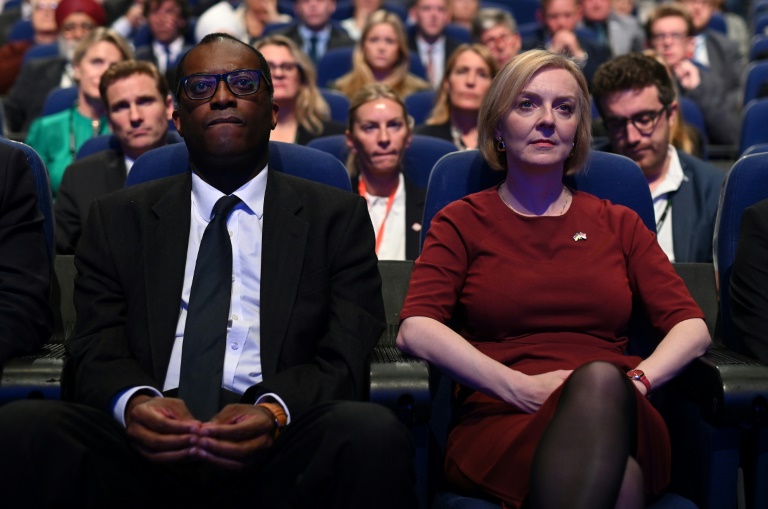
Finance minister Kwasi Kwarteng will unveil debt-reduction plans and independent economic predictions later this month after his borrowing-fuelled budget sparked markets turmoil.

In his latest U-turn, Kwarteng revealed he would publish his medium-term fiscal plan alongside the forecasts on October 31 rather than late November.

“It’s clear there is still much scepticism about the government’s plans. The risk is that if the numbers don’t add up, the markets could take fright again on Halloween,” said Hargreaves Lansdown analyst Susannah Streeter.

It comes after Chancellor of the Exchequer Kwarteng was already forced to axe a tax cut for the richest earners, in the face of outrage as millions of Britons face a cost-of-living crisis with UK inflation around 10 percent.

Markets have been shaken by the budget from the government of new Prime Minister Liz Truss, which also included a costly energy price freeze for households and businesses in the budget.

The plans that are aimed at supporting Britain’s recession-threatened economy sent UK bond yields soaring and the pound tumbling to a record low against the dollar.

– Bank of England action –

The Bank of England earlier Monday revealed it was launching a temporary facility aimed at easing liquidity pressures that arose after the budget shocked markets.

The BoE in a statement announced “additional measures to support market functioning”.

It added that the central bank was ready to increase the size of its UK government bond purchases under an emergency measure due to end Friday.

The BoE said it was launching a Temporary Expanded Collateral Repo Facility, enabling “banks to help to ease liquidity pressures facing” client funds beyond the end of this week.

Budget turmoil triggered the emergency buying of long-dated bonds by the BoE.

The central bank has so far made purchases of so-called gilts totalling around £5 billion ($5.5 billion), far less than its £65-billion limit, under a plan ending Friday.

The purchases are “to restore market functioning in long-dated government bonds and reduce risks from contagion to credit conditions for UK households and businesses”, the BoE stressed in its statement Monday.

The budget was widely criticised, including by the International Monetary Fund, over fears that government debt would balloon to pay for the tax cuts.

Fitch last week lowered the outlook on its credit rating for British government debt to negative from stable.

The pound was down against the dollar Monday but above the record-low level that was close to parity.

– Calm for now –

Despite the measures calming volatility, yields on Britain’s bonds remain elevated on concern over sustainability.

The yield on 30-year UK government bonds, which spiked to 5.14 percent following the budget, stood at 4.54 percent on Monday.

“The central bank’s action has helped to calm government debt markets but there are concerns about what happens next week after the BoE’s support package ends,” noted Victoria Scholar, head of investment at Interactive Investor.

Monday’s intervention comes as Britain suffers a cost-of-living crisis caused by the highest inflation in decades after energy and food prices have rocketed.

The BoE has piled on further pressure by hiking its main interest rate to a 14-year high of 2.25 percent in a bid to cool inflation.

This in turn has seen retail banks ramp up interest rates on mortgages, with analysts predicting heavy price falls for property.

Air France, Airbus trial opens over 2009 Rio-Paris crash

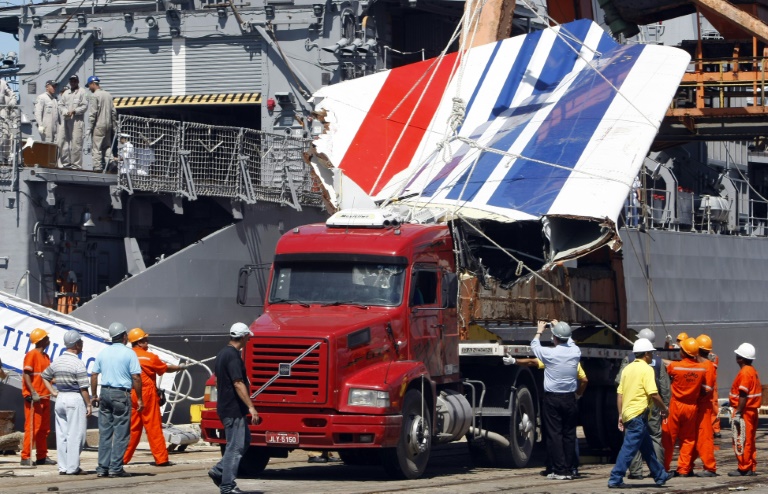
A French trial of Air France and Airbus began Monday on charges of involuntary manslaughter over the fatal 2009 crash of a jet heading to Paris from Brazil, killing all 228 people aboard.

Victims’ families and some aviation experts say the pilots were insufficiently trained to handle a loss of speed readings caused by crucial equipment freezing over in a storm.

Around 50 relatives of the victims sat on the benches in the packed Paris criminal court, while Airbus’s chief executive Guillaume Faury and Air France boss Anne Rigail also attended.

Judges read out the charges before listing aloud the names of every person killed in the crash.

Flight AF 447 from Rio de Janeiro plunged into the Atlantic Ocean in the early hours of June 1, 2009, after entering a zone near the Equator known for strong turbulence.

The Airbus A330 was carrying 12 crew members and 216 passengers. It was the carrier’s deadliest crash.

It took nearly two years to locate the bulk of the fuselage and recover the “black box” flight recorders.

French flagship carrier Air France and aircraft maker Airbus were charged as the inquiry progressed. 

Experts determined the crash resulted from mistakes made by pilots disorientated by so-called Pitot speed-monitoring tubes that had frozen over in thick cloud.

But investigating magistrates overseeing the case dropped the charges in 2019, a decision that infuriated victims’ families.

Prosecutors appealed against the decision and in 2021 a Paris court ruled there was sufficient evidence for a trial to go ahead. 

Ophelie Toulliou, who lost her brother on the flight, said it was essential “the truth come out, and that the sentences, if deserved, are handed down”.

“But the message is also to make companies that think they’re untouchable understand ‘You’re like everyone else and if you make mistakes, they will be punished,'” she told AFP.

– ‘Lost our speeds’ –

The court will hear testimony from dozens of aviation experts and pilots over two months of hearings, and each company faces a maximum fine of 225,000 euros ($220,000).

There will also be analysis of the final minutes in the cockpit before the plane went into free-fall after entering a so-called “intertropical convergence zone” that often produces volatile storms with heavy precipitation.

In the cold, the Pitot tubes froze, a problem that had already been reported by other pilots. The tubes were quickly replaced on planes worldwide in the months after the accident.

“We’ve lost our speeds,” one pilot is heard saying in the flight recordings, before other indicators mistakenly show a loss of altitude and a series of alarm messages appear on the cockpit screens. 

The pilots start climbing and even though a “STALL” alert sounds, reach 11,600 metres (38,060 feet).

“I don’t know what’s happening,” one of the pilots is heard saying as the stall begins.

– Training overhaul –

Air France pilots’ union SPAF said it was now “indispensable for a court to hear all the parties and decide where responsibility lies in a public hearing”.

The crash prompted an overhaul of training protocols across the industry, in particular to prepare pilots to handle the intense stress of unforeseen circumstances.

Pilots are also now required to continually practise stall responses on simulators.

“That was the big change after this accident for all civil airline companies. Before, it was something pilots learned in basic training and then they were never trained again,” one airline executive told AFP, on condition of anonymity.

Testimony will also be heard from some of the 476 members of victims’ families who are civil plaintiffs in the case.

But Nelson Faria Marinho, president of the Brazilian association of victims’ relatives, said: “I’m not expecting anything from this trial.”

“Even if there is a conviction, who will be punished? The CEOs? They were changed at Airbus and Air France a long time ago,” he told AFP during an interview at his Rio home.

He will be represented by former French pilot Gerard Arnoux, who has advised several of the victims’ families and wrote a book titled “Rio-Paris Is Not Responding: AF447, the Crash that Should Not Have Happened”.

US trio, including ex-Fed chief Bernanke, win economics Nobel

A US trio including ex-Federal Reserve chief Ben Bernanke, who played a key role battling the 2008 financial crisis, won the economics Nobel on Monday for research on banks in times of turmoil.

Bernanke, together with Douglas Diamond and Philip Dybvig, were honoured for having “significantly improved our understanding of the role of banks in the economy, particularly during financial crises, as well as how to regulate financial markets”, the jury said.

Bernanke, 68, has been both credited for spurring recovery after the 2008 recession and pilloried by critics for doing little to avert it, allowing investment bank Lehman Brothers to collapse.

He received the award for his analysis, conducted in the early 1980s, of the Great Depression in the 1930s, the worst economic crisis in modern history.

In particular, Bernanke showed “how failing banks played a decisive role in the global depression,” making the downturn “not only deep, but also long-lasting,” the Nobel jury noted.

In his role as chief of the central bank, Bernanke “was able to put knowledge from research into policy,” during the financial crisis of 2008-2009, the Nobel Committee said.

Bernanke has been hailed for the Fed’s unorthodox response of slashing interest rates and flooding the financial system with liquidity.

– Bank runs –

Diamond, a professor at the University of Chicago born in 1953, and Dybvig, 67, a professor at Washington University in St. Louis, were honoured for showing how “banks offer an optimal solution” for channelling savings to investments by acting as an intermediary.

The pair also showed how these institutions were vulnerable to so called banks runs.

“If a large number of savers simultaneously run to the bank to withdraw their money, the rumour may become a self-fulfilling prophecy –- a bank run occurs and the bank collapses,” the Nobel Committee said.

The committee added that this dangerous dynamic can be avoided by governments providing deposit insurance and giving banks a life-line by becoming a lender of last resort.

“The laureates’ insights have improved our ability to avoid both serious crises and expensive bailouts,” Tore Ellingsen, chair of the Committee for the Prize in Economic Sciences, said.

“In a nutshell, the theory says that banks can be tremendously useful but they are only guaranteed to be stable if they are properly regulated”, he added.

Diamond, speaking to reporters after the announcement, reflected Monday on the decision by US authorities not to bailout US investment bank Lehman Brothers, as they later did other financial institutions.

The bank’s collapse sent shockwaves through financial markets when it filed for bankrupcy in September 2008.

“It would have been better to find a more accommodating way, a less unstable way and unexpected way to resolve Lehman Brothers,” Diamond said, stressing there were questions about what regulators were legally able to do at the time.

“Had they found a way, I think the world would have had less of a severe crisis than it did,” Diamond said.

– ‘False Nobel’ –

Of all the Nobels, the economics prize has the fewest number of female winners, just two since it was first awarded in 1969 — Elinor Ostrom in 2009 and Esther Duflo in 2019.

The economics prize, set up by the Swedish central bank, was the only award absent from the original five created by scientist Alfred Nobel, sometimes earning it the moniker of “false Nobel”.

But like the other prizes it comes with a medal and an award sum of 10 million Swedish kronor (around $900,000).

The winners will receive the prize from King Carl XVI Gustaf at a formal ceremony in Stockholm on December 10, the anniversary of the 1896 death of scientist Alfred Nobel who created the prizes in his last will and testament. 

Last year, the honour went jointly to Canada’s David Card, Israeli-American Joshua Angrist and Dutch-American Guido Imbens for research that “revolutionised” empirical work in their field and brought better understanding of how labour markets work.

The Economics Prize closes this year’s Nobel season. 

Close Bitnami banner
Bitnami