US Business

French energy giant offers pay talks to end fuel strike

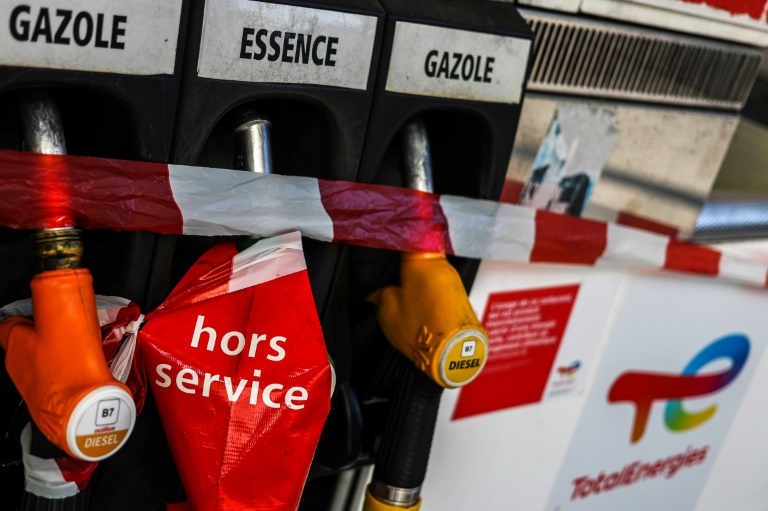
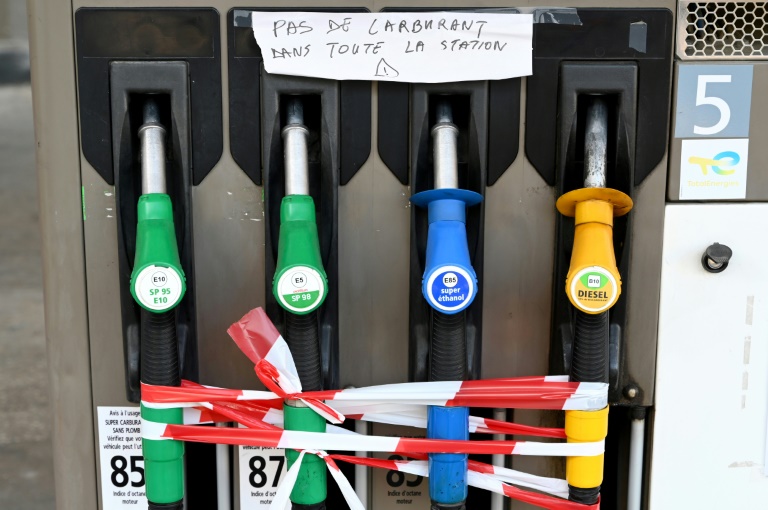
France’s TotalEnergies said Sunday it would advance annual pay talks with unions if they dropped a blockade of fuel depots and refineries that has slashed petrol supplies across the country.

Vehicle owners have faced increasingly long waits to fill up after two weeks of strikes by workers demanding higher wages in response to soaring prices.

“I haven’t been able to work for two days now,” complained 60-year-old taxi driver Thierry.

He had “gone round the whole of Paris” to find fuel and had already been waiting for three hours at a filling station in the capital for fuel tankers to turn up, he said.

Like other major oil companies, TotalEnergies has seen its profits soar as energy prices skyrocket during the war in Ukraine. Government officials have been pressing the company to settle the standoff.

TotalEnergies runs a network of around 3,500 filling stations in France, nearly a third of the total. Most of them are low on fuel or even empty for some kinds of petrol.

“If the depot blockades end and with the agreement of all labour representatives, the company proposes to move forward the annual salary negotiations from November to October,” TotalEnergies said.

The discussions would define “how employees will benefit from TotalEnergies’ exceptional results before the end of this year, taking into account this year’s inflation”.

– Relief on the way: ministers –

On Sunday, the CGT union branch at the company — which is leading the strikes at TotalEnergies and at rival Esso-ExxonMobil — said the industrial action would continue, but that it was open to talks as soon as Monday.

“If we do start talks, it will be based on our demands — a 10-percent salary hike… retroactive for the year 2022,” branch coordinator Eric Sellini told AFP.

Currently three of Total’s refineries are blocked, including its largest, in Normandy, and a fuel depot near Flandres in the north.

Management at Esso-ExxonMobil said it would hold talks with the unions representing its staff Monday, expressing confidence it could reach a rapid settlement.

The government has already dipped into strategic stockpiles in a bid to bring relief, and exceptionally fuel tankers are being allowed to make deliveries Sunday.

“I’m all in favour of dialogue so French people don’t have to put up with this industrial action for too long,” Energy Transition Minister Agnes Pannier-Runacher told BFM television.

The government has increased supplies by 20 percent, she said, but fears of running out of fuel were aggravating the shortage. Some areas have seen a 30-percent spike in sales to motorists.

“The situation should improve tomorrow,” she added.

That sentiment was echoed by Prime Minister Elisabeth Borne.

“The situation is going to improve throughout the week,” she told journalists on Sunday on the sidelines of her visit to Algeria.

The government had freed up stocks of fuel to supply filling stations and the deliveries would arrive “progressively”, she added.

Russia blames Ukraine for Crimean bridge blast

Moscow on Sunday blamed Ukraine for the deadly blast on the bridge linking Crimea to Russia, as Ukraine denounced the latest lethal missile attack in its territory that killed at least 13 people.

“The authors, perpetrators and sponsors are the Ukrainian secret services,” Russian President Vladimir Putin said of Saturday’s Crimea bridge bombing, which he described as a “terrorist act”.

Putin was speaking during a meeting with the head of the investigation committee he has set up to look into the bombing, Russian news agencies reported.

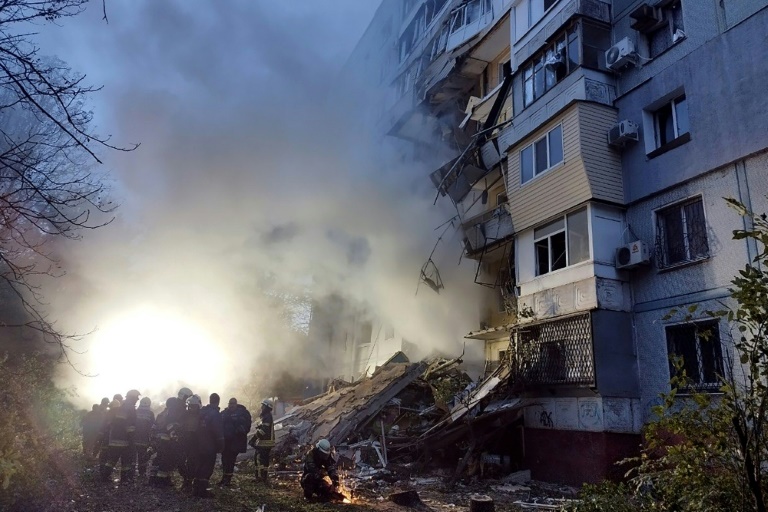
Ukrainian President Volodymyr Zelensky meanwhile denounced a Russian missile strike on Sunday that killed at least 13 people — one of them a child — in Zaporizhzhia — the latest deadly bombardment of the southern Ukrainian city.

The attack also wounded 89 people, including 11 children, according to a statement from the president’s office.

Zelensky described the “merciless strikes on peaceful people” and residential buildings as “absolute evil” perpetrated by “savages and terrorists”.

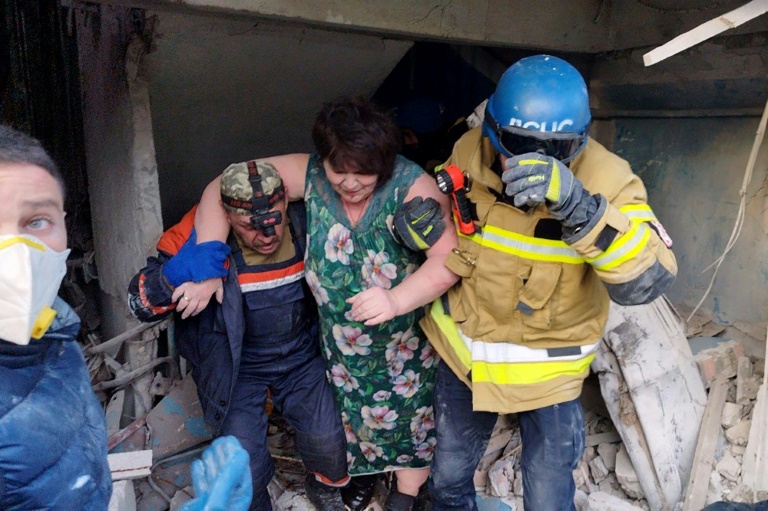
Regional official Oleksandr Starukh posted pictures of heavily damaged apartment blocks on Telegram and said a rescue operation had been launched to find victims under the rubble.

Russia officials also denounced on Sunday what they said was a surge in Ukrainian fire into its territory that had hit homes, administrative buildings and a monastery.

– Divers inspect damage –

Russia’s FBS, which is responsible for border security, reported on Sunday: “Since the start of October, the number of attacks from Ukrainian armed formations on Russia’s border territory has considerably increased.”

More than a hundred artillery attacks, concentrated on the western border regions of Belgorod, Bryansk and Kursk, had hit housing and administrative buildings, said the statement.

The attacks had killed one person and wounded five others, including a child.

The governor of Kursk region, Roman Starovoyt, said Ukrainian fire had hit the Garnalski Saint Nicolas monastery, on the border.

Although the building had been hit, starting a fire that was quickly put out, nobody was hurt, he said, posting photos of the damage on Telegram.

Moscow meanwhile said divers were to inspect the waters beneath the giant Crimea bridge on Sunday, a day after a truck bomb ignited a massive fire on the road and rail link, killing three people.

Russian Deputy Prime Minister Marat Khusnullin said the divers would make their initial report later on Sunday.

Already on Saturday, Russia said some road and rail traffic had resumed over the strategic link, a symbol of the Kremlin’s 2014 annexation of Crimea.

The 19-kilometre (12-mile) bridge is a vital supply link between Russia and the annexed Crimean peninsula.

Following the attack at dawn on Saturday, the bodies of an unidentified man and a woman were pulled out of the water, probably passengers in a car driving near the exploded truck, Moscow said.

Russian officials said they had identified the owner of the truck as a resident of Russia’s southern Krasnodar region.

The blast sparked celebrations from Ukrainians and others on social media, but Zelensky, in his nightly address on Saturday, did not directly mention the incident, and officials in Kyiv have made no direct claim of responsibility.

Until Putin’s statement on Sunday, most Russian officials had stopped short of blaming Kyiv.

– Power restored at power plant –

Putin has ordered the creation of a commission to look into the Crimea bridge blast, and the Russian leader will chair a scheduled meeting of his Security Council on Monday. 

Some military analysts argue that the blast could have a major impact if Moscow sees the need to shift already hard-pressed troops to Crimea from other regions — or if it prompts a rush by residents to leave.

Mick Ryan, a retired Australian senior officer now with the Center for Strategic and International Studies in Washington, said that even if Ukrainians were not behind the blast, it constituted “a massive influence operation win for Ukraine.

“It is a demonstration to Russians, and the rest of the world, that Russia’s military cannot protect any of the provinces it recently annexed,” he said on Twitter.

Authorities in Crimea tried to allay fears of food and fuel shortages in the territory, which has been dependent on the Russian mainland since its annexation from Ukraine.

It is just the latest in a series of setbacks for Russia.

Recent lightning territorial gains by Ukraine in the east and south have undermined the Kremlin’s official annexation of Donetsk, neighbouring Lugansk and the southern regions of Zaporizhzhia and Kherson.

After growing domestic criticism of Russia’s army, Moscow on Saturday announced that a new general — Sergei Surovikin — would take over its forces in Ukraine.

Surovikin previously led Russia’s military in southern Ukraine. He has combat experience from the 1990s conflicts in Tajikistan and Chechnya, as well as, more recently, in Syria.

Ukraine’s power operator Energoatom announced on Sunday that engineers had managed to restore power to Zaporizhzhia nuclear plant, Europe’s largest, a day after they said shelling had cut the last source of external power there.

'Smile' beats 'Lyle' to top N.American box office

Paramount executives kept the “Smile” on their face Sunday, as the deceptively named horror film topped North America’s box office for a second weekend, scaring up an estimated $17.6 million, industry watcher Exhibitor Relations said.

Sosie Bacon, daughter of actors Kevin Bacon and Kyra Sedgwick, stars as a therapist whose grasp on reality starts to slip after she witnesses a gruesome event involving a patient.

“Lyle, Lyle, Crocodile,” Sony’s new live-action/computer animated musical comedy, placed second at $11.5 million on a slow weekend. Analyst David A. Gross called that a “weak opening” despite good reviews.

With a budget of just $50 million, he added, “the film was not designed to be in the league of the big Disney/Pixar/Illumination family juggernauts.” It stars Javier Bardem, Shawn Mendes and Constance Wu.

Another new arrival, 20th Century’s comedy thriller “Amsterdam,” took in just $6.5 million for third place, suffering from poor reviews despite what Gross called “an impressive collection of talent in front of and behind the camera.”

Directed by David O. Russell (“Silver Linings Playbook,” “American Hustle”), its all-star cast includes Christian Bale, Margot Robbie, Chris Rock, Taylor Swift, Matthias Schoenaerts, Rami Malek and Robert De Niro in a tale about the mysterious murder of a US senator.

In fourth, down one spot from last weekend, was Sony’s history-inspired “The Woman King,” at $5.3 million. Viola Davis stars as the leader of an all-female army of African warriors.

And in fifth was “Don’t Worry Darling” from Warner Bros., at $3.5 million. The psychological horror film slipped from second last weekend.

Rounding out the top 10 were:

“Avatar” (Re-release, $2.6 million)

“Barbarian” ($2.2 million)

“Bros” ($2.2 million)

“Terrifier 2” ($925,000)

“Ponniyin Selvan: Part One” ($920,000)

US hurricane rebuilding rules must adapt to 'era of climate change': expert

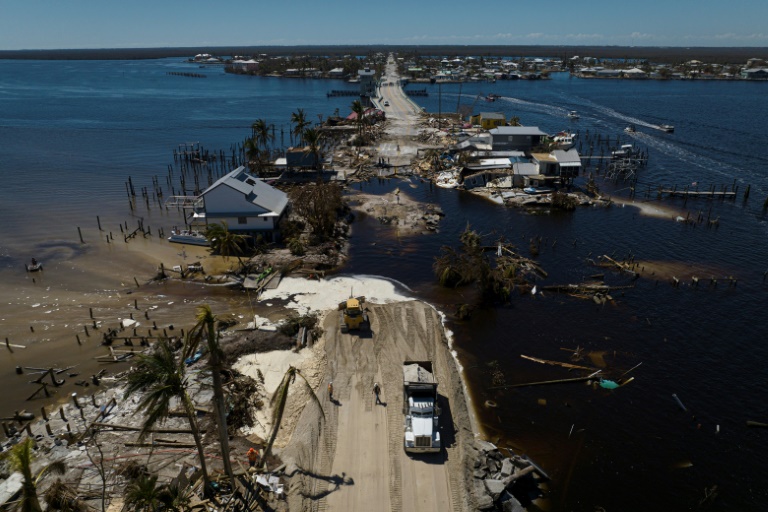
After an extreme weather event, such as Hurricane Ian which devastated parts of Florida last month, most Americans choose to rebuild rather than move to less hazardous areas.

But as climate change increases the frequency and scale of natural disasters, does US policy need to adapt?

Gavin Smith, a professor of environmental planning at the University of North Carolina, worked for several states following major hurricanes, including Katrina in Mississippi (2005) and Matthew in North Carolina (2016).

According to him, current reconstruction standards are not up to the challenges posed by climate change, but correcting them will require real “political will.”

Smith’s responses to AFP have been lightly edited and condensed for clarity.

– Current reconstruction rules –

Q: What are the rules for re-construction after a hurricane, and are they adapted to climate change?

A: Communities must comply with the local codes and standards in place in their jurisdiction before the storm struck.

In the US, we have the National Flood Insurance Program (NFIP), which has historically been subsidized by the federal government. 

For a community to join the program, it has to adopt certain flood risk reduction standards. They include building codes as well as land use plans. 

Then, if a home is damaged in the storm more than 50 percent of their value, it must be built back to the most recent code and standards in place.

Our standard for flood is rebuilding largely back to the “100 year flood,” more accurately termed the one percent annual chance flood event. But in an era of climate change, that “100 year” flood is happening more and more often.

Most risk reduction codes and standards often reflect a climate of the past.

For example, we spent $14 billion rebuilding the levee system in New Orleans after hurricane Katrina. That levee system was built back to the “100 year flood.” 

So you could make the argument that in the era of climate change, that levee system is already out of date. 

– Political will –

Q: What do you expect from government officials?

A: Disasters can present opportunities to rebuild communities safer.

What I’m suggesting is that if we’re going to spend hundreds of millions of dollars building these communities back, we need to require communities to adopt higher codes and standards. 

But that takes political will of both members of Congress and local elected officials.

These are really difficult trillion dollar questions.

You’ll also have builders and the private sector saying, “We should limit those kinds of regulations, as we need to quickly rebuild.”

It takes a lot of political will for a mayor or for a governor to say “No, we’ve got to do what’s right in the long run.:

Unfortunately, people don’t get elected by saying “I am going to require higher standards.”

That’s not a winning slogan. It takes political will to say, enough is enough, we need to adopt higher standards, it’s going to take time, cost more, and people may have to pay more to do it.

That said, we also need to make sure we include equity in processes adopted to develop those standards. 

The shrimpers and the crabbers that live in a very modest house on the water, if we make them adopt higher standards, can they afford it?

– Rules for resilience – 

Q: Concretely, what would be these better standards?

A: A really simple way to think about it is “where” and “how” you build in relation to natural hazards, including those exacerbated by climate change.

The “how” include elevating structures, more stringent standards for wind performance, like better roof shingles, hardening our infrastructure — communication systems, bridges, roads, levees… We can also do this by protecting natural systems like dunes and wetlands.

The “where” is what we would often refer to as land use planning.

Should we be putting a hospital, or a school, in an area subject to storm surge? Probably not. 

A community may choose to say, we’re not going to build a house within 200 meters of the beach. 

Or adopt a gradual disinvestment strategy in extremely risky areas (managed retreat). It’s very difficult to do politically, but it’s happening on a small scale.

Resilience is really about a series of protective measures or choices. It’s not just one. A levee, if that’s your only protection and it fails, to me that’s not resilience. 

Greece and Egypt call Turkish-Libyan gas deal 'illegal'

Egypt and Greece on Sunday said a deal allowing Turkish hydrocarbon exploration in Libya’s Mediterranean waters was “illegal” as Athens said it would oppose it by all “legal means”.

On Monday, Turkey said it had signed a memorandum of understanding on exploration for hydrocarbons in Libya’s seas with the authorities in Tripoli.

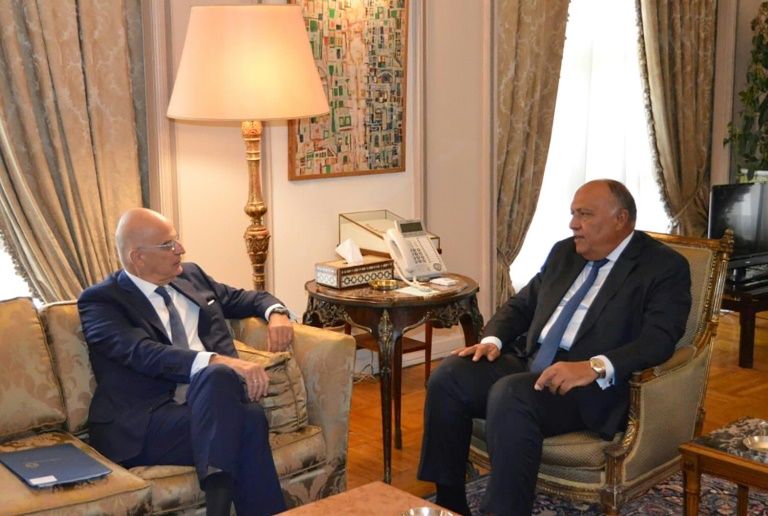
“This agreement threatens stability and security in the Mediterranean,” Greek Foreign Minister Nikos Dendias said in Cairo, where he met his Egyptian counterpart Sameh Shoukry.

The deal follows an agreement Turkey signed three years ago with Tripoli that demarcated the countries’ shared maritime borders.

Greece, Egypt and Cyprus believe the 2019 agreement violates their economic rights in an area suspected to contain vast natural gas reserves.

“We will use all legal means to defend our rights,” Dendias added.

He said Tripoli “does not have the necessary sovereignty over this area”, and that the agreement is therefore “illegal and inadmissible”.

Shoukry charged that the mandate of the authorities in Tripoli has “expired” and that “the government of Tripoli does not have the legitimacy to sign agreements”.

A rival Libyan administration in the war-torn country’s east — which since March has been attempting to take office in Tripoli and also argues the government’s mandate has expired — has rejected the accord.

Monday’s deal builds on an agreement signed between Ankara and a previous Tripoli-based administration in 2019, at the height of a battle for the capital after eastern-based military chief Khalifa Haftar attempted to seize it by force.

The delivery of Turkish drones to Tripoli-based forces shortly afterwards was seen as crucial in the victory over Haftar, who was backed at the time by Egypt, Russia and the United Arab Emirates.

The question of rights to Libya’s vast hydrocarbon resources has become more urgent this year as global energy prices have soared.

The European Union has denounced the 2019 maritime border deal, while France has said the recent agreement was “not in accordance with international law”.

Fake heiress Anna Sorokin vows to fight deportation to Germany

Anna Sorokin, the young Russian-German woman who bilked wealthy New Yorkers while pretending to be an heiress herself, has said she would fight deportation to Germany after her recent release from prison.

The 31-year-old Sorokin, whose extraordinary story inspired a fictionalized series on Netflix and who has been a social-media phenomenon, was freed on bail late Friday and immediately placed under house arrest, with an ankle bracelet confining her to her modest Manhattan apartment.

She had spent the last year and a half in a detention center north of New York City operated by the US Immigration and Customs Enforcement agency, known as ICE, convicted of overstaying her tourist visa. 

Sorokin was first arrested in 2017, then sentenced in 2019 to two years in a New York detention center on charges including grand larceny. No sooner had she served that sentence — she was released early for good behavior — than ICE agents detained her.

Since February she has faced a deportation order to Germany, but in a weekend interview in her Manhattan building with The New York Times, Sorokin said she was fighting to stay in the United States.

“Letting them deport me would have been like a sign of capitulation — confirmation of this perception of me as this shallow person who only cares about obscene wealth, and that’s just not the reality,” she told the Times.

“I could have left,” Sorokin added, “but I chose not to because I’m trying to fix what I’ve done wrong. I have so much history in New York and I felt like if I were in Europe, I’d be running from something.”

Passing herself off in 2016 and 2017 as Anna Delvey — a German heiress who claimed to have a fortune of $60 million — Sorokin insinuated herself into the upper reaches of New York society, persuading members of the elite to invest in an exclusive arts club bearing her name.

She had a rare talent for spinning elaborate lies with a preternatural poise that made them seem believable.

Sorokin obtained tens of thousands of dollars in loans, free trips on a private jet and accommodation in some of New York’s swankiest boutique hotels.

In all, prosecutors said, she swindled the unsuspecting out of $275,000.

The Russian-born Sorokin, who holds German citizenship, is the daughter of a truck driver and a shopkeeper who emigrated to Germany in 2007.

In her oversized designer glasses that were something of a trademark, she frequented the fashion worlds of London and Paris before moving to New York in 2013 for Fashion Week.

Her story eventually caught the attention of American producer Shonda Rhimes (“Grey’s Anatomy,” “Scandal”), who turned it into the Netflix miniseries “Inventing Anna,” starring Julia Garner. 

French energy giant offers pay talks to end fuel strike

France’s TotalEnergies said on Sunday it would advance annual pay talks with unions if they dropped a blockade of fuel depots and refineries that has slashed petrol supplies across the country.

Vehicle owners have faced increasingly long waits to fill up after two weeks of strikes by workers demanding higher wages in response to soaring prices.

“I haven’t been able to work for two days now,” complained 60-year-old taxi driver Thierry. 

He said he had “gone round the whole of Paris” to find fuel and had already been waiting for three hours at a filling station in the capital for fuel tankers to turn up.

Like other major oil companies, TotalEnergies has seen its profits soar as energy prices skyrocket during the war in Ukraine, and government officials have been pressing the company to settle the standoff.

TotalEnergies runs a network of around 3,500 filling stations in France, nearly a third of the total. Most of them are low on fuel or even empty for some types.

“If the depot blockades end and with the agreement of all labour representatives, the company proposes to move forward the annual salary negotiations from November to October,” TotalEnergies said.

The discussions would define “how employees will benefit from TotalEnergies’ exceptional results before the end of this year, taking into account this year’s inflation”.

On Sunday, the CGT union branch at the company — which is leading the strikes at TotalEnergies and at rival Esso-ExxonMobil — said the industrial action would continue but it was open to talks as soon as Monday.

“If we do start talks, it will be based on our demands — a 10-percent salary hike … retroactive for the year 2022,” branch coordinator Eric Sellini told AFP.

Currently three of Total’s refineries are blocked, including its largest, in Normandy, as well as a fuel depot near Flandres in the north.

The government has already dipped into strategic stockpiles in a bid to bring relief, and fuel tankers are being allowed exceptionally to make deliveries on Sunday to replenish filling stations.

“I’m all in favour of dialogue so French people don’t have to put up with this industrial action for too long,” Energy Transition Minister Agnes Pannier-Runacher told BFM television.

She said the government had increased supplies by 20 percent but fears of running out of fuel were aggravating the shortage. Some areas have seen a 30-percent spike in sales to motorists.

“The situation should improve tomorrow,” she said.

New deadly strike hits Ukraine city after Crimean bridge blast

A Russian missile strike killed at least 13 people in Zaporizhzhia, authorities said on Sunday — the latest deadly attack targeting the southern Ukrainian city, prompting President Volodymyr Zelensky to call the bombardment “absolute evil”.

The reports came a day after a key bridge linking Russia with the annexed Crimean peninsula was partially destroyed by an explosion, and as the Kremlin replaced its top general amid major battlefield setbacks in Ukraine.

Russian President Vladimir Putin will chair a meeting of his Security Council on Monday in the wake of the bridge attack, the Kremlin told Russian media.

Ukrainian officials said 13 people had died and 49 people, including six children, were in hospital after Russian missiles again hit Zaporizhzhia.

At least 17 people, including a child, died when seven Russian missiles hit the centre of the industrial city earlier this week.

Regional official Oleksandr Starukh posted pictures of heavily damaged apartment blocks on Telegram and said a rescue operation had been launched to find victims under the rubble.

Zelensky denounced the “merciless strikes on peaceful people” and residential buildings as “absolute evil” perpetrated by “savages and terrorists”.

Divers were to inspect the waters beneath the giant Crimea bridge on Sunday, a day after a truck bomb ignited a massive fire on the road and rail link, killing three people.

“We are ordering the examination by divers. They will start work from six in the morning,” Russian Deputy Prime Minister Marat Khusnullin announced.

“First results” of Russia’s inspection of the bridge were due on Sunday, he added.

Russia on Saturday said traffic had resumed over the strategic link, a symbol of the Kremlin’s 2014 annexation of Crimea.

The 19-kilometre (12-mile) bridge was attacked at dawn on Saturday, sparking celebrations from Ukrainians and others on social media. Dramatic footage showed it burning and a road section plunging into the water.

But Zelensky did not directly mention it in his nightly address and officials made no claim of responsibility. 

Following the blast, the bodies of an unidentified man and a woman were pulled out of the water, probably passengers in a car driving near the exploded truck, Moscow said.

Authorities had identified the owner of the truck as a resident of Russia’s southern Krasnodar region and said his home was being searched.

– ‘Emergency situation’ –

The bridge is logistically crucial for Moscow — a vital transport link for carrying military equipment to Russian soldiers fighting in Ukraine.

It is also hugely symbolic. President Vladimir Putin personally inaugurated the structure in 2018 — even driving a truck across it — and Moscow had maintained the link was safe despite the fighting.

While some in Moscow hinted at Ukrainian “terrorism”, Russian state media continued to call it an “emergency situation”. 

Zelensky’s adviser Mykhailo Podolyak posted a picture on Twitter of a long section of the bridge half-submerged. “Crimea, the bridge, the beginning,” he wrote.

But in a later statement, he appeared to suggest Moscow had a hand in the blast, noting the truck that detonated “entered the bridge from the Russian side”.

The Kremlin’s spokesman said Putin had ordered a commission to be set up to look into the blast. 

Officials in Moscow stopped short of blaming Kyiv but a Russian-installed official in Crimea pointed the finger at “Ukrainian vandals.”

“There is an undisguised terrorist war against us,” Russian ruling party deputy Oleg Morozov told the RIA Novosti news agency. 

Military analysts said the blast could have a major impact if Moscow saw the need to shift already hard-pressed troops to Crimea from other regions or if it prompted a rush by residents to leave.

Mick Ryan, a retired Australian senior officer now with the Center for Strategic and International Studies in Washington, said that even if Ukrainians were not behind the blast, it constituted “a massive influence operation win for Ukraine”.

“It is a demonstration to Russians, and the rest of the world, that Russia’s military cannot protect any of the provinces it recently annexed,” he said on Twitter.

Authorities in Crimea tried to allay fears of food and fuel shortages in the territory, which has been dependent on the Russian mainland since its annexation from Ukraine.

– Moscow appoints new general –  

The blast came after lightning territorial gains by Ukraine in the east and south that have undermined the Kremlin’s official annexation of Donetsk, neighbouring Lugansk and the southern regions of Zaporizhzhia and Kherson.

After weeks of military setbacks that triggered unprecedented domestic criticism of Russia’s army, Moscow on Saturday announced that a new general — Sergei Surovikin — would take over its forces in Ukraine. 

Surovikin previously led Russia’s military in southern Ukraine. He has combat experience from the 1990s conflicts in Tajikistan and Chechnya, as well as, more recently, in Syria.

Energy firm starts tests at sensitive Israel-Lebanon border gas field

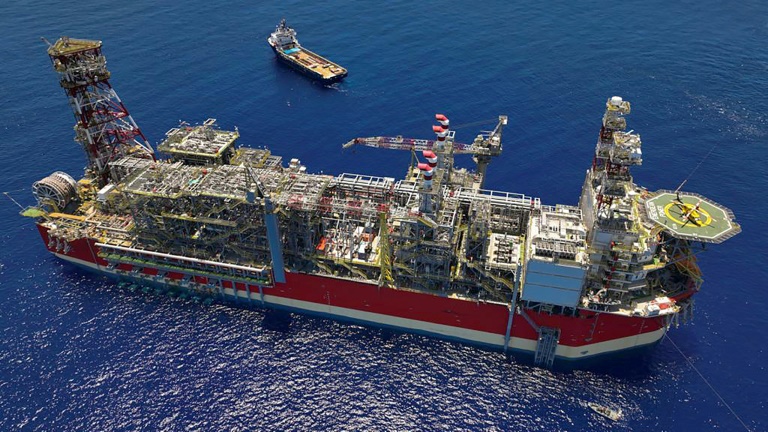
London-listed firm Energean on Sunday began testing pipes between Israel and the Karish offshore gas field, a key step towards production from the eastern Mediterranean site, a source of friction between neighbours Israel and Lebanon.

Israel has maintained that Karish falls entirely within its territory and is not a subject of negotiation at ongoing, US-mediated maritime border talks with Lebanon.

The two countries remain technically at war.

Beirut has reportedly made claims to parts of Karish, and the Iran-backed Shiite group Hezbollah, which holds huge influence in Lebanon, has previously threatened attacks if Israel began production from the field.

In a statement Sunday, Energean said that “following approval received from the Israeli Ministry of Energy to start certain testing procedures, the flow of gas from onshore to the FPSO has commenced”, referring to the Karish floating production storage offloading facility.

The tests, set to take a number of weeks, were “an important step” towards extracting gas from the Karish, Energean said. 

Lebanon and Israel have engaged in on-off indirect talks since 2020 to delineate their Mediterranean border, which could allow both countries to boost offshore natural gas exploration.

A draft agreement floated by US envoy Amos Hochstein aims to settle competing claims over offshore gas fields and was delivered to Lebanese and Israeli officials in recent days.

Israel had welcomed the terms set out by Hochstein and said they would be subjected to legal review, but gave no indication if it sought substantive changes.

Lebanon presented its response to Washington’s proposal on Tuesday.

Israel said two days later that it planned to reject a proposed Lebanese amendment, even if that jeopardises a possible agreement. 

Israel reiterated this week that production at Karish would begin as soon as possible, regardless of Lebanon’s demands.

Two Lebanese officials involved in the talks told AFP on Sunday the US mediator had  informed Beirut that the operation at Karish was only a test.

Negotiations on the maritime border are still going on, one official said.

On Saturday, the French foreign ministry said Paris was “actively contributing to the American mediation”. 

Under the terms of the US draft agreement leaked to the press, all of Karish would fall under Israeli control, while Qana, another potential gas field, would be divided but its exploitation would be under Lebanon’s control.

French company Total would be licensed to search for gas in the Qana field, and Israel would receive a share of future revenue.

Germany probes rail 'sabotage' amid Russia tensions

German police were on Sunday probing an act of “sabotage” on the country’s rail infrastructure, with some officials pointing the finger at Russia in the wake of the Nord Stream pipeline explosions.

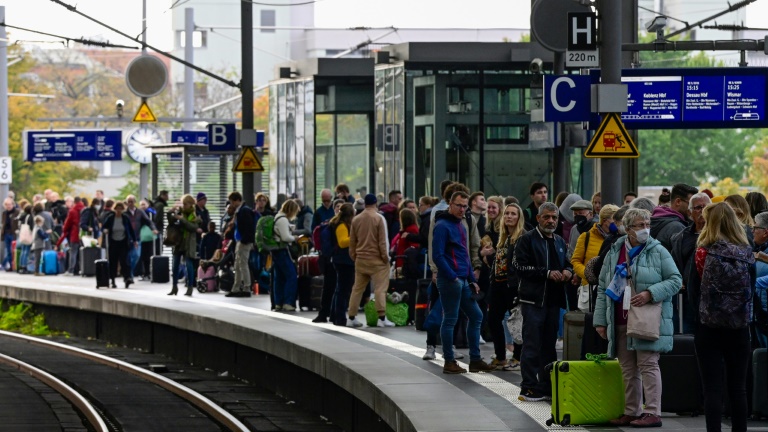
Important communications cables were cut at two sites on Saturday, forcing rail services in the north to be halted for three hours and causing travel chaos for thousands of passengers.

Rail operator Deutsche Bahn blamed the travel disruptions on “sabotage”, while Transport Minister Volker Wissing spoke of “a targeted and deliberate action”.

Germany’s top-selling daily Bild cited an internal document from the Federal Criminal Police Office (BKA) as saying, in an early analysis of the incident, that an act of “state-ordered sabotage would be conceivable”.

The document pointed to the “widely separated crime scenes” where the cables were severed, in Herne in the western state of North Rhine-Westphalia and in Berlin in the east, some 540 kilometres (335 miles) away.

The BKA also noted that the incident comes not long after last month’s undersea blasts on Nord Stream 1 and 2 gas pipelines between Germany and Russia.

The pipeline sabotage further raised tensions between Russia and the West, already sky-high over the Ukraine war, but Moscow denies any involvement in the blasts.

Anton Hofreiter, a Green party lawmaker and chairman of the German parliament’s European affairs committee, said Russia could have been behind the train disruptions.

“To pull this off, you have to have very precise knowledge of the railway’s radio system. The question is whether we are dealing with sabotage by foreign powers,” Hofreiter told the Funke newspaper group.

Given that the Nord Stream leaks “pointed to the Kremlin”, “we can’t rule out that Russia could also be behind the attack on the rail services,” he said.

“Maybe both are warning shots because we support Ukraine.”

Police have said the investigation into Saturday’s incident is still wide open and they have not publicly mentioned any suspects. According to local media, authorities are also looking into whether far-left extremists could be to blame.

– ‘Hybrid threats’ –

With concern growing about the vulnerability of Germany’s critical infrastructure, Hofreiter called for 20 billion euros ($19 billion) to be invested in the coming years to boost security, including cyber security.

A senior German military official warned that further attacks were possible.

“Every power station, every energy transport pipe is a potential target,” Major General Carsten Breuer told Bild, speaking of growing “hybrid threats”.

Germany’s conservative opposition CDU party also called for closer monitoring of key infrastructure.

“We must rethink the security architecture of Germany and the EU,” senior CDU lawmaker Thorsten Frei told the RND media group. “The modern age of hybrid warfare requires us to adapt,” he said.

Close Bitnami banner
Bitnami