US Business

Apple wins 728-mn-euro cut to France antitrust fine

A French court on Thursday slashed more than 700 million euros from a record 1.1-billion-euro fine imposed on US tech giant Apple in 2020, sources close to the case told AFP.

France’s competition authority levied the fine — its biggest ever — after concluding that the firm squeezed independent sellers of Apple products as it tried to push buyers towards its own stores and preferred retailers.

But the Paris appeal court revised the decision and knocked 728 million from the fine, meaning Apple still faces having to pay 370 million euros.

Apple says the fine is unfair and told AFP the whole complaint should be quashed. 

“We consider that the decision should have been annulled in its entirety and plan to appeal to the French supreme court,” the firm told AFP in a statement. 

“The decision concerns practices that go back more than 10 years and that even the French competition authority has recognised as no longer being in force.”

The initial case was made up of three linked complaints — one was dismissed by the appeals court and two were upheld.

Sources close to the case, who did not want to be named because of the sensitivity of the issue, confirmed the amounts and the details of the decision.

The Paris appeals court told AFP the ruling would be made public on Friday.

Stocks mostly retreat, pound drops

Global equity markets mostly fell Thursday and the pound retreated once more against the dollar on lingering recession fears despite hopes that the US Federal Reserve will tame the pace of aggressive interest rate hikes.

Oil prices advanced, building on gains made before OPEC and other major producers led by Russia decided to slash output by two million barrels per day.

OANDA market analyst Craig Erlam said European markets erased early gains as “investors take a cautious approach” ahead of Friday’s release of a US jobs report that could influence the Fed’s next move.

Wall Street stocks mostly moved lower, with the Dow shedding 0.3 percent.

Stocks had snapped higher at the start of this week as disappointing US economic data fuelled hopes that the Federal Reserve may let up in its campaign of aggressive interest rate hikes to get soaring inflation under control.

“The narrative in recent days of weaker data being positive as it could be a precursor to slower tightening didn’t seem sustainable and it’s already proving to be the case,” added Erlam.

Instead, he said he believed the rally to be a response to the sharp drop in shares in the previous weeks as the Fed made clear it would keep raising rates until inflation is brought down, even if that triggers a recession.

Investors are now looking forward to the release Friday of US non-farm payroll jobs data for the latest glimpse at how the economy is handling rising interest rates.

Data showing tougher labour market conditions could trigger a new relief rally, while a resilient figure could send stocks lower as investors fret about further rate hikes.

Data out Thursday showed first time unemployment claims dropped to 219,000, but that was above expectations.  

“The key takeaway from the report is that initial claims — a leading indicator — have a lot more scope for deterioration before the Fed can be convinced that its rate hikes have induced a sufficient softening in the labor market to ease wage-based inflation pressures,” said Patrick O’Hare at Briefing.com.

– Oil prices steady –

Oil prices advanced further after a decision by OPEC+ nations to cut production by two million barrels per day, the biggest reduction in output since the Covid-19 pandemic.

Oil prices, which had slumped to pre-Ukraine war levels in recent weeks as global recession worries mount, had surged in the days ahead of the OPEC+ meeting.

The production cut should support crude prices, but as high oil prices have been stoking the inflation that is prompting central banks to raise interest rates, the move will further exacerbate the situation.

“The oil producing nations want to support the oil market, but a high oil price hurts most nations, so in a roundabout way, the move will probably add to global inflation,” said analyst David Madden at Equiti Capital.

The pound was down about 1.1 percent against the dollar after Fitch ratings agency lowered the outlook for British debt to negative from stable.

This comes after the government of new Prime Minister Liz Truss recently announced a budget packed with debt-fuelled tax cuts.

Ahead of the downgrade Wednesday, sterling had plunged more than two percent after Truss failed to reassure investors with a speech at her Conservative party conference.

The pound, however, has recovered since reaching a record-low close to parity against the dollar at the end of September.

– Key figures around 1530 GMT –

New York – Dow: DOWN 0.3 percent at 30,178.58 points

EURO STOXX 50: DOWN 0.4 percent at 3,433.45

London – FTSE 100: DOWN 0.8 percent at 6,997.27 (close) 

Frankfurt – DAX: DOWN 0.4 percent at 12,470.78 (close)

Paris – CAC 40: DOWN 0.8 percent at 5,936.42 (close)

Tokyo – Nikkei 225: UP 0.7 percent at 27,311.30 (close)

Hong Kong – Hang Seng Index: DOWN 0.4 percent at 18,012.15 (close)

Shanghai – Composite: Closed for a holiday

Pound/dollar: DOWN at $1.1184 from $1.1326 on Wednesday

Euro/dollar: DOWN at $0.9828 from $0.9889

Euro/pound: UP at 87.91 pence from 87.29 pence

Dollar/yen: UP at 144.77 yen from 144.59 yen

Brent North Sea crude: UP 0.8 percent at $94.08 per barrel

West Texas Intermediate: UP 0.7 percent at $88.33 per barrel

burs-rl/kjm

66 abortion clinics shut in US since court ruling: report

At least 66 clinics in 15 US states have stopped performing abortions since the June Supreme Court ruling that overturned the constitutional right to the procedure, according to a report published on Thursday.

The Guttmacher Institute, a group which supports abortion rights, said there had previously been 79 clinics offering abortions in the 15 states which have implemented strict abortion bans.

That number has since fallen to 13 clinics, all of them in Georgia, which has banned abortion after six weeks of gestation, before many people even know they are pregnant, it said. 

The institute said 26 clinics in the 15 states have closed their doors entirely, while 40 remain open providing reproductive health services other than abortion.

The Guttmacher Institute said the 15 states are home to nearly 22 million girls and women of reproductive age — between the ages of 15 and 49 — nearly one-third of the total US population of women of reproductive age.

The institute said more than 125,000 abortions were performed in 2020 in the 14 states where abortion is no longer available at all and another 41,000 in Georgia.

“Individuals who can no longer obtain an abortion from a clinic in these states are now forced to travel to another state for abortion care,” Guttmacher said.

This extra step to access the procedure can impose travel and child care costs along with those associated with having to take time off work, it said, while some women are instead forced to continue their pregnancy.

Meanwhile, states where abortion remains legal “are being inundated with people from states with abortion bans seeking care,” the report said.

“These dramatic increases in caseloads mean clinic capacity and staff are stretched to their limits, resulting in longer wait times for appointments even for residents of states where abortion remains legal,” it said.

The institute predicted that the “already precarious abortion access landscape is likely to continue to deteriorate” with a total of 26 states certain or likely to impose near-total abortion bans within a year.

Kevin Spacey in court over 1980s sex misconduct claim

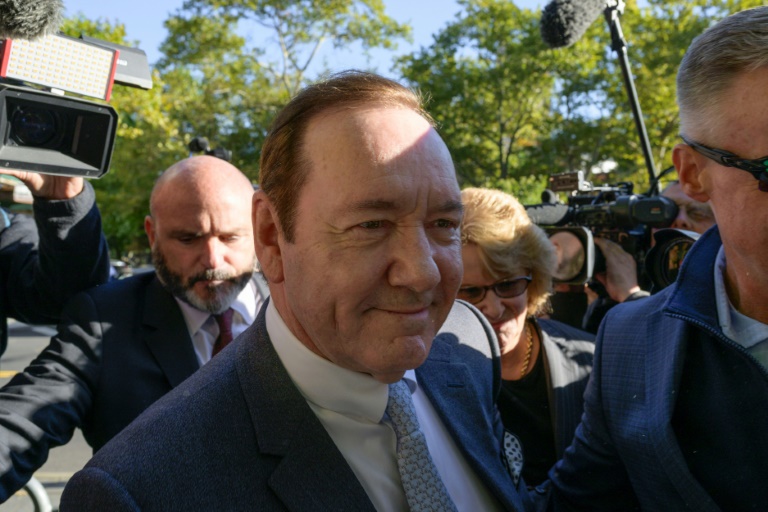
Five years after sexual misconduct allegations ended his Hollywood career, Kevin Spacey appeared in a New York court Thursday to face a civil lawsuit brought by actor Anthony Rapp, who accuses the disgraced Oscar winner of assaulting him as a teenager, in 1986.

One of the first stars to be caught up in the global #MeToo reckoning over sexual abuse, the 63-year-old Spacey smiled as he arrived at a federal court in Manhattan at around 9 am (1300 GMT), just after Rapp entered the building.

Jury selection was slated to begin about a half hour later in a case presided over by Judge Lewis Kaplan.

“Star Trek: Discovery” star Rapp, who turns 51 this month, filed a complaint in September 2020 against Spacey for advances and an alleged sexual assault at a party in Manhattan in 1986, when Rapp was 14 and Spacey was in his late 20s. 

The “House of Cards” actor, who built his worldwide fame since the 1980s in movies such as “The Usual Suspects” and “American Beauty,” has always denied allegations of sexual abuse. 

But Spacey, whose full name is Kevin Spacey Fowler, has disappeared from public view after becoming caught up in the early days of the #MeToo movement.

– Global fame –

The #MeToo movement exploded in October 2017, when more than 80 women in the movie industry accused — and ultimately brought down — the previously untouchable producer Harvey Weinstein.

At the end of the month, Rapp accused Spacey for the first time, in great detail, in an interview with BuzzFeed News.

The next day, on Twitter, Spacey presented his “sincerest apology” to Rapp for any “deeply inappropriate drunken behavior,” saying he did not recall the incident.

After a 2020 criminal charge of sexual assault was dismissed by a judge, Rapp filed a civil suit.

According to a court document, Rapp claims that during the 1986 party, Spacey lifted him up, and that his hand “grazed” his buttocks while doing so. Rapp claims Spacey then placed him back down on a bed and “briefly placed his own clothed body partially beside and partially across” the 14-year-old’s.

During his testimony 35 years after the incident, Rapp agreed there had been “no kissing, no undressing, no reaching under clothes, and no sexualized statements or innuendo,” during an incident that had lasted no more than two minutes. 

– ‘An impartial jury’ –

“Mr Spacey will appear Thursday and throughout the trial. We look forward to his vindication by an impartial jury,” his lawyer Jennifer Keller previously told AFP in an email.

If found guilty, Spacey faces significant damages.

Kaplan had dropped Rapp’s initial charge of sexual assault, ruling it had been brought too late and was not covered by a New York state law on child protection, implemented in 2019.

Spacey has pleaded not guilty to charges of sexual assault of three men between March 2005 and April 2013 in Britain, and in 2019 charges against the actor of indecent assault and sexual assault were dropped in Massachusetts. 

UN Human Rights Council rejects debate on Xinjiang

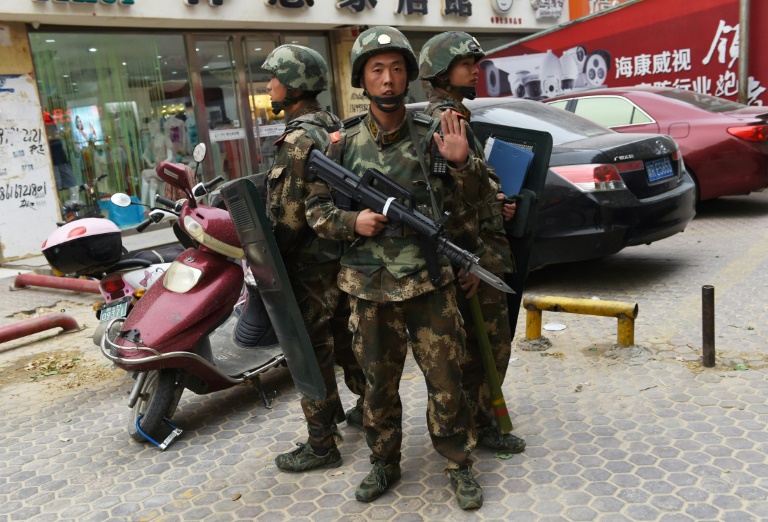
The UN Human Rights Council on Thursday voted against holding a debate on alleged widespread abuses in China’s Xinjiang region after intense lobbying by Beijing, in a major setback for Western nations.

The United States and allies last month presented the first draft decision targeting China to the UN’s top rights body, seeking as a bare minimum a discussion on Xinjiang.

The move came after former UN rights chief Michelle Bachelet released her long-delayed Xinjiang report, citing possible crimes against humanity against Uyghurs and other Muslim minorities in the far-western region.

Western countries thought that by going no further than simply seeking to talk about the findings, enough other nations would not block putting it on the agenda.

But in a moment of drama, countries on the 47-member council in Geneva voted 19-17 against holding a debate on human rights in Xinjiang, with 11 nations abstaining.

Amnesty International branded the vote farcical, while Human Rights Watch (HRW) said it betrayed abuse victims.

“The United States condemns today’s vote preventing a discussion about Xinjiang,” US ambassador to the council Michele Taylor tweeted.

Inaction “shamefully suggests some countries are free from scrutiny and allowed to violate human rights with impunity”.

– China says being ‘targeted’ –

The nations voting against a debate were Bolivia, Cameroon, China, Cuba, Eritrea, Gabon, Indonesia, Ivory Coast, Kazakhstan, Mauritania, Namibia, Nepal, Pakistan, Qatar, Senegal, Sudan, the United Arab Emirates, Uzbekistan and Venezuela.

Argentina, Armenia, Benin, Brazil, Gambia, India, Libya, Malawi, Malaysia, Mexico and Ukraine abstained.

China’s ambassador Chen Xu said the push to discuss the issue was “taking advantage” of the United Nations “to interfere in China’s internal affairs”.

“The draft decision is not pro-human rights but for political manipulation,” he told the council.

“Today China is targeted; tomorrow any other developing country could be targeted.”

The draft decision was put forward by the United States, Australia, Canada, France, Germany, Norway, Sweden and Turkey, among others.

One Western diplomat stressed that regardless of the outcome, “the number one objective has been fulfilled” in putting Xinjiang in the spotlight.

– ‘Dreadful message’ –

Bachelet’s report, published minutes before her term ended on August 31, highlighted “credible” allegations of widespread torture, arbitrary detention and violations of religious and reproductive rights.

It brought UN endorsement to long-running allegations that Beijing detained more than one million Uyghurs and other Muslims and forcibly sterilised women.

Beijing vehemently rejected the charges, insisting it running vocational training centres in the region to counter extremism.

Amnesty secretary general Agnes Callamard said Thursday’s vote was a “dismaying result that puts the UN’s main human rights body in the farcical position of ignoring the findings of the UN’s own human rights office”.

“For council member states to vote against even discussing a situation where the UN itself says crimes against humanity may have occurred makes a mockery of everything the Human Rights Council is supposed to stand for.”

HRW’s China director Sophie Richardson called it an “abdication of responsibility and a betrayal of Uyghur victims”.

The International Service for Human Rights’ China advocate Raphael Viana David said: “Council members sent today a dreadful message: China remains so far untouchable.”

– Muslim countries’ position ‘shameful’ –

ISHR executive director Phil Lynch said it was “shameful” that “Muslim countries… have overwhelmingly failed to even support a UN discussion on rights abuses against Uyghurs.”

Indonesian ambassador Febrian Ruddyard said, “As the world’s largest Muslim country and a vibrant democracy, we cannot close our eyes to the plight of our Muslim brothers and sisters”.

But, as China did not consent, a discussion “will not yield meaningful progress”, hence Indonesia voted ‘no’.

The sentiment was echoed by Qatari ambassador Hend Al-Muftah.

China launched an all-out offensive to dismiss Bachelet’s report.

African countries, where China is the leading creditor after making massive infrastructure  investments, faced particularly heavy lobbying, observers said.

In the end, only Somalia voted ‘yes’ out of 13 countries.

Britain’s ambassador Simon Manley said the close result nonetheless showed Beijing that “a significant number of countries will not be silenced when it comes to egregious human rights violations”, whoever the perpetrator.


OPEC+: a thriving Saudi-Russian marriage of convenience

By ignoring the United States and slashing its oil production, the OPEC+ group of petro-states demonstrated the tightening bond between Saudi Arabia, normally a close US ally, and Russia.

Here are key questions about the group’s evolution:

– When did it start? –

OPEC+ was born in late 2016 when 10 oil-producing countries, including Russia, joined forces with the Saudi-led 13 nations of the Organization of the Petroleum Exporting Countries to prop up falling prices.

With 60 percent of global crude exports under its control, the cartel exerts great influence over the oil markets by coordinating its production targets.

It is a motley crew of countries: Saudi Arabia and Iran are bitter rivals, South Sudan and Libya have been wracked by civil wars and others such as Venezuela are mired in economic crises.

“Anyone who believed back in 2016 that the enlargement of the producer group by 10 non-OPEC producing countries will be a brief affair has been proven wrong,” said Tamas Varga, analyst at PVM Energy.

“It has survived turbulent periods, including a short but devastating price war between the two heavyweights, Saudi Arabia and Russia in 2020,” Varga said, referring to disagreements on production levels.

The cartel faced its biggest crisis back then as countries locked down due to the Covid pandemic, sending oil demand plunging to a point that prices sank into negative territory.

The group agreed in April 2020 to slash output by 9.7 million barrels per day in order to boost sagging prices. It began to raise production again last year as the market improved.

– How has it responded to the war? –

A new global crisis emerged when Russia invaded Ukraine in late February, sending oil prices close to a 14-year high of $140 per barrel.

But OPEC+ maintained a united front as it resisted Western calls to boost production in order to bring down energy-fuelled inflation.

With fears of recession bringing prices under $90 in recent months, the group decided instead on Wednesday to cut production by two million barrels per day from November.

The move “shows the Gulf States are still unwilling to distance themselves from Russia even as the conflict in Ukraine grinds on,” said London-based consultancy Energy Aspects.

The group also extended its “declaration of cooperation” for another year.

“This is good news for Russia,” said Cornelia Meyer, chief executive of consultancy MRL Corporation. 

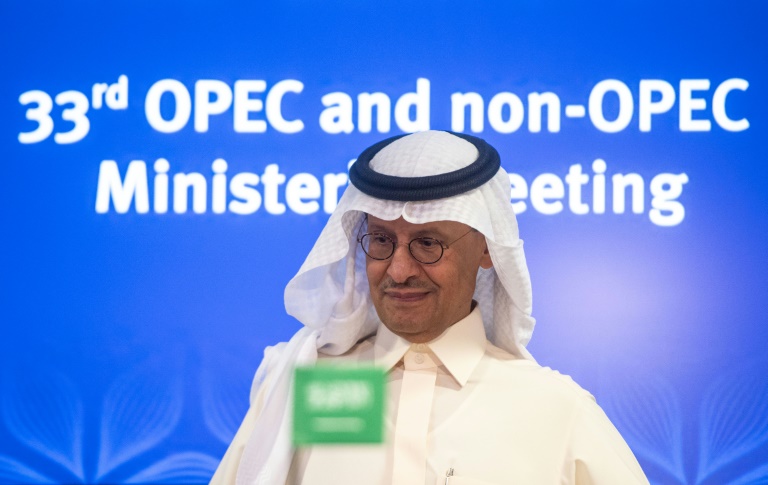
“The clue for OPEC+ success is first and foremost our cohesion,” the Saudi energy minister, Prince Abdulaziz bin Salman, said following Wednesday’s OPEC+ meeting in Vienna, adding that it was “not an accident” that the group has been collaborating since 2016.

– How does Russia benefit from the cut? – 

Russia has raked in at least 116 billion euros ($114 billion) in oil exports since the start of the war, according a September report by the Centre for Research on Energy and Clean Air.

But its production has declined as Western sanctions bite and it has sold its oil at a discount.

“The ultimate winner of the agreement is Russia,” Varga said.

“Its declining production together with falling prices and a relatively strong ruble critically hindered the country’s ability to finance the war against Ukraine,” he said.

Moscow faces a new problem later this year when a European Union ban on most of its oil comes into effect. The EU and G7 are also considering a price cap on Russian oil.

The OPEC+ output cut could send crude prices soaring again, giving Russia a boost before the ban and potential cap begin.

“Given Russia’s limited ability to ramp up production due to sanctions the agreement goes a long way to maximise its revenue from oil exports,” Varga told AFP.

– Was it a political decision? –

When asked how Washington might react to the group’s next move, UAE energy minister Suhail al-Mazrouei insisted OPEC+ was merely a “technical organisation” — suggesting there are no political motives behind its decisions.

Kremlin spokesman Dmitry Peskov said the output cut was “aimed at stabilising oil markets”.

“The issue is that it’s very difficult to take politics out of the situation when high energy prices are being driven by a war started by one of the main OPEC+ member states,” Erlam said.

“While other countries may insist decisions aren’t political, that’s difficult to accept when they’re continuing to cooperate with Russia and refusing to condemn their invasion,” he said.

The White House was not pleased, saying it was “clear that OPEC+ is aligning with Russia”.

IMF chief urges action as global recession risks rise

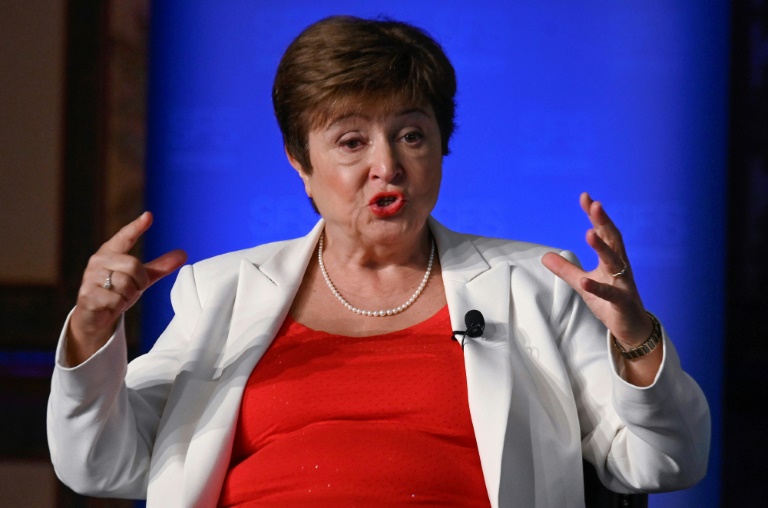
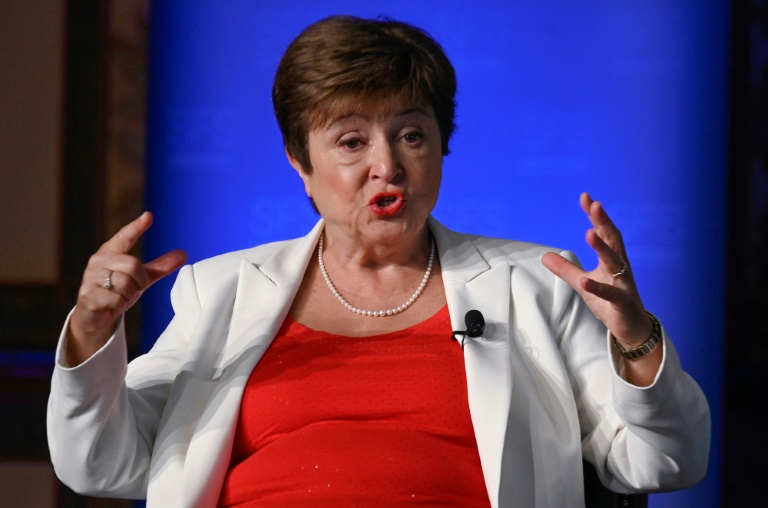
IMF chief Kristalina Georgieva urged global policymakers Thursday to take concerted action to avoid a “dangerous ‘new normal,'” as the risks of a worldwide recession are driven ever higher by repeated economic shocks.

In a speech ahead of the fund’s annual meetings next week, the IMF’s managing director said it was critical to “stabilize the global economy by addressing the most immediate challenges” — including rampant inflation.

Policymakers need to act together to “prevent this period of heightened fragility from becoming a dangerous ‘new normal,'” Georgieva said.

But she warned the process will be painful — and that if central banks move too aggressively to tamp down price pressures, it could trigger a “prolonged” economic downturn.

Finance ministers and central bank governors from more than 180 nations will gather next week in Washington for the first fully in-person meeting of the International Monetary Fund and World bank since 2019, prior to the Covid-19 pandemic.

Faced with the “darkening global outlook … the risks of recession are rising,” Georgieva said — announcing that the crisis lender plans to once again downgrade its 2023 forecast for the world economy, in the forecasts due to be published next week for the annual meeting.

One-third of countries are expected to see at least two quarters of contraction, and “even when growth is positive, it will feel like a recession” because of rising prices eroding incomes, she said.

The fund in July slashed its growth forecast for this year to 3.2 percent, and for next year to 2.9 percent — the third consecutive downgrade.

– ‘Shock, after shock’ –

The meetings come at a difficult time for the global economy, with the pandemic largely under control, but soaring inflation and rising interest rates now threatening to reverberate around the globe and choke off nascent recoveries.

“In less than three years we lived through shock, after shock, after shock,” Georgieva said in her speech at Georgetown University.

Global supply snarls already were a challenge as demand surged following the pandemic slowdown, fueling inflation worldwide, and strains worsened in the wake of the Russian invasion of Ukraine — which Georgieva called a “senseless war” — sending food and food prices soaring.

“Far from being transitory, inflation has become more persistent,” and acting before high prices become entrenched is a key challenge for policymakers, Georgieva said — warning that “the cost of a policy misstep can be enormous.”

“Not tightening enough would cause inflation to become deanchored and entrenched,” but moving “too much and too fast — and doing so in a synchronized manner across countries — could push many economies into prolonged recession,” she said.

Despite the risks, central banks need to continue “act decisively.”

“This is not easy, and it will not be without pain in the near term,” she cautioned. “But the key is to avoid much greater and longer-lasting pain for everyone later on.”

– Debt distress –

Georgieva stressed the need for fiscal policies to help the most vulnerable segments of society, but warned that efforts must be targeted “with a laser-sharp focus on lower-income households,” to avoid acting against the current of monetary policy.

She cautioned against relying on price controls which are not affordable nor effective.

The pandemic forced many countries to take on more borrowing, and now many are already facing or at risk of debt distress amid rising interest rates. That “raises the risk of a widening debt crisis” which could further harm global growth.

To reduce the risk “large creditors such as China and private-sector creditors have a responsibility to act,” she said, calling for “faster and more predictable” action on debt restructuring.

IMF chief urges action as global recession risks rise

IMF chief Kristalina Georgieva urged global policymakers Thursday to take concerted action to avoid a “dangerous ‘new normal,'” as the risks of a worldwide recession are driven ever higher by repeated economic shocks.

In a speech ahead of the fund’s annual meetings next week, the IMF’s managing director said it was critical to “stabilize the global economy by addressing the most immediate challenges” — including rampant inflation.

Policymakers need to act together to “prevent this period of heightened fragility from becoming a dangerous ‘new normal,'” Georgieva said.

But she warned the process will be painful — and that if central banks move too aggressively to tamp down price pressures, it could trigger a “prolonged” economic downturn.

Finance ministers and central bank governors from more than 180 nations will gather next week in Washington for the first fully in-person meeting of the International Monetary Fund and World bank since 2019, prior to the Covid-19 pandemic.

Faced with the “darkening global outlook … the risks of recession are rising,” Georgieva said — announcing that the crisis lender plans to once again downgrade its 2023 forecast for the world economy, in the forecasts due to be published next week for the annual meeting.

One-third of countries are expected to see at least two quarters of contraction, and “even when growth is positive, it will feel like a recession” because of rising prices eroding incomes, she said.

The fund in July slashed its growth forecast for this year to 3.2 percent, and for next year to 2.9 percent — the third consecutive downgrade.

– ‘Shock, after shock’ –

The meetings come at a difficult time for the global economy, with the pandemic largely under control, but soaring inflation and rising interest rates now threatening to reverberate around the globe and choke off nascent recoveries.

“In less than three years we lived through shock, after shock, after shock,” Georgieva said in her speech at Georgetown University.

Global supply snarls already were a challenge as demand surged following the pandemic slowdown, fueling inflation worldwide, and strains worsened in the wake of the Russian invasion of Ukraine — which Georgieva called a “senseless war” — sending food and food prices soaring.

“Far from being transitory, inflation has become more persistent,” and acting before high prices become entrenched is a key challenge for policymakers, Georgieva said — warning that “the cost of a policy misstep can be enormous.”

“Not tightening enough would cause inflation to become deanchored and entrenched,” but moving “too much and too fast — and doing so in a synchronized manner across countries — could push many economies into prolonged recession,” she said.

Despite the risks, central banks need to continue “act decisively.”

“This is not easy, and it will not be without pain in the near term,” she cautioned. “But the key is to avoid much greater and longer-lasting pain for everyone later on.”

– Debt distress –

Georgieva stressed the need for fiscal policies to help the most vulnerable segments of society, but warned that efforts must be targeted “with a laser-sharp focus on lower-income households,” to avoid acting against the current of monetary policy.

She cautioned against relying on price controls which are not affordable nor effective.

The pandemic forced many countries to take on more borrowing, and now many are already facing or at risk of debt distress amid rising interest rates. That “raises the risk of a widening debt crisis” which could further harm global growth.

To reduce the risk “large creditors such as China and private-sector creditors have a responsibility to act,” she said, calling for “faster and more predictable” action on debt restructuring.

Barcelona predict record revenues, rising profits

Barcelona on Thursday forecast profits of 274 million euros (270.7 million dollars) this season and record revenues of 1.255 billion euros. 

“It’s a conservative budget,” Barca’s financial vice-president Eduard Romeu said, as the club released figures for the 2021/22 financial year and forecasts for the current campaign. 

Barcelona said the revenue figure included more than 450 million euros from the sale of long-term television and other rights.

The Catalans said in the year just ended they made a profit of 98 million euros after taxes, with operating income of 1.017 billion euros and expenses of 856 million euros. 

That followed two loss-making seasons during the Covid-19 pandemic.

Barca said they were “back on the road to profit and looking to initiate a new virtuous circle”.

The budget for next year predicts expenses of 1.065 billion euros, of which 656 million euros would go on the sporting wage bill. 

Romeu said salaries had been cut from 617 euros for the 2020/21 season to 518 million euros last season. 

New player signings and a lack of departures have led to expectations of an increase this season. 

“We were planning for a more significant reduction in the salary bill,” Romeu said, adding that even so, the club would be happy to take Lionel Messi back.

“Messi is an asset for Barca and has the doors open,” Romeu said. 

“It is a matter for the sporting management and if the sporting management want it, we will get to work on that objective.”

In the 2020/21 season Barcelona posted losses of 481 million euros and blamed them for not being able to renew their all-time record scorer’s contract, leading him to sign for Paris Saint-Germain on a free transfer. 

Romeu lamented that he had not been able to persuade other high-priced stars to leave.

“There are a number of contracts that have a very high cost and between this season and next season they disappear,” said Romeu, adding that he wants to achieve a balance by the 2024/25 season. 

“Five hundred million euros would be the ideal figure for a competitive first-team squad.”

In the summer, the club sold 25 percent of their La Liga television rights to investment firm Sixth Street for the next 25 years, raising more than 500 million euros, and 49 percent of their Barca Studios production company to two companies for a total of around 200 million. Some of that revenue is included in the 2022/23 forecast.  

Barca said “without the effect of this extraordinary sale, the club still received 750 million euros in other operating income.”

They highlighted the “sale of metaverses, NFTs and tokens” by Barca Studios and said the new partnerships “will produce an acceleration of the business.” 

The budget will be submitted to the club’s annual general assembly of members on October 9.

Stocks mostly retreat, pound drops

Global equity markets mostly fell Thursday and the pound retreated once more against the dollar on lingering recession fears despite hopes that the US Federal Reserve will tame the pace of aggressive interest rate hikes.

Oil prices held steady, failing to build on gains after OPEC and other major producers led by Russia decided to slash output by two million barrels per day.

OANDA market analyst Craig Erlam said markets erased early gains as “investors take a cautious approach” ahead of Friday’s release of a US jobs report that could influence the Fed’s next move.

Wall Street stocks dipped at the start of trading with the Dow shedding 0.4 percent while European markets were down in afternoon deals.

Stocks had snapped higher at the start of this week as disappointing US economic data fuelled hopes that the Federal Reserve may let up in its campaign of aggressive interest rate hikes to get soaring inflation under control.

“The narrative in recent days of weaker data being positive as it could be a precursor to slower tightening didn’t seem sustainable and it’s already proving to be the case,” added Erlam.

Instead, he said he believed the rally to be a response to the sharp drop in shares in the previous weeks as the Fed made clear it would keep raising rates until inflation is brought down, even if that triggers a recession.

Investors are now looking forward to the release Friday of US non-farm payroll jobs data for the latest glimpse at how the economy is handling rising interest rates.

Data showing tougher labour market conditions could trigger a new relief rally, while a resilient figure could send stocks lower as investors fret about further rate hikes.

Data out Thursday showed first time unemployment claims dropped to 219,000, but that was above expectations.  

“The key takeaway from the report is that initial claims — a leading indicator — have a lot more scope for deterioration before the Fed can be convinced that its rate hikes have induced a sufficient softening in the labor market to ease wage-based inflation pressures,” said Patrick O’Hare at Briefing.com.

– Oil prices steady –

Oil prices failed to advance further after a decision by OPEC+ nations to cut production by two million barrels per day, the biggest reduction in output since the Covid-19 pandemic.

Oil prices, which had slumped to pre-Ukraine war levels in recent weeks as global recession worries mount, had surged in the days ahead of the OPEC+ meeting.

The production cut should support crude prices, but as high oil prices have been stoking the inflation that is prompting central banks to raise interest rates, the move will further exacerbate the situation.

The pound was down about 0.8 percent against the dollar after Fitch ratings agency lowered the outlook for British debt to negative from stable.

This after the government of new Prime Minister Liz Truss recently announced a budget packed with debt-fuelled tax cuts.

Ahead of the downgrade Wednesday, sterling had plunged more than two percent after Truss failed to reassure investors with a speech at her Conservative party conference.

The pound, however, has recovered since reaching a record-low close to parity against the dollar at the end of September.

– Key figures around 1330 GMT –

London – FTSE 100: DOWN 1.0 percent at 6,984.45 points

Frankfurt – DAX: DOWN 0.2 percent at 12,487.60

Paris – CAC 40: DOWN 0.7 percent at 5,944.41

EURO STOXX 50: DOWN 0.3 percent at 3,437.26

New York – Dow: DOWN 0.4 percent at 30,156.75

Tokyo – Nikkei 225: UP 0.7 percent at 27,311.30 (close)

Hong Kong – Hang Seng Index: DOWN 0.4 percent at 18,012.15 (close)

Shanghai – Composite: Closed for a holiday

Pound/dollar: DOWN at $1.1223 from $1.1326 on Wednesday

Euro/dollar: DOWN at $0.9835 from $0.9889

Euro/pound: UP at 87.66 pence from 87.29 pence

Dollar/yen: UP at 144.79 yen from 144.59 yen

Brent North Sea crude: UP less than 0.1 percent at $93.41 per barrel

West Texas Intermediate: FLAT at $87.76 per barrel

burs-rl/lth

Close Bitnami banner
Bitnami