US Business

'Watched the whole time': China's surveillance state grows under Xi

When Chen picked up his phone to vent his anger at getting a parking ticket, his message on WeChat was a drop in the ocean of daily posts on China’s biggest social network.

But soon after his tirade against “simple-minded” traffic cops in June, he found himself in the tentacles of the communist country’s omniscient surveillance apparatus.

Chen quickly deleted the post, but officers tracked him down and detained him within hours, accusing him of “insulting the police”.

He was locked up for five days for “inappropriate speech”.

His case — one of the thousands logged by a dissident and reported by local media — laid bare the pervasive monitoring that characterises life in China today.

Its leaders have long taken an authoritarian approach to social control. 

But since President Xi Jinping took power in 2012, he has reined in the relatively freewheeling social currents of the turn of the century, using a combination of technology, law and ideology to squeeze dissent and preempt threats to his rule.

Ostensibly targeting criminals and aimed at protecting order, social controls have been turned against dissidents, activists and religious minorities, as well as ordinary people — such as Chen — judged to have crossed the line.

– Eyes in the sky –

The average Chinese citizen today spends nearly every waking moment under the watchful eye of the state.

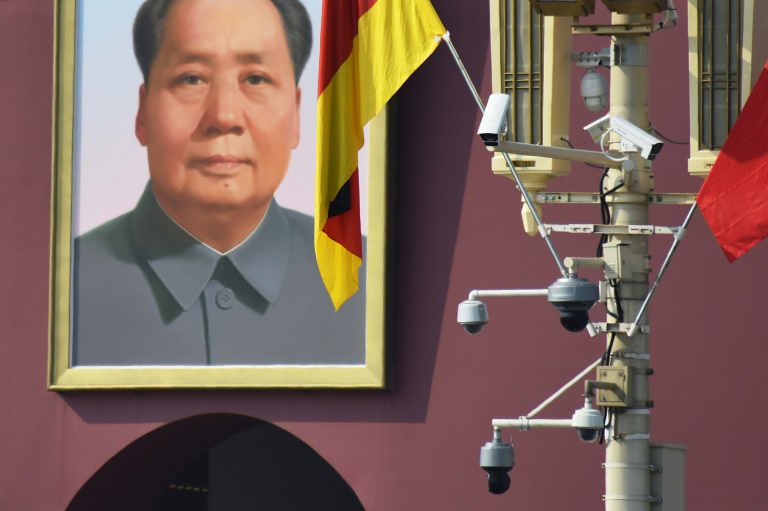
Research firm Comparitech estimates the average Chinese city has more than 370 security cameras per 1,000 people — making them the most surveilled places in the world — compared with London’s 13 or Singapore’s 18 per 1,000.

The nationwide “Skynet” urban surveillance project has ballooned, with cameras capable of recognising faces, clothing and age.

“We are being watched the whole time,” an environmental activist who declined to be named told AFP.

The Communist Party’s grip is most stark in the far-western region of Xinjiang, where facial recognition and DNA collection have been deployed on mainly Muslim minorities in the name of counter-terrorism.

The Covid-19 pandemic has turbo-charged China’s monitoring framework, with citizens now tracked on their smartphones via an app that determines where they can go based on green, yellow or red codes.

Regulations rolled out since 2012 closed loopholes that allowed people to purchase SIM cards without giving their names, and mandated government identification for tickets on virtually all forms of transport.

– Online offences –

There is no respite online, where even shopping apps require registration with a phone number tied to an identification document.

Wang, a Chinese dissident speaking to AFP under a pseudonym due to safety concerns, recalled a time before Xi when censors were not all-knowing and “telling jokes about (former Chinese president) Jiang Zemin on the internet was actually very popular”.

But the Chinese internet — behind the “Great Firewall” since the early 2000s — has become an increasingly policed space.

Wang runs a Twitter account tracking thousands of cases of people detained, fined or punished for speech acts since 2013.

Thanks to the real-name verification system as well as cooperation between police and social media platforms, people have been punished for a vast array of online offences.

Platforms such as Weibo employ thousands of content moderators and automatically block politically sensitive keywords, such as tennis star Peng Shuai’s name after she accused a senior politician of sexual assault last year.

Cyberspace authorities are proposing new rules that would force platforms to monitor comments sections on posts — one of the last avenues for people to voice their grievances online.

– Ideological policing –

Many of the surveillance technologies in use have been embraced in other countries.

“The real difference in China is the lack of independent media and civil society able to provide meaningful criticism of innovations or to point out their many flaws,” Jeremy Daum, from the Paul Tsai China Center at Yale Law School, told AFP.

Xi has reshaped Chinese society, with the Communist Party stipulating what citizens “ought to know, to feel, to think, and say, and do”, Vivienne Shue, professor emeritus of contemporary China studies at Oxford University, told AFP.

Youngsters are kept away from foreign influences, with authorities banning international books and forbidding tutoring companies from hiring overseas teachers.

Ideological policing has even extended to fashion, with television stations censoring tattoos and earrings on men.

“What disturbs me more is not the censorship itself, but how it shaped the ideology of people,” said Wang, the Twitter account owner.

“With dissenting information being eliminated, every website becomes a cult, where the government and leaders have to be worshipped.”

Asian markets drift as global rally peters, focus now on US jobs

Asian markets were mixed Thursday as this week’s global rally ran out of juice, with concerns about a huge oil output cut’s impact on inflation tempering hopes that central banks could soon ease back on their rate hike campaigns.

The mood on trading floors has been a little lighter this week, sending equities surging and weighing on the dollar, after weak readings on US factory activity and job openings feeding speculation that the Federal Reserve’s strict tightening drive was having an effect.

But the confidence took a knock Wednesday from a better-than-expected read on private jobs hiring and a report showing the key services sector holding up more than expected.

The figures highlighted the resilience of the US economy in the face of multiple rate hikes and point to the long road ahead for the Fed in fighting decades-high inflation.

Fed officials have lined up for weeks to insist that they will not budge from lifting borrowing costs until prices are tempered — even at the cost of a recession — while some have warned traders not to expect any cuts next year.

“After an increase in expectations of an imminent Fed pivot given the softer than expected US (factory data), the strength in the services (sector) not only eases concerns of an imminent US recession, it also refutes any notion that the Fed will look to take its foot off the tighten pedal any time soon,” said National Australia Bank’s Rodrigo Catril.

The latest US data came as OPEC and other major producers led by Russia had decided to slash output by a massive two million barrels a day — the biggest reduction since the pandemic struck. 

Moscow said a possible price cap by the European Union on Russian crude would have a “detrimental effect” on the global oil sector, saying Moscow would not sell to countries that introduced it.

The news gave already elevated oil prices another leg up, with both contracts piling on more than one percent, and fuelling concerns that energy costs — a major driver of the spike in global inflation since Russia’s Ukraine invasion — will drive higher again.

“All the developments we have seen on the supply side at this point very much sets the stage for what we believe will be higher prices into the end of this year,” Damien Courvalin, at Goldman Sachs, told Bloomberg Television.

“With this cut and the winter seasonal demand, inventories will continue to fall.”

All three main indexes on Wall Street ended in the red, though they managed to claw back most of their earlier losses thanks to a late rally, though Asian markets fared a little better.

Tokyo, Singapore, Seoul, Taipei and Jakarta all rose again, but Hong Kong retreated after blasting almost six percent higher Wednesday. Sydney, Wellington and Manila were also slightly lower.

But commentators remained on guard over the outlook, with eyes now on the release of US non-farm payroll jobs on Friday, warning that an above-forecast reading could spark another major selloff.

On currency markets the dollar, which bounced Wednesday after suffering a sell-off for most of the week, was slightly down again in Asian business. 

Even sterling managed to resume its gains despite news that Fitch had lowered the outlook for British debt from stable to negative after the government of new Prime Minister Liz Truss announced a mini-budget packed with debt-fueled tax cuts.

The pound plunged more than two percent earlier as Truss failed to reassure investors with a speech at her Conservative party conference where she insisted she would stick to her fiscal plan.

– Key figures around 0230 GMT –

Tokyo – Nikkei 225: UP 0.9 percent at 27,370.37 (break)

Hong Kong – Hang Seng Index: DOWN 0.6 percent at 17,983.43

Shanghai – Composite: Closed for a holiday

Pound/dollar: UP at $1.1353 from $1.1326 on Wednesday

Euro/dollar: UP at $0.9910 from $0.9889

Euro/pound: DOWN at 87.27 pence from 87.29 pence

Dollar/yen: UP at 144.65 yen from 144.59 yen

West Texas Intermediate: UP 0.2 percent at $87.92 per barrel

Brent North Sea crude: UP 0.2 percent at $93.55 per barrel

New York – Dow: DOWN 0.1 percent at 30,273.87 (close)

London – FTSE 100: DOWN 0.5 percent at 7,051.60 (close) 

Former Uber security chief convicted in hack cover-up: reports

A jury on Wednesday found Uber’s former security chief guilty of federal crimes for covering up a massive hack that compromised personal information of users and drivers, according to US media reports.

Joseph Sullivan was found guilty of obstructing the work of the Federal Trade Commission and of failing to let authorities know about a crime when he hid a 2016 hack instead of reporting it, according to news outlets.

Sullivan could be sentenced to prison time.

Sullivan sought to pay off the hackers by funneling money through a “bug bounty” program that rewards developers for revealing security vulnerabilities without doing any harm, according to the criminal complaint.

Uber paid the hackers $100,000 in bitcoin cryptocurrency in December 2016, and Sullivan wanted them to sign non-disclosure agreements promising to keep mum about the affair, prosecutors said.

Sullivan was Uber chief security officer from April 2015 to November 2017.

The criminal complaint maintains that Sullivan deceived Uber’s new chief executive Dara Khosrowshahi, appointed in mid-2017 to replace Travis Kalanick, about the breach.

“Silicon Valley is not the Wild West,” US Attorney David Anderson for the Northern District of California said in a statement when the charges were filed.

“We will not tolerate corporate cover-ups. We will not tolerate illegal hush money payments.”

Two members of the Uber information security team who “led the response” that included not alerting users about the data breach were let go from the San Francisco-based company, according to Khosrowshahi.

The Uber chief said he had learned that outsiders broke into a cloud-based server used by the company for data and downloaded a significant amount of information.

Stolen files included names, email addresses and mobile phone numbers for millions of riders, and the names and driver license information of some 600,000 drivers, according to Uber.

Co-founder and ousted chief Kalanick was advised of the breach shortly after it was discovered, but it was not made public until Khosrowshahi learned of the incident, according to an AFP source.

Uber did not respond to a request for comment on the verdict.

Casey Ellis, founder and CTO at Bugcrowd, a San Francisco-based leader in crowd-sourced cybersecurity, said, “It’s a significant precedent that has already sent shockwaves through the CISO (chief information security officer) community.”

“It highlights the personal liability involved in being a CISO in a dynamic policy, legal, and attacker environment.”

Ursa Major: Voting starts in Fat Bear Week

Americans are weighing their options this week and deciding where to cast their ballot in the only contest that really matters: Fat Bear Week.

The annual poll will see thousands of people glued to webcams watching bears in Alaska stuff themselves with salmon as they ready for hibernation.

The creatures in Katmai State Park “could easily be eating 100 pounds (45 kilograms) or more of fish in a day,” former park ranger Mike Fitz, who thought up the vote, told AFP.

“It’s common for them to eat 20 or more salmon in a day.”

In a series of head-to-head elimination contests, voters are looking for the creature that appears to have piled on the most pounds to help it get through the lean months of winter.

A solid reserve of chubbiness is vital to survival.

During five months of deep sleep, the bears do not wake to eat, drink or even go to the toilet, emerging famished — and a lot thinner — in the spring.

Defending champion Otis, who has four titles to his name, tips the scales at around 1,000 pounds.

This year, he faces a hefty challenge for the overall crown from a bear dubbed 747 — named after Boeing’s enormous plane, and himself a former champ.

But, says Fitz, another pretender to the crown of Ursa-most-Major could emerge from the park’s population of 2,000 bears.

The contest, which takes place online — and of which the bears are probably unaware — began in 2014 with just a few thousand people voting.

By last year, it had become a titan in its own right, with more than 800,000 ballots cast.

“It’s an event to raise awareness for brown bears in Alaska and in Katmai National Park,” said Fitz, who now works as a naturalist for environmental NGO Explore.

“And hopefully through that awareness, people come to care for the animals.” 

That awareness is crucial to Fitz’s larger aim of helping to prevent environmental damage.

“On much of the west coast of North America, salmon runs are just hanging on by a thread,” he said.

“We’re doing very poorly in parts of California, in Oregon and Washington due to habitat loss and barriers to their migration like dams. 

“And climate change is exacerbating those things with drought and heat waves.” 

Ballots for Fat Bear Week can be cast at www.explore.org, and voting begins on Thursday.

Hazy timeframe for reaching electric plane era

Recent test flights suggest the era of electric airplanes is coming closer, but aviation experts caution that achieving commercial use hinges on regulatory approval which has an unknowable timeframe.

Eviation Aircraft successfully completed a test flight in Washington state last week, showcasing a plane the company plans to begin delivering to airlines in 2027.

That came on the heels of an Icelandair flight in August which carried Iceland’s president and prime minister among its passengers.

Besides the benefit in eliminating carbon dioxide emissions, electric airplane travel potentially means less noise than conventional plane transport, as well as eliminating the need for jet fuel, a major expense for commercial airlines.

Gregory Davis, chief executive of Eviation, called last week’s test flight the start of “the next era of aviation,” and said it offered a glimpse of what “affordable, clean and sustainable aviation looks and sounds like.”

But industry experts speak of a hazy timeframe before that future becomes reality, in part because of murkiness over how quickly US air safety authorities will move to greenlight new technology from a seven-year old company with no operating history.

Eviation is “stepping into some unknown areas as far as how you certify and support electric aircraft,” said Glenn McDonald, a principal at AeroDynamic Advisory, a consultancy.

While the 2027 timeframe for the Eviation plane “could be realistic,” McDonald noted that the Federal Aviation Administration has taken a more painstaking approach to certifications since the Boeing 737 MAX crashes in 2018 and 2019.

The two-seat Velis Electro, certified by the European Union Aviation Safety Agency in 2020, is the only electric plane currently cleared for service.

Michel Merluzeau, director of aerospace and defense analysis at AIR consultancy, said the end of the decade was probably a more realistic timeframe than 2027 for the US market.

“It’s fundamentally early days,” said Merluzeau, adding that the FAA will only approve the vehicle after exhaustive testing.

– Much testing ahead –

The September 27 test flight of Eviation’s “Alice” aircraft was an eight-minute voyage that reached an altitude of 3,500 feet (1,065 meters) on a sunny morning.

The company plans to produce a cargo plane, a six-seat “executive” version and a “commuter” model carrying up to nine passengers on flights of up to 250 nautical miles.

Davis characterized the test plane as “prototype aircraft built by hand.” The commercial version is expected to be the same size and weight, but with more advanced battery technology.

“We fully expect to have our choice” of battery, Davis told AFP in an interview.

Among those closely watching the process is Global Crossing Airlines Group, a Miami flight company that has signed a letter of intent for 50 aircraft it plans to fly in Florida, the Bahamas and the Caribbean.

Alice’s appeal stems from the savings in jet fuel costs, said Ryan Goepel, chief financial officer at Global Crossing, which has said it expects to begin receiving planes in 2027.

“We see this as a product that has a lot of demand and really low operating costs,” Goepel said, adding that the test flight represented a “huge milestone.”

Davis said the next step will be to analyze flight data, and the company expects to begin FAA testing in 2025, with commercial production also beginning that year.

The agency declined to comment directly on Eviation, but a spokesman said, “speaking generally, the FAA can certify these new aircraft through its existing regulatory framework.” 

“Some certifications could require the FAA to issue special conditions or additional airworthiness criteria, depending on the type of project,” the official said in an email.

Setting specific conditions is a typical response from the FAA when addressing new technologies but that process can “take a while,” said Waruna Seneviratne of the National Institute for Aviation Research at Wichita State University.

Testing will be extensive before the FAA allows the jet on the market for the flying public, Seneviratne predicted.

“The goal is to find that one incident, one bad part that’s going to take an airplane down,” he said.

Merluzeau said the fact Alice is a new plane rather than an established model reconfigured with an electric engine amounts to “an incredibly complex assignment” for the FAA.

A lengthy, costly certification process would be a challenge for the young firm.

“How do you survive long enough as a company when you know the certification is going to take a long time?” Merluzeau said. “How will they be able to do that when they are burning through cash?”

Eviation is currently backed by the Clermont Group, a Singapore private investment group chaired by Richard Chandler, whose wealth is estimated by Forbes at $2.6 billion.

An Eviation spokeswoman said the company “will be pursuing additional funding on the path to certification and production.”

Four decades after shooting Reagan, John Hinckley seeks redemption through music

More than four decades after John Hinckley shot Ronald Reagan, the man who was acquitted of the crime on an insanity defense and subsequently hospitalized for 34 years is fully free.

But the one thing he wants most after decades of treatments and years of conditional release still eludes him: a guitarist and songwriter, Hinckley longs to play a live concert.

On June 15, the day he was released from court oversight, Hinckley also learned the Brooklyn venue where he was scheduled to perform had scrapped his set over safety concerns, saying they’d faced “very real and worsening threats.”

“It was just a huge disappointment,” says Hinckley, who’s now 67 and wields an acoustic guitar with his name emblazoned across its soundboard. 

He faced the same disappointment just before other scheduled shows in Chicago, Virginia and Connecticut.

Speaking to AFP at a park in Williamsburg, Virginia where he lives in an apartment with his cat Theo, Hinckley insists he’s a changed man, eager to share his music with a world that’s long branded him “violent and unstable.”

“They know me from all the negativity that came out about me for 41 years, but I’m a different person now,” he says with a southern twang. 

– Music therapy –

On March 30, 1981, Hinckley shot Reagan and three others in Washington. All survived, but the former president’s press secretary, James Brady, was left permanently disabled.

Hinckley said he committed the crime to impress Jodie Foster; he’d grown obsessed with the actor after watching her in Martin Scorsese’s “Taxi Driver.”

He was declared not guilty on grounds of insanity and admitted to St. Elizabeth’s Hospital in Washington for more than three decades.

But Hinckley’s public image remained firmly in 1981. Stephen Sondheim wrote him as a character in the musical “Assassins,” while the new wave band Devo released one of his poems as a song.

He was discharged from the hospital in September 2016 but mandated to live with his elderly mother, who has since passed, in Williamsburg. His movements, electronic devices and online activity were limited and monitored.

Those conditions were lifted this summer, and Hinckley passes his days in the sleepy town painting, songwriting and uploading performances online.

He’s amassed more than 50,000 Twitter followers, and notches nearly 5,000 monthly listeners on Spotify.

But the self-taught musician yearns for the connection of a live audience.

“I want them to feel better coming out of the show than going into the show,” Hinckley says. “I have people that write to me and say, ‘I listened to your music and it helps me to get through my day.'”

“That’s a great feeling.”

– ‘I’m sorry’ –

For years, the Reagan Foundation ardently protested Hinckley’s freedom, conditional or otherwise, accusing him of seeking “to make a profit from his infamy.” 

If his criminal act had not involved someone as high-profile as Reagan, it’s likely Hinckley would’ve been released from the hospital, at least conditionally, earlier than the court approved it.

Even if you are technically acquitted for reasons of insanity, “there is a punitive element to the way the system works,” said Paul Appelbaum, a professor of psychiatry at Columbia University.

“If you commit a heinous act — for example, if you try to kill a president of the United States — you can expect to spend a long time confined, whether or not your mental state continues to require it.”

Hinckley holds he has tried apologizing to the Reagan Foundation numerous times.

“I’m sorry for what I did,” he says. “I’m not the person I was back then.”

“I was totally alienated and depressed and unstable” leading up to the attack, Hinckley says.

“I can’t relate to the way I was, because now I kind of have that feeling of, ‘What was I thinking?'”

At this point, the barrier to his stage ambitions appears to be a question of morality.

“We’re in a society where people have gained fame and notoriety for all kinds of reasons, including not very savory reasons, and in many cases are subsequently able to capitalize on that,” said Appelbaum.

“It’s not easy to see why somebody like John Hinckley should be treated differently than everybody else.”

– ‘Too many guns’ –

Hinckley offers a folksy brand of acoustic rock with unambiguous lyrics.

“Freedom stands next to me / Everybody knows my history,” he croons on “I Sing My Songs.” 

“True remorse is real / It has been the way I feel.”

As his quest for a venue continues, Hinckley’s got an album set for release on vinyl by year’s end with Asbestos Records, an indie ska and punk label.

He says he’s written thousands of songs, with musical influences including Bob Dylan, Neil Young and The Beatles.

Recalling the assassination of John Lennon, which occurred just months before Hinckley’s own crime, he says, “I’m sure it didn’t help in my psyche to have that happen.”

Hinckley applauded increased attention in recent years to mental health research and treatments, but says he thinks “a lot more can be done.”

“I think the country is in a really, really volatile spot right now,” he says. “I just wish people would calm down.” 

And the man who changed his own life forever by wielding a firearm emphasizes a need for gun control.

“There’s too many guns in America,” Hinckley reflects, giving his guitar a languid strum.

“That’s why all this crime and all this violence keeps happening.”

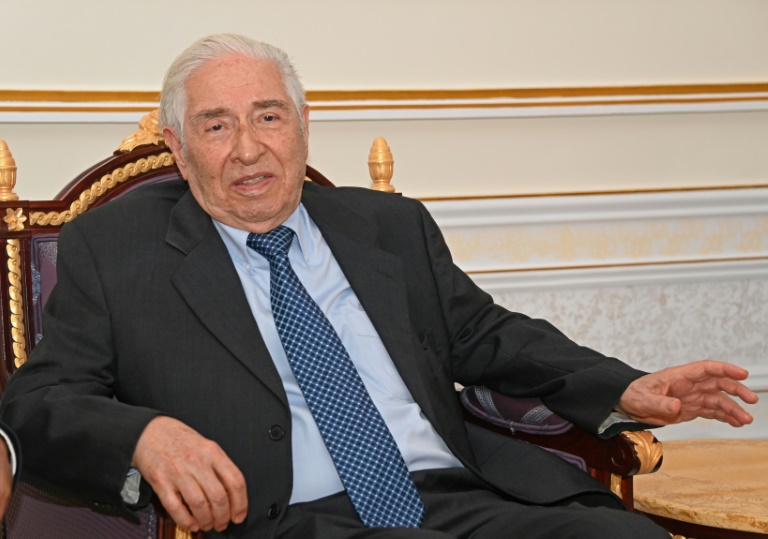
US citizen, 85, flies out of Iran for medical care

An 85-year-old Iranian-American arrested in Tehran more than six years ago who is seeking urgent medical treatment has landed in Abu Dhabi, the State Department said Wednesday, with the United States pressing for the release of three other citizens.

Baquer Namazi, a former UNICEF official, was detained in February 2016 when he travelled to Iran to press for the release of his son Siamak, who had been arrested in October of the previous year.

Namazi “is now in Abu Dhabi after departing Iran for Muscat; he has been reunited with his family and will soon receive urgently needed medical treatment,” US Secretary of State Antony Blinken said in a statement.

Another son, Babak Namazi, said in a statement ahead of the reunion that it was “impossible to articulate and describe sufficiently how I am feeling. I am just so grateful that after so long, I will shortly be able to embrace my father again.”

He thanked Oman and UN Secretary-General Antonio Guterres for their efforts as well as UNICEF and the governments of Qatar, Switzerland, Britain and the United States.

But he called the release “bittersweet,” noting that his brother and two other Americans remained detained.

“Our nightmare will not be over until our entire family and the other Americans are reunited with their families,” he said.

Baquer Namazi landed briefly in Oman — a neutral country that has often played a mediating role for Westerners jailed in Iran — before heading to Abu Dhabi for treatment at a branch of the Cleveland Clinic.

Namazi needs treatment for a life-threatening blockage in his left carotid artery, which supplies blood to the brain. He underwent a similar operation for the right artery a year ago in Iran after he was not permitted to leave the country.

His son Siamak has been granted furlough to spend time with family but has not been allowed to leave Iran.

Blinken expressed his “gratitude for all of the friends and partners who helped bring about his freedom”.

But he added that the United States’ work “is far from finished”, and that the country remained “committed to securing the freedom of all remaining wrongfully detained US citizens in Iran and around the world.”

The United Nations announced the Namazis’ release last week after an appeal from Guterres, following years of unsuccessful efforts by the United States.

– Gesture on nuclear accord? –

The United States has been pressing for the release of the Namazis and two other Americans amid efforts to revive a 2015 nuclear deal between Iran and major powers.

The signing of the original deal in 2015 was accompanied by the release of detained Americans and Namazi’s departure has been seen in Iran as a move that should be mirrored by the other side.

“With the finalisation of negotiations between Iran and the United States to release the prisoners of both countries, $7 billion of Iran’s blocked resources will be released,” state news agency IRNA reported.

The State Department has described the assertion as “categorically false” and said there were no plans to release money in return for the Namazis.

The release comes as Iran’s clerical state comes under new sanctions as it cracks down on major protests triggered by the death in custody of Mahsa Amini, a young woman accused of violating rules on covering her hair.

Billions of dollars in Iranian funds have been frozen in a number of countries — notably China, South Korea and Japan — since the United States reimposed sanctions in 2018.

A drive to salvage the nuclear deal began in April last year, with the aim of returning the United States under President Joe Biden to the accord through the lifting of sanctions ordered by Donald Trump and Iran’s return to full compliance.

The Namazis were both convicted of espionage in October 2016 and sentenced to 10 years in prison. Both have denied the charges, with the younger Namazi saying he came under suspicion for associations with US think tanks. 

Baquer Namazi was released on medical leave in 2018 and had been serving his sentence under house arrest.

At least two other American citizens are held in Iran.

Businessman Emad Sharqi was sentenced last year to 10 years in prison for espionage, and environmentalist Morad Tahbaz, who is also a British national, was arrested in 2018 and released on bail in July.

US duo and Dane win Nobel for 'click chemistry'

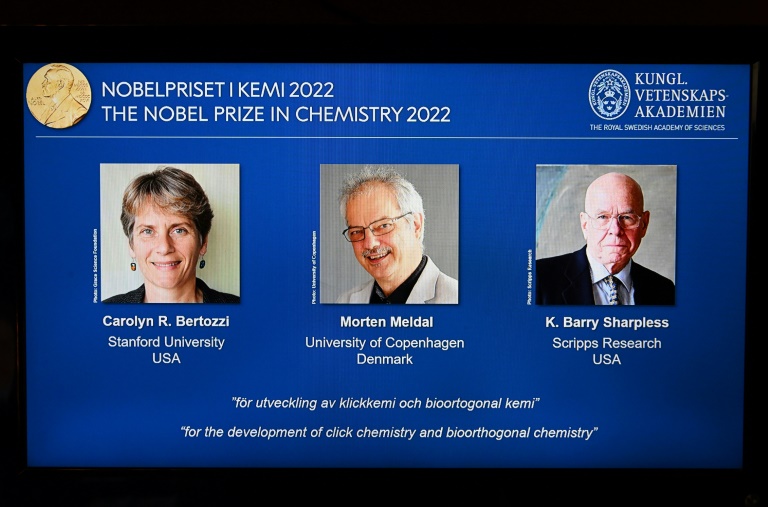
A trio of scientists from the United States and Denmark won the Nobel Chemistry Prize on Wednesday for laying the foundation for a more functional form of chemistry where molecules are linked together.

Americans Carolyn Bertozzi and Barry Sharpless, together with Denmark’s Morten Meldal, were honoured “for the development of click chemistry and bioorthogonal chemistry”, the jury said.

Bertozzi is the only woman among the seven Nobel laureates honoured so far this year, with women vastly under-represented in the history of the prizes, especially in the science disciplines.

The chemist is only the eighth woman to win a Nobel Chemistry Prize, out of 189 recipients.

As an undergraduate at Harvard she played keyboards in a band called Bored of Education, with future Rage Against the Machine guitarist Tom Morello. But, speaking to AFP, Bertozzi conceded she didn’t have the musical talent of her former bandmate.

“So I think I chose the right path. Especially today,” she said.

Benjamin Schumann, a chemist at London’s Imperial College and former student in Bertozzi’s lab, said she was still known as “the rock star of sciences”.

The award marks the second Nobel for 81-year-old Sharpless, who won in chemistry in 2001. 

Only four other individuals have achieved the feat of winning two Nobel Prizes, including Polish-born Frenchwoman Marie Curie, who won the chemistry prize in 1911 after first winning the physics prize in 1903.

“Prizes aren’t what I’m doing science for. For better or for worse, I have to do it. It’s kind of a compulsion,” Sharpless told a news conference.

– Like Lego –

Click chemistry “is an elegant and efficient chemical reaction that is now in widespread use,” the jury said in a statement.

“Among many other uses, it is utilised in the development of pharmaceuticals,for mapping DNA and creating materials that are more fit for purpose,” it added.

Sharpless, a professor at Scripps Research in California, “started the ball rolling” and “coined the concept of click chemistry” around 2000, the jury said.

Afterwards, Sharpless and Meldal, a professor at the University of Copenhagen, independently of each other, presented “what is now the crown jewel of click chemistry: the copper catalysed azide-alkyne cycloaddition”.

The process allows chemists to “snap” molecules together “with the help of some copper ions”, which among other things allow for the production of new materials.

It is possible to click in substances that conduct electricity, capture sunlight, are antibacterial, protect from ultraviolet radiation or have other desirable properties, it said.

“The discovery that we did was more or less by serendipity” Meldal told AFP, calling his win a “big surprise”.

Speaking to reporters, the Danish professor said the application of click chemistry could be likened to Lego — the iconic plastic blocks that also hail from Denmark.

“You can make a house or bike or car or whatever functionality you want. By combining differently these building blocks… in chemistry, we do the same thing,” Meldal explained.

– ‘A new level’ –

Bertozzi, 55, a professor at Stanford University in the United States, was highlighted for then taking “click chemistry to a new level”.

“She developed click reactions that work inside living organisms. Her bioorthogonal reactions take place without disrupting the normal chemistry of the cell,” the jury said.

Her research is now being used to investigate how these reactions can be used to diagnose and treat cancer.

“I’m absolutely stunned, I’m sitting here and I can hardly breathe,” Bertozzi told reporters via telephone, minutes after the announcement.

Silvia Diez-Gonzalez, a chemist who works on click chemistry at Imperial College, London, welcomed the win.

“Thank goodness” that the days of women not being allowed in chemistry labs are over, she told AFP, though “there is a lot of bias still out there”.

“I want to believe that it’s just a matter of time that as women and non-white people get more opportunities to achieve their potential, then eventually the recognition they get will be spread more widely.”

The Royal Swedish Academy of Sciences, which awards the Nobels in the science disciplines, has refused to introduce quotas despite the dearth of women laureates.

Goran Hansson, then-secretary general of the academy, told AFP last year after all of the science nods went to men, that it wanted every laureate to be accepted “because they made the most important discovery, and not because of gender or ethnicity”. 

The lack of women laureates “reflects the unfair conditions in society, particularly in years past but still existing”, he acknowledged.

burs-jll/po/jmm/dw/it

US duo and Dane win Nobel for 'click chemistry'

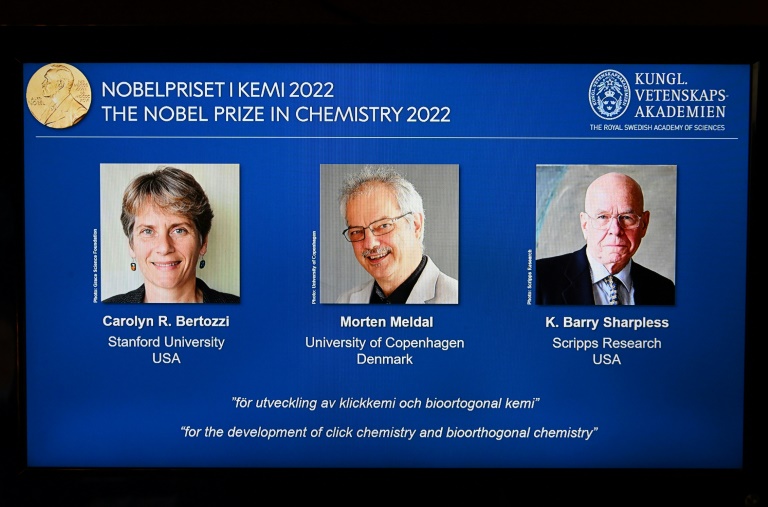
A trio of scientists from the United States and Denmark won the Nobel Chemistry Prize on Wednesday for laying the foundation for a more functional form of chemistry where molecules are linked together.

Americans Carolyn Bertozzi and Barry Sharpless, together with Denmark’s Morten Meldal, were honoured “for the development of click chemistry and bioorthogonal chemistry”, the jury said.

Bertozzi is the only woman among the seven Nobel laureates honoured so far this year, with women vastly under-represented in the history of the prizes, especially in the science disciplines.

The chemist is only the eighth woman to win a Nobel Chemistry Prize, out of 189 recipients.

As an undergraduate at Harvard she played keyboards in a band called Bored of Education, with future Rage Against the Machine guitarist Tom Morello. But, speaking to AFP, Bertozzi conceded she didn’t have the musical talent of her former bandmate.

“So I think I chose the right path. Especially today,” she said.

Benjamin Schumann, a chemist at London’s Imperial College and former student in Bertozzi’s lab, said she was still known as “the rock star of sciences”.

The award marks the second Nobel for 81-year-old Sharpless, who won in chemistry in 2001. 

Only four other individuals have achieved the feat of winning two Nobel Prizes, including Polish-born Frenchwoman Marie Curie, who won the chemistry prize in 1911 after first winning the physics prize in 1903.

“Prizes aren’t what I’m doing science for. For better or for worse, I have to do it. It’s kind of a compulsion,” Sharpless told a news conference.

– Like Lego –

Click chemistry “is an elegant and efficient chemical reaction that is now in widespread use,” the jury said in a statement.

“Among many other uses, it is utilised in the development of pharmaceuticals,for mapping DNA and creating materials that are more fit for purpose,” it added.

Sharpless, a professor at Scripps Research in California, “started the ball rolling” and “coined the concept of click chemistry” around 2000, the jury said.

Afterwards, Sharpless and Meldal, a professor at the University of Copenhagen, independently of each other, presented “what is now the crown jewel of click chemistry: the copper catalysed azide-alkyne cycloaddition”.

The process allows chemists to “snap” molecules together “with the help of some copper ions”, which among other things allow for the production of new materials.

It is possible to click in substances that conduct electricity, capture sunlight, are antibacterial, protect from ultraviolet radiation or have other desirable properties, it said.

“The discovery that we did was more or less by serendipity” Meldal told AFP, calling his win a “big surprise”.

Speaking to reporters, the Danish professor said the application of click chemistry could be likened to Lego — the iconic plastic blocks that also hail from Denmark.

“You can make a house or bike or car or whatever functionality you want. By combining differently these building blocks… in chemistry, we do the same thing,” Meldal explained.

– ‘A new level’ –

Bertozzi, 55, a professor at Stanford University in the United States, was highlighted for then taking “click chemistry to a new level”.

“She developed click reactions that work inside living organisms. Her bioorthogonal reactions take place without disrupting the normal chemistry of the cell,” the jury said.

Her research is now being used to investigate how these reactions can be used to diagnose and treat cancer.

“I’m absolutely stunned, I’m sitting here and I can hardly breathe,” Bertozzi told reporters via telephone, minutes after the announcement.

Silvia Diez-Gonzalez, a chemist who works on click chemistry at Imperial College, London, welcomed the win.

“Thank goodness” that the days of women not being allowed in chemistry labs are over, she told AFP, though “there is a lot of bias still out there”.

“I want to believe that it’s just a matter of time that as women and non-white people get more opportunities to achieve their potential, then eventually the recognition they get will be spread more widely.”

The Royal Swedish Academy of Sciences, which awards the Nobels in the science disciplines, has refused to introduce quotas despite the dearth of women laureates.

Goran Hansson, then-secretary general of the academy, told AFP last year after all of the science nods went to men, that it wanted every laureate to be accepted “because they made the most important discovery, and not because of gender or ethnicity”. 

The lack of women laureates “reflects the unfair conditions in society, particularly in years past but still existing”, he acknowledged.

burs-jll/po/jmm/dw/it

No longer a Mystery Incorporated: Scooby-Doo's Velma is gay

After decades of rumor and innuendo, one of animation’s worst kept secrets has finally been confirmed: Scooby-Doo’s Velma is lesbian.

Clips from Halloween special “Trick or Treat Scooby-Doo,” released this week, show the brainy sleuth’s glasses fogging up and her cheeks reddening when she first meets villainous costume designer Coco Diablo.

“OK, who am I kidding? I’m crushing big time Daphne! What do I do? What do I say?” she asks her friend in another scene.

The gang of amateur detectives in “Scooby Doo” have been solving mysteries since 1969, delighting generations of children as they unmask a villain who invariably declares he “would have gotten away with it, if it weren’t for you pesky kids.”

The titular oversized dog, who will do anything for a “Scooby snack,” stumbles through crimes discovering clues with the help of friends, Shaggy, Daphne, Fred and Velma, who collectively make up “Mystery Incorporated.”

Fans have long agreed that Velma is queer, but the new movie marks the first definitive confirmation.

Producers of the franchise’s various series and movies have previously spoken about Velma Dinkley’s sexuality, even if they were not able to make it explicit on screen.

In 2020 producer Tony Cervone posted an Instagram photo of Velma and another female character against a rainbow-themed Pride backdrop.

“We made our intentions as clear as we could ten years ago,” he wrote in the caption at the time.

“Most of our fans got it. To those that didn’t, I suggest you look closer.”

Audie Harrison, director of the new movie, told NPR he did not expect Velma’s same-sex attraction to be “so groundbreaking,” and that he had “just set out to have fun with the comedy of an awkward teenage crush.”

He added: “That being said, it does feel great to be a part of normalizing representation, especially with such a well-known franchise like Scooby-Doo!”

Fans took to social media to celebrate the news.

“OMG LESBIAN VELMA FINALLY CANON CANON IN THE MOVIES LETS GOOOOOO,” said one tweet which received well over 200,000 likes.

“LET’S GO LESBIANS #Velma” wrote another.

Close Bitnami banner
Bitnami