US Business

Loretta Lynn, country music luminary and songwriting pioneer, dies at 90

Loretta Lynn, America’s groundbreaking country titan whose frank lyricism delving into women’s experiences with sex, infidelity and pregnancy touched the nerve of a nation, has died. She was 90 years old.

She “passed peacefully in her sleep” at her ranch in Tennessee Tuesday morning, her family said in a statement sent to AFP.

Lynn saw a number of her edgy tracks banned by country music stations, but over the course of more than six decades in the business, she became a standard-bearer of the genre and its most decorated female artist ever.

Born Loretta Webb on April 14, 1932 in small-town Kentucky, Lynn was the eldest daughter in an impoverished family of eight kids, a childhood she immortalized in her iconic track “Coal Miner’s Daughter” — a staple on lists of all-time best songs.

“We were poor but we had love / That’s the one thing that daddy made sure of,” Lynn sang in the hit recorded in 1970 — later the theme song for a 1980 movie about her life starring Sissy Spacek, who won an Oscar for the role. 

At just 15 the artist married Oliver Vanetta Lynn, who she remained married to for nearly 50 years until his death in 1996.

They moved to a logging community in Washington state, and Lynn gave birth to four children before the age of 20, adding twins to the family not long after.

An admirer of his wife’s voice, her husband bought Lynn a guitar in the early 1950s.

The self-taught musician went on to pen lyrics inspired by her own early experiences as a married woman and her oft-tumultuous relationship, the nascent days of a prolific career that would see the artist release dozens of albums.

She started her own band, Loretta and the Trailblazers, and began playing bar sets before cutting her first record — “I’m a Honky Tonk Girl” in 1960.

Her twang was warm and languid but Lynn’s lyrics were anything but: she sang with searing precision of marriage’s growing pains and gave voice to issues facing women that had long been kept quiet.

“Most songwriters tended to write about falling in love, breaking up and being alone, things like that,” Lynn told The Wall Street Journal in 2016. “The female view I wrote about was new.”

“I just wrote about what I knew, and what I knew usually involved something that somebody did to me.”

– ‘The Pill’ –

The Lynns began touring nationwide to promote the singer’s work to radio stations, and she made her debut at the storied Grand Ole Opry in 1960, going on to become one of the Nashville institution’s most acclaimed acts.

“Our Opry family turns to music when words fail. Thank you for all you’ve given to the Opry, @LorettaLynn,” the show tweeted.

During her early years in the industry, she found a friend and mentor in Patsy Cline, one of the 20th century’s most influential singers who died in a plane crash in 1963 at age 30.

She also forged a longstanding creative partnership with Conway Twitty, with whom she formed one of country’s classic duet acts.

Lynn released a steady stream of hit singles, including 1966’s “Dear Uncle Sam” — one of the era’s first tracks to document the tragedy of the Vietnam War.

That same year she put out “You Ain’t Woman Enough (To Take My Man),” which made her the first woman in country to pen a number one hit.

In 1969, she released one of her most controversial songs, “Wings Upon Your Horns,” which describes through religious metaphor a teenager losing her virginity.

But her runaway success continued and she dominated the 1970s with hits such as “Fist City” — a stern warning to her cheating husband’s lover — and 1972’s “Rated X,” which triggered an outcry in discussing the stigmas faced by divorced women.

In 1975, she released “The Pill,” which praised the freedoms of birth control. 

“When I’d put out a record, they’d say, ‘Uh oh, another dirty song.’ ‘Rated X’? They thought that was going to be bad. But hey, it sold. ‘One’s on the Way’? They thought that song would really be dirty,” she told Billboard in 2015. 

“But everything I sang about was everyday living.”

– ‘The truth’ –

In 1988, Lynn was inducted into the Country Music Hall of Fame as one of its most storied legends.

She won virtually every arts honor available, including the prestigious Presidential Medal of Freedom.

Despite the progressive airs of her music, Lynn would insist her clearly political art had “no politics.” 

She leaned Republican most of her life, frequently performing for and supporting right-wing candidates — including Donald Trump in 2016 — even as she also voiced support for Democrats like Jimmy Carter.

But she was universally beloved in the industry she deeply influenced, collaborating with scores of artists including Dolly Parton, Willie Nelson and Elvis Costello. In 2004 she released the album “Van Lear Rose,” produced by Jack White.

In 2021, a month before turning 89, she released the album “Still Woman Enough,” which featured re-recordings and new material.

Music world accolades quickly flooded social media, praising Lynn’s pivotal life.

“We’ve been like sisters all the years we’ve been in Nashville and she was a wonderful human being, wonderful talent, had millions of fans and I’m one of them,” wrote the superstar Dolly Parton.

White, in a tribute on Instagram, hailed Lynn as “the greatest female singer-songwriter of the 20th century.”

Crystal Gayle, Lynn’s actual sister and a singer in her own right, wrote that “the world lost a legend. We lost a sister. Love you Loretta.”

Lynn once told Billboard she’d never retire from music, vowing that “when they lay me down six feet under, they can say, ‘Loretta’s quit singing.’ I’ll have on one of my gowns,” she continued.

“That’s morbid, but it’s the truth.”
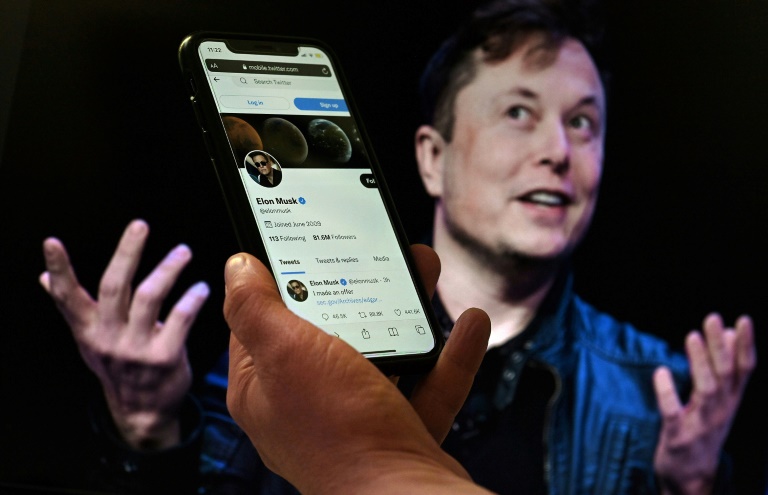
Musk offers to close Twitter buyout deal at original price

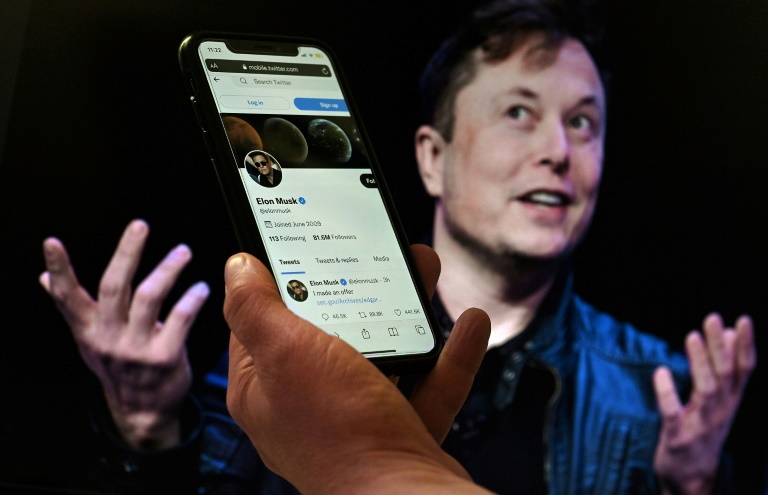
Elon Musk on Tuesday offered to push through with his buyout of Twitter at the original agreed price, as a trial over his efforts to withdraw from the deal loomed.

The world’s richest man said in a filing with the Securities and Exchange Commission that he sent Twitter a letter vowing to honor the contract.

The latest twist in the long-running saga came ahead of the high-stakes court battle launched by Twitter in an attempt to hold the Tesla chief to the deal he signed in April.

Musk’s potential stewardship of the influential social media site has sparked worry from activists who fear he could open the gates to more abusive and misinformative posts.

“We write to notify you that the Musk Parties intend to proceed to closing of the transaction,” read a copy of the letter to Twitter filed with the SEC.

Twitter confirmed to AFP that it received the letter from Musk, and said it intends to close the buyout deal at the agreed-on price of $54.20 per share.

Conditions noted in Musk’s letter included that the court halt action in the lawsuit against him. He had been slated to be questioned under oath by Twitter attorneys later this week.

The 51-year-old tweeted that buying Twitter “is an accelerant to creating X, the everything app,” offering no details.

During an annual shareholders meeting in August, Musk said Twitter could add momentum to a vision he had for the X.com company he founded in 1999.

X.com merged with Confinity, whose co-founders include Peter Thiel, and the entity went on to become PayPal.

“I do sort of have a grander vision for what I thought X.com, or X corporation, could have been back in the day,” Musk said at the shareholder meeting.

“I think Twitter would help accelerate that by three to five years.”

– Buyer’s remorse? –

A serial entrepreneur made rich through his success with Tesla electric cars, Musk began to step back from the Twitter deal soon after it was agreed.

But “I think that Musk realized he was not going to win that trial” next week, University of Richmond law professor Carl Tobias told AFP.

“Ever since he had buyer’s remorse, the problem has been why, and why had he not done due diligence up front.”

Musk said in July he was canceling the purchase because he was misled by Twitter concerning the number of fake “bot” accounts, allegations rejected by the company.

Twitter meanwhile has sought to prove Musk was contriving excuses to walk away because he changed his mind.

In July, a Delaware judge agreed to fast-track a trial on Twitter’s allegations.

Wedbush analyst Dan Ives said in an email that Musk’s pivot showed he recognized “this $44 billion deal was going to be completed one way or another.”

Musk made his unsolicited bid to buy Twitter without asking for estimates regarding spam or fake accounts, and even sweetened his offer to the board by withdrawing a diligence condition, the lawsuit said.

“Ultimately, we will not know why Elon elected to change course ahead of trial, though we speculate that there are details of the negotiation or legal process that he preferred remain private — including deposition,” Baird Equity Research analysts said in a note to investors.

– Free speech –

Seen by his champions as an iconoclastic genius and by his critics as an erratic megalomaniac, Musk surprised many investors with his pursuit of Twitter.

Claiming to be a free speech advocate, he has said he favored lifting the site’s ban on Donald Trump, who was kicked off shortly after the former president’s efforts to overturn his election defeat led to the January 6, 2021 assault on the US Capitol by his supporters.

“Musk made it clear that he would roll back Twitter’s community standards and safety guidelines, reinstate Donald Trump along with scores of other accounts suspended for violence and abuse, and open the floodgates of disinformation,” said Angelo Carusone, president of watchdog group Media Matters for America.

“In effect, Musk will turn Twitter into a fever swamp of dangerous conspiracy theories, partisan chicanery, and operationalized harassment.”

Musk’s norm-defying conduct over Twitter come after the Tesla and SpaceX chief’s past record of statements that flout or test convention and sometimes provoke a crackdown from regulators.

On Monday he was embroiled in a Twitter spat with Ukrainian President Volodymyr Zelensky over his ideas on ending Russia’s invasion.

Musk offers to close Twitter buyout deal at original price

Elon Musk on Tuesday offered to push through with his buyout of Twitter at the original agreed price, as a trial over his efforts to withdraw from the deal loomed.

The world’s richest man said in a filing with the Securities and Exchange Commission that he sent Twitter a letter vowing to honor the contract.

The latest twist in the long-running saga came ahead of the high-stakes court battle launched by Twitter in an attempt to hold the Tesla chief to the deal he signed in April.

Musk’s potential stewardship of the influential social media site has sparked worry from activists who fear he could open the gates to more abusive and misinformative posts.

“We write to notify you that the Musk Parties intend to proceed to closing of the transaction,” read a copy of the letter to Twitter filed with the SEC.

Twitter confirmed to AFP that it received the letter from Musk, and said it intends to close the buyout deal at the agreed-on price of $54.20 per share.

Conditions noted in Musk’s letter included that the court halt action in the lawsuit against him. He had been slated to be questioned under oath by Twitter attorneys later this week.

The 51-year-old tweeted that buying Twitter “is an accelerant to creating X, the everything app,” offering no details.

During an annual shareholders meeting in August, Musk said Twitter could add momentum to a vision he had for the X.com company he founded in 1999.

X.com merged with Confinity, whose co-founders include Peter Thiel, and the entity went on to become PayPal.

“I do sort of have a grander vision for what I thought X.com, or X corporation, could have been back in the day,” Musk said at the shareholder meeting.

“I think Twitter would help accelerate that by three to five years.”

– Buyer’s remorse? –

A serial entrepreneur made rich through his success with Tesla electric cars, Musk began to step back from the Twitter deal soon after it was agreed.

But “I think that Musk realized he was not going to win that trial” next week, University of Richmond law professor Carl Tobias told AFP.

“Ever since he had buyer’s remorse, the problem has been why, and why had he not done due diligence up front.”

Musk said in July he was canceling the purchase because he was misled by Twitter concerning the number of fake “bot” accounts, allegations rejected by the company.

Twitter meanwhile has sought to prove Musk was contriving excuses to walk away because he changed his mind.

In July, a Delaware judge agreed to fast-track a trial on Twitter’s allegations.

Wedbush analyst Dan Ives said in an email that Musk’s pivot showed he recognized “this $44 billion deal was going to be completed one way or another.”

Musk made his unsolicited bid to buy Twitter without asking for estimates regarding spam or fake accounts, and even sweetened his offer to the board by withdrawing a diligence condition, the lawsuit said.

“Ultimately, we will not know why Elon elected to change course ahead of trial, though we speculate that there are details of the negotiation or legal process that he preferred remain private — including deposition,” Baird Equity Research analysts said in a note to investors.

– Free speech –

Seen by his champions as an iconoclastic genius and by his critics as an erratic megalomaniac, Musk surprised many investors with his pursuit of Twitter.

Claiming to be a free speech advocate, he has said he favored lifting the site’s ban on Donald Trump, who was kicked off shortly after the former president’s efforts to overturn his election defeat led to the January 6, 2021 assault on the US Capitol by his supporters.

“Musk made it clear that he would roll back Twitter’s community standards and safety guidelines, reinstate Donald Trump along with scores of other accounts suspended for violence and abuse, and open the floodgates of disinformation,” said Angelo Carusone, president of watchdog group Media Matters for America.

“In effect, Musk will turn Twitter into a fever swamp of dangerous conspiracy theories, partisan chicanery, and operationalized harassment.”

Musk’s norm-defying conduct over Twitter come after the Tesla and SpaceX chief’s past record of statements that flout or test convention and sometimes provoke a crackdown from regulators.

On Monday he was embroiled in a Twitter spat with Ukrainian President Volodymyr Zelensky over his ideas on ending Russia’s invasion.

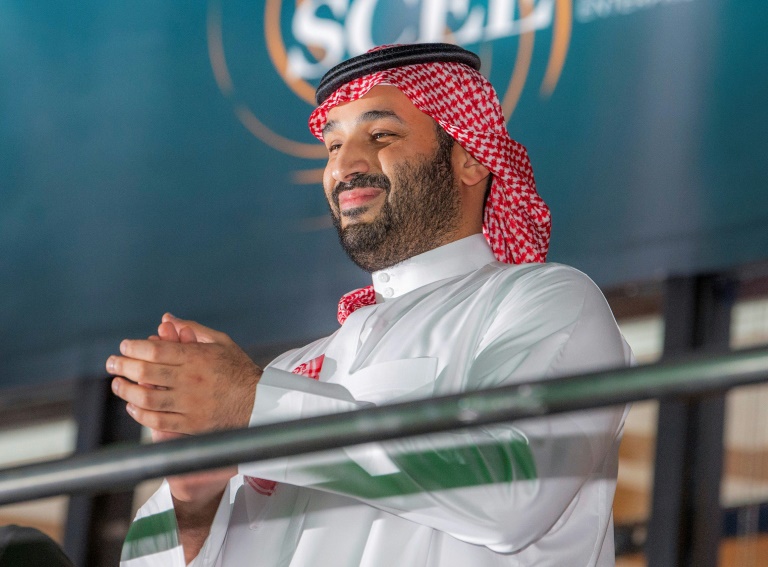
Saudi prince's lawyers says PM title ensures legal immunity

Lawyers for Saudi Crown Prince Mohammed bin Salman have argued that his appointment as prime minister qualifies him for immunity from lawsuits in US courts, including one related to the 2018 killing of journalist Jamal Khashoggi.

Prince Mohammed, who previously served as deputy prime minister and defence minister, was named prime minister by royal decree last week, sparking concern from human rights activists and government critics that he was looking to skirt exposure in cases filed in foreign courts.

His lawyers had previously argued that he “sits at the apex of Saudi Arabia’s government” and thus qualifies for the kind of immunity US courts afford foreign heads of state and other high-ranking officials.

Last week’s royal decree “leaves no doubt that the Crown Prince is entitled to status-based immunity”, his lawyers said in a filing Monday in a case brought in 2020 by Khashoggi’s fiancee, Hatice Cengiz.

The 2018 killing of Khashoggi, a Saudi insider turned critic, in the kingdom’s Istanbul consulate temporarily turned Prince Mohammed into a pariah in the West.

But he has been welcomed back on the world stage this year, notably by US President Joe Biden, who travelled to Saudi Arabia in July despite an earlier pledge to make the kingdom a “pariah”.

Last year, Biden declassified an intelligence report that found Prince Mohammed had approved the operation against Khashoggi, an assertion Saudi authorities deny.

The Biden administration has yet to weigh in on whether it believes Prince Mohammed qualifies for immunity.

A judge had given US lawyers a deadline of October 3 to file a “statement of interest” on the question.

But on Friday, citing Prince Mohammed’s new position, the administration requested an additional 45 days to make up its mind.

That request was granted and the new deadline is November 17.

The legal threats to Prince Mohammed in US courts go beyond Khashoggi.

He was also named in a lawsuit filed by Saad al-Jabri, a former top intelligence official who fell out of favour as Prince Mohammed manoeuvred to become first in line to the throne in 2017. 

That complaint accuses Prince Mohammed of trying to lure Jabri back to Saudi Arabia from exile in Canada — then, when that didn’t work, “deploying a hit squad” to kill him on Canadian soil, a plot foiled when most of the would-be assailants were turned back at the border.

However on Friday a judge granted a motion to dismiss the case, saying his court did not have jurisdiction over nearly all of the defendants listed by Jabri — a group that includes Prince Mohammed, other Saudi officials and “several US-based individuals”.

Prince Mohammed’s father, 86-year-old King Salman, has been hospitalised twice this year, but he chaired the weekly cabinet meeting Tuesday, just as he did the day Prince Mohammed’s promotion was announced.

In July, a group of NGOs filed a complaint in France alleging that Prince Mohammed was an accomplice to Khashoggi’s torture and enforced disappearance.

They said the charges could be prosecuted in France, which recognises universal jurisdiction.

Prince Mohammed “does not have immunity from prosecution because as crown prince he is not head of state”, they said.

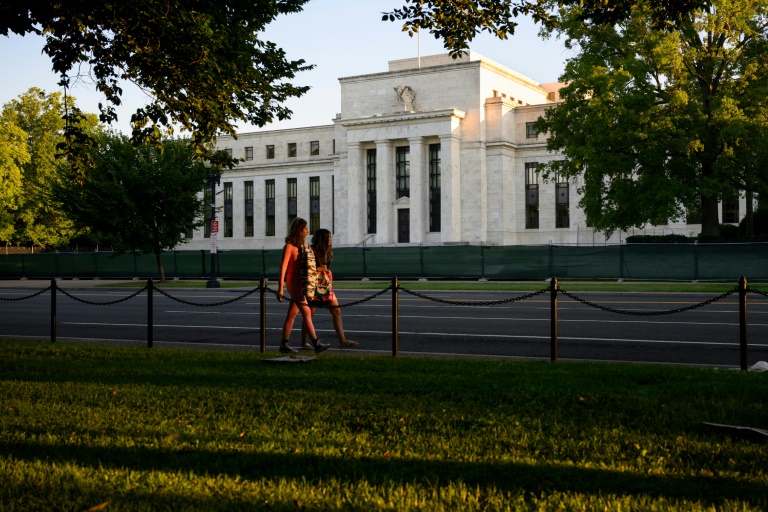
Stocks surge on hopes interest rate hikes will slow

Global stocks gained on Tuesday and the dollar slid amid growing hopes the Federal Reserve could ease its interest-rate hiking plans.

Frankfurt and Paris equities each soared around four percent in value after Tokyo gained 3.0 percent, while London won 2.6 percent.

Wall Street’s surged higher for the second straight day, with the Dow rising 2.8 percent. The S&P 500 jumped 3.1 percent and the Nasdaq Composite 3.3 percent.

The Federal Reserve and other central banks have raised interest rates rapidly to tame soaring inflation, but the monetary tightening has raised fears it could plunge countries into recession.

Those concerns fueled sharp drops in stocks in recent weeks, especially since the Fed has said it will continue to raise interest rates this year and possibly early next year as well to get on top of inflation.

But Wall Street enjoyed a bumper start to the fourth quarter after an industry survey released Monday showed US manufacturing growth slowed more than expected in September to its weakest in more than two years, and pricing pressures eased.

The buoyant trend equities continued on Tuesday after the Reserve Bank of Australia (RBA) raised its policy interest rate just 0.25 percentage point, half the expected increase.

“Weaker-than-expected manufacturing data from the US was taken as a signal that rising interest rates may be having some effect on cooling demand for goods,” said Interactive Investor analyst Richard Hunter.

“This in turn led to hopes of a Federal Reserve pivot, even though the spectre of inflation remains firmly at the top of their stated to-do list.”

The yield on the 10-year US Treasury, a proxy for interest rates expectations, retreated further as investors bet that weakening economic data will prompt a similar pullback from the Fed.

Earlier, Asian markets built on the Wall Street surge. Tokyo and Seoul were among the leaders, despite news that North Korea had fired a missile over Japan for the first time since 2017.

Sydney soared 3.8 percent after the Reserve Bank of Australia lifted interest rates by less than expected.

Hong Kong and Shanghai were closed for holidays.

Investors will focus later this week on Friday’s all-important US employment report for the latest reading on the health of the world’s biggest economy, but new data Tuesday showed a dramatic decline in job openings in August.

That decline lowered the ratio of US openings to unemployed workers — a key indicator of strains in the labor market — to 1.7, from 2.0 in the prior month.

– Sterling extends gains –

Oil also continued to push higher on expectations OPEC and other major producers will slash output this week, having become spooked by a plunge in the price of the commodity on recession fears.

The 13 members of the Organization of the Petroleum Exporting Countries (OPEC), led by Riyadh, and their 10 allies headed by Moscow will hold Wednesday their first in-person meeting at the group’s headquarters in Vienna since March 2020.

The rally in equities came as the US dollar weakened owing to moderating expectations for interest rate hikes, with the pound also supported by the UK government’s decision to scrap a planned cut in the top rate of income tax.

The pound extended gains after breaking back above $1.14, having last Monday tanked to a record low $1.0350. The euro rose around 1.7 percent against the greenback.

– Key figures around 2050 GMT –

New York – Dow: UP 2.8 percent at 30,316.32 (close)

New York – S&P 500: UP 3.1 percent at 3,790.93 (close)

New York – Nasdaq: UP 3.3 percent at 11,176.41 (close)

Paris – CAC 40: UP 4.2 percent at 6,039.69 (close)

Frankfurt – DAX: UP 3.8 percent at 12,670.48 (close)

London – FTSE 100: UP 2.6 percent at 7,086.46 (close)

EURO STOXX 50: UP 4.3 percent at 3,484.48 (close)

Tokyo – Nikkei 225: UP 3.0 percent at 26,992.21 (close)

Hong Kong – Hang Seng Index: Closed for a holiday

Shanghai – Composite: Closed for a holiday

Pound/dollar: UP at $1.1477 from $1.1323 on Monday

Euro/dollar: UP at $0.9992 from $0.9826

Euro/pound: UP at 87.03 pence from 86.77 pence

Dollar/yen: DOWN at 144.09 yen from 144.55 yen

Brent North Sea crude: UP 3.4 percent at $91.80 per barrel

West Texas Intermediate: UP 3.5 percent at $86.52 per barrel

burs-jmb/hs

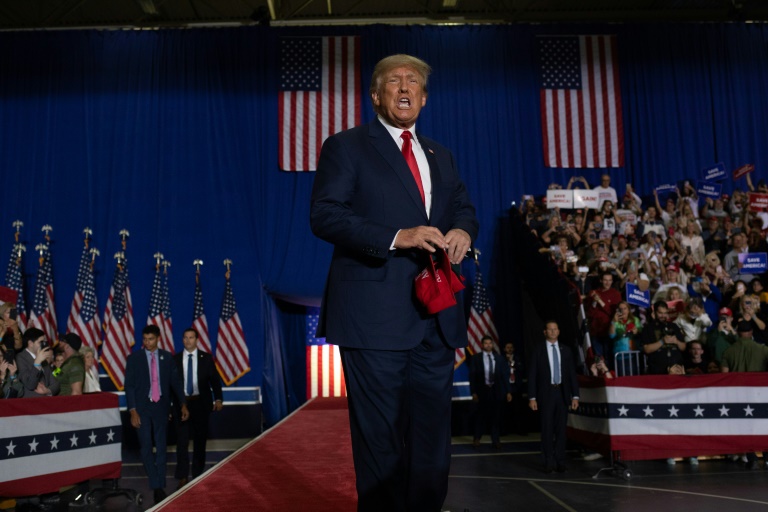
Trump asks Supreme Court to intervene in classified docs case

Former US president Donald Trump asked the Supreme Court on Tuesday to intervene in the legal tussle over classified documents seized in the FBI raid of his Florida home.

Trump urged the conservative-dominated court to stay a ruling by the 11th Circuit Court of Appeals that restored access to the classified documents to the Justice Department.

The FBI, in the affidavit used to justify the August 8 raid on Trump’s home, said it was conducting a criminal investigation into “improper removal and storage of classified information” and “unlawful concealment of government records.”

The search warrant said the probe was also related to “willful retention of national defense information,” an offense that falls under the Espionage Act, and potential “obstruction of a federal investigation.”

A “special master,” a senior New York judge, was appointed by a District Court judge in Florida to screen the seized files for materials potentially subject to attorney-client privilege.

A three-judge appellate panel ruled that while the special master conducts his review, the government should be able to continue using documents marked as classified for its criminal investigation.

Trump, in his emergency request to the Supreme Court, is appealing that unanimous ruling by the appellate panel made up of two judges appointed by Trump and one by Barack Obama.

Trump nominated three of the justices on the nine-member Supreme Court but it has delivered him several defeats in high-profile cases, most notably by refusing to hear his claims alleging fraud in the November 2020 presidential election.

Nobel physics winner wanted to topple quantum theory he vindicated

American physicist John Clauser won the 2022 Nobel Prize for a groundbreaking experiment vindicating quantum mechanics — a fundamental theory governing the subatomic world that is today the foundation for an emerging class of ultra-powerful computers.

But when he carried out his work in the 1970s, Clauser was actually hoping for the opposite result: to upend the field and prove Albert Einstein had been right to dismiss it, he told AFP in an interview.

“The truth is that I strongly hoped that Einstein would win, which would mean that quantum mechanics was giving incorrect predictions,” the 79-year-old said, speaking by telephone from his home in Walnut Creek, just outside San Francisco.

Born in Pasadena in 1942, Clauser credits his father, an engineer who designed planes in the war and founded the aeronautics department at Johns Hopkins University in Baltimore, for instilling in him a lifelong love of science. 

“I used to wander around his laboratory and say ‘Wow, oh boy, when I grow up I want to be a scientist so I can play with these fun toys too.'”

As a graduate student at Columbia in the mid-1960s, he grew interested in quantum physics alongside his thesis work on radio astronomy.

– Quantum entanglement –

According to quantum mechanics, two or more particles can exist in what’s called an entangled state — what happens to one in an entangled pair determines what happens to the other, no matter their distance.

The fact that this occurred instantly contradicted Einstein’s theory of relativity which held that nothing — including information — can travel faster than the speed of light. 

In 1935 he dismissed this element of quantum entanglement — called nonlocality — as “spooky action at a distance.” 

Einstein instead believed that “hidden variables” that instructed the particles what state to take must be at play, placing him at odds with his great friend but intellectual adversary Niels Bohr, a founding father of quantum theory.

In 1964, the Northern Irish physicist John Bell proposed a theoretical way to measure whether there were in fact hidden variables inside quantum particles. Clauser realized he could resolve the long standing Bohr-Einstein debate if he could create the right experiment.

“My thesis advisor thought it was a distraction from my work in astrophysics,” he recalled, but undeterred, he wrote to Bell, who encouraged him to take up the idea.

It wasn’t until Clauser had completed his doctorate and taken up a job at UC Berkeley that he was actually able to start working on the experiment, along with collaborator Stuart Freedman.

They focused a laser on calcium atoms, making it emit particles of entangled photon pairs that shot off in opposite directions, and used filters set to the side to measure whether they were correlated.

After hundreds of thousands of runs, they found the pairs correlated more than Einstein would have predicted, proving the reality of “spooky action” with hard data.

At the time, leading lights of the field were unimpressed, said Clauser, including the renowned physicist Richard Feynman who told him the work was “totally silly, you’re wasting everybody’s time and money” and threw him out his office.

Questioning the foundation of quantum mechanics was deemed unnecessary.

– Quantum computing  –

That wasn’t the view of the Nobel committee, who awarded Clauser, Alain Aspect of France, and Anton Zeilinger of Austria the world’s most prestigious science prize for their pioneering work in advancing the field.

“It took a long time for people to realize the importance of the work,” chuckled Clauser. 

“But I suppose it is a certain vindication, everyone was telling me it was silly.”

Einstein’s theory had more appeal to Clauser than Bohr’s, which he confessed to not fully grasping.

But over time, he came to realize the true value of his and his co-winners’ experiments. Demonstrating that a single bit of information can be distributed through space is today at the core of quantum computers. 

Clauser pointed to China’s quantum-encrypted Micius communications satellite, which relies on entangled photons thousands of kilometers apart.

“We did not prove what quantum mechanics is — we proved what quantum mechanics isn’t,” he said, “and knowing what it is not then has practical applications.”

EU lawmakers impose single charger for all smartphones

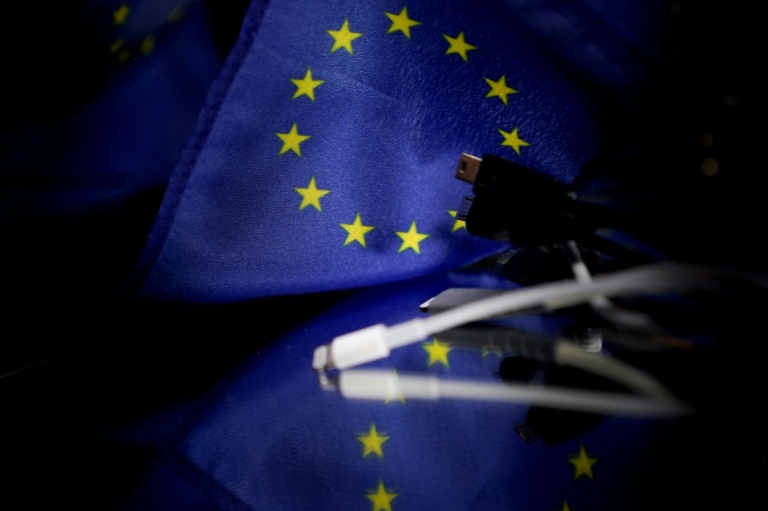
The EU parliament on Tuesday passed a new law requiring USB-C to be the single charger standard for all new smartphones, tablets and cameras from late 2024.

The measure, which EU lawmakers adopted with a vote 602 in favour, 13 against, will — in Europe at least — push Apple to drop its outdated Lightning port on its iPhones for the USB-C one already used by many of its competitors.

Makers of laptops will have extra time, from early 2026, to also follow suit.

EU policymakers say the single charger rule will simplify the life of Europeans, reduce the mountain of obsolete chargers and reduce costs for consumers. 

It is expected to save at least 200 million euros ($195 million) per year and cut more than a thousand tonnes of EU electronic waste every year, the bloc’s competition chief Margrethe Vestager said.

The EU move is expected to ripple around the world.

The European Union’s 27 countries are home to 450 million people who count among the world’s wealthiest consumers. Regulatory changes in the bloc often set global industry norms in what is known as the Brussels Effect.

“Today is a great day for consumers, a great day  for our environment,” Maltese MEP Alex Agius Saliba, the European Parliament’s pointman on the issue, said.

“After more than a decade; the single charger for multiple electronic devices will finally become a reality for Europe and hopefully we can also inspire the rest of the world,” he said.

– Faster data speed –

Apple, the world’s second-biggest seller of smartphones after Samsung, already uses USB-C charging ports on its iPads and laptops. 

But it resisted EU legislation to force a change away from its Lightning ports on its iPhones, saying that was disproportionate and would stifle innovation.

However some users of its latest flagship iPhone models — which can capture extremely high-resolution photos and videos in massive data files — complain that the Lightning cable transfers data at only a bare fraction of the speed USB-C does.

The EU law will in two years’ time apply to all handheld mobile phones, tablets, digital cameras, headphones, headsets, portable speakers, handheld videogame consoles, e-readers, earbuds, keyboards, mice and portable navigation systems.

People buying a device will have the choice of getting one with or without a USB-C charger, to take advantage of the fact they might already have at least one cable at home.

Makers of electronic consumer items in Europe agreed a single charging norm from dozens on the market a decade ago under a voluntary agreement with the European Commission.

But Apple refused to abide by it, and other manufacturers kept their alternative cables going, meaning there are still some six types knocking around.

They include old-style USB-A, mini-USB and USB-micro, creating a jumble of cables for consumers.

USB-C ports can charge at up to 100 Watts, transfer data up to 40 gigabits per second, and can serve to hook up to external displays.

Apple also offers wireless charging for its latest iPhones — and there is speculation it might do away with charging ports for cables entirely in future models. But currently the wireless charging option offers lower power and data transfer speeds than USB-C.

US Supreme Court hears Alabama Black voting rights case

The US Supreme Court heard arguments on Tuesday in a racially-charged case involving the rights of Black voters.

The case involves the 1965 Voting Rights Act and a congressional redistricting map in the southern state of Alabama that critics say diminishes the influence of African American voters.

The Voting Rights Act is intended to prevent racial discrimination against minorities in voting and a ruling in the Alabama case by the conservative-dominated court could potentially limit its scope.

The Alabama case concerns a map that was redrawn in 2021 by Alabama’s Republican majority legislature to allocate seats in the US House of Representatives.

Under the map, Black voters — who represent around a quarter of registered voters state-wide — are in a majority in only one of seven congressional districts. 

Citizens and rights groups took the matter to court, accusing legislators of violating civil rights laws which prohibit diluting the African American vote in this way. 

The new map, they say, cuts through the middle of a predominantly Black region, the “Black Belt,” and splits it in two, and Alabama should have created a second district with a Black majority instead. 

The stakes are particularly high in the state, where African Americans vote mostly Democratic, while white voters mostly support Republicans. 

“It’s one of the great achievements of American democracy,” Justice Elena Kagan, one of the three liberals on the nine-member court, said of the Voting Rights Act during Tuesday’s arguments.

The act seeks to provide “equal political opportunities regardless of race to ensure that African Americans could have as much political power as white Americans could,” Kagan said.

– ‘Race-neutral’ –

Justice Ketanji Brown Jackson, the first Black woman on the high court, pushed back against arguments by Alabama officials that congressional district maps be drawn up on “race-neutral” principles.

Jackson noted that constitutional amendments passed after the US Civil War were intended to ensure that former slaves “were brought equal to everyone else in society.”

“That’s not a race neutral or race blind idea in terms of the remedy,” she said. “I don’t think that the historical record establishes that the founders believed that race neutrality or race blindness was required.”

Earlier this year, a lower court ruled in favor of the plaintiffs in the Alabama case and ordered local officials to turn in a new copy of the map. 

Republican officials then turned to the Supreme Court.

In February, five of the nine judges allowed them to keep the 2021 map for now — and thus for the US mid-term elections in November — while postponing consideration of the merits of the case until Tuesday.

The Alabama case is one of several the court will hear this term revolving around race.

Later this month, the court is to hear arguments on the use of race in deciding who gets to attend Harvard University and the University of North Carolina.

Harvard and UNC, like many other US institutions of higher education, use race as a factor in trying to ensure a diverse student body and to make up for a legacy of racial discrimination against African Americans and Hispanics.

The court has ruled previously in favor of affirmative action but it has long been in the cross-hairs of the right and its opponents believe the current court will be receptive to their arguments.

US Navy's $13 bn carrier embarks on first deployment

The US Navy’s newest aircraft carrier embarked on its maiden deployment Tuesday, a milestone for a ship that has suffered problems with some of the advanced technologies it carries.

The USS Gerald R. Ford — which cost more than $13 billion — will work with countries including Canada, France and Germany during a deployment that will include training on air defense, anti-submarine warfare and amphibious operations.

A live video on a US Navy Facebook page showed tugboats moving the gray-painted ship away from the pier at Naval Station Norfolk in Virginia.

The ship’s deployment will “demonstrate its unmatched, multi-domain, full-spectrum lethality in the Atlantic,” Admiral Daryl Caudle said in a statement ahead of the ship’s departure.

The deployment will involve 9,000 people, 20 ships and 60 aircraft from nine different countries, the US Navy said, without providing a breakdown by nation.

Commissioned in 2017, the carrier is massive — more than 1,100 feet (335 meters) long, and displacing 100,000 long tons (101,000 tonnes) when fully loaded. But it can still sail at a speed of more than 34 miles (54 kilometers) per hour. 

The ship — named for the 38th US president — requires hundreds fewer crew members to operate than previous carriers and is designed to be able to carry futuristic energy weapons that are still under development.

A key improvement over previous carriers is supposed to be the rate at which it can launch and retrieve aircraft, but there have been issues with the systems involved, according to a June 2022 report to Congress.

– Delayed deployment –

“The Navy anticipates achieving reliability goals in the 2030s,” the Government Accountability Office report said of the carrier’s Electromagnetic Aircraft Launch System and Advanced Arresting Gear, adding that reliability issues could “prevent the ship from demonstrating one of its key requirements — rapidly deploying aircraft.”

The vessel’s weapons elevators — which move missiles and bombs from its magazines to the deck so they can be loaded onto planes — have also suffered problems.

“The ship’s first deployment was delayed by a need to complete work on the ship’s weapons elevators and correct other technical problems,” the Congressional Research Service said in a report updated in August, adding that the final elevator was tested and certified in late 2021.

As the Gerald R. Ford goes to sea and with other similar carriers in the works, there is debate over whether new weapons such as anti-ship ballistic missiles have rendered such ships obsolete, or will do so in the future.

Mackenzie Eaglen, a senior fellow and defense expert at the American Enterprise Institute, argues that their time is far from over due to the deterrent role they play.

“The US military — most visibly through US Navy… carrier strike groups — first deters bad actors and messy wars. If deterrence is lost, then we have a lot of equipment and bases that are vulnerable in the next conflict,” Eaglen said.

“As the US (seemingly constantly) debates the utility of the carrier, other nations are busy heavily investing in aircraft carriers — from India, China, France, UK, Australia and Italy — which speaks to the ship’s continued utility both in peacetime and war,” she added.

Close Bitnami banner
Bitnami