US Business

Eurozone inflation jumps to record 10% as energy prices soar

Eurozone consumer prices skyrocketed by a record 10 percent in September, official data showed on Friday, as inflation reached double digits on the back of soaring energy prices caused by Russia’s war on Ukraine.

Stoked by a staggering 40.8 percent rise in energy prices, the yearly inflation rate in the 19-country single currency area hit its highest level since records began, according to Eurostat.

The historic level of inflation will encourage the European Central Bank to stay on its current path of rate hikes, in an effort to cool prices despite the risk of triggering economic recession in Europe.

The ECB is desperate to prevent inflation from taking root in the economy and is taking measures that will reduce demand and could therefore slow growth.

The ECB argues that the hikes are also necessary to put monetary policy on a more “neutral” footing after many years of negative rates and stimulus programmes that pumped tens of billions of euros into the eurozone economy.

The leap to 10 percent followed a 9.1 percent rise in August and doused hopes that inflation would begin to ease as energy markets stabilise seven months after Russia launched its invasion of Ukraine.

Making matters more complicated for policymakers, the eurozone’s powerhouse economies showed widely divergent inflation rates, with Germany seeing price hikes of 10.8 percent and France at 6.2 percent.

In the Netherlands inflation prices rose by 17.1 percent, the highest since World War II, in a major leap from an already sky-high 12 percent a month earlier.

Also muddying the waters, some eurozone countries are pushing through major national spending to ease the energy price burden on consumers, creating further fragmentation in the European economy.

In an urgent effort to tame prices, European Union energy ministers on Friday agreed to cut peak-hour power consumption and impose windfall levies on energy companies.

– ECB rate hike looms –

In the face of a tough balancing act, ECB chief Christine Lagarde indicated this week she would go ahead with another hefty rate hike of 0.75 percentage points at the bank’s next meeting on October 27.

“We expect to raise interest rates further over the next several meetings to dampen demand and guard against the risk of a persistent upward shift in inflation expectations,” she told EU lawmakers. 

Energy prices in Europe remain under intense pressure with Russia starving the continent of gas supply as winter approaches.

The ECB’s target for inflation is two percent and efforts to get closer to that level have raised fears that the central bank may lead the bloc into a recession in its effort to reduce prices.

“The jump in the eurozone’s headline inflation rate in September into double digits will be of grave concern to the ECB,” said Jessica Hinds of Capital Economics.

“Despite the weak economic outlook we expect the banks to prioritise inflation and deliver another bumper rate hike next month,” she added.

Eurostat data also published on Friday showed the eurozone unemployment rate remaining at a record low of 6.6 percent in July.

This will further encourage the ECB to stay the course and choose fighting inflation over concerns about economic growth and its consequences on employment.

UK teen died after 'negative effects of online content': coroner

A 14-year-old British girl died from an act of self harm while suffering from the “negative effects of online content”, a coroner said Friday in a case that shone a spotlight on social media companies.

Molly Russell was “exposed to material that may have influenced her in a negative way and, in addition, what had started as a depression had become a more serious depressive illness,” Andrew Walker ruled at North London Coroner’s Court.

The teenager “died from an act of self-harm while suffering depression”, he said, but added it would not be “safe” to conclude it was suicide.

Some of the content she viewed was “particularly graphic” and “normalised her condition,” said Walker.

Russell, from Harrow in northwest London, died in November 2017, leading her family to set up a campaign highlighting the dangers of social media.

“There are too many others similarly affected right now,” her father Ian Russell said after the ruling.

“At this point, I just want to say however dark it seems, there is always hope. 

“I hope that this will be an important step in bringing about much needed change,” he added.

The week-long hearing became heated when the family’s lawyer, Oliver Sanders, took an Instagram executive to task.

A visibly angry Sanders asked Elizabeth Lagone, the head of health and wellbeing at Meta, Instagram’s parent company, why the platform allowed children to use it when it was “allowing people to put potentially harmful content on it”.

“You are not a parent, you are just a business in America. You have no right to do that. The children who are opening these accounts don’t have the capacity to consent to this,” he said.

Lagone apologised after being shown footage, viewed by Russell, that “violated our policies”.

Of the 16,300 posts Russell saved, shared or liked on Instagram in the six-month period before her death, 2,100 related to depression, self-harm or suicide, the inquest heard.

Children’s charity NSPCC said the ruling “must be a turning point”.

“Tech companies must be held accountable when they don’t make children’s safety a priority,” tweeted the charity. 

“This must be a turning point,” it added, stressing that any delay to a government bill dealing with online safety “would be inconceivable to parents”.

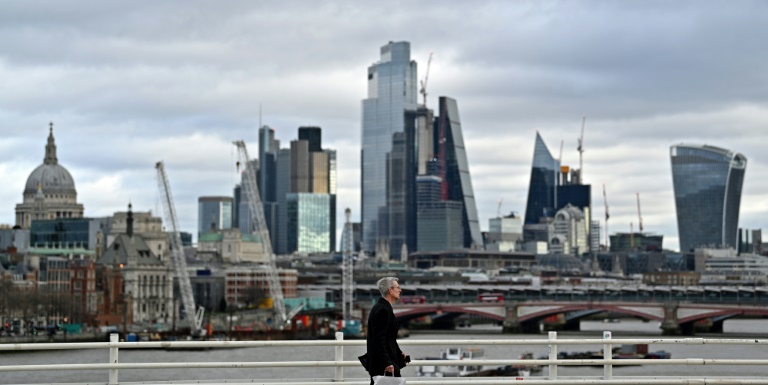
UK avoids recession in boost for under-fire Truss

Britain is not yet in recession, revised data showed Friday in a boost for under-fire Prime Minister Liz Truss, but its economy may still face a downturn on soaring interest rates.

Gross domestic product expanded 0.2 percent in the second quarter, said the Office for National Statistics in an upgrade from its previous estimate of a 0.1-percent contraction.

Even if the economy has shrunk in the current third quarter that ends Friday, as the Bank of England forecasts, it would mean the UK had avoided two successive quarters of contraction — the technical definition of a recession.

The turnaround follows a rough week for new PM Truss as the country’s borrowing costs soared and the pound hit a record dollar-low after her government announced a controversial budget plan on September 23 that included a cap on soaring energy bills.

Truss and finance minister Kwasi Kwarteng met Friday with Britain’s fiscal watchdog to discuss the economic and fiscal outlook in the wake of last week’s announcement of also debt-fuelled tax cuts.

“We will deliver the first iteration of that forecast” next week, the Office for Budget Responsibility said in a statement after the meeting.

The country’s economy output remains fragile, with Friday’s ONS data also revised to show that it was still below pre-Covid levels.

– ‘Calamitous week’ –

“In what has been a calamitous week for the UK economy, there was a rare glimmer of hope… (with it) defying expectations of a recession — for now,” said Interactive Investor analyst Richard Hunter.

“Sterling has also found some cautious support… although the jitters will remain as the government continues to justify and explain the implications of its fiscal largesse.”

Investors were spooked this week by the huge amount of borrowing likely needed for a UK budget seen as benefitting the rich more than the poorest during the cost-of-living crisis.

Less than a month into the job, Truss is already deep in a financial crisis.

The pound on Monday collapsed to an all-time low at $1.0350 on fears the budget would make sky-high inflation worse and cause the Bank of England (BoE) to hike its main interest rate even more aggressively.

Sterling has since recovered slightly.

The upbeat GDP figure came two days after the BoE carried out emergency action to snap up government bonds, whose yields had soared following the budget.

And the central bank is forecast to hike its interest rate far beyond the current 2.25 percent, which compares with a record-low 0.1 percent less than a year ago, as markets fear ever-higher inflation.

This in turn could see businesses closing and home-owners defaulting on their mortgages.

– ‘Good news, bad news’ –

Despite growth in the latest quarter, the UK economy is 0.2 percent smaller than its pre-pandemic size, the ONS added Friday. 

The statistics office previously had the UK economy at 0.6 percent larger than in 2019.

“The good news is that the economy is not already in recession,” said Capital Economics analyst Paul Dales.

“The bad news is that contrary to previous thinking, it still hasn’t returned to pre-pandemic levels.”

The ONS also said the UK economy slumped 11 percent in 2020 on fallout from the Covid pandemic.

It then rebounded with 7.5-percent growth in 2021.

Attack kills 25 in Ukraine ahead of Kremlin annexation

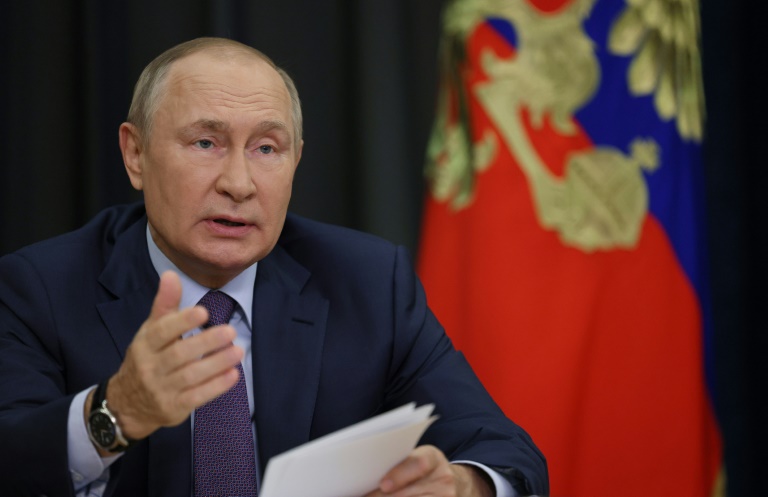
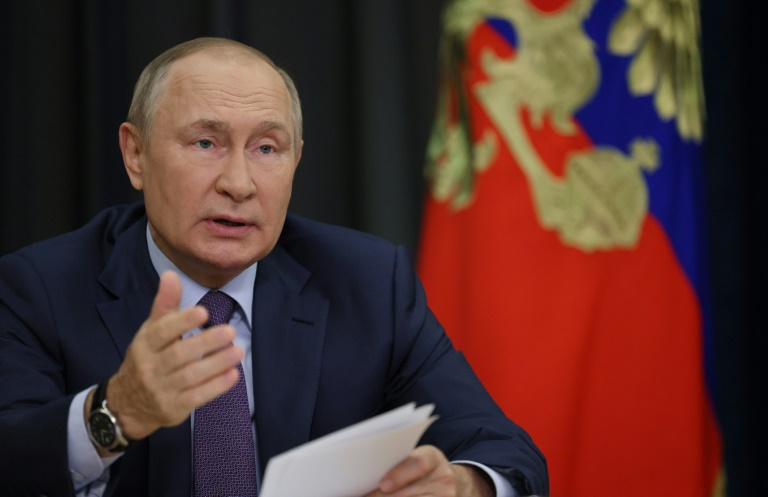
An attack on a frontline civilian convoy killed at least 25 people in southern Ukraine on Friday, just hours before Moscow was due to annex four occupied Ukrainian regions.

Russian President Vladimir Putin is poised to formally annex Kherson, Zaporizhzhia, Donetsk and Lugansk, which his forces mostly control, at a grand Kremlin ceremony later on Friday.

He has warned he could use nuclear weapons to retain control of the territory as the United States leads Western allies in vowing “never” to recognise the regions as anything other than part of Ukraine.

Kremlin spokesman Dmitry Peskov told reporters that the annexations would be formalised at an event at (1200 GMT) during which Putin would deliver a “major” speech.

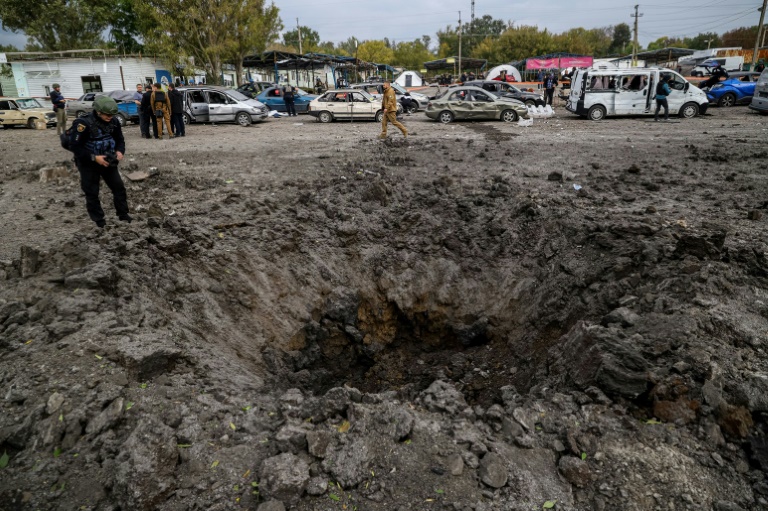
But early on Friday, an attack in Zaporizhzhia in the south, killed at least 25 people as civilians were preparing to leave to pick up relatives, Ukrainian officials said.

“Twenty-five killed and about 50 wounded in an attack by the Russian military on a humanitarian convoy in Zaporizhzhia. Investigation launched,” said the prosecutor general’s office on Telegram.

Bodies of people wearing civilian clothes were left on the ground after the attack and windows of cars blown out, an AFP photographer said. 

“Only complete terrorists could do this,” said Ukrainian President Volodymyr Zelensky. “Bloodthirsty scum! You will definitely answer,” he added. 

– Some 20 percent of Ukraine –

“The enemy launched rockets on a civilian convoy leaving the city centre,” said Zaporizhzhia governor Oleksandr Starukh.

But pro-Kremlin regional chief Vladimir Rogov accused Ukrainian troops of carrying out a “terrorist act”.

“The regime in Kyiv is trying to portray what happened as shelling by Russian troops, resorting to a heinous provocation,” he said on social media.

Preparations were underway in Moscow’s Red Square for state-organised celebrations to announce the annexation of Zaporizhzhia and the three other regions.

Municipal workers were climbing scaffolding in advance to install huge banners emblazoned with: “Donetsk. Lugansk. Zaporizhzhia. Kherson. Russia!”

“I’m happy if they want to join Russia,” Natalya Bodner, a 37-year-old lawyer told AFP in central Moscow. “They have more hope than we do”.

“It should have been done a long time ago,” a Russian serviceman Ildar Babaev from the southern region of Dagestan said.

“This is the right decision”.

The four territories create a crucial land corridor between Russia and the Crimean peninsula, annexed by Moscow in 2014.

– ‘Nobody believes it’ –

But the Kremlin said Friday it “needed to clarify” the exact borders of Kherson and Zaporizhzhia — neither fully controlled by Moscow’s forces — that it intends to annex.

Together, all five regions including Crimea, make up around 20 percent of Ukraine, whose forces in recent weeks have been clawing back wins as part of a counter-offensive.

In Sloviansk, a city in Donetsk, a military medic who goes by the name of Coconut said the annexations were nonsense.

“If my neighbour comes to my house and announces that it’s his, nobody believes it actually belongs to him,” he told AFP.

In Kherson, Russian officials announced that Ukrainian strikes with US-supplied precision artillery systems had killed a senior security chief of the Russian-controlled region.

A “pinpoint” strike by Himars hit his house, Kirill Stremousov, the deputy head of the Russian proxy administration said.

It was the latest of several targeted attacks on Russian-appointed officials in the region.

– Security Council vote –

Ukrainian forces are also on the doorstep of Lyman in Donetsk, which Moscow’s forces pummelled for weeks to capture this summer. 

“Lyman is partially surrounded,” said Denis Pushilin, the pro-Moscow leader in the breakaway region of Donetsk, on social media. Two nearby villages were “not fully under our control,” he added.

On Thursday, President Joe Biden said the United States would “never, never, never” recognise Russian sovereignty over the territories set for annexation.

The four regions’ Kremlin-installed leaders this week assembled in the Russian capital ahead of the ceremony.

They formally requested annexation after claiming residents backed the move in hastily organised referendums that were dismissed by Kyiv and the West as fraudulent.

Ukraine has said the West’s only appropriate response is to hit Russia with more sanctions and to supply Ukrainian forces with more weapons to keep reclaiming territory.

The UN Security Council will vote Friday on a resolution condemning the referendums, according to France, the council’s current president, but it has no chance of passing due to Moscow’s veto power.

Zelensky is calling an “urgent” meeting of his national security council for Friday, his spokesman said.

burs/jm

European stocks climb, pound stalls on mixed data

European stock markets climbed Friday but the pound and euro fell as traders assessed mixed growth and inflation data.

The pound jumped on revised figures showing the UK economy had avoided recession — but it swiftly fell back on expectations of an eventual downturn owing to sky-high inflation.

In the eurozone, consumer prices rocketed a record 10 percent in September on soaring energy prices caused by Russia’s war on Ukraine, separate official data showed.

“Stock markets are bouncing back… although I don’t think anyone is getting excited by the moves which pale in comparison to the losses that preceded them,” noted OANDA senior market analyst Craig Erlam.

“This looks like nothing more than a dead cat bounce after a steep decline over the last couple of weeks as investors have been forced to once again accept that interest rates are going to rise further and faster than hoped.”

In the United States, Federal Reserve officials have again reiterated their intention to ramp up rates until they have tamed inflation, even if that means plunging the world’s top economy into recession.

The case for a fourth successive 0.75-percentage point lift was strengthened by news Thursday that first-time unemployment benefit claims fell below 200,000 for the first time since May.

All three main indices on Wall Street finished deep in the red Thursday, with the S&P 500 ending at its lowest level since November 2020.

In Asia on Friday, Shanghai dropped as data showed China’s manufacturing and services sectors struggled again in September from Covid lockdowns in parts of the country that have battered the world’s number-two economy.

There was also little reaction to news that Beijing would allow some cities to reduce mortgage rates for first-home purchases as it tries to support the property market.

Market sentiment was being eroded also by rising fears about developments in the Ukraine war, as Russia prepares to annex four occupied regions of its neighbour Friday, with President Vladimir Putin threatening to use nuclear weapons to defend the territories.

– Key figures around 1100 GMT –

London – FTSE 100: UP 0.4 percent at 6,909.18 points 

Frankfurt – DAX: UP 0.4 percent at 12,017.95

Paris – CAC 40: UP 0.8 percent at 5,723.46

EURO STOXX 50: UP 0.6 percent at 3,297.15

Tokyo – Nikkei 225: DOWN 1.8 percent at 25,937.21 (close)

Hong Kong – Hang Seng Index: UP 0.3 percent at 17,222.83 (close)

Shanghai – Composite: DOWN 0.6 percent at 3,024.39 (close)

New York – Dow: DOWN 1.5 percent at 29,225.61 (close)

Pound/dollar: DOWN at $1.1067 from $1.1116 on Thursday

Euro/dollar: DOWN at $0.9764 from $0.9818

Euro/pound: DOWN at 88.20 pence from 88.28 pence

Dollar/yen: UP at 144.47 yen from 144.42 yen

Brent North Sea crude: UP 0.7 percent at $89.12 per barrel

West Texas Intermediate: UP 0.3 percent at $81.41 per barrel

European stocks climb, pound stalls on mixed data

European stock markets climbed Friday but the pound and euro fell as traders assessed mixed growth and inflation data.

The pound jumped on revised figures showing the UK economy had avoided recession — but it swiftly fell back on expectations of an eventual downturn owing to sky-high inflation.

In the eurozone, consumer prices rocketed a record 10 percent in September on soaring energy prices caused by Russia’s war on Ukraine, separate official data showed.

“Stock markets are bouncing back… although I don’t think anyone is getting excited by the moves which pale in comparison to the losses that preceded them,” noted OANDA senior market analyst Craig Erlam.

“This looks like nothing more than a dead cat bounce after a steep decline over the last couple of weeks as investors have been forced to once again accept that interest rates are going to rise further and faster than hoped.”

In the United States, Federal Reserve officials have again reiterated their intention to ramp up rates until they have tamed inflation, even if that means plunging the world’s top economy into recession.

The case for a fourth successive 0.75-percentage point lift was strengthened by news Thursday that first-time unemployment benefit claims fell below 200,000 for the first time since May.

All three main indices on Wall Street finished deep in the red Thursday, with the S&P 500 ending at its lowest level since November 2020.

In Asia on Friday, Shanghai dropped as data showed China’s manufacturing and services sectors struggled again in September from Covid lockdowns in parts of the country that have battered the world’s number-two economy.

There was also little reaction to news that Beijing would allow some cities to reduce mortgage rates for first-home purchases as it tries to support the property market.

Market sentiment was being eroded also by rising fears about developments in the Ukraine war, as Russia prepares to annex four occupied regions of its neighbour Friday, with President Vladimir Putin threatening to use nuclear weapons to defend the territories.

– Key figures around 1100 GMT –

London – FTSE 100: UP 0.4 percent at 6,909.18 points 

Frankfurt – DAX: UP 0.4 percent at 12,017.95

Paris – CAC 40: UP 0.8 percent at 5,723.46

EURO STOXX 50: UP 0.6 percent at 3,297.15

Tokyo – Nikkei 225: DOWN 1.8 percent at 25,937.21 (close)

Hong Kong – Hang Seng Index: UP 0.3 percent at 17,222.83 (close)

Shanghai – Composite: DOWN 0.6 percent at 3,024.39 (close)

New York – Dow: DOWN 1.5 percent at 29,225.61 (close)

Pound/dollar: DOWN at $1.1067 from $1.1116 on Thursday

Euro/dollar: DOWN at $0.9764 from $0.9818

Euro/pound: DOWN at 88.20 pence from 88.28 pence

Dollar/yen: UP at 144.47 yen from 144.42 yen

Brent North Sea crude: UP 0.7 percent at $89.12 per barrel

West Texas Intermediate: UP 0.3 percent at $81.41 per barrel

Hurricane Ian dumped 10% more rain due to climate change: research

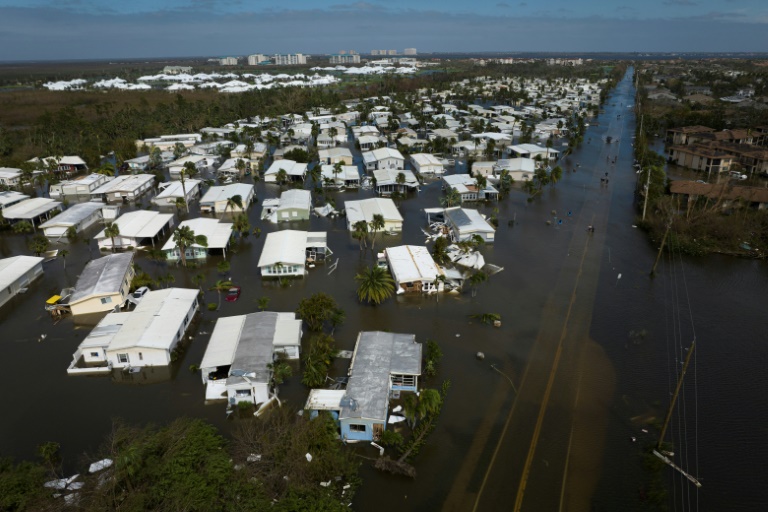
Climate change increased the rainfall from Hurricane Ian by more than 10 percent, according to a new quick-fire analysis, as one of the most powerful storms ever to hit the United States devastated parts of Florida. 

Ian “could be the deadliest hurricane in Florida history”, President Joe Biden said after the storm brought ferocious winds, turned streets into churning rivers that swept away homes and left an unknown number of casualties. 

According to a rapid and preliminary analysis, human-caused climate change increased the extreme rain that Ian unleashed by over 10 percent, US scientists said.

“Climate change didn’t cause the storm but it did cause it to be wetter,” said Lawrence Berkeley National Laboratory’s Michael Wehner, one of the scientists behind the new finding. 

The researchers compared simulations of today’s world — which has warmed nearly 1.2 degrees Celsius since pre-industrial times — with counterfactual simulations of a world without human-induced climate change. 

Wehner said these were “conservative estimates”, adding that while they are not peer reviewed, they are based on methods used in a study on the 2020 Atlantic hurricane season, which was published in April in the journal Nature Communication.

Climate change from emissions of planet-heating greenhouse gases is warming the ocean’s surface and increasing moisture in the atmosphere that fuels hurricanes. 

Although the total number of tropical storms, or cyclones, may not increase, scientists say warming is whipping up more powerful cyclones with stronger winds and more precipitation.

“Human-caused climate change is affecting hurricanes in many ways including causing them to intensify faster, be stronger overall, and dump a lot more rain,” tweeted climate scientist Katharine Hayhoe, who was not involved in the research. 

For each degree Celsius of warming, scientists expect the water in the atmosphere to increase by around seven percent.  

But Wehner said that his research found that storms are “more efficient” at turning the available moisture into rainfall.

Ian swept across Cuba on Tuesday, downing the country’s power network, before slamming into the Florida coast on Wednesday as a strong Category 4 hurricane.

The National Hurricane Center said Thursday the now Category 1 storm is expected to bring “life-threatening flooding, storm surge and strong winds” to the Carolinas.

Eurozone inflation jumps to record 10%

Eurozone consumer prices skyrocketed by a record 10 percent in September, official data showed on Friday, as inflation reached double digits on the back of soaring energy prices caused by Russia’s war on Ukraine.

Stoked by a staggering 40.8 percent rise in energy prices, the yearly inflation rate in the 19-country single currency area hit its highest level since records began, according to Eurostat.

The historic level of inflation will encourage the European Central Bank to stay on its current path of rate hikes, in an effort to cool prices despite the risk of triggering economic recession in Europe.

The ECB is desperate to prevent inflation from taking root in the economy and is taking measures that will reduce demand and could therefore slow growth.

In an urgent effort to tame prices, European Union energy ministers agreed on Friday to peak-hour power consumption and to impose windfall levies on energy companies.

The leap to 10 percent followed a 9.1 percent rise in August and doused hopes that inflation would begin to ease as energy markets stabilise seven months after Russia launched its invasion of Ukraine.

Making matters more complicated for policymakers, the eurozone’s powerhouse economies showed widely divergent inflation rates, with Germany seeing price hikes of 10.8 percent and France at 6.2 percent.

In the Netherlands inflation prices rose by 17.1 percent, the highest since World War II, in a major leap from an already sky-high 12 percent a month earlier.

Also muddying the waters, some eurozone countries are pushing through major national spending to ease the energy price burden on consumers, creating further fragmentation in the European economy.

– ECB rate hike looms –

In the face of a tough balancing act, ECB chief Christine Lagare indicated this week she would go ahead with another hefty rate hike of 0.75 percentage points at the bank’s next meeting on October 27.

“We expect to raise interest rates further over the next several meetings to dampen demand and guard against the risk of a persistent upward shift in inflation expectations,” she told EU lawmakers. 

Energy prices in Europe remain under intense pressure with Russia starving the continent of gas supply as winter approaches.

The ECB’s target for inflation is two percent and efforts to get closer to that level have raised fears that the central bank may lead the bloc into a recession in its effort to reduce prices.

“The jump in the eurozone’s headline inflation rate in September into double digits will be of grave concern to the ECB,” said Jessica Hinds of Capital Economics.

“Despite the weak economic outlook we expect the banks to prioritise inflation and deliver another bumper rate hike next month,” she added.

Eurostat data also published on Friday showed the eurozone unemployment rate remaining at a record low of 6.6 percent in July.

This will further encourage the ECB to stay the course and choose fighting inflation over concerns about economic growth and its consequences on employment.
Japan's digital minister says he's ready for a fight

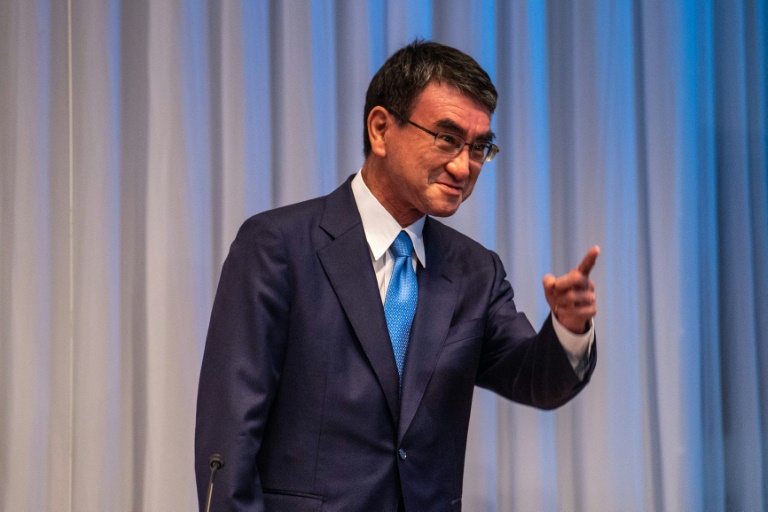
Japan’s media-savvy digital minister said Friday he’s ready to take an iron-fisted approach to speed up the nation’s slow embrace of online services at government offices and workplaces.

Taro Kono — a political heavyweight who has been minister of defence, foreign affairs and Covid vaccines — has already declared war on fax machines, floppy disks and other obsolete technologies that are still common in the world’s third-largest economy.

“I have no plan to be a coordinator. If there are people who have a problem with it, I will beat them up,” he quipped in an online interview with a small group of journalists.

“The pandemic forced everyone to acknowledge that Japan’s digitalisation has been slow,” added Kono.

“It has become crystal clear, compared with other countries, how difficult it is to do business and to conduct daily affairs.”

Japan is often internationally considered a byword for high-tech, but fax machines are still routinely used by businesses and households along with email and texting apps.

Floppy disks and CD-ROMs are less visible to consumers, but some official documents are legally required to be stored in these outdated formats.

“Throughout Covid, we have seen so many countries move their government procedures onto digital platforms,” Kono said. 

“At the same time, we are not there yet.”

He blamed a culture that does not necessarily encourage people to suggest change in the workplace, which he said results in people pretending not to notice problems.

“People are so quick to make changes if something is not convenient at home. But once you step out of your house, everything becomes someone else’s problem,” Kono said. 

“We must build a society where people take actions and suggest improvements to better society.

Kono, who has also sought to phase out the personal ink signature stamps known as hanko, said he was optimistic society would embrace the convenience of digitalisation. 

“If people feel their lives are getting better, more convenient, easier, I think that means the digital agency is successful,” he said.

“How do you measure that? If you see people have more smiles on their face.” 

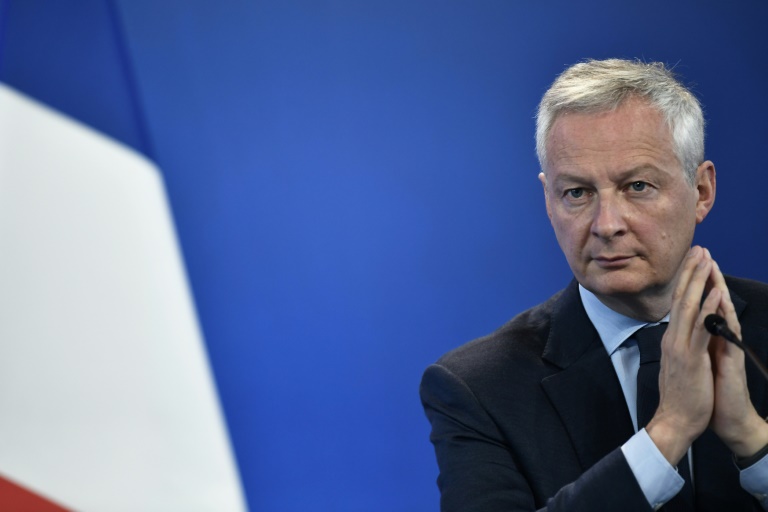
French economy minister 'worried' by British 'disaster'

France’s economy minister said Friday that he was worried by the financial turbulence in Britain, criticising Prime Minister Liz Truss’s economic policies for causing a “disaster” of high borrowing rates for her country.

“I’m not worried about the situation in the eurozone,” Bruno Le Maire told Europe 1 radio when asked about the risk of the crisis spreading. “On the other hand, I am worried about the British situation.”

“What does it show? It shows firstly that there are costs for financial and economic policies,” he said.

Truss’s “mini-budget” announced last Friday included major tax cuts that would need to be financed by extra borrowing, spooking investors who immediately questioned the credibility of the policies and Britain’s financial standing. 

“When you take on major costs like that, with spectacular announcements, as some opposition parties want to do in France, it perturbs the markets. It perturbs financial balances,” Le Maire said.

“And it leads to a real disaster with interest rates which are 4.5 percent or even higher in Great Britain. We have interest rates which are reasonable, which are quite close to Germany’s because there is consistency in our economic and financial policymaking,” he said.

“The second thing is that leaving Europe comes with a considerable cost because Europe is a protection,” he added, referring to Britain’s exit from the European Union.

The pound fell to an all-time low against the dollar and the yield on 10-year British government bonds — which sets the cost of borrowing for the government — briefly rose to above 4.5 percent on Wednesday.

That led the Bank of England to intervene with a £65 billion ($71 billion) emergency bond-buying programme to stabilise the market.

Le Maire has been under pressure this week to explain his own budget choices, with the government planning to borrow a record 270 billion euros ($260 billion) next year and a run a deficit of 5.0 percent of GDP.

Some analysts see the deficit as likely to be higher because of Le Maire’s optimistic growth forecast for the economy and assumptions about savings from a controversial pensions reform that has not been passed by parliament.

French-British relations have been rocky for years, particularly under former prime minister Boris Johnson, with a host of issues souring ties from Brexit and fishing rights to migrants.

French ministers had been reluctant to comment on Truss since she came to power despite deep concerns about her Brexit policies and her statement while campaigning that she did not know if French President Emmanuel Macron was a “friend or foe.”

Close Bitnami banner
Bitnami