US Business

UK eyes big TikTok fine over child privacy lapse

Britain on Monday warned it could fine TikTok £27 million ($29 million) over a potential failure to protect children’s privacy on the Chinese-owned video app.

The Information Commissioner’s Office said the social media company “may have processed the data of children under the age of 13 without appropriate parental consent”.

The ICO also found that the short-form video platform may have “failed to provide proper information to its users in a concise, transparent and easily understood way”.

The watchdog has served the group with a notice of intent — which is a legal document that precedes a possible fine — over the possible breach of UK data protection law.

“We all want children to be able to learn and experience the digital world, but with proper data privacy protections,” said Information Commissioner John Edwards.

“Companies providing digital services have a legal duty to put those protections in place, but our provisional view is that TikTok fell short of meeting that requirement.”

In response, TikTok said it disagreed with the ICO’s provisional views and stressed that no final conclusions had been reached.

“While we respect the ICO’s role in safeguarding privacy in the UK, we disagree with the preliminary views expressed and intend to formally respond to the ICO in due course,” TikTok said in a statement.

Pound hits record low versus dollar, Italy stocks up after vote

The pound hit a record low against the dollar Monday on surging fears about the ailing UK economy.

Stock markets mostly extended losses and oil prices fell further after last week’s routs that were triggered by growing prospects of a global recession.

However, the Italian stock market climbed as markets assessed Italy’s future political landscape after Eurosceptic populists swept to victory in the eurozone member’s general election.

“The pound’s crash is showing markets have a lack of confidence in the UK and that its financial strength is under siege,” said Jessica Amir at Saxo Capital Markets.

“The pound is a whisker away from (dollar) parity and the situation is going to only worsen from here.”

Economists expressed concerns that last week’s huge tax-cutting budget from the government of new Prime Minister Liz Truss — aimed at helping the recession-threatened economy — could actually spark massive borrowing and further fuel inflation.

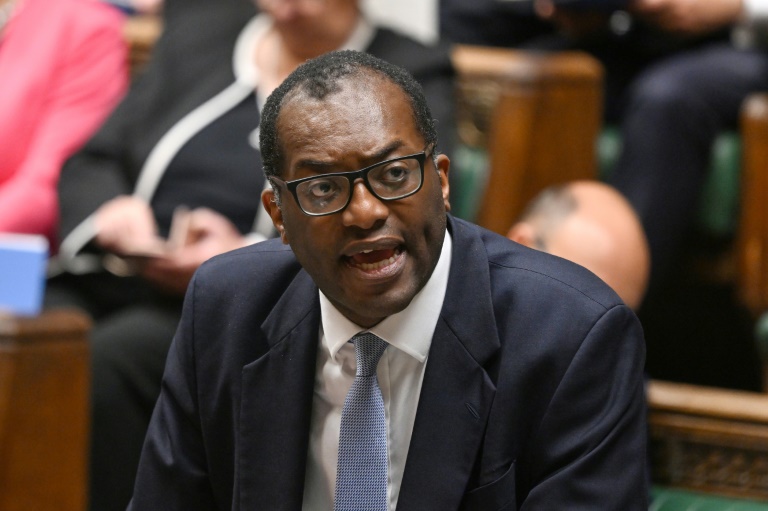
The pound on Monday struck an all-time low at $1.0350, days after new UK finance minister Kwasi Kwarteng’s inflation-fighting budget.

Sterling has struggled in recent years as the UK fails to strike major trade deals following its exit from the European Union.

Prior to Monday’s crash, the pound suffered a series of 37-year lows against the greenback this month on UK recession fears propelled by sky-high inflation.

The euro has additionally come under heavy selling pressure against the dollar in recent months, as the Federal Reserve hikes interest rates more aggressively than the European Central Bank.

– Italian stocks –

In stock market trading Monday, Milan’s FTSE MIB rose 0.5 percent to 21,174.60 points.

However the euro struck a new 20-year low at $0.9554.

“Italy is clearly outperforming following the election result,” noted Craig Erlam, analyst at Oanda trading group. 

“Time will tell how successful the new government will prove to be but the prospect of some political stability appears to be generating a small relief rally today.”

Italy took a sharp turn to the right after Giorgia Meloni’s Eurosceptic populist party swept to victory in a weekend general election, putting a one-time Mussolini admirer on course to become the first woman to lead the country.

Meloni’s Brothers of Italy party, which has neo-fascist roots, won 26 percent in Sunday’s election, according to partial results.

It leads a coalition set to win a majority in parliament.

Elsewhere, the Moscow stock exchange plunged 10 percent to its lowest point since Russia began its Ukraine offensive seven months ago as tensions grew across the country over partial military mobilisation.

The benchmark ruble-denominated Moex index sank 10.2 percent to 1,873.55 points in early afternoon trading, dropping below the 1,900 points mark for the first time since the February invasion of neighbouring Ukraine.

– Key figures at around 1215 GMT –

Pound/dollar: DOWN at $1.0721 from $1.0852 on Friday

Euro/dollar: DOWN at $0.9645 from $0.9695

Euro/pound: UP at 89.93 pence from 89.28 pence 

Dollar/yen: UP at 144.30 yen from 143.31 yen

London – FTSE 100: DOWN 0.7 percent at 6,969.77 points

Frankfurt – DAX: DOWN 0.1 percent at 12,273.63

Paris – CAC 40: DOWN 0.1 percent at 5,777.09

EURO STOXX 50: DOWN 0.1 percent at 3,346.93

Tokyo – Nikkei 225: DOWN 2.7 percent at 26,431.55 (close)

Hong Kong – Hang Seng Index: DOWN 0.4 percent at 17,855.14 (close)

Shanghai – Composite: DOWN 1.2 percent at 3,051.23 (close)

New York – Dow: DOWN 1.6 percent at 29,590.41 (close)

West Texas Intermediate: DOWN 1.0 percent at $77.98 per barrel

Brent North Sea crude: DOWN 1.1 percent at $85.17 per barrel

burs-bcp/rfj/kjm

Ian strengthens to Category 1 hurricane as it nears Cuba: NHC

Tropical storm Ian has strengthened into a Category 1 hurricane as it nears western Cuba, the US National Hurricane Center (NHC) said on Monday.

“Ian becomes a hurricane,” the NHC said in an advisory, warning that “additional rapid strengthening is expected today.”

The storm was moving northwest toward Cuba and the Cayman Islands with maximum sustained winds of 75 miles (120 kilometers) per hour, the NHC said.

It added that western Cuba was expected to bear the brunt of the storm on Monday when it could be hit by “significant wind and storm surge impacts.”

People in the US state of Florida were also preparing for the storm’s imminent arrival, with the NHC issuing a hurricane watch for the state’s west coast, including Tampa Bay.

On Sunday, Florida’s Governor Ron DeSantis declared a state of emergency in all 67 counties as officials scrambled to prepare for the storm. 

“Expect heavy rains, strong winds, flash flooding, storm surge and even isolated tornados,” DeSantis told reporters on Sunday.

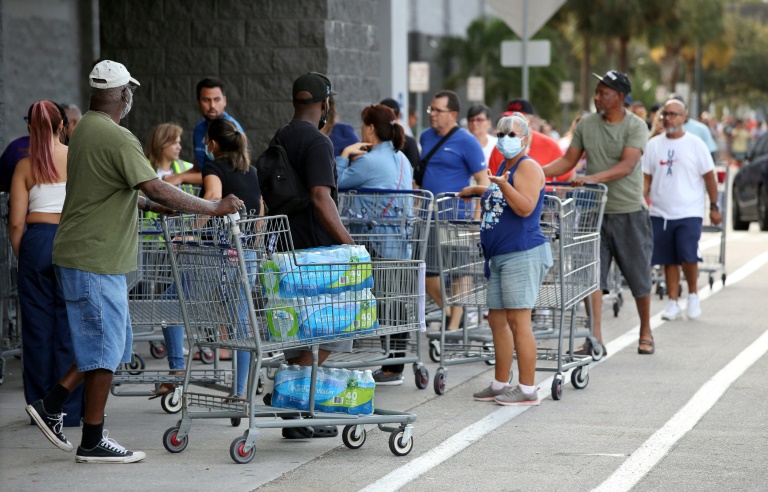
The governor urged residents to stock up on food, water, medicine and fuel and to prepare for power outages.

DeSantis activated 2,500 National Guard members to help with the effort.

Authorities in several Florida municipalities, including Miami, Fort Lauderdale and Tampa, began distributing free sandbags to residents to help them protect their homes from the risk of flooding. 

President Joe Biden approved emergency aid to 24 counties in Florida through the Federal Emergency Management Agency (FEMA).

“It’s never too early to prepare,” Tampa Mayor Jane Castor tweeted.

– Fiona’s wake –

The Caribbean and parts of eastern Canada are still counting the costs of powerful storm Fiona, which tore through the region last week.

Fiona claimed seven lives as it roared through the Caribbean at the start of a week of havoc.

When it arrived in eastern Canada, the storm packed intense winds of 80 miles (130 kilometers) per hour, bringing torrential rain and waves of up to 40 feet (12 meters).

Canadian authorities have now confirmed two deaths caused when Fiona tore into Nova Scotia and Newfoundland as a post-tropical cyclone early Saturday.

Prince Edward Island authorities on Sunday confirmed the death of one person while officials in Newfoundland said they found the body of a 73-year-old woman believed to have been swept from her home. She was apparently sheltering in her basement when waves broke through.

“The devastation is immense,” Nova Scotia Premier Tim Houston told reporters. “The magnitude of the storm is incredible.”

Storm surges swept at least 20 homes into the sea in the town of Channel-Port aux Basques, on the southwestern tip of Newfoundland.

Mayor Brian Button described “a total war zone” in the coastal community. 

Around 200 residents had been evacuated before the storm hit.

“Some people have lost everything, and I mean everything,” Button told CBC News.

NASA to deflect asteroid in key test of planetary defense

NASA will on Monday attempt a feat humanity has never before accomplished: deliberately smacking a spacecraft into an asteroid to slightly deflect its orbit, in a key test of our ability to stop cosmic objects from devastating life on Earth.

The Double Asteroid Redirection Test (DART) spaceship launched from California last November and is fast approaching its target, which it will strike at roughly 14,000 miles (22,500 kilometers) per hour.

To be sure, neither the asteroid moonlet Dimorphos, nor the big brother it orbits, called Didymos, pose any threat as the pair loop the Sun, passing about seven million miles from Earth at nearest approach.

But NASA has deemed the experiment important to carry out before an actual need is discovered.

If all goes to plan, impact between the car-sized spacecraft, and the 530-foot (160 meters, or two Statues of Liberty) asteroid should take place at 7:14 pm Eastern Time (2314 GMT), and can be followed on a NASA livestream.

By striking Dimorphos head on, NASA hopes to push it into a smaller orbit, shaving ten minutes off the time it takes to encircle Didymos, which is currently 11 hours and 55 minutes — a change that will be detected by ground telescopes in the days that follow.

The proof-of-concept experiment will make a reality of what has before only been attempted in science fiction — notably films such as “Armageddon” and “Don’t Look Up.” 

– Technically challenging –

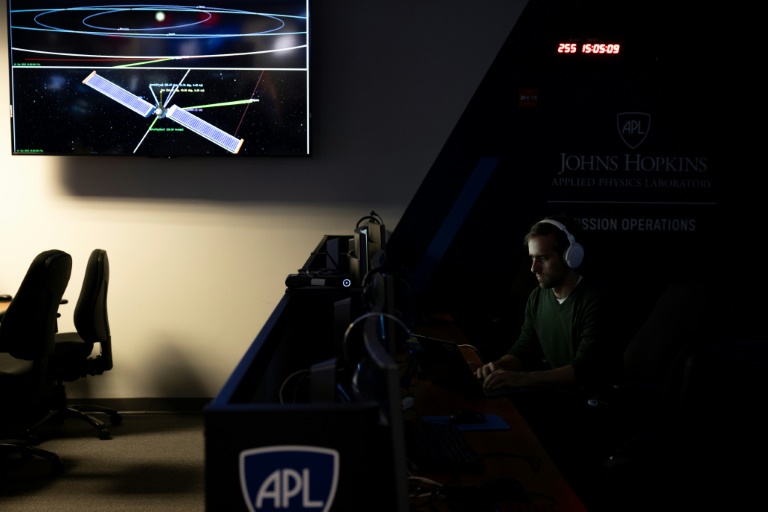
As the craft propels itself through space, flying autonomously for the mission’s final phase, its camera system will start to beam down the very first pictures of Dimorphos.

Minutes later, a toaster-sized satellite called LICIACube, which separated from DART a couple of weeks earlier, will make a close pass of the site to capture images of the collision and the ejecta — the pulverized rock thrown off by impact.

LICIACube’s pictures will be sent back in the weeks and months that follow. 

Also watching the event: an array of telescopes, both on Earth and in space — including the recently operational James Webb — which might be able to see a brightening cloud of dust.

Finally, a full picture of what the system looks like will be revealed when a European Space Agency mission four years down the line called Hera arrives to survey Dimorphos’s surface and measure its mass, which scientists can only guess at currently.

– Being prepared –

Very few of the billions of asteroids and comets in our solar system are considered potentially hazardous to our planet, and none are expected in the next hundred or so years. 

But “I guarantee to you that if you wait long enough, there will be an object,” said NASA’s Thomas Zurbuchen. 

We know that from the geological record — for example, the six-mile wide Chicxulub asteroid struck Earth 66 million years ago, plunging the world into a long winter that led to the mass extinction of the dinosaurs along with 75 percent of all species.

An asteroid the size of Dimorphos, by contrast, would only cause a regional impact, such as devastating a city, albeit with greater force than any nuclear bomb in history.

How much momentum DART imparts on Dimorphos will depend on whether the asteroid is solid rock, or more like a “rubbish pile” of boulders bound by mutual gravity, a property that’s not yet known.

The shape of the asteroid is also not known, but NASA engineers are confident DART’s SmartNav guidance system will hit its target.

If it misses, NASA will have another shot in two years’ time, with the spaceship containing just enough fuel for another pass.

But if it succeeds, Chabot said, the mission will mark the first step towards a world capable of defending itself from a future existential threat.

NASA to deflect asteroid in key test of planetary defense

NASA will on Monday attempt a feat humanity has never before accomplished: deliberately smacking a spacecraft into an asteroid to slightly deflect its orbit, in a key test of our ability to stop cosmic objects from devastating life on Earth.

The Double Asteroid Redirection Test (DART) spaceship launched from California last November and is fast approaching its target, which it will strike at roughly 14,000 miles (22,500 kilometers) per hour.

To be sure, neither the asteroid moonlet Dimorphos, nor the big brother it orbits, called Didymos, pose any threat as the pair loop the Sun, passing about seven million miles from Earth at nearest approach.

But NASA has deemed the experiment important to carry out before an actual need is discovered.

If all goes to plan, impact between the car-sized spacecraft, and the 530-foot (160 meters, or two Statues of Liberty) asteroid should take place at 7:14 pm Eastern Time (2314 GMT), and can be followed on a NASA livestream.

By striking Dimorphos head on, NASA hopes to push it into a smaller orbit, shaving ten minutes off the time it takes to encircle Didymos, which is currently 11 hours and 55 minutes — a change that will be detected by ground telescopes in the days that follow.

The proof-of-concept experiment will make a reality of what has before only been attempted in science fiction — notably films such as “Armageddon” and “Don’t Look Up.” 

– Technically challenging –

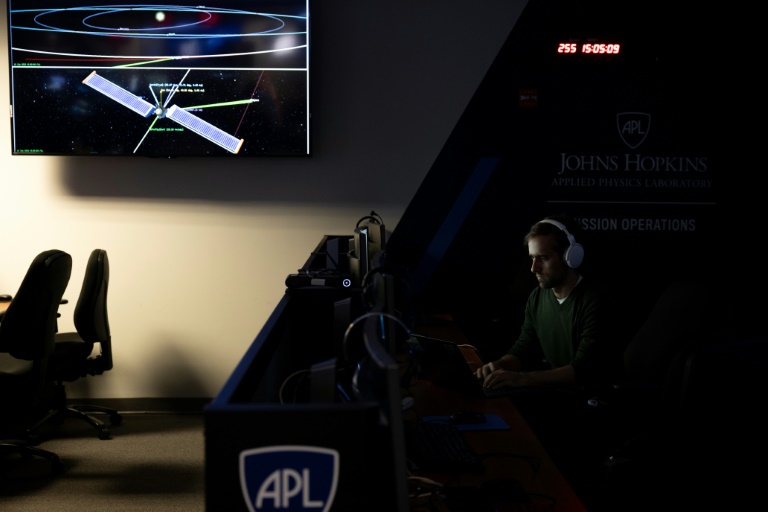
As the craft propels itself through space, flying autonomously for the mission’s final phase, its camera system will start to beam down the very first pictures of Dimorphos.

Minutes later, a toaster-sized satellite called LICIACube, which separated from DART a couple of weeks earlier, will make a close pass of the site to capture images of the collision and the ejecta — the pulverized rock thrown off by impact.

LICIACube’s pictures will be sent back in the weeks and months that follow. 

Also watching the event: an array of telescopes, both on Earth and in space — including the recently operational James Webb — which might be able to see a brightening cloud of dust.

Finally, a full picture of what the system looks like will be revealed when a European Space Agency mission four years down the line called Hera arrives to survey Dimorphos’s surface and measure its mass, which scientists can only guess at currently.

– Being prepared –

Very few of the billions of asteroids and comets in our solar system are considered potentially hazardous to our planet, and none are expected in the next hundred or so years. 

But “I guarantee to you that if you wait long enough, there will be an object,” said NASA’s Thomas Zurbuchen. 

We know that from the geological record — for example, the six-mile wide Chicxulub asteroid struck Earth 66 million years ago, plunging the world into a long winter that led to the mass extinction of the dinosaurs along with 75 percent of all species.

An asteroid the size of Dimorphos, by contrast, would only cause a regional impact, such as devastating a city, albeit with greater force than any nuclear bomb in history.

How much momentum DART imparts on Dimorphos will depend on whether the asteroid is solid rock, or more like a “rubbish pile” of boulders bound by mutual gravity, a property that’s not yet known.

The shape of the asteroid is also not known, but NASA engineers are confident DART’s SmartNav guidance system will hit its target.

If it misses, NASA will have another shot in two years’ time, with the spaceship containing just enough fuel for another pass.

But if it succeeds, Chabot said, the mission will mark the first step towards a world capable of defending itself from a future existential threat.

World economy to slow, 'paying the price of war': OECD

The world economy will take a bigger hit than previously forecast next year due to the effects of Russia’s war in Ukraine, the OECD said Monday.

In a bleak report titled “paying the price of war”, the Paris-based organisation noted that the conflict aggravated inflationary pressure when the cost of living was already rising quickly.

Covid outbreaks are still having an impact on the global economy while growth has also been affected by rising interest rates as central banks scramble to cool red-hot prices, the OECD said.

“A number of indicators have taken a turn for the worse, and the global growth outlook has darkened,” the Organisation for Economic Co-operation and Development said in the report.

Global growth stalled in the second quarter of this year and data in many economies “now point to an extended period of subdued growth”, the OECD said.

The organisation slashed its 2023 growth forecast for the global economy to 2.2 percent, down from 2.8 percent in its previous estimate in June.

– German recession –

The outlook for nearly all nations in the Group of 20 top economies was cut, except for Turkey, Indonesia and Britain, though the latter is forecast to have zero growth.

Growth in the United States — the world’s biggest economy — is forecast to slow to 0.5 percent in 2023.

The growth forecast for China, whose economy has been hit by strict Covid lockdowns, was cut sharply for this year to 3.2 percent while it was slightly lower to 4.7 percent for 2023.

Germany is now expected to go into recession next year with Europe’s biggest economy now seen shrinking by 0.7 percent — a 2.4-percentage-point drop from the previous forecast.

The country’s economy has been hit the hardest in Europe as it has relied heavily on Russian supplies of natural gas, which Moscow has cut significantly in suspected retaliation to Western sanctions.

The eurozone as a whole will post meagre growth of 0.3 percent, a sharp downgrade from 1.6 percent.

The OECD kept its 2022 global growth forecast unchanged at three percent after previously lowering it.

To highlight the impact of Russia’s invasion of Ukraine, the OECD said global output in 2023 is now projected to be $2.8 trillion lower than previously estimated before the conflict in December 2021.

– ‘Significant uncertainty’ –

The war has sent energy and food prices soaring over concerns about supply as Russia is a major oil and gas producer while Ukraine is a key exporter of grains to countries across the world.

Inflation had already been on the rise before the conflict due to bottlenecks in the global supply chain after countries emerged from Covid lockdowns.

“The effects of the war and the continuing impacts of Covid-19 outbreaks in some parts of the world have dented growth and put additional upward pressure on prices,” the OECD said.

“Inflationary pressures have become increasingly broad-based, with higher energy, transportation and other costs being passed through into prices,” it said.

The OECD raised its inflation forecast for the G20 to 8.2 percent for 2022 and 6.6 percent for next year.

Governments have announced emergency measures to help households and businesses cope with the soaring cost of living.

But the fiscal measures to offset energy costs “have been poorly targeted”, the OECD said.

Central banks, meanwhile, have ramped up interest rates, a move necessary to tame inflation but that can also push economies into recession.

The monetary tightening is a “key factor slowing global growth”, the OECD said.

The organisation warned that “significant uncertainty surrounds the projections” for the global economy.

More severe fuel shortages could shave off a further 1.25-percentage-points from Europe’s economy in 2023 and a half-point for global growth

World economy to slow, 'paying the price of war': OECD

The world economy will take a bigger hit than previously forecast next year due to the effects of Russia’s war in Ukraine, the OECD said Monday.

In a bleak report titled “paying the price of war”, the Paris-based organisation noted that the conflict aggravated inflationary pressure when the cost of living was already rising quickly.

Covid outbreaks are still having an impact on the global economy while growth has also been affected by rising interest rates as central banks scramble to cool red-hot prices, the OECD said.

“A number of indicators have taken a turn for the worse, and the global growth outlook has darkened,” the Organisation for Economic Co-operation and Development said in the report.

Global growth stalled in the second quarter of this year and data in many economies “now point to an extended period of subdued growth”, the OECD said.

The organisation slashed its 2023 growth forecast for the global economy to 2.2 percent, down from 2.8 percent in its previous estimate in June.

– German recession –

The outlook for nearly all nations in the Group of 20 top economies was cut, except for Turkey, Indonesia and Britain, though the latter is forecast to have zero growth.

Growth in the United States — the world’s biggest economy — is forecast to slow to 0.5 percent in 2023.

The growth forecast for China, whose economy has been hit by strict Covid lockdowns, was cut sharply for this year to 3.2 percent while it was slightly lower to 4.7 percent for 2023.

Germany is now expected to go into recession next year with Europe’s biggest economy now seen shrinking by 0.7 percent — a 2.4-percentage-point drop from the previous forecast.

The country’s economy has been hit the hardest in Europe as it has relied heavily on Russian supplies of natural gas, which Moscow has cut significantly in suspected retaliation to Western sanctions.

The eurozone as a whole will post meagre growth of 0.3 percent, a sharp downgrade from 1.6 percent.

The OECD kept its 2022 global growth forecast unchanged at three percent after previously lowering it.

To highlight the impact of Russia’s invasion of Ukraine, the OECD said global output in 2023 is now projected to be $2.8 trillion lower than previously estimated before the conflict in December 2021.

– ‘Significant uncertainty’ –

The war has sent energy and food prices soaring over concerns about supply as Russia is a major oil and gas producer while Ukraine is a key exporter of grains to countries across the world.

Inflation had already been on the rise before the conflict due to bottlenecks in the global supply chain after countries emerged from Covid lockdowns.

“The effects of the war and the continuing impacts of Covid-19 outbreaks in some parts of the world have dented growth and put additional upward pressure on prices,” the OECD said.

“Inflationary pressures have become increasingly broad-based, with higher energy, transportation and other costs being passed through into prices,” it said.

The OECD raised its inflation forecast for the G20 to 8.2 percent for 2022 and 6.6 percent for next year.

Governments have announced emergency measures to help households and businesses cope with the soaring cost of living.

But the fiscal measures to offset energy costs “have been poorly targeted”, the OECD said.

Central banks, meanwhile, have ramped up interest rates, a move necessary to tame inflation but that can also push economies into recession.

The monetary tightening is a “key factor slowing global growth”, the OECD said.

The organisation warned that “significant uncertainty surrounds the projections” for the global economy.

More severe fuel shortages could shave off a further 1.25-percentage-points from Europe’s economy in 2023 and a half-point for global growth

Pound hits record low versus dollar, markets hit by recession fears

The pound hit a record low against the dollar Monday on surging fears about the UK economy after the government unveiled a huge tax-cutting budget.

The selloff came as equity markets across Asia and Europe fell again owing to a growing expectation that central bank interest rate hikes to fight runaway inflation would lead to deep and painful recessions. Oil also suffered more hefty selling.

Officials in several countries including the United States, Britain, Switzerland and Sweden announced more increases in the cost of borrowing.

The moves sent equity markets deep into the red again after officials reiterated their focus on fighting inflation, even if that means causing a recession.

But the biggest casualty of the week was the pound, which fell below $1.10 for the first time since 1985 as new finance minister Kwasi Kwarteng announced his controversial mini-budget.

It then extended the losses Monday to briefly touch an all-time low of $1.0350 in Asian trade after he said he intended to unveil further reductions, despite his budget causing ructions on London’s markets.

It also fell to a two-year low against the euro, though the single currency remains under pressure against the dollar, sitting at 2002 levels.

Now, observers are warning that the pound could fall even further.

“The pound’s crash is showing markets have a lack of confidence in the UK and that its financial strength is under siege,” said Jessica Amir, of Saxo Capital Markets. 

“The pound is a whisker away from parity and the situation is going to only worsen from here.”

Kwarteng, who was appointed by Liz Truss after she became prime minister earlier this month, said he planned to slash taxes to kickstart the British economy and provide cash to cushion families from rocketing energy costs.

But investors were spooked by the huge amount of borrowing likely needed for the multi-billion-pound package, which critics said would benefit the rich far more than the poorest during a cost-of-living crisis.

Sterling’s drop has led to speculation the Bank of England will have to step in with an emergency interest rate hike to give the currency a much-needed shot in the arm.

– ‘Macau casinos soar’ –

“Whether or not the UK government announcement of the biggest tax reduction since 1972… will in time yield a significant growth dividend is not something markets are yet willing to contemplate,” said National Australia Bank’s Ray Attrill.

“Instead, they were consumed by worries over the scale of near-term UK government financing needs, at a time when the current account deficit is running at more than eight percent of GDP.”

He added: “Chatter about a possible UK sovereign rating downgrade has already begun.”

And former US treasury secretary Lawrence Summers was scathing of Britain’s recent monetary policy decisions.

“It makes me very sorry to say, but I think the UK is behaving a bit like an emerging market turning itself into a submerging market,” he told Bloomberg Television’s Wall Street Week last week.

“Between Brexit, how far the Bank of England got behind the curve and now these fiscal policies, I think Britain will be remembered for having (pursued) the worst macroeconomic policies of any major country in a long time.”

The collapse in sterling came as markets across the world are sent into a spin by recession worries caused by a sharp tightening of monetary policy by central banks fighting decades-high inflation. 

New York’s three main indexes ended well down, with the Dow at a two-year low, and Asia followed suit.

Tokyo shed more than two percent as traders there returned from a long weekend break, while Seoul was off more than three percent, with Sydney, Shanghai, Mumbai, Singapore, Taipei and Jakarta also tanking.

Hong Kong was also down having reversed early gains that came after the city said it would relax strict hotel quarantine measures for international travellers.

Still, Macau casino stocks rallied as the city said it would accept Chinese tour groups again from November, having been blocked during the pandemic.

London edged up tentatively after Friday’s hammering, while Paris and Frankfurt were also higher.

Oil prices ticked lower, extending the big losses suffered Friday as expectations that a recession is looming hammer demand expectations.

The surging greenback added to the sell-off in crude, which is priced in dollars and therefore ore expensive for buyers using other currencies. 

Both main contracts are sitting at their lowest levels since January, having wiped out all the gains seen in the wake of Russia’s invasion of Ukraine.

Black Gold Investors’ Gary Ross described the strong dollar as “a wrecking ball for commodities”.

– Key figures at around 0810 GMT –

Pound/dollar: DOWN at $1.0700 from $1.0852 on Friday

Euro/pound: UP at 90.40 pence from 89.28 pence 

Euro/dollar: DOWN at $ 0.9673 from 0.9695

Dollar/yen: UP at 143.96 yen from 143.31 yen

London – FTSE 100: UP 0.3 percent at 7,039.64

Tokyo – Nikkei 225: DOWN 2.7 percent at 26,431.55 (close)

Hong Kong – Hang Seng Index: DOWN 0.4 percent at 17,855.14 (close)

Shanghai – Composite: DOWN 1.2 percent at 3,051.23 (close)

West Texas Intermediate: DOWN 0.2 percent at $78.58 per barrel

Brent North Sea crude: DOWN 0.4 percent at $85.84 per barrel

New York – Dow: DOWN 1.6 percent at 29,590.41 (close)

Tokyo stocks end 2.7% lower on slowdown fears

Tokyo stocks closed lower Monday with investors disheartened by global selloffs linked to growing fears over an economic slowdown.

The benchmark Nikkei 225 index plunged 2.66 percent, or 722.28 points, to end at 26,431.55, while the broader Topix index lost 2.71 percent, or 51.84 points, to 1,864.28.

The dollar fetched 143.89 yen, against 143.31 yen on Friday in New York.

Recession fears spread on Friday after central banks ramped up interest rates to combat decades-high inflation, causing stock markets to tumble and the pound to crash against the dollar.

The Federal Reserve’s decision Wednesday to again lift borrowing costs by 75 basis points was followed by a warning that more big rises were in the pipeline and that rates would likely come down only in 2024.

There were similar moves by central banks in other countries, including Britain, Sweden, Norway, Switzerland, the Philippines and Indonesia — all pointing to a dark outlook for markets.

“Last week’s monetary policy meetings around the world highlighted the prospect that rate hikes will continue, which is having a negative impact on Japanese stocks, too,” Makoto Sengoku, senior equity market analyst at Tokai Tokyo Securities, told AFP.

“Stock prices also keep going down, leaving more and more investors feeling uncertain,” he added.

Among major shares in Tokyo, SoftBank Group nosedived 5.18 percent to 5,066 yen, Sony Group plummeted 3.85 percent to 9,682 yen and Toyota plunged 3.20 percent to 1,963 yen. 

Uniqlo operator Fast Retailing ended down 0.83 percent at 80,600 yen. 

Ukrainian heavy industry ground down by Russia's war

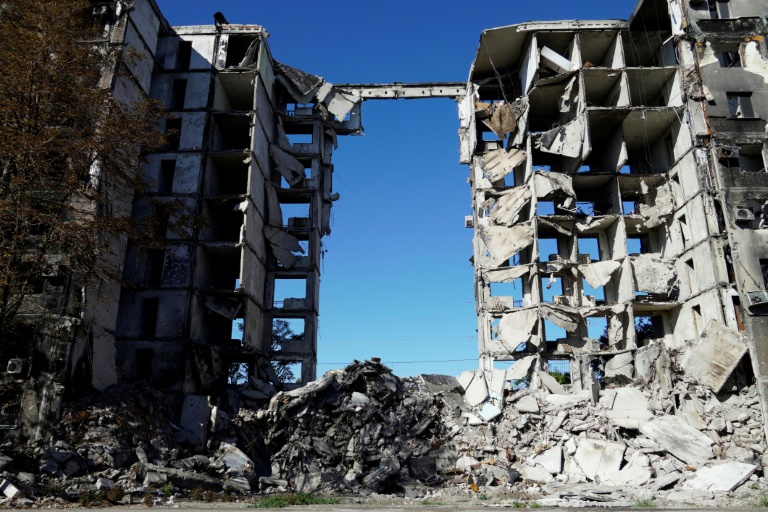
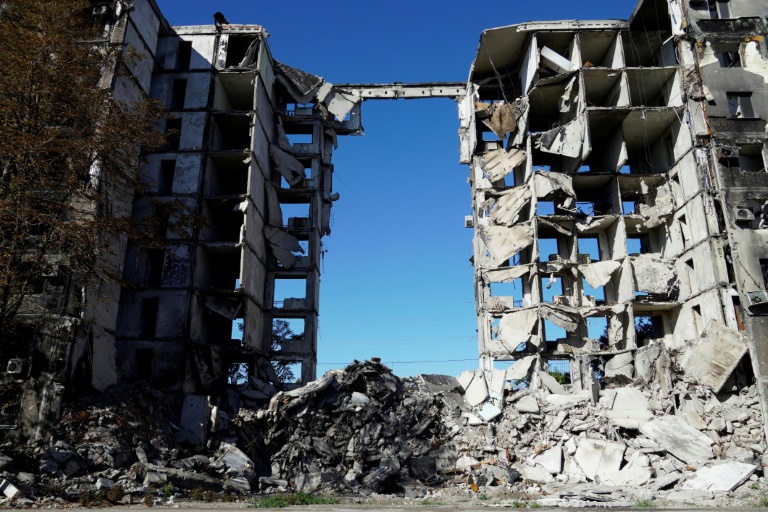
Usually the engine-room of the Ukrainian economy, heavy industry has fallen victim to Russia’s invasion, with output ground down under the pressure of the war. 

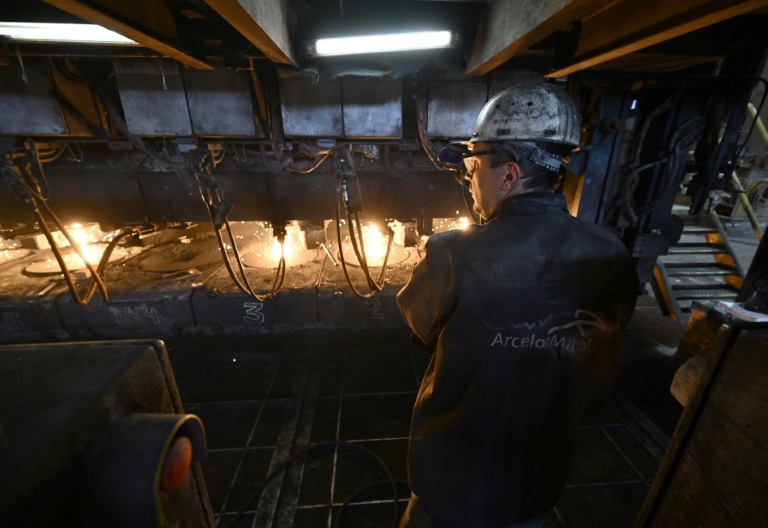
In the gigantic ArcelorMittal steelworks and iron mine complex in Kryvyi Rih, three of the four blast furnaces have been shut down, while the mine lies dormant. 

The last working blast furnace, a cathedral of metal surrounded by colossal pipes, was running on low gear when AFP visited.

Much of the site which sprawls over 70 square kilometres — two-thirds the size of the city of Paris — and normally employs 22,000 people was running below normal operations. 

A handful of workers took turns tending a small river of glowing metal, while square steel beams clank along a treadmill in a cavernous hangar nearby. 

The complex in the southern city close to the frontline is considered a national jewel by Ukrainians. 

Bought in 2005 by ArcelorMittal for nearly $5 billion, its products are sold internationally — including for the Burj Khalifa skyscraper in Dubai, the tallest in the world. 

But after the invasion began in February, work halted for a month when Russian troops approached Kryvyi Rih. 

Production eventually restarted, but at a reduced tempo. 

By the end of August, output was “between 15 and 20 percent” of the corresponding period in 2021, according to Artem Filipiev, the site’s deputy director.

– Logistical headaches –

“We keep the site running, that’s our mission,” Filipiev told AFP.  

Some 2,000 of the site’s employees are currently fighting in the Ukrainian army, and 17 have been killed, so keeping the plant functional is “not just about profit…(but) social responsibility”, he said. 

Among the myriad logistical headaches the war has caused for Ukraine’s industrial sector are how to maintain supplies, keep customers, and deliver products.

Moscow now controls the major Black Sea ports of Mariupol and Berdiansk in southeast Ukraine. 

Ports in the southwest like Odesa and Chernomorsk remain in Ukrainian hands, although Russia — under strong international pressure — has only allowed their use for grain exports.

“The ports are closed, the metallurgical industries of Mariupol were among our main consumers of iron ore, clients in Zaporizhzhia have also slowed down their activity, our iron mines are at a standstill,” said Sergiy Milutin, deputy mayor of Kryvyi Rih.  

ArcelorMittal — which exports 85 percent of its products — says it now uses rail and river transport for deliveries, mainly via Poland and the Baltic Sea, as well as Romania. 

But the costs have “multiplied by two or three” for steel producers, Marina Bozkurt, an analyst with Rystad, told AFP. 

– ‘De-economisation’ –

The months-long shelling by Russia of Ukrainian troops entrenched in the Azovstal steelworks in Mariupol showed the resilience of such Soviet-era infrastructure — but ultimately the facility was left destroyed. 

By September, over 420 Ukrainian industries and companies had been damaged or destroyed by the war, comprising an estimated loss of $30 billion, according to the Kyiv School of Economics.

Mining and manufacturing processing industries made up 17 percent of Ukraine’s GDP in 2021, and the sector “is part of the economic security” of the country, said Dmytro Goryunov, an economist with the Centre for Economic Strategy. 

The importance of heavy industry for the economy explains why Russia pounds it, according to Anatoly Kovaliov, rector of the Odessa National University of Economics. 

“After three days of failed ‘blitzkrieg’, of absolute fiasco, the Russians understood that they would not take our country easily, so they decided to destroy it”, Kovaliov told AFP. 

The Kremlin has an aim of “de-economisation”, he said. 

Ukrainian GDP collapsed by 37 percent in the second quarter of 2022 compared to the same period last year, according to Goryunov.

According to Kovaliov, the country needs a good five to eight years of reconstruction once it wins the war, which he believes is a certainty.

“We will need a Marshall Plan,” he said, referring to the US-devised giant economic rescue scheme to rebuild Europe after World War II. 

Close Bitnami banner
Bitnami